ARIES (March 21-April 19): Aries poet Anna Kamienska wrote, “I’ve learned to value failed conversations, missed connections, confusions. What remains is what’s unsaid, what’s underneath. Understanding on another level of being.” In the coming weeks, I suggest you adopt her perspective as you evaluate both past and present experiences. You’re likely to find small treasures in what you’d assumed were wastelands. You may uncover inspiring clues in plot twists that initially frustrated you. Upon further examination, interludes you dismissed as unimportant or uninteresting could reveal valuable wrinkles.
TAURUS (April 20-May 20): After studying your astrological omens, I’ve decided to offer you inspiration from the ancient Roman poet Catullus. I hope the extravagant spirit of his words will free you to be greedy for the delights of love and affection. Catullus wrote, “Give me a thousand kisses, then a hundred; then another thousand, then a second hundred; then yet another thousand.” I’ll add the following to Catullus’ appeal: Seek an abundance of endearing words, sweet favors and gifts, caresses and massages, help with your work, and fabulous orgasms. If there’s no one in your life to provide you with such blessings, give them to yourself.
GEMINI (May 21-June 20): Gemini author Elif Batuman writes that the Old Uzbek language was rich in expressions about crying. There were “words for wanting to cry and not being able to, for loudly crying like thunder in the clouds, for crying in gasps, for weeping inwardly or secretly, for crying ceaselessly in a high voice, for crying in hiccups, and for crying while uttering the sound ‘hay hay.’” I recommend all of these to you in the coming days, as well as others you might dream up. Why? It’s prime time to seek the invigorating release and renewal that come from shedding tears generated by deep and mysterious feelings.about:blankabout:blank
CANCER (June 21-July 22): A blogger named MythWoven imagines an “alternate universe where I literally go to school forever (for free) so I can learn about art and literature and history and languages for 100 years. No job skills. No credit requirements. No student loans. Just learning.” I have longings like hers. There’s an eternal student within me that wants to be endlessly surprised with exciting information about interesting subjects. I would love to be continually adding fresh skills and aptitudes to my repertoire. In the coming weeks, I will give free rein to that part of me. I recommend you do the same, my fellow Cancerian.
LEO (July 23-Aug. 22): In 2016, the International Garden Photograph of the Year depicted lush lupine flowers in New Zealand. The sea of tall purple, pink and blue blooms was praised as “an elegant symphony” and “a joy to behold.” What the judges didn’t mention is that lupine is an invasive species in New Zealand. It forces native plant species out of their habitat, which in turn drives away native animal species, including birds like the wrybill, black stilt and banded dotterel. Is there a metaphorically comparable phenomenon in your life, Leo? Problematic beauty? Some influence that’s both attractive and prickly? A wonderful thing that can also be troublesome? The coming weeks will be a favorable time to try to heal the predicament.
VIRGO (Aug. 23-Sept. 22): “I often wonder who I am and where is my country and where do I belong and why was I ever born at all,” wrote Virgo author Jean Rhys (1890–1979). I don’t think you will be agitated by those questions during the next eight weeks, Virgo. In fact, I suspect you will feel as secure in your identity as you have in a long time. You will enjoy prolonged clarity about your role in the world, the nature of your desires, and how you should plan your life for the next two years. If for some inexplicable reason you’re not already enjoying these developments, stop what you’re doing and meditate on the probability that I am telling you the bold truth.
LIBRA (Sept. 23-Oct. 22): Several states in the U.S. have statutes prohibiting blasphemy. Saying “God damn it” could theoretically get you fined in Massachusetts, South Carolina and Wyoming. In the coming days, it’s best to proceed carefully in places like those, since you’ve been authorized by cosmic forces to curse more often and more forcefully than usual. Why? Because you need to summon vivid and intense protests in the face of influences that may be inhibiting and infringing on your soul’s style. You have a poetic license to rebel against conventions that oppress you.https://b24038525c5c2a97d12eef89197fb444.safeframe.googlesyndication.com/safeframe/1-0-38/html/container.html
SCORPIO (Oct. 23-Nov. 21): Everyone dreams at least three dreams per night. In a year, your subconscious mind generates over 1,100 dreams. About this remarkable fact, novelist Mila Kundera writes, “Dreaming is not merely an act of coded communication. It is also an aesthetic activity, a game that is a value in itself. To dream about things that have not happened is among humanity’s deepest needs.” I bring this to your attention, Scorpio, because September is Honor Your Dreams Month. To celebrate, I suggest the following experiments. 1. Every night before sleep, write down a question you’d like your dreams to respond to. 2. Keep a notebook by your bed and transcribe at least one dream each time you sleep. 3. In the morning, have fun imagining what the previous night’s dreams might be trying to communicate to you. 4. Say prayers of gratitude to your dreams, thanking them for their provocative, entertaining stories.
SAGITTARIUS (Nov. 22-Dec. 21): In her autobiography “Changing,” Sagittarian actor Liv Ullmann expresses grief about how she and a loved one failed to communicate essential truths to each other. I propose we regard her as your anti-role model for the rest of 2021. Use her error as your inspiration. Make emotionally intelligent efforts to talk about unsaid things that linger like ghostly puzzles between you and those you care about.
CAPRICORN (Dec. 22-Jan. 19): “I could do with a bit more excess,” writes author Joanne Harris. “From now on I’m going to be immoderate—and volatile,” she vows. “I shall enjoy loud music and lurid poetry. I shall be rampant.” Let me be clear, Capricorn: I’m not urging you to be immoderate, volatile, excessive and rampant every day for the rest of your long life. But I think you will generate health benefits and good fortune if you experiment with that approach in the coming weeks. Can you think of relatively sane, sensible ways to give yourself this salubrious luxury?about:blankabout:blank
AQUARIUS (Jan. 20-Feb. 18): While wading through the internet’s wilder terrain, I found a provocative quote alleged to have been uttered by the ancient Greek philosopher Socrates. He supposedly said, “My ultimate goal is to look totally hot, but not be unapproachable.” I confess that in the past I have sometimes been fooled by fake quotes, and I suspect this is one. Still, it’s amusing to entertain the possibility that such an august personage as Socrates, a major influencer of Western culture, might say something so cute and colloquial. Even if he didn’t actually say it, I like the idea of blending ancient wisdom with modern insights, seriousness with silliness, thoughtful analysis with good fun. In accordance with astrological omens, I recommend you experiment with comparable hybrids in the coming weeks. (P.S.: One of your goals should be to look totally hot, but not be unapproachable.)
PISCES (Feb. 19-March 20): “If you don’t know what you want,” writes Piscean novelist Chuck Palahniuk, “you end up with a lot you don’t.” Very true! And right now, it’s extra important to keep that in mind. During the coming weeks, you’ll be at the peak of your ability to attract what you want and need. Wouldn’t you prefer to gather influences you really desire—as opposed to those for which you have mild or zero interest? Define your wants and needs very precisely.
Homework: What’s your greatest blessing? Newsletter@FreeWillAstrology.com.
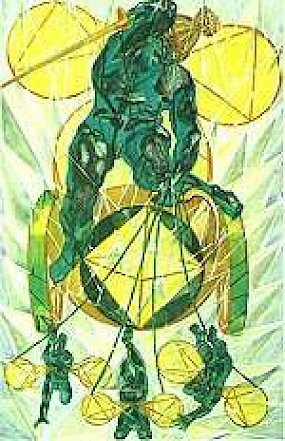
One of the most common interpretation of this card is that it represents a dangerous or treacherous man – which, IMHO, is a very superficial way of looking at a Court card.
Certainly this Prince can be sly, dishonest and untrustworthy – but only when badly dignified by the cards around him. The card can also sometimes come up to mark a person who is angry, or vengeful.
But the pure Prince of Swords type is a highly intellectual and usually well-educated person, with a rapid fire mind and a great capacity for abstract thinking. He produces ideas with astonishing speed, but often moves on too quickly to follow through or elaborate on them. He can be challenging, entertaining, stimulating – and completely exhausting!
The card represents a private person, who defends his inner space quite determinedly. This is some-one who is hard to get to know – in fact, you’ll probably not succeed entirely no matter how long you know him. He is a thinker, and chooses those he shares his thoughts with carefully. He’s usually also very independent, and often appears unemotional and cold.
Sometimes the Prince of Swords will come up to represent somebody who is embarking on a serious course of occult study – with the Knight indicating the dedicated initiate.
The bad reputation comes from one peculiarity of this card and the Knight of Swords, I think. They both tend to appear when a man is angry, violent or vicious. However this is a function of the Suit – Swords deal with conflict and pain quite extensively. So don’t imagine that every Prince of Swords you see is bad – most of them aren’t.
Since Descartes famously proclaimed, “I think, therefore I am,” science has often overlooked emotions as the source of a person’s true being. Even modern neuroscience has tended, until recently, to concentrate on the cognitive aspects of brain function, disregarding emotions. This attitude began to change with the publication of Descartes’ Error in 1995. Antonio Damasio—”one of the world’s leading neurologists” (The New York Times)—challenged traditional ideas about the connection between emotions and rationality. In this wondrously engaging book, Damasio takes the reader on a journey of scientific discovery through a series of case studies, demonstrating what many of us have long suspected: emotions are not a luxury, they are essential to rational thinking and to normal social behavior.
Sir Winston Leonard Spencer Churchill, KG, OM, CH, TD, DL, FRS, RA (November 30, 1874 – January 24, 1965) was a British statesman who served as Prime Minister of the United Kingdom from 1940 to 1945, during the Second World War, and again from 1951 to 1955. Wikipedia
To become a butterfly, a caterpillar first digests itself. But certain groups of cells survive, turning the soup into eyes, wings, antennae and other adult structures.
As children, many of us learn about the wondrous process by which a caterpillar morphs into a butterfly. The story usually begins with a very hungry caterpillar hatching from an egg. The caterpillar, or what is more scientifically termed a larva, stuffs itself with leaves, growing plumper and longer through a series of molts in which it sheds its skin. One day, the caterpillar stops eating, hangs upside down from a twig or leaf and spins itself a silky cocoon or molts into a shiny chrysalis. Within its protective casing, the caterpillar radically transforms its body, eventually emerging as a butterfly or moth.
But what does that radical transformation entail? How does a caterpillar rearrange itself into a butterfly? What happens inside a chrysalis or cocoon?
First, the caterpillar digests itself, releasing enzymes to dissolve all of its tissues. If you were to cut open a cocoon or chrysalis at just the right time, caterpillar soup would ooze out. But the contents of the pupa are not entirely an amorphous mess. Certain highly organized groups of cells known as imaginal discs survive the digestive process. Before hatching, when a caterpillar is still developing inside its egg, it grows an imaginal disc for each of the adult body parts it will need as a mature butterfly or moth—discs for its eyes, for its wings, its legs and so on. In some species, these imaginal discs remain dormant throughout the caterpillar’s life; in other species, the discs begin to take the shape of adult body parts even before the caterpillar forms a chrysalis or cocoon. Some caterpillars walk around with tiny rudimentary wings tucked inside their bodies, though you would never know it by looking at them.
Once a caterpillar has disintegrated all of its tissues except for the imaginal discs, those discs use the protein-rich soup all around them to fuel the rapid cell division required to form the wings, antennae, legs, eyes, genitals and all the other features of an adult butterfly or moth. The imaginal disc for a fruit fly’s wing, for example, might begin with only 50 cells and increase to more than 50,000 cells by the end of metamorphosis. Depending on the species, certain caterpillar muscles and sections of the nervous system are largely preserved in the adult butterfly. One study even suggests that moths remember what they learned in later stages of their lives as caterpillars.
Getting a look at this metamorphosis as it happens is difficult; disturbing a caterpillar inside its cocoon or chrysalis risks botching the transformation. But Michael Cook, who maintains a fantastic website about silkworms, has some incredible photos of a Tussah silkmoth (Antheraea penyi) that failed to spin a cocoon. You can see the delicate, translucent jade wings, antennae and legs of a pupa that has not yet matured into an adult moth—a glimpse of what usually remains concealed.
Ferris Jabr is a contributing writer for Scientific American. He has also written for the New York Times Magazine, the New Yorker and Outside.
This article was originally published on August 10, 2012, by Scientific American, and is republished here with permission.
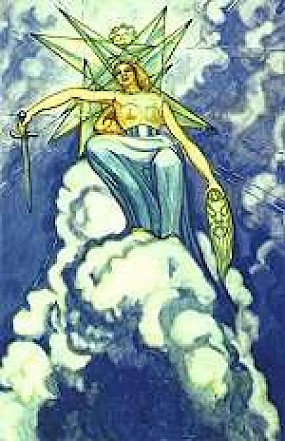
The Queen of Swords indicates a woman who is blessed (or cursed) with sharp perception, and highly honed intuition. She is acutely analytical, with a razor-sharp ability to get to the heart of a situation, seeing exactly what is, rather than what others would wish her to see.
She is a private woman, unwilling to let people too close to her until she is satisfied she thoroughly understands their motivations. But once won as a friend, she is unfailingly loyal, honest and supportive.
She’s usually very intelligent, with a dry sense of humour. Her penetrating insight will often reveal aspects of themselves to others that they had previously been unable to grasp – thus she is a capable therapist, teacher or leader.
The woman represented by this card will be experienced in the flow of life, understanding a great deal about both the great triumphs, and the deepest failings of the race. Her clarity and measured expression will be of great value at times of confusion and sadness.
Sometimes in a reading, this card will turn up to indicate a woman in a particular phase of her life, where she temporarily becomes a Sword as a result of what is happening to her. In that case the card is not quite so positively defined, for it can indicate a woman left alone, and perhaps embittered. She may be a widow, or a woman passing through the aftermath of divorce.
In this case we often see the more negative aspects of the Queen – coldness, judgementalism, criticism. At these times there is a certain sourness about her, with cynicism and sharpness making themselves felt.
It should be said that these qualities are inherent to the woman who is a Queen of Swords by nature too – if the woman concerned has not evolved sufficiently you will often find that the card represents a person who is hard and cold toward others.
Rupert Spira A man asks if there could be overlapping fields of unlimited consciousness. This clip has been taken from Rupert’s Retreat at Buckland Hall in December 2019.
Anne Lamott writes: When a lot of things start going wrong all at once, it is to protect something big and lovely that is trying to get itself born—and that this something needs for you to be distracted so that it can be born as perfectly as possible.
(Courtesy of Rob Brezsny’s Astrology Newsletter (freewillastrology@substack.com)
John Stuart Mill (20 May 1806 – 7 May 1873),[10] usually cited as J. S. Mill, was an English philosopher, political economist, Member of Parliament (MP), and civil servant. One of the most influential thinkers in the history of classical liberalism, he contributed widely to social theory, political theory, and political economy. Dubbed “the most influential English-speaking philosopher of the nineteenth century”,[11] he conceived of liberty as justifying the freedom of the individual in opposition to unlimited state and social control.[12] In his later years, whilst continuing to staunchly defend individual rights and freedoms, he became more critical of economic liberalism and his views on political economy moved towards a form of liberal socialism.[13]
John Stuart Mill was born at 13 Rodney Street in Pentonville, Middlesex, the eldest son of Harriet Barrow and the Scottish philosopher, historian, and economist James Mill. John Stuart was educated by his father, with the advice and assistance of Jeremy Bentham and Francis Place. He was given an extremely rigorous upbringing, and was deliberately shielded from association with children his own age other than his siblings. His father, a follower of Bentham and an adherent of associationism, had as his explicit aim to create a genius intellect that would carry on the cause of utilitarianism and its implementation after he and Bentham had died.[17]
Mill was a notably precocious child. He describes his education in his autobiography. At the age of three he was taught Greek.[18] By the age of eight, he had read Aesop’s Fables, Xenophon‘s Anabasis,[18] and the whole of Herodotus,[18] and was acquainted with Lucian, Diogenes Laërtius, Isocrates and six dialogues of Plato.[18] He had also read a great deal of history in English and had been taught arithmetic, physics and astronomy.
At the age of eight, Mill began studying Latin, the works of Euclid, and algebra, and was appointed schoolmaster to the younger children of the family. His main reading was still history, but he went through all the commonly taught Latin and Greek authors and by the age of ten could read Plato and Demosthenes with ease. His father also thought that it was important for Mill to study and compose poetry. One of his earliest poetic compositions was a continuation of the Iliad. In his spare time he also enjoyed reading about natural sciences and popular novels, such as Don Quixote and Robinson Crusoe.
His father’s work, The History of British India was published in 1818; immediately thereafter, at about the age of twelve, Mill began a thorough study of the scholasticlogic, at the same time reading Aristotle‘s logical treatises in the original language. In the following year he was introduced to political economy and studied Adam Smith and David Ricardo with his father, ultimately completing their classical economic view of factors of production. Mill’s comptes rendus of his daily economy lessons helped his father in writing Elements of Political Economy in 1821, a textbook to promote the ideas of Ricardian economics; however, the book lacked popular support.[19] Ricardo, who was a close friend of his father, used to invite the young Mill to his house for a walk to talk about political economy.
At the age of fourteen, Mill stayed a year in France with the family of Sir Samuel Bentham, brother of Jeremy Bentham. The mountain scenery he saw led to a lifelong taste for mountain landscapes. The lively and friendly way of life of the French also left a deep impression on him. In Montpellier, he attended the winter courses on chemistry, zoology, logic of the Faculté des Sciences, as well as taking a course in higher mathematics. While coming and going from France, he stayed in Paris for a few days in the house of the renowned economist Jean-Baptiste Say, a friend of Mill’s father. There he met many leaders of the Liberal party, as well as other notable Parisians, including Henri Saint-Simon.
Mill went through months of sadness and contemplated suicide at twenty years of age. According to the opening paragraphs of Chapter V of his autobiography, he had asked himself whether the creation of a just society, his life’s objective, would actually make him happy. His heart answered “no”, and unsurprisingly he lost the happiness of striving towards this objective. Eventually, the poetry of William Wordsworth showed him that beauty generates compassion for others and stimulates joy.[20] With renewed joy he continued to work towards a just society, but with more relish for the journey. He considered this one of the most pivotal shifts in his thinking. In fact, many of the differences between him and his father stemmed from this expanded source of joy.
Mill had been engaged in a pen-friendship with Auguste Comte, the founder of positivism and sociology, since Mill first contacted Comte in November 1841. Comte’s sociologie was more an early philosophy of science than we perhaps know it today, and the positive philosophy aided in Mill’s broad rejection of Benthamism.[21]
Mill’s career as a colonial administrator at the East India Company spanned from when he was 17 years old in 1823 until 1858, when the Company’s territories in India were directly annexed by the Crown, establishing direct Crown control over India.[25] In 1836, he was promoted to the Company’s Political Department, where he was responsible for correspondence pertaining to the Company’s relations with the princely states, and in 1856, was finally promoted to the position of Examiner of Indian Correspondence. In On Liberty, A Few Words on Non-Intervention, and other works, he opined that “To characterize any conduct whatever towards a barbarous people as a violation of the law of nations, only shows that he who so speaks has never considered the subject”.[26](Mill immediately added, however, that “A violation of the great principles of morality it may easily be.”)[27] Mill viewed places such as India as having once been progressive in their outlook, but had now become stagnant in their development; he opined that this meant these regions had to be ruled via a form of “benevolent despotism“, “provided the end is improvement”.[28] When the Crown proposed to take direct control over the territories of the East India Company, he was tasked with defending Company rule, penning Memorandum on the Improvements in the Administration of India during the Last Thirty Years among other petitions.[29] He was offered a seat on the Council of India, the body created to advise the new Secretary of State for India, but declined, citing his disapproval of the new system of administration in India.[29]
In 1851, Mill married Harriet Taylor after 21 years of intimate friendship. Taylor was married when they met, and their relationship was close but generally believed to be chaste during the years before her first husband died in 1849. The couple waited two years before marrying in 1851. Brilliant in her own right, Taylor was a significant influence on Mill’s work and ideas during both friendship and marriage. His relationship with Taylor reinforced Mill’s advocacy of women’s rights. He said that in his stand against domestic violence, and for women’s rights he was “chiefly an amanuensis to my wife”. He called her mind a “perfect instrument”, and said she was “the most eminently qualified of all those known to the author”. He cites her influence in his final revision of On Liberty, which was published shortly after her death. Taylor died in 1858 after developing severe lung congestion, after only seven years of marriage to Mill.
Between the years 1865 and 1868 Mill served as Lord Rector of the University of St Andrews. At his inaugural address, delivered to the University on 1 February 1867, he made the now-famous (but often wrongly attributed) remark that “Bad men need nothing more to compass their ends, than that good men should look on and do nothing”.[30] That Mill included that sentence in the address is a matter of historical record, but it by no means follows that it expressed a wholly original insight. During the same period, 1865–68, he was also a Member of Parliament (MP) for City of Westminster.[31][32] He was sitting for the Liberal Party. During his time as an MP, Mill advocated easing the burdens on Ireland. In 1866, he became the first person in the history of Parliament to call for women to be given the right to vote, vigorously defending this position in subsequent debate. He also became a strong advocate of such social reforms as labour unions and farm cooperatives. In Considerations on Representative Government, he called for various reforms of Parliament and voting, especially proportional representation, the single transferable vote, and the extension of suffrage. In April 1868, he favoured in a Commons debate the retention of capital punishment for such crimes as aggravated murder; he termed its abolition “an effeminacy in the general mind of the country”.[33]
Mill joined the debate over scientific method which followed on from John Herschel‘s 1830 publication of A Preliminary Discourse on the study of Natural Philosophy, which incorporated inductive reasoning from the known to the unknown, discovering general laws in specific facts and verifying these laws empirically. William Whewell expanded on this in his 1837 History of the Inductive Sciences, from the Earliest to the Present Time, followed in 1840 by The Philosophy of the Inductive Sciences, Founded Upon their History, presenting induction as the mind superimposing concepts on facts. Laws were self-evident truths, which could be known without need for empirical verification.
Mill countered this in 1843 in A System of Logic (fully titled A System of Logic, Ratiocinative and Inductive, Being a Connected View of the Principles of Evidence, and the Methods of Scientific Investigation). In “Mill’s Methods” (of induction), as in Herschel’s, laws were discovered through observation and induction, and required empirical verification.[39] Matilal remarks that Dignāga analysis is much like John Stuart Mill’s Joint Method of Agreement and Difference, which is inductive. He suggested that it is very likely that during his stay in India he may have come across the tradition of logic, on which scholars started taking interest after 1824, though it is unknown whether it influenced his work or not.[40][41]
Mill’s On Liberty (1859) addresses the nature and limits of the power that can be legitimately exercised by society over the individual. However, Mill is clear that his concern for liberty does not extend to all individuals and all societies. He states that “Despotism is a legitimate mode of government in dealing with Barbarians.”[42]
Mill states that it is not a crime to harm oneself as long as the person doing so is not harming others. He favours the harm principle: “The only purpose for which power can be rightfully exercised over any member of a civilized community, against his will, is to prevent harm to others.”[43][page needed] He excuses those who are “incapable of self-government” from this principle, such as young children or those living in “backward states of society”. More controversially, he also argues that the state may legitimately regulate marriage and child-bearing. In fact, Gregory Claeys argues, this effectively renders his method of social analysis family-centred rather than individualistic, as is usually assumed. But this in turn must be understood as defined in part in class terms. For the harm principle seemingly permits the wealthy to do many things denied to the poor.
Though this principle seems clear, there are a number of complications. For example, Mill explicitly states that “harms” may include acts of omission as well as acts of commission. Thus, failing to rescue a drowning child counts as a harmful act, as does failing to pay taxes, or failing to appear as a witness in court. All such harmful omissions may be regulated, according to Mill. By contrast, it does not count as harming someone if—without force or fraud—the affected individual Consents to assume the risk: thus one may permissibly offer unsafe employment to others, provided there is no deception involved. (He does, however, recognise one limit to consent: society should not permit people to sell themselves into slavery.)
The question of what counts as a self-regarding action and what actions, whether of omission or commission, constitute harmful actions subject to regulation, continues to exercise interpreters of Mill. He did not consider giving offence to constitute “harm”; an action could not be restricted because it violated the conventions or morals of a given society.[44]John Stuart Mill and Helen Taylor. Helen was the daughter of Harriet Taylor and collaborated with Mill for fifteen years after her mother’s death in 1858.
Social liberty and tyranny of majority
Mill believed that “the struggle between Liberty and Authority is the most conspicuous feature in the portions of history.”[45] For him, liberty in antiquity was a “contest…between subjects, or some classes of subjects, and the government.”[45]
Mill defined social liberty as protection from “the tyranny of political rulers”. He introduced a number of different concepts of the form tyranny can take, referred to as social tyranny, and tyranny of the majority. Social liberty for Mill meant putting limits on the ruler’s power so that he would not be able to use that power to further his own wishes and thus make decisions that could harm society. In other words, people should have the right to have a say in the government’s decisions. He said that social liberty was “the nature and limits of the power which can be legitimately exercised by society over the individual.” It was attempted in two ways: first, by obtaining recognition of certain immunities (called political liberties or rights); and second, by establishment of a system of “constitutional checks”.
However, in Mill’s view, limiting the power of government was not enough:[46]
Society can and does execute its own mandates: and if it issues wrong mandates instead of right, or any mandates at all in things with which it ought not to meddle, it practises a social tyranny more formidable than many kinds of political oppression, since, though not usually upheld by such extreme penalties, it leaves fewer means of escape, penetrating much more deeply into the details of life, and enslaving the soul itself.
Liberty
Mill’s view on liberty, which was influenced by Joseph Priestley and Josiah Warren, is that the individual ought to be free to do as they wished unless they caused harm to others. Individuals are rational enough to make decisions about their well being. Government should interfere when it is for the protection of society. Mill explained:[47]
The sole end for which mankind are warranted, individually or collectively, in interfering with the liberty of action of any of their number, is self-protection. That the only purpose for which power can be rightfully exercised over any member of a civilized community, against his will, is to prevent harm to others. His own good, either physical or moral, is not sufficient warrant. He cannot rightfully be compelled to do or forbear because it will be better for him to do so, because it will make him happier, because, in the opinion of others, to do so would be wise, or even right.… The only part of the conduct of anyone, for which he is amenable to society, is that which concerns others. In the part which merely concerns him, his independence is, of right, absolute. Over himself, over his own body and mind, the individual is sovereign.
Freedom of speech
On Liberty involves an impassioned defense of free speech. Mill argues that free discourse is a necessary condition for intellectual and social progress. We can never be sure, he contends, that a silenced opinion does not contain some element of the truth. He also argues that allowing people to air false opinions is productive for two reasons. First, individuals are more likely to abandon erroneous beliefs if they are engaged in an open exchange of ideas. Second, by forcing other individuals to re-examine and re-affirm their beliefs in the process of debate, these beliefs are kept from declining into mere dogma. It is not enough for Mill that one simply has an unexamined belief that happens to be true; one must understand why the belief in question is the true one. Along those same lines Mill wrote, “unmeasured vituperation, employed on the side of prevailing opinion, really does deter people from expressing contrary opinions, and from listening to those who express them.”[48][44]:51
As an influential advocate of freedom of speech, Mill objected to censorship:[49]
I choose, by preference the cases which are least favourable to me – In which the argument opposing freedom of opinion, both on truth and that of utility, is considered the strongest. Let the opinions impugned be the belief of God and in a future state, or any of the commonly received doctrines of morality … But I must be permitted to observe that it is not the feeling sure of a doctrine (be it what it may) which I call an assumption of infallibility. It is the undertaking to decide that question for others, without allowing them to hear what can be said on the contrary side. And I denounce and reprobate this pretension not the less if it is put forth on the side of my most solemn convictions. However positive anyone’s persuasion may be, not only of the faculty but of the pernicious consequences, but (to adopt expressions which I altogether condemn) the immorality and impiety of opinion. – yet if, in pursuance of that private judgement, though backed by the public judgement of his country or contemporaries, he prevents the opinion from being heard in its defence, he assumes infallibility. And so far from the assumption being less objectionable or less dangerous because the opinion is called immoral or impious, this is the case of all others in which it is most fatal.
Mill outlines the benefits of ‘searching for and discovering the truth’ as a way to further knowledge. He argued that even if an opinion is false, the truth can be better understood by refuting the error. And as most opinions are neither completely true nor completely false, he points out that allowing free expression allows the airing of competing views as a way to preserve partial truth in various opinions.[50] Worried about minority views being suppressed, he argued in support of freedom of speech on political grounds, stating that it is a critical component for a representative government to have to empower debate over public policy.[50] He also eloquently argued that freedom of expression allows for personal growth and self-realization. He said that freedom of speech was a vital way to develop talents and realise a person’s potential and creativity. He repeatedly said that eccentricity was preferable to uniformity and stagnation.[50]
Harm principle
The belief that freedom of speech would advance society presupposed a society sufficiently culturally and institutionally advanced to be capable of progressive improvement. If any argument is really wrong or harmful, the public will judge it as wrong or harmful, and then those arguments cannot be sustained and will be excluded. Mill argued that even any arguments which are used in justifying murder or rebellion against the government shouldn’t be politically suppressed or socially persecuted. According to him, if rebellion is really necessary, people should rebel; if murder is truly proper, it should be allowed. However, the way to express those arguments should be a public speech or writing, not in a way that causes actual harm to others. Such is the harm principle: “That the only purpose for which power can be rightfully exercised over any member of a civilised community, against his will, is to prevent harm to others.”[51]
At the beginning of the 20th century, Associate justiceOliver Wendell Holmes Jr. made the standard of “clear and present danger” based on Mill’s idea. In the majority opinion, Holmes writes:[52]
The question in every case is whether the words used are used in such circumstances and are of such a nature as to create a clear and present danger that they will bring about the substantive evils that Congress has a right to prevent.
Holmes suggested that falsely shouting out “Fire!” in a dark theatre, which evokes panic and provokes injury, would be such a case of speech that creates an illegal danger.[53] But if the situation allows people to reason by themselves and decide to accept it or not, any argument or theology should not be blocked.
In On Liberty, Mill thought it was necessary for him to restate the case for press freedom. He considered that argument already won. Almost no politician or commentator in mid-19th-century Britain wanted a return to Tudor and Stuart-type press censorship. However, Mill warned new forms of censorship could emerge in the future.[55] Indeed, in 2013 the Cameron Tory government considered setting up a so-called independent official regulator of the UK press.[56] This prompted demands for better basic legal protection of press freedom. A new British Bill of Rights could include a US-type constitutional ban on governmental infringement of press freedom and block other official attempts to control freedom of opinion and expression.[57]