The Invention of Zero: How Ancient Mesopotamia Created the Mathematical Concept of Nought and Ancient India Gave It Symbolic Form

By Maria Popova (brainpickings.org)

thenothingthatis_kaplan.jpg?fit=320%2C474

If the ancient Arab world had closed its gates to foreign travelers, we would have no medicine, no astronomy, and no mathematics — at least not as we know them today.

Central to humanity’s quest to grasp the nature of the universe and make sense of our own existence is zero, which began in Mesopotamia and spurred one of the most significant paradigm shifts in human consciousness — a concept first invented (or perhaps discovered) in pre-Arab Sumer, modern-day Iraq, and later given symbolic form in ancient India. This twining of meaning and symbol not only shaped mathematics, which underlies our best models of reality, but became woven into the very fabric of human life, from the works of Shakespeare, who famously winked at zero in King Lear by calling it “an O without a figure,” to the invention of the bit that gave us the 1s and 0s underpinning my ability to type these words and your ability to read them on this screen.

Mathematician Robert Kaplan chronicles nought’s revolutionary journey in The Nothing That Is: A Natural History of Zero (public library). It is, in a sense, an archetypal story of scientific discovery, wherein an abstract concept derived from the observed laws of nature is named and given symbolic form. But it is also a kind of cross-cultural fairy tale that romances reason across time and spacelittle1_page10.jpg

Art by Paul Rand from Little 1 by Ann Rand, a vintage concept book about the numbers

Kaplan writes:

2e292385-dc1c-4cfe-b95e-845f6f98c2ec.pngIf you look at zero you see nothing; but look through it and you will see the world. For zero brings into focus the great, organic sprawl of mathematics, and mathematics in turn the complex nature of things. From counting to calculating, from estimating the odds to knowing exactly when the tides in our affairs will crest, the shining tools of mathematics let us follow the tacking course everything takes through everything else – and all of their parts swing on the smallest of pivots, zero

With these mental devices we make visible the hidden laws controlling the objects around us in their cycles and swerves. Even the mind itself is mirrored in mathematics, its endless reflections now confusing, now clarifying insight.

[…]

As we follow the meanderings of zero’s symbols and meanings we’ll see along with it the making and doing of mathematics — by humans, for humans. No god gave it to us. Its muse speaks only to those who ardently pursue her.

With an eye to the eternal question of whether mathematics is discovered or invented — a question famously debated by Kurt Gödel and the Vienna Circle — Kaplan observes:

2e292385-dc1c-4cfe-b95e-845f6f98c2ec.pngThe disquieting question of whether zero is out there or a fiction will call up the perennial puzzle of whether we invent or discover the way of things, hence the yet deeper issue of where we are in the hierarchy. Are we creatures or creators, less than – or only a little less than — the angels in our power to appraise?

themissingpiecemeetsthebigo23.jpg

Art by Shel Silverstein from The Missing Piece Meets the Big O

Like all transformative inventions, zero began with necessity — the necessity for counting without getting bemired in the inelegance of increasingly large numbers. Kaplan writes:

2e292385-dc1c-4cfe-b95e-845f6f98c2ec.pngZero began its career as two wedges pressed into a wet lump of clay, in the days when a superb piece of mental engineering gave us the art of counting.

[…]

The story begins some 5,000 years ago with the Sumerians, those lively people who settled in Mesopotamia (part of what is now Iraq). When you read, on one of their clay tablets, this exchange between father and son: “Where did you go?” “Nowhere.” “Then why are you late?”, you realize that 5,000 years are like an evening gone.

The Sumerians counted by 1s and 10s but also by 60s. This may seem bizarre until you recall that we do too, using 60 for minutes in an hour (and 6 × 60 = 360 for degrees in a circle). Worse, we also count by 12 when it comes to months in a year, 7 for days in a week, 24 for hours in a day and 16 for ounces in a pound or a pint. Up until 1971 the British counted their pennies in heaps of 12 to a shilling but heaps of 20 shillings to a pound.

Tug on each of these different systems and you’ll unravel a history of customs and compromises, showing what you thought was quirky to be the most natural thing in the world. In the case of the Sumerians, a 60-base (sexagesimal) system most likely sprang from their dealings with another culture whose system of weights — and hence of monetary value — differed from their own.

Having to reconcile the decimal and sexagesimal counting systems was a source of growing confusion for the Sumerians, who wrote by pressing the tip of a hollow reed to create circles and semi-circles onto wet clay tablets solidified by baking. The reed eventually became a three-sided stylus, which made triangular cuneiform marks at varying angles to designate different numbers, amounts, and concepts. Kaplan demonstrates what the Sumerian numerical system looked like by 2000 BCE:

sumerian.jpg?resize=680%2C633

This cumbersome system lasted for thousands of years, until someone at some point between the sixth and third centuries BCE came up with a way to wedge accounting columns apart, effectively symbolizing “nothing in this column” — and so the concept of, if not the symbol for, zero was born. Kaplan writes:

2e292385-dc1c-4cfe-b95e-845f6f98c2ec.pngIn a tablet unearthed at Kish (dating from perhaps as far back as 700 BC), the scribe wrote his zeroes with three hooks, rather than two slanted wedges, as if they were thirties; and another scribe at about the same time made his with only one, so that they are indistinguishable from his tens. Carelessness? Or does this variety tell us that we are very near the earliest uses of the separation sign as zero, its meaning and form having yet to settle in?

But zero almost perished with the civilization that first imagined it. The story follows history’s arrow from Mesopotamia to ancient Greece, where the necessity of zero awakens anew. Kaplan turns to Archimedes and his system for naming large numbers, “myriad” being the largest of the Greek names for numbers, connoting 10,000. With his notion of orders of large numbers, the great Greek polymath came within inches of inventing the concept of powers, but he gave us something even more important — as Kaplan puts it, he showed us “how to think as concretely as we can about the very large, giving us a way of building up to it in stages rather than letting our thoughts diffuse in the face of immensity, so that we will be able to distinguish even such magnitudes as these from the infinite.”archimedes.jpg?resize=680%2C906

“Archimedes Thoughtful” by Domenico Fetti, 1620

This concept of the infinite in a sense contoured the need for naming its mirror-image counterpart: nothingness. (Negative numbers were still a long way away.) And yet the Greeks had no word for zero, though they clearly recognized its spectral presence. Kaplan writes:

2e292385-dc1c-4cfe-b95e-845f6f98c2ec.pngHaven’t we all an ancient sense that for something to exist it must have a name? Many a child refuses to accept the argument that the numbers go on forever (just add one to any candidate for the last) because names run out. For them a googol — 1 with 100 zeroes after it — is a large and living friend, as is a googolplex (10 to the googol power, in an Archimedean spirit).

[…]

By not using zero, but naming instead his myriad myriads, orders and periods, Archimedes has given a constructive vitality to this vastness — putting it just that much nearer our reach, if not our grasp.

Ordinarily, we know that naming is what gives meaning to existence. But names are given to things, and zero is not a thing — it is, in fact, a no-thing. Kaplan contemplates the paradox:

2e292385-dc1c-4cfe-b95e-845f6f98c2ec.pngNames belong to things, but zero belongs to nothing. It counts the totality of what isn’t there. By this reasoning it must be everywhere with regard to this and that: with regard, for instance, to the number of humming-birds in that bowl with seven — or now six — apples. Then what does zero name? It looks like a smaller version of Gertrude Stein’s Oakland, having no there there.

Zero, still an unnamed figment of the mathematical imagination, continued its odyssey around the ancient world before it was given a name. After Babylon and Greece, it landed in India. The first surviving written appearance of zero as a symbol appeared there on a stone tablet dated 876 AD, inscribed with the measurements of a garden: 270 by 50, written as “27°” and “5°.” Kaplan notes that the same tiny zero appears on copper plates dating back to three centuries earlier, but because forgeries ran rampant in the eleventh century, their authenticity can’t be ascertained. He writes:

2e292385-dc1c-4cfe-b95e-845f6f98c2ec.pngWe can try pushing back the beginnings of zero in India before 876, if you are willing to strain your eyes to make out dim figures in a bright haze. Why trouble to do this? Because every story, like every dream, has a deep point, where all that is said sounds oracular, all that is seen, an omen. Interpretations seethe around these images like froth in a cauldron. This deep point for us is the cleft between the ancient world around the Mediterranean and the ancient world of India.

But if zero were to have a high priest in ancient India, it would undoubtedly be the mathematician and astronomer Āryabhata, whose identity is shrouded in as much mystery as Shakespeare’s. Nonetheless, his legacy — whether he was indeed one person or many — is an indelible part of zero’s story.aryabhata.jpg?resize=680%2C958

Āryabhata (art by K. Ganesh Acharya)

Kaplan writes:

2e292385-dc1c-4cfe-b95e-845f6f98c2ec.pngĀryabhata wanted a concise way to store (not calculate with) large numbers, and hit on a strange scheme. If we hadn’t yet our positional notation, where the 8 in 9,871 means 800 because it stands in the hundreds place, we might have come up with writing it this way: 9T8H7Te1, where T stands for ‘thousand’, H for “hundred” and Te for “ten” (in fact, this is how we usually pronounce our numbers, and how monetary amounts have been expressed: £3.4s.2d). Āryabhata did something of this sort, only one degree more abstract.

He made up nonsense words whose syllables stood for digits in places, the digits being given by consonants, the places by the nine vowels in Sanskrit. Since the first three vowels are a, i and u, if you wanted to write 386 in his system (he wrote this as 6, then 8, then 3) you would want the sixth consonant, c, followed by a (showing that c was in the units place), the eighth consonant, j, followed by i, then the third consonant, g, followed by u: CAJIGU. The problem is that this system gives only 9 possible places, and being an astronomer, he had need of many more. His baroque solution was to double his system to 18 places by using the same nine vowels twice each: a, a, i, i, u, u and so on; and breaking the consonants up into two groups, using those from the first for the odd numbered places, those from the second for the even. So he would actually have written 386 this way: CASAGI (c being the sixth consonant of the first group, s in effect the eighth of the second group, g the third of the first group)…

There is clearly no zero in this system — but interestingly enough, in explaining it Āryabhata says: “The nine vowels are to be used in two nines of places” — and his word for “place” is “kha”. This kha later becomes one of the commonest Indian words for zero. It is as if we had here a slow-motion picture of an idea evolving: the shift from a “named” to a purely positional notation, from an empty place where a digit can lodge to “the empty number”: a number in its own right, that nudged other numbers along into their places.

Kaplan reflects on the multicultural intellectual heritage encircling the concept of zero:

2e292385-dc1c-4cfe-b95e-845f6f98c2ec.pngWhile having a symbol for zero matters, having the notion matters more, and whether this came from the Babylonians directly or through the Greeks, what is hanging in the balance here in India is the character this notion will take: will it be the idea of the absence of any number — or the idea of a number for such absence? Is it to be the mark of the empty, or the empty mark? The first keeps it estranged from numbers, merely part of the landscape through which they move; the second puts it on a par with them.

In the remainder of the fascinating and lyrical The Nothing That Is, Kaplan goes on to explore how various other cultures, from the Mayans to the Romans, contributed to the trans-civilizational mosaic that is zero as it made its way to modern mathematics, and examines its profound impact on everything from philosophy to literature to his own domain of mathematics. Complement it with this Victorian love letter to mathematics and the illustrated story of how the Persian polymath Ibn Sina revolutionized modern science.
Vincent Van Gogh’s The Starry Night: Great Art Explained

Great Art Explained Please consider supporting this channel on Patreon, thanks! https://www.patreon.com/user?u=53686503 My English subtitles are available, as well as many other languages thanks to volunteers Este video esta disponible con subtítulos en español. Haga clic en “settings” ⚙️ Thanks to Michael Payne and Laura Arumí Arderiu for the Translation. Thanks to Bart Vergouwe for Dutch Subtitles. Thanks to Cosimo Botticelli for the Italian Subtitles Questo video è disponibile con sottotitoli in Italiano, premi sull’icona delle impostazioni ⚙️ Bosnian subtitles by Ajdin Islamovic – thank you! Farsi subtitles by Hamed Manoochehri – thank you! I would like to thank all my Patreon supporters, in particular David Abreu, Christa Sawyer Eric Mann, and Pawel Juszczyk. “What a brilliant series this is” – Stephen Fry on Twitter 12 December 2020 “Thoroughly researched and cleverly presented, with stunning visuals, Great Art Explained makes you realise that familiarity with a work of art sometimes makes us indifferent to its power” – Forbes Magazine, 9 July 2020 Great art explained. James Payne discusses ‘The Starry Night’. If you would like to know why I didn’t include the theory about Vincent being murdered or killed by accident, here is a very good article which explains the reason – https://www.theartnewspaper.com/blog/… If you are affected by any of the issues in this video please go to www.samaritans.org and if you would like to donate to a mental health charity please go to MIND at –https://tinyurl.com/2vh3zn6b I started “Great Art Explained” during lockdown. My aim is to make videos which focus on one great artwork. I want to present art in a jargon free, entertaining, clear and concise way with no gimmicks. Subscribe and click the bell icon to get more arts content. Each video takes me about three weeks to a month, so I download at least once a month: https://www.youtube.com/channel/UCePD… Vincent van Gogh was a largely self-taught artist who didn’t pick up a paintbrush until he was 30 years old. Just seven years later, he would be dead. It was really his last four years where he developed the style we would come to know him by, and these were also his most prolific years. Once he found his way, he was making up for lost time. CREDITS All the videos, songs, images, and graphics used in the video belong to their respective owners and I or this channel does not claim any right over them. Copyright Disclaimer under section 107 of the Copyright Act of 1976, allowance is made for “fair use” for purposes such as criticism, comment, news reporting, teaching, scholarship, education and research. Fair use is a use permitted by copyright statute that might otherwise be infringing. Photo of Van Gogh bedroom – Saint Rémy de Provence Tourisme Music: Gymnopedie No 1 – Satie https://youtu.be/bLbxSHFHPuk Stars timelapse video – https://www.youtube.com/watch?v=kYcuO… Paris 1900 footage – https://www.youtube.com/watch?v=G3YY3… BOOKS Starry Night: Van Gogh at the Asylum by Martin Bailey (recommended) Vincent Van Gogh: The Asylum Year by Edwin Mullins Van Gogh’s Ear: The True Story by Bernadette Murphy (excellent) On the Verge of Insanity: Van Gogh and His Illness – Various Van Gogh Paintings: The Masterpieces by Belinda Thomson The Letters of Vincent Van Gogh (Penguin Classics)

Greek Philosophy Before Socrates

Centre Place Socrates, his student Plato, and Plato’s student Aristotle are often credited with founding Western philosophy. Nevertheless, even great thinkers do not emerge ex nihilo, but rather are born into an existing context and paradigm that the build from, respond to, and react against. John Hamer of Toronto Centre Place looks at the Pre-Socratic philosophers and how their ideas created the ground from which Socrates’ own thought emerged.

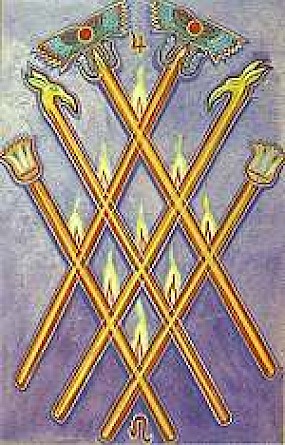
Tarot card for August 4: The Six of Wands

The Six of Wands

The Lord of Victory is a card of fight, competition and eventual victory. It applies to areas of our lives where we feel we have had to fight very hard to achieve our goals. It can apply to any area of our lives where we have had to contest our position strongly.

So, for instance, it could indicate passing successfully through tough training courses; it could apply to spiritual development after a period of test and trial; it could show that we have managed to establish stable and harmonious relationships through hard work and tenderness; it could even indicate that we have finally managed to get our bank balances to match our desired level of spending after much difficulty!

It’s a card which indicates that we have achieved both a point of balance and a moment of ascension during which we feel justifiably proud of ourselves, but maybe just a little overwhelmed by our final breakthrough into good fortune.

There will always have been struggle before this card appears. We will have been striving – sometimes against frustratingly unhelpful influences – to grasp our dreams, our hopes, our ambitions, our needs. There will sometimes have been pain or confusion as a result of that struggle. But when this card comes up, we can relax a little, and enjoy the fruits of our labour.

The Six of Wands

(via angelpaths.com and Alan Blackman)

Sri Chinmoy on paradise

“Paradise is not a place; it’s a state of consciousness.”
—Sri Chinmoy 

Chinmoy Kumar Ghose, better known as Sri Chinmoy (August 27, 1931 – October 11, 2007), was an Indian spiritual leader who taught meditation in the West after moving to New York City in 1964. Chinmoy established his first meditation center in Queens, New York, and eventually had 7,000 students in 60 countries. Wikipedia

Cult Leader Warns Followers Things Need To Get Way More Deranged To Be Made Into HBO Documentary Series

Yesterday 7:00AM (theonion.com)

SEATTLE—Telling his acolytes that they were simply not hitting the mark to attract the eye of the acclaimed cable channel, Glensard Handswith, principle master of the Tricyclonian Order, warned followers Tuesday that things needed to get way more deranged for their cult to ever be made into an HBO documentary. “All Inductees of the Order, hear me on this grand sanctum day: If we are going to get our story before a prestige audience, we need to amp all the unhinged stuff way, way up,” said the Guiding Teacher, pointing to the relative tameness of the mud-splattered demonic orgies, videotaped unburdening sessions, and 5,000 rounds of live munitions stored in the leadership’s Celestial Yurts. “Obviously, we’ll take Netflix if that’s our best option, but HBO is going to give our narrative room to really breathe—I’m talking nine or ten hours, stark close-ups of excommunicated member testimony, and a really killer cinematographer making all the shots of the compound sing. Only way we’re getting that is if we ramp up our celebrity recruitment and give a few of them permanent brain damage during a Prismatic Tribunal. Unfortunately, inseminating a few teenagers with my divine seed just isn’t cutting mustard anymore.” At press time, Handswith had punished his followers for their failings by forcing them to strip naked in a cold cellar and stitch Tricyclonian patterns into their clothing for eight hours of footage that he said would make great B-Roll.

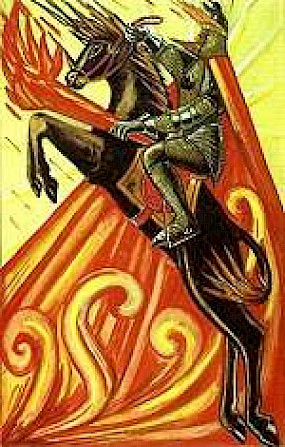
Tarot card for August 3: The Knight of Wands


The Knight of Wands

The man represented by the Knight of Wands will be a loving and open-hearted person, with a strong sense of morality and a great sense of humour. He will be active, energetic and willing to help. You often find these types of men in the healing professions, or in other areas where they are required to assist, guide and support others.

He’s a man with a deep respect for life and all living things, attuned to Nature and to the creatures of the earth. He has a deep well of compassion which spills over readily to anyone who needs his help, but he also has the restraint to know when too much assistance is a bad thing. Then he will act to enable and empower, rather than to assisting.

He’s a faithful, and dedicated family man, being fully engaged in the domestic situation. His life reflects his high ethical standards, though he is not given to sermonising, nor standing in judgement on others. He could be defined as an idealistic realist – accepting the frailties of the race, whilst doing his best to strengthen it.

His faults spring from his good points – for instance, he dislikes causing pain, and will therefore delay when he needs to act if he thinks it will hurt other people. He will sometimes remain in limiting or painful circumstances because of this. His sense of rightness and duty is intense, and sometimes drives him to make foolish choices and decisions. He will shy away from conflict and unpleasant situations, especially when these arise as a result of his own needs, though he will never walk away from a struggle on behalf of somebody else.

If you are regarding this card as a spiritual change, then see it as an indication that the warrior of right and light is required – you’ll need to stand up for something that matters, and which is unable to defend itself.

The Knight of Wands

(Angelpaths.com via Alan Blackman)

August 2021 forecast – Getting things done

It’s August, so we are in full Leo season! Apart from some Saturn oppositions early this month, which are always a bit challenging, August 2021 is a month to look forward to.

We have a record number of planets in their home sign: Sun in Leo, Mercury in Virgo, Venus in Libra, and Saturn in Aquarius, which means that we have a lot of dignified energy to work with.

The Full Moon in Aquarius is really special too, since it is conjunct the Great benefic Jupiter!

And the Grand Earth Trines that the planets in Virgo make with Uranus in Taurus and Pluto in Capricorn will help us materialize our ideas and projects. Things are finally starting to happen.

Are you excited?

Let’s take a closer look at the most important transits of the month:

August 1st, 2021 – Sun Conjunct Mercury

On August 1st, 2021 Sun is conjunct Mercury at 9° Leo. This is the “Full Moon” phase of the current Mercury cycle that started on June 10th, 2021 (when Mercury retrograde was conjunct the Sun and the Gemini Eclipse).

If you’re still processing that eclipse in June, the Sun-Mercury conjunction on August 1st will bring you much-needed clarity.

This mid-cycle conjunction is opposite Saturn, so the revelations the Sun and Mercury will bring will require emotional maturity and discernment. If at times you feel at odds with society, keep in mind that any struggle, any conflict is an opportunity to understand yourself, and your place in the world better.

August 8th, 2021 – New Moon In Leo

On August 8th, 2021, we have a New Moon at 16° Leo. The New Moon is conjunct Mercury, it is square Uranus and opposite Saturn. This is a very important lunation, because it directly activates the Saturn-Uranus square.

If, until now Saturn square Uranus was something out there, outside of ourselves that happened to others, things suddenly turn personal.

Initially, we may feel in between a rock and a hard place. The questions are the same: who am I, really? What makes me different from others? What’s my place in the world?

You may not have all the answers yet, but make an effort and stay with the tension. Sometimes the things that we have the greatest resistance towards can lead to our greatest breakthroughs.

August 11th, 2021 – Mercury Enters Virgo

On August 11th, 2021 Mercury enters his favorite sign: Virgo. Mercury in Virgo is really special because it is the only placement where a planet is both exalted and in domicile. This means that Mercury feels really really good in Virgo.

Mercury in Virgo is as witty and quick as Mercury in Gemini, but it also brings the analytical, practical Virgoan qualities to the table.

No wonder many scientists, researchers, linguists, writers and intellectuals of any kind have this placement. When Mercury is in Virgo, we too have the chance to tap into this energy. If you have a Mercury project in mind now it’s time to make it happen!

August 16th, 2021 – Venus Enters Libra

“When love comes to town”. The Goddess of love and relationships is at home in Libra. No matter what your Venus sign is, you will love Venus in Libra.

Your relationships will improve, because Venus in Libra just knows what makes people tick.

You will feel better about yourself too, because Libra brings balance and promotes a healthy relationship with your feelings. Venus is such an important planet, because it tells us how we feel about life, it describes our quality of life in general. When Venus is at home in Libra, the world feels like a good place to be in.

August 18th, 2021 – Mercury Conjunct Mars

“Show me the details!” On August 18th, 2021, Mercury is conjunct Mars at 16° Virgo. This transit is great for verbal expression of any kind, to voice your opinions, do research, and go deep into a topic.

Mercury is in domicile AND exaltation in Virgo so it is operating at its full capacity. You can’t get a better transit for bringing your Mercury ideas to life.

The great thing about Mercury conjunct Mars is that this time you’re not only talking about your ideas… you also take action. And when Mercury and Mars also trine Uranus in Taurus, you know you’re up for some exciting developments.

You will especially benefit from this transit if you have personal planets in Earth signs.

August 19th, 2021 – Uranus Goes Retrograde

On August 19th, 2021 Uranus goes retrograde at 13° Taurus. When outer planets like Uranus go retrograde, their energy is intensified. So from a few days before, and a few days after August 19th, you can expect Uranus serendipities, revelations and illuminating insights.

Uranus brings clarity even – and especially – when it goes retrograde. Uranus’ station will make you more aware of the subtle energies and information that surround you all the time, but are usually more difficult to access.

When you tap into Uranus’ energies, when you align yourself with Uranus, you are on the same frequency as the Universe, and gain incredible insight and clarity.

August 22nd, 2021 – Full Moon In Aquarius

On August 22nd, 2021 we have a 2nd Full Moon in Aquarius. Last month we had a Full Moon at 1° Aquarius, and this time we have a Full Moon in the last degree of Aquarius.

We are coming full circle. This is a highly auspicious Full Moon because it is conjunct Jupiter. This Full Moon is in a way, our saving grace.

Everytime we have 2 lunations in the same sign (and this doesn’t happen too often) the universe gives us the chance to make things right.

If the New Moon in Leo early this month has come with the problem, the Full Moon in Aquarius brings the solution. You will finally be able to connect the dots. Things will finally start to make sense. You will finally find your place in the world.

August 22nd, 2021 – Sun Enters Virgo

Hours after the Full Moon, the Sun leaves Leo and enters Virgo. Happy birthday to all Virgos out there!

Once it has understood what its mission is (thanks to the insights revealed by the Full Moon), the Sun is now ready to make things happen. Sometimes we are crystal clear about what we want, but we don’t know what exactly we need to do to turn our idea into a reality.

And that’s exactly what we have Virgo for. Virgo will diligently break down plans into manageable tasks, and will show us, step-by-step, what we need to do.

August 30th, 2021 – Mercury Enters Libra

On August 30th, 2021 Mercury leaves Virgo and enters Libra. During this transit, we’re more diplomatic and we find it easier to see other people’s points of view.

With Mercury in Libra we are more likely to talk things through, get things straight, and find a “win-win” solution. When we have clarity around where we’re coming from, as well as where other people are coming from, we find that middle ground, that perfect balance between give and take, and this is when magic happens.

–Astro Butterfly (astrobutterfly.com)