Biblical arguments for LGBTQ rights and a queer Jesus may seem like new ideas, but they were pioneered about 200 years ago by an influential British philosopher — in writings that were published only in recent years.
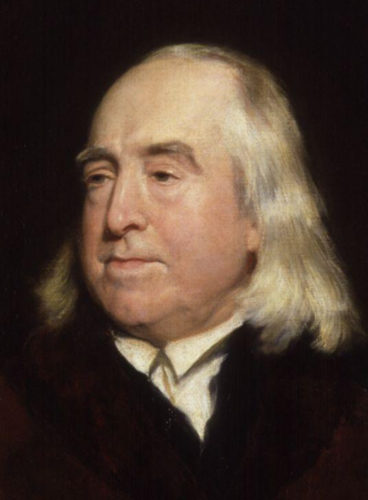
Philosopher Jeremy Bentham (1748 – 1832) presented Biblical evidence for Jesus’ homosexuality as part of his theological defense for same-sex love in “Not Paul, but Jesus Vol. III.” It was published for the first time in 2013 and is freely available to download or view online. He died on June 6, 1832.
Bentham didn’t dare publish it during his lifetime because he feared being labeled a “sodomite” himself. At the time “buggery” was punished with death by hanging in England.
This champion of sexual freedom was far, far ahead of his time. “Not Paul, but Jesus” lays out many of the same arguments that are still used today by LGBTQ Christians and our allies: debunking the scriptures typically used to condemn LGBTQ people and pointing out that Jesus never said anything about homosexuality. Bentham goes on to present an idea that many still consider blasphemous. He suggests that Jesus had male-male sexual relationships.
Bentham wrote the book so long ago that the word “homosexuality” had not been invented yet. Instead he has a chapter titled “The eccentric pleasures of the bed, whether partaken of by Jesus?” His language may sound quaint, but his ideas are right on target for today. Bentham himself struggled with words for what we call homosexuality, deliberately creating new vocabulary so he could avoid the negative connotations associated with the terminology of his day (sodomy, buggery, perversion, etc.).
Bentham is best known as the founder of Utilitarianism, a philosophy that advocates “the greatest happiness of the greatest number of people” A respected thinker during his lifetime, Bentham was also far advanced on a wide range of other legal, economic and political issues. He coined the word “international.” He was one of the first proponents of animal rights. He supported women’s equality and opposed slavery and capital punishment. He corresponded with various world leaders, including US presidents Jefferson and Madison. Several South and Central American nations sought his advice in creating their constitutions and legal codes. Born and raised in a devout Anglican family in London, he became an agnostic who believed that religion was an instrument of oppression. His solution was separation of church and state.
Bentham sheds light on “clobber passages”
In the third volume of “Not Paul, but Jesus Vol. III,” Bentham corrects false interpretations of what would later come to be called the “clobber passages.” He identifies the sin of Sodom as gang-rape. He puts the sexual prohibitions of the Hebrew scriptures into historical context, pointing out that many of the other taboos are no longer enforced.
Bentham dismisses Paul’s condemnations of homosexuality as an asceticism not shared by Jesus himself. He sees romantic love between Old Testament heroes Jonathan and David — and possibly between Jesus and his beloved disciple John, noting that the Bible reports their loving touch without condemnation.
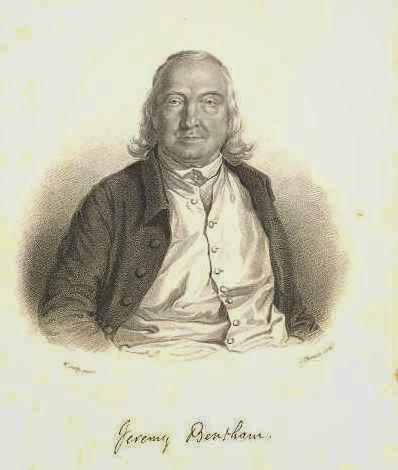
Jeremy Bentham engraving by J. Thomson, from a painting by W. Derby (courtesy of the Bentham Project)
Bentham goes on to analyze the account in Mark’s gospel of “the stripling in the loose attire” (now usually known as “the naked young man”) at the arrest of Jesus — a passage that continues to fuel 21st-century speculations in the LGBTQ community. He urges readers to consider the most “probable interpretation” for the nakedness. (In a different manuscript he made it clear that the youth was probably a male prostitute loyal to Jesus.) Bentham even hints that Jesus was killed for homosexuality, asking readers to consider what interaction with a naked man could be “so awful” that it leads to cruel execution.
Pro-LGBTQ Christians today often note that Jesus never said anything against homosexuality. Bentham makes the same point in his own elaborate way, with sentences such as: “In the acts or discourses of Jesus, had any such marks of reprobation towards the mode of sexuality in question been to be found as may be seen in such abundance in the epistles of Paul—in a word, had any one decided mark of reprobation been so to be found as pronounced upon it by Jesus, in the eyes [of] no believer in Jesus could any such body of evidence as hath here been seen [to] present itself be considered as worth regarding.”
Indeed Bentham’s main purpose in all three volumes of “Not Paul, but Jesus” is to show the error in following the ascetic Paul instead of the true Christianity of the more tolerant Jesus, who accepted the human pursuit of pleasure. This concept is introduced in the first volume of “Not Paul, but Jesus” was published in 1823. Fearing hostile reactions, Bentham used the pseudonym Gamaliel Smith. The second volume, which deals with the early church, and the third volume, which focuses on sexual morality, remained unpublished.
Bentham wrote a lot about homosexuality
Bentham wrote more than 500 pages explaining his liberal views on homosexuality during the last 50 years of his life. Some of these documents may have circulated among his followers, but none of it was published during his lifetime.
The first Bentham writings on homosexuality to be published were primarily secular. His 1785 essay “Offences Against One’s Self: Paederasty” is considered the first document arguing for decriminalization of homosexuality in England. He reasoned that consensual sex between same-sex partners should not be punished because it does not harm anyone. The essay was not published until 1931, when a fragment first appeared in print. The full essay was finally published in 1978.
Only now are Bentham’s writings on Jesus and homosexuality coming to light. The third volume of “Not Paul, but Jesus” was not published in any form until 2013. It was released last year by the Bentham Project at University College London, which counts him as its spiritual father.
A section on “Jesus’s Sexuality” is also included in the 2012 article “Jeremy Bentham: Prophet of Secularism” by Philip Schofield, director of the Bentham Project. He draws on the “Not Paul” book and another set of manuscripts to draw powerful conclusions such as this:
Bentham claimed that, unlike Paul, Jesus did not, according to any account that appeared in the four Gospels, condemn either the pleasures of the table or the pleasures of the bed. On the contrary, Jesus’s opposition to asceticism was shown in his condemnation of the Mosaic law in Matthew 9: 9–17…. Bentham pointed out that Paul’s most forceful condemnation was directed towards homosexuality. Bentham responded that not only had Jesus never condemned homosexuality, but that he had probably engaged in it. There were, moreover, many females in Jesus’s immediate circle, and again Bentham saw no reason why Jesus might not have engaged in heterosexual activity as well.
Bentham’s mysterious life and lasting impact
Although Bentham doggedly defended consensual sexual activity between same-sex couples for half a century, his own love life remains a mystery. The son of a wealthy lawyer, he was a child prodigy who grew up to be a brilliant and eccentric recluse, living alone in London in what he called “a state of perpetual and unruffled gaiety.” He referred to his home as his “hermitage.” He lived there with a “sacred teapot” called Dicky, a favorite walking stick named Dapple, and a beloved tom cat addressed as the Reverend Doctor John Langborn. He declared, “I love everything that has four legs,” and allowed a colony of mice to share his office. One study concludes he had Asperger Syndrome, a high-functioning form of autism. Check this link for an 1827 description of Bentham’s eccentricities.
The philosopher’s influence continued to grow after his death as his supporters spread his ideas. Most of what is now known as liberalism is rooted in Bentham’s philosophy. His diverse followers included economist John Stuart Mill and feminist firebrand Frances “Fanny” Wright, who once exclaimed in a poem, “Oh had I but the Lesbyan’s lyre, / Blue-eyed Sappho’s fervid strain, / Then might I hope thy blood to fire…”.
Contemporary queer theologians such as Robert Shore-Goss have recognized him too. Shore-Goss writes a section about Bentham in the chapter on “Christian Homodevotion to Jesus” in his book “Queering Christ: Beyond Jesus Acted Up.”
During his 84 years Bentham wrote manuscripts totaling more than 5 million words, and many remain unstudied and unpublished. The Bentham Project is busy recruiting volunteers worldwide to transcribe them. More words of wisdom are likely to emerge from this prophet of LGBTQ rights who once summed up his approach to life by saying: “Create all the happiness you are able to create: remove all the misery you are able to remove.”
____ This post is part of the LGBTQ Saints series by Kittredge Cherry. Traditional and alternative saints, people in the Bible, LGBTQ martyrs, authors, theologians, religious leaders, artists, deities and other figures of special interest to lesbian, gay, bisexual and transgender and queer (LGBTQ) people and our allies are covered. It is also part of the Queer Christ series by Kittredge Cherry at the Jesus in Love Blog. The series gathers together visions of the queer Christ as presented by artists, writers, theologians and others.
This article was first published on Q Spirit in June 2017 and was updated for accuracy on June 5, 2021.
Kittredge Cherry Founder at Q Spirit Kittredge Cherry is a lesbian Christian author who writes regularly about LGBTQ spirituality.She holds degrees in religion, journalism and art history.She was ordained by Metropolitan Community Churches and served as its national ecumenical officer, advocating for LGBTQ rights at the National Council of Churches and World Council of Churches.
Image Credit : Pinkpasty – Artist Credit : artist Malcolm – CC BY 4.0
The Sacred Band of Thebes was an elite force of shock troops in the Theban army, consisting of 150 paired male lovers that were famed in the classical world during the 4th century BC for their legendary courage and military strength in battle.
(heritagedaily.com)
The view of homosexuality or same sex relations in Ancient Greece was distinguished not by sexual desire, but instead was perceived by the role that each participant played by either being the penetrator, or passively penetrated.
The role of the penetrator corresponded with attributes of being dominant, masculine, and of high social status, whilst the passive role was associated with femininity, lower social status, and youth, with the latter often being the subject of social stigma in Greek society.
According to the philosopher and historian Plutarch (AD 46 – 119), the Sacred Band consisted of 300 hand-picked men, that were identified as either an older erastês or a younger passive erômenos, who would exchange sacred vows and worship at the shrine of Iolaus (claimed to be one of the lovers of Heracles) at Thebes.
The earliest record of the Sacred Band was in the oration “Against Demosthenes” by the Athenian logographer Dinarchus in 324 BC, but accounts of their full story is given by Plutarch, who likely drew on earlier text from contemporary chroniclers whose works are now lost.
Plutarch describes how the Sacred Band was formed by the boeotarch Gorgidas, shortly after the expulsion of the Spartan garrison occupying the Theban citadel of Cadmea.
Plutarch’s “Parallel Lives” from the second century AD records: “The sacred band, we are told, was first formed by Gorgidas, of three hundred chosen men, to whom the city furnished exercise and maintenance, and who encamped in the Cadmeia; for which reason, too, they were called the city band; for citadels in those days were properly called cities. But some say that this band was composed of lovers and beloved.”
The Sacred Band were first deployed during the Boeotian War in 378 BC, but gained a legendary reputation for their participation in the Battle of Leuctra in 371 BC, in which the Sacred Band fought at the head of the Theban column against the Spartans.
They remained undefeated until the battle of Chaeronea in 338 BC, in which a Macedonian army under the command of Phillip II and his son Alexander, crushed an alliance of Greek city-states led by Athens and Thebes.
In Plutarch’s accounts of the battle: “It is said, moreover, that the band was never beaten, until the battle of Chaeroneia; and when, after the battle, Philip was surveying the dead, and stopped at the place where the three hundred were lying, all where they had faced the long spears of his phalanx, with their armour, and mingled one with another, he was amazed, and on learning that this was the band of lovers and beloved, burst into tears and said: Perish miserably they who think that these men did or suffered aught disgraceful.”
The Greek geographer Pausanias (AD 110-180) in his “Description of Greece”, mentions that the Thebans had erected a lion statue near Chaeronea to commemorate the Thebans killed in the battle.
During the 19th century, pieces of a large stone lion were rediscovered, along with a quadrangular enclosure containing the remains of 254 men, that many historians argue is the final resting place of the fallen soldiers from the Sacred Band of Thebes.
My propositions serve as elucidations in the following way: anyone who understands me eventually recognizes them as nonsensical, when he has used them—as steps—to climb beyond them. (He must, so to speak, throw away the ladder after he has climbed up it.)
He must transcend these propositions, and then he will see the world aright.
Given the preceding problematic at work in his Tractatus, this passage suggests that, if a reader understands Wittgenstein’s aims in the text, then those propositions the reader would have just read would be recognized as nonsense. From Propositions 6.4–6.54, the Tractatus shifts its focus from primarily logical considerations to what may be considered more traditionally philosophical topics (God, ethics, meta-ethics, death, the will) and, less traditionally along with these, the mystical. The philosophy presented in the Tractatus attempts to demonstrate just what the limits of language are—and what it is to run up against them. Among what can be said for Wittgenstein are the propositions of natural science, and to the nonsensical, or unsayable, those subjects associated with philosophy traditionally—ethics and metaphysics, for instance.[4]
Curiously, the penultimate proposition of the Tractatus, proposition 6.54, states that once one understands the propositions of the Tractatus, one will recognize that they are nonsensical (unsinnig), and that they must be thrown away.[5] Proposition 6.54, then, presents a difficult interpretative problem. If the so-called picture theory of language is correct, and it is impossible to represent logical form, then the theory, by trying to say something about how language and the world must be for there to be meaning, is self-undermining. This is to say that the picture theory of language itself requires that something be said about the logical form sentences must share with reality for meaning to be possible. This requires doing precisely what the picture theory of language precludes. It would appear, then, that the metaphysics and the philosophy of language endorsed by the Tractatus give rise to a paradox: for the Tractatus to be true, it will necessarily have to be nonsense by self-application; but for this self-application to render the propositions of the Tractatus nonsense (in the Tractarian sense), then the Tractatus must be true.
In his notes of 1930 Wittgenstein returns to the image of a ladder[6] with a different perspective:
I might say: if the place I want to get could only be reached by way of a ladder, I would give up trying to get there. For the place I really have to get to is a place I must already be at now. Anything that I might reach by climbing a ladder does not interest me.[7]
Theories of Everything with Curt Jaimungal Rupert Spira is a teacher of the “direct path”-method of spiritual self-enquiry, and a world renowned expert on non-dualism. Sponsors: https://brilliant.org/TOE for 20% off. http://algo.com for supply chain AI. Patreon for conversations on Theories of Everything, Consciousness, Free Will, and God: https://patreon.com/curtjaimungal Crypto (anonymous): https://tinyurl.com/cryptoTOE PayPal: https://tinyurl.com/paypalTOE Twitter: https://twitter.com/TOEwithCurt Discord Invite: https://discord.com/invite/kBcnfNVwqs iTunes: https://podcasts.apple.com/ca/podcast… Pandora: https://pdora.co/33b9lfP Spotify: https://open.spotify.com/show/4gL14b9… Subreddit r/TheoriesOfEverything: https://reddit.com/r/theoriesofeveryt… LINKS MENTIONED: Rupert’s Website: https://rupertspira.com/ Rupert’s Twitter: https://twitter.com/RupertSpira Interview with Bernardo Kastrup: https://www.youtube.com/watch?v=lAB21… Interview with Donald Hoffman: https://www.youtube.com/watch?v=CmieN… Interview with Iain McGilchrist: https://www.youtube.com/watch?v=M-SgO… THANK YOU: Cooper Sheehan and Henry Hoffman-Bakoussis for formatting the audience questions. TIMESTAMPS: 00:00:00 Introduction 00:06:07 Overview of non-dualism 00:09:09 Experience vs consciousness vs awareness 00:10:31 “In ignorance, I am something. In understanding, I am nothing. I love, I am everything.” 00:14:29 Discovering “you” by taking off your thoughts and perceptions 00:17:09 Meditative exercise to see union between the self and the world 00:33:14 Can you be aware of not being aware? 00:48:34 Why can there only be “one” consciousness? 00:51:54 Consciousness as fundamental. Not matter 01:04:55 Why does infinite consciousness need to become finite? 01:09:17 There no real “things” 01:11:40 Definition of enlightenment 01:14:47 Are atheists / materialists lying when they say they have peace? 01:21:30 It’s okay for your body’s pain to not have caught up to your mind’s peace 01:28:19 The nature of consciousness is happiness 01:34:55 Logos 01:40:35 Donald Hoffman and Bernardo Kastrup 01:48:03 Psychedelics 01:58:01 Consciousness as “love” requires subtlety to understand 02:00:19 Love, truth, and beauty are the same, but depend on the path one takes 02:04:12 Psychological suffering is veiled happiness 02:07:31 Some truths will break you at your core 02:17:40 New age is missing the malicious element of humanity 02:24:26 Rupert’s distinctive manner of speech 02:27:07 Does infinite consciousness “speak” to us? 02:29:15 Why does suffering exist? Why does it have to be so drastic? 02:43:04 “Overlapping consciousness” and the objective world 02:49:40 Materialists don’t disagree with non-dualism 02:51:22 Curt’s “fractal” theory of reality and the extremization of a parameter unifying with its opposite 02:56:55 Iain McGilchrist, the bihemispheric model, and fractals 03:00:17 On death, and continuing on 03:06:11 Science 2.0 (“abhijgnosis” as Curt calls it) 03:18:48 [Hubur Galula] Does Rupert still get overwhelmed with emotions / attached to objects or people? 03:23:44 Functional vs dysfunctional attachments (co-dependence) 03:25:37 [Inannawhimsey] Rupert, is there any emotion that isn’t valid? 03:35:22 [Rebecca Briggs] Ego and shadow work in the non-dual recognition tradition? 03:42:10 Why are we separate at all? Why are these truths something we have realize? 03:47:59 Descartes was wrong, or right? 03:52:27 The East vs The West (the East was first to non-dualism) 03:57:59 Rupert Spira interprets the Prodigal son with non-dualism 04:02:59 Prayer in the West vs meditation in the East 04:20:27 Does infinite consciousness suffer? Does it lack? 04:25:07 No background necessary to realize the insights of non-dualism 04:32:52 [DIYCraftq] What happens when you die in your model vs. Rupert Sheldrake’s model? 04:41:01 Where to find out more about Rupert Spira * * * Just wrapped (April 2021) a documentary called Better Left Unsaid http://betterleftunsaidfilm.com on the topic of “when does the left go too far?” Visit that site if you’d like to watch it.
Russell Brand A clip from the upcoming Under The Skin podcast with the incredible Brené Brown! You can listen to the entire conversation this Sat 22nd June on Luminary, sign up here to listen for free: http://luminary.link/russell Have you seen Brené’s TEDtalk on YouTube or her new Netflix special? If not…go watch it, it’s fantastic and very moving. You might cry a little. Subscribe to my channel here: http://tinyurl.com/opragcg (make sure to hit the BELL icon to be notified of new videos!) You can get my new book Mentors here (and as an audiobook!): https://amzn.to/2t0Zu9U Get my book “Recovery” here: https://amzn.to/2R7c810 Instagram: http://instagram.com/trewrussellbrand/ Twitter: http://twitter.com/rustyrockets Produced by Jenny May Finn (Instagram: @jennymayfinn)
Allow me to introduce you to the ruinous, tragicomic state of Britain circa 2021. This week, the Health Secretary was caught…on video…breaking his own lockdown rules…to have an affair…with his key aide…who was married, by the way…and whose brother had won a lucrative Covid contract from the NHS…which said Health Secretary is also busy selling off to American hedge funds…so soon, Brits will pay American prices for healthcare…while there’s a third wave of Covid’s Delta variant breaking loose.
Did you get all that?
Now, put aside for a moment that the Health Secretary, Matt Hancock, is a man that nobody should have an affair with. He gives off creepy vibes like a stalker at midnight, only he wears a suit. You don’t even need to consider how weirdly creepy like a Stepford Man or a Manchurian Plutocrat Matt Hancock is…you don’t need to consider how astoundingly ass-grabbingly sleazy the video is…no, just the raw facts are mind-boggling enough. After all, Hancock appears to have been quite possibly breaking the law, which is what his own lockdown rules were about, but I guess they don’t matter if you’re the Health Secretary, and you need to grab your aide’s ass. Not only that, but he apparently knew the video was coming out, and used that time to tell his wife, who he had given Covid to, that he was leaving her. He woke his kids in the night to tell them he was moving out. What the?
Ah, but we’re barely just beginning.
The next day, the Metropolitan Police (aka “the Met”) announced that they were going to arrest. Who? Matt Hancock? The aide’s brother? Nope. Environmental activists. They were going to raid…wait for it…art centres.
That’s because these environmental activists, Extinction Rebellion, stage elaborate, dramatic, artistic protests. Here, check out a few pictures. Tell me that’s not aesthetically impressive — whatever your particular politics might be. Now, Londoners, some of them, anyways, find Extinction Rebellion annoying. Oh no, how annoying. To have to care about the planet. At any rate, it’s hardly the stuff of serious crime.
At this point, you might be asking: wait, what? Why were the Police wasting their time raiding art centres? Instead of the Health Secretary who broke his own lockdown rules?
After all, the rest of the nation had to follow those rules. People didn’t see their loved ones for months. Parents died without children ever saying goodbye. And the doctors who witnessed all this, handled it, treated it? They’re quitting in droves, because, well, who wants to work for an assh*le like that?
But I digress. Why are the police raiding art centres…while the Health Secretary was getting off scot-free? Sorry — did I forget to mention that part? That’s right. While Matt Hancock has now resigned, Boris defended him, instead of saying, “That’s a serious offense.”
What on earth is going here?
Wait, let me give you one final example. While all is going on, right under Brit’s noses, the NHS is being sold off to American hedge funds. Has anyone told Brits that Americans get medical bills like this one — for three million dollars? Channel 4, too — one of the world’s finest broadcasters — is being privatised. It was something unique and beautiful and cool — a public indie broadcaster which took big, bold risks, tasked with making the highest quality, most original stuff around. You probably don’t know it if you’re American, but Channel 4 has made some of your favourite shows and actors and directors. Meanwhile, a new channel — “GB News” — has been set up, with a little help from pals and billionaires — and it’s more rancid and conservative than Fox News.
These are seismic, irreversible shifts in Britain’s cultural and institutional landscape. No more NHS — a once indispensable part of modern British life. Sure, it might still be there — as a paid phone line or app or something. But not as a social system. No more Channel 4 — liberal, open, uncompromising, critical, artistic — instead, the dun, mindless propaganda of florid, angry, red-faced old conservative men, ranting about how much they hate the people they hate on “GB News.”
All these are examples as clear as day.That, dear reader, modern-day Britain is the world’s newest failing state. You can’t see it more clearly than the examples above. Let me sum up more formally what happened here. One of the nation’s senior politicians broke his own rules — while the police are wasting their time, and everyone’s money, going after artsy, harmless environmental protestors…who are now classed as “terrorists.”
Let’s count how many levels and features of failed states are present in this one tiny example alone — and then we’ll zoom out to the others. The rule of law has ceased to function. Elites operate according to one set of rules, and everyone else, another. The public good has stopped mattering, and private interests — like making out with your aide during a lockdown everyone else is supposed to follow — is all that counts. The little people don’t matter anymore — maybe they never did. Most of them don’t seem to care at all, in fact. Hence, basic public institutions are being subverted and perverted for nakedly, openly authoritarian ends.
Yes, authoritarian ones. What else do you call it when environmental protesters in art centres are being “raided”…by heavily armed police…because they’re classed as “terrorists”? That’s happening because the ultra-conservative government doesn’t want any dissent. It doesn’t want any unrest. It doesn’t much like the idea of caring about anything that isn’t money, power, sex, or fame. Like, say, the planet, democracy, the future, each other. It doesn’t want people to be intelligent, thoughtful, sane, optimistic, forward-looking.
It doesn’t want the rule of law to function at all — it’s abusing public institutions for not just openly political ends, but ones corrosive and inimical to democracy, like free expression and association.
So environmental protesters can’t hang out at art centres to try and save the planet. But if you’re the Health Secretary, apparently, you’re free to…freely associate…with anyone you like…even during lockdown. Because you have power. To abuse the system. While everyone else just has to submit to your abusive, absolute power.
Get all that? You should. You should think about it carefully. Nothing shows failed states more clearly than the juxtapositions of elites and ordinary people — especially ones who dissent, care, try to change the system.
In this case, we have an alarming, bizarre, juxtaposition so extreme, it takes on comical proportions. Art centres being raided, because freedom of expression is now so severely curtailed caring about the environment is “terrorism” — for ordinary people — while for elites, no rules apply at all, and you can cheat on your wife at the office during lockdown. Laugh or cry? You tell me, I guess.
In failing states — truly failing ones — elites do something strange and perverse. They rub it in. They flaunt it. The absoluteness of their power. That they don’t have to follow the rules, because the rules are for the little people, marks, rubes, suckers. They openly break the very rules they’ve made.
Why do they do that? For three reasons. One, to demonstrate their power really is absolute. Two, to build authoritarian cults of personality. And three, because they can.
Remember how the aide’s brother has a lucrative NHS Covid contract? He’s just one of a long string of examples. The same Health Secretary awarded another lucrative Covid contract to…who, a company run by doctors?…a non-profit?…no, the guy that ran his pub.
The corruption isn’t even hidden in plain sight anymore. No, it’s not hidden at all. Like, for example, “GB News,” more conservative than Fox, magically arising, while Channel 4, which made people think critically, is sold off to the lowest bidder. Or like selling off the NHS to American hedge funds, who are quite happy watching Americans die because they can’t get basic medicine like insulin, which costs ten times or as much in America as it does in Canada, life openly sacrificed — or should I say taken? — for the sake of even more money for a tiny malicious, ultra rich few.
When elites reach that point — not even bothering to hide the corruption, but doing the very opposite, which is flaunting it — a society is crossing a dark, grim, and dangerous threshold. Everything is changing. Elites only flaunt how badly they can break the rules when they know they can get away with it, and that means that a) social norms are corroding b) the rule of law has no teeth b) politics doesn’t work anymore c) you’re not living in much of a democracy and d) people have been demoralised and dispirited so much that nothing seems to matter anymore, and today’s latest depredation is met with shrugs of “what else did you expect?”
That, my friends, is a failed state.
How did Britain get here?
Let me give you another story of what happened this week. Kids are literally going to be made to sing a song at school that goes: “Strong Britain, Great Nation!”
Go ahead and giggle. That’s pretty…North Korean. Kim Jong Un would be proud. Shall we put them in stadiums and have them do synchronised billboard-holding next? But you know who else would be proud? Donald Trump.
Because Britain’s kids are going to be made to sing about Making Britain Great Again. LOL.
That’s another example of subverting and perverting many things. Institutions — schools. Social norms — what kids should say and think. These things shouldn’t be part of the British government’s insane nationalistic crusade to Make Britain Great Again. But they are — and that’s how Britain became a failing state.
You know part of the story by now. 2008, financial crisis. 2010, austerity begins. 2015, people have plunged into poverty, and, desperate, bewildered, they buy the stupid, stupid nationalistic myth — “Those Europeans are responsible for our woes! Get them!!” Gentle, wise, friendly Europeans became scapegoats for the catastrophic mistakes a string of conservative governments made — the worst in modern history, reducing Britain to something like a neo Weimar Republic, dysfunctional, bereft, sinking into poverty and despair and ruin, florid with the rage and vitriol which usually accompanies such implosions.
Bang. Cue Brexit. And since then, well, Britain has simply fallen apart. No, that’s too kind. It’s been put through the shredder. Brexit’s caused some of Britain’s key exports to collapse in ways totally unseen — ever — in a modern, rich society. As in, simply stop dead. Fish, farming, dairy, cars — all these are industries which are simply now dying. And yet the fishermen and farmer and assembly line worker — these are the people who voted for Brexit, and still do, because they still back the conservatives so heavily, by a two to one ratio, that Britain’s future looks even more ultra-conservative, authoritarian, regressive — read, backwards, foolish, hateful, corrupt, malign, and broken — than it is now.
Think about it for a second. You’re some farmer or fisherman. Along come a bunch of malign elites, and tell you Europeans are to blame for your sinking income — not the incredibly dumb mistakes, like austerity, those very elites have made. Confused, afraid, you buy the myth. You’d think you’d come to your senses when you were literally losing the farm. But that’s not happened, nor happening, in Britain. Instead, the average Brit is more committed to backing the very agents of his own ruin — conservative elites — than ever.
So of course Britain’s conservative elites think they can flout the rules, flaunt it, and get away with it. They can. They have a pretty good measure of how deluded and broken in the mind and spirit the average Brit is now. They don’t even care about the fact that they scapegoated the wrong people — they still back conservatives, who led them off Brexit’s cliff edge. So why would they hold those very same elites accountable for much, much smaller things — mere seeming peccadilloes, like affairs, or garden-variety corruption, or the abuse of everyday power?
Britain’s elites have the measure of the average Brit, and it’s about the height of a slug. They know that the average person is still fervid with nationalism, that the fever of hate and venom and spite which began to poison Britain around 2015 or so hasn’t broken. And so, with a bit of clever misdirection — or just time — they can get away with anything.
And they do.
Why would people who won’t hold you accountable for wrecking their lives, jobs, livelihoods, communities, towns, politics, democracy, futures…hold you accountable for raiding art centres, for selling their healthcare system, for brainwashing their children with North Korean chants?
Of course they won’t.
Britain’s conservative elites understand this all perfectly. Sadly, it’s Britain’s liberals and social democrats who don’t. Britain is a nation gripped by a terrible fever. No, not (just) Covid. Nationalism. And nationalism is proceeding in Britain just the way it always does. The fever doesn’t break. It develops. Into the organ failures of authoritarianism and fascism. Those happen when public institutions are abused for repressive, regressive political ends. Like, say, the police raiding art centres because the government doesn’t like environmental protestors and calls them “terrorists” now — that’s the real crime now, not corruption, cronyism, incompetence, letting your country have one of the highest Covid death rates in the world, breaking your society, shredding your economy. All that stuff? Not just perfectly OK in Britain today — that’s what the people want.
So, naturally, conservative elites are giving it to them. Of course, they’re the ones who fed Brits the lies that they should want all this in the first place. But really — who’s foolish enough, apart from Americans, to believe that liberation lies in their own self-destruction? Remember how the NHS and Channel 4 are being privatised. For what? For purely political ends, for money and power’s sake.
Nationalism, authoritarianism, fascism. It’s a sequence as old as time — Athens fell victim to it, and so did Rome, in the end. Why should modern-day Britain be any different, or better, than those far older and enduring societies?
Actually written sixty years after the plague of 1665 swept through London, Defoe brings the city to life in all of its hardship and fear. With a wealth of detail, “A Journal of the Plague Year” seems almost a firsthand account, taking readers through the neighborhoods, houses, and streets that have drastically changed with the rising death toll. The bustle of business and errands gives way to doors marked with the cross to signify a house of death, as well as the dead-carts transporting those struck down to the mass graves as the dead rise in number to nearly 100,000. As the epidemic progresses and the narrator encounters more stories of isolation and horror, Defoe reveals his masterful balance as both a historical and imaginative writer.
White supremacists fetishise ancient Rome – but antiquity was more diverse and polychromatic than racists will admit
The figure of a sportsman, sculpted to reflect classical Roman statuary, is one of many constructed during Mussolini’s fascist dictatorship that adorn the Stadio dei Marmi, located alongside the Olympic Stadium in Rome. Photo by Filippo Monteforte/Getty
Jamie Mackay is a writer and translator whose work has appeared in The Guardian, Frieze and The Times Literary Supplement, among others. He is the author of The Invention of Sicily (July 2021). He lives in Florence, Italy.
At the dawn of the 20th century, Italian patriots were struggling to overcome a profound inferiority complex. Ever since 1861, when Giuseppe Garibaldi unified the country’s disparate regions into a nation-state, politicians and intellectuals had been anticipating the arrival of a glorious new era. Decades on, however, the economic, diplomatic and cultural results were wanting. Nationalists knew they needed a new mythos to boost public confidence, something to make Italy seem strong and competitive on the world stage. Several options were on the table. Some saw religion as a source of potential unity. Others pointed to the Renaissance, and the long tradition of democratic republicanism as admirable blueprints. After much debate, however, most statesmen came to settle on ancient Rome. The classical legacy, so they reasoned, while admittedly rather distant, was a moment when the peninsula had been at the centre of European and, arguably, world affairs. They set out, quite consciously, with this history in mind, to tell their fellow citizens a new story: that they would make Italy great again.
What this meant in concrete terms was imperialism. In 1912, to demonstrate its global aspirations, Italy launched a ferocious attack against Ottoman Libya. As the bombs fell over Janzur, the poet Gabriele D’Annunzio wrote the ‘Songs of Our Exploits Overseas’, in which he conjured up the spirit of Vittoria, the Roman goddess, to call on all patriots to re-connect with the ‘eternal memory’ of the ancient past, and overcome the stifling ‘crust of centuries’ in order to set out again, under a new flag, to dominate the world. Other nationalists followed suit. The essayist Alfredo Oriani’s 1889 tract describing the need for the country to ‘sail once more on its sea’ as the ‘bringer of a new civilisation’ was republished in 1912, while the journalist Enrico Corradini went as far as to suggest that there was a hidden Roman road concealed under the Mediterranean Sea that linked the modern Italian nation to the African colonies over which it had a ‘historic claim’. Notably, all of these writers referred to the water by its ancient Roman name, Mare Nostrum (‘Our Sea’).
Like all modern colonialism, Italy’s propagandising had racist overtones. In fact, one of the main reasons that the country’s intellectuals were so anxious to present themselves as a homogeneous group was, ironically, a byproduct of their nation’s Mediterranean geography. Over generations, people from both sides of the sea, from Tangier to Istanbul, had mixed with one another to the point that the Italian peninsula’s inhabitants couldn’t feel certain of their ethnic ‘purity’. In response, in the 1920s, philosophers such as Julius Evola posited esoteric theories about an Aryan ‘super-race’, a kind of spiritual nobility that had apparently always existed in Italy since Roman times, and which gave the ‘true’ Italians the moral right to dominate non-Europeans. These strands of thought combined in the ideology of fascism.
When Benito Mussolini came to power in 1922, he did so wielding Roman imagery – the eagle, the fasci and a fictitious ‘ancient’ salute – even more aggressively than D’Annunzio and his forbearers had. At the same time, Mussolini opportunistically supported the burgeoning field of race science, encouraging anthropologists and eugenicists such as Alfredo Niceforo and Sabato Visco to produce ‘empirical’ evidence for what he called the ‘innate vitality’ of the Italian race.
In 1934, Italy’s fascist regime commissioned an installation to visualise their destiny as the righteous inheritors of a white Roman empire. The work, which was realised by the architect Antonio Muñoz, was comprised of five maps that were displayed along the exterior walls of the ancient Basilica di Massenzio in Rome. Four showed Roman civilisation at different stages of its evolution, from the age of Romulus to that of Trajan. The final image, however, which Muñoz completed during Italy’s campaigns in Ethiopia in 1936, depicted Mussolini’s own plan, to obtain control over the entirety of East Africa. This wasn’t all. Muñoz also designed his maps according to an anachronistic and ideologically charged colour scheme, rooted in ‘race science’. Everything inside the ‘Italian’ world – in both the ancient and modern images – was designated by white travertine marble. Everything beyond it was black.
Muñoz’s maps of Italy’s imperial imagination, displayed on the Basilica di Massenzio in Rome. Creative Commons Licence
Today, it’s tempting to disregard Mussolini’s use of classical antiquity as a minor quirk of Italian fascism. The uncomfortable truth, however, is that all the major European powers have drawn comparisons of a similar sort that leaned on ancient Rome. Britain, for example, which led the opposition to Axis forces in the Second World War, had long appealed to this kind of symbolism to justify its own imperial expansion. In the 19th century, intellectuals across the political spectrum, including Benjamin Disraeli, Lord Curzon, Arthur Balfour and Rudyard Kipling, all cited Rome as a moral justification for British incursions in India, on the basis that they, the white Europeans, were, as they thought, ‘bringing civilisation’ to the brown and Black natives. In London in 1912, the painter Sigismund Goetze began a series of D’Annunzio-esque murals for the Foreign Office, in which he invented his own white fantasy of Roman antiquity. Like the fascists, Goetze used Latin and neoclassical figures to celebrate his country’s victories over various nonwhite peoples. One image, which professes to show God’s kingdom on Earth, is particularly disturbing. At the centre we see Britannia, clad in her Roman imperial armour. She is surrounded by an array of highly stereotyped devotees, including a Japanese geisha and a Persian warrior. Africa, meanwhile, is depicted at the very bottom of the racial hierarchy, as a naked servant boy, carrying fruit on his shoulders
Britannia Pacificatrix by Goetze (1921). Photo courtesy the FCO
The myth of a white Rome is so embedded in the Western imagination that it has even found advocates outside Europe. It’s well known that the founding fathers of the United States held the ancient republic in high esteem. Thomas Jefferson and John Adams were great admirers of Cicero, whom they saw as a defender of justice, while Alexander Hamilton and Patrick Henry identified Cato the Younger as the incarnation of liberty.
Their idealism, though, can’t be disentangled from the realities of racism and slavery on which the US was actually built. Indeed, it’s hardly surprising, given the rhetorical efforts to disguise such unpalatable realities, that anti-abolitionists would later turn to Rome to justify white supremacism. In 1852, Thomas Roderick Dew, a well-respected professor from Virginia, argued that ancient Rome, where ‘the spirit of liberty glowed with the most intensity’, was able to do so only because ‘slaves were more numerous than the freemen’. In 1916, following emancipation, the lawyer and zoologist Madison Grant tried to exploit the fears of many white Americans by appealing to a story of Black people ‘breeding out their masters … [as] in the declining days of the Roman Republic’.
Most of us would, I hope, oppose this kind of racist discourse on moral grounds. Yet it’s important to recognise that, while there are big differences between Italian fascism, British colonialism and pro-slavery groups in the US, all have contributed to a fantasy idea about Rome’s whiteness that’s still a feature of Western civilisation. Of course, a diverse cast of high-profile figures in these countries, from Antonio Gramsci to Franklin D Roosevelt, have, in different ways, worked to rebuff this abuse of history. Here, however, I want to focus on two lesser-known arguments that are particularly relevant for our own postcolonial times: firstly, that the Romans didn’t have a sense of race in the modern sense of that word. Secondly, and just as importantly, that their empire, unlike modern equivalents, was one in which people we’d now consider nonwhite played a leading role.
Before turning to the ancient world, it’s important to confront any lingering suspicions that race is a legitimate scientific concept. This shouldn’t be contentious. Numerous studies have demonstrated that the vast majority of human genetic alleles are shared across the entire species, and that, even among groups we habitually call ‘races’, variation is too great to identify distinctive, stable categories. The consensus on this matter is now so great that Craig Venter himself, the pioneer of DNA sequencing, has stated that ‘the concept of race has no genetic or scientific basis’.
This caveat aside, my main interest here is not the biology of race but how we imagine race though narratives of whiteness. White skin is a neutral physical trait. The idea of whiteness, however, has strong cultural connotations. Postcolonial theorists, inspired by the seminal work of Frantz Fanon and Edward Said, now agree that European powers invented this concept during the Enlightenment as a pseudoscientific justification for their political expansion. Whiteness was, as these figures demonstrated, both an explanation for and a condition of European supremacy. This normative system, which inequitably required a Black other to inhabit all corresponding inferior concepts, is the basis on which modern racism thrives today.
There is a case to be made that the Romans, through the Latin language, were the progenitors of Western culture. As members of an ancient Mediterranean society, however, they didn’t have any notion of whiteness. One straightforward reason for this is that they weren’t, or weren’t primarily, what we’d now term white. In the past, such discussions were largely speculative. Today, though, thanks to research from Stanford University published in 2019, we have a full genetic history of Rome showing that, in the 1st century CE, the city-state was populated by many peoples of Near Eastern and North African descent. So the fascist idea that ‘it is a mere legend that large masses of migrants came into [Italy]’ – as the authors of the country’s ‘Race Manifesto’ argued in 1938 – has now been proven wrong definitively.
Archaeological and literary sources add further nuance to this picture. Virgil himself, of course, wrote in his Aeneid that Rome’s founding fathers weren’t Europeans but Trojans, a mix of Anatolians and other Asian and Middle Eastern peoples who crossed sea to create a new cosmopolis. Meanwhile, the remains of houses, temples and other artefacts in Sicily and southern Italy clearly show that Asian Greeks and Middle Eastern Phoenicians were integrating with Italic tribes as early as the 7th century BCE.
Some scholars have suggested that the Romans didn’t have any concept of race as a category. This isn’t quite correct. They actually had several words, including ethnos, genos and natio, by which they distinguished peoples according to familial lineage, and which, at times, overlapped with race. Their main organising principle, however, was geographic. The Romans divided the tribes of modern-day France and Germany into groups including the Belgae, Aquitani and Celtic Gauls; and they distinguished these groups in turn from the Spanish Iberians and Gallaecians. As far as Africa is concerned, they carved up the continent to establish distinctions between Egyptians, Algerian Berbers, whom they called mauri, and the ‘Punic’ Phoenicians.
Almost all white marble works were originally painted in polychrome blues, reds and yellows
One term that does present some issues is aethiops. Originally, the Romans used the word to refer to a particular tribe: the Kush peoples of Nubia. Over time, however, writers came to use it rather generically to refer to all peoples from Sub-Saharan Africa. Unusually for a Latin ethnic distinction, the word itself, which has its etymological origin in the Greek for ‘burntfaced’, does seem to evoke physical appearance. In practice, however, this isn’t how Romans used it. When they did need to describe dark skin as a physical property, they turned to other concepts, such as melas, ater and fuscus – terms used to describe individual people. Aethiops was a geographical and value-neutral term that, just like Gauls, referred to cultures with origins south of the imperial frontiers in Tunisia and Libya.
Roman writers were certainly guilty of what we’d now call ‘racialism’, which is to say they speculated that certain cultures of certain areas exhibited certain behavioural traits. A lot of this was tied to their ideas about the weather. Vitruvius, for example, notes that Africans were healthy and intelligent, but that the sun had dried up their blood which, he thought, made them cowardly. He describes the Germans, by contrast, as being stupid people, but who, having had to deal with cold weather, were strong, with a healthy blood flow. Crucially, there’s no hierarchy here in which ‘white people’ might be seen as being ‘above’ Black people: while Juvenal warns that Africans are cannibals and criminals, Seneca celebrates them as being naturally freedom-loving which, in his own personal schema, is a virtue. It’s important to note that these were subjective remarks. There is no evidence that Roman institutions made any attempt to develop either of these positive and negative judgments into a system, let alone a science with a claim to objectivity. In fact, even the most bigoted writers fell short of extrapolating from whiteness as a signifier of supremacy. Juvenal might have despised Africans, but he also reserved a disgust for the Germanic tribes, whom he considered degenerate and unnatural in part on account of their pale skin and blue eyes.
Many people, wittingly or otherwise, have failed to grasp the importance of these distinctions. In the 18th century, the art historian Johann Joachim Winckelmann identified ‘The Apollo Belvedere’, a 2nd-century sculpture, as a paradigm of classical beauty, something he attributed at least in part to its whiteness. Like others to this day, he made the mistake of assuming that the abundance of plain marble statues that remain from antiquity are evidence that Roman populations preferred white bodies to Black ones. This is wrong for many reasons. Firstly, because there are plenty of examples of statues that were made from grey, pink and green marble. More importantly, though, because literary sources tell us that almost all such works were originally painted in polychrome blues, reds and yellows.
Some particularly obstinate critics have responded to this by arguing that most statues nevertheless demonstrate a ‘European physiognomy’. Leaving aside the question of what this might actually mean, we can see from other artforms, such as paintings, that Roman ideas of beauty weren’t exclusively white. The Fayum portraits, from the 1st to 3rd centuries, depict brown-skinned, dark-eyed people in a manner that clearly suggests them worthy of admiration. Poets too have left numerous odes celebrating Black bodies: Asclepiades, an Asian physician, likens the object of his desire to a ‘coal’ that, when heated, comes to ‘glow like rosebuds’, and Martial describes a woman who is ‘darker than night, than an ant, pitch, a jackdaw, a cicada’ as an ideal of beauty.
The Fayum portraits, from the 1st to 3rd centuries. Photo montage courtesy Wikipedia
There might be no evidence to suggest that African Romans experienced any serious discrimination based on their skin colour. Nevertheless, much like the English and Germans, these people did struggle to overcome their reputation among Romans for being ‘provincial’. While Rome’s imperial elite was multiethnic, the ruling class was dominated by patrician families who claimed ancestry to the founding nobility. This made it difficult for citizens born in more distant territories to rise through the ranks. It wasn’t, however, impossible. In fact, there are plenty of examples of nonwhite individuals achieving respectable positions. One of the most common ways of doing so was through a military career. Lusius Quietus, a cavalry commander, born in modern-day Morocco, obtained such prestige on the battlefield that Trajan actually named him as his successor to be emperor (unfortunately for Quietus, though, he was assassinated in 118 CE and thus unable to take up the position). Maris Ibn Qasith, a dashing soldier from Asia Minor, became a celebrity following his successes in fighting the Gauls.
Literature and philosophy provided an alternative path for success. Terence, who was from modern-day Tunisia, authored several popular comedies that in later centuries would influence such European luminaries as William Shakespeare and Molière. Apuleius, from modern-day M’Daourouch in Algeria, authored the only surviving Roman novel, The Golden Ass. Marcus Cornelius Fronto, an orator and grammarian, was of Berber origins, though he clearly encountered no obstacles that prevented him being selected to tutor two future emperors, Marcus Aurelius and Lucius Verus.
Not even Caracalla’s most vocal critics forwarded objections based on the emperor’s skin colour
The rise of Septimius Severus is perhaps the most clear-cut example of someone we’d now call a ‘Black Roman’ reaching the top levels of the establishment. Born in 145 CE in Leptis Magna, in what is now Libya, Septimius moved to the capital in his teens and worked his way slowly through the political ranks, attacking corruption in the senate as he went. In 193 CE, having secured considerable public support, he launched a successful military coup and took power as emperor. However, what’s most interesting about Septimius, for our purposes, is how he both downplayed and celebrated his African identity. On the one hand, the emperor was anxious not to appear provincial. He worked hard to disguise his Punic accent, and made a concerted effort to travel to the extreme north, as far as Scotland, to demonstrate his worldliness. At same time, Septimius was clearly proud of his roots. His closest advisor, Plautianus, was a friend from Libya, and he established a new imperial corps, filled with Punic soldiers, to replace the Praetorian Guard in Italy. Septimius invested large sums of money in Leptis Magna throughout his reign and commissioned both a triumphal arch and a sizeable forum for the city. By the end of the 2nd century, his once unremarkable hometown was, along with Alexandria, one of the wealthiest metropolises in the empire.
The most remarkable aspect of the Severan story, though, is not so much Septimius’s individual achievements as what his dynasty tells us about politics of race in the empire. Septimius’s elder son Caracalla was, by most accounts, a poor, vengeful and intemperate ruler. Nevertheless, it was he who in 212 CE passed one of the most ‘progressive’ works of Roman legislation, the Antonine Constitution, which declared that all free peoples residing within imperial territories were entitled to full citizenship.
Historians have often sought to downplay the importance of this measure, arguing that Caracalla introduced the policy only to increase tax revenues for his own benefit. His personal motivations, though, are hardly relevant here. The fact remains that in the 3rd century, a fledgling, peripheral dynasty successfully united all peoples from Germany to Syria into the same body politic. Caracalla’s contemporaries attacked the emperor for his decadence, his narcissism, his superstition and his bloodthirstiness. Not even his most vocal critics, however, such as the historian Cassius Dio, forwarded objections based on skin colour. We can’t ignore this silence. Indeed, it arguably tells us as much about the Romans’ attitudes to race as the few fragmented chronicles that do remain.
It’s not difficult to see why modern colonial powers turned to Rome for inspiration. The republic and empire were both patriarchal societies that, at times, condoned military expansionism. And although they were cosmopolitan in a sense, they were also xenophobic, and intolerant of other cultures that proposed to govern according to their own rules. However, as I’ve shown, the idea that Rome has ever been white is unsustainable on just about every count. Unfortunately, to this day, this hasn’t stopped far-Right groups from reproducing a distorted and racist version of the classical past for their own benefit. In 2016, members of Identity Evropa (later called the American Identity Movement), a now-disbanded neo-Nazi organisation, began deploying classical statues as avatars in their forums. This trope has since become a hallmark of white supremacist communities.
Meanwhile, Richard Spencer, the US conspiracy theorist, has openly called for the formation of a new ‘ethno state’ that would, he claims (contrary to all historical truth), represent a ‘reconstitution of the Roman empire’. His supporters include members of the chauvinist group the ‘Proud Boys’, and the incels once associated with the Reddit forum called the Red Pill and who are now producing ‘classical’ gifs, in which they attribute fictional ‘racist’ quotes to ancient writers in order to ‘own the Libs’ on Twitter and Facebook. There’s nothing trivial about this phenomenon. As the classicist Donna Zuckerberg warned in 2018, these groups aren’t just joking around: they’re ‘[turning] the ancient world into a meme’ in order to project their ideology into the world.
It might be reasonable to simply ignore this propaganda if it wasn’t increasingly visible offline too. In 2017, when far-Right activists marched in Charlottesville, they did so behind images of Hadrian and Marcus Aurelius, over which they superimposed phrases such as ‘Protect Your Heritage’ and ‘Every Month Is White History Month’. Several of the rioters who stormed the Capitol building in Washington, DC earlier this year were wearing T-shirts with Rome’s golden aquila, as well as tattoos of the letters SPQR, the motto of the ancient Republic. One demonstrator even attended the rally with a placard in which Donald Trump’s face had been Photoshopped over of the face of Maximus Decimus Meridius, the fictional hero of the film Gladiator (2000), above the message ‘Cross the Rubicon’ (a reference to the moment when Julius Caesar ascended to the role of dictator).
How many TV shows are produced each year about the Celts and Gauls, how few about Berbers and Aethiops?
The Washington, DC rioters planned their insurrection to contest what they saw, falsely, as a ‘rigged’ presidential election. Yet their actions had a symbolic meaning too that’s inseparable from uncomfortable truths about US history. The organisers were clearly aware that the Roman iconography of the Capitol building, which was built by enslaved people, does indeed represent a fraught duality of democracy, on the one hand, and racism on the other. By ‘occupying’ the space in such a bizarre theatrical fashion, and sharing selfies among the Corinthian columns, they were eking out the unresolved contradictions still present at the heart of the institutions themselves. By re-animating a US version of the white-Rome fantasy, they were, like many before them, providing an anachronistic justification for racism.
Since the 1980s, and the publication of Martin Bernal’s seminal three-volume history Black Athena (1987-2006), classicists have been trying to decolonise their discipline to prevent misappropriations of just this sort. Today, there’s a new urgency to this discussion. In 2015, Zuckerberg founded Eidolon, an online, open-access journal that aims to provide a platform for ‘Classics without fragility’, and, by extension, better educate the public on the nuances of how ancient peoples actually approached subjects including race. In 2017, in a similar vein, a coalition of scholars set up Pharos, a web project that’s working to counteract the far-Right distortion of the past by ‘documenting and responding to appropriations of Greco-Roman antiquity’ in the form of a fact-checking database. It’s clear, however, that serious changes are still needed within the academy itself. In 2019, during a meeting in San Diego of the Society of Classical Studies, Dan-el Padilla Peralta, a Classics scholar at Princeton University, was publicly accused by a white classicist of having reached his position thanks only to his skin colour. Peralta responded provocatively, stating that if Classics doesn’t prioritise diversity immediately, it will never confront its own complicity in constructing the ideology of whiteness and, as such, the field should be dissolved for the good of humanity.
Inevitably, the discussion about how to actually improve representation, and so transform the canon, will have to take place in universities. Those of us watching from the outside, though, need look no further than our TV screens to see where else things might usefully change. Think, for example, of how white our cinematic ideas of Rome are. How many films have been made that explore the assassination of an improbably Caucasian Julius Caesar? And how few engage with the realities of life in, say, Leptis Magna? How many narratives are produced each year about the Celts and Gauls, and how few about ancient Berbers and Aethiops?
Thankfully, over the past two decades, increasing numbers of artists have been working to address this imbalance, and some have even taken up the invitation to ‘rediscover’ Rome’s forgotten cosmopolitan frontiers. Bernardine Evaristo’s novel The Emperor’s Babe (2001), which follows a young girl from Sudan who has an affair with Septimius Severus in ancient Londinium, is an exciting and energetic work of fiction. By conjuring up the Black voices of imperial Rome, however, it’s also a political text that challenges readers to rethink their assumptions about ancient societies. Beya Gille Gacha’s Venus Nigra (2017), a black bust of the classical Roman love goddess, is a beautiful and enigmatic work in its own right. Like Evaristo’s novel, though, it too serves a didactic purpose, in this case to educate the public about the racist appropriation of white marble statues.
The significance of Rome changes with every generation, and ours is no exception. Yet there is an opportunity here, as well as a threat. While classicists face the urgent question of how to redeem their discipline from colonial bias, cultural practitioners have an unprecedented chance to help the wider public engage with an idea of Rome that’s more diverse, realistic and interesting than the monochrome fantasy that has dominated our recent past. As white supremacists storm the centres of Western governance, this is not just a niche issue. It could play a vital role in strengthening our democracies.
Charlotte Perkins Gilman, born on this day in 1860, was a prominent American humanist, author, socialist, and feminist, probably best known today for her loosely autobiographical short story “The Yellow Wallpaper”.
Gilman served as a role model for future generations of feminists due to her unorthodox concepts and lifestyle, such as leaving her husband (rare for the era) and living with another woman in what was possibly, though unconfirmed, a romantic relationship.
Gilman is possibly best known today for her semi-autobiographical short story “The Yellow Wallpaper”, authored after a severe bout of postpartum psychosis. The story depicts the way in which sick women are maligned in a sexist society.
She was also an advocate for assisted suicide for the chronically ill, and died from a self-inflicted chloroform overdose in 1935 after a struggle with breast cancer.
“To attain happiness in another world we need only to believe something, while to secure it in this world we must do something.”