
 by Astro Butterfly by Astro ButterflyOne of the most anticipated transits of the decade is Pluto in Aquarius. Pluto enters Aquarius on March 23rd, 2023, retrogrades back into Capricorn on June 11th, 2023, and then back in Aquarius on January 21s, 2024. Pluto leaves Aquarius on January 19th, 2044.Yes, you read that right – that’s 20 years of Pluto in Aquarius! Some of us might even be thinking “20 years! Will I even be alive in 2044?”. And as gloomy as this may sound, this is exactly the type of question a Pluto transit usually triggers.When Pluto enters a new sign (and this only happens once every 20 years on average), our lives, and society as a whole changes in unprecedented ways. Pluto is still in Capricorn for a while, and some might say it’s too early to talk about Pluto in Aquarius. But perhaps now is the best time to talk about Pluto in Aquarius.Saturn and Jupiter’s recent transit through Aquarius (2020-2023), have given us a good taste of Aquarius and the themes that are relevant in today’s world.  Pluto in Aquarius – We, The People Pluto in Aquarius – We, The PeoplePluto takes 248 years to go around the Sun. The last time Pluto was in Aquarius was between 1778 and 1798, a period of massive change all over the world.The American constitution, still considered the pinnacle of democracy, was written when Pluto was in Aquarius.The Constitution’s first three words – We the People – are perhaps the first modern expression of the “Aquarius entity”. This entity is not a king, a ruler, nor the government. This is exactly what the European settlers were running away from.“ We the people” is the people – an entity without a leader, an entity that self-governs and self-regulates according to the interests and well being of everyone. In Aquarius, it is this plural entity that takes priority over the individual.“We the People” is also a reminder that people’s representatives – rulers, governors, politicians, and policy makers – are here to represent and serve their citizens (an important principle that we will come back to later in this article).Pluto in AquariusTo understand Pluto in Aquarius, let’s remind ourselves what Pluto and Aquarius stand for. Pluto is the last planet in our solar system, the ‘final frontier’ of reality as we know it. Pluto is perhaps the most mysterious planet, because it holds the key to the unknown, to what’s on “the other side”.Common keywords associated with Pluto are: power, depth, transformation, crisis, surrender, resilience, the big natural cycles of birth, death, and rebirth.Pluto is the higher octave of Mars. Mars is the planet of personal will; when we take action and assert ourselves, that’s Mars. When you go to the grocery store, you act from your Mars. No one can tell you not to go to the grocery store. You go there when you want to.But if the council decides to close down the grocery store and build a warehouse for Amazon, there’s not much you can do. Of course, you can try to fight the council or sign petitions, but the council is a force greater than yourself, it is the sum of personal interests of multiple individuals.Similarly, Pluto is the collective dimension of Mars, so it is the sum of all the wills of all the individuals, it is the life force itself.  Pluto is the power of nature. When our personal will (Mars) is aligned with the collective will (Pluto) all is fine… but when it’s not, this ‘collective will’ will simply crush our personal will.Indeed, when Pluto strikes, we often feel we have no say and that we are at the mercy of powers greater than ourselves.With Pluto, the secret is not to put up a stronger fight, since this is a battle we cannot win – but to surrender, and trust in the workings of the universe.At the same time, Pluto doesn’t like wimps. So if you think that doing nothing and ‘going with the flow’ is a good way to keep Pluto happy, think again. Pluto wants you to get stronger and to put up a fight if necessary… but Pluto also wants you to know when to call it quits.Pluto is a Mars that is more strategic, thinks long term, and understands how society works. Politicians, businesspeople, strategists, psychologists oftentimes have a strong Pluto in their chart, and it is exactly their ability to channel the raw force of Mars into long-term, complex projects that makes them successful. Pluto is the power of nature. When our personal will (Mars) is aligned with the collective will (Pluto) all is fine… but when it’s not, this ‘collective will’ will simply crush our personal will.Indeed, when Pluto strikes, we often feel we have no say and that we are at the mercy of powers greater than ourselves.With Pluto, the secret is not to put up a stronger fight, since this is a battle we cannot win – but to surrender, and trust in the workings of the universe.At the same time, Pluto doesn’t like wimps. So if you think that doing nothing and ‘going with the flow’ is a good way to keep Pluto happy, think again. Pluto wants you to get stronger and to put up a fight if necessary… but Pluto also wants you to know when to call it quits.Pluto is a Mars that is more strategic, thinks long term, and understands how society works. Politicians, businesspeople, strategists, psychologists oftentimes have a strong Pluto in their chart, and it is exactly their ability to channel the raw force of Mars into long-term, complex projects that makes them successful.Pluto’s role is to keep the engine of the universe going, by eliminating what can no longer sustain life. If something is rotten, Pluto will eliminate it, to leave space for healthy growth.Knowing what’s rotten is a good thing. If your tooth rots, you go to the dentist and fix the problem… and save your other teeth. If you want your tree to grow healthy, you trim the dead branches.At a personal level, Pluto helps you eliminate what’s no longer working in your life, helping you build resilience and true personal power – a personal power based on a deep understanding of yourself and the world around you.At a society level, Pluto will eliminate what’s corrupted and rotten, so that society can grow stronger and be more equipped to withstand difficult conditions. What about Aquarius? Aquarius is an Air sign, and we know that Air signs are concerned with communication and the intellect. If Gemini is our internal communication, Libra, one-on-one communication, – Aquarius is a collective sign, so it rules one-to-many and many-to-many communication. That’s why the internet and social media are ruled by Aquarius! Aquarius wants to bring the light of knowledge to as many people as possible.“Communication” is not only verbal communication, but in general, the “distribution” of thoughts, words, energy, people, resources. It’s interesting that in the human body, Aquarius rules the circulatory system. Aquarius makes sure that information, resources, energy get distributed and shared where they are needed.We all know that Aquarius rules friends and groups of people. But not only that. Organizations, committees, infrastructure, and councils are all Aquarius. Marketplaces, from the small farmer markets to Amazon, the stock exchange – the largest marketplace in the world – are Aquarius as well.Because Aquarius rules groups of people, and society is a large group of people, we say that Aquarius rules society as a whole. Society is a sum of all the individuals, plus all the multiple interactions between these people. Society is the most complex Aquarius system out there.Aquarius has two ruling planets: Saturn (the traditional ruler) and Uranus (the modern ruler). Saturn gives Aquarius an interest in policy-making, and a focus on building solid foundations for the future.If the cardinal sign of Capricorn, the other Saturn-ruled sign, represents the executive power – the president, the prime minister or the CEO – Aquarius is the Congress, the Supervisory boards, the Unions, and all other entities where people get elected to represent a large group of people, and quality-control the executive power.Aquarius is also ruled by futuristic Uranus, which gives Aquarius the drive to continuously challenge the status quo, make changes, and innovate. Uranus is the planet of the sky, so Aquarius is also connected with sky-related topics like broadbands, air transportation, astronomy, astrology, electricity, reiki, intergalactic communication, and artificial intelligence. Pluto in Aquarius will expose what is rotten (Pluto) in our society (Aquarius) so that we can build a better structure and infrastructure for everyone here on Earth.Pluto in Aquarius will initially expose what is no longer working in our society, because this is how Pluto operates: it purges what’s toxic and no longer needed.Like with any Pluto transit, it won’t be pretty at first.But this process of a complete overhaul of the very fabric of society is very much needed – and it will be totally worth the intrusive workings of Plutonic transformation. The result? A more resilient, autonomous society that can self-regulate and quickly adapt to circumstances.Pluto in Capricorn Vs. Pluto In AquariusPluto has been in Capricorn since 2008. 2008 is when we had the big economic crisis, so we had a Pluto in Capricorn experience pretty much straight away.Oftentimes, Pluto’s ingress into a new sign comes to correct the flaws of the previous transit. Pluto’s transit in expansive Sagittarius has coincided with the housing and economic bubble, rising inflation and interest rates, production outsourcing, and over reliance on foreign trade.Pluto in Capricorn has fixed the interest rates issues, but of course, has created different types of issues, like too much consolidation of power at the top.When Pluto will ingress into Aquarius in 2023, it will most likely correct some of the excesses of Pluto in Capricorn. The Capricorn Tower of Babel, the Capricorn house of cards, will most likely collapse, allowing for a reorganization and rescheduling of the centers of power, from the bottom up, rather than top-down. If a country, or a business is ruled by a king, or an owner, all the decisions and everything that happens is pretty much one direction. From top to bottom. Aquarius is not just top down, but is also bottom up, left to right, right to left, and everything in between.Pluto is the planet of power. With Pluto in Capricorn, the state/government/big institutions were ‘in charge’ and had all the power. Pluto in Capricorn is that Big Father that gives directives, but also looks after their children.With Pluto in Aquarius there is no more Big Father. With Pluto in Aquarius, we will have to (by choice, or by force) stop relying on Capricorn, top-down systems or parent figures.In Aquarius, we the people have the power, with the opportunities and obligations that come with it. Pluto in Aquarius – Society, Systems, Infrastructure Aquarius rules all the systems, routes, and multiple, complex networks and infrastructure.Since we are in the process of migrating into the Age Of Aquarius, we have already noticed Aquarius’ archetype embedding itself into all of the aspects of our lives.Our decisions are driven more and more from the bottom up. We are no longer sold vacation packages. Now we check Tripadvisor to learn other people’s experiences. We select our accommodation based on Airbnb’s feedback, and feedback systems used by companies like Airbnb and Uber discourage fraud and encourage ‘good behavior’.These platforms are not perfect, but they have definitely solved some of the problems of the previous systems, and now, most of us can’t imagine our lives without them.All the big companies that have become successful in the last few decades have Aquarius qualities. Amazon, Google, Facebook, Airbnb, and Uber, are all platforms that facilitate the exchange of goods and information, that bring together demand and supply.None of these companies produce anything palpable, yet they create value by offering an infrastructure to make information and services exchange more transparent, creating value in the process.Of course, many of these companies are now also known for shady business practices, and this is something that Pluto in Aquarius will likely correct. Still, these are good examples to illustrate how society has, and will continue to shape under the new Aquarian operating model.Pluto In Aquarius – The Circle Without The DotThe good news is that Pluto should feel quite good in Aquarius.Pluto has been assigned the rulership of Scorpio, and there is not much research on how Pluto ‘behaves’ in other signs.Given that Pluto, the King of the Underworld, is pretty much the antithesis of the Sun, the light-giver, we can expect Pluto to express itself in a more dignified way when it is in signs where the Sun is NOT dignified: that is Libra (because the Sun is in fall in Libra), and Aquarius (because the Sun is in detriment in Aquarius).Pluto’s role is to kill the ego (the Sun) so that it can find a power that goes beyond the superficial concerns of the Ego, to get to the bottom of consciousness itself. Scorpio, with its natural connection to the 8th house and planet Mars, has of course a natural affinity with the Plutonic process of transformation.But so does Libra, and Aquarius. We can expect Pluto to feel quite good in a sign where the Sun doesn’t. This doesn’t mean we will not go through the trials and tribulations that Pluto always exposes us to.Pluto in Aquarius will be as demanding and transformative as any other Pluto transit. It is just that Pluto behaves more naturally in the sign of Aquarius, and will put on less of a fight than Pluto in Leo, or Pluto in Cancer would.Pluto In Aquarius – Power To The People  When you read the title of this write-up, “Pluto – Power to the people”, you perhaps rejoiced, thinking something along the lines of: “Great! no more power to the government, corrupt politicians, or greedy businesses … finally, power to ME”.And the title is a bit ironic when we think of it this way, because “power to the people” doesn’t mean power to you, or to me, or to any other individual. It doesn’t mean that we get to do whatever we want.It means exactly that: “power to the people”, to that autonomous entity where the majority decides. This means that on average, half of the time, this is not what YOU want – it is what the majority wants.This concept is very difficult to grasp, because even when reading this, most of us still think “yes, of course, and what I want is what people want”. “I want equality, peace, justice etc, and of course this is what people want, too”.The thought that power to the people is not necessarily a good thing for you, as an individual may be almost impossible to grasp. But it is something to keep in mind, as the Plutonian Aquarification begins to unfold.Aquarius And The Fear Of Public SpeakingAccording to research, many people fear public speaking more than they fear death.Researchers and historians have tried to explain why this happens. In the past, if you did something wrong, you were dragged in front of the tribe/village/small community, for the community to decide what to do with you.In many cases, the community would decide to eliminate you, either by excluding you from it, which pretty much meant death, or by killing you straightaway.Stoning is a good example of Aquarius “punishment”. It was not one individual that killed you, so the individual was exempt from personal responsibility. It was the people’s power, people coming together, that killed the ‘outcast’.This may have been a practice that served its purpose back in the day, but we can see how “power to the people” can easily translate into “herd mentality”, and not something that we would look forward to now.These examples may sound horrific, and of course, there is not all gloom and doom, but we’re talking about Pluto here, so we all need to toughen up a bit for our own sake. Pluto will eventually empower you, but at first, it will kill your ego.The Aquarification process can be very humbling, and especially so when Pluto transits Aquarius. Aquarius is the opposite sign from Leo, so it is everything Leo is not. If Leo is about “Me”, Aquarius is about “We”.Leo encourages us to express our individuality, while Aquarius asks us to conform to the group. This is another Aquarian paradox. We all know Aquarius is ruled by Uranus, and Uranus is all about being original, eccentric, and a genius. So what does this have to do with conforming? When you read the title of this write-up, “Pluto – Power to the people”, you perhaps rejoiced, thinking something along the lines of: “Great! no more power to the government, corrupt politicians, or greedy businesses … finally, power to ME”.And the title is a bit ironic when we think of it this way, because “power to the people” doesn’t mean power to you, or to me, or to any other individual. It doesn’t mean that we get to do whatever we want.It means exactly that: “power to the people”, to that autonomous entity where the majority decides. This means that on average, half of the time, this is not what YOU want – it is what the majority wants.This concept is very difficult to grasp, because even when reading this, most of us still think “yes, of course, and what I want is what people want”. “I want equality, peace, justice etc, and of course this is what people want, too”.The thought that power to the people is not necessarily a good thing for you, as an individual may be almost impossible to grasp. But it is something to keep in mind, as the Plutonian Aquarification begins to unfold.Aquarius And The Fear Of Public SpeakingAccording to research, many people fear public speaking more than they fear death.Researchers and historians have tried to explain why this happens. In the past, if you did something wrong, you were dragged in front of the tribe/village/small community, for the community to decide what to do with you.In many cases, the community would decide to eliminate you, either by excluding you from it, which pretty much meant death, or by killing you straightaway.Stoning is a good example of Aquarius “punishment”. It was not one individual that killed you, so the individual was exempt from personal responsibility. It was the people’s power, people coming together, that killed the ‘outcast’.This may have been a practice that served its purpose back in the day, but we can see how “power to the people” can easily translate into “herd mentality”, and not something that we would look forward to now.These examples may sound horrific, and of course, there is not all gloom and doom, but we’re talking about Pluto here, so we all need to toughen up a bit for our own sake. Pluto will eventually empower you, but at first, it will kill your ego.The Aquarification process can be very humbling, and especially so when Pluto transits Aquarius. Aquarius is the opposite sign from Leo, so it is everything Leo is not. If Leo is about “Me”, Aquarius is about “We”.Leo encourages us to express our individuality, while Aquarius asks us to conform to the group. This is another Aquarian paradox. We all know Aquarius is ruled by Uranus, and Uranus is all about being original, eccentric, and a genius. So what does this have to do with conforming?Pluto In Aquarius – “Normal” Is The New Cool People with Aquarius energy are indeed original and unique… but perhaps a better word to describe the Aquarius energy is “liberated”.In the safe, inclusive Aquarius container, people find the freedom to be themselves. This is not the same thing as trying to get people’s attention by dressing weirdly, for example. Pluto doesn’t like wannabes, or people who try to be cool, because when we copy someone else we distance from who we truly are.If someone dresses like Liberace to make a statement, that’s probably uncool by Pluto’s standards. Liberace was, of course, genuinely cool – because he was himself – and he was genuinely eager to show it to everyone (he had Pluto conjunct an out-of-bounds Venus on the Descendant).If you genuinely want to wear a 1-meter yellow hat, then you are definitely cool, because this is who you are. Chances are, not many of us will wear yellow hats when Pluto is in Aquarius.Perhaps the real you likes white t-shirts and jeans. When Pluto is in Aquarius, “normal is the new cool”. Normal not in the sense of boring, but in the sense of self-aware, authentic, breezy and relaxed. It is ok to be you, whoever you are.Pluto In Aquarius – The Light At The End Of The Tunnel“The light at the end of the tunnel” is such a common phrase, that it has lost its significance. Yet, it beautifully describes the silver lining of a Pluto transit.  It is only in Pluto’s underworld that we can find the sacred light of pure consciousness, stripped of ego.While Pluto always asks us to let go of something that we find it incredibly difficult to live without, while Pluto may want to break our ego, Pluto never wants to break our spirit. On the contrary.Pluto in Aquarius will help you find your true power. Not a power that seeks to control, take advantage of, and win; but a power that seeks to express one’s truth in a way that serves the best interests of humanity at large.The Aquarian ‘revolution’ will eventually democratize our society. Pluto in Aquarius is that freedom we can only find when we take responsibility for our lives and become fully autonomous.Join The Age Of AquariusIf you want to explore this Aquarian version of the future, there’s no better place than our Age Of Aquarius Community.Age Of Aquarius is built on Aquarian values, such as inclusion, freedom, bias-free content, and collaboration.If you want to deepen your knowledge of astrology, here you will find quality and varied content.If you’re interested in the Community aspect, this is a drama-free space, where people are eager to share, and are genuinely interested in you.If you resonate with these values, join hundreds of happy members here: It is only in Pluto’s underworld that we can find the sacred light of pure consciousness, stripped of ego.While Pluto always asks us to let go of something that we find it incredibly difficult to live without, while Pluto may want to break our ego, Pluto never wants to break our spirit. On the contrary.Pluto in Aquarius will help you find your true power. Not a power that seeks to control, take advantage of, and win; but a power that seeks to express one’s truth in a way that serves the best interests of humanity at large.The Aquarian ‘revolution’ will eventually democratize our society. Pluto in Aquarius is that freedom we can only find when we take responsibility for our lives and become fully autonomous.Join The Age Of AquariusIf you want to explore this Aquarian version of the future, there’s no better place than our Age Of Aquarius Community.Age Of Aquarius is built on Aquarian values, such as inclusion, freedom, bias-free content, and collaboration.If you want to deepen your knowledge of astrology, here you will find quality and varied content.If you’re interested in the Community aspect, this is a drama-free space, where people are eager to share, and are genuinely interested in you.If you resonate with these values, join hundreds of happy members here:Age Of Aquarius Community |
Monthly Archives: July 2021
Bio: Emma Curtis Hopkins
From Wikipedia, the free encyclopedia
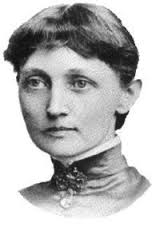
Portrait of Emma Curtis Hopkins from High Mysticism.

| Part of a series of articles on |
| New Thought |
|---|
| showBeliefs |
| showMovement |
| showPeople |
| showRelated ideas |
| showCategories |
| Religion portal |
| vte |

Emma Curtis Hopkins (September 2, 1849 – April 8, 1925 age 75) was an American spiritual teacher and leader. She was involved in organizing the New Thought movement and was a primary theologian, teacher, writer, feminist, mystic, and healer, who ordained hundreds of people, including women, at what she named (with no tie to the Christian Science church in Boston) the Christian Science Theological Seminary of Chicago. Emma Curtis Hopkins was called the “teacher of teachers” because a number of her students went on to found their own churches or to become prominent in the New Thought Movement.
Biography in Brief
Emma Curtis Hopkins was born Josephine Emma Curtis in 1849 in Killingly, Connecticut, to Rufus Curtis and Lydia Phillips Curtis.[1] She worked as a secondary-school teacher, in math, science, and the languages, and married George Irving Hopkins on July 19, 1874, which, by law ended her teaching career. Their son, John Carver, was born in 1875, graduated from the merchant marine academy and died in 1905.[2] Her husband divorced her in 1901. She discovered Christian Science in 1883 when a neighbor healed her family of a difficult respiratory illness[3] and later broke away, teaching and healing patients a broader understanding of mental healing and mysticism until her death, in her family home, in 1925. Hopkins is often referred to as the “Teacher of teachers” or “the mother of New Thought.” Those who studied with Hopkins included the Fillmores, founders of Unity; Ernest Holmes, founder of Religious Science; Malinda Cramer and Nona L. Brooks, founders of Divine Science; and Harriet Emilie Cady, author of Unity’s cornerstone text Lessons in Truth.
Career
Hopkins was initially a student of the Christian Science of Mary Baker Eddy, who had been healed of a long-term back condition by Phineas Parkhurst Quimby, who had discovered what he believed to be “the science of Christ,”[4] and went on to teach his “mental healing” methods around New England,[5] Eddy claimed, after Quimby’s death in 1866, to have found in the Christian Bible a science behind the alleged healing miracles of Jesus which could (as taught by Quimby and demonstrated in her own work) be practiced by anyone. Eddy went on to found the Massachusetts Metaphysical College in 1876, and Hopkins studied with her in 1883. Hopkins would afterwards (see below) leave Christian Science to develop her own more eclectic form of metaphysical idealism, known later as New Thought with, like it, certain mystical traits of Gnosticism, Theosophy, and a wide variety of early Christian and Eastern teachings (detailed in her last book, High Mysticism.
Hopkins came to differ from Eddy in the fundamental idea of matter: where Eddy taught that “there is no intelligence in matter,”[6] Hopkins logically deduced that if God as Intelligence is omnipresent, then God’s intelligence must be present in matter, and every other aspect of the universe.[7] She also moved away from Eddy’s lead in speaking of God as both Mother and Father, Hopkins conceptualized the Trinity as three aspects of divinity, each playing a leading role in different historical epochs: God the Father, God the Son, and God the Mother-Spirit or Holy Comforter. Hopkins believed (as did Eddy, though not as parochially) that spiritual healing was the Second Coming of Christ into the world. Hopkins also believed more specifically that the changing roles of women indicated their emerging prominence in the Godhead, signaling a new epoch identified by the inclusion of the Mother aspect of God.
While Phineas Parkhurst Quimby is sometimes described as the founder of New Thought, he died in 1866, leaving his notes to his students, the Dresser family, to compile and publish, which didn’t happen until 1907.[8] New Thought, therefore, did not formally organize until Hopkin’s students brought together and focused the national movement, leading to the formation of the International New Thought Association in 1918, with Hopkins elected as its first president.[9]
Her first work, Class Lessons 1888, was based on her notes from Eddy’s classes, modified as she had begun teaching on her own. She went on to author a prolific body of written work (see bibliography below), which evolved with her own understanding. She was acclaimed for the giftedness of her personal lectures. Those who heard her speak noted her charismatic oratory, and many cases were documented of attendees experiencing healings during, or shortly after, attending.[10]
Relation to Christian Science and work with Mary Plunkett
Hopkins completed the first course of study at Eddy’s Metaphysical college in December 1883, and worked as a practitioner in Boston and New Hampshire starting in February 1884. She was brought on as editor of the Christian Science Journal, then in October 1885, just over a year later, was relieved of the post—apparently for writing an editorial syncretizing too wide an Asian influence for Eddy’s increasing identification with Christianity and suggesting the Mrs. Eddy was not the only mystical writer and teacher worth studying.[11]
She had earlier criticized A.J. Swartz for plagiarism of Eddy’s work in his Mind-Cure Journal but, apparently through the help of another of Eddy’s students, Mary Plunkett, was asked to edit Swartz’s magazine for a period during 1886, while he was out of the country. That required a move to Chicago, where Hopkins remained for the next decade.
In Chicago, Hopkins and Plunkett established the Emma Hopkins College of Christian Science and the Hopkins Metaphysical Association, appropriating the then-common term Christian Science. Hopkins and Plunkett believed the term appropriately described their work, in spite of their breach with Eddy, who by that time had changed the name of her operation to the Church of Christ, Scientist. Their first class graduated in 1886 and were, as were all Hopkins’ students henceforth, enjoined to both “make these ideas your own” and “teach these principles to ensure their power in you.”[12]
Plunkett asked Eddy for a division of Eddy’s Christian Science movement, with Eddy to yield everything west of the Mississippi, and then took offense at Eddy’s rebuff.[13] Hopkins and Plunkett would in time take in other disaffected students of Eddy, such as Ursula Gestefeld, who were dissatisfied with either the teachings or Eddy’s promotional methods.[14]
Among the several hundred students who attended the college over the next 2 years were Charles and Myrtle Fillmore, who also began to use the term as they, too, began to heal others and to teach.
In 1888 Plunkett, dissatisfied with the limitations of their work in Chicago, left Hopkins and used her own past ties to Eddy to build a following in New York City. She fell into public disgrace after the scandal of her parting with her husband John, who had fathered neither of her children, in favor of a free love relationship with A. Bentley Worthington. Within a month after her adoption of his name Worthington was exposed as an embezzler and multi-state bigamist. Plunkett moved to Australia, where she committed suicide.[15]
It was only in the late 1890s, when it became clear that Eddy was determined that only her teachings could be called Christian Science that the term was let go, by Hopkins and other students of the philosophy and methods.
The Theological Seminary
Plunkett took with her the mailing list and other files associated with their joint venture, which left Hopkins in a difficult situation. She applied the principles and methods she taught to help her through is, and in the process realized that what she had to offer was not a profession, but a ministry.[16] She rebounded from Plunkett’s departure by launching a new journal, which she called Christian Science, and sent it to those who had studied with her to promulgate the idea of healing as a ministry, and, with the help of a local Methodist minister, founding a seminary,[17] which focused on training spiritual leaders – especially women. Hopkins believed that mankind was supposed to live through three spiritual ages, corresponding with the Holy Trinity. God the Father represented the patriarchies of the past. God the Son represented Jesus Christ and the freeing of human thought. The present age of God the Holy Spirit would place women in charge. Hopkins thought of the Holy Spirit in terms of the Shekinah, the Mother Comforter.[18] Her focus on women as leaders was made evident in both her creation and support of the Hopkins’ Association chapters around the world and in maintaining a booth in the Women’s Pavilion at the Chicago World’s Fair of 1893.
She led the seminary and, with a dozen faculty, taught classes to hundreds of students, with 110 graduates becoming ordained over the years. (see list of well-known New Thought leaders, below) Then, following the graduation ceremonies of June, 1896, she abruptly shut it down.[19][20]
12 Lessons
Building on what she learned from Mrs. Eddy, Hopkins taught 12 lessons, the content of which evolved as she taught and practiced. She describes them in her early book, Scientific Mental Practice,
There are twelve aspects of consciousness, represented by the twelve Apostles of the early Christian church, and you must be awake in every one. The twelve lessons herein teach us to realize them all, leaving nothing undone.
There are twelve conditions of human life that may be met with twelve truths, to be found in all religions, around the world. These twelve conditions are represented by the twelve Apostles and, when they have been met by Truth, you may be sure that your life will be free, glad, and powerful.
Mind is composed of twelve powers. When your mind exercises these twelve powers, the twelve aspects of consciousness shine like polished jewels. They make a perfect foundation for an absolute demonstration of the Spirit within each of us, and so are described in the biblical Revelation as “foundation stones.”
The first six lessons in this work describe the beautiful powers of your mind as to your own experience and judgment. The last six relate to your surroundings.
Let the mind go step by step: one lesson seems to be all, then the next takes you to another level of realization, then the next—till the twelve gates of understanding are opened.[21][22]
Except for compilations of her articles, Class Lessons of 1888, and High Mysticism, each of the books that has been published under Hopkins’ name is a transcription of her lectures, prepared by her students, and, since Hopkins spoke without notes and in a stream of consciousness, offers a slightly different version of the principles and methods. As a result, modern readers sometimes find the material difficult to follow. For this reason, Ruth L. Miller, a New Thought minister, has “translated” some of her works into modern prose and style, under the titles Unveiling Your Hidden Power[23] and The Spiritual Science of Emma Curtis Hopkins.[24]
A Wandering Mystic
For nearly 30 years after the closing of the Seminary, Hopkins traveled. She was seeking, as she said in High Mysticism, to own as little as possible and, through service to others, allow her divine Source to be her supply and protection. She wrote and lectured and offered individual healing sessions. She spent winters in New York, participating in the “season” of plays and concerts, and summers on the family farm in Connecticut. Among many other luminaries, she came to know the socialite Mabel Dodge before she married and became Mabel Dodge Lujan, and visited her in Taos, New Mexico, where Georgia O’Keefe and D.H. Lawrence had homes.[25]
In 1918 she was elected the first president of the newly formed International New Thought Association. There, her many students honored her for giving them the gift of New Thought healing methods, her final book, High Mysticism, was presented at that time. and a persistent young man sought an interview, but she refused—not agreeing to see him until October 1924, when he became her last student: Ernest Holmes, who went on to write The Science of Mind, as a result.[26]
In 1923 Hopkins was diagnosed with congenital heart failure, which she called “not so much an illness as God’s ending a career,”[27] and spent most of that year on the family farm. She returned to New York in the fall of 1924, where she shared her teachings with Ernest Holmes, but was back on the farm come spring. There, some of her students, members of what were once Hopkins Associations but now called the High Watch Fellowship, had bought a home across the road. They met almost daily, working through the daily practices Hopkins had described over and over in her classes and lectures. On April 8, 1925, they came to see her and she was in bed. She asked them to read her favorite Bible verses, and as they did, she breathed her last.[28]
Gore Vidal – ‘South Bank Show’ (2008) – Full Show
chriskyle20 Gore Vidal on the South Bank Show 2008
Music in this video
Learn more
Listen ad-free with YouTube Premium
Song
(3b) Preghiera: “Giusto Cielo, in tal periglio” (Anna, Coro) – Scena: “Ahi, padre!” (Anna, Erisso)
Artist
Licensed to YouTube by
UMG (on behalf of Universal Music); SODRAC, and 3 Music Rights Societies
(Contributed by Gwyllm Llwydd)
Talking out loud to yourself is a technology for thinking

Photo by Marcos Brindicci/Reuters
Nana Arielis a writer, literary scholar and lecturer in the Faculty of Humanities at Tel Aviv University, a fellow of the Minducate Science of Learning Research and Innovation Center, and a guest lecturer at Harvard University. She specialises in theoretical and practical rhetoric and in adventurous pedagogy. She lives in Tel Aviv.
Edited by Sally Davies
23 December 2020 (psyche.co)
This week, a woman was strolling in my street, walking in circles and speaking out loud to herself. People were looking at her awkwardly, but she didn’t particularly mind, and continued walking vigorously and speaking.
Yes, that woman was me.
Like many of us, I talk to myself out loud, though I’m a little unusual in that I often do it in public spaces. Whenever I want to figure out an issue, develop an idea or memorise a text, I turn to this odd work routine. While it’s definitely earned me a reputation in my neighbourhood, it’s also improved my thinking and speaking skills immensely. Speaking out loud is not only a medium of communication, but a technology of thinking: it encourages the formation and processing of thoughts.
The idea that speaking out loud and thinking are closely related isn’t new. It emerged in Ancient Greece and Rome, in the work of such great orators as Marcus Tullius Cicero. But perhaps the most intriguing modern development of the idea appeared in the essay ‘On the Gradual Formation of Thoughts During Speech’ (1805) by the German writer Heinrich von Kleist. Here, Kleist describes his habit of using speech as a thinking method, and speculates that if we can’t discover something just by thinking about it, we might discover it in the process of free speech. He writes that we usually hold an abstract beginning of a thought, but active speech helps to turn the obscure thought into a whole idea. It’s not thought that produces speech but, rather, speech is a creative process that in turn generates thought. Just as ‘appetite comes with eating’, Kleist argues, ‘ideas come with speaking’.
A lot of attention has been given to the power of spoken self-affirmation as a means of self-empowerment, in the spirit of positive psychology. However, as Kleist says, talking to oneself is also a cognitive and intellectual tool that allows for a wider array of possible use cases. Contemporary theories in cognition and the science of learning reaffirm Kleist’s speculations, and show how self-talk contributes not only to motivation and emotional regulation, but also to some higher cognitive functions such as developing metacognition and reasoning.
If self-talk is so beneficial, why aren’t we talking to ourselves all the time? The dynamic between self-talk and inner speech might explain the dubious social status of the former. Self-talk is often seen as the premature equivalent of inner speech – the silent inner voice in our mind, which has prominent cognitive functions in itself. The tendency to express our inner thoughts in actual self-talk, typical of children, is internalised, and transforms to voiceless inner speech in adulthood, as the developmental psychologist Lev Vygotsky already speculated in the 1920s.
Self-talk is deemed legitimate only when done in private, by children, by people with intellectual disabilities, or in Shakespearean soliloquies
Vygotsky’s view stood in opposition to a competing one from the psychological school known as behaviourism, which saw children’s self-talk as a byproduct of (supposedly) less competent minds. But Vygotsky claimed that self-talk has an active mental role. He observed children performing tasks while speaking to themselves out loud, and reached the conclusion that their ‘private-talk’ is a crucial stage in their mental development. Gradually, a child’s interaction with others turns into an uttered conversation with the self – self-talk – until it becomes muted inner speech in adulthood. Vygotsky’s successors, such as the psychologist Charles Fernyhough, have demonstrated that inner speech goes on to facilitate an array of cognitive functions including problem solving, activating working memory and preparation for social encounters. It is inner speech rather than self-talk, then, that has been the focus of research in adults.
However, the internalisation of self-talk isn’t necessarily evidence of cognitive maturity: rather, it could represent the degeneration of an essential cognitive skill in the face of social pressure. The sociologist Erving Goffman noted that self-talk is taboo because it is a ‘threat to intersubjectivity’ and violates the social assumption that speech is communicative. As he wrote in his book Forms of Talk (1981): ‘There are no circumstances in which we can say: “I’m sorry, I can’t come right now, I’m busy talking to myself”.’ Self-talk is deemed legitimate only when done in private, by children, by people with intellectual disabilities, or in Shakespearean soliloquies.
Yet self-talk enjoys certain advantages over inner speech, even in adults. First, silent inner speech often appears in a ‘condensed’ and partial, form; as Fernyhough has shown, we often tend to speak to ourselves silently using single words and condensed sentences. Speaking out loud, by contrast, allows the retrieval of our thoughts in full, using rhythm and intonation that emphasise their pragmatic and argumentative meaning, and encourages the creation of developed, complex ideas.
Not only does speech retrieve pre-existing ideas, it also creates new information in the retrieval process, just as in the process of writing. Speaking out loud is inventive and creative – each uttered word and sentence doesn’t just bring forth an existing thought, but also triggers new mental and linguistic connections. In both cases – speech and writing – the materiality of language undergoes a transformation (to audible sounds or written signs) which in turn produces a mental shift. This transformation isn’t just about the translation of thoughts into another set of signs – rather, it adds new information to the mental process, and generates new mental cascades. That’s why the best solution for creative blocks isn’t to try to think in front of an empty page and simply wait for thoughts to arrive, but actually to continue to speak and write (anything), trusting this generative process.
Speaking out loud to yourself also increases the dialogical quality of our own speech. Although we have no visible addressee, speaking to ourselves encourages us to actively construct an image of an addressee and activate one’s ‘theory of mind’ – the ability to understand other people’s mental states, and to speak and act according to their imagined expectations. Mute inner speech can appear as an inner dialogue as well, but its truncated form encourages us to create a ‘secret’ abbreviated language and deploy mental shortcuts. By forcing us to articulate ourselves more fully, self-talk summons up the image of an imagined listener or interrogator more vividly. In this way, it allows us to question ourselves more critically by adopting an external perspective on our ideas, and so to consider shortcomings in our arguments – all while using our own speech.
You might have noticed, too, that self-talk is often intuitively performed while the person is moving or walking around. If you’ve ever paced back and forth in your room while trying to talk something out, you’ve used this technique intuitively. It’s no coincidence that we walk when we need to think: evidence shows that movement enhances thinking and learning, and both are activated in the same centre of motor control in the brain. In the influential subfield of cognitive science concerned with ‘embodied’ cognition, one prominent claim is that actions themselves are constitutive of cognitive processes. That is, activities such as playing a musical instrument, writing, speaking or dancing don’t start in the brain and then emanate out to the body as actions; rather, they entail the mind and body working in concert as a creative, integrated whole, unfolding and influencing each other in turn. It’s therefore a significant problem that many of us are trapped in work and study environments that don’t allow us to activate these intuitive cognitive muscles, and indeed often even encourage us to avoid them.
Technological developments that make speaking seemingly redundant are also an obstacle to embracing our full cognitive potential. Recently, the technology entrepreneur Elon Musk declared that we are marching towards a near future without language, in which we’ll be able to communicate directly mind-to-mind through neural links. ‘Our brain spends a lot of effort compressing a complex concept into words,’ he said in a recent interview, ‘and there’s a lot of loss of information that occurs when compressing a complex concept into words.’ However, what Musk chalks up as ‘effort’, friction and information loss also involves cognitive gain. Speech is not merely a conduit for the transmission of ideas, a replaceable medium for direct communication, but a generative activity that enhances thinking. Neural links might ease intersubjective communication, but they won’t replace the technology of thinking-while-speaking. Just as Kleist realised more than 200 years ago, there are no pre-existing ideas, but rather the heuristic process by which speech and thought co-construct each other.
So, the next time you see someone strolling and speaking to herself in your street, wait before judging her – she might just be in the middle of intensive work. She might be wishing she could say: ‘I’m sorry, I can’t chat right now, I’m busy talking to myself.’ And maybe, just maybe, you might find yourself doing the same one day.
Frank Lloyd Wright on why architecture should be about ideas and ideals
One of the most influential architects and designers of the 19th and 20th centuries, Frank Lloyd Wright helped define modern US architecture through his innovative style, which emphasised harmony between human structures and the natural world. In this 1957 interview, conducted just two years before his death and the opening of his polarising Guggenheim Museum building in 1959, the notoriously outspoken, often arrogant, Wright discusses why he’s wholly unimpressed by New York City’s iconic skyline, and how architecture can change lives for the better by reflecting the highest values of the people it serves – in his case, the ideals he sees in US notions of freedom.
Video by Blank on Blank, Quoted Studios
Producers: Amy Drozdowska, David Gerlach
Animator: Jennifer Yoo
Flying cars will be a reality by 2030, says Hyundai’s Europe chief
Michael Cole says urban air mobility could free up congestion and help with emissions in cities

Joanna Partridge Tue 29 Jun 2021 (theguardian.com)
Flying cars will be a reality in cities around the globe by the end of this decade, according to a leading car manufacturer, and will help to reduce congestion and cut vehicle emissions.
Michael Cole, the chief executive of the European operations of South Korean carmarker Hyundai, said the firm had made some “very significant investments” in urban air mobility, adding: “We believe it really is part of the future”.
Cole conceded: “There’s some time before we can really get this off the ground.
“We think that by the latter part of this decade certainly, urban air mobility will offer great opportunity to free up congestion in cities, to help with emissions, whether that’s intra-city mobility in the air or whether it’s even between cities.”
He told a conference of industry group Society of Motor Manufacturers and Traders: “It’s part of our future solution of offering innovative, smart mobility solutions.”
The company showcased its flying car concept, developed in conjunction with the ride-sharing firm Uber, at the Consumer Electronics Show in Las Vegas in January 2020.
Hyundai is also involved in the UK’s first airport without a runway, designed for aircraft that are capable of electric vertical take-off and landing (eVTOL), scheduled to open in Coventry later this year.
The “urban airport” could be used by aircraft including air taxis and autonomous delivery drones.
Leo Tolstoy on Kindness and the Measure of Love
By Maria Popova (brainpickings.org)
“Practice kindness all day to everybody and you will realize you’re already in heaven now,” Jack Kerouac wrote in a beautiful letter to his first wife and lifelong friend. Somehow, despite our sincerest intentions, we repeatedly fall short of this earthly divinity, so readily available yet so easily elusive. And yet in our culture, it has been aptly observed, “we are never as kind as we want to be, but nothing outrages us more than people being unkind to us.” In his stirring Syracuse commencement address, George Saunders confessed with unsentimental ruefulness: “What I regret most in my life are failures of kindness.” I doubt any decent person, upon candid reflection, would rank any other species of regret higher. To be human is to leap toward our highest moral potentialities, only to trip over the foibled actualities of our reflexive patterns. To be a good human is to keep leaping anyway.
In the middle of his fifty-fifth year, Leo Tolstoy (September 9, 1828–November 20, 1910) set out to construct a reliable springboard for these moral leaps by compiling “a wise thought for every day of the year, from the greatest philosophers of all times and all people,” whose wisdom “gives one great inner force, calmness, and happiness” — thinkers and spiritual leaders who have shed light on what is most important in living a rewarding and meaningful life. Such a book, Tolstoy envisioned, would tell a person “about the Good Way of Life.” He spent the next seventeen years on the project.
Leo Tolstoy
In 1902, by then seriously ill and facing his own mortality, Tolstoy finally completed the manuscript under the working title A Wise Thought for Every Day. It was published two years later, in Russian, but it took nearly a century for the first English translation, by Peter Sekirin, to appear: A Calendar of Wisdom: Daily Thoughts to Nourish the Soul, Written and Selected from the World’s Sacred Texts (public library). For each day of the year, Tolstoy had selected several quotes by great thinkers around a particular theme, then contributed his own thoughts on the subject, with kindness as the pillar of the book’s moral sensibility.
Perhaps prompted by the creaturely severity and the clenching of heart induced by winter’s coldest, darkest days, or perhaps by the renewed resolve for moral betterment with which we face each new year, he writes in the entry for January 7:
The kinder and the more thoughtful a person is, the more kindness he can find in other people.
Kindness enriches our life; with kindness mysterious things become clear, difficult things become easy, and dull things become cheerful.
At the end of the month, in a sentiment Carl Sagan would come to echo in his lovely invitation to meet ignorance with kindness, Tolstoy writes:

Art by Olivier Tallec from Big Wolf & Little Wolf by Nadine Brun-Cosme.
In the entry for February 3, he revisits the subject:
After copying out two kindness-related quotations from Jeremy Bentham (“A person becomes happy to the same extent to which he or she gives happiness to other people.”) and John Ruskin (“The will of God for us is to live in happiness and to take an interest in the lives of others.”), Tolstoy adds:
Nothing can make our life, or the lives of other people, more beautiful than perpetual kindness.
Feast on more of Tolstoy’s deeply nourishing Calendar of Wisdom here. Complement this particular fragment with Albert Einstein on the meaning of kindness, Jacqueline Woodson’s lovely letter to children about kindness, and Naomi Shihab Nye on the remarkable true story behind her beloved poem “Kindness,” then revisit Tolstoy on love and its paradoxical demands, his early diaries of moral development, and his deathbed writings on what gives meaning to our lives.
The Margaret Mead problem
Mead, so radical about gender and sex in her early work, doubled down on the differences between men and women later. Why?

A boy builds a model airplane as a girl watches on in Robstown, Texas, January 1942. Photo by Arthur Rothstein/Library of Congress
Elesha J Coffman is associate professor of history at Baylor University in Texas. She is the author of The Christian Century and the Rise of the Protestant Mainline (2013) and Margaret Mead: A Twentieth-Century Faith (2021).
1 July 2021 (aeon.co)
Edited by Sam Haselby
Aeon for Friends
Viola Klein was vexed. She did not know the world-famous anthropologist Margaret Mead personally, but she had glimpsed Mead’s mind in her groundbreaking early books, especially the radical study Sex and Temperament in Three Primitive Societies (1935). Klein also studied gender roles, although her own first book, The Feminine Character (1946), had not made nearly as big a splash as Mead’s. Klein believed that the two scholars were on the same side of the fight to liberate women from outmoded, biologically based restrictions. And then, in 1949, it seemed that Mead’s mind changed. Klein’s ally had become an enemy, and she wanted to know why.
Klein raised her concerns in a special volume of the Journal of Social Issues in 1950 on the ‘Problems of Professional Women’. (Those problems included lower pay, reduced chance of promotion, disrespect, and lack of affordable childcare, all of which will sound familiar to professional women 60 years later.) In Sex and Temperament, Mead had, in Klein’s estimation, ‘done more than anybody else to underline the relativity of the terms “masculine” and “feminine”,’ demonstrating ‘the great malleability of human nature’. Only cultural conventions limited women’s horizons, that book decreed. But in the book Male and Female: A Study of the Sexes in a Changing World (1949), Mead had ‘come out in favour of a theory which explains feminine psychology in terms of women’s biological function’. Women’s lives, Mead suddenly claimed, were indelibly shaped by the fact that their bodies could make babies. ‘It is in direct contradiction to the views expressed by the same author in many places even in the same book,’ wrote Klein. What could explain such a devastating reversal?
There are at least three possible explanations for Mead’s apparent shift. One, she had changed, from a Bohemian rebel into a middle-aged frump. Two, the world had changed from one side of a global war to the other. Three, Mead had come under the spell of Freudianism, like so many midcentury thinkers. An exchange of letters between Klein and Mead, unearthed from Mead’s vast archive in the US Library of Congress, reveals a fourth and more perplexing possibility. Maybe no one had understood what Mead was trying to say about gender at all.
Margaret Mead (1901-78) earned her reputation as a rebel. In the 1920s, she trained with Franz Boas at Columbia University in New York, in the nascent field of anthropology. Papa Franz hesitated to allow his female students to travel anywhere too exotic for their fieldwork, but Mead insisted on venturing to the South Pacific, seeking to observe a culture sharply different from her own. She ended up in Samoa, posing as an unmarried maiden and asking adolescent girls about their sex lives. She wanted to find out whether the teen years were universally difficult, owing to the physiological changes of puberty, or whether American youths were particularly fractious because they chafed against leftover Victorian mores. Her bestselling book Coming of Age in Samoa (1928) blamed prudishness rather than puberty. The book suggested that, if everyone lived as freely as the half-clad couple on the cover dashing toward a moonlit stand of palm trees, most neuroses would disappear.
In contrast with the armchair anthropologists of a previous generation, Mead wrote to open a window directly on to the sights, sounds and tastes of other societies. She also wrote with an eye toward a popular readership. She didn’t just want to describe Samoan culture, she wanted to explain what Americans could learn from it. Less overtly, she wrote to work out tensions in her own life. Unbeknown to her Samoan hosts, she was already married to her high-school sweetheart but uneasily so. Additionally, she was in love with Ruth Benedict, one of her graduate school mentors, and she had just broken off an affair with Edward Sapir, a colleague. On the return voyage from Samoa, she began a relationship with yet another anthropologist, Reo Fortune. Was it possible to live as freely as the Samoans? The prospect was certainly appealing.
By 1931, Mead was back in the South Pacific, now married to Fortune, once again uneasily. While sailing up and down the Sepik River in New Guinea, looking for cultures to compare, the couple ran into Gregory Bateson, a younger, English anthropologist. They were soon embroiled in a love triangle that would help shape the discipline of anthropology. Fortune was a man’s man, jealous and sometimes violent. Bateson was kinder, more responsive, more like Mead’s perception of herself. While Mead was studying the way men and women related to each other in New Guinea, she was trying to figure out what kind of woman she wanted to be, paired with what kind of man. (A woman partner was, at this point in her life, out of the question.)
A society that required women to compete with men but penalised women for achievement was unsustainable
In 1933, she returned to New York, where at a furious pace of thousands of words per hour, she wrote Sex and Temperament in Three Primitive Societies. The book’s argument was straightforward. Among the indigenous groups whom she called Arapesh, Mundugumor and Tchambuli, Mead noticed that expectations for men and women varied significantly. Although the book contained much more detail and nuance, in simplified terms all of the Arapesh were feminine by Western standards, all of the Mundugumor were masculine, and the Tchambuli reversed Western norms, with dominant, managerial women and emotionally dependent men. Mead asserted that, by comparing sex roles across these societies, ‘it is possible to gain a greater insight into what elements are social constructs, originally irrelevant to the biological facts of sex-gender.’ She concluded that ‘human nature is almost unbelievably malleable, responding accurately and contrastingly to contrasting cultural conditions.’ In short, nurture rather than nature produced gender. The book said nothing about her personal life, but members of the social science community noticed Fortune’s hasty return to New Guinea and Mead’s marriage to Bateson in 1936.
Coming of Age and Sex and Temperament established Mead as a maverick, one whom Klein thought that she understood. By the late 1940s, however, Mead was the mother of a young daughter, Mary Catherine Bateson (called Cathy), and headed toward her third divorce. It had been a decade since she’d conducted field research when Male and Female (1949) was published, a book centred on the travails of middle-class America. In it, she asked:
Have we over-domesticated men, denied their natural adventurousness, tied them down to machines that are after all only glorified spindles and looms, mortars and pestles and digging sticks, all of which were once women’s work? Have we cut women off from their natural closeness to their children, taught them to look for a job instead of the touch of a child’s hand, for status in a competitive world rather than a unique place by a glowing hearth?
These were the concerns of an older woman whose standing as an intellectual made her feel responsible to address the problems of modern family life.
Every American, in Male and Female, was unhappy: girls and boys bewildered by conflicting instructions to ‘be good’; adolescents flustered by courtship rituals; women and men resenting each other in the workplace; mothers and fathers at their wits’ end in isolated, suburban homes. A society that required women to compete with men but penalised women for achievement was unsustainable. A better world, Mead counselled, would foster ‘two kinds of freedom, freedom to use untapped gifts of each sex, and freedom to admit freely and cultivate in each sex their special superiorities.’ If, as Mead suspected, women were better at childrearing and intuition while men excelled at invention and analysis, the price for attempting to overrule biology was simply too high.
Mead herself didn’t fit the gender type that she described in Male and Female, but perhaps she felt that she would have been happier if she did. Even though she didn’t return to South Pacific fieldwork while her daughter was young, she travelled frequently, often leaving Cathy in the care of her lifelong friend Marie Eichelberger. Mead’s career significantly overshadowed those of Fortune and Bateson, causing friction in both marriages. She could, at times, be intuitive as a mother. Her responsive approach to infant care, based on patterns she observed in her fieldwork, became the model for her paediatrician’s bestselling guide, The Common Sense Book of Baby and Child Care (1946). Mead had chosen a then-unknown Dr Benjamin Spock as Cathy’s paediatrician because he would allow Mead to have a natural childbirth, keep the baby in her own room at the hospital, and feed on demand, all departures from the era’s ‘scientific’ protocols. Mead could also be oblivious. She once told another mother that her daughter never faced bullying at school, causing Cathy, who was miserable at school, to burst into tears. In effect, Mead was dishing out a lot of advice in Male and Female that she had never bothered to take, and Klein – who never married, nor became a mother – was left dismayed.
Mead did not address her personal life in Male and Female, but she did acknowledge that the world had changed between 1935 and 1949. The most significant change, in her mind, was the advent of nuclear weapons. The human capability to end life on the planet made anthropological enquiries about harmonious interpersonal relations and the rearing of future generations vitally urgent. In the book’s first chapter she asked:
Are such questions about the rôles and the possible rôles of the sexes academic, peripheral to the central problems of our times? Are such discussions querulous fiddling while Rome burns? I think they are not. Upon the growing accuracy with which we are able to judge our limitations and our potentialities, as human beings and in particular as human societies, will depend the survival of our civilisation.
It was imperative to, in what became her signature phrase, ‘cherish the life of the world’.
The Cold War shaped everyone’s concerns. In 1950, Mead noted in her contribution to the Journal of Social Issues that the Soviet Union had embarked on a radical experiment in gender parity and had ‘freed’ (Mead placed that word in scare quotes) women to work in factories by having ‘freed’ them from the burdens of childcare. She also pointed out that Soviet women remained ‘saddled with problems of homemaking’ after their factory shifts. She was suspicious of nations experimenting on citizens through social engineering. She wrote:
A totalitarian society which places the assumed welfare of the state above the welfare of the individual determines what an individual may and may not, must and must not do. A democracy ideally seeks to create conditions within which individuals will be able to make choices which integrate their own intentions and the welfare of the community as a whole.
Mead clearly preferred the latter approach. What if (taking the Soviets’ five-year plans for example) the state’s assumptions about welfare proved disastrously wrong? Mead pleaded: ‘We know far too little to risk losing the most precious privilege of a democratic society, free experimentation.’
The sexual possibilities of the South Pacific felt very remote from the confines of parenthood
And then there was the Baby Boom. The US birth rate in 1935 was 17 live births per 1,000 people, adding more than 2.1 million babies to the population. By 1949, the rate had risen to 24 births per 1,000 people, adding more than 3.5 million babies. That high rate held for about a decade, deviating from the long, sharply downward trend stretching from the 1820s (54 births per 1,000) to the 2010s (around 12 births per 1,000). The Baby Boom meant that Mead’s focus in Male and Female on men and women as fathers and mothers, rather than as individuals at liberty to explore ‘the great malleability of human nature’, resonated with many Americans’ contemporary experience. The sexual possibilities of the South Pacific felt very remote from the confines of parenthood.
Klein, however, thought that Mead had strayed from solid, social-scientific ground into some psychoanalytic morass. As an example, Klein cited a passage from Male and Female that read:
So the life of the female starts and ends with sureness, first with the simple identification with her mother, last with the sureness that that identification is true, and that she has made another human being. The period of doubt, of envy of her brother, is brief, and comes early, followed by the long years of sureness.
Mead presented this scenario as both a specific feature of New Guinea societies and an experience as universal as the Oedipus complex. Klein argued:
Thus, as a social anthropologist Margaret Mead stresses the variety of culture patterns and the purely conventional coincidence of psychological traits with sex; under the influence of psychoanalytic theory she links the two.
Klein rejected both Mead’s mixing of disciplines and her alignment with Sigmund Freud, a theorist who was widely considered misogynist.
More than a decade later, Betty Friedan, who had found Mead’s life and early work inspiring, felt similarly betrayed by Male and Female. Friedan addressed Mead directly in The Feminine Mystique (1963), writing:
For when sexual differences become the basis of your approach to culture and personality, and when you assume that sexuality is the driving force of human personality (an assumption that you took from Freud), and when, moreover, as an anthropologist, you know that there are no true-for-every-culture sexual differences except those involved in the act of procreation, you will inevitably give that one biological difference, the difference in reproductive role, increasing importance in the determination of woman’s personality.
Mead, Friedan thought, had taken a disastrous turn to essentialism, and Male and Female became ‘the cornerstone of the feminine mystique’.
Mead never responded to Friedan, but she did try to explain herself to Klein. Their 1950 letters suggest a different way to understand the apparent contradictions between Mead’s 1935 and 1949 books. Klein insisted to Mead that, between Sex and Temperament and Male and Female, ‘something has happened that has produced in you a change of heart, if not of mind, and that you now maintain two contradictory points of view.’ In her early work, as Klein read it, Mead asserted that ‘masculine’ and ‘feminine’ were relative terms, based on ‘purely cultural conditioning’. In the 1949 book, Mead instead posited ‘fundamental, biologically conditioned differences in the mental make-up of the sexes which are universal, ie independent of cultural conditions.’
Klein couldn’t understand how one person could hold both of these diametrically opposed ideas. She guessed that Mead was unconsciously replicating a kind of schizophrenia arising from scientific specialisation. As the modern academy couldn’t decide between truth claims put forth by different disciplines, neither could Mead. Klein hoped that Mead wouldn’t mind being ‘treated as “symptomatic”’ of this larger phenomenon, and would recognise Klein as a fellow labourer in the project of stretching ideas of gender to accommodate a wider variety of individuals.
In a long and thoughtful reply to Klein, Mead explained she saw no contradiction between her books. On one level, the apparent disagreement between the two books, and between Mead and Klein, rested on the adverbs ‘almost’ and ‘purely’. Mead had written that ‘human nature is almost unbelievably malleable’. Klein had interpreted that sentence, and others in Sex and Temperament, to conclude that Mead attributed gender to ‘purely cultural conditioning’. Mead stood firm, writing: ‘In your phrasing I am made to say that masculine and feminine typing is relative and based on purely [emphasis in original] cultural conditioning, but I didn’t say that, and I never believed it.’
Mead outlined a model of gender that was not linear and binary but multidimensional
Instead, Mead held that all human beings were born with both sex and temperament. In a published response to a review of Sex and Temperament, a copy of which she sent to Klein, Mead defined temperament as ‘those aspects of the personality which are physiologically “given”.’ She distinguished it from character, which she defined as ‘that part of individual personality which is the result of the interaction between native equipment – or temperament – and cultural conditioning.’ Decoupling observed traits from the biological facts of sex did not, according to Mead, decouple them from biology. If males were more often born with temperaments that cultures recognised as masculine, and females were born with temperaments that cultures recognised as feminine, then gendered patterns were not purely cultural. Mead lacked evidence to settle that question in 1935, and in 1950 she was still mulling over what she had written earlier: ‘Whether or not these temperamental traits are equally distributed among both sexes remains for further investigation,’ she wrote.
In her letter, Mead outlined a model of gender that was not linear and binary but multidimensional. She laid out much of her vision in one long sentence, here in full:
Each human culture – of which we have any knowledge – takes clues from temperament, sometimes from only one for each sex, sometimes in highly patterned ways, by sex, caste, occupation, etc, and by education produces in members of other temperaments an appearance of the desired temperament, but the dynamics within the personality will be very different, as to whether little As are being made into Bs or little Bs are being made into As. So also if one is born a female A, in a culture which thinks only males should be A, there are severe penalties which differ from being born a female B in a culture that doesn’t recognise any Bs at all. Using As and Bs like that is of course terrific oversimplification of the point, but I do believe that the same temperaments occur in every human population, and can be identified.
If the phrase ‘almost unbelievably malleable’ represents human nature as clay, in Mead’s later formulation it was more like a bonsai tree, still able to be shaped but not just any which way. Mead knew the pain of having qualities of temperament associated strongly with the opposite sex. But she did not believe that her desire to be a wife and a mother arose only from cultural conditioning, nor did she find it uncongenial to appear or act feminine. That was who she was, how she wanted to present herself. She just wanted to have a vibrant career and room for sexual exploration, too.
Mead allowed that she had shifted emphasis between 1935’s Sex and Temperament and 1949’s Male and Female. But, she explained to Klein, there was a logic: ‘one couldn’t talk about real sex differences without talking first about acquired ones.’ She had also decided that ‘temperament was not a very good place to put major emphasis [in the 1930s], given the state of the world.’ Mead referred to the menace of eugenics, a programme pursued by the Nazis but powerful in the United States too. Like all of the Boasians at Columbia, Mead considered it her responsibility to combat the idea that any human being was genetically unfit to survive. On that score, she and Klein were in total agreement. Klein’s Jewish family had fled Vienna for Prague to escape political pressure, and then she and her brother relocated to England shortly before the German invasion in 1939. Her parents died in concentration camps. All of Klein’s work was informed by her awareness that attributing supposedly innate characteristics to groups of people, by race or gender, could lead to abuse, even to mass murder.
Additionally, Mead told Klein that her 1936-39 field research in Bali and Iatmul, New Guinea, taught her ‘more about the role of the body and the role of inward bodily oriented thinking’. Here the ethnographic use of film and photography, methods that Mead and Bateson pioneered, proved important. For example, Mead believed that the film Bathing Babies in Three Cultures, a compilation of footage from the 1930s fieldwork, showed formative interactions between mothers and children. ‘There is really no difference in my premises throughout this entire period,’ she insisted to Klein, only that she was now elaborating on different aspects of sex and gender.
In Mead’s mind, she had never elevated nature or nurture to the exclusion of the other factor in her analysis, but rather investigated their ‘cross-cut’ interaction. Adding and blending without subtraction came naturally to her. She maintained correspondence with past lovers, spouses, in-laws, students and colleagues, constantly adding names to her circle of acquaintance while rarely deleting any. ‘I can’t bear people who drop other people,’ she once said. She never held a single, full-time job but split her time between teaching at Columbia University, serving as a curator at the American Museum of Natural History, writing and lecturing. Her sprawling collected papers constitute one of the largest single archives in the Library of Congress.
Perhaps the best answer to any question about her, then, is: ‘All of the above.’ She admitted to Klein that her graduate students ‘were completely enraged after I had given a semester on cultural conditioning, when I gave a final lecture on temperament. [They] said with great bitterness that I couldn’t have it both ways.’ She did want to have it both ways – sex and temperament, male and female, nature and nurture. Why choose, when life always offered so many different experiences and mysteries?
Democracy needs discomfort and distrust is a political virtue

The reverend Ralph Abernathy, a desegregation leader, and Martin Luther King, Jr leave Albany city jail in Georgia in 1962. Photo by Donald Uhrbrock/Getty
Meena Krishnamurthyis an assistant professor of philosophy at Queen’s University in Kingston, Ontario. She is currently writing a book, ‘The Emotions of Nonviolence’, on the political philosophy of Martin Luther King, Jr.
Edited by Sam Dresser
30 JUNE 2021 (psyche.co)
The American political theorist Danielle Allen worries about our tendency, from an early age, to avoid talking with strangers. She sees this as leading to a greater likelihood of distrusting people – people that we must trust and talk to, if we aspire to a healthy democracy. ‘Congealed distrust’, she argues in Talking to Strangers (2004), undermines the grounds for civic friendship – that is, friendship between citizens – which is necessary for a well-functioning and robust democracy. ‘Democracy depends on trustful talk among strangers,’ she writes. When this talk is ‘properly conducted’ it can ‘dissolve any divisions that block’ the effective functioning of democracy. When democracy depends on ‘trustful talk among strangers’, it is distrust between citizens that puts democracy at risk.
Yet, the fact that distrust makes trustful conversation and civic friendship more difficult does not make distrust itself morally objectionable. Sometimes distrust is not only appropriate but is also a way to initiate the conversation that’s needed for civic friendship. Distrust, in a democracy, can actually be a good thing.
Let’s start by considering what distrust is. In the standard case, distrust consists of at least three parts. First, distrust has a cognitive component. It’s the confident belief that others cannot be relied upon, that others will not do as they say they will. Distrust also involves non-reliance – we act on our supposition that they will not do what they have committed to doing: if I distrust my neighbour, then I won’t wait for her to pick me up from work, even if she has committed to doing so. Finally, distrust has an affective component. When we distrust people, we feel that we can’t count on them to fulfil their commitments, which is a disappointment. If we believe that the situation is unlikely to improve, we might even feel a sense of despair.
The civic value of distrust is evident when we reflect on the role it played in the Birmingham campaign during the American Civil Rights movement. Consider the response of Martin Luther King, Jr to the white moderates in his ‘Letter from Birmingham Jail’ (1963). The ‘Letter’ was an official response to the ‘Call for Unity’, which was made by eight Alabama clergymen. It was also written to other white moderates outside the Church, such as those within the Kennedy administration and readers of major newspapers and magazines. According to King, white moderates were those who explicitly agreed that racial segregation was wrong but did not personally join the movement and counselled those already in the movement not to demonstrate. Indeed, they advised King and his supporters to do nothing but engage in ‘honest and open’ discussion, encouraging them to wait patiently for the courts to end racial segregation. King saw this as asking him to patiently continue to accept injustice, exploitation and indignity – hardly a moral act. He was deeply disappointed by these white moderates, writing:
I must confess that over the past few years I have been gravely disappointed with the white moderate. I have almost reached the regrettable conclusion that the Negro’s great stumbling block in his stride toward freedom is not the White Citizens’ Counciler or the Ku Klux Klanner, but the white moderate, who is more devoted to ‘order’ than to justice; who prefers a negative peace which is the absence of tension to a positive peace which is the presence of justice; who constantly says: ‘I agree with you in the goal you seek, but I cannot agree with your methods of direct action.’
King made clear his willingness to engage in the sacrifice that is characteristic of democratic conversation
King distrusted the white moderates. He believed that he could not rely on the white moderates to meet their commitments to engage in the kind of action that was needed to promote racial equality and the end of racial segregation. That distrust was further confirmed after negotiations with the merchants of Birmingham. In September 1962, King met with the leaders of Birmingham’s economic community. During these negotiations, promises were made by business owners to remove ‘the stores’ humiliating racial signs’. As a result, all demonstrations were halted. However, King writes:
As the weeks and months went by, we realised that we were the victims of a broken promise. A few signs, briefly removed, returned; the others remained. As in so many past experiences, our hopes had been blasted, and the shadow of deep disappointment settled upon us. We had no alternative except to prepare for direct action, whereby we would present our very bodies as a means of laying our case before the conscience of the local and the national community.
Initiating trustful conversation in the presence of distrust is no easy task. As Allen acknowledges, where trust has completely disintegrated, someone has to go first. In writing his ‘Letter’, King went first: he called out the white moderates for being unreliable and for failing to meet their moral commitments. He took a further step when he made his way to the streets in Birmingham, making clear not only his distrust of the white moderates, but also his willingness to engage in the sacrifice that was required to publicly express it.
Whenever appropriate distrust is expressed, a typical and morally appropriate response on the part of those who are distrusted and of good will is to engage in actions to re-establish the grounds for trust, which involves making up for past wrongs. This kind of responsiveness is key to the kind of democratic conversation and civic friendship that Allen envisions.
At least, on one prominent reading of the Civil Rights movement, King’s expression of distrust in the ‘Letter’ was followed by a change in the behaviour and support of white moderates in the north. In the words of the reverend James H Cone, the white churches in the north were ‘embarrassed by the opposition and silence of their southern colleagues’ and they ‘were determined to let the world know that they supported King in his identification of segregation as a moral evil which must be exterminated’.
Soon after King published the ‘Letter’, the National Council of Churches (NCC) urged its 31 member denominations to initiate ‘nationwide demonstrations against racial discrimination’. The NCC said: ‘words and declarations are no longer useful in this struggle unless accompanied by sacrifice and commitment.’ In the following months, members of these white churches contributed to the movement financially and participated physically in the March on Washington, which took place after the Birmingham campaign. White Civil Rights activists were beaten, jailed and murdered for their actions alongside their fellow Black citizens. White Civil Rights activists were labelled ‘race traitors’, socially ostracised and publicly condemned. These newly committed white moderates demonstrated their willingness to make sacrifices for strangers – something that is essential to establishing trust, in Allen’s view.
These laws, born of distrust, created the conditions for more trustful conversation and civic friendship
While most people didn’t have this kind of active response to King’s expression of distrust, we do see that it occurred across the movement at other important moments. Consider the powerful speech that president John F Kennedy made on 11 June 1963, just months after King’s ‘Letter’ was published. In this speech, Kennedy set aside his previous moderate position, saying that: ‘The events in Birmingham and elsewhere have so increased the cries for equality that no city or state or legislative body can prudently choose to ignore them.’ With this speech, Kennedy announced his Civil Rights legislation, the codification into law of the movement’s moral position and the culmination of political action.
The Civil Rights Act (1964) and the Voting Rights Act (1965) were midwifed by the Birmingham campaign, the March on Washington for Jobs and Freedom, the Selma to Montgomery marches, and many smaller acts of protest, all of which required great sacrifices – physical, emotional, social, economic – of Black Americans. As Allen suggests, acts of self-sacrifice must be appropriately reciprocated in order to generate trust; when Kennedy and other white moderates began to meet their moral commitments and respond by proposing legislation and making their own sacrifices by contributing money to the movement and, in some cases, joining King on the streets, they took the first steps toward building trust.
These political laws and institutions were designed to foster civic friendship between Black and white individuals by requiring that power be shared between different racial groups – a further precondition of trust. Title I of the Civil Rights Act requires that voting rules and procedures be applied equally to all races, and the Voting Rights Act eliminated most voting qualifications beyond citizenship. These laws were passed to institutionalise the idea that everyone – including Black Americans – ought to have a voice in national decision-making, and that political wins and losses must be equitably negotiated and shared. These laws, born of distrust, created the conditions for more trustful conversation and ultimately sought to foster a broader sense of civic friendship among Black and white Americans across the nation.
Trust is not only the belief that you can rely on your fellow citizens to do what they commit to doing; it’s also, according to Allen, a feeling of ‘confidence, or a lack of fear, during a moment of vulnerability before other citizens’. Trusting democratic conversation requires that both sides be willing to engage in voluntary and equitable reciprocal sacrifice. In any contentious decision, some groups of citizens will win and others will lose; democracies need appropriate ways to moderate, acknowledge and appreciate those sacrifices, while assuring equitable reciprocity of sacrifice over the long run. This is the role of conversation in a democracy: when conversations demonstrate the participants’ willingness to engage in reciprocal sacrifice, citizens draw each other into a network of mutual responsibility, trustworthiness is established, and, over time, relationships of civic friendship are slowly built.
Somewhat paradoxically, distrust can play a role in building the kind of trust that Allen rightly sees as being essential to civic friendship: it can lead to the willingness to engage in reciprocal sacrifice that grounds trustful conversation and civic friendship.
But we must be cautious in our optimism about the potential for widespread civic friendship in the United States. In King’s mind, the 1964 adoption of the Civil Rights Act and the Voting Rights Act of 1965 completed only the ‘first phase’ of the freedom movement. After this, King planned to launch a second phase, which involved the struggle for ‘economic equality’ and would ensure that everyone had a basic level of income and access to reasonable healthcare, education and fair housing – the background conditions for a more deeply felt sense of trust and civic friendship.
This second phase received little support from white moderates of the North. In the white communities in Chicago, where marches for fair housing were taking place, King’s so-called liberal friends cried out in ‘horror’ and ‘dismay’, as he put it, claiming that King was creating ‘hostility’ and ‘hatred’, while telling him: ‘You are only developing a white backlash.’ In the end, King’s dream of economic justice remains unfulfilled and the promise of distrust and genuine civic friendship continues to be elusive.
This Might Hurt — Trailer
This Might Hurt Official selection: Austin Film Festival // Trailer for 80-minute, in-depth documentary on chronic pain order a copy at https://www.thismighthurtfilm.com This Might Hurt is an intimate vérité film that follows three chronic pain patients who have spent years trying to cure their illness through modern medicine. Desperate for relief, they enter a mind-body medicine program that focuses on uncovering buried trauma at the root of their suffering, and retraining their brains to turn off pain. The film follows these people over several years as they make astonishing discoveries about their hidden emotional lives. With 100 million Americans suffering from chronic pain, and the opioid epidemic overwhelming the nation, this film explores a path to healing without drugs. // This film has stories of people overcoming chronic pains such as Complex Regional Pain Syndrome (CRPS), migraine headaches, abdominal pain and spasms, back pain, neck pain, and fibromyalgia. It features the work of Dr. Howard Schubiner in Detroit, Michigan, and includes interviews with Doctors Lorimer Moseley, Daniel Clauw, and Joel Saper.