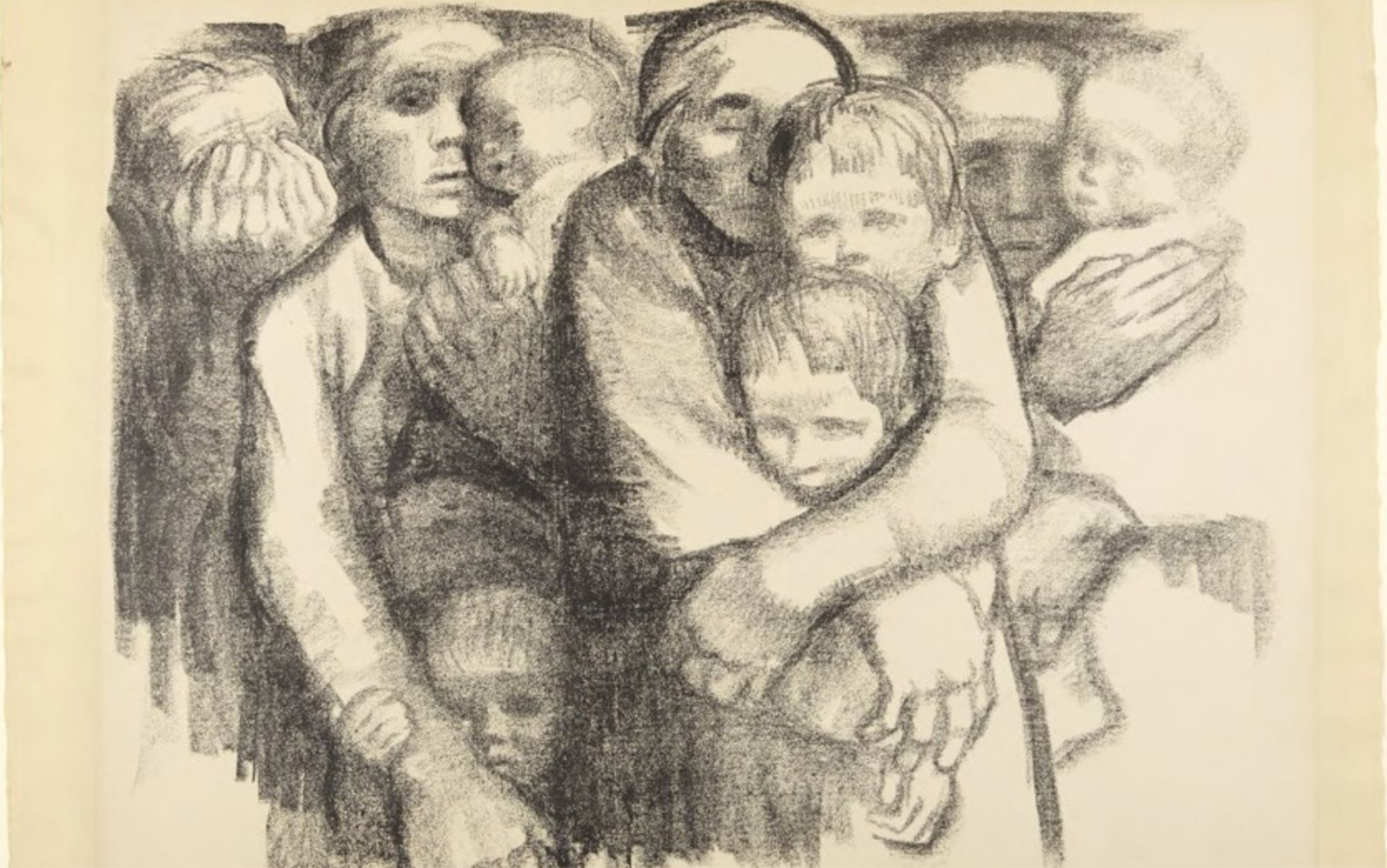
Simone Weil: mystic, philosopher, activist. Her ethics demand that we look beyond the personal and find the universalThe Mothers (Die Mütter; 1919), lithograph by Käthe Kollwitz. Courtesy the Princeton University Art Museum
Deborah Casewel is a Humboldt Research Fellow in philosophy at the University of Bonn and co-director of the UK-based Simone Weil Network. Her most recent book is Eberhard Jüngel and Existence: Being Before the Cross (2021).
Brought to you by Curio, an Aeon partner
Edited byNigel Warburton
9 July 2021 (aeon.co)
Aeon for Friends
The short life of Simone Weil, the French philosopher, Christian mystic and political activist, was one of unrelenting self-sacrifice from her childhood to her death. At a very young age, she expressed an aversion to luxury. In an action that prefigured her death, while still a child, she refused to move until she was given a heavier burden to carry than her brother’s. Her death in Ashford in England in 1943, at just 34, is attributed to her apparent refusal to eat – an act of self-denial, in solidarity with starving citizens of occupied France, which she carried out despite suffering from tuberculosis. For her uncompromising ethical commitments, Albert Camus described her as ‘the only great spirit of our time’.
This is certainly more complimentary than her university nicknames of ‘the Red Virgin’, ‘the Categorical Imperative in Skirts’, and even ‘the Martian’. Indeed, Weil’s reported interactions with the other great spirits of those times further underline the force of her personality. Simone de Beauvoir, who attended the Sorbonne at the same time, came across her during their student days and described a conversation with Weil sparked by her response to the famine in China:
she declared in no uncertain tones that only one thing mattered in the world: the revolution which would feed all the starving people of the earth. I retorted, no less peremptorily, that the problem was not to make men happy, but to find the reason for their existence. She looked me up and down: ‘It’s easy to see you’ve never been hungry,’ she snapped.
Despite this put-down, Beauvoir admired Weil and her ‘heart that could beat right across the world’.
Weil took no prisoners in any debate. Although Leon Trotsky had recently excoriated her critique of Marxism, Weil arranged for the Marxist revolutionary to stay in her parents’ apartment in December 1933 and host an illicit political gathering. This did, however, come at the expense of a night-long, intense discussion with Weil. While she always argued softly and clearly, that did not prevent the discussion from being punctuated by violent shouts.
That heart that beat across the world is perhaps why she always remained outside contemporary philosophical trends, and certainly outside of the academic and elite conversations in philosophy at the time. Weil’s philosophical commitments, while constant, often pale in comparison with her dramatic life and her political engagement. She enacted her philosophy with her commitment to causes, and finally with her body. This began with her declaration of Bolshevism at the age of 10, through to her university involvement in Marxism, trade unionism and pacificism. The first commitment declined as she found in Marxism itself plenty to criticise, though this did not prevent her from joining the republicans in the Spanish Civil War, albeit rather ineffectively. Yet, through all of this, two elements of her character remained constant: her self-denial for the sake of others, and the strength of her will.
Evident of this totalising, personality-driven self-sacrifice are her attempted actions in the Spanish Civil War. She first tried to join the anarchist Durruti Column, but had to be excluded from combat due to her extreme short-sightedness and the danger that she would pose to her own side. Having failed there, she then demanded to be sent out by the anti-fascist commander Julián Gorkin as a covert agent to rescue the prisoner Joaquín Maurín. When she was refused, Gorkin commented that, as someone obviously not Spanish, she would not be particularly covert and so would be sacrificing herself for nothing; Weil replied that she had every right to sacrifice herself.
Under the Vichy regime, those with Jewish heritage, which included Weil and her family, were excluded from white-collar professions, and they later fled to New York. She then expended significant effort trying to return, even though it would have been to certain death. One particular plan of hers, which made it back to Charles de Gaulle, was to air-drop nurses on to battlefields, with her at their head. De Gaulle’s alleged reaction was ‘Elle est folle!’ (‘She’s mad!’) Yet, as easy as it is, in the face of such intensity, to find such gestures amusing and even slightly unhinged, this strongly held, strongly asserted desire to give up everything, including life itself, makes her ethical vision so fascinating, because it aims at the precise opposite of her own life – at ignoring all that is particular and assertive in favour of something impersonal and universal. This is a paradoxical aspect of her life: by drawing attention to herself through public acts of radical self-sacrifice, she gained a platform for her philosophical ideas about the universal in humanity and the need to adopt an attitude of impersonal self-effacing attentiveness to others.
Weil’s ethics can be reconstructed from three key texts written in 1943, the last year of her life. These are the essay ‘La Personne et le sacré’ (1957), the manifesto ‘Draft for a Statement of Human Obligations’, and her book The Need for Roots (1949). Written while she was working in London for the Free French forces, these texts explore several key concepts in Weil’s ethical thought – that ethical action is grounded in our obligation to something impersonal and universal in the other, not in rights; that this obligation is expressed best in the attitude of attention, or reading, towards the other person; and that this obligation is grounded not in the world but outside it. This latter aspect draws both from her philosophical love of Plato and her own religious convictions, stemming from a series of mystical experiences and practices, which brought her to, but kept her at the door of, the Catholic Church. She remained as fiercely singular in this respect as in all others, though her outlook was broadly Christian.
These concepts are evocatively drawn out in the essay ‘La Personne et le sacré’, translated variously as ‘Human Personality’ or ‘What Is Sacred in Every Human Being?’ Here, she uses two examples to illustrate her ethical vision and challenge our immediate idea of why and how we should act towards others. She begins by focusing on what appears to be a rather common-sense approach to the question of how we should relate to other people – we should look at each of them as a person, with a personality, a certain je ne sais quoi, which we respond and relate to. This is a form of personalism.
Personalism sees that the personality constitutes the particular metaphysical centre of the person, and thus grounds the rights of the individual. Weil explores this, and asks us to imagine encountering a man on the street. When you do, you notice particular aspects of him. For example, he has long arms, blue eyes, his mind is full of thoughts, probably about nothing in particular. Now, Weil poses her direct challenge: what prevents her from putting out his eyes? After all, if it is to the personality, that particular metaphysical centre of the person, that we owe and direct ethical action:
If the human personality were what is sacred for me, I could easily put out his eyes. Once he was blind, he would still have a personality.
This stark thought experiment underlines her fundamental dispute with personalism: it ignores the effects of suffering on the personality. In making that the centre of our response to the other, it supposes it impossible that human beings can be utterly destroyed by suffering, and instead maintains that they have the power to overcome their circumstances, no matter what. So, it cannot be that which stops her from putting out his eyes. Instead, what would stay her hand is ‘knowing that if someone were to poke out his eyes that it would be his soul that was lacerated by the thought that someone had done evil to him’.
Similarly, she rejects the idea that what prevents us from harming others are their rights. The notions of rights and of the person give you nothing if unconnected with the language of our human relatedness. Rights talk doesn’t stop evil: it is more appropriately the language of commerce and legal pleading. When the language of rights is used, the relationship that we hold towards that person becomes objectifying, it transforms a cry of pain into a weight on the mute scales of justice. We see them, not as a person to whom we owe a fundamental, impersonal and constant duty, but as a holder of various externally imputed values. For example, she argues, if you’re a farmer setting a price for your eggs, you have the right to reject someone offering a ridiculous price because of your relationship to the eggs and the price being set. In the case of a young woman who is forced into a brothel, that language of rights is ludicrous. Another thing entirely is being violated; what you are dealing with is an ‘uprising of the whole being, fierce and desperate’ and ‘at the same time a cry of hope coming from the bottom of the heart’. This is an injury that cannot be paid back or bargained away.
It is the human being to which we owe everything. The language of rights obscures this
Her argument here is that we owe ethical action, not to the person conceived or known through any aspects of their personality, but instead to this universal cry of pain, which is impersonal – it’s not attached to the person, but present in everyone. It is not only this universal capacity to suffer that we are obligated to, but also a fundamental universal expectation that this is not right. Even though Weil is, as the above brief biographical comments show, extraordinarily aware of the pain and suffering of others, and the universality and frequency of it, she argues that, despite this, humanity hopes and expects good to be done rather than evil. This is not linked to any particular aspect of personality, nor to anything that differentiates one from another. Instead, Weil argues that the cry of the person who is suffering is an impersonal cry. This impersonal cry comes from the capacity to suffer, not from the means, reason for, or gravity of the suffering in the particular case, as ‘[w]hat is sacred in a human being is that which is, far from the personal, the impersonal. Everything that is impersonal in a human being is sacred, and that alone.’ Another way of putting this is that there is something absolutely sacred about every human being, something that goes beyond the circumstances of their lives and the contingencies of their personalities. What should prevent evil is an awareness of this sacred aspect of humanity, not their right not to be harmed.
Saying that the impersonal is what is sacred entails, for Weil, that our ethical response to another person is rooted in that, not in the particularity of how they present themselves to us, or whether or not they grab our attention. In the text ‘Draft for a Statement of Human Obligations’, she acknowledges that despite this inherent universality and equality in being subject to harm, we do not live in situations that enable us to realise this, because, in our social situations and interactions, ‘[m]en are unequal in all their relations with the things of this world, without exception’. This is why Weil stresses the identical, the impersonal and the sacred in each person. If we do not have this base, she says: ‘It is impossible to feel equal respect for things that are in fact unequal unless the respect is given to something that is identical in all of them.’ Our obligation to another human has to be unconditional to be of use and of meaning. And it is only unconditional because it has its source in that reality outside of us.
This reality that is outside the world, and outside of humanity’s understanding and efforts, is the good, as found in the being of God. This undergirds all that is beautiful, truthful and good in the world, and ‘at the centre of the human heart, is the longing for an absolute good, a longing which is always there and is never appeased by any object in this world’. It is this Platonic vision of reality that grounds our obligations, because ‘consciousness of the various obligations always proceeds from a desire for good which is unique, unchanging and identical with itself for every man, from the cradle to the grave’. The language of rights, she claims, obscures this and locates our duty and obligation elsewhere. It is the human being to which we owe everything, and we do so ‘for the sole reason that he or she is a human being, without any other condition requiring to be fulfilled, and even without any recognition of such obligation on the part of the individual concerned’.
Yet, as her example of the man on the street shows, we are not immediately aware of this. It is not only that aspects of their personality stand out and call us to care more about one person than the other; it is not only that we live in situations that elevate one person over all the others; it is also not only that we are more inclined to view others as means, but we ourselves rarely look beyond this to find the impersonal. So, while the impersonal is universal and thus the basis of our ethical obligation and response to the other, it needs bringing out and working towards. This is where the development of a particular ethical stance of attention, rather than a set of ethical mandates, comes in – although it must be said that Weil insists that the principal needs of the human body – such as food, warmth, sleep, health, rest, exercise, fresh air – and the principal needs of the soul must all be met for a society to be just.
Weil’s ethics entail an attitude of ‘attention and love’ that is both developed from us and given to us from that external reality. We cannot, by our own efforts, bring the good into the world as it is beyond the world and any human faculties, but we do have the power of turning our attention and love towards it. It is thus that ‘[t]hose minds whose attention and love are turned towards that reality are the sole intermediary through which good can descend from there and come among men’.
Paying attention to others in this way is something that we have the potential to do, but not something that comes naturally. Instead, it needs to be trained and developed. In ‘Reflections on the Right Use of School Studies with a View to the Love of God’ (1942), Weil suggests that learning to attend is akin to the drudgery of schoolwork:
If we concentrate our attention on trying to solve a problem of geometry, and if at the end of an hour we are no nearer to doing so than at the beginning, we have nevertheless been making progress each minute of that hour in another more mysterious dimension. Without our knowing or feeling it, this apparently barren effort has brought more light into the soul.
Attention is not as active a process as it might first appear in this analogy. As Weil conceives it, attention is less like the active straining to solve a geometric problem, and instead more a sustained passive state where you are attentive to what the conditions are that aid you in solving the problem. ‘Attention,’ Weil wrote, ‘consists of suspending our thought, leaving it detached, empty, and ready to be penetrated by the object.’ You hold this knowledge that you have acquired in your mind, but let that object itself make its mark on you.
This attention is at the higher level directed to God and to the other. I have described this as a stance or a posture, but another way that she describes this is ‘looking’ and ‘reading’. She sees that the ethical action towards the other, especially to the other who is suffering, is to look at them in a way that is attentive, where ‘[t]he soul empties itself of all its own contents in order to receive into itself the being it is looking at, just as he is, in all his truth’. This way of looking is only possible after training in attention.
Weil understands that we have to be forced out of our partiality for the particular over the universal
This is what Iris Murdoch, among others, appreciated about Weil’s thought. Weil’s concept of attention does not presume that ethics is purely a matter of calculation, choice and action, or that the consequences are of the greatest importance. Instead, in Murdoch’s characterisation of Weil’s concept, attention involves the development of a ‘just and loving gaze’ towards the other. It is this, not the choices that are made, which is the proper mark of a moral agent. Ethics then becomes the entire attitude that is adopted towards the other person in specific and the world in general. When you view someone with this just and loving gaze, you can see them as they really are (as Murdoch explores through the always topical example of a mother- and daughter-in-law).
This demand is not an easy one. While akin to the Kantian demand to view another as an end, not a means, it does not easily define or detail how you are to act towards the other. Instead, it details how you are to adjust your vision of the other. And perhaps our immediate response to this is that we are already well aware of those who suffer and well aware, too, of how best to alleviate their pain. We echo the words of the young Weil and call, if not for revolutions to feed the starving, at least for increased donations to charity and structural changes to aid those most vulnerable. Yet Weil’s ethical concern is not just for those abstract, suffering others (as her identification of the vital needs of the person shows), but for the way that we delude and justify ourselves. As she writes in the ‘Draft for a Statement of Human Obligations’, we live in a world where we do not notice those, in front of us, who are suffering. We are dazzled by certain people who attract our attention, often through chance or affinity, and all others escape our notice.
If we keep our attention on this world, we never notice those others, because we cannot give equal respect unless we look beyond the particularities to that which is identical in all. We must go past the personalities and stories that capture us to the impersonal that underscores our duty to the other person. This is the tension at the heart of Weil’s life and vision. She understands that we have to be forced out of our partiality for the particular over the universal. Yet her ethics challenge us to do this to her. She lived an exceptional, singular life, one that catches the eye and holds our attention, a life that challenges and changes our ethical ideals. But, if we are to take the mandate of her ethics seriously, if they are to be possible, then we must turn our gaze beyond her and attend instead to the impersonal, universal in humanity. It is this that is everything, without which we will be lost. That, surely, is worth another self-sacrifice.
Thinkers and theoriesEthicsPhilosophy of religion