Making Gay history: Jill Johnston vs. Studs Terkel

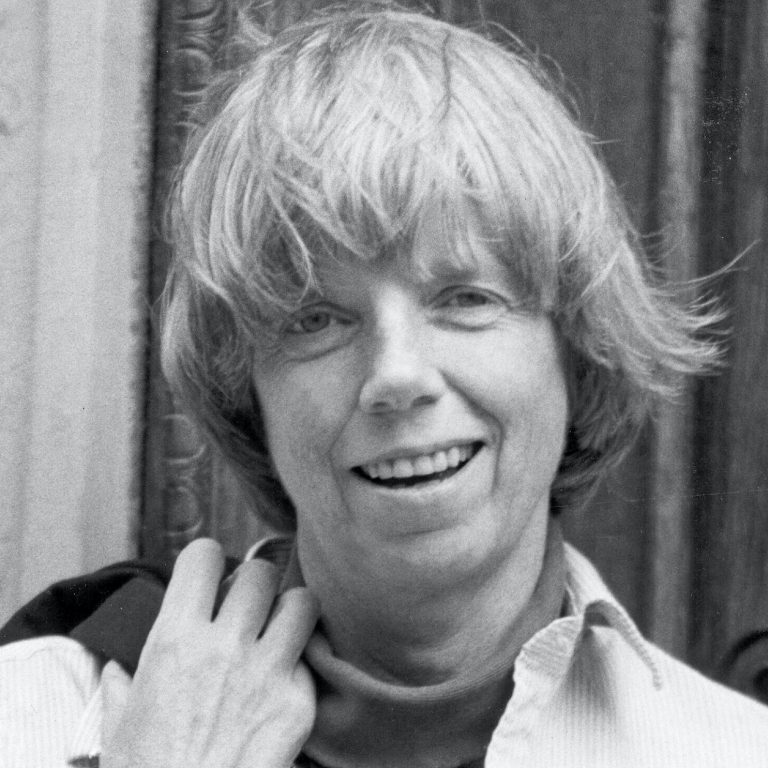
Jill Johnston

Jill Johnston, 1985. Credit: Jack Manning/The New York Times/Redux.

Episode Notes

Sparks flew when radical lesbian feminist Jill Johnston sat down for an interview with Studs Terkel in 1973. Jill had just published a controversial manifesto called Lesbian Nation, which advocated that women break with men entirely. It was provocative stuff—even for the usually unflappable Studs.

———

To learn more about Jill Johnston, read her New York Times obituary here and explore this website dedicated to her life and published works.   

Johnston wrote for the Village Voice for 15 years. She became known for her experimental writing style—punctuation and indentation optional—which reflected her affinity for the avant-garde cultural scene she covered. You can read some of her pieces herehere, and here. In two columns written in 1970 and 1971, Johnston came out as a lesbian; find out more about the first column here and read the second column, titled “Lois Lane Is a Lesbian,” here.

On April 30, 1971, Johnston participated in a legendary panel on women’s liberation, held at New York City’s Town Hall.  The event was billed as a battle of the sexes, in which the female panelists (who also included Germaine Greer and Diana Trilling) were to square off against moderator Norman Mailer, who had just published his controversial essay “The Prisoner of Sex.” The panel was the subject of the documentary Town Bloody Hall by Chris Hegedus and D. A. Pennebaker, which you can watch here. Johnston’s raucous segment begins at 21:30 and ends with Johnston and two friends engaging in a memorable bit of proto-performance art when they start hugging and rolling around on stage.
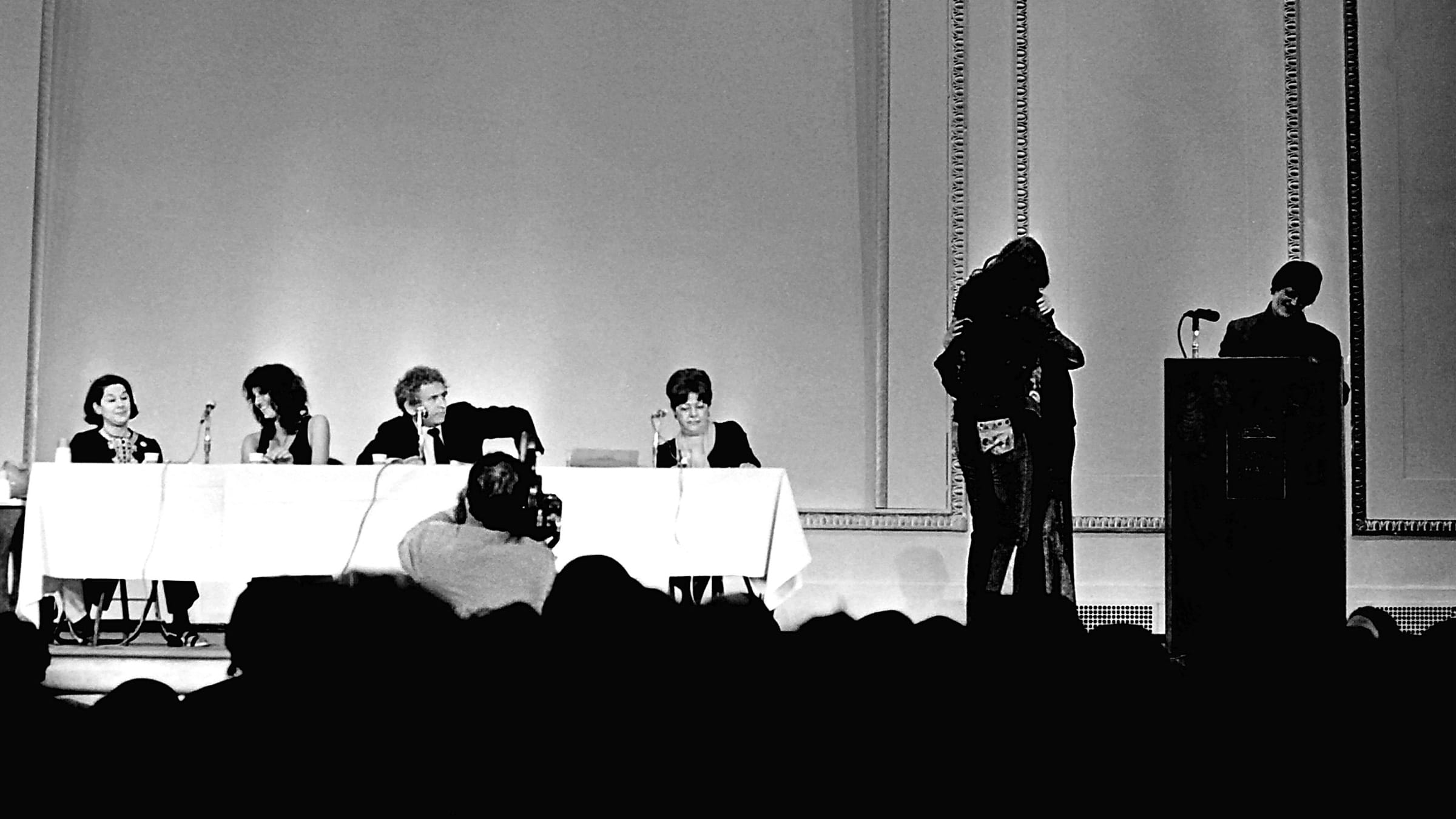
Still image from the documentary “Town Bloody Hall,” showing Jill Johnston hugging an unidentified female friend at the conclusion of her speech. Seated at the table, from left to right: Jacqueline Ceballos, Germaine Greer, Norman Mailer, and Diana Trilling. Credit: Courtesy Pennebaker Hegedus Films, Inc./The Criterion Collection.

In 1973, Johnston published Lesbian Nation: The Feminist Solution, a collection of essays from her Village Voice column. It was a seminal lesbian separatist work that argued for a complete break with men and male-dominated capitalist institutions. Hear Johnston discuss the book in this 1975 interview (click the link at the bottom to stream), read her 1973 interview with Lesbian Tide here, and check out this 2007 interview about the book’s legacy.  

Johnston discusses lesbian feminism here, starting at 39:49. To learn more about the subject, listen to lesbian feminist theorist Charlotte Bunch here. And check out this conversation (courtesy of the Lesbian Herstory Archives) between Johnston and Radicalesbian Martha Shelley about the pleasures and politics of being a lesbian on Shelley’s radio program, aptly titled Lesbian Nation. (Martha Shelley is featured in this Making Gay History episode.)

Johnston’s work had a profound impact on many of her lesbian contemporaries; read tributes by journalists Michele Kort and Victoria A. Brownworth here and here. But opposition to Johnston’s views came from many corners, including trans activists and more mainstream feminists like Betty Friedan, who once pronounced Johnston “the biggest enemy of the movement.” 

In 1993, Johnston married her longtime partner Ingrid Nyeboe in Denmark; read about the ceremony and see photos here. They married again in Connecticut in 2009, a year before Johnston’s death in September 2010.

Johnston ephemera: Watch 16mm clips of one of Johnston’s gatherings for lesbians here, courtesy of the Phyllis Birkby Papers at Smith College. And play this lesbian crossword puzzle on page 14, whose first clue reads “Jill Johnston’s book.”
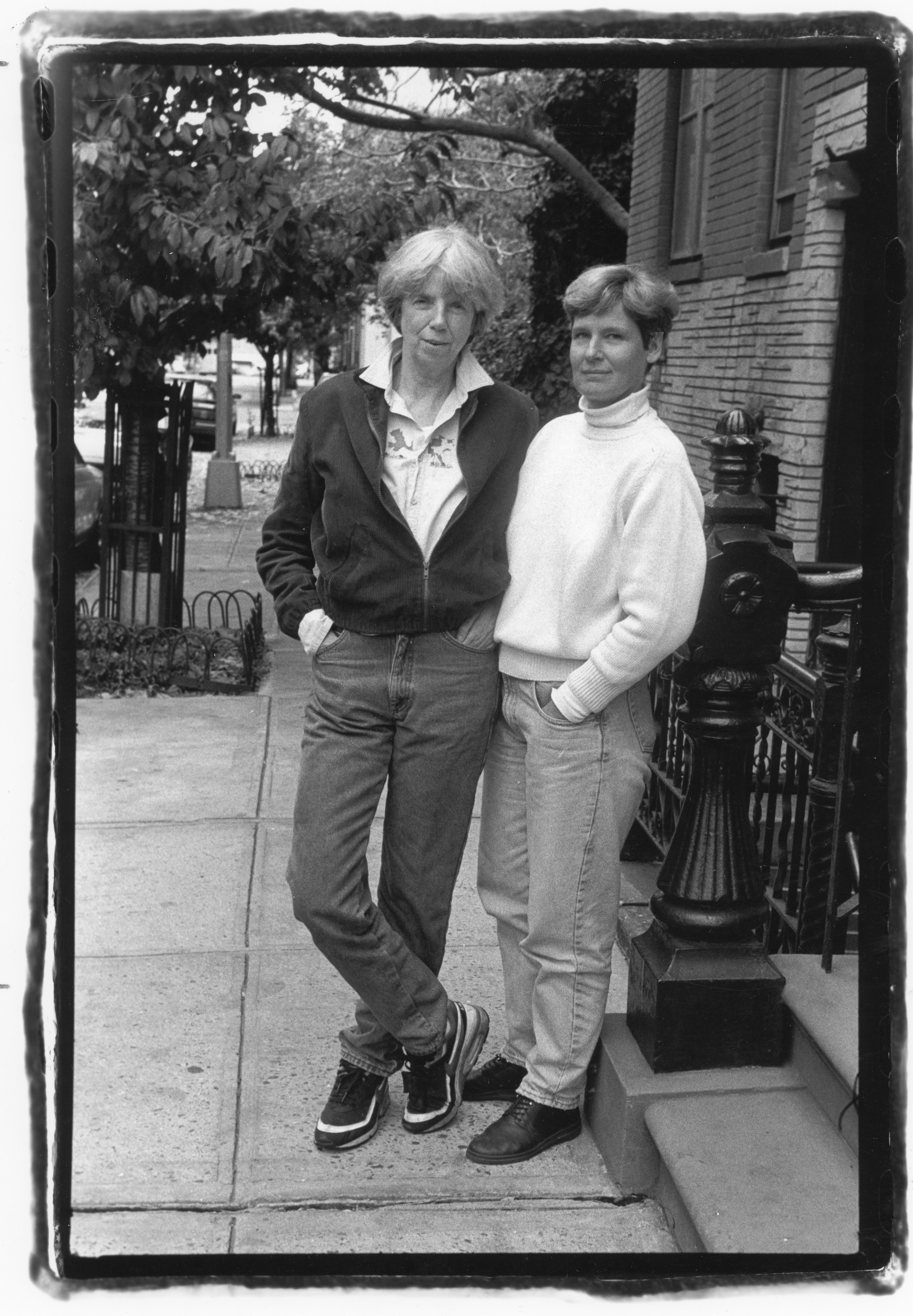
1993 portrait of Jill Johnston (at left) with her spouse Ingrid Nyeboe. Credit: © Estate of Fred W. McDarrah.

The Coronavirus Update

(image) WIRED Coronavirus Update Logo

12.11.20 (Wired.com)

An FDA advisory panel authorizes the first vaccine, the US hits grim milestones, and cases rise worldwide. Here’s what you should know:

FDA advisory panel authorizes the US’ first vaccine, and it may soon be on the way

On Thursday night, an independent advisory panel reporting to the FDA gave Pfizer and BioNTech’s Covid-19 vaccine the green lightHours later, the FDA said it will work to quickly issue the shot an emergency use authorization. Once the EUA is issued, ultracold trucks packed full of vaccines will leave Pfizer’s Kalamazoo plant and head to distribution sites around the US. Vaccines can start being doled out as soon as the CDC officially recommends it, and its Advisory Committee on Immunization Practices has emergency meetings on the books for today and next Monday.Once it’s here, how will the vaccine make it into the arms of Americans in need? On Thursday, FedEx and UPS executives told a Senate transportation subcommittee that they will provide location tracking and priority flights for vaccine shipments, even during the busiest holiday shipping season on record. Meanwhile, Walmart announced that it is preparing more than 5,000 of its pharmacies to administer the vaccine. Each of us can do our part to prepare too, by encouraging skeptical loved ones to get on board with receiving a shot.

“The Mysterious Journey of ATTENTION”

Heather Williams, H.W., M.

I invite you to my next Sunday Zoom Talk. See link below. My talk will focus on “OUR ATTENTION” and how social media is impacting us. I will open this important focus to GROUP DISCUSSION ABOUT SOCIAL MEDIA. I am interested in what you think about social media.
Watch this important documentary on Netflix: https://www.thesocialdilemma.com/

This documentary is about how social media is capturing our attention in not so truth filled ways. If you are interested and want to learn a little more about my Sunday Talk: https://www.theprosperos.org/prosperos-events/the-mysterious-journey-of-attention

TITLE: “The Mysterious Journey of ATTENTION”

DATE: Sunday, 12/13/20

TIME: 11:00 am Pacific / Noon Mtn / 1:00 pm Central / 2:00 pm Eastern

ZOOM LINK: https://us02web.zoom.us/j/848372474

A strategy for supporting and listening to others

Jeremy Brewer|TED2020 (ted.com)

As a police officer, Jeremy Brewer interacts with individuals experiencing trauma and loss on a daily basis. Giving us a peek into this little-discussed aspect of the job, Brewer shares thoughtful insights on why respecting people’s space is sometimes more important than trying to fix an unfixable moment — and explains how you can use this approach to support someone when they need you the most.

This talk was presented at an official TED conference, and was featured by our editors on the home page.

ABOUT THE SPEAKER

Jeremy Brewer · Police officer, crisis advocateJeremy Brewer embodies the idea that good policing means more than enforcing the law — it’s also about reaching out to and supporting each community’s most marginalized members.

The pandemic exposes human nature: 10 evolutionary insights

Benjamin M. Seitza,1, Athena Aktipisb, David M. Bussc, Joe Alcockd, Paul Bloome, Michele Gelfandf, Sam Harrisg, Debra Liebermanh, Barbara N. Horowitzi,j, Steven Pinkerk, David Sloan Wilsonl,
and Martie G. Haseltona,1

Edited by Michael S. Gazzaniga, University of California, Santa Barbara, CA, and approved September 16, 2020 (received for review June 9, 2020)

Insight 7: We Have Not Evolved to Seek the Truth

Humans evolved in small groups under threat of starvation, pre- dation, and exploitation by outsiders—and generally lived brief lives, favoring short-term strategies for consuming resources that could support successful reproduction (59). We have not evolved to think clearly about long-term threats like pandemics—which are statistically abstract and global. And yet, for at least a century, we’ve understood that the threat of a deadly pandemic is real and ever present (60). How should we have responded to this knowledge?

We should have prepared for the next pandemic in advance. But, to do this, we would have had to feel the need to prepare—and been willing to incur actual costs in the face of what could have seemed, in the absence of dead and dying people, like nothing more than morbid speculation.

Unfortunately, most of us are terrible at weighing risks pre- sented as abstract probabilities (61). We also heavily discount the well-being of our future selves (62), along with that of distant strangers (63) and future generations (64), and in ways that are both psychologically strange and, in a modern environment, ethically indefensible. We’re highly susceptible to conspiracy thinking (65), and display an impressive capacity to deceive ou- rselves, before doing the hard work of deceiving others (66). These predispositions likely endowed our ancestors with advan- tages (67, 68), but they also suggest that our species is not wired for seeking a precise understanding of the world as it actually is.

Thus, our conversation about most things tends to be a tissue of false certainties and unhedged bets. We look for evidence to support our current beliefs, while ignoring the rest (69). When we encounter friends or family in thrall to some fresh piece of misin- formation, we often lack the courage to correct them. Meanwhile, behind a screen of anonymity, we eagerly confront the views of complete strangers online. Paradoxically, the former circumstance presents an opportunity to actually change opinion, while the latter is more likely to further entrench people in their misinformed views (70). Although these predispositions did not cause SARS-CoV-2 to first enter the human population, they are, at least in part, responsible for the pandemic that ensued.

Scientific Agenda. Evaluate methods to combat shortcomings in reasoning due to mismatches between the demands of the an- cestral past and the present, conspiracy thinking, and the spread of misinformation, both in face-to-face communication and on social networks, particularly as they relate to the pandemic and health-relevant information.

(Submitted by Michael Kelly, H.W.)

Word-Built World: Numinous

(merriam-webster.com)

numinous

adjective

nu·​mi·​nous | \ ˈnü-mə-nəs  , ˈnyü- \

Definition of numinous

1: SUPERNATURALMYSTERIOUS 2: filled with a sense of the presence of divinity HOLY 3: appealing to the higher emotions or to the aesthetic sense SPIRITUAL Other Words from numinous Synonyms Numinous and Supernatural Example Sentences Learn More about numinous

Other Words from numinous

numinousness \ ˈnü-​mə-​nəs-​nəs  , ˈnyü-​ \ noun

Synonyms for numinous

Synonyms

Visit the Thesaurus for More 

Numinous and Supernatural

Numinous is from the Latin word numen, meaning “divine will” or “nod” (it suggests a figurative nodding, of assent or of command, of the divine head). English speakers have been using numen for centuries with the meaning “a spiritual force or influence.” We began using numinous in the mid-1600s, subsequently endowing it with several senses: “supernatural” or “mysterious” (as in “possessed of a numinous energy force”), “holy” (as in “the numinous atmosphere of the catacombs”), and “appealing to the aesthetic sense” (as in “the numinous nuances of her art”). We also created the nouns numinousness and numinosity, although these are rare.

(Submitted by Michael Kelly, H.W.)

Interesting conversation with Matt Christman on the Republican and Democratic Divide | Useful Idiots

DISCUSSION WITH MATT BEGINS AT ABOUT 36 MINUTES IN. Rolling Stone December 11, 2020 Matt Christman joins the show to talk modern political identity in America and ‘Chapo Trap House.’ Katie Halper and Matt Taibbi watch a clip from MSNBC ridiculing him for his record of passing legislation that he’s written Merch Link: https://teespring.com/stores/useful-i… Get the full story at: http://www.rollingstone.com/

Book: “A Very Private Life”

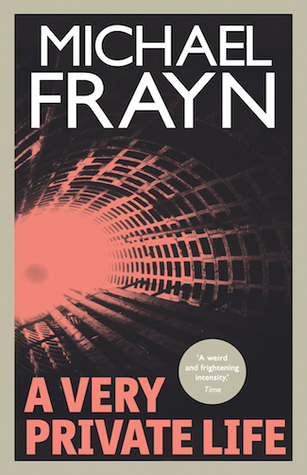
A Very Private Life

A Very Private Life

by Michael Frayn 

Uncumber lives in the distant future, in a world sharply divided between ‘Insiders’ and ‘Outsiders’. The Insiders lead a privileged existence: never having to leave their homes, they enjoy a vastly prolonged lifespan, a regular supply of food and mind-altering drugs, and holographic entertainment at the push of a button. Meanwhile, the Outsiders, half-savage, inhabit a polluted wilderness of ruins and industrial waste, struggling for survival.

Uncumber has been warned never to go outside. But when she meets an Outsider on the Holovision and falls in love with him, she becomes curious and decides to venture out into the world . . .

Equal parts dystopian science fiction and brilliant social satire, Michael Frayn’s eerily prescient fourth novel A Very Private Life (1968) earned widespread critical acclaim and comparisons to Aldous Huxley’s Brave New World. This edition features a new introduction by the author.

WHAT CRITICS ARE SAYING

‘A weird and frightening intensity.’ – Time

‘Easily the most original thing Frayn has done . . . written with elegant simplicity.’ – New Statesman

‘An ingenious fable . . . at times poetically imaginative.’ – Sunday Times

‘An intriguing fantasy.’ – Sunday Telegraph(less)

All Editions | Add a New Edition | Combine

(Goodreads.com, suggested by Suzanne Deakins, H.W., M.)