This book is an in-depth examination of the much needed process of ‘self’-study known as self observation. We live in an age where the “attention function” in the brain has been badly damaged by TV and computers – up to 90 percent of the public under age 35 suffers from attention-deficit disorder! This book offers the most direct, non-pharmaceutical means of healing attention dysfunction. The methods presented here are capable of restoring attention to a fully functional and powerful tool for success in life and relationships. This is also an age when humanity has lost its connection with conscience. When humanity has poisoned the Earth’s atmosphere, water, air and soil, when cancer is in epidemic proportions and is mainly an environmental illness, the author asks: What is the root cause? And he boldly answers: failure to develop conscience! Self-observation, he asserts, is the most ancient, scientific, and proven means to develop this crucial inner guide to awakening and a moral life. This book is for the lay-reader, both the beginner and the advanced student of self observation. No other book on the market examines this practice in such detail. There are hundreds of books on self-help and meditation, but almost none on self-study via self observation, and none with the depth of analysis, wealth of explication, and richness of experience which this book offers.
Think Neo, Think! Jung discusses his concerns for the world in regard to communism, nuclear weapons, and the fragile state of democracy. Most troubling to Jung are the ever-increasing proclivity to mass-mindedness, and the eradication of the individual by the “State”. Written decades ago, this brilliant work has more impact than ever in today’s world, where many of Jung’s concerns have come to fruition. The informed listener will, no doubt, find Jung’s predictions, and assessment of human nature, spookily accurate. Note: this is my second narration of this essay. The original narration of it was my first narration ever, and I believe this one to be a considerable improvement over the first. Read by Gregg Boethin
In late December 2020, the two largest planets in our Solar System, Jupiter and Saturn, will be so close in the sky that you’ll be able to see them both through the same telescope at the same time. Such close passes are known as Great Conjunctions. The Great Conjunction of 2020 will be the closest in almost 400 years, and it may well be the closest pass that has ever been viewed through a telescope.
The Astrophysics Group at the University of Exeter and Exeter Science Centre invite you to join them in observing this once in a lifetime event. In addition to the videos below, we plan to try to live stream a view of Jupiter and Saturn from a telescope from 4:15–6:15pm GMT on Saturday 19th December. Sign-up below for updates.
If you heard one book called “universally acknowledged as the most important of all printed books,” which do you expect it would be?
If you were Margaret Leslie Davis, the answer would be obvious. Davis’s The Lost Gutenberg: The Astounding Story of One Book’s Five-Hundred-Year Odyssey, released this March, begins with just that descriptor. It recounts the saga of a single copy of the Gutenberg Bible—one of the several surviving copies of the 450-year-old Bible printed by Johannes Gutenberg, the putative inventor of the printing press, in one of his earliest projects—through a 20th-century journey from auction house to collector to laboratory to archive.
Davis quotes Mark Twain, who wrote, in 1900, a letter celebrating the opening of the Gutenberg Museum. For Davis, Twain’s words were “particularly apt.” “What the world is to-day,” Twain wrote, “good and bad, it owes to Gutenberg. Everything can be traced to this source. . . .” Indeed, Gutenberg’s innovation has long been regarded an inflection point in human history—an innovation that opened the door to the Protestant Reformation, Renaissance, the scientific revolution, the advent of widespread education, and a thousand more changes that touch nearly everything we now know.
The only problem?
The universal acclaim is, in fact, not so universal—and Gutenberg himself is a, but not the, source of printing. Rather, key innovations in what would become revolutionary printing technology began in east Asia, with work done by Chinese nobles, Korean Buddhists, and the descendants of Genghis Khan—and, in a truth Davis acknowledges briefly, their work began several centuries before Johannes Gutenberg was even born.
*
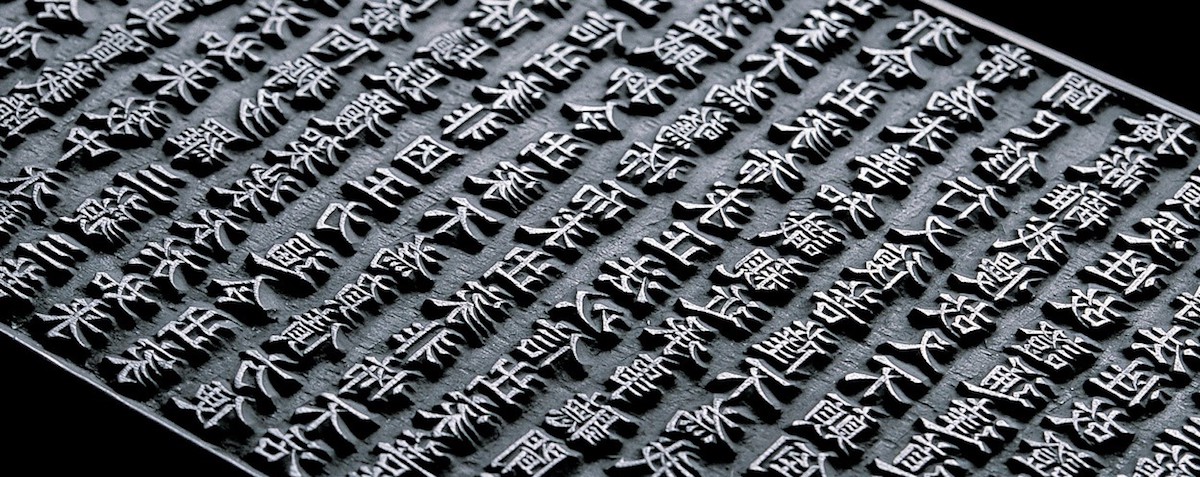
In a traditional printing press, small metal pieces with raised backwards letters, known as movable type, are arranged in a frame, coated with ink, and applied to a piece of paper. Take the paper away, and it’s a printed page. Do this with however many pages make up a book, and there’s a printed copy. Do this many times, and swiftly printed, mass-produced books appear.
The printing press is often said to have been created by Gutenberg in Mainz, Germany, around 1440 AD, and it began taking root in Europe in the 1450s with the printing of the aforementioned Bible. Books themselves had been present in Europe long before then, of course, but only in hand-copied volumes that were accessible mainly to members of the clergy. Access to mass-produced books revolutionized Europe in the late 1400s, with advancing literacy altering religion, politics, and lifestyles worldwide.“What the world is to-day,” Twain wrote, “good and bad, it owes to Gutenberg. Everything can be traced to this source.”
At least, this is how the story is rendered in most books, including, for the most part, The Lost Gutenberg. But a single sentence late in the book nods to a much longer story before that: “Movable type was an 11th-century Chinese invention, refined in Korea in 1230, before meeting conditions in Europe that would allow it to flourish—in Europe, in Gutenberg’s time.”
That sentence downplays and misstates what occurred.
The first overtures towards printing that began around roughly 800 AD, in China, where early printing techniques involving chiseling an entire page of text into a wood block backwards, applying ink, and printing pages by pressing them against the block. Around 971 AD, printers in Zhejiang, China, produced a print of a vast Buddhist canon called the Tripitaka with these carved woodblocks, using 130,000 blocks (one for each page). Later efforts would create early movable type—including the successful but inefficient use of ideograms chiseled in wood and a brief, abortive effort to create ceramic characters.
Meanwhile, imperial imports from China brought these innovations to Korean rulers called the Goryeo (the people for whom Korea is now named), who were crucial to the next steps in printing history. Their part of the story is heavy with innovation in the face of invasion.
First, in 1087 AD, a group of nomads called the Khitans attempted to invade the Korean peninsula. This prompted the Goryeo government to create its own Tripitaka with woodblock printing, perhaps with the aim of preserving Korean Buddhist identity against invaders. The attempt would be prescient; it preserved the concept and technique for later years, when more invaders eventually arrived. In the 12th and 13th centuries, the Mongol ruler Genghis Khan had created the largest empire in human history, which stretched from the Pacific coast of Asia west to Persia. After he died in 1227, his successor, Ögedei Khan, continued conquering, including gaining ground that Genghis Khan had never held. In 1231, Ögedei ordered the invasion of Korea, and in 1232, invading Mongol troops reached the capital. As part of their conquering, they burned the Korean copy of the Tripitaka to ash.
The Goryeo dynasty immediately recreated the book. This is thought to have been “as prayers to the power of Buddhas for the protection of the nation from the invading Mongols,” per a text by Thomas Christensen, but it was also done with the intention of preserving the dynasty’s culture. This was important; attacks by Mongols would continue for the next 28 years.
The Tripitaka reboot was scheduled to take Korean monks until 1251 AD to complete, and, meanwhile, the rulers began expanding into printing other books. In 1234 AD, they asked a civil minister named Choe Yun-ui to print a Buddhist text called The Prescribed Ritual Text of the Past and Present (Sangjeong Gogeum Yemun). But the lengthy book would have required an impossibly large number of woodblocks, so Choe came up with an alternative. Building on earlier Chinese attempts to create movable type, he adapted a method that had been used for minting bronze coins to cast 3-dimensional characters in metal. Then he arranged these pieces in a frame, coated them with ink, and used them to press sheets of paper. When he was done, he could reorganize the metal characters, eliminating the need to persistently chisel blocks. It was faster—to a certain extent. He completed the project in 1250 AD.Perhaps it should be Choe Yun-ui whose name we remember, not Gutenberg’s.
It is important to recognize what this means. The innovation that Johannes Gutenberg is said to have created was small metal pieces with raised backwards letters, arranged in a frame, coated with ink, and pressed to a piece of paper, which allowed books to be printed more quickly. But Choe Yun-ui did that—and he did it 150 years before Gutenberg was even born.
Perhaps it should be Choe Yun-ui whose name we remember, not Gutenberg’s.
However, Korea’s printed books did not spread at a rapid pace, as Gutenberg’s books would 200 years later. Notably, Korea was under invasion, which hampered their ability to disseminate their innovation. In addition, Korean writing, then based closely on Chinese, used a large number of different characters, which made creating the metal pieces and assembling them into pages a slow process. Most importantly, Goryeo rulers intended most of its printing projects for the use of the nobility alone.
Nonetheless, it is possible that printing technology spread from East to West. Ögedei Khan, the Mongol leader, had a son named Kublai who had situated himself as a ruler in Beijing. Kublai Khan had access to Korean and Chinese printing technology, and he may have shared this knowledge with another grandson of Genghis Khan, Hulegu, who was then ruling the Persian part of the Mongol empire. This could have moved printing technologies from East Asia westward by thousands of miles. “Mongols just tended to take their technologies everywhere they go, and they become a part of local culture, sometimes acknowledged, sometimes not,” Colgate University Asian history professor David Robinson explains.
To get from East Asia to Persia at that time, one traveled the Silk Road. In the middle of that route lay the homeland of the Uyghur people, a Turkic ethnic group that had been recruited into the Mongol army long before. “If there was any connection in the spread of printing between Asia and the West,” the scholar Tsien Tsuen-Hsien wrote in Science and Civilization in China in 1985, “the Uyghurs who used both blocking printing and movable type had good opportunities to play an important role in this introduction.”
This is because, in the 13th century, Uyghurs were considered distinguished, learned people—the sort for whom printing might be a welcome innovation. They had also something no one else in printing had had up till then: an alphabet, a simple group of relatively few letters for writing every word one wished to say.
There was no explosion of printing in the Western Mongol empire. “There was no market, no need for the leaders to reach out to their subjects, no need to raise or invest in capital in a new industry,” the historian John Man points out in his book, The Gutenberg Revolution. Nonetheless, movable-type Uyghur-language prints have been discovered in the area, indicating the technology was used there.
Furthermore, the Mongols may have carried the technology not only through Uyghur and Persian territory, but into Europe, including Germany. The Mongol empire repeatedly invaded Europe from roughly 1000 to 1500 AD; that period saw the entry of enough Western Asian recruits and captives to bring the loanword horde from their Turkic languages into European ones. “Generally, if something is going from East Asia [to the west], it would be hard to imagine without the Mongols,” Christopher Atwood, a Central Eurasian Studies professor at Indiana University, said in an interview.The fantastical idea that Gutenberg alone invented the printing press ignores an entire continent and several centuries of relevant efforts.
Eventually, early capitalists in Europe invested in Johannes Gutenberg’s business venture—the one that combined technology quite like the movable type innovated by Choe Yun-ui with a screw-threaded spiral mechanism from a wine or olive press to ratchet up printing to commercial speeds. That business took decades of his life to bring to fruition, forced him into bankruptcy, and led to court filings by investors who repeatedly sued him to get their money back. As Davis notes in The Lost Gutenberg, these records are the means by which we know Gutenberg and his Bible: “This most famous of books has origins that we know little about. The stories we tell about the man, and how the Bibles came to be, have been cobbled together from a fistful of legal and financial records, and centuries of dogged scholarly fill-in-the-blank.”
*
Indeed, the entire history of the printing press is riddled with gaps. Gutenberg did not tell his own story in documents created on the printing presses he built; to the best of modern knowledge, he did not leave any notes on his work at all. And if Gutenberg was reticent, the Mongols, their Uyghur compatriots, and Eastern Asia government heads were even more so.
But if doubts are natural, then the result we’ve made of them is not. The fantastical idea that Gutenberg alone invented the printing press ignores an entire continent and several centuries of relevant efforts and makes no effort to understand how or why technology might have spread. During a study of Gutenberg’s lettering techniques, computer programmer Blaise Agṻera y Arcas pointed out how strange this is: “The idea that a technology emerges fully formed at the beginning is nuts. Anyone who does technology knows that’s not how it works.”
To her credit, Davis notes the same, explaining it this way: “Perhaps the image of Johannes Gutenberg as a lone genius who transformed human culture endures because the sweep of what followed is so vast that it feels almost mythic and needs an origin story to match.”
But Davis, who was unavailable for an interview for this article, does little to correct the record in The Lost Gutenberg. She mentions China just a few times and Korea only once—and the Mongols, Uyghurs, and non-Christian aspects of printing history not at all.
Indeed, she never explains that the Gutenberg Bible is not universally acclaimed as the most important book in history. Nor are copies of the Bible the oldest books created with movable type that still exist today—although a reader could be forgiven for gathering that impression from The Lost Gutenberg.
Rather, the earliest extant movable-type-printed book is the Korean Baegun Hwasang Chorok Buljo Jikji Simche Yojeo (“The Anthology of Great Buddhist Priests’ Zen Teachings”). It dates to 1377 and has served as a starting point for scholarship on the origin of movable type.
Korea regards it and other ancient volumes as national points of pride that rank among the most important of books. But it is only very recently, mostly in the last decade, that their viewpoint and the Asian people who created printing technologies have begun to be acknowledged at all. Most people—including Davis, who declined an interview with the remark, “I’m afraid I can’t really add much further on the topic of ancient printing”—still don’t know the full story.
M. Sophia Newman is a writer and medical editor from Chicago. As a health journalist, she reported from Ghana, Kenya, South Africa, Bangladesh, India, Nepal, and France, and has received grants from the International Thomas Merton Society, Collegeville Institute, and the Pulitzer Center for Crisis Reporting. In addition, Sophia has researched mental health in Bangladesh under a Fulbright fellowship and earned a certification in global mental health from the Harvard Program on Refugee Trauma.
Join millions in the annual GLOBAL SILENT MINUTE on 21 December 2020 at 9pm GMT.* You can participate wherever you are by simply ringing a bell and entering one minute of Silence – the exact same minute of silence everywhere on the planet!
Last year millions around the world – and across the veil – participated in one Global Silent Minute at the exact same minute everywhere.
Throughout 2020, the Global Silent Minute has become a daily practice. The annual Global Silent Minute will celebrate humanity’s widespread engagement with the power of Silence to bring about global cooperation, peace and freedom.
The inspiration for the Silent Minute was born on a battlefield in World War I and launched in World War II. And now participation in the Global Silent Minute addresses the myriad of “battlefields” around the globe to embed the culture of peace.For more information:
On December 19th, 2020 Jupiter leaves Capricorn and enters Aquarius.
To understand what Jupiter in Aquarius wants from us, let’s analyze the transit step-by-step so that the bigger picture can emerge:
Jupiter
Aquarius
Jupiter in Aquarius
Jupiter and Saturn conjunction in Aquarius
Jupiter – Growth, Faith, Beliefs
Jupiter is the largest planet in our solar system and has the magical quality of expanding everything it touches. Without Jupiter, there would be no growth and no expansion.
Jupiter is also the planet of consensus and coherence – Jupiter connects the dots to find a greater and more meaningful whole.
Jupiter doesn’t like ambiguity and helps us stay focused on our goals, so that we don’t get side-tracked.
Jupiter is the planet of justice, morals, and what everyone agrees on. We all agree on some basic principles, such as human rights, or that we need health and education to function as a society.
Jupiter doesn’t operate like Mars. Jupiter will not try to force you into doing something against your will – instead, Jupiter will try to convince you. And if you have a valid point to raise, Jupiter will take this into consideration to come up with an even better, overarching ‘formula’.
Jupiter promotes a sense of inner coherence, and when things start to feel ‘right’, faith naturally emerges.
Even when you’re far from reaching your goal, even when the whole world seems to go against you, Jupiter gives you that inner faith that things will eventually work out.
The trick here, and the reason why this approach works, is that at this level, you BECOME Jupiter.
Jupiter is the massive gas bubble with the highest gravitation mass, and just like Jupiter, you too will start to attract exactly those circumstances that will help you achieve your goals.
Finally, the last and the most important Jupiter attribute is “belief”. Belief is more than faith. If having faith simply means holding hope that things will turn out well, a belief is an overarching principle that guides you in everything you do.
Beliefs are the most powerful force in the universe. Our beliefs encompass our religious choices, our political views, and our lifestyle.
These beliefs govern our lives, and our results and accomplishments (Saturn) are a direct consequence of these beliefs.
When we have healthy Jupiter beliefs (a consequence of having done the honest, Mars work), these beliefs are a natural extension of ourselves and how we can contribute to the greater good of society.
When we don’t do the Mars work, these beliefs, of course, are not a natural expression of who we are, but a reflection of what society tells us to believe. If you don’t reach your goals, take an honest look at your beliefs. Are they really yours? If not, go back to Mars.
Having sound beliefs is not enough. There comes a time when we move from theory (Jupiter) to practice (Saturn) and take risks.
And it is Jupiter’s task to drive this final push. At this level, we don’t know yet how we are going to make it. But unless we try, we will never find out.
Aquarius – Freedom
Jupiter moves into Aquarius, so the Jupiter qualities we described above: growth, faith, beliefs will follow Aquarius’ agenda.
Since Aquarius is a complex, collective sign, this is not an easy task – but is, however, an exciting one.
Aquarius is ruled by Uranus. Uranus is one of the 3 outer planets: Neptune is the ocean, Pluto the underworld, and Uranus, the sky.
All these outer planets help us move beyond our earthly experience and merge with something greater than ourselves, but their modus operandi differs.
Neptune is the mermaid that seduces us into the primordial water, so that we eliminate any separation, and merge into oneness. We are a drop of water in the sea, and the sea is a drop of water, we are at one with everything.
Pluto does the same thing by stripping away anything that is false and can no longer sustain growth.
Pluto works in a more brutal way, much like splitting the atom, again and again, so that it can find the primordial source of energy and creation. And when we get to the center, to the soul of everything, we become one with the power generator of the universe.
Uranus works differently. Uranus connects us with these higher realms by lifting us up. Unlike Neptune (we “fall” in love) or Pluto (we surrender to a higher force, to find our own personal power), Uranus has an upward movement.
Uranus lights a spark of light inside us. With Uranus, we feel elated, excited and electric.
“Let there be light”, sometimes all it takes is to turn the light on, and we can see. Everything is 0’s and 1’s, and the revelations that Uranus brings are like lightning – they instantaneously come to us when we tune into the higher frequencies of the skies.
Uranus has the highest affinity with Aquarius, because Aquarius is a collective, air sign. In the air, in that light uplifting space, anything is possible.
And in the Uranian ethereal space, we find Aquarian keywords: network, friendships, inclusion, sovereignty, autonomy, hopes, dreams, and innovation.
What does friendship have to do with innovation? What does sovereignty have to do with our hopes and dreams? These keywords may seem to have little in common – but not if we find the common denominator.
Aquarius is a fixed, air sign, so it looks for routes and connections (fixed) in the space of infinite possibilities (Air). Aquarius is the invisible ties that keep us connected, and hold our society together.
Airplanes have predefined routes to fly. The internet is built on connected networks. Innovation emerges when people have frameworks to exchange ideas and create something even greater together. When we look after each other, the world is a better place to live in.
In Aquarius’ invisible web, we can jump over the cliff and do pretty much what we want, because we know we are loved and looked after. And when we feel accepted and we know there is a network of support that ‘has our back’, this is when we can finally be free.
Jupiter In Aquarius – The Sky’s The Limit
Jupiter and Aquarius have a lot of things in common. Freedom. Exploration. Wisdom. Big picture. Hopes and dreams.
Jupiter in Aquarius’ motto can well be “the sky’s the limit” which pretty much means there is no limit, and that there is nothing that can prevent us from achieving our potential.
With Jupiter in Aquarius, we are more ready than ever to take a big leap of faith so that we can find that place where we truly belong, where we don’t have to feel alone and disconnected ever again.
Jupiter in Aquarius will help us dream more boldly than we ever did before. There may be thousands of reasons why we could fail, but unless we BELIEVE and give it a try, nothing will ever happen.
When Jupiter changes signs, once a year, it asks for a change in direction. Moving forward, the approach you used when Jupiter was in Capricorn will no longer work.
If Jupiter in Capricorn had a clear goal, and something specific to achieve, Jupiter in Aquarius may not know ‘what it is’ that it is trying to achieve.
Jupiter in Aquarius is as excited as Jupiter in Sagittarius, as experienced as Jupiter in Capricorn, but also agile, flexible and ready to co-create with the universe.
With Jupiter in Aquarius, you want to dare to fly, to say yes to the irresistible pull of freedom.
You may not know ‘how’ to get there, or what you’ll find on the other side. There’s one thing we can be sure of, however, Aquarius’ promise of freedom and liberation is something worth pursuing.
Jupiter Conjunct Saturn In Aquarius – Learning To Fly
From December 19th, 2021 until December 30th, 2021 Jupiter is not alone in Aquarius – it shares the sign with Saturn.
Jupiter and Saturn’s energies may feel contradictory, but perhaps a better word is complementary. To architect grand things that don’t only look grand, but can also stand the test of time, we need both Jupiter and Saturn, in the ‘right’ balance.
Think of Jupiter and Saturn as a tire of a car. If the tire is too inflated, it can explode, and if there’s not enough air, it wears and eventually gets damaged. That’s why we want to find a balance between expansion and contraction, and Jupiter conjunct Saturn will help us do that.
Jupiter alone may get too excited and forget to put on his seatbelt. But thanks to Saturn, enthusiasm meets experience. You don’t have to jump over a cliff for a brief experience of freedom. You can get a pilot license and do what you love for the rest of your life.
When Jupiter and Saturn, the 2 largest planets of our solar system change signs and elements, we will witness a monumental shift in the way we get on with our lives. Doing things the “Earth way” will stop working. In the next 200 years, the “Air way” is the way forward.
When you do something new, there are no maps, operating procedures, or “HOW TOs”, so you’ll have to learn on-the-fly.
The good thing is that change is not a traumatic experience, or at least it doesn’t have to be. Change is usually preceded by a pull, or a call to do things differently – even if we’re totally inexperienced and may not even know where we’re going.
We call this pull “intuition” and Jupiter’s intuition will always guide us in the right direction.
“The sole intention is learning to fly / Condition grounded, but determined to try”
Change is a condition of life. Change is always ‘good’ because stagnation means death, and movement means life. Change follows when we have outgrown the “old paradigm”, and instinctively feel that there is a better way forward.
With Jupiter in Aquarius, the pull to find a different direction is just stronger than the comfort of doing what we’ve always been doing.
In the new Air era, we will all learn how to fly.
Jupiter And Saturn In Aquarius – Create Your Vision Board For 2021
Jupiter and Saturn are the best planets for vision boarding. Jupiter comes with the far-reaching vision, and Saturn with the determined execution. When the 2 join forces, they are unstoppable.
To celebrate Jupiter’s move into Aquarius, and the Jupiter-Saturn conjunction in Aquarius on December 21st, we will hold a 3-day “Vision Board challenge” on Astro Butterfly’s public Facebook page.
From December 19th to December 21st, you will get guidance on how to create an intentional vision board that is aligned with your natal chart and with these very special energies we are about to experience.
If you don’t have a Facebook account, you can get access to the Vision Board Challenge materials inside the Age of Aquarius Community (which has a dedicated website, outside Facebook). The Age of Aquarius Community opens for enrollment on December 21st, 2020.
If you do have a Facebook account and want to be part of the Vision Board challenge, make sure you check Astro Butterfly’s Facebook page each day from December 19th to December 21st, as we won’t send out email reminders.
MONTREAL—In an effort to add strict safeguards to the content shared to its platform, adult video giant PornHub announced Tuesday it would be deleting millions of uploads that it was unable to verify were really between a stepson and a stepmother. “Our site has taken this unprecedented step in an effort to provide our users with the assurance that any media they’re watching is bonafide stepson-on-stepmom incest action,” said CEO Feras Antoon, telling reporters they would no longer accept any user submissions that didn’t also include a marriage certificate to ensure the taboo familial connection is as genuinely titillating as possible. “These new strictures will allow users to enjoy viewing shy stepsons caught masturbating by big-titted MILFs without having to question the video’s validity or origin.” PornHub also announced plans to permanently ban all cucking videos where it’s really obvious that the husband would be able to see his wife fucking someone else with his peripheral vision.
Leos can benefit from lessons learned by Ariana Grande, who had Japanese characters tattooed on her palm that she thought corresponded with sentiments in her song “7 Rings,” but in actuality did not. (Courtesy photo)
Leo, express your creativity and innovative spirit with good planning and discernment
ARIES(March 21-April 19): Temporary gods are deities who come alive and become available for particular functions, and are not otherwise necessary or called upon. For instance, in ancient Greece, the god Myiagros showed up when humans made sacrifices to the goddess Athena. His task was to shoo away flies. I encourage you to invent or invoke such a spirit for the work you have ahead of you. And what’s that work? 1. To translate your recent discoveries into practical plans. 2. To channel your new-found freedom into strategies that will ensure freedom will last. 3. To infuse the details of daily life with the big visions you’ve harvested recently. What will you name your temporary god?
TAURUS (April 20-May 20): Author Virginia Woolf said that we don’t wholly experience the unique feelings that arise in any particular moment. They take a while to completely settle in, unfold, and expand. From her perspective, then, we rarely “have complete emotions about the present, only about the past.” With that as your starting point, Taurus, I invite you to take a journey through the last 11 months and thoroughly evolve all the emotions that weren’t entirely ripe when they originally appeared. Now is an excellent time to deepen your experience of what has already happened, to fully bloom the seeds that have been planted.
GEMINI(May 21-June 20): “Wonder is a bulky emotion,” writes author Diane Ackerman. “When you let it fill your heart and mind, there isn’t room for anxiety, distress, or anything else.” I’d love for you to use her observation as a prescription in 2021, Gemini. According to my understanding of the coming year’s astrological portents, you will have more natural access to wonder and amazement and awe than you’ve had in a long time. And it would make me happy to see you rouse those primal emotions with vigor —so much so that you drive away at least some of the flabby emotions like anxiety, which are often more neurotic than real.
CANCER(June 21-July 22): I’ll use the words of Cancerian painter Frida Kahlo to tell you the kind of intimate ally you deserve. If for some inexplicable reason you have not enjoyed a relationship like this before now, I urge you to make 2021 the year that you finally do. And if you HAVE indeed been lucky in this regard, I bet you’ll be even luckier in 2021. Here’s Frida: “You deserve a lover who wants you disheveled … who makes you feel safe … who wants to dance with you … who never gets tired of studying your expressions … who listens when you sing, who supports you when you feel shame and respects your freedom … who takes away the lies and brings you hope.”
LEO (July 23-Aug. 22): In 2019, singer Ariana Grande got Japanese characters tattooed on her palm. She believed them to be a translation of the English phrase “7 Rings,” which was the title of a song she had released. But knowledgeable observers later informed her that the tattoo’s real meaning was “small charcoal grill.” She arranged to have alterations made, but the new version was worse: “Japanese barbecue grill finger.” I offer you this story for two reasons, Leo. First, I applaud the creativity and innovative spirit that have been flowing through you. Second, I want to make sure that you keep them on the right track — that they continue to express what you want them to express. With proper planning and discernment, they will.
VIRGO (Aug. 23-Sept. 22): While sleeping, most of us have over a thousand dreams every year. Many are hard to remember and not worth remembering. But a beloved few can be life-changers. They have the potential to trigger epiphanies that transform our destinies for the better. In my astrological opinion, you are now in a phase when such dreams are more likely than usual. That’s why I invite you to keep a recorder or a pen and notebook by your bed so as to capture them. For inspiration, read this testimony from Jasper Johns, whom some call America’s “foremost living artist”: “One night I dreamed that I painted a large American flag, and the next morning I got up and I went out and bought the materials to begin it.” Painting flags ultimately became one of Johns’ specialties.
LIBRA (Sept. 23-Oct. 22): I composed a prayer that’s in alignment with your current astrological omens. If it feels right, say it daily for the next 10 days. Here it is: “Dear Higher Self, Guardian Angel, and Future Me: Please show me how to find or create the key to the part of my own heart that’s locked up. Reveal the secret to dissolving any inhibitions that interfere with my ability to feel all I need to feel. Make it possible for me to get brilliant insights into truths that will enable me to lift my intimate alliances to the next level.”
SCORPIO (Oct. 23-Nov. 21): Author Herman Hesse observed, “Whoever wants music instead of noise, joy instead of pleasure, soul instead of gold, creative work instead of business, passion instead of foolery, finds no home in this trivial world.” I hope you will prove him wrong in 2021, Scorpio. According to my reading of astrological omens, the rhythms of life will be in alignment with yours if you do indeed make bold attempts to favor music over noise, joy over pleasure, soul over gold, creative work over business, passion over foolery. Moreover, I think this will be your perfect formula for success — a strategy that will guarantee you’ll feel at home in the world more than ever before.
SAGITTARIUS(Nov. 22-Dec. 21): According to researcher Nick Watts and his documentary film “The Human Footprint,” the average person speaks more than 13 million words in a lifetime, or about 4,300 per day. But I suspect and hope that your output will increase in 2021. I think you’ll have more to say than usual — more truths to articulate, more observations to express, more experiences to describe. So please raise your daily quota of self-expression to account for your expanded capacity to share your intelligence with the world.
CAPRICORN(Dec. 22-Jan. 19): “Our thinking should have a vigorous fragrance, like a wheat field on a summer’s night,” wrote philosopher Friedrich Nietzsche. I encourage you to adopt that joyful mandate as your own. It’s a perfect time to throw out stale opinions and moldy ideas as you make room for an aromatic array of fresh, spicy notions. To add to your bliss, get rid of musty old feelings and decaying dreams and stinky judgments. That brave cleansing will make room for the arrival of crisp insights that smell really good.
AQUARIUS(Jan. 20-Feb. 18): Have you heard the term “catastrophize”? It refers to when people experience a small setback or minor problem but interpret it as being a major misfortune. It’s very important that you not engage in catastrophizing during the coming weeks. I urge you to prevent your imagination from jumping to awful conclusions that aren’t warranted. Use deep breathing and logical thinking to coax yourself into responding calmly. Bonus tip: In my view, the small “setback” you experience could lead to an unexpected opportunity — especially if you resist the temptation to catastrophize.
PISCES (Feb. 19-March 20): My Buddhist friend Marcia says the ultimate goal of her meditation practice is to know that the material world is an illusion and that there is no such thing “I” or “you,” no past or future. There is only the quality-less ground of being. My Sufi friend Roanne, on the other hand, is a devotee of the poet Rumi. The ultimate goal of her meditation practice is to be in intimate contact, in tender loving communion, with the Divine Friend, the personal face of the Cosmic Intelligence. Given your astrological omens, Pisces, I’d say you’re in a prime position to experience the raw truth of both Marcia’s and Roanne’s ideals. The coming days could bring you amazing spiritual breakthroughs!
Homework: Carry out an act of love that’s unique in your history. Testify at FreeWillAstrology.com.
Consciousness, spirituality, biography, sexuality, androgyny, futurism, space, the arts, science, astrology, democracy, humor, books, movies and more



 For more information: