“To understand all is to forgive all.”
–French Proverb


by Vandana Shiva with Kartikey Shiva
Basing her analysis on explosive little-known facts, Shiva exposes the model of philanthrocapitalism, which is about deploying unaccountable money to bypass democratic structures, derail diversity, and impose totalitarian ideas, based on One Science, One Agriculture and One History. She calls for a resurgence of real knowledge..so that people can reclaim their right to Live Free, Think Free, Breathe Free, Eat Free.
(Goodreads.com)
FRANCE 24 English Subscribe to France 24 now: http://f24.my/youtubeEN FRANCE 24 live news stream: all the latest news 24/7 http://f24.my/YTliveEN
Our guest is Vandana Shiva, a world-famous environmental activist from India. Her latest book is entitled “One Earth, One Humanity vs. the 1%”. She tell us about more her opposition to big multinationals such as Monsanto for their nefarious influence on agriculture. But Shiva also singles out billionaires like Bill Gates and Mark Zuckerberg for criticism. “When Bill Gates pours money into Africa for feeding the poor in Africa and preventing famine, he’s pushing the failed Green Revolution, he’s pushing chemicals, pushing GMOs, pushing patterns”, she tells FRANCE 24’s Marc Perelman.
Visit our website: http://www.france24.com
Covid-19 is killing off the myth that we are the greatest country on earth.

By Viet Thanh Nguyen
Contributing Opinion Writer

Sometimes people ask me what it takes to be a writer. The only things you have to do, I tell them, are read constantly; write for thousands of hours; and have the masochistic ability to absorb a great deal of rejection and isolation. As it turns out, these qualities have prepared me well to deal with life in the time of the coronavirus.
The fact that I am almost enjoying this period of isolation — except for bouts of paranoia about imminent death and rage at the incompetence of our nation’s leadership — makes me sharply aware of my privilege. It is only through my social media feeds that I can see the devastation wreaked on people who have lost their jobs and are worried about paying the rent. Horror stories are surfacing from doctors and nurses, people afflicted with Covid-19, and those who have lost loved ones to the disease.
Many of us are getting a glimpse of dystopia. Others are living it.
If anything good emerges out of this period, it might be an awakening to the pre-existing conditions of our body politic. We were not as healthy as we thought we were. The biological virus afflicting individuals is also a social virus. Its symptoms — inequality, callousness, selfishness and a profit motive that undervalues human life and overvalues commodities — were for too long masked by the hearty good cheer of American exceptionalism, the ruddiness of someone a few steps away from a heart attack.
Even if America as we know it survives the coronavirus, it can hardly emerge unscathed. If the illusion of invincibility is shredded for any patient who survives a near-fatal experience, then what might die after Covid-19 is the myth that we are the best country on earth, a belief common even among the poor, the marginal, the precariat, who must believe in their own Americanness if in nothing else.
Perhaps the sensation of imprisonment during quarantine might make us imagine what real imprisonment feels like. There are, of course, actual prisons where we have warehoused human beings who have no relief from the threat of the coronavirus. There are refugee camps and detention centers that are de facto prisons. There is the economic imprisonment of poverty and precariousness, where a missing paycheck can mean homelessness, where illness without health insurance can mean death.
But at the same time, prisons and camps have often served as places where new consciousnesses are born, where prisoners become radicalized, become activists and even revolutionaries. Is it too much to hope that the forced isolation of many Americans, and the forced labor of others, might compel radical acts of self-reflection, self-assessment and, eventually, solidarity?
A crisis often induces fear and hatred. Already we are seeing a racist blowback against Asians and Asian-Americans for the “Chinese virus.” But we have a choice: Will we accept a world of division and scarcity, where we must fight over insufficient resources and opportunities, or imagine a future when our society is measured by how well it takes care of the ill, the poor, the aged and the different?
As a writer, I know that such a choice exists in the middle of a story. It is the turning point. A hero — in this case, the American body politic, not to mention the president — is faced with a crucial decision that will reveal who he or she fundamentally is.
We are not yet at the halfway point of our drama. We have barely made it to the end of the first act, when we slowly awaken to the threat coming our way and realize we must take some kind of action. That action, for now, is simply doing what we must to fight off Covid-19 and survive as a country, weakened but alive.
The halfway point comes only when the hero meets a worthy opponent — not one who is weak or marginal or different, but someone or something that is truly monstrous. Covid-19, however terrible, is only a movie villain. Our real enemy does not come from the outside, but from within. Our real enemy is not the virus but our response to the virus — a response that has been degraded and deformed by the structural inequalities of our society.
America has a history of settler colonization and capitalism that ruthlessly exploited natural resources and people, typically the poor, the migratory, the black and the brown. That history manifests today in our impulse to hoard, knowing that we live in an economy of self-reliance and scarcity; in our dependence on the cheap labor of women and racial minorities; and in our lack of sufficient systems of health care, welfare, universal basic income and education to take care of the neediest among us.
What this crisis has revealed is that, while almost all of us can become vulnerable — even corporations and the wealthy — our government prioritizes the protection of the least vulnerable.
If this was a classic Hollywood narrative, the exceptionally American superhero, reluctant and wavering in the first act, would make the right choice at this turning point. The evil Covid-19 would be conquered, and order would be restored to a society that would look just as it did before the villain emerged.
But if our society looks the same after the defeat of Covid-19, it will be a Pyrrhic victory. We can expect a sequel, and not just one sequel, but many, until we reach the finale: climate catastrophe. If our fumbling of the coronavirus is a preview of how the United States will handle that disaster, then we are doomed.
But amid the bumbling, there are signs of hope and courage: laborers striking over their exploitation; people donating masks, money and time; medical workers and patients expressing outrage over our gutted health care system; a Navy captain sacrificing his career to protect his sailors; even strangers saying hello to other strangers on the street, which in my city, Los Angeles, constitutes a nearly radical act of solidarity.
I know I am not the only one thinking these thoughts. Perhaps this isolation will finally give people the chance to do what writers do: imagine, empathize, dream. To have the time and luxury to do these things is already to live on the edge of utopia, even if what writers often do from there is to imagine the dystopic. I write not only because it brings me pleasure, but also out of fear — fear that if I do not tell a new story, I cannot truly live.
Americans will eventually emerge from isolation and take stock of the fallen, both the people and the ideas that did not make it through the crisis. And then we will have to decide which story will let the survivors truly live.
The Times is committed to publishing a diversity of letters to the editor. We’d like to hear what you think about this or any of our articles. Here are some tips. And here’s our email: letters@nytimes.com.
Follow The New York Times Opinion section on Facebook, Twitter (@NYTopinion) and Instagram.
Viet Thanh Nguyen, a contributing opinion writer, is the author, most recently, of “The Refugees” and the editor of “The Displaced: Refugee Writers on Refugee Lives.” He teaches English at the University of Southern California. @viet_t_nguyen

| April 18, 2020 (makinggayhistory.org) On April 9, LGBTQ civil rights pioneer Phyllis Lyon died at age 95. That’s Phyllis, at right above, with her life partner, Del Martin, during their 2008 wedding ceremony. Phyllis and Del were the first couple to get married in San Francisco after the California Supreme Court ruled that same-sex marriage was legal (then-Mayor Gavin Newsom, seen in the background, officiated). By the time of their wedding, Phyllis and Del had been making lesbian history for decades—starting in 1955, when they co-founded the Daughters of Bilitis, the first organization for lesbians. The 2003 documentary No Secret Anymore: The Times of Del Martin and Phyllis Lyon offers a loving portrait of the two women and a record of the remarkable breadth and longevity of their activism. It was directed by Joan E. Biren, or JEB, the pioneering LGBTQ photographer and filmmaker. Click the image above to watch the trailer. For more on Phyllis, read her New York Times obituary here and listen to my interview with her and Del in this MGH episode. |

Invisible College #5 Photos: Jon Hanna
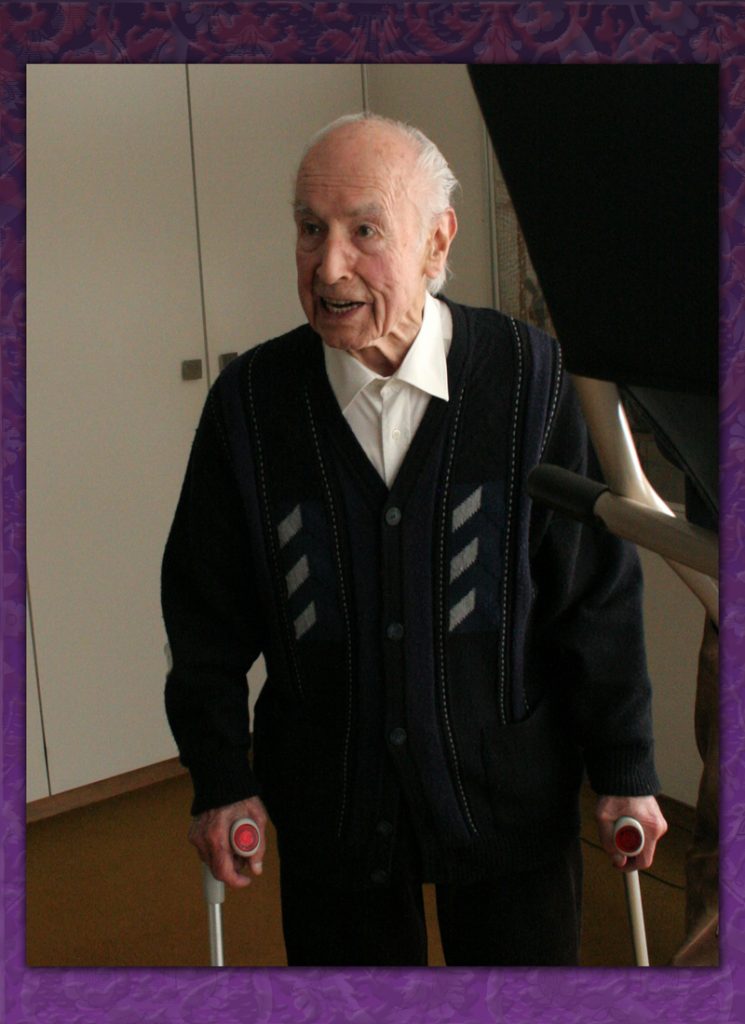
Perhaps the last photographs of Albert Hofmann. Taken the month he died in Switzerland.
You can see the rest of the edition here: https://www.invisiblecollege-publishing.com/pdfs/
Albert Hofmann was the inventor of LSD, Today marks his second experience with the substance (the first by accident, the second on purpose.)
Everything changes on that pivotal moment in 1943 is Basel Switzerland…
corbettreport SHOW NOTES AND MP3: https://www.corbettreport.com/?p=35884
The numbers are in on the great Covid-19 pandemic . . . but unfortunately those numbers are unreliable. From mendacious models and puffed-up projections to dodgy death data and tainted tests, today on The Corbett Report James highlights what the accredited scientists and award-winning researchers are saying about the pandemic pandemonium of 2020.
BY YES! EDITORS APR 17, 2020 (yesmagazine.org)
“What is this thing that has happened to us? It’s a virus, yes. In and of itself it holds no moral brief. But it is definitely more than a virus.”
This is an excerpt of an essay called “Pandemic Is a Portal,” a selection from author Arundhati Roy’s forthcoming book Azadi: Freedom. Fascism. Fiction. (Haymarket, September 2020). The Man Booker Prize-winning Indian novelist (The God of Small Things, 1997) is a longtime activist for antiglobalization movements and an outspoken critic of U.S. foreign policy.
“Some believe it’s God’s way of bringing us to our senses. Others that it’s a Chinese conspiracy to take over the world.”
“Whatever it is, coronavirus has made the mighty kneel and brought the world to a halt like nothing else could. Our minds are still racing back and forth, longing for a return to ‘normality,’ trying to stitch our future to our past and refusing to acknowledge the rupture. But the rupture exists. And in the midst of this terrible despair, it offers us a chance to rethink the doomsday machine we have built for ourselves. Nothing could be worse than a return to normality.
“Historically, pandemics have forced humans to break with the past and imagine their world anew. This one is no different. It is a portal, a gateway between one world and the next. We can choose to walk through it, dragging the carcasses of our prejudice and hatred, our avarice, our data banks and dead ideas, our dead rivers and smoky skies behind us. Or we can walk through lightly, with little luggage, ready to imagine another world. And ready to fight for it.”
Roy has released text of the full essay here.
BY ROBERT JENSEN MAY 25, 2013 (yesmagazine.org)
Feeling anxious about life in a broken-down society on a stressed-out planet? That’s hardly surprising: Life as we know it is almost over. While the dominant culture encourages dysfunctional denial—pop a pill, go shopping, find your bliss—there’s a more sensible approach: Accept the anxiety, embrace the deeper anguish—and then get apocalyptic.
We are staring down multiple cascading ecological crises, struggling with political and economic institutions that are unable even to acknowledge, let alone cope with, the threats to the human family and the larger living world. We are intensifying an assault on the ecosystems in which we live, undermining the ability of that living world to sustain a large-scale human presence into the future. When all the world darkens, looking on the bright side is not a virtue but a sign of irrationality.
In these circumstances, anxiety is rational and anguish is healthy, signs not of weakness but of courage. A deep grief over what we are losing—and have already lost, perhaps never to be recovered—is appropriate. Instead of repressing these emotions we can confront them, not as isolated individuals but collectively, not only for our own mental health but to increase the effectiveness of our organizing for the social justice and ecological sustainability still within our grasp. Once we’ve sorted through those reactions, we can get apocalyptic and get down to our real work.
Perhaps that sounds odd, since we are routinely advised to overcome our fears and not give in to despair. Endorsing apocalypticism seems even stranger, given associations with “end-timer” religious reactionaries and “doomer” secular survivalists. People with critical sensibilities, those concerned about justice and sustainability, think of ourselves as realistic and less likely to fall for either theological or science-fiction fantasies.
Many associate “apocalypse” with the rapture-ranting that grows out of some interpretations of the Christian Book of Revelation (aka, the Apocalypse of John), but it’s helpful to remember that the word’s original meaning is not “end of the world.” “Revelation” from Latin and “apocalypse” from Greek both mean a lifting of the veil, a disclosure of something hidden, a coming to clarity. Speaking apocalyptically, in this sense, can deepen our understanding of the crises and help us see through the many illusions that powerful people and institutions create.
But there is an ending we have to confront. Once we’ve honestly faced the crises, then we can deal with what is ending—not all the world, but the systems that currently structure our lives. Life as we know it is, indeed, coming to an end.
Let’s start with the illusions: Some stories we have told ourselves—claims by white people, men, or U.S. citizens that domination is natural and appropriate—are relatively easy to debunk (though many cling to them). Other delusional assertions—such as the claim that capitalism is compatible with basic moral principles, meaningful democracy, and ecological sustainability—require more effort to take apart (perhaps because there seems to be no alternative).
“Apocalypse” need not involve heavenly rescue fantasies or tough-guy survival talk; to get apocalyptic means seeing clearly and recommitting to core values.
But toughest to dislodge may be the central illusion of the industrial world’s extractive economy: that we can maintain indefinitely a large-scale human presence on the earth at something like current First-World levels of consumption. The task for those with critical sensibilities is not just to resist oppressive social norms and illegitimate authority, but to speak a simple truth that almost no one wants to acknowledge: The high-energy/high-technology life of affluent societies is a dead end. We can’t predict with precision how resource competition and ecological degradation will play out in the coming decades, but it is ecocidal to treat the planet as nothing more than a mine from which we extract and a landfill into which we dump.
We cannot know for sure what time the party will end, but the party’s over.
Does that seem histrionic? Excessively alarmist? Look at any crucial measure of the health of the ecosphere in which we live—groundwater depletion, topsoil loss, chemical contamination, increased toxicity in our own bodies, the number and size of “dead zones” in the oceans, accelerating extinction of species, and reduction of biodiversity—and ask a simple question: Where are we heading?
Remember also that we live in an oil-based world that is rapidly depleting the cheap and easily accessible oil, which means we face a major reconfiguration of the infrastructure that undergirds daily life. Meanwhile, the desperation to avoid that reconfiguration has brought us to the era of “extreme energy,” using ever more dangerous and destructive technologies (hydrofracturing, deep-water drilling, mountaintop coal removal, tar sands extraction).
Oh, did I forget to mention the undeniable trajectory of global warming/climate change/climate disruption?
Scientists these days are talking about tipping points and planetary boundaries, about how human activity is pushing Earth beyond its limits. Recently 22 top scientists warned that humans likely are forcing a planetary-scale critical transition “with the potential to transform Earth rapidly and irreversibly into a state unknown in human experience,” which means that “the biological resources we take for granted at present may be subject to rapid and unpredictable transformations within a few human generations.”
That conclusion is the product of science and common sense, not supernatural beliefs or conspiracy theories. The political/social implications are clear: There are no solutions to our problems if we insist on maintaining the high-energy/high-technology existence lived in much of the industrialized world (and desired by many currently excluded from it). Many tough-minded folk who are willing to challenge other oppressive systems hold on tightly to this lifestyle. The critic Fredric Jameson has written, “It is easier to imagine the end of the world than to imagine the end of capitalism,” but that’s only part of the problem—for some, it may be easier to imagine the end of the world than to imagine the end of air conditioning.
We do live in end-times, of a sort. Not the end of the world—the planet will carry on with or without us—but the end of the human systems that structure our politics, economics, and social life. “Apocalypse” need not involve heavenly rescue fantasies or tough-guy survival talk; to get apocalyptic means seeing clearly and recommitting to core values.
Never in human history have potential catastrophes been so global; never have social and ecological crises of this scale threatened at the same time …
First, we must affirm the value of our work for justice and sustainability, even though there is no guarantee we can change the disastrous course of contemporary society. We take on projects that we know may fail because it’s the right thing to do, and by doing so we create new possibilities for ourselves and the world. Just as we all know that someday we will die and yet still get out of bed every day, an honest account of planetary reality need not paralyze us.
Then let’s abandon worn-out clichés such as, “The American people will do the right thing if they know the truth,” or “Past social movements prove the impossible can happen.”
There is no evidence that awareness of injustice will automatically lead U.S. citizens, or anyone else, to correct it. When people believe injustice is necessary to maintain their material comfort, some accept those conditions without complaint.
Social movements around race, gender, and sexuality have been successful in changing oppressive laws and practices, and to a lesser degree in shifting deeply held beliefs. But the movements we most often celebrate, such as the post-World War II civil rights struggle, operated in a culture that assumed continuing economic expansion. We now live in a time of permanent contraction—there will be less, not more, of everything. Pressuring a dominant group to surrender some privileges when there is an expectation of endless bounty is a very different project than when there is intensified competition for resources. That doesn’t mean nothing can be done to advance justice and sustainability, only that we should not be glib about the inevitability of it.
Here’s another cliché to jettison: Necessity is the mother of invention. During the industrial era, humans exploiting new supplies of concentrated energy have generated unprecedented technological innovation in a brief time. But there is no guarantee that there are technological fixes to all our problems; we live in a system that has physical limits, and the evidence suggests we are close to those limits. Technological fundamentalism—the quasi-religious belief that the use of advanced technology is always appropriate, and that any problems caused by the unintended consequences can be remedied by more technology—is as empty a promise as other fundamentalisms.
If all this seems like more than one can bear, it’s because it is. We are facing new, more expansive challenges. Never in human history have potential catastrophes been so global; never have social and ecological crises of this scale threatened at the same time; never have we had so much information about the threats we must come to terms with.
It’s easy to cover up our inability to face this by projecting it onto others. When someone tells me “I agree with your assessment, but people can’t handle it,” I assume what that person really means is, “I can’t handle it.” But handling it is, in the end, the only sensible choice.
Mainstream politicians will continue to protect existing systems of power, corporate executives will continue to maximize profit without concern, and the majority of people will continue to avoid these questions. It’s the job of people with critical sensibilities—those who consistently speak out for justice and sustainability, even when it’s difficult—not to back away just because the world has grown more ominous.
Adopting this apocalyptic framework doesn’t mean separating from mainstream society or giving up ongoing projects that seek a more just world within existing systems. I am a professor at a university that does not share my values or analysis, yet I continue to teach. In my community, I am part of a group that helps people create worker-cooperatives that will operate within a capitalist system that I believe to be a dead end. I belong to a congregation that struggles to radicalize Christianity while remaining part of a cautious, often cowardly, denomination.
I am apocalyptic, but I’m not interested in empty rhetoric drawn from past revolutionary moments. Yes, we need a revolution—many revolutions—but a strategy is not yet clear. So, as we work patiently on reformist projects, we can continue to offer a radical analysis and experiment with new ways of working together. While engaged in education and community organizing with modest immediate goals, we can contribute to the strengthening of networks and institutions that can be the base for the more radical change we need. In these spaces today we can articulate, and live, the values of solidarity and equity that are always essential.
To adopt an apocalyptic worldview is not to abandon hope but to affirm life. As James Baldwin put it decades ago, we must remember “that life is the only touchstone and that life is dangerous, and that without the joyful acceptance of this danger, there can never be any safety for anyone, ever, anywhere.” By avoiding the stark reality of our moment in history we don’t make ourselves safe, we undermine the potential of struggles for justice and sustainability.
As Baldwin put it so poignantly in that same 1962 essay, “Not everything that is faced can be changed; but nothing can be changed until it is faced.”
It’s time to get apocalyptic, or get out of the way.
| ROBERT JENSEN is an emeritus professor in the School of Journalism at the University of Texas at Austin and a founding board member of the Third Coast Activist Resource Center. He is the author of 11 books, most recently The End of Patriarchy: Radical Feminism for Men. |
Craig Hamilton When it seems as if the world around us is falling apart, it’s important to stay rooted in a deep source of spiritual equanimity. This is one of several key “Spiritual Survival Skills” that I covered in my Facebook LIVE event: Spiritual Survival Skills for a World in Chaos. You can watch to the full talk here: https://www.youtube.com/watch?v=y_cO0…