I like men who are cruel to me; men who know how I will end; men who, when they touch me, fasten their shadows to my neck then get out my face when certain they haven’t much use for being seen. I like men to be cruel to me. Any men who build their bodies into widths of doors I only walk through once will do. There’s a difference between entrances and exits I don’t have much use for now. I’ve seen what’s left behind after a hawk has seized a smaller bird midair. The feathers lay circled in prattle with rotting crab apples, grasses passing between the entrances and exits of clover. The raptor, somewhere over it, over it. Cruelty where? The hell would grief go in a goshawk? It’s enough to risk the open field, its rotten crab apples, grasses passing out like lock-kneed mourners in sun. There I was, scoping, scavenging the damage to drag mystery out of a simple read: two animals wanted life enough to risk the open field and one of them took what it hunted. Each one tells me he wants me vulnerable. I already wrote that book. The body text cleaved to the spine, simple to read as two animals wanting to see inside each other and one pulling back a wing to offer—See? Here—the fastest way in or out and you knew how it would end. You cleaved the body text to the spine cause you read closely. You clock damage. It was a door you walked through once before pivoting toward a newer image of risk.
“This poem emerged by treating as true an assessment of me that was declared to me: You like men who are cruel to you. Fine. Meanwhile, I had written several drafts and fragments of poems that obsessed over the single image of a circle of feathers strewn atop the grass of a backyard I used to have, which bothered me for at least two years, and which Carl Phillips elucidated for me as ‘what’s left behind after a hawk has seized a smaller bird in midair.’ The assessment and the image shuffled forms of my usual questions: what is natural (about) violence/ dominance/ power/ resistance among animals, including people? and what, if anything, does it have to do with my speciesistic tendency to rationalize, or my poetical desire to magnify? In addition to maintaining a three- and four-beat line for its occasion, the poem uses a villanelle-y formal device that I cooked up in the margin of my notebook while bored at a poetry reading, and which arranges repetitions as links of chain—forcing a lull of time and distance (in which change could happen) against saying a thing I’ve said before, as happens in relationships, politics, poetry, blues, etc.” —Justin Phillip Reed
Justin Phillip Reed is the author of Indecency (Coffee House Press, 2018), winner of the 2018 National Book Award and the 2019 Lambda Literary Award, and The Malevolent Volume (Coffee House Press, 2020). He is the Fellow in Creative Writing at the Center for African American Poetry and Poetics at the University of Pittsburgh.
Wellness, mindfulness, and self-care are all pretty buzzy words right now, and have been for some time now. Is there anyone you know who doesn’t have a meditation app on their phone? Group meditations and sound baths are becoming as popular as cycling classes, and, of course, athleisure is still ruling the runways and the streets.
However, wellness can mean different things for different people. One person may love going to the gym, but doesn’t know the first thing about meditation, while another may be a seasoned cab and subway meditator (believe me, it’s possible), yet despises the idea of going to a group fitness class. We all have our own practices, and none of them are right or wrong. But yet, not all of us know where to begin, especially when it comes to the specifics. How can we be mindful? How can we learn to love taking care of our physical wellbeing?
I recently spent some time in the Miami Design District for The Retreat, a four-day getaway thrown by Funkshion, the brains behind Miami Swim Week, in collaboration with Mini. At this retreat, virtually every aspect of wellness, self-care, and mindfulness was touched upon—from food and meditation to whipping our asses into physical shape in fitness classes with top instructors (admittedly, the only non-relaxing part about the whole weekend, but well worth it).
Through the series of workouts, panels, dinners, fashion shows, and more, I got to learn first-hand how the leaders of this very buzzy industry interpret wellness. They also shared their own tips for becoming a more mindful human being and how to create a more well-rounded practice, whether you’re a wellness newbie or a seasoned yogi. Read all about it, below.
Focus on the Now, Not the Later
A lot of the time we find ourselves completely overwhelmed, it’s because we’re stressing out over our seemingly never-ending to-do lists. Usually, these future tasks we’re stressing over have nothing to do with the present moment. Christina Powter, co-founder of activewear brand Chill by Will, wants us to learn to stop “future tripping” (aka, freaking out about everything we have to get done) and focus on the now. “When I feel overwhelmed, it’s usually because I’m future tripping—I’m not in the present,” she says. “It’s overwhelming and stressful to think about the many things and activities [I have coming up], but when I’m feeling that way, I try to focus on what’s needed of me at the present moment and slowly chip away at the tasks.” So slow it down, and take it one thing at a time—starting with what’s most important for right now.
Learn to “Monotask”
Multitasking is a skill we’ve honed over the years, learning to first balance school with homework and hanging out with our friends. Nowadays, every aspect of our life consists of multitasking. We’re plugged into our texts and e-mails while taking notes in an important class or meeting, or we find that our jobs or school schedule require constantly working on ten things at once—and doing so with perfection. When this happens, we likely find ourselves wondering how the time flew by; we’re totally worn out, and never once are we able to take a moment to truly be present.
How do we remedy that? Bianca Cheah, founder of Sporteluxe.com, wants us to learn how to “monotask,” really striving to do one thing—and only one thing—at a time. “[I practice mindfulness] by being present in every moment, whether that’s enjoying every spoonful of my lunch or putting down my phone and listening to the person who is talking to me,” she says. “Sometimes it’s challenging, as multitasking was once the skill to have. But nowadays? It’s monotasking.”
Meditate in the Shower
Are you the type that blames a lack of free time for your lack of meditating? Believe me, I hear you, but there is a way to squeeze it in to even the busiest of schedules, no excuses. Tiffany Noelani, co-founder of Chill by Will, recommends making time for meditation in the shower. “I’m still working on my own ritual, but I think the shower is a great place to sneak in a quick mini meditation,” she says. “It’s something we all do every day, and adding a few extra minutes won’t have an effect on your timeline, yet could have a huge impact on your mindset.” Sink-side candles and in-shower incense, optional.
Find the Best Form of Meditation for You
When meditation comes to mind, most of us immediately picture ourselves sitting silently in a quiet room for anywhere from ten to 45 minutes. While many people do choose to practice that way, it’s definitely not the only form of meditation out there. “Most people think meditation only happens when you sit in a quiet room, close your eyes, and focus, but that’s not the only way,” says Nima TaherZadeh, founder of athletic wear brand Heroine Sport. “Try to find what naturally clears your mind, instead of trying to force your mind to be quiet.”
This could be a number of things, of course, and it doesn’t always have to involve sitting still. Whether it’s during yoga, going for a run, or cooking, people will find their zen in all sorts of places. How does TaherZadeh do this? “By trying to have a portion of my day only for myself, whether it’s my fitness class or a run in the park. I have my best clarity when I’m physical. That’s my personal form of meditation.”
Do a bit of trial and error and find when you feel your best.
Take 30 Seconds to Connect to Your Breath
Whether or not meditation is a part of your daily practice (or daily shower), we all should strive to take a moment to give our buzzing minds a break when they need one. Thankfully, there small things we can do to practice mindfulness each and every day.
Myk Likhov, founder of Miami meditation club Modern OM, suggests taking 30 seconds to focus on your breath—and it really is as simple and easy as that. “Connect with your breath. Our breath is the one constant in life, yet we rarely pay attention to it. Take 30 seconds to simply notice your breath,” he says.
This especially comes in handy for stressful moments. “What’s pretty wild is that when your attention is on the breath, you can’t actually think about your problems,” says Likhov. “Our minds can’t concentrate on two things at once, so just following your breath for 30 seconds or more, you’re giving your mind (and nervous system) a rest from that anxious state.”
Simply Just Get Moving
Look, being active is crucial to our physical and mental health, but this doesn’t necessarily mean we have to become the type to hit the gym at 6am each morning or join the latest cult-y fitness craze, either—especially if those aren’t things you’re passionate about.
What it comes down to is that we choose to simply move a little each day, and we can totally start small, especially if fitness isn’t really our thing. Fitness trainer Ron “Boss” Everline suggests setting some simple daily goals. “You can incorporate fitness into your wellness practices by setting a daily goal of small movements—such as going for a walk,” he says. He points out that not only is movement beneficial to heart health, but also it could reap benefits for those who are stressed out or overwhelmed (which, let’s be honest, is probably all of us). “You can use working out as a means of releasing anxiety and tension, and it also helps with freeing your mind and putting yourself in a better place.” So whether it means trying out one of his ass-kicking classes for yourself, doing a few sets of squats while watching TV, or adding an evening stroll to your daily rituals, just, simply, get moving!
This article was originally published on May 11, 2018, by NYLON, and is republished here with permission.
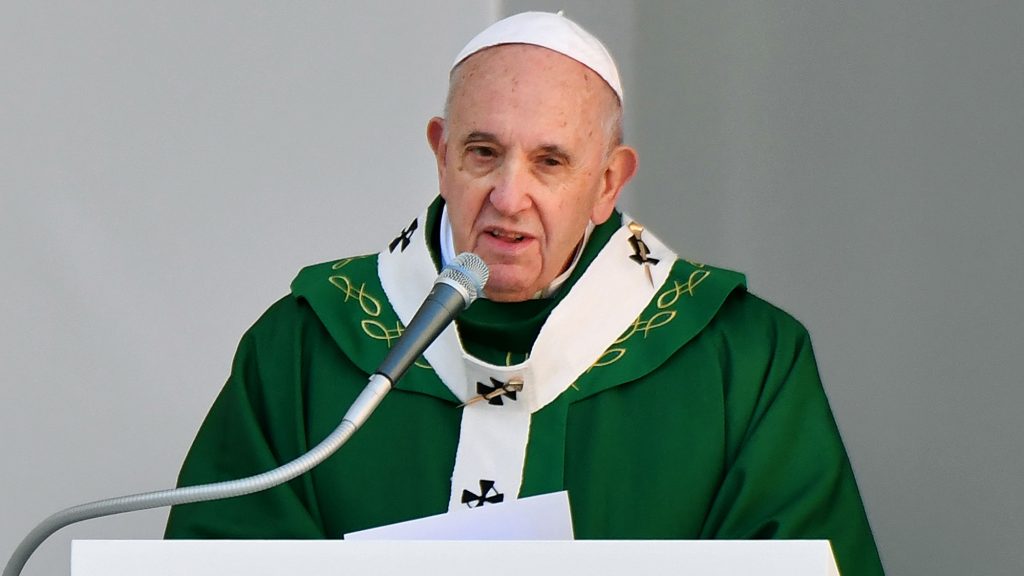
Pope Francis speaks as he celebrates an outdoors mass during a visit to Bari, southern Italy, on February 23, 2020 to address a conference entitled “Mediterranean: Frontier of Peace” which sees the participation of some 60 Catholic bishops from 19 nations bordering the Mediterranean. (Photo by Alberto PIZZOLI / AFP) (Photo by ALBERTO PIZZOLI/AFP via Getty Images)
VATICAN CITY—Stressing that ensuring the safety of all clergy members remained the Holy See’s primary concern, Pope Francis issued a statement Monday urging priests worldwide to refrain from molesting children over escalating coronavirus fears. “During this trying period, we are recommending all priests do their part to stem the spread of this deadly virus by temporarily ceasing all fondling of children in their congregations,” said the supreme pontiff, acknowledging that the announcement represented a severe measure but one justified by the increased susceptibility to the virus shown by elderly priests, deacons, and bishops who engage in pedophilia with infected boys or girls. “In the event a priest feels compelled to molest a child, we’re recommending they wear a face mask and thoroughly wash their hands with soap and warm water both before and after. Of course, we understand this is an urgent concern and hope to have it sorted out within the month.” Francis also cautioned priests against succumbing to the natural impulse to touch an altar boy’s face or mouth every few minutes. (theonion.com)
Alongside Homer Plessy, Mixed-Race Activists Used a Unique Legal Arsenal to Attack White Supremacy
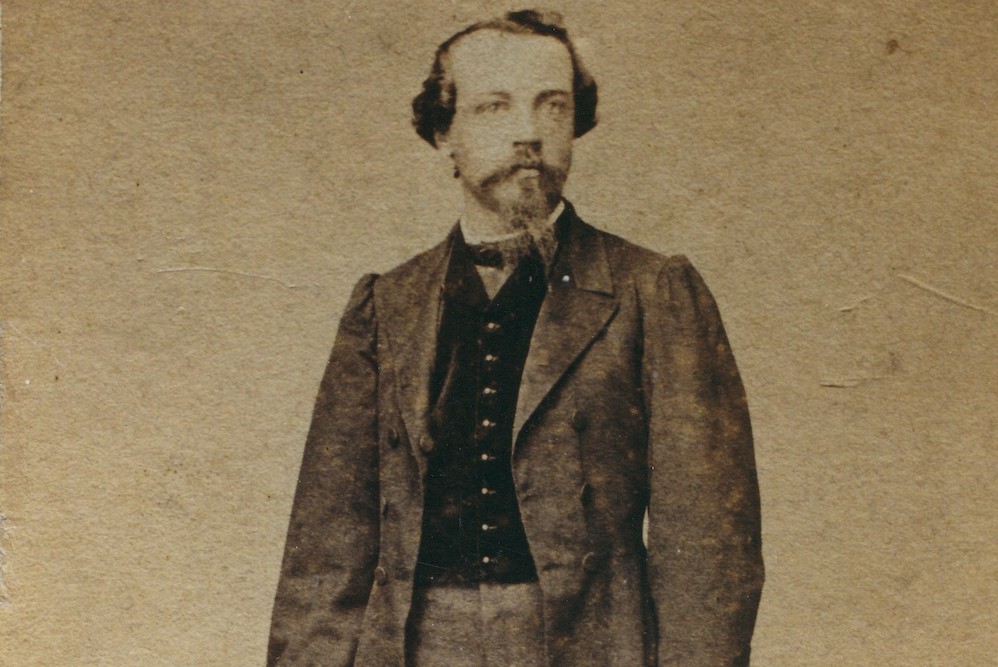
A photo of Arnold Bertonneau, taken around 1880. Bertonneau and other Creole activists fought racism by challenging the very concept of race itself. Courtesy of Thomas Bertonneau/The Orthosphere.
by DANIEL BROOK | MARCH 8, 2020 (zocalopublicsquare.com)
It took years of research for me to track down a photograph of the mysterious New Orleanian E. Arnold Bertonneau. Born in 1834, this Civil War-era civil rights pioneer was famous in his day but somehow has disappeared from the national consciousness. In 1864, Bertonneau lobbied President Lincoln in the White House for African American voting rights. In 1877, he filed the first-ever federal case challenging school segregation, Bertonneau vs. Board of Directors of City Schools, on behalf of his two school-age sons, who had been excluded from a whites-only school. Yet today, Bertonneau’s portrait hangs not in the Smithsonian but sits instead in the out-of-the-way upstate New York home of his great-grandson.
Finally coming face-to-face with Bertonneau’s image, I was shocked. I had been reading about Bertonneau for book research. But while Bertonneau fought valiantly for the rights of black Americans, he didn’t look “black” himself. In the photo, his skin was fair, his eyes were light, and his hair was wavy. In contemporary America he might read as Latino, with a complexion somewhere on the spectrum between Pope Francis pale and Marco Rubio tan. Looking at the late great Bertonneau reminded me that the way passersby perceive a stranger’s race on the streets of America doesn’t necessarily match their actual background. Indeed, one’s own ethnic background may not even be what one assumes it is—as genetic testing has recently made clear to millions of Americans.
The leading civil rights litigants of the Reconstruction era, including Bertonneau, lived these complex racial realities—and it led them to challenge racism by challenging the concept of race itself. Most were openly mixed-race Creoles from New Orleans with roots in both Africa and Europe. This gave them a piercing perspective on American white supremacy and a unique legal arsenal for attacking it.
The most famous civil rights plaintiff of them all, Homer Plessy, who challenged railcar segregation at the U.S. Supreme Court in 1896, was described in the African American New Orleans Crusader newspaper as being “as white as the average white Southerner.” To launch his case, he had had to out himself to the train conductor as mixed-race to get ejected from the whites-only car. Plessy’s ethnic background was estimated to be seven-eighths European and one-eighth African but it was impossible to pin down for sure. That was the whole point. As Plessy’s lawyers asked the Supreme Court justices, “Is not the question of race … very often impossible of determination?” Plessy’s case was an attempt to resist not merely segregation but binary racial labels like “white” and “colored” altogether.
It was only after Plessy, Bertonneau, and the other leaders of the first civil rights movement had been defeated—and indeed because of their defeat—that the black-white binary solidified. Even on the Census, multiracial options dwindled and then died out. Tellingly, on the 1910 Census, Homer Plessy was black but, in 1920, white.
These early Creole civil rights activists who fought against the constricting racial categories of “black” or “white” defined themselves not by color but by culture—much as Latinos in the U.S. do today. Creoles came in every shade and had no pretense to racial purity. What bound the community together was their linguistic roots in a Romance language—French and its Caribbean Kreyol off-shoots—and their Mediterranean-influenced mindset.
Following the Louisiana Purchase in 1803, as Latin American Nouvelle-Orléans/Nueva Orleans was turned into Anglo-American New Orleans, the Creole community was racialized by outsiders. Anglo-Americans, who were wary of influential free-born Creoles and who were increasingly making “whiteness” a prerequisite for citizenship, obsessed over who among the Creoles had family-tree roots in African soil. The Anglo-Americans began revoking rights, including suffrage, on the murky basis of “race.” Soon after the purchase, they passed an “anti-miscegenation” law requiring whites to marry whites, blacks to marry blacks, and biracial people to marry one another.
Activists like Bertonneau and Plessy, who descended from this third group, fought against all racial categorizations. They were skeptical of the Anglos’ concept of race and their arrogant presumption to assign it on sight. After all, Plessy had had to explicitly tell the train conductor that he was mixed-race to launch his test case.The leading civil rights litigants of the Reconstruction era, including Bertonneau, lived these complex racial realities—and it led them to challenge racism by challenging the concept of race itself.
For nearly 30 years, Creole activists brought a series of cases that needled the Anglo-Americans’ binary view of race. This legal tradition was launched at the height of Radical Reconstruction when the light-skinned newly elected Orleans Parish sheriff, Charles St. Albin Sauvinet, was refused a drink in a French Quarter bar in 1870 and responded by suing for “violation of his civil rights.” In court, the Creole Sauvinet explained that his roots were in the Caribbean, where race was no black-or-white matter. “Whether I am a colored man or not is a matter I myself do not know,” he told the court. And he pointed out that no one could know anyone’s race for sure. Of his two drinking buddies, he remarked, “Finnegan and Conklin who were with me are said to be white men. I do not know. To all appearances they are.” But, of course, as Sherriff Sauvinet himself proved, you couldn’t necessarily ascertain people’s backgrounds by sight.
Sauvinet’s line of argument was seconded by Creole civil rights plaintiff Josephine DeCuir in her challenge to riverboat segregation. In 1872, she’d bought a first-class “ladies’ cabin” ticket for a journey upriver from New Orleans only to be asked to move to the inferior “colored cabin.” The ship’s crew cuttingly referred that section as “the Freedman’s Bureau,” which DeCuir took as a grave insult since she’d been born free into a wealthy slave-holding family. In court, DeCuir, who had roots on the European, African, and North American continents, was described as being the color of a “law book.” To problematize the whole concept of race for the jury, her attorney called to the stand a light-skinned French Quarter resident of Caribbean descent, one Mr. Duconge. In New Orleans, where his Creole heritage was widely known, Duconge explained, he was considered a person of color but in the rest of America, where he was a stranger, he was considered a white man. Hoping to show the jury how absurd the American racial system looked—and, indeed, still looks—to the rest of the world, he offered the statement: “the difference between a white man and a colored man is that the colored man has a darker face than the white man, but you can find a quantity of colored men reputed to be colored men who have white faces.”
Creoles then, like Latinos now, accepted that in the New World—in the U.S. no less than the Caribbean and Latin America—people from different continents have been mixing for centuries. Ultimately, in this view, New World people have become a race unto ourselves—referred to as la raza in Spanish. But Anglo-Americans rejected this reality by engaging in the dastardly fool’s errand of retroactively sorting New World people back out into definitive races, a practice that continues to this day.
Unfortunately, the brilliant Creole legal strategy to challenge racism by challenging race did not win in its time. While Sheriff Sauvinet’s civil rights victory was upheld by the U.S. Supreme Court, the justices overturned DeCuir’s state court victory and Homer Plessy lost his precedent-setting case 7-to-1.
Learning of their defeat, the Creole Citizens’ Committee that had planned Plessy’s civil disobedience and funded his suit put out a statement: “Notwithstanding this decision … we … still believe that we were right.” Indeed, they were. The Supreme Court could permit the states to draw stark lines between black and white but that didn’t make actual Americans any less mixed.
An older Cuban-born gentleman illustrated this point precisely when he raised his hand after I presented at the Miami Book Fair last November. Recounting his introduction to race in America, he explained that he’d moved to Miami as an 8-year-old boy, in 1960, and at the neighborhood supermarket encountered his first segregated water fountains. Florida had lived under Jim Crow for more than half a century but to the boy it was brand new. Flummoxed, he asked his mother which fountain he should drink from. To the child, the people on the streets of Florida with their full range of skin tones didn’t look much different from the people on the streets of Cuba. But while Cubans acknowledged that they had mixed roots on different continents and thought of themselves, even in the same families, as lighter or darker, the Americans insisted that everyone was distinctly either “white” or “colored.” While Cubans considered “Cuban” to be an ethnicity, Americans refused to see “American” that way—even though they too were a New World melting-pot society.
On his mother’s advice, the boy chose the whites-only water-fountain—after all, he was light-skinned and it was clearly the superior appliance. His decision echoed E. Arnold Bertonneau’s in the previous century. After losing his federal case challenging school segregation and the racial binary, Bertonneau moved out to California and he, too, became “white.”
Americans long ago abolished the segregated water fountains but the binary racial mindset survives both in the American psyche and in American outcomes in health, wealth, education, and criminal justice. But the Latino concept of la raza has the potential to again take up the torch of challenging American racism by challenging the idea of race itself. Through this lens, America is not a society of warring tribes but a dysfunctional family. Warring tribes can only make peace treaties; dysfunctional families are better adept to reconcile and heal. At the dawn of Jim Crow, W.E.B. DuBois observed, “the problem of the 20th century is the problem of the color-line.” The question of the 21st century may be whether we continue to see ourselves divided by race or unified as la raza.
In much of the world, gender is viewed as binary: man or woman, each assigned characteristics and traits designated by biological sex. But that’s not the case everywhere, says France Villarta. In a talk that’s part cultural love letter, part history lesson, he details the legacy of gender fluidity and inclusivity in his native Philippines — and emphasizes the universal beauty of all people, regardless of society’s labels.
This talk was presented at a TED Institute event given in partnership with Wells Fargo. TED editors featured it among our selections on the home page. Read more about the TED Institute.
Samuel Rivera In this video, Joe Rogan talks about how to find happiness and live a fulfilled life. I think this is one that everyone needs to listen to. Share this with someone that needs to be reminded of what’s truly important. Special thank you to Sophia Nilsson for allowing me to use footage from her golding video. Go check her out here: https://www.youtube.com/watch?v=aNNZz… Excerpts are taken from JRE podcast numbers 1291, 1333 & 1404.
In Islam, Barakah or Baraka (Arabic: بركة “blessing”) is a blessing power,[1] a kind of continuity of spiritual presence and revelation that begins with God and flows through that and those closest to God.[2]
Baraka can be found within physical objects, places, and people, as chosen by God. This force begins by flowing directly from God into creation that is worthy of baraka. These creations endowed with baraka can then transmit the flow of baraka to the other creations of God through physical proximity or through the adherence to the spiritual practices of the Islamic prophet Muhammad. God is the sole source of baraka and has the power to grant and withhold baraka.
Islamic mysticism
Baraka is a prominent concept in Islamic mysticism, particularly Sufism. It pervades Sufi texts, beliefs, practices, and spirituality. Sufism emphasizes the importance of esoteric knowledge and the spiritual union with God through the heart. Baraka symbolizes this connection between the divine and the worldly through God’s direct and intentional blessing of those that are most reflective of Him and his teachings.
Baraka is not a state, it is a flow of blessings and grace. It flows from God to those that are closest to God, such as saints and prophets. Those that have received baraka are thought to have the abilities to perform miracles (karamat), such as thought-reading, healing the sick, flying, and reviving the dead.[3][page needed] However, according to Abd al-Karīm ibn Hawāzin Qushayri, a prominent Sufi mystic, the use of these miracles and the actual possession of these abilities are not indicative of a saint’s status, however, the performance of these miracles by prophets is important to establish credentials.[3][page needed]
Alan Eichler The legendary singer-pianist Hadda Brooks made this rare TV appearance in 1994, performing one of her big hits, “Anytime, Anyplace, Anywhere” and chatting with host Bill McCuddy.
Consciousness, sexuality, androgyny, futurism, space, the arts, science, astrology, democracy, humor, books, movies and more