Want to join the debate? Check out the Intelligence Squared website to hear about future live events and podcasts: http://www.intelligencesquared.com
__________________________
Dystopian books and films are in the zeitgeist. Reflecting the often dark mood of our times, Intelligence Squared are staging a contest between two of the greatest dystopian novels, ‘Brave New World’ and ‘Nineteen Eighty-Four’. Each book captured the nightmares of the 1930s and 40s. But which vision looks more prescient to us now in the 21st century? Are we living in George Orwell’s sinister surveillance state? Or in Aldous Huxley’s vapid consumerist culture? To battle it out, we brought two celebrated writers, Adam Gopnik and Will Self, to our stage.
After Donald Trump was elected, it seemed as if ‘Nineteen Eighty-Four’ had clinched it. The book shot to the top of the bestseller charts. It felt so ominously familiar. In Orwell’s dystopia, the corporate state controls the news, insisting that ‘whatever the Party holds to be truth is truth’. That sounds very like Trump’s ‘alternative facts’, and the war he is waging on the ‘fake news’ media. Orwell imagined two-way telescreens spying on every citizen’s home. Today we have Amazon’s ‘always listening’ Alexa device, while Google, Facebook and the security agencies hoover up our personal data for their own ends. Orwell also described an Inner Party – two percent of the population – enjoying all the privileges and political control. Isn’t that scarily close to the ‘one percent’, reviled for their wealth and influence by anti-capitalists today? No wonder everyone rushed out to buy the book.
But Orwell’s critics say ‘Nineteen Eighty-Four’ is a dated dystopia, a vision that died along with communism. The novel that better resonates with our present, they say, is ‘Brave New World’. Here Aldous Huxley imagined a plastic techno-society where sex is casual, entertainment light and consumerism rampant. There are pills to make people happy, virtual reality shows to distract the masses from actual reality, and hook-ups to take the place of love and commitment. Isn’t that all a bit close to home? Huxley even imagined a caste system created by genetic engineering, from alpha and beta types right down to a slave underclass. We may not have gone down that road, but gene-editing might soon enable Silicon Valley’s super-rich to extend their lifespans and enhance the looks and intelligence of their offspring. Will we soon witness the birth of a new genetic super-class?
Both these novels imagined extraordinary futures, but which better captures our present and offers the keener warning about where we may be heading?
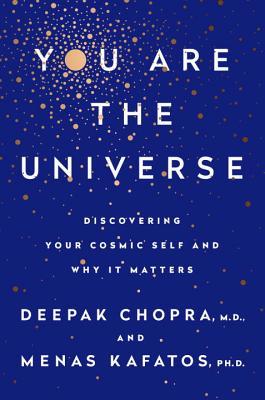
Now a New York Times Bestseller! “A riveting and absolutely fascinating adventure that will blow your mind wide open!” –Dr. Rudolph E. Tanzi
Deepak Chopra joins forces with leading physicist Menas Kafatos to explore some of the most important and baffling questions about our place in the world.
What happens when modern science reaches a crucial turning point that challenges everything we know about reality? In this brilliant, timely, and practical work, Chopra and Kafatos tell us that we’ve reached just such a point. In the coming era, the universe will be completely redefined as a “human universe” radically unlike the cold, empty void where human life is barely a speck in the cosmos.
You Are the Universe literally means what it says–each of us is a co-creator of reality extending to the vastest reaches of time and space. This seemingly impossible proposition follows from the current state of science, where outside the public eye, some key mysteries cannot be solved, even though they are the very issues that define reality itself:
What Came Before the Big Bang?
Why Does the Universe Fit Together So Perfectly?
Where Did Time Come From?
What Is the Universe Made Of?
Is the Quantum World Linked to Everyday Life?
Do We Live in a Conscious Universe?
How Did Life First Begin?
“The shift into a new paradigm is happening,” the authors write. “The answers offered in this book are not our invention or eccentric flights of fancy. All of us live in a participatory universe. Once you decide that you want to participate fully with mind, body, and soul, the paradigm shift becomes personal. The reality you inhabit will be yours either to embrace or to change.” What these two great minds offer is a bold, new understanding of who we are and how we can transform the world for the better while reaching our greatest potential.
Deepak Chopra, MD serves as the Founder and Chairman of The Chopra Foundation, and Co-Founder of the Chopra Center for Wellbeing.
As a global leader and pioneer in the field of mind-body medicine, Chopra transforms the way the world views physical, mental, emotional, spiritual, and social wellness. Known as a prolific author of eighty books books with twenty-two New York Times best sellers in both fiction and non-fiction, his works have been published in more than forty-three languages.
Chopra’s medical training is in internal medicine and endocrinology. He is a Fellow of the American College of Physicians and a member of the American Association of Clinical Endocrinologists. Dr. Chopra serves as Co-Founder and Chairman of The Chopra Center for Wellbeing, Founder of The Chopra Well on YouTube, Adjunct Professor of Executive Programs at Kellogg School of Management at Northwestern University, Adjunct Professor at Columbia Business School, Columbia University, Assistant Clinical Professor, in the Family and Preventive Medicine Department at the University of California, San Diego, Health Sciences, Faculty at Walt Disney Imagineering, and Senior Scientist with The Gallup Organization.
GlobeIn acknowledges Chopra as “one of top ten most influential spiritual leaders around the world.” TIME magazine has described Dr. Chopra as “one of the top 100 heroes and icons of the century and credits him as “the poet-prophet of alternative medicine.”
Our society is in the midst of a social crisis, says op-ed columnist and author David Brooks: we’re trapped in a valley of isolation and fragmentation. How do we find our way out? Based on his travels across the United States — and his meetings with a range of exceptional people known as “weavers” — Brooks lays out his vision for a cultural revolution that empowers us all to lead lives of greater meaning, purpose and joy.
Get TED Talks recommended just for you! Learn more at https://www.ted.com/signup.
Law Works Action
Published on Jun 27, 2019
Have you had a chance to read the Mueller Report yet? If not, we hope you’ll watch it instead!
The Mueller Report is required reading for every American who cares about defending our democracy. Now, thanks to our friends at Law Works, the Mueller Report will be required viewing! It shows that President Trump likely obstructed justice and that President Trump’s campaign not only knew Russia wanted them to win, but welcomed it.
The Investigation was written by Robert Schenkkan, a Pulitzer Prize and Tony Award-winning screenwriter and playwright. The live cast includes Annette Bening, Kevin Kline, John Lithgow, Frederick Weller, Ben Mckenzie, Michael Shannon, Noah Emmerich, Justin Long, Jason Alexander, Gina Gershon, Wilson Cruz, Joel Grey, Alyssa Milano, Kyra Sedgwick, Alfre Woodard, Piper Perabo, Zachary Quinto, and Aidan Quinn, with additional participation by Sigourney Weaver, Julia Louis-Dreyfus, Mark Hamill and more.
At age 18, Jemima Wilkinson dedicated herself to religion. Born in 1752, in Cumberland, Rhode Island, she attended Quaker meetings with her family and also went to the more mainline Protestant New Light Baptist church. Through dedicated studying, she became well-versed in both the Hebrew scriptures and the Gospels.
In 1776, the warship Columbus docked in Providence, bringing with it the often-deadly disease typhus, which Wilkinson caught. Like many infected people, she developed a high fever and became ill. As frequently happens with a high fever, Wilkinson had visions. Her visions were religious in nature. She saw “archangels, descending from the East, with golden crowns upon their heads [proclaiming] room, room, room in the many mansions of eternal glory for thee!”
We do not know whether Wilkinson’s vision was truly mystical or the result of a fevered hallucination. But when she recovered from typhus, Wilkinson had changed. She told her friends and family that Jemima Wilkinson had died and that she was a new person, neither male nor female. She took the name “Publick Universal Friend.” From that day onward, Friend refused to use the self-describing words “she” or “he.”
Instead of women’s clothing, Publick Universal Friend chose to wear long robes like a priest or monk. The robes hid the body underneath, and in them, Friend looked like neither a man nor a woman. Newspaper accounts of the time show that most people thought Friend was a man.
Publick Universal Friend began to preach a message of universal friendship, speaking out against slavery and alcohol and urging everyone, even married couples, to refrain from sex. A tall impressive figure with a strong voice, Friend had absolute faith in these beliefs. Friend’s sermons were reported on and published in newspapers, leading to fame and inspiring a following of well-educated men and women. Writers at the time still wondered if Friend was male or female, although the many people who listened to and followed Friend did not seem to care.
Perhaps Friend’s refusal to be seen as male or female was what attracted followers from throughout Rhode Island, Pennsylvania, and Massachusetts. Many people loved Publick Universal Friend, whom they saw as a messenger from God. However, others found Friend’s message and gender-free appearance disturbing, and on at least one occasion, they confronted Friend in the street.
After a decade of preaching, Publick Universal Friend decided to start a colony, named Jerusalem, in central New York state—a place where “no Intruding foot could set.” So, in 1788, Friend and followers set out for land west of the Genesee River in New York. At that time, most of northern New York was home to the Haudenosaunee Confederacy (sometimes called the Iroquois). Friend had no worries about relations with Native Americans and befriended them. Preaching universal love and tolerance, Friend and Friend’s followers supported many of the Native people’s basic rights and stood with them against other colonists by insisting that signed treaties be honored. The Native Americans called Friend the “Great Woman Preacher.”
Ironically, Publick Universal Friend’s success became a problem. The colony did so well at building and farming that more and more unbelievers came to share the wealth. Because of the prohibition on sexual activity, the colony had no new children. Slowly, the religious colony dwindled as Publick Universal Friend’s followers died. Friend died in 1819.
Publick Universal Friend appeared at a pivotal moment in American history, right in the middle of the American Revolution and the start of a new country. The United States was evolving and growing in exciting ways, and gender roles were also changing. For many men, this meant highlighting aspects of traditional, heterosexual masculinity. The image of the frontier woodsman or the revolutionary fighter was an important identity to separate American men from what they saw as the “sissified” British man. Daniel Boone, a former Revolutionary War soldier whose exploits as a hunter, trapper, and explorer became folklore, exemplified the rugged “new” American man.
For women, changing gender roles often meant exploring new, more independent ways of behaving. Abigail Adams, the wife of founding father John Adams, for example, ran the family farm, invested their money, conducted the family business (and raised the children) when he was at the Continental Congress, the group of delegates from each colony that governed the newly formed United States during the Revolution. Women were free to enter political debates and sign petitions.
Publick Universal Friend viewed gender in a totally different way, by breaking out of the traditional expectations. Being “neither male nor female,” Friend felt free to behave without meeting the gender expectations of the time. Publick Universal Friend preached and practiced sexual abstinence, so the words “homosexual,” “gay,” or even “queer” do not apply. All we know of Friend is through the preaching and writing. It would be inaccurate to use any modern terms here in a description.
For women, changing gender roles often meant exploring new, more independent ways of behaving.
How can we think about Friend’s gender? What words do we use? Words are important. In the case of Friend, the lack of language is also important. Words not only express what we want to communicate but also influence how we think and how we see and construct the world around us. We all feel we know what the word “red” means: we can see the color in our minds. On the other hand, it is not as simple as that. There are many words for different shades of red—“crimson,” “carmine,” “scarlet,” “rose,” “ruby,” “vermillion,” “cardinal,” “claret”—all of which are similar yet distinctly different. The same is true for how we think about people and gender. It might be useful to think of Friend’s gender as a shade of gender and—as Friend’s followers did—not worry too much about it.
We don’t know if any of Friend’s followers followed Friend’s gender-free example. We can guess, based on diaries and letters, that large numbers of people were intrigued with the idea that gender was not fixed. Maybe they understood that the traditional ideas about gender were limiting. Or maybe they were fascinated by the idea that someone could be as bold to break from firmly established conventions. Perhaps in this new country, where so much seemed possible, the traditional limits of gender were also up for reinvention.
Publick Universal Friend’s life and ministry spanned the years at the very beginning of the United States. For many colonists, political freedom meant freedom from the British Crown. It meant not paying taxes to the king, and it meant being able to make your own laws. For some people, though, like Friend, it meant the freedom to break out of the usual roles in which society placed you.
Excerpted from A Queer History of the United States for Young People by Michael Bronski, adapted by Richie Chevat, (Beacon Press, 2019). Reprinted with permission by Beacon Press.
The Black Cat Tavern protest of 1967. Photo courtesy USC Digital Archive.
It’s been 50 years since those infamous hot nights in June 1969 when LGBTQ patrons at the Stonewall Inn fought back against a brutal police raid. What started out as a spontaneous attack on a New York City gay bar turned into a multi-night uprising in the streets of Greenwich Village.
Those nights have been widely credited as the birthplace of the modern-day LGBTQ rights movement. While there’s no denying Stonewall was a key turning point for the movement, it was not nearly the first notable confrontation between LGBTQ people and police.
In the early 1950s, there was a burgeoning movement of gay men, lesbians, and transgender peope fighting for their civil rights. Since then, historians have documented more than thirty LGBTQ demonstrations, sit-ins, protests, and riots that occurred in the U.S. in the years leading up to the 1969 Stonewall uprising.
Here are just five of those important protests worth remembering alongside Stonewall.
Still from Kent Mackenzie’s 1961 film “The Exiles,” via Wikimedia commons.
Cooper’s Do-Nuts Riot, Los Angeles, 1959
In May of 1959, LGBTQ customers rioted at a 24-hour cafe in Los Angeles called Cooper’s Do-Nuts after being harassed by a group of police officers. Because cross-dressing was illegal at the time, police could use the presence of drag queens or transgender people in an establishment as the basis for making an arrest or raid. And that’s exactly what they did.
That night, members of the Los Angeles Police Department attempted to arrest two drag queens, two sex workers, and a gay man cruising other patrons, according to most accounts. One of those arrested was novelist John Rechy, who wrote about the incident in his now-classic debut novel City of Night. In an interview with historian Lillian Faderman, Rechy recalled onlookers throwing coffee cups, doughnuts, and trash at the police until he and the other detainees were able to escape.
Having taken place ten years before Stonewall, this incident is considered one of the earliest known LGBTQ uprisings in the U.S.
Via Special Collections Research Center, Temple University Libraries
Dewey’s Restaurant Sit-in, Philadelphia, 1965
Influenced heavily by the Black civil rights movement and demonstrations like the 1955 Montgomery Bus Boycotts and the 1960 Woolworth’s lunch counter sit-in, LGBTQ people became more defiant in their political activism during the 1960s.
“As the homophile movement of the 1950s grew stronger into the 60s and 70s,” says Marc Stein, professor of history at San Francisco State University, “LGBTQ people began to feel emboldened and discovered the courage they needed during a powerful period of social movements.” One example is the earliest known LGBTQ sit-in, which took place on April 25, 1965 at Dewey’s lunch counter in Philadelphia. The eatery had become a hub for LGBTQ people in Philly, but that spring, staff began denying service to any customers who appeared to be gay or gender non-conforming. On April 25, approximately 150 people were denied service for that reason, according to Stein’s City Of Sisterly And Brotherly Loves: Lesbian And Gay Philadelphia, 1945–1972. But three teenagers decided that they wouldn’t leave.
The police were called and the three were arrested, in addition to Clark Polak, a gay-rights leader in Philidelphia who rushed to the scene to help the three protesters obtain a lawyer, and was subsiquently arrested by police. All four were found guilty of disorderly conduct.
A week later, on May 2, 1965, three more people conducted a second sit-in at Dewey’s to protest the arrests. When they refused to leave, the restaurant owners once again called the police. This time, however, the police conceded that they had no reason to force the protestors out. Dewey’s agreed to stop denying LGBTQ people service.
Photo by Henry Leleu, via the Gay, Lesbian, Bisexual, Transgender Historical Society
Compton’s Cafeteria Riot, San Francisco, 1966
In August 1966, after management and police harassed a group of transgender women and drag queens at Compton’s Cafeteria in San Francisco—a late-night hangout for many local queers and sex workers at the time—the city’s LGBTQ community responded with two nights of resistance.
It was not the first time that customers of Compton’s had clashed with the police, but on this summer night, clientele had had enough. “The police treated trans people and street queens with impunity. They would often be forcefully strip-searched and charged with nuisance crimes and given very brutal treatment,” says Susan Stryker, director of the 2015 documentary about the riot, Screaming Queens. “There had never been any effective resistance to police harassment until Compton’s.”
The protest began with peaceful picketing against Compton’s increasingly discriminatory service, but police were eventually called when things got rowdy. According to accounts of the night, when a police officer then tried to arrest one of the trans women present, she threw her coffee in his face. That’s when all hell broke loose. In Screaming Queens, Amanda St. Jaymes recalls dishes and furniture being thrown all over the diner. As the fighting spilled into the street, dozens of trans people, drag queens, and gay men fought back against the police and smashed the glass windows of the restaurant.
Although smaller in scale than the Stonewall riots, which occurred three years later, the Compton’s riot invigorated the local LGBTQ community in the Tenderloin district of San Francisco to begin organizing itself. In the months following the riot, the community began to build a network of medical and social support services for trans people, which led to the creation of the National Transexual Counseling Unit in the late 1960s.
Dick Leitsch on December 30, 1965. Photo by Louis Liotta/New York Post Archives /(c) NYP Holdings, Inc. via Getty Images
Mattachine Society Sip-in, New York City, 1966
Another pivotal LGBTQ demonstration was the 1966 “Sip-in” at Julius’ Bar in New York City. At the time, it was common practice for bars to refuse service to gay, trans, and gender-nonconforming people. Although there was no law explicitely sanctioning the descrimination, bars had the right to refuse service to “disorderly” patrons, and at the time, being homosexual was enough for many people to consider you disorderly. On April 21, Dick Leitsch and two other members of the New York chapter of the Mattachine Society, one of the earliest gay rights organizations in the U.S., decided they would try to change that.
In an effort to bring scrutiny to the regulation, the group, along with four newspaper reporters, headed to Julius’ Bar in Manhattan, where a man had been arrested for “gay activity” a few days prior after being entrapped by a police officer. The bartender poured them drinks when they arrived. But, as Leitsch recalls on an episode of the podcast Making Gay History, when they identified themselves as homosexuals, the bartender placed a hand over one of the glasses and said, “I can’t serve you if you’re gay. You know that.” That moment was captured in a now-iconic photo by Village Voice photographer Fred McDarrah, which later ran in the newspaper.
“We are gay people and we just want to be served food and liquor, and we are orderly, and we intend to remain orderly,” the group responded. “Please serve us.”
“For Dick, entrapment was the single most important issue for the gay rights movement to tackle. If you can’t get together in public places without risk of arrest, you can’t live your life,” says host and historian Eric Marcus on Making Gay History. “If you were a gay man in New York City back then, wherever you went, you risked falling prey to an undercover police officer doing his very best to trick you into letting down your guard, and showing an interest in him. Back then, an arrest like that spelled personal, professional, and financial ruin for many.”
The demonstration ultimately lead to two lawsuits that struck down the New York State Liquor Authority’s practice of taking away liquor licenses based on bars having queer clientele— opening the door for gay bars to begin opening and thriving in the city—and an agreement by New York City Mayor John Lindsay to end entrapment practices by police in gay bars. While these practices weren’t totally wiped out by these victories, they did decrease.
Photo via USC Digital Archive.
Black Cat Tavern Riot, Los Angeles, 1967
On New Year’s Eve 1966, the newly established Black Cat Tavern on Los Angeles’ Sunset Boulevard was filled with LGBTQ people ringing in the new year. That was until undercover police officers who had been waiting in the crowd began arresting patrons for exchanging midnight kisses. Police brutally beat several of the patrons and detained 16 people that night, two of whom escaped. As detailed in the Faderman’s Gay L. A.: A History of Sexual Outlaws, Power Politics, And Lipstick Lesbians, the police chased the men down the street to a bar called, New Faces, on Sanborn Avenue. There, the officers assaulted the club’s owner and beat her two bartenders unconscious. One of the bartenders, Robert Haas, suffered a ruptured spleen from the attack. Once he recovered, he was charged with felony assault of a police officer. Six men were later changed and found guilty of lewd conduct that night at the Black Cat Tavern.
Six weeks after the raid, on February 11, 1967, 200 people gathered at the Black Cat to peacefully picket outside the bar in protest of police harassment and brutality.
The demonstration was organized by a group called P.R.I.D.E. (Personal Rights in Defense and Education), who became inspired to publish a newsletter called the Los Angeles Advocate. It eventually transformed into a nationally distributed magazine known today as the Advocate.
In a Fourth of July holiday special, we hear the words of Frederick Douglass. Born into slavery around 1818, Douglass became a key leader of the abolitionist movement. On July 5, 1852, in Rochester, New York, he gave one of his most famous speeches, “The Meaning of July Fourth for the Negro.” He was addressing the Rochester Ladies Antislavery Society. This is actor James Earl Jones reading the speech during a performance of historian Howard Zinn’s acclaimed book, “Voices of a People’s History of the United States.” He was introduced by Zinn.
Consciousness, spirituality, biography, sexuality, androgyny, futurism, space, the arts, science, astrology, democracy, humor, books, movies and more