Amid our Nation’s Mounting Democracy Crisis, Hope Is Power

Hope ignites our brains toward solutions

Let us drop any thought that hope is a weakling. (Photo: Samuel Corum/Getty Images)

Yeah, I know. “Hope” gets shoved into a corner called “nice” where weaklings huddle who can’t face hard realities. In fact, hope and power don’t often show up in the same sentence.

Truth is, though, hope is a tap root of power.

First, note that the word power derives from the Latin, posse, “to be able.” It is our capacity to act. So understood, power seems rather impossible without its partner, hope; for most of us have a hard time acting without at least a bit of it.

Then consider the work of Harvard’s Srini Pillay, who grapples with hope’s power from the world of psychiatry and neuroscience. In Life Unlocked he explains that hope has the power to help reorganize our brains toward solutions. “When the brain thinks that something is possible, it sketches out the route for achieving it.”

“Hope is not an answer,” he underscores, but because it stimulates the imagination “hope helps us to pose the right questions.” And, I’ve learned that asking the right questions is foundational to achieving just about any goal.

And then Pillay adds the kicker.

Because “hope seems to travel in the same dungeons [parts of the brain] as fear, it might be a good soldier to employ if we want to meet fear.” That sure sounds like power to me.

And there’s yet another way hope wields power. It is the power to attract. When I sense hope in someone, immediately I am attracted. I want some of that!

And, in an era of multiplying threats, don’t all of us, more than ever, want others near us?

Given our nation’s mounting democracy crisis, with a president violating norms and rules that we long thought had protected us, don’t we want others—in fact, millions more—joining together in the good work of fixing our democracy’s system flaws that allowed this sad turn? Don’t we want citizens closing the doors to big, secret money  drowning out the voices of regular citizens?

Yes. Yes. Yes.

We want to attract strangers—people who’ve never ever been engaged in public actions—to join the work of hope that is the Democracy Movement.

Hope, I’m convinced, is one key to the birth and speedy growth of Democracy Initiative, an organization that in just five years has attracted nearly 70 national organizations—from labor to the environment to racial justice—representing 40 million Americans committed to pursuing reforms together to make democracy work for all of us.

A scowl of anger or despair won’t draw in more new faces.  Hope will. Hope is contagious, and that’s a really good thing.

So, let us drop any thought that hope is a weakling.

No. It’s pure muscle.

Hope ignites our brains toward solutions. It gets us asking the right questions. It counters fear. It attracts others.  Wow.

Yes, hope is power, what we need now more than ever to fortify us to act boldly.

Biography: Norbert Wiener

Norbert Wiener (November 26, 1894 – March 18, 1964) was an American mathematician and philosopher. He was a professor of mathematics at the Massachusetts Institute of Technology (MIT). A child prodigy, Wiener later became an early researcher in stochastic and mathematical noise processes, contributing work relevant to electronic engineeringelectronic communication, and control systems.

Wiener is considered the originator of cybernetics, a formalization of the notion of feedback, with implications for engineeringsystems controlcomputer sciencebiologyneurosciencephilosophy, and the organization of society.

Biography

Youth

Wiener was born in Columbia, Missouri, the first child of Leo Wiener and Bertha Kahn, Jews[3] from Poland and Germany, respectively. Through his father, he was related to Maimonides, the famous rabbi, philosopher and physician from Al Andalus, as well as to Akiva Eger, chief rabbi of Posen from 1815 to 1837.[4] Leo had educated Norbert at home until 1903, employing teaching methods of his own invention, except for a brief interlude when Norbert was seven years of age. Earning his living teaching German and Slavic languages, Leo read widely and accumulated a personal library from which the young Norbert benefited greatly. Leo also had ample ability in mathematics and tutored his son in the subject until he left home. In his autobiography, Norbert described his father as calm and patient, unless he (Norbert) failed to give a correct answer, at which his father would lose his temper.

He became an agnostic.[5]

After graduating from Ayer High School in 1906 at 11 years of age, Wiener entered Tufts College. He was awarded a BAin mathematics in 1909 at the age of 14, whereupon he began graduate studies of zoology at Harvard. In 1910 he transferred to Cornell to study philosophy.

Harvard and World War I

The next year he returned to Harvard, while still continuing his philosophical studies. Back at Harvard, Wiener became influenced by Edward Vermilye Huntington, whose mathematical interests ranged from axiomatic foundations to engineering problems. Harvard awarded Wiener a Ph.D. in 1912, when he was merely 17 years old, for a dissertation on mathematical logic, supervised by Karl Schmidt, the essential results of which were published as Wiener (1914). In that dissertation, he was the first to state publicly that ordered pairs can be defined in terms of elementary set theory. Hence relations can be defined by set theory, thus the theory of relations does not require any axioms or primitive notions distinct from those of set theory. In 1921, Kazimierz Kuratowski proposed a simplification of Wiener’s definition of ordered pairs, and that simplification has been in common use ever since. It is (x, y) = {{x}, {x, y}}.

In 1914, Wiener traveled to Europe, to be taught by Bertrand Russell and G. H. Hardy at Cambridge University, and by David Hilbert and Edmund Landau at the University of Göttingen. During 1915–16, he taught philosophy at Harvard, then was an engineer for General Electric and wrote for the Encyclopedia Americana. Wiener was briefly a journalist for the Boston Herald, where he wrote a feature story on the poor labor conditions for mill workers in Lawrence, Massachusetts, but he was fired soon afterwards for his reluctance to write favorable articles about a politician the newspaper’s owners sought to promote.[6]

Although Wiener eventually became a staunch pacifist, he eagerly contributed to the war effort in World War I. In 1916, with America’s entry into the war drawing closer, Wiener attended a training camp for potential military officers, but failed to earn a commission. One year later Wiener again tried to join the military, but the government again rejected him due to his poor eyesight. In the summer of 1918, Oswald Veblen invited Wiener to work on ballistics at the Aberdeen Proving Ground in Maryland.[7]Living and working with other mathematicians strengthened his interest in mathematics. However, Wiener was still eager to serve in uniform, and decided to make one more attempt to enlist, this time as a common soldier. Wiener wrote in a letter to his parents, “I should consider myself a pretty cheap kind of a swine if I were willing to be an officer but unwilling to be a soldier.”[8] This time the army accepted Wiener into its ranks and assigned him, by coincidence, to a unit stationed at Aberdeen, Maryland. World War I ended just days after Wiener’s return to Aberdeen and Wiener was discharged from the military in February 1919.[9]

After the war

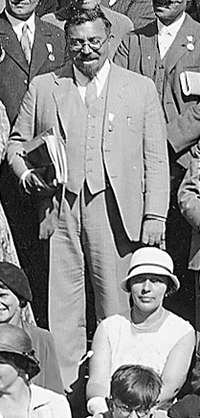
Norbert Wiener was regarded as a semi-legendary figure at MIT

Norbert (standing) and Margaret (sitting) Wiener at the International Congress of Mathematicians, Zurich 1932

Wiener was unable to secure a permanent position at Harvard, a situation he blamed largely on anti-semitism at the university and in particular on the antipathy of Harvard mathematician G. D. Birkhoff.[10] He was also rejected for a position at the University of Melbourne. At W. F. Osgood’s suggestion, Wiener became an instructor of mathematics at MIT, where he spent the remainder of his career, becoming promoted eventually to Professor. There is a photograph of him prominently displayed in one of the hallways, often used in giving directions.

In 1926, Wiener returned to Europe as a Guggenheim scholar. He spent most of his time at Göttingen and with Hardy at Cambridge, working on Brownian motion, the Fourier integralDirichlet’s problem, harmonic analysis, and the Tauberian theorems.

In 1926, Wiener’s parents arranged his marriage to a German immigrant, Margaret Engemann; they had two daughters. His sister, Constance, married Philip Franklin. Their daughter, Janet, Wiener’s niece, married Václav E. Beneš.[11]

Many tales, perhaps apocryphal, were told of him at MIT, especially concerning his absent-mindedness. It was said that he returned home once to find his house empty. He inquired of a neighborhood girl the reason, and she said that the family had moved elsewhere that day. He thanked her for the information and she replied, “That’s why I stayed behind, Daddy!”[12]

In the run-up to World War II (1939–45) Wiener became a member of the China Aid Society and the Emergency Committee in Aid of Displaced German Scholars.[13] He was interested in placing scholars such as Yuk-Wing Lee and Antoni Zygmund who had lost their positions.[14]

During and after World War II

During World War II, his work on the automatic aiming and firing of anti-aircraft guns caused Wiener to investigate information theory independently of Claude Shannon and to invent the Wiener filter. (To him is due the now standard practice of modeling an information source as a random process—in other words, as a variety of noise.) His anti-aircraft work eventually led him to formulate cybernetics.[15] After the war, his fame helped MIT to recruit a research team in cognitive science, composed of researchers in neuropsychology and the mathematics and biophysics of the nervous system, including Warren Sturgis McCullochand Walter Pitts. These men later made pioneering contributions to computer science and artificial intelligence. Soon after the group was formed, Wiener suddenly ended all contact with its members, mystifying his colleagues. This emotionally traumatized Pitts, and led to his career decline. In their biography of Wiener, Conway and Siegelman suggest that Wiener’s wife Margaret, who detested McCulloch’s bohemian lifestyle, engineered the breach.[16]

Wiener later helped develop the theories of cybernetics, robotics, computer control, and automation. He discussed the modeling of neurons with John von Neumann, and in a letter from November 1946 von Neumann presented his thoughts in advance of a meeting with Wiener.[17]

Wiener always shared his theories and findings with other researchers, and credited the contributions of others. These included Soviet researchers and their findings. Wiener’s acquaintance with them caused him to be regarded with suspicion during the Cold War. He was a strong advocate of automation to improve the standard of living, and to end economic underdevelopment. His ideas became influential in India, whose government he advised during the 1950s.

After the war, Wiener became increasingly concerned with what he believed was political interference with scientific research, and the militarization of science. His article “A Scientist Rebels” for the January 1947 issue of The Atlantic Monthly[18] urged scientists to consider the ethical implications of their work. After the war, he refused to accept any government funding or to work on military projects. The way Wiener’s beliefs concerning nuclear weapons and the Cold War contrasted with those of von Neumann is the major theme of the book John Von Neumann and Norbert Wiener.[19][citation needed]

Wiener was a participant of the Macy conferences. He died in March 1964, aged 69, in Stockholm, from a heart attack. Wiener and his wife are buried at the Vittum Hill Cemetery in Sandwich, New Hampshire.

Work

Information is information, not matter or energy.

Wiener was an early studier of stochastic and mathematical noise processes, contributing work relevant to electronic engineeringelectronic communication, and control systems. It was Wiener’s idea to model a signal as if it were an exotic type of noise, giving it a sound mathematical basis. The example we give our students nowadays is that English text could be modeled as a random string of letters and spaces, where each letter of the alphabet (and the space) has an assigned probability. But Wiener dealt with analog signals, where such a simple example doesn’t exist. Wiener’s early work on information theory and signal processing was limited to analog signals, and was largely forgotten with the development of the digital theory.[23]

Wiener originated cybernetics, a formalization of the notion of feedback, with many implications for engineeringsystems controlcomputer sciencebiologyphilosophy, and the organization of society.

Wiener’s work with cybernetics influenced Gregory Bateson and Margaret Mead, and through them, anthropologysociology, and education.[24]

In the mathematical field of probability, the “Wiener sausage” is a neighborhood of the trace of a Brownian motion up to a time t, given by taking all points within a fixed distance of Brownian motion. It can be visualized as a cylinder of fixed radius the centerline of which is Brownian motion.

Wiener equation

A simple mathematical representation of Brownian motion, the Wiener equation, named after Wiener, assumes the current velocity of a fluid particle fluctuates randomly.

Wiener filter

For signal processing, the Wiener filter is a filter proposed by Wiener during the 1940s and published in 1942 as a classified document. Its purpose is to reduce the amount of noise present in a signal by comparison with an estimate of the desired noiseless signal. Wiener developed the filter at the Radiation Laboratory at MIT to predict the position of German bombers from radar reflections. It is necessary to predict the future, because by the time the shell reaches the vicinity of the target, the target has moved, and maybe has changed direction slightly. They even modeled the muscle response of the pilot, which led eventually to cybernetics. The unmanned V1’s were particularly easy to model, and on a good day, American guns fitted with Wiener filters would shoot down 99 out of 100 V1’s as they entered Britain from the English channel, on their way to London. What emerged was a mathematical theory of great generality—a theory for predicting the future as best one can on the basis of incomplete information about the past. It was a statistical theory that included applications that did not, strictly speaking, predict the future, but only tried to remove noise. It made use of Wiener’s earlier work on integral equations and Fourier transforms.[25] [26]

In mathematics

Wiener took a great interest in the mathematical theory of Brownian motion (named after Robert Brown) proving many results now widely known such as the non-differentiability of the paths. Consequently, the one-dimensional version of Brownian motion was named the Wiener process. It is the best known of the Lévy processescàdlàg stochastic processes with stationary statistically independent increments, and occurs frequently in pure and applied mathematics, physics and economics (e.g. on the stock-market).

Wiener’s Tauberian theorem, a 1932 result of Wiener, developed Tauberian theorems in summability theory, on the face of it a chapter of real analysis, by showing that most of the known results could be encapsulated in a principle taken from harmonic analysis. In its present formulation, the theorem of Wiener does not have any obvious association with Tauberian theorems, which deal with infinite series; the translation from results formulated for integrals, or using the language of functional analysis and Banach algebras, is however a relatively routine process.

The Paley–Wiener theorem relates growth properties of entire functions on Cn and Fourier transformation of Schwartz distributions of compact support.

The Wiener–Khinchin theorem, (or Wiener – Khintchine theorem or Khinchin – Kolmogorov theorem), states that the power spectral density of a wide-sense-stationary random process is the Fourier transform of the corresponding autocorrelation function.

An abstract Wiener space is a mathematical object in measure theory, used to construct a “decent”, strictly positive and locally finite measure on an infinite-dimensional vector space. Wiener’s original construction only applied to the space of real-valued continuous paths on the unit interval, known as classical Wiener space. Leonard Gross provided the generalization to the case of a general separable Banach space.

The notion of a Banach space itself was discovered independently by both Wiener and Stefan Banach at around the same time.[27]

The Norbert Wiener Center for Harmonic Analysis and Applications (NWC) in the Department of Mathematics at the University of Maryland, College Park is devoted to the scientific and mathematical legacy of Norbert Wiener. The NWC website highlights the research activities of the Center. Further, each year the Norbert Wiener Center hosts the February Fourier Talks, a two-day national conference displaying advances in pure and applied harmonic analysis in industry, government, and academia.

More at:  https://en.wikipedia.org/wiki/Norbert_Wiener

Book: “The Mathematical Theory of Communication”

The Mathematical Theory of Communication

The Mathematical Theory of Communication

by Claude Shannon, Warren Weaver

Scientific knowledge grows at a phenomenal pace–but few books have had as lasting an impact or played as important a role in our modern world as The Mathematical Theory of Communication, published originally as a paper on communication theory in the Bell System Technical Journal more than fifty years ago. Republished in book form shortly thereafter, it has since gone through four hardcover and sixteen paperback printings. It is a revolutionary work, astounding in its foresight and contemporaneity. The University of Illinois Press is pleased and honored to issue this commemorative reprinting of a classic.

(Goodreads.com.  Submitted by Richard Branam.)

“Another Shakeup in The Prosperos Leadership” by Mike Zonta, H.W., M.

Newly-minted full mentor Rick Thomas, H.W., M., has left the Executive Council to seek a new direction in his teaching and counseling.  William Fennie, H.W., M., has returned from his sabbatical to join serving members  Al Haferkamp, H.W., M., (Dean) and Heather Williams, H.W., M.

One of the first actions of the newly formed Executive Council was to deny the proposed Comprehensive Workshop class which the long-standing Monday Night listening and dialogue group had hoped to begin on September 24.  This would have been an online class presented by Thane (on audiotape) and discussed by the group using the Group Dynamics method taught by Thane in his lesson “Group Dynamics and the Art of Leadership.”

The reason cited for denial of this class was that “it is not timely.”  No further elaboration was offered by the Executive Council other than to say:  “Comprehensive Workshop is part of the Pinnacle Class series. The Executive Council is not prepared to approve these lessons at this time.”

According to our best sources, the last time Comprehensive Workshop was presented in public was at The Prosperos Assembly over Labor Day weekend in 2002, when it was presented in full (via Thane on audiotape) and monitored by Trustee Anne Bollman, H.W., M.

The Monday Night group is still deciding how (and perhaps whether) to proceed.

–Mike Zonta, H.W., M.,  editor of the Bathtub Bulletin (and host of the Monday Night listening and dialogue group)

Dreaming into the Dark (scarletsage.com)

The Autumnal Equinox is upon us. Modern pagans celebrate this time of year as Mabon, honoring the Green Man with cider, wine, acorns, and horns of plenty. Mabon is the second harvest which is intended to help us prepare for the winter. Come and join us for the Autumnal Equinox Celebration!

Dreaming will be heightened at this time now that we are at the Equinox – moving into the darker time of year. In honor of this time, our dear Jungian Analyst and Archetypal Astrologer, Sherene Vismaya is teaching tonight on Astrology, Dreams, and Ritual, aiding us in welcoming the messages from our dreams to inform our waking life. We have a few spots left!

The energy in the world can be quite heavy, and I believe one of the best ways to move it is through tangible, sensual experiences. I’m so thrilled to welcome a macramé teacher from Knotty Ambitions for the last two Saturdays of the month. I will personally be doing the plant hanger class, and the wall hanging class is to be a smash! Feel free to weave your woes and joys into a piece that can last forever. All materials included in the class, sign up soon as space is limited.

Lastly, I want to welcome Carsten Spencer to our Wellness Space as our newest practitioner. We are honored to have his energy alignment & chakra balancing. Please check out our Wellness Space to see what we have to offer!

Lots of love during this dreamy harvest time,

xo
Laura
Owner, Scarlet Sage

How to be happy: Aristotle’s 11 guidelines for a good life

People often ask “What should I do?” when faced with an ethical problem. Aristotle urges us to ask “What kind of person should I be?”

SCOTTY HENDRICKS (BigThink.com)

21 May, 2018

While most of us ask “What should I do?” when we think about ethics, many philosophers have approached it by asking, “What kind of person should I be?” These thinkers often turn to virtue ethics for answers. Aristotle, one of the most influential philosophers of all time, developed a comprehensive system of virtue ethics that we can learn from even today.

Why be virtuous?

In the Nicomachean Ethics, Aristotle proposed that humans are social, rational animals that seek to “live well.” To that end, he proposed a system of ethics designed to help us reach eudaimonia, a world that means living well or flourishing.

Eudaimonia is reached by living virtuously and building up your character traits until you don’t even have to think about your choices before making the right one.

Such a person will be happy, but not in the same way as a hedonistic person. They will strive for self-improvement and will live their lives to the fullest. They will be the kind of person that others want to be like. Above all else, they will flourish.

What are virtues?

Aristotle sees virtues as character traits and tendencies to act in a particular way. We gain them through practice and by copying ‘moral exemplars’ until we manage to internalize the virtue. We become temperate by practicing temperance, courageous by practicing courage, and so on. Eventually, the virtue becomes a habit.

He further explains that each virtue is the “golden mean” between a vice of excess and deficiency. Taking the example of temperance, if we have the vice of deficiency we will be intemperate but if we the vice of excess we will never drink at all. Aristotle sees both traits as vicious. The virtuous person will know how much they can drink without having too much or teetotaling.

What are Aristotle’s virtues?

The virtues he lists in his Nicomachean Ethics are:

Courage: The midpoint between cowardice and recklessness. The courageous person is aware of the danger but goes in any way.

Temperance: The virtue between overindulgence and insensitivity. Aristotle would view the person who never drinks just as harshly as the one who drinks too much.

Liberality: The virtue of charity, this is the golden mean between miserliness and giving more than you can afford.

Magnificence: The virtue of living extravagantly. It rests between stinginess and vulgarity. Aristotle sees no reason to be ascetic but also warns against being flashy.

Magnanimity: The virtue relating to pride, it is the midpoint between not giving yourself enough credit and having delusions of grandeur. It is a given that you also have to act on this sense of self-worth and strive for greatness.

Patience: This is the virtue that controls your temper. The patient person must neither get too angry nor fail to get angry when they should.

Truthfulness: The virtue of honesty. Aristotle places it between the vices of habitual lying and being tactless or boastful.

Wittiness: At the midpoint between buffoonery and boorishness, this is the virtue of a good sense of humor.

Friendliness: While being friendly might not seem like a moral virtue, Aristotle claims friendship is a vital part of a life well lived.  This virtue lies between not being friendly at all and being too friendly towards too many people.

Shame: The midpoint between being too shy and being shameless. The person who has the right amount of shame will understand when they have committed a social or moral error but won’t be too fearful not to risk them.

Justice: The virtue of dealing fairly with others. It lies between selfishness and selflessness. This virtue can also be applied in different situations and has a whole chapter dedicated to the various forms it can take.

Each virtue is the midpoint between a vice of deficiency (red) and excess (blue). The virtuous person will tend to the center.

Aristotle sees ethics as more of an art than a science, and his explanations purposely lack specifics. We have to learn what the right approach to a situation is as part of our moral development.

He also doesn’t mean to say that we can’t break the rules. Just because a person is honest, for example, doesn’t mean they can’t lie when they need to. This makes virtue ethics more flexible than deontological systems of ethics but also harder to use since we have to determine when we can lie, get angry, or be prideful on our own.

This list seems a little strange

Keep in mind that this list was designed for upper class, Greek men who had a decent education and a fair amount of luck. The virtue of magnificence, for example, would be impossible for a person of limited means to practice.

Most of the virtues on the list always have relevance to us though. As philosopher Martha Nusbaum explains, “What [Aristotle] does, in each case, is to isolate a sphere of human experience that figures in more or less any human life, and in which more or less any human being will have to make some choices rather than others.”

We must all face danger at some point, so we must ask how to be courageous. We must all deal with other people, so we must ask how to be friendly. We all get angry, so we must ask how to be patient. The virtues Aristotle lists remain relevant even if the world they were created for has long vanished.

While the exact nature of what the good life is and how to reach it is subject to never-ending debate, the ideas of great minds are always relevant. While some of Aristotle’s views may not be as relevant now as they were 2,000 years ago, they can still inform our efforts to live better lives. While not every person that tries to live up to the virtues will succeed in every case, wouldn’t we be better for trying?

PODS by Calvin Harris, H.W., M

I have always felt that a Mentor is like a good coach, my Aqua Aerobics instructor is like a Mentor or a good coach, as he has the task of overseeing between 30 and 50 people. He sets the pace with 70 &80’s music, he calls out instructions to remind us of the steps or movements we will take and at the pace needed. We all know the steps and movements but may not do them in a manner that will give the body the same benefit of the exercise nor keep our heart rate up in the same way if we did them alone. We come to him to gain maximum benefits from doing these exercise for the time and effort we put into it.  Likewise, someone wanting max benefits in Translation or RHS should consider using the services of a Mentor.

Speaking about my Aqua Aerobics class. I was glad to be back in the pool again after about a week and a half away, doing prep and participation at the Prosperos Assembly 2018 event. Within a few days, I had gotten back into the routine. in sync with the others, as we all moved across the pool like a pod of dolphins. It took a few days, but I once again felt part of the group.  Strange, but at that moment one of my aqua buddies came over gave me a hug, smiled, and said the pod missed you, I made some kind of guttural sound and smiled. 

In the ocean, the “school” (or, in the case of dolphins, the “pod”) is the basic social unit. It provides for a cooperative, social way of life and increases the chances for individual survival. The pod uses both acoustic and non-acoustic means of communication. Cooperation and forming alliances are ways in which the more complex mammals attempt to manipulate their social environment. Such alliances require sophisticated means of communication in order to manage relationships.

 Every dolphin develops a specific whistle pattern unique to that animal. This is called a “signature whistle”. dolphins remember the signature whistles of “friends” for up to 20 years. This so-called “social memory” is the longest recorded ever in the animal kingdom. The ability to remember these whistles is an advantage to the dolphin who lives in a “fission-fusion” society where they continuously join and leave different groups over a lifetime.

Dolphins are very social creatures and appear to need each other. Pods may combine for several minutes or hours to form larger social groups called “herds”. Pod size appears to be related to the availability of food, and the size, depth, and openness of their Ocean environment.

Pod composition is largely based on sex, age and reproductive status. Pods provide advantages vs the dolphin Feeding alone is inefficient and in danger.

One type of pod is the Adult males. Once mature, they “pair-bond” with another male and come and go to mate with the females. These pair-bonds are intended to be lifelong associations. Should a male lose his pair-bond, he often tries to pair up with another male. Most male mammals do not work cooperatively with each other Male dolphins, on the other hand, find an advantage in working with their male pair-bond.

Like a Human Mentor, or Coach, or Aqua Aerobics Instructor, there are pods that will naturally form around those dolphins, who through evolution is tasked with the overseeing of the pod/herd. These leaders through age have become the repositories of learned knowledge and behavior and act as group leaders to pass on this information to the young and for the continuation of the species.

Have you considered a Mentor in your efforts toward self – actualization or finding your pod?

Consider the Tree: Philosopher Martin Buber on the Discipline of Not Objectifying and the Difficult Art of Seeing Others as They Are, Not as They Are to Us

By Maria Popova (brainpickings.org)

iandthou_buber.jpg?fit=320%2C486

When Walt Whitman contemplated the wisdom of trees, he saw in them qualities “almost emotional, palpably artistic, heroic,” and found in their resolute being a counterpoint to the human charade of seeming. “When we have learned how to listen to trees,” Hermann Hesse rhapsodized in his lyrical love letter to our arboreal companions“then the brevity and the quickness and the childlike hastiness of our thoughts achieve an incomparable joy.” A century and a half earlier, William Blake wrote in his most beautiful letter“The tree which moves some to tears of joy is in the eyes of others only a green thing which stands in the way… As a man is, so he sees.”

But to truly see and listen to a tree — or to any being beyond ourselves — as more than a teaching, more than an object of envy or worship or desire, more than a metaphor for our own lives, requires a special kind of regard — the kind to which Ursula K. Le Guin alluded in contemplating the difference between objectifying and subjectifying the universe.

This unsolipsistic orientation to another’s reality does not come easily to us, being such colonizers of the experience and essence of others as we are. What it takes to cultivate it is what philosopher Martin Buber (February 8, 1878–June 13, 1965) explores in poignant passage from I and Thou (public library) — his 1923 existentialist masterpiece, laying out Buber’s visionary lens on what makes us real to one another and extracting from it abiding insight into the meaning of love and presence.

martinbuber.jpg?resize=680%2C933

Martin Buber

Buber illustrates the distinction between I-It and I-Thou relationships — the redignifying shift of perspective at the heart of his philosophy — with the example of how one regards a tree:

2e292385-dc1c-4cfe-b95e-845f6f98c2ec.pngI consider a tree.

I can look on it as a picture: stiff column in a shock of light, or splash of green shot with the delicate blue and silver of the background.

I can perceive it as movement: flowing veins on clinging, pressing pith, suck of the roots, breathing of the leaves, ceaseless commerce with earth and air—and the obscure growth itself.

I can classify it in a species and study it as a type in its structure and mode of life.

I can subdue its actual presence and form so sternly that I recognise it only as an expression of law — of the laws in accordance with which a constant opposition of forces is continually adjusted, or of those in accordance with which the component substances mingle and separate.

I can dissipate it and perpetuate it in number, in pure numerical relation.

In all this the tree remains my object, occupies space and time, and has its nature and constitution.

It can, however, also come about, if I have both will and grace, that in considering the tree I become bound up in relation to it. The tree is now no longer It. I have been seized by the power of exclusiveness.

To effect this it is not necessary for me to give up any of the ways in which I consider the tree. There is nothing from which I would have to turn my eyes away in order to see, and no knowledge that I would have to forget. Rather is everything, picture and movement, species and type, law and number, indivisibly united in this event.

Everything belonging to the tree is in this: its form and structure, its colours and chemical composition, its intercourse with the elements and with the stars, are all present in a single whole.

The tree is no impression, no play of my imagination, no value depending on my mood; but it is bodied over against me and has to do with me, as I with it — only in a different way.

Let no attempt be made to sap the strength from the meaning of the relation: relation is mutual.

arthurrackham_grimm5.jpg

Illustration by Arthur Rackham for a rare 1917 edition of the Brothers Grimm fairy tales.

Decades before scientists came to uncover what trees feel and how they communicate, Buber adds:

2e292385-dc1c-4cfe-b95e-845f6f98c2ec.pngThe tree will have a consciousness, then, similar to our own? Of that I have no experience. But do you wish, through seeming to succeed in it with yourself, once again to disintegrate that which cannot be disintegrated? I encounter no soul or dryad of the tree, but the tree itself.

Complement this particular fragment of I and Thou with Henry David Thoreau on the language of trees and biologist David George Haskell on what a dozen of the world’s most unusual trees taught him about the art of relationship, then revisit bryologist and Native American storyteller Robin Wall Kimmerer on how to regard non-human life with dignity.

SUNDAY NIGHT TRANSLATION GROUP – 9/16/18

Translators:  Mike Zonta, Melissa Goodnight, Richard Branam

SENSE TESTIMONY:   Addiction to the past keeps us living in the problems of the past.

5th Step Conclusions:

1)  All is addicted to Truth, the only “past.”  Problems are an indication of the underlying Truth, which is “alive and kicking.”

2)  One Infinite Consciousness Beingness, is the always already entirely PRESENT, that is living all unconditionally and boundlessly, creating perfectly wholesome reliable dependency.

3)  Truth Being Inherently Observable motivational motive, the nature of Self Investing Autismical Assurance, This living Aliveness is the Absolute Unpredictable Self Addictive sensuousness, Being Consciousness Awareness.