“Quantum Physics with Drawings of Yellow Men”

The building blocks of the universe are particles and waves.

Particles, such as neutrons or atoms, come together to create bigger and more complex structures, like molecules. Put together 2 hydrogen atoms and 1 oxygen atom and you end up with a water molecule. Put many water molecules together and you have a glass of water.

Waves however require a bit more abstract thought.

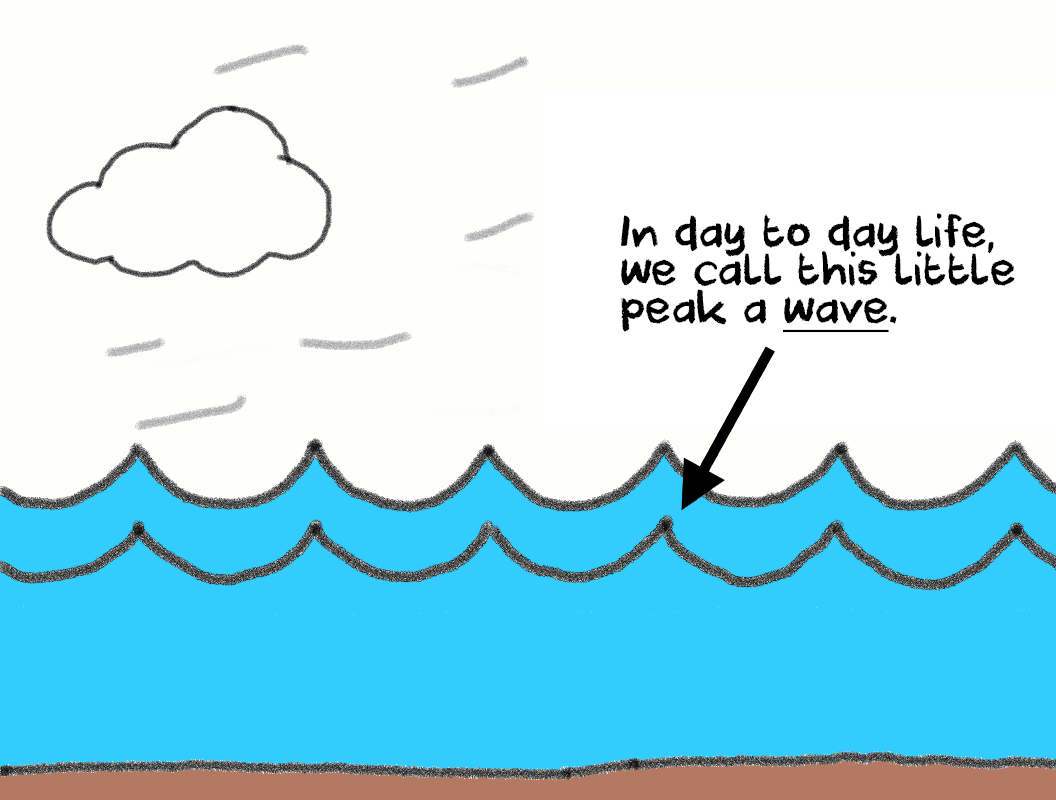
Imagine a stormy sea.

drawing 5

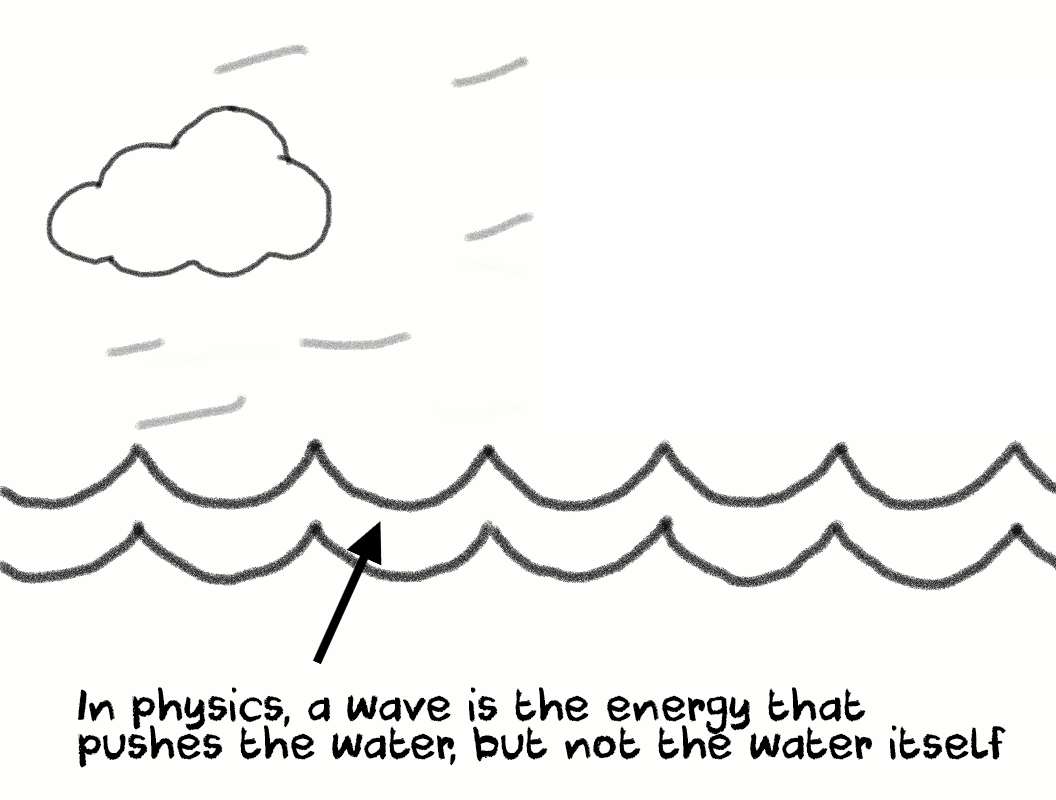
In normal day-to-day life, we say that the ripple and wave in the water is one and the same thing. But in physics, the wave isn’t actually the water moving up and down.

In physics, the wave is the energy that pushes the water molecules to take a ripple shape. This energy makes the water go up and down, until it dissipates and the particles returns to their resting position.
drawing 6

drawing 7.1

Some waves can only travel in a medium. Sound waves for instance, need air to go from one place to another. But, as some popular movie posters say, “In space, nobody can hear you scream.”  That’s because vacuum can’t transport sound waves.

However, other types of waves don’t need a medium. X-rays, Radio waves, microwaves go through anything – air, vacuum, water, you name it.

The difference between a wave and a particle has some practical implications. A particle exists only at one location at a given time. But a wave is spread out across a lot of space, so it doesn’t have a defined location.
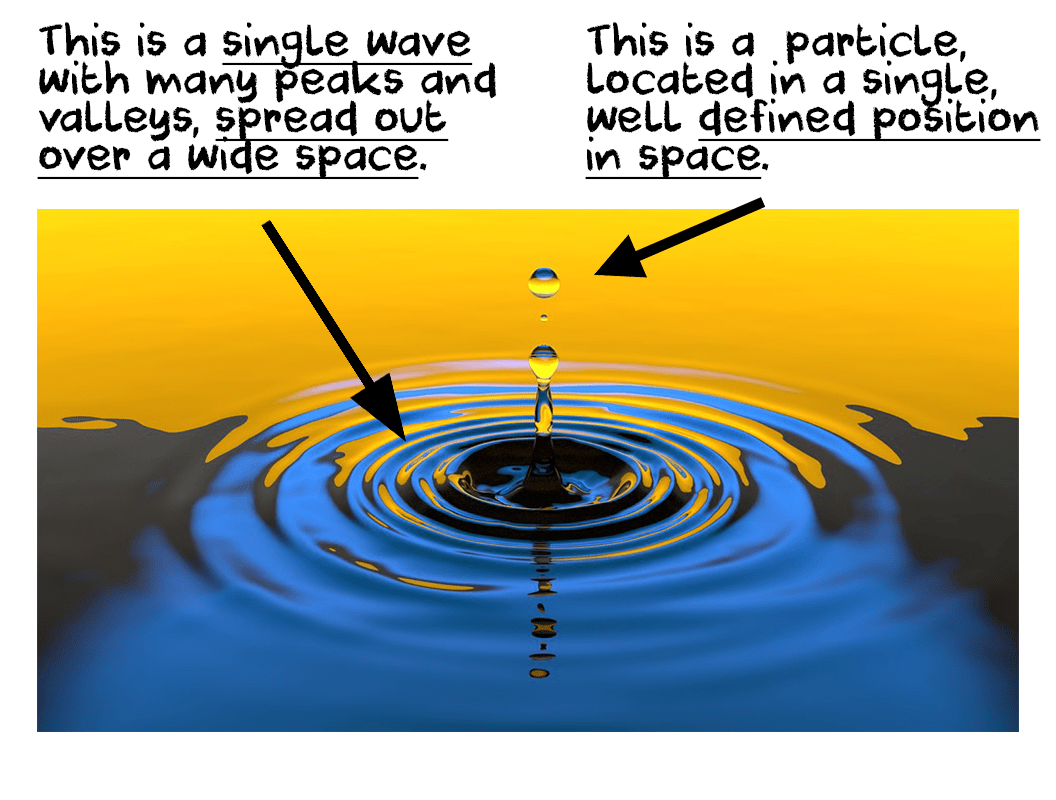
drawing 8

The water droplets in the photo above can be localized into a single position. But the wave itself cannot. The peaks and valleys are not separate waves, but instead they are components of a single wave.

In classical physics, waves and particles were distinct from one another. You are either one or the other.

But classical physics had a hard time figuring out if light is a wave or a particle. Newton said light was a bunch of particles (we now call them photons, but the term didn’t exist in Newton’s time) that come out of a light source.
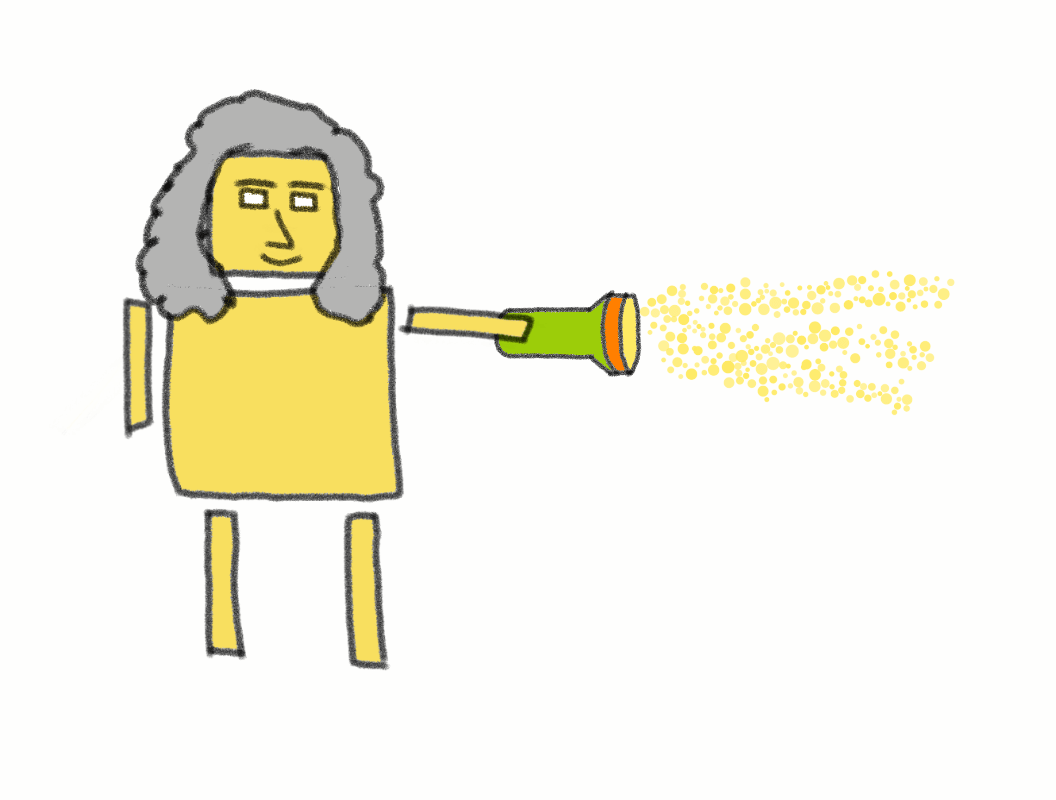
drawing 9

But many other scientists argued that light was actually a wave.

This conversation lasted for a few hundred years, until one James Maxwell convincingly proved that light behaves like a wave. From this point onward, light was generally treated as a wave.
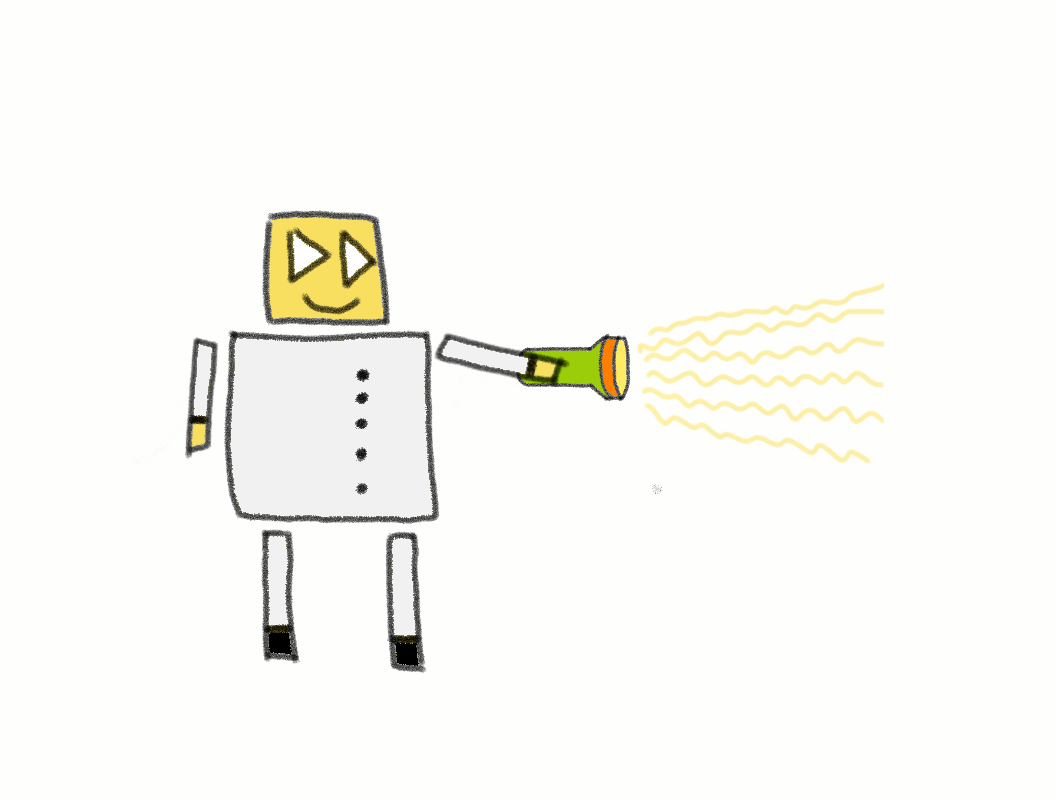
drawing 10

Despite this, the wave theory of light wasn’t able to explain all of lights properties. It was a better approximation and descriptor than the particle theory of light, but it was nevertheless an incomplete version. Something was missing.

The double slit experiment

In 1905, Albert Einstein, demonstrated the photoelectric effect. Among some of its implications was that in certain conditions light had to behave like particles.  In doing so, he also came up with the basic notions of quantum physics.

So by now, both wave and particle theories of light were proven to be correct. Light was both a wave and a particle at the same time.

Wait, what?

Yes, light is both a wave and a particle simultaneously.

To give you a visual sense of how such a thing can be possible, we will use the most widespread and relevant experiment of quantum physics: the double slit.

In this experiment, physicists use a specialized particle gun that shoots photons towards a screen. But between the screen and the light source you will have a plate with one or two slits.

drawing 11

What we want to do is to light up the screen behind the slit. To do this, you fire a whole bunch of photons through it, machine gun style.
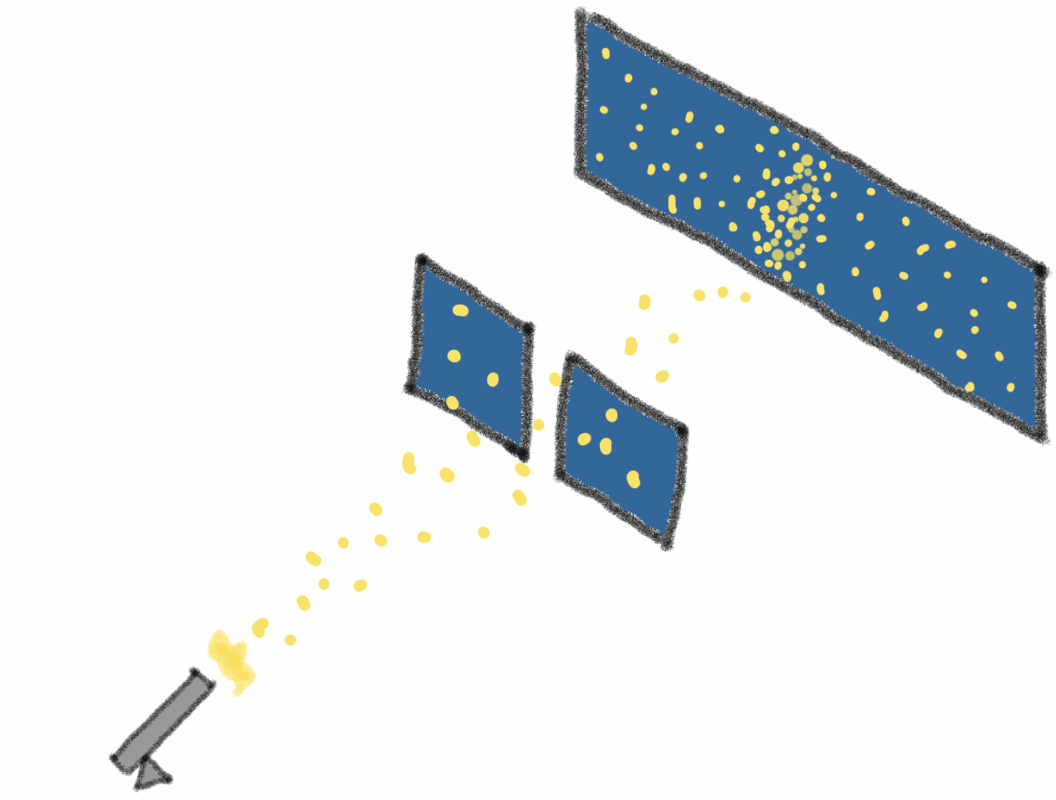
Everything turned out as expected. Most photons concentrated on the part of the screen directly behind the slit, while a few others were spread out across the entire surface.

Now let’s replace the single slit plate with the double slit one.

You will probably expect this result:

Logical enough. After all, the plates block most of the photons, but the ones that manage to pass the two slits will form 2 stripes behind them.

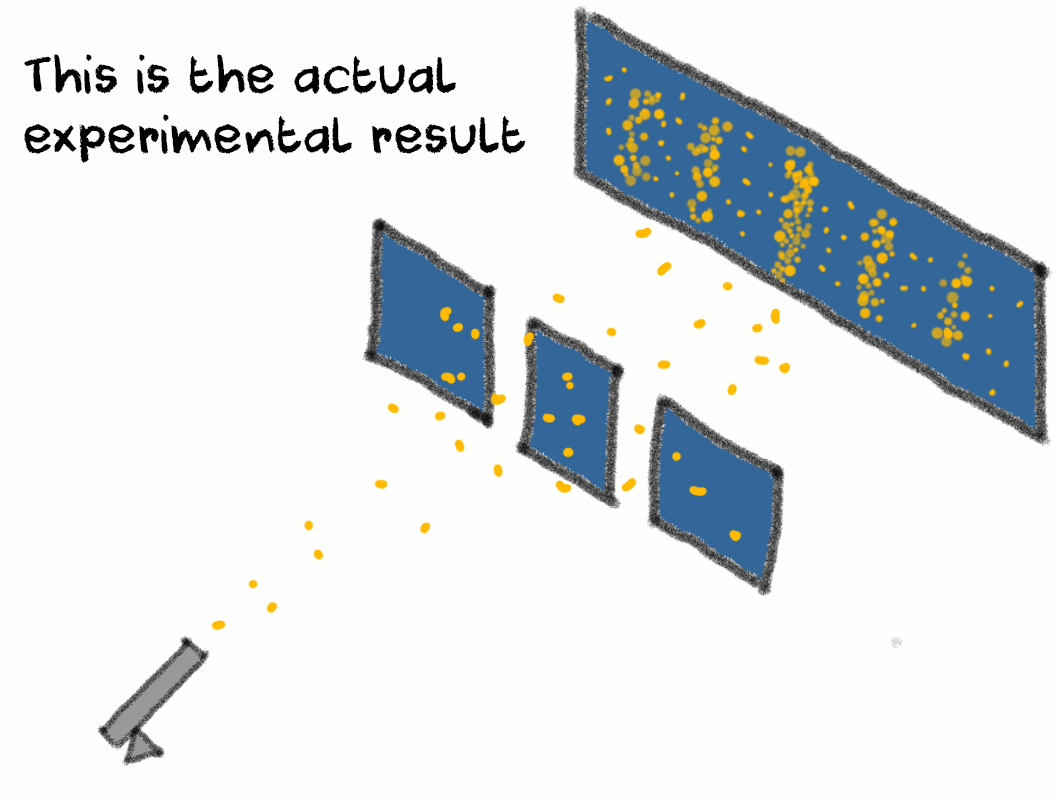
Now let’s see what the real experiment shows us:
drawing 14

This is the point where things get messy. If light was made only of particles, then you would see two stripes, each one behind one of the slits.

Instead, we now have something known as an interference pattern. This pattern takes shape when you have two waves that touch each other. These interference points then move forward and touch the screen, creating those stripes we saw earlier.

Here’s a visualization of it all.

drawing 15 gif

GIF Source

Light being both a particle and a wave simultaneously isn’t something that should happen in classical physics. How can one thing be in two states at once? It’s as if you had a coin that could be simultaneously be both heads and tails.

But this is what all experiments proved, time and again. Thinking of light as both a wave and a particle simultaneously describes all of its properties perfectly. Trying to see it as just a wave or just a particle won’t.

Soon enough though, physicists discovered it wasn’t just photons that could be two things at once. Basically anything that is microscopic in size, such as neutrons, photons and atoms, behaves like both a wave and a particle simultaneously.

Classical physics had reached its limits. So, a new theory was created to explain these weird phenomena.

They called it quantum theory (or quantum physics/mechanics). And the people who wanted to learn more about this new field of physics found even stranger things than the wave-particle duality.

The probability wave, superposition, entanglement

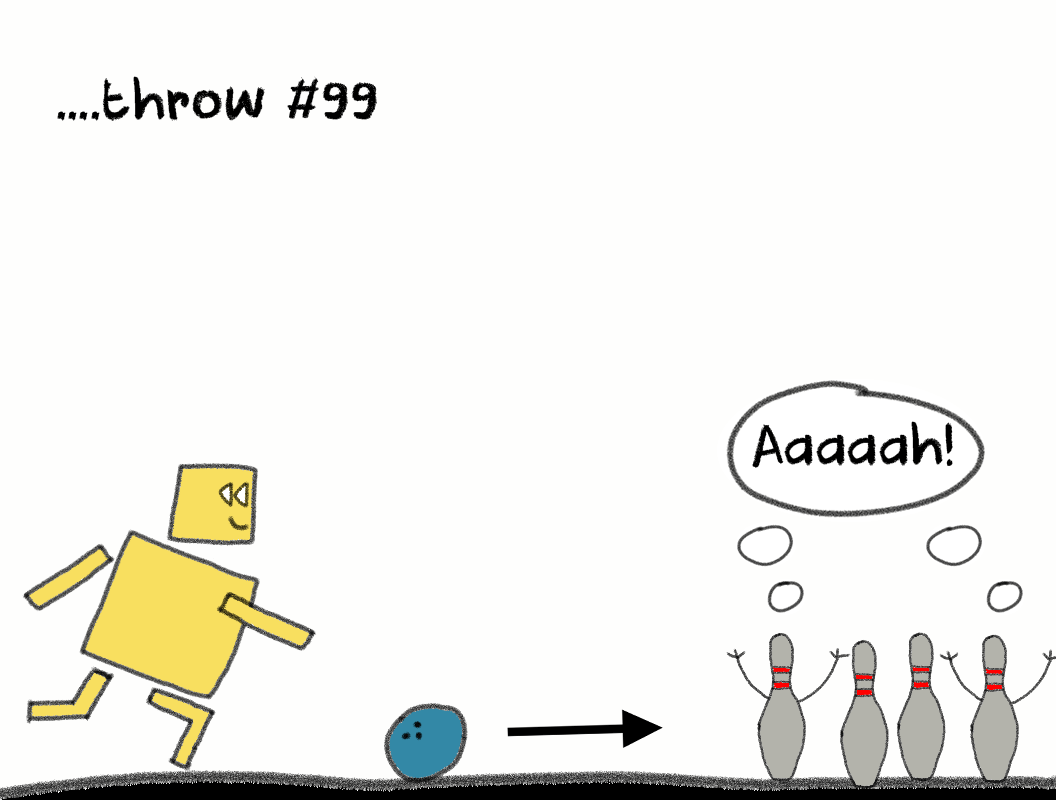
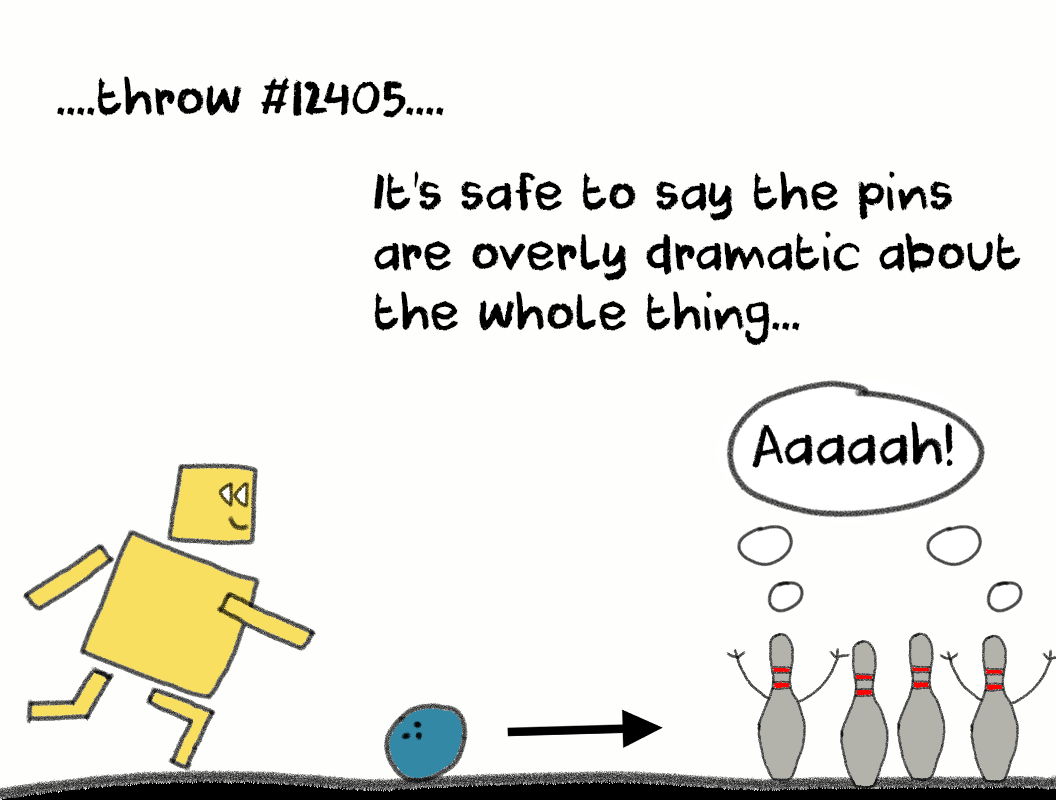
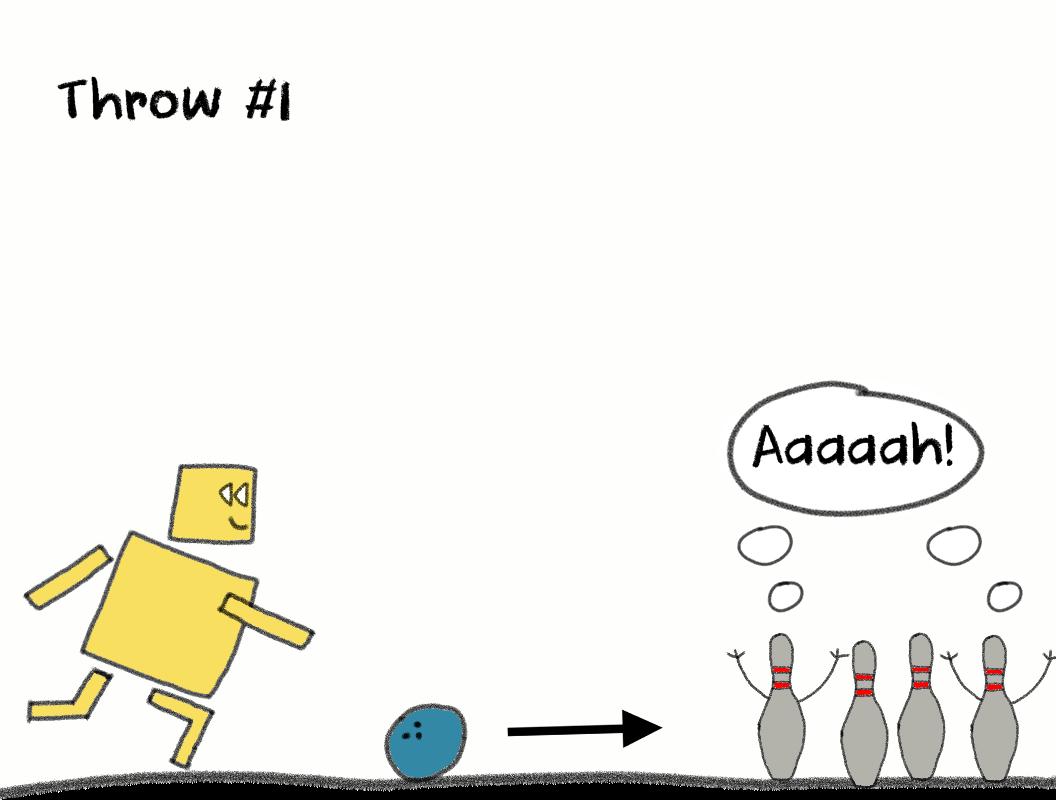
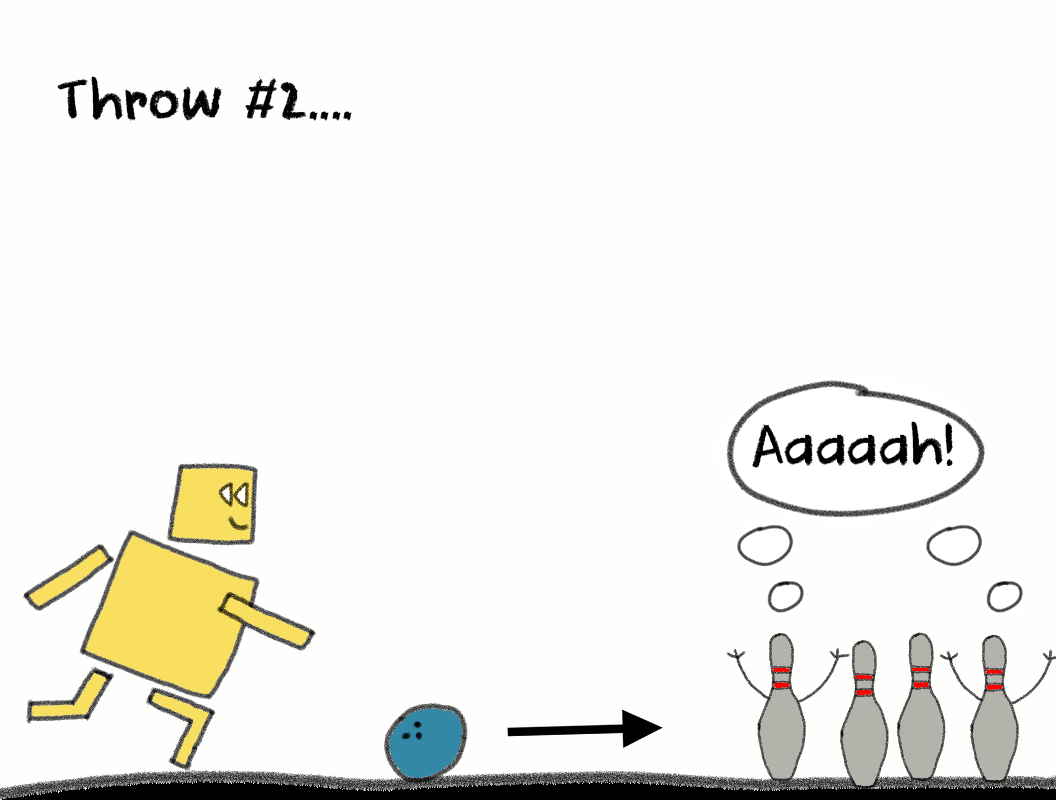
In classical physics, throwing a bowling ball in exactly the same way will make the ball follow the same path 100% of the time.
drawing 16

Drawing 17

drawing 18

drawing 19

The ball doesn’t do anything special. It just follows the path and trajectory you set out for it each them you threw it. Its fate was determined the moment you released it from your hand.

This is a critical principle of classical physics called determinism.

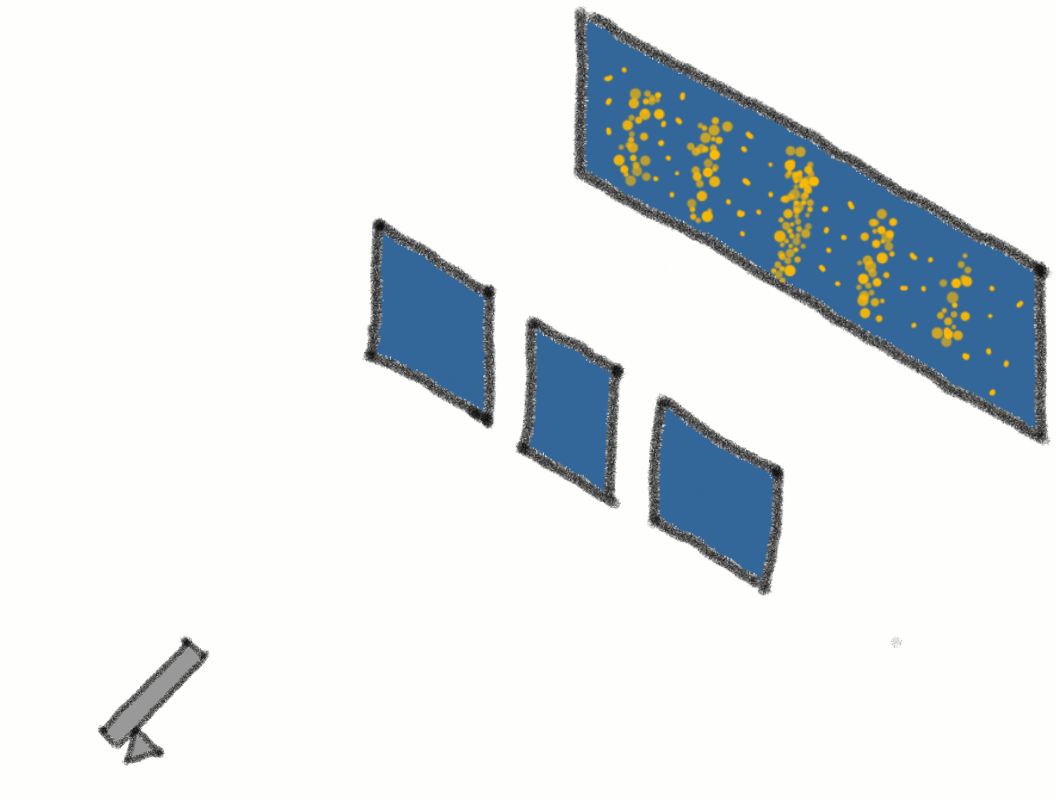
Now let’s go back to our two slit experiment. We’ve seen how particles form an interference pattern on the screen if you fire a large amount of them towards the slits.
drawing 20

However, each particle follows a wildly different and unpredictable path, even if the gun points in exactly the same spot.

For this reason, almost no two particles land on exactly the same spot. Indeed, the places where they do land on the screen seem to be almost random.

We say almost random, because the particles seem to have a higher probability of landing on one of the areas corresponding to the five stripes.
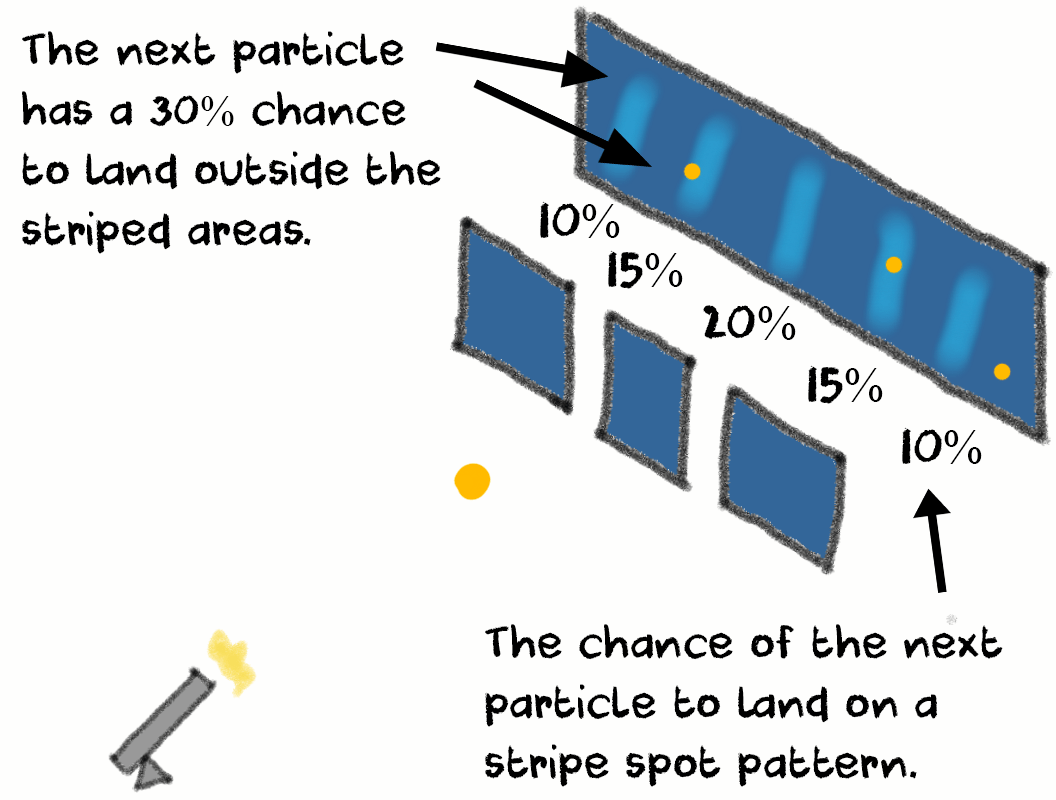
 

drawing 21

The numbers aren’t really that accurate, they’re just there to help you visualize.

However, this isn’t “probability by ignorance” as in the case of the coin toss. This is true probability, meaning that it isn’t affected by any sort of variable. It is absolutely impossible to know beforehand where a particle will land on the screen.

In other words, determinism doesn’t apply to individual particles..

What quantum physicists discovered was that at microscopic levels, the Universe is governed by probability rather than determinism. It was very probable that a particle would land on one of the 5 interference stripes, but you couldn’t be sure that it would do so. It’s almost random.

This went against everything scientists knew about the laws of physics. Einstein, a firm believer in a deterministic Universe, summed up his objections to quantum probability with the phrase “God does not play dice”.

What he meant was that the Universe is ordered and predictable. Everything is interconnected in a long cause and effect chain, and with sufficient information you can predict anything that will happen because nothing is left to chance.

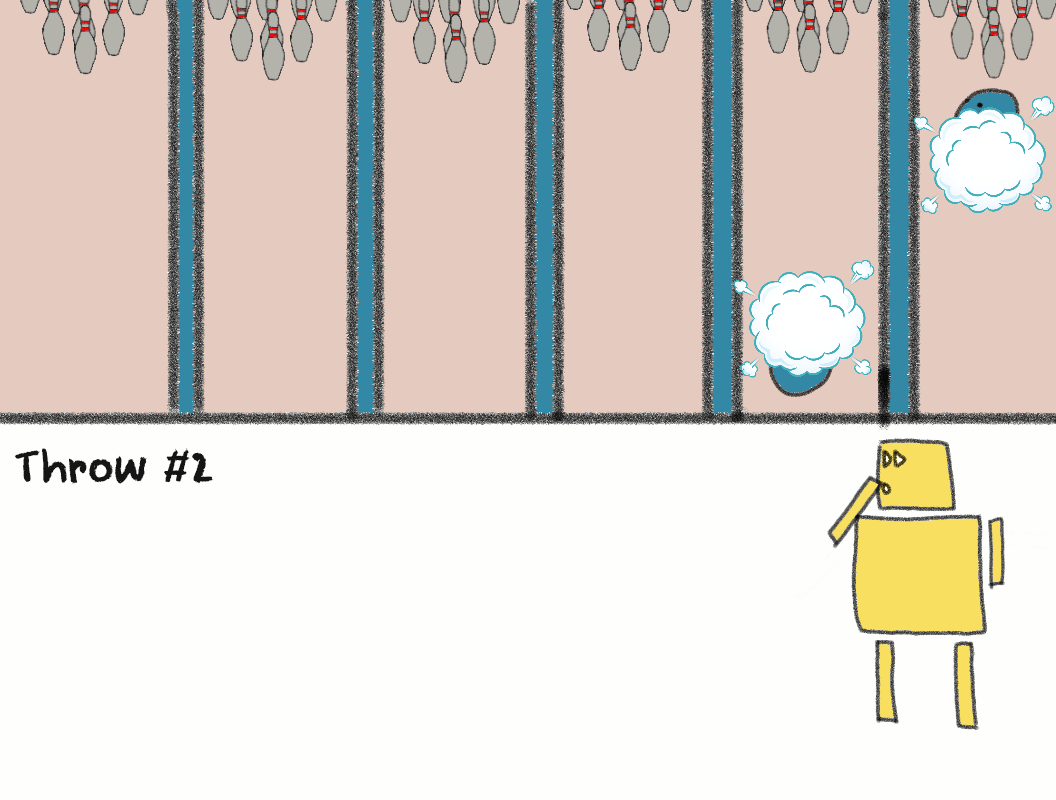
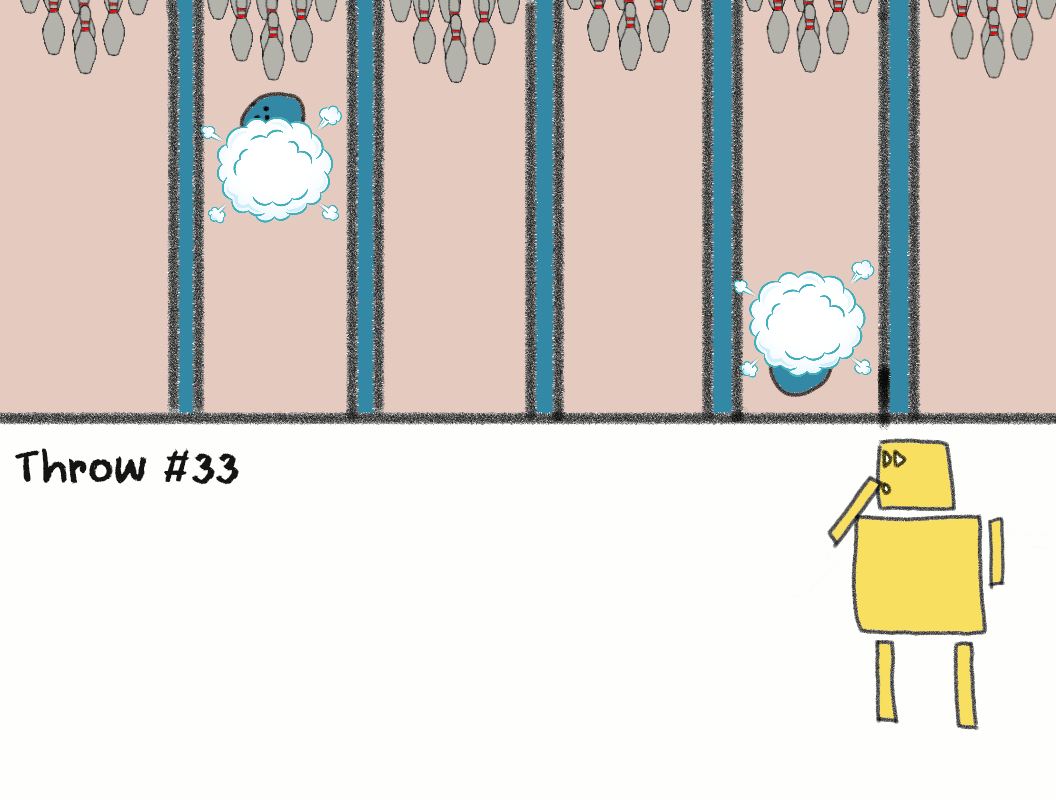
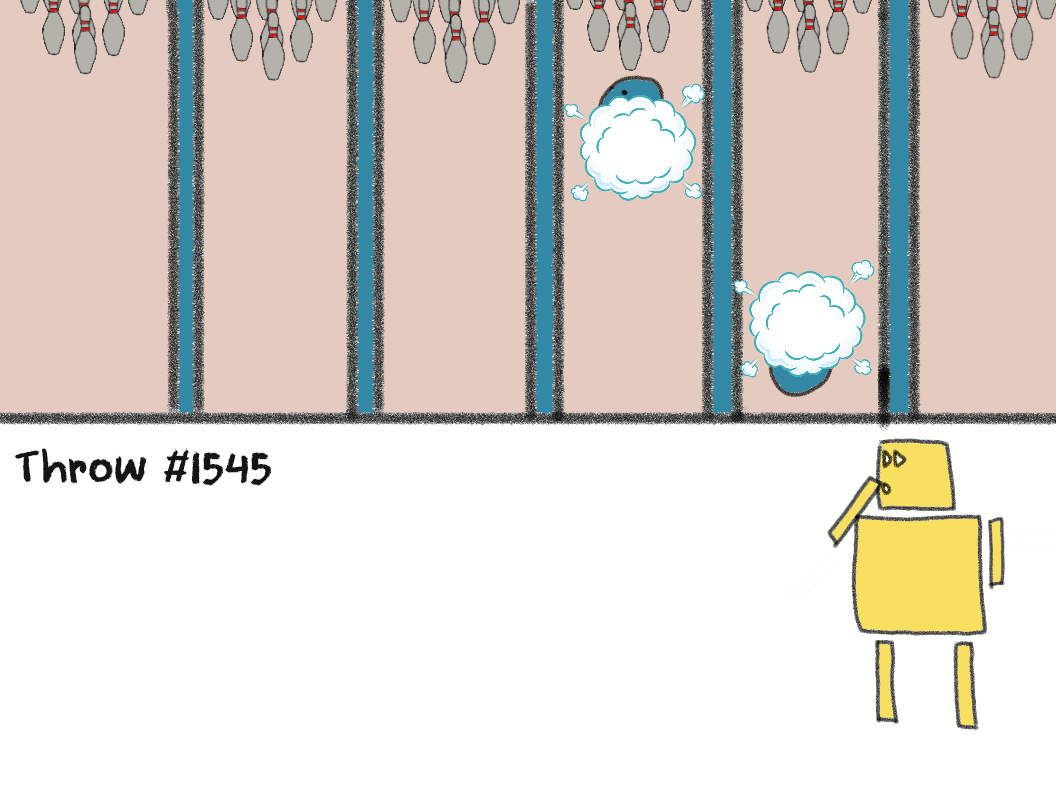
If quantum probability is applied to our everyday lives, then a bowling ball game would look something like this:
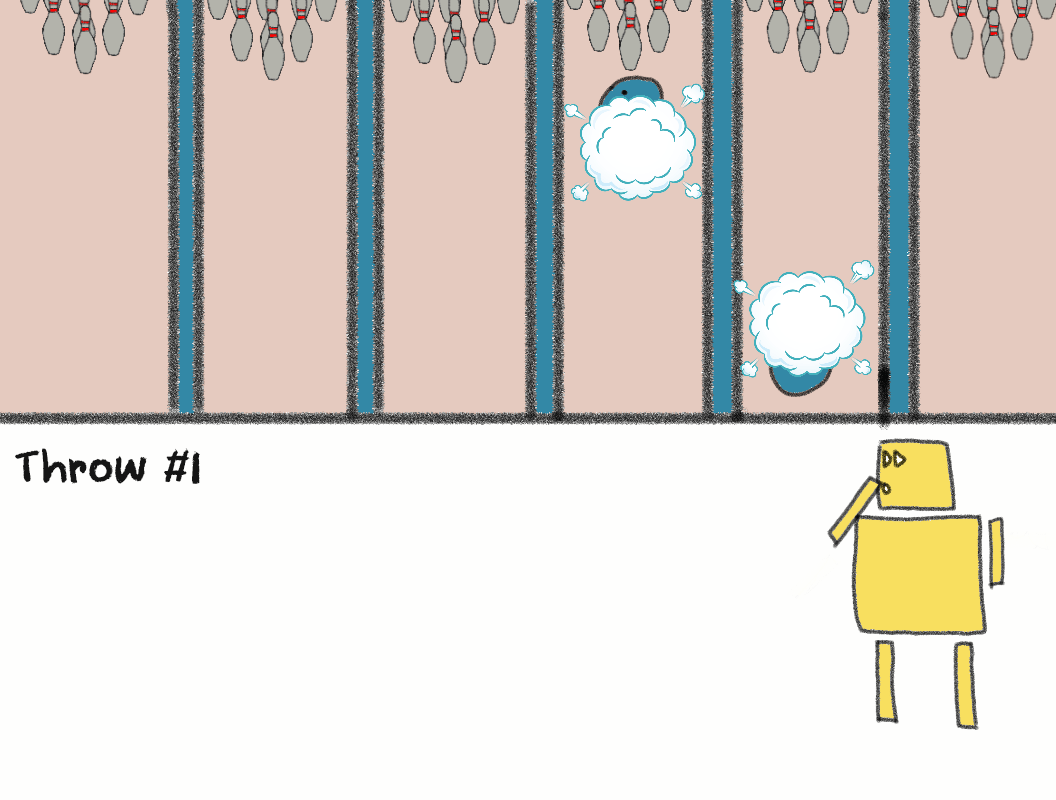
drawing 22.1

drawing 22.2

drawing 22.3

drawing 22.4

Even though you launched the bowling ball on a certain path, it randomly seemed to skip it and go in an entirely different direction and towards a completely different destination.

A particle passes two slits simultaneously

Scientists didn’t easily accept the wave-particle duality of the microscopic Universe. Neither did they like the seemingly random behavior of particles. So they tinkered with their experiment.

They figured that by firing particles in rapid fire, like a machine gun, they ricochet and bounce of each other. This would explain why particles can form wave-like interference pattern and also the probabilistic way they land on a screen.

So instead of firing the particles like a machine gun, they decided to shoot them one by one.

The gun’s firing rate was adjusted, the experiment initiated. All they had to do now was to wait while a few thousand particles landed on the screen.

To their surprise, they got the exact same result:
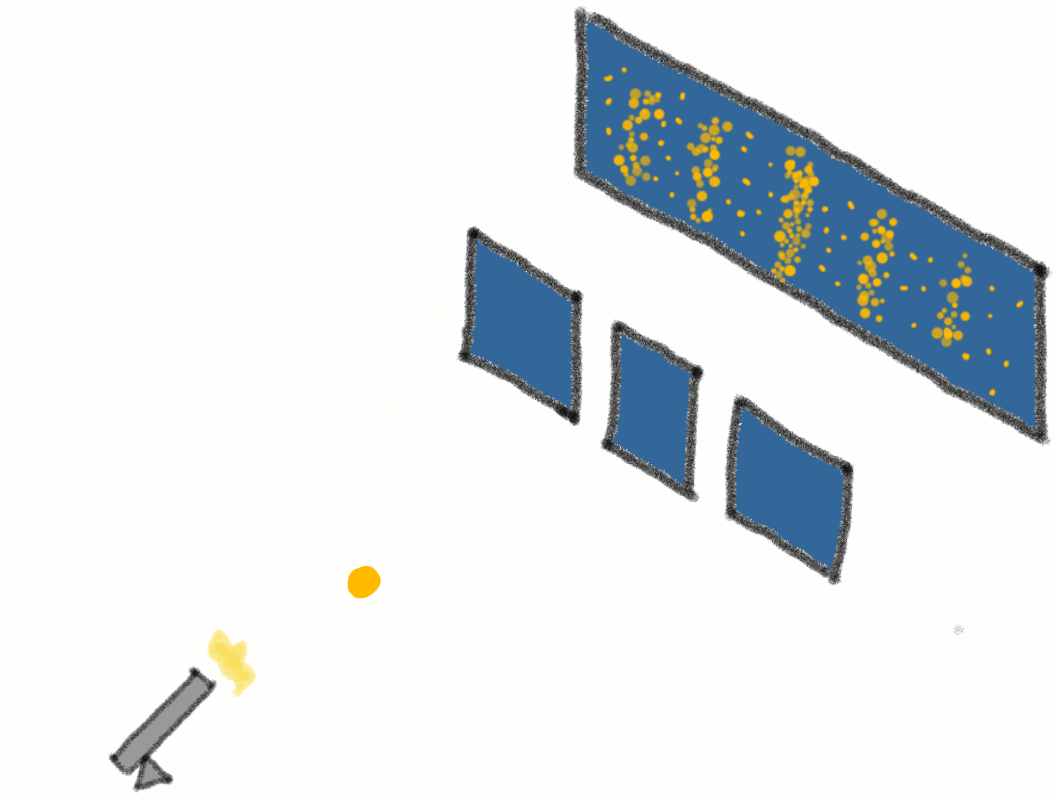
drawing 25

This proved once again that microscopic particles behave in a probabilistic fashion, rather than a deterministic one.

However, this time around, the real problem was that you still ended up with an interference pattern.

But the stripes only appear if you have two waves that make contact with each other.
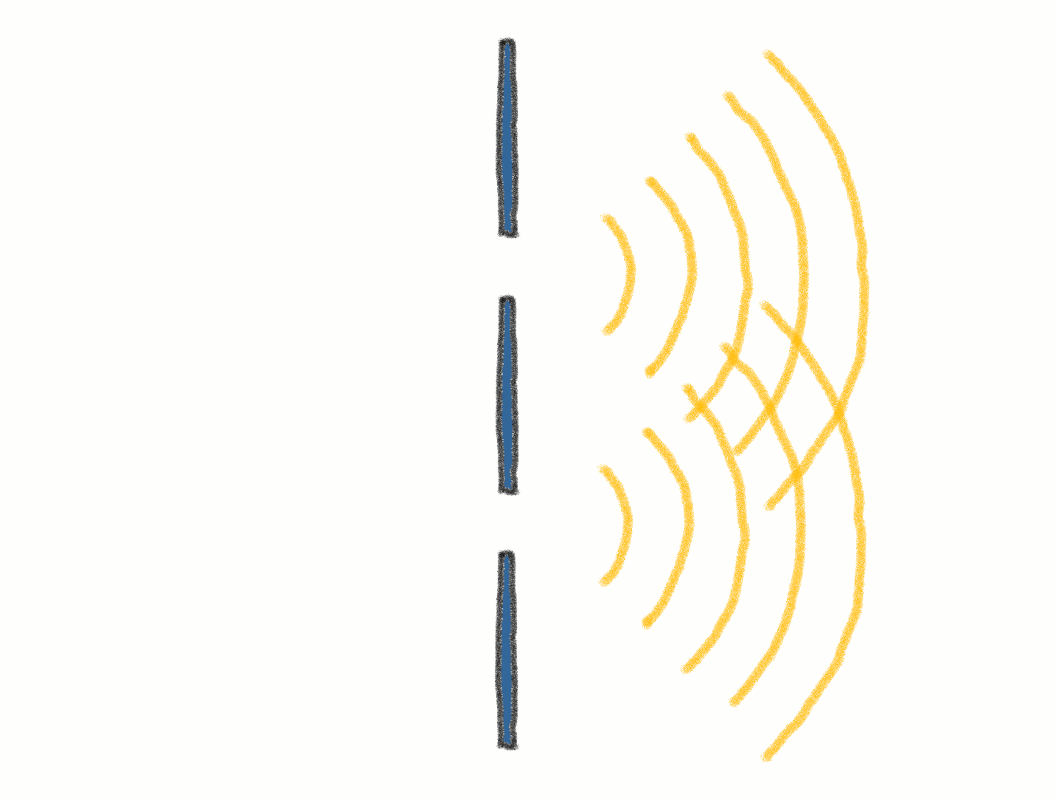
drawing 28

And yet the gun fired just one particle at a time.
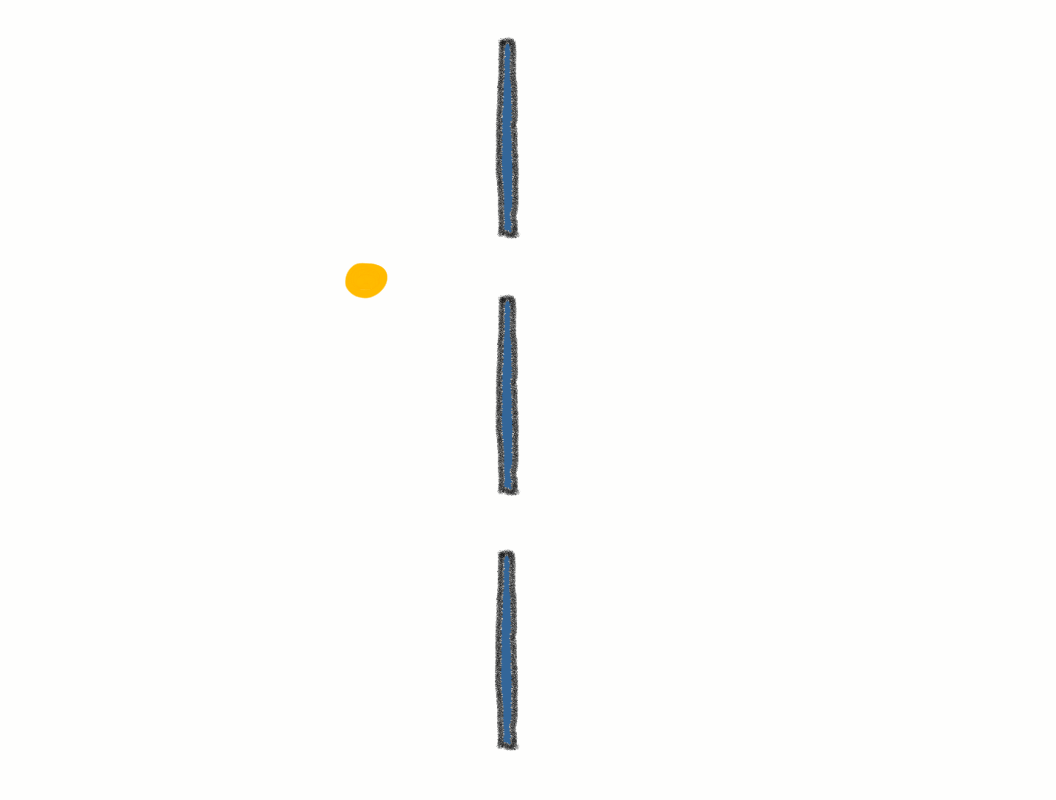
drawing 27

So the only possible way for a single particle to form an interference pattern was if it could somehow pass through both slits, and then interact with itself on the other side.
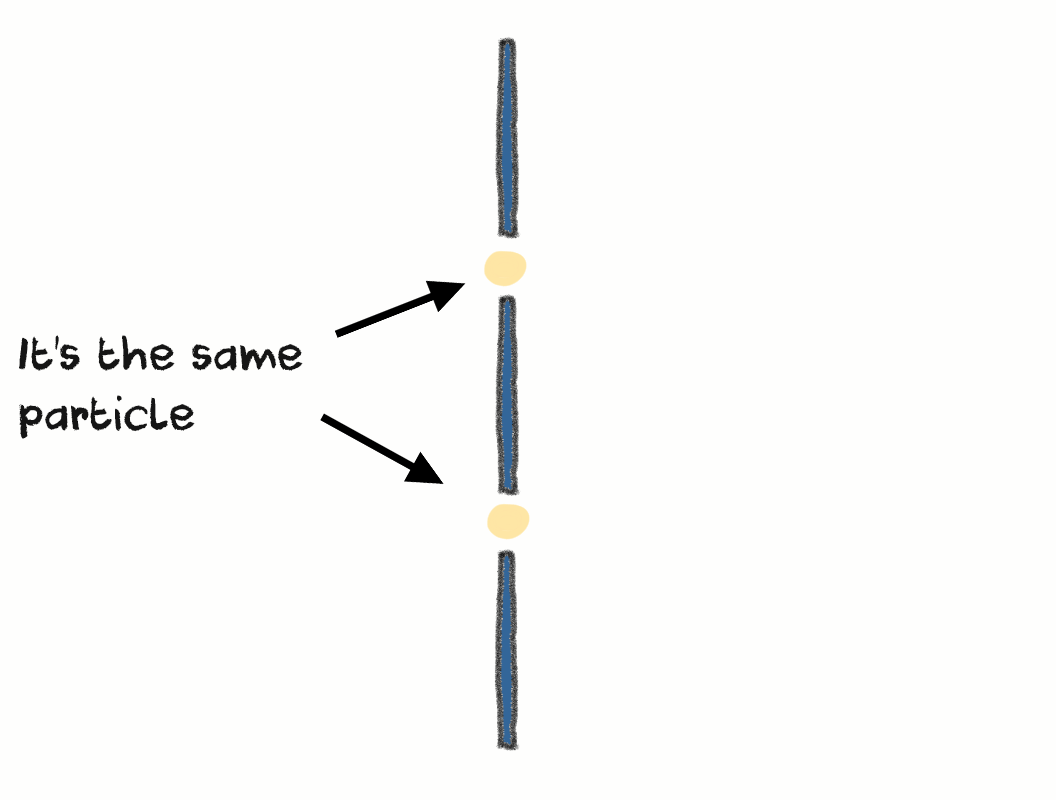
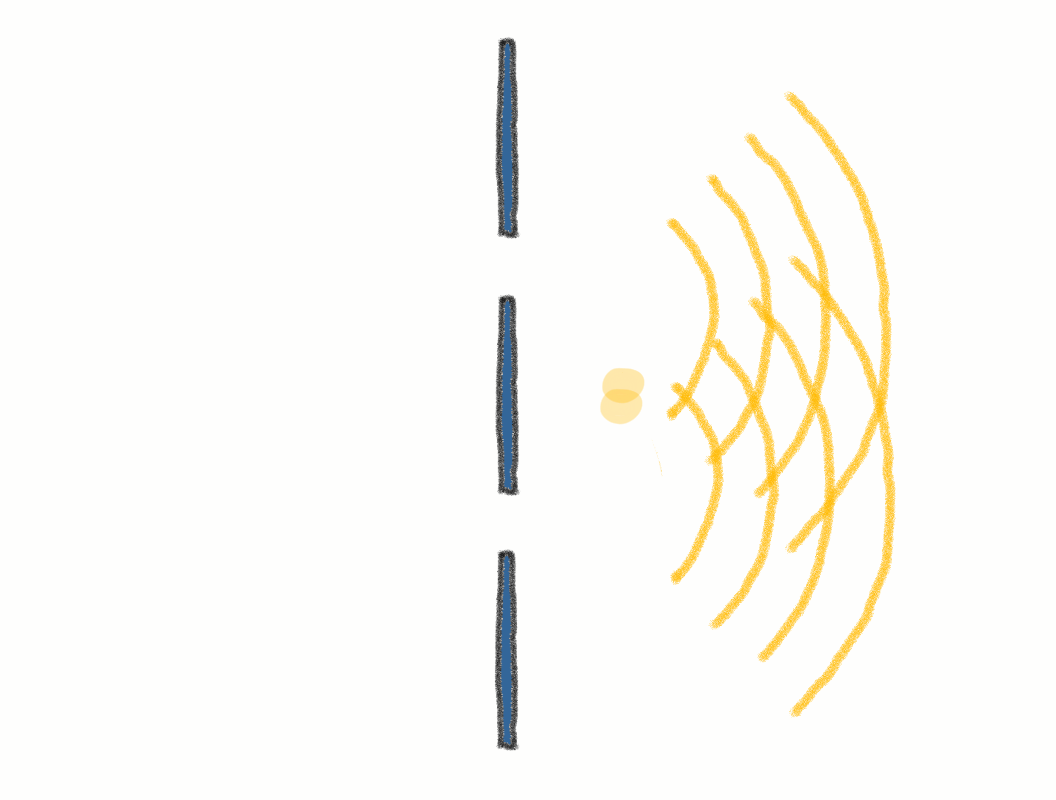
drawing 28.2

drawing 29

On top of all the other issues scientists found with quantum physics, now they had to deal with the fact that a particle could somehow be in two places at the same time.

The weirdness just didn’t seem to end.

The probability wave

By now, you have three strange aspects of quantum physics:

  1. Microscopic objects such as neutrons and photons can be both waves and particles at the same time.
  2. The microscopic Universe behaves in a probabilistic fashion rather than a deterministic one.
  3. A particle can seemingly be in more than one location at the same time.

To better understand all of these 3 aspects, scientists came up with a new concept called a probability wave.

When you propel classical objects forward, such as as bowling balls, you give them a predetermined path to follow.

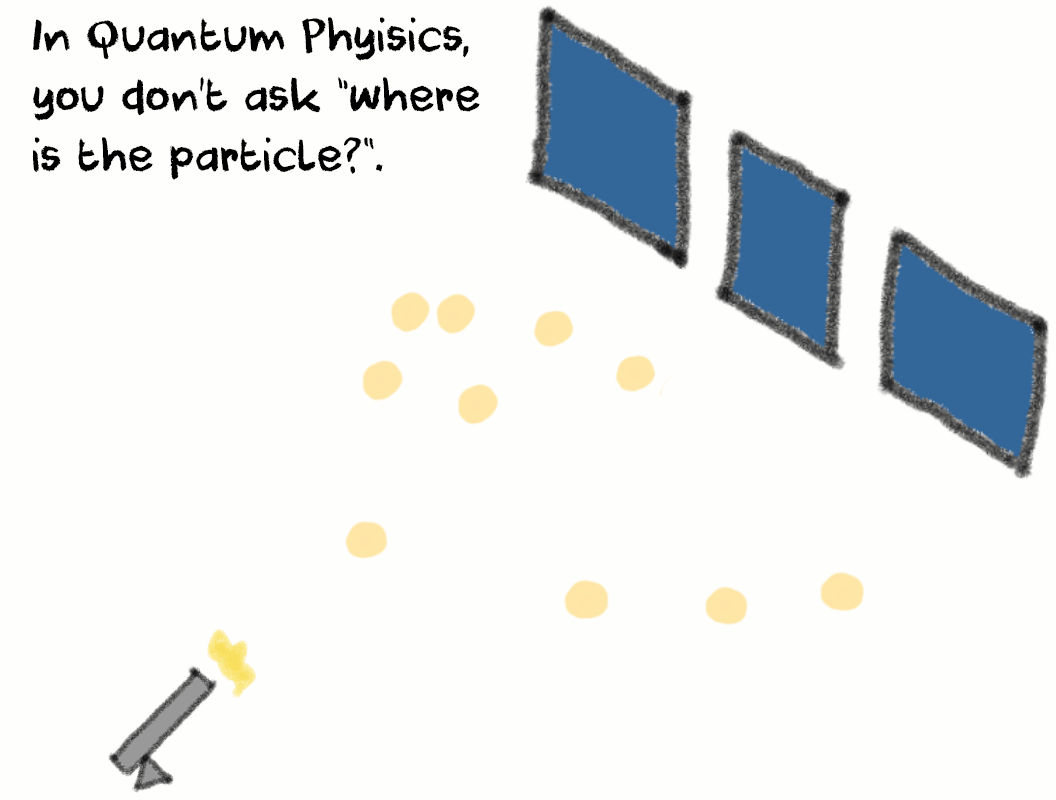
However, when you fire a particle, it stops having a clearly defined position in space. It also doesn’t have a predefined trajectory and destination.

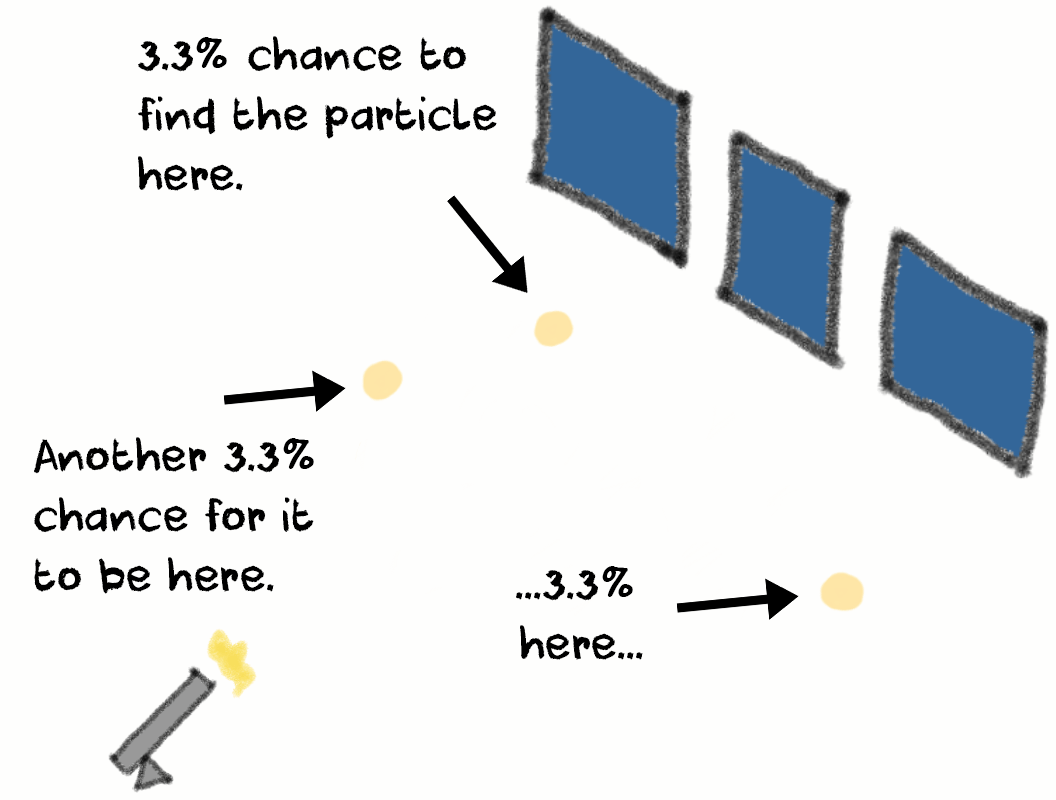
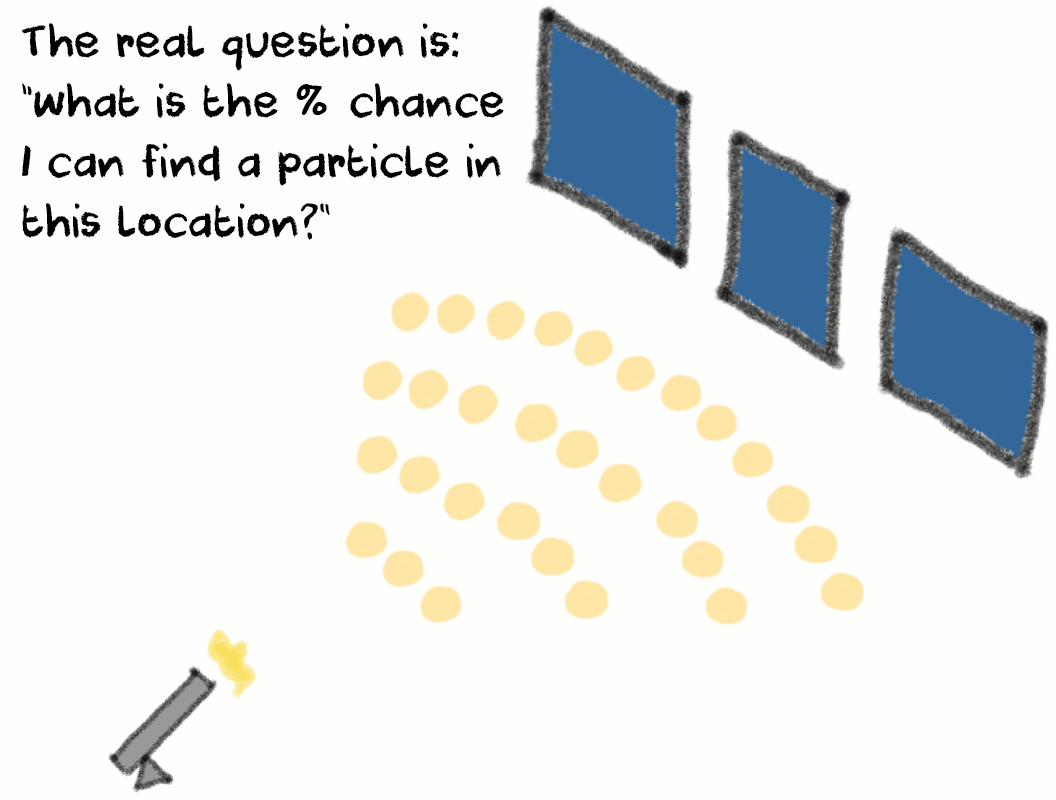
Instead, the particle is now governed by probability. This means there is x% chance for you to find it in position A, y% chance to find it in position B, z% chance to find it in position C, and so on.

Once you start to add up all the possible positions, you get something like this:
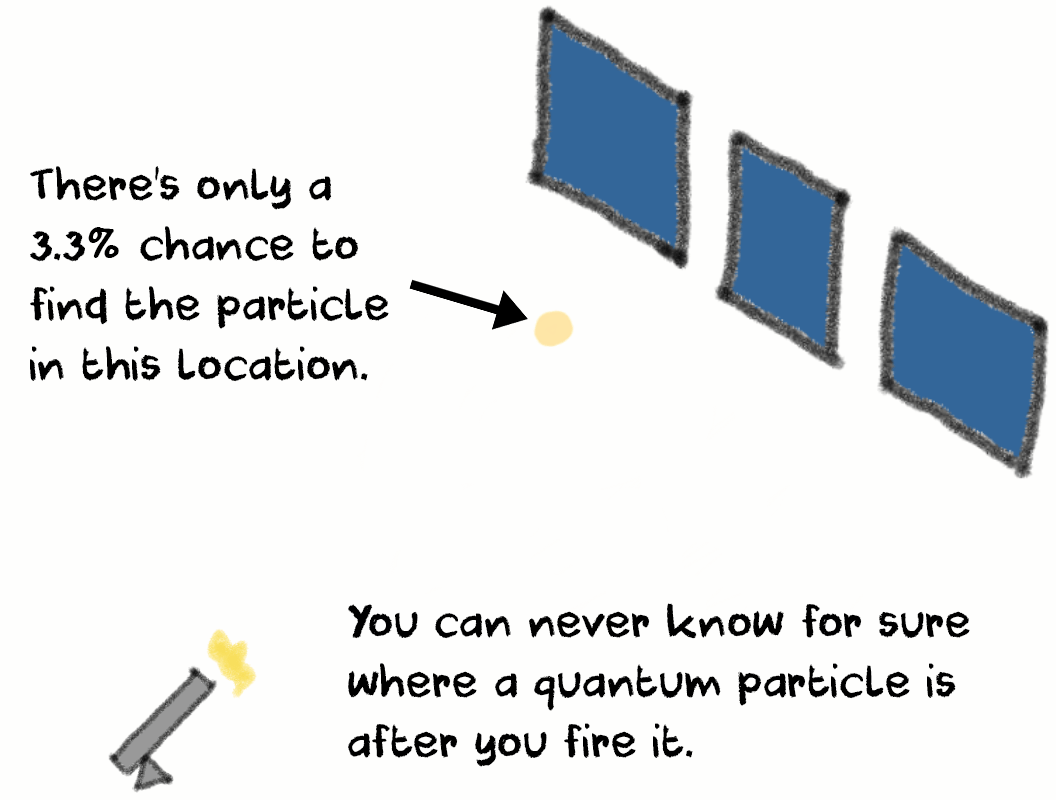
drawing 32

drawing 33

drawing 34

drawing 35

Instead, the particle can occupy multiple possible positions and follow many possible paths on its way to the screen.

Out of all these possible paths and positions, the particle ends up choosing just one position and path, but it is impossible to know beforehand which path/position it will take.

In the sketch above there is just one particle. This is important, so we’ll say it again: there is only one particle. But each transparent shape represents just one possible position where you might find the particle.

As you can see, the particle’s potential positions are clumped up together in certain locations while avoiding others. This corresponds to a wave’s peaks and valleys.

If you were to then imagine this distribution of a particle’s potential positions as a probability wave, it would look something like this:
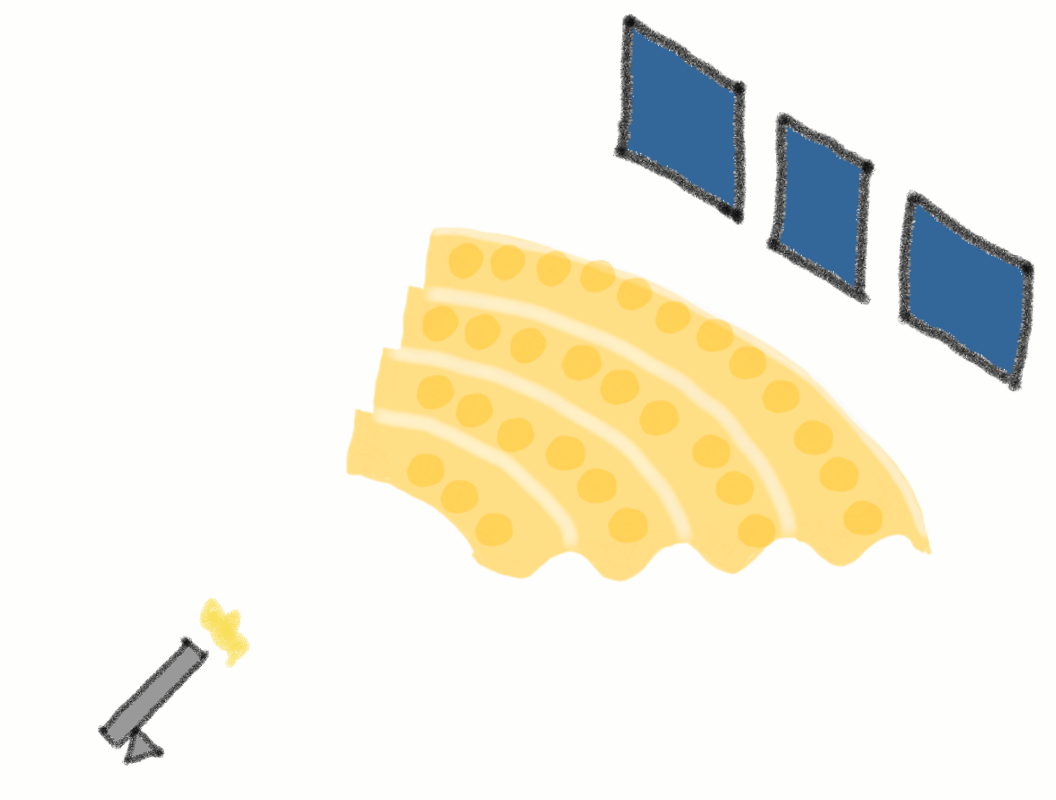
drawing 36

We will point it out again, but there is only one particle within that probability wave. In fact, you can actually say that the probability wave and the particle area all one and the same thing.

Now that we have a visual representation of how a particle behaves, let’s see how it managed to pass through both slits.

Superposition

Superposition describes a particle’s ability to:

  1. Be in multiple states simultaneously, such as both a wave and a particle at the same time.
  2. Occupy many potential positions, all at once.

A particle can be both a wave and a particle simultaneously. At the same time, a particle doesn’t have a fixed position, but rather multiple potential positions you might find it in, as we’ve seen in the probability wave section. Put these two concepts together, and you now have the concept of superposition.
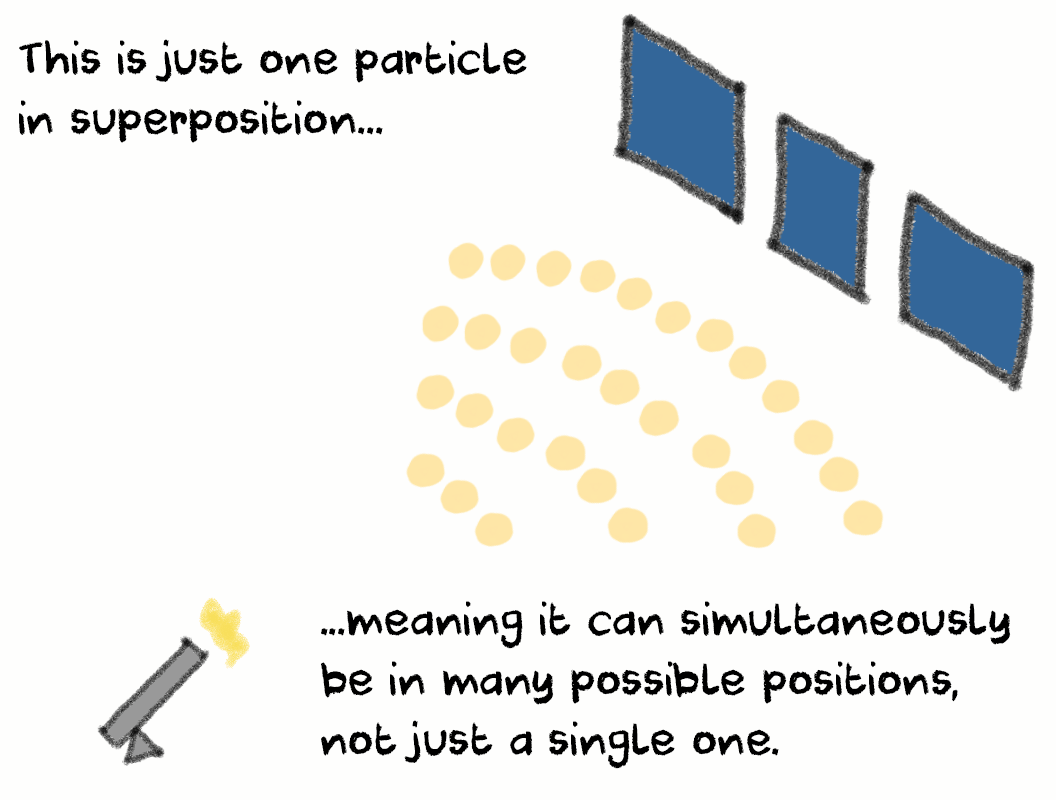
drawing 37

The probability wave is just a single particle in a state of superposition. Once the probability wave reaches the screen, its superposition randomly collapses at a single point, with a higher probability to do so in one of the 5 interference stripes.
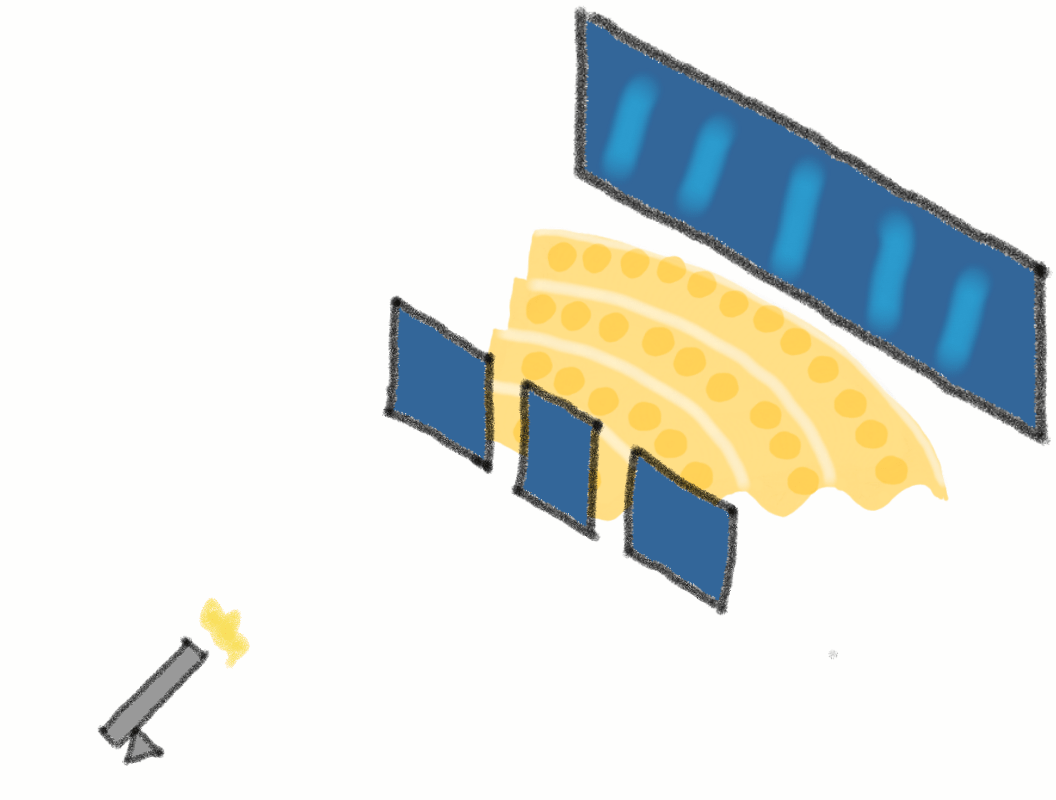
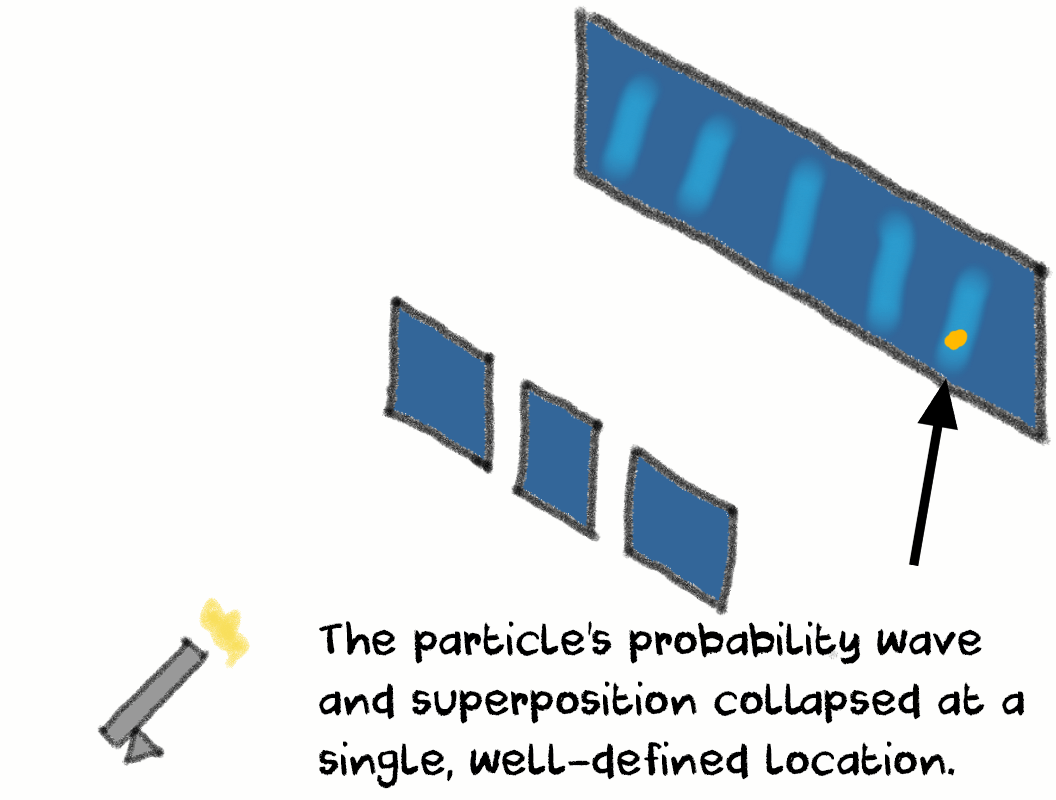
Drawing 38

drawing 39

This still didn’t explain how the particle can somehow pass through both slits simultaneously.

The only thing left to do was to see the particle in action as it passed through both slits simultaneously.

The measurement problem.

Scientists had had enough of quantum shenanigans. This time they did something they should have done all along: put a detector in front of the slits and see the particle in action.
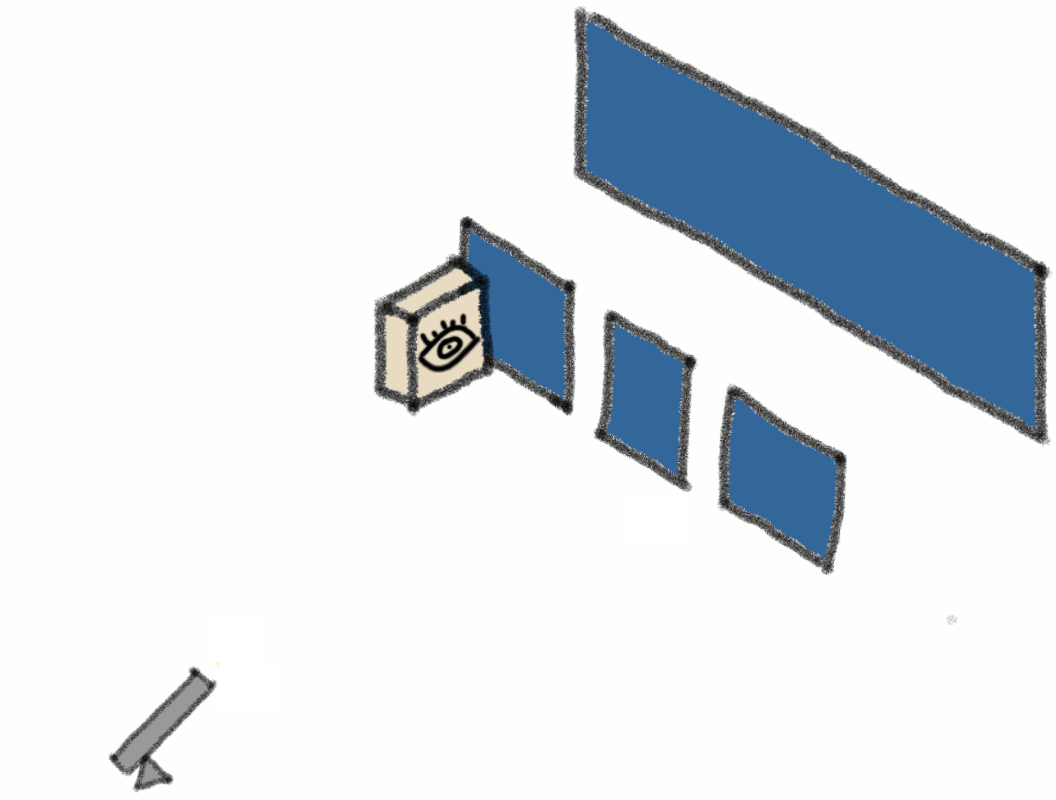
drawing 40

They warmed up the gun and shot the first particle.

Then they fired the second particle.

They just kept firing.

And firing.

And firing.

And firing.

One by one until the pattern on the screen took shape.

A few more particles left.

Continue reading “Quantum Physics with Drawings of Yellow Men”

Short story: “Teddy” by J.D. Salinger

Teddy” is a short story by J. D. Salinger, completed on November 22, 1952 and originally published in the January 31, 1953 issue of The New Yorker.[1] Under the influence of The Gospel of Sri Ramakrishna, Salinger created an engaging child character, Teddy McArdle, to introduce to his readership some of the basic concepts of Zen enlightenment and Vedanta reincarnation – a task that Salinger recognized would require overcoming some 1950s American cultural chauvinism.[2]

Salinger wrote “Teddy” while he was arranging publication for a number of his short stories and crafted the story to balance and contrast the collections’ intended opening work “A Perfect Day for Bananafish“.[3]

In Salinger’s novella, “Seymour: An Introduction“, a meditation written by a member of the fictional Glass family, Buddy Glass writes about his brother, Seymour, where Buddy claims authorship to “Teddy” as well as other pieces in Nine Stories.[4]

Summary

The story comprises several vignettes which take place aboard a luxury liner. The events occur roughly between 10:00 and 10:30 am on October 28, 1952.[5]

Teddy is Theodore “Teddy” McArdle, a 10-year-old mystic-savant returning home to America with his entertainer-socialite parents and his younger sister. As part of their tour of Great Britain, Teddy has been interviewed as an academic curiosity by professors of religious and philosophical studies – the “Leidekker examining group” – from various European universities in order to test his claims of advanced spiritual enlightenment.[6]

The first scene opens in the McArdle’s stateroom. Teddy is standing on his father’s expensive suitcase, peering out of the porthole. Mr. McArdle, apparently hung-over, is attempting to verbally assert control over his son; Mrs. McArdle indulges the boy as a provocative counterpoint to her husband’s bullying: neither adult has any real impact on the child’s behavior.[7]

Responding to his parents’ outbursts impassively, he contemplates the nature of existence and physical permanence while observing fragments of orange peel that have been discarded overboard. The concepts that the preternatural child ponders are evidently derived from Zen and Vedantic religious philosophy, and suggest that Teddy possesses advanced enlightenment or God-consciousness. When Teddy conveys his spiritual insights to his father and mother, they interpret them merely as the products of his precociousness, eliciting annoyance or indifference from the adults.

Teddy is ordered to retrieve his six-year-old sister, Booper, who has absconded to the sport deck with her father’s expensive camera, which Teddy – indifferent to its material value – has bestowed upon her as a plaything. As he departs, Teddy delivers a short, cryptic caveat to his parents, informing them that they may never see him again outside the realm of memory.[8]

On the Main Deck, Teddy has a brief encounter with one of the ship’s female officers, Ensign Mathewson. Forthright and exacting, the boy questions the officer and obtains information about a shipboard word game competition – and disabuses the bemused woman as to her misapprehensions regarding his advanced intellectual development.

Teddy proceeds to the Sport Deck and locates his little sister, Booper, at play with another young passenger. Booper is a domineering and hateful child, contrasting sharply with her older brother’s equanimity. Teddy, with firmness, politely exhorts the girl to return with the camera to the cabin and report to their mother. Ignoring his sister’s verbal ripostes, he reminds her to meet him shortly for their swimming lesson at the swimming pool. She submits with bad grace as he departs.

The final scene takes place on the Sun Deck, where Teddy, reclining on one of his family’s reserved deckchairs, reviews his recent diary entries. The document has been conscientiously edited and neatly written. It contains reminders to foster better relations with his father; commentary on a letter from a Professor of Literature; a list of vocabulary words to study and notes on his meditation schedule – all matters of self-improvement. While making his daily entry, he writes the following non sequitur: “It will either happen today or February 14, 1958 when I am sixteen. It is ridiculous to mention it even.”

Teddy is interrupted by a passenger named Bob Nicholson, a graduate of an unnamed university, who teaches curriculum and instruction. Nicholson is on a first name basis with the Leidekker group and has listened to a taped interview with Teddy, in which he shows a lurid interest. He peppers Teddy with questions on the boy’s commitment to the precepts of Vedantic reincarnation; Teddy remains composed in the face of the young man’s veiled hostility, and provides him with a brief sketch of this discovery of God, his relationships with his parents and his views on Zen philosophy. The boy offers Nicholson an extended metaphor on the nature of logic that challenges the young man’s rational and orthodox commitment to material reality. Teddy, in explaining his position on death and reincarnation gives a hypothetical example describing a series of events at his upcoming swimming lesson in which a fatality occurs: his own.

Teddy disengages from the interview and hurries to his lesson. Nicholson pursues him through the levels of the ship’s decks, and as he begins to descend the stairs to the swimming pool, he hears the scream of “a small, female child” emanating from the enclosed walls of the indoor pool. The story ends on this ambiguous note.

More at:  https://en.wikipedia.org/wiki/Teddy_(story)

Book: “The Hidden Spirituality of Men: Ten Metaphors to Awaken the Sacred Masculine”

The Hidden Spirituality of Men: Ten Metaphors to Awaken the Sacred Masculine

by Matthew Fox

It is no secret that men are in trouble today. From war to ecological collapse, most of the world’s critical problems stem from a distorted masculinity out of control. Yet our culture rewards the very dysfunctions responsible for those problems.

To Matthew Fox, our crucial task is to open our minds to a deeper understanding of the healthy masculine than we receive from our media, culture, and religions. Popular religion forces the punitive imagery of fundamentalism on us, pushing most men away from their natural yearning for spirituality and toward intolerance and domination. Meanwhile, many men, particularly young men, are looking for images of healthy masculinity to emulate and finding nothing.

To awaken what Fox calls “the sacred masculine,” he unearths ten metaphors, or archetypes, ranging from the Green Man, an ancient pagan symbol of our fundamental relationship with nature, to the Grandfatherly Heart to the Spiritual Warrior. He explores archetypes of sacred marriage, showing how partnership becomes the ultimate expression of healthy masculinity. By stirring our natural yearning for healthy spirituality, Fox argues, these timeless archetypes can inspire men to pursue their higher calling to reinvent the world.

Matthew Fox-The Hidden Spirituality of Men: Ten Metaphors to Awaken the Sacred Masculine


YELLAWE
Published on Jul 13, 2009
A summarization or review of the book The Hidden Spirituality of Men: Ten Metaphors to Awaken the Sacred Masculine by author Matthew Fox.

(Submitted by Alex Gambeau, H.W.)

Book: “Metaphysical Bible Dictionary” By Charles Fillmore

Overview

This one-of-a-kind volume presents the esoteric meanings of names and people, places, key words, and phrases found in the Bible. The ideas presented in this Bible reference book are based on the teachings of Jesus Christ and are presented in a cross-denominational format.

Free PDF | Metaphysical Bible Dictionary By Charles Fillmore

American mystic Charles Fillmore founded a new variety of religious expression, the Unity movement, which combines traditional Christian elements with esoteric and metaphysical principles. In this core text of the movement, Fillmore presents user-friendly identifications and explanations of the Bible’s many names, places, and events, including alphabetical listings of terms with pronunciation guide and derivation; multiple brief definitions; and expert, insightful analysis that provides scriptural context and metaphysical interpretations.

This unique guide is designed to open up new avenues of thought and to inspire a greater understanding and interest in Bible study. Readers will find it a steppingstone to a higher consciousness and the source of a wide array of solutions to life’s problems.

Pages: 1045
Language: English

Free pdf:  http://www.lojsociety.org/Metaphysical_Bible_Dictionary_Charles_Fillmore.pdf

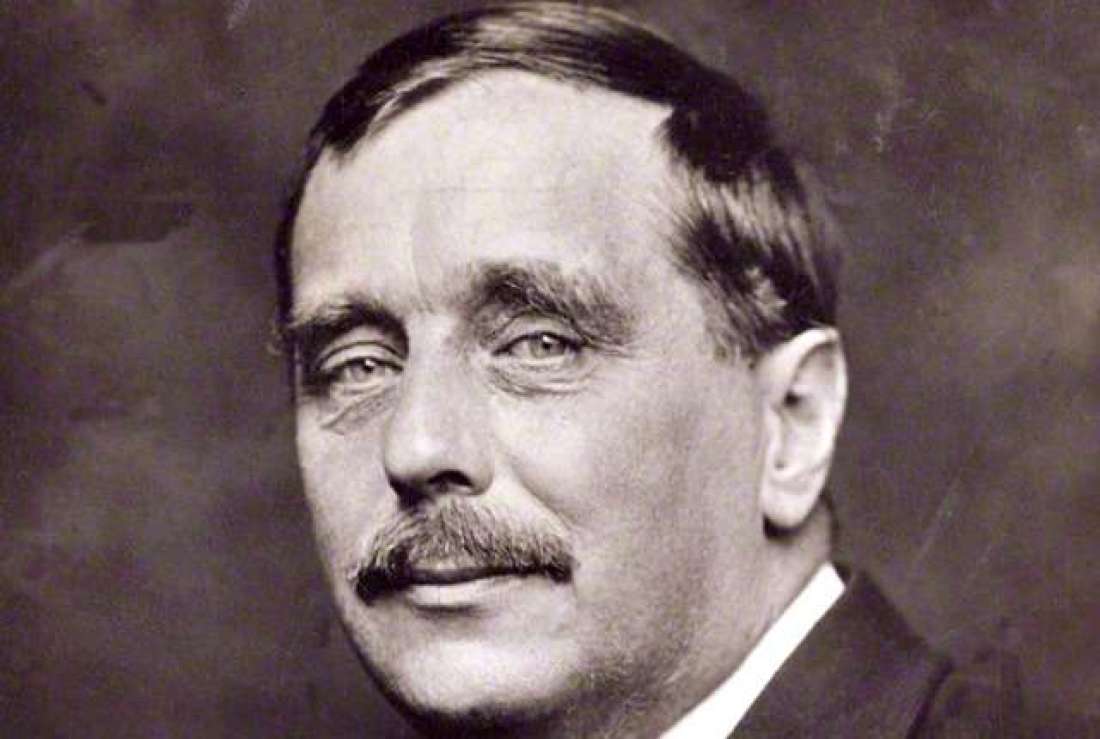
H.G. Wells on man as the unnatural animal

Man is the unnatural animal, the rebel child of nature, and more and more does he turn himself against the harsh and fitful hand that reared him.

–Herbert George Wells, usually referred to as H. G. Wells (September 21, 1866 – August 13, 1946), was an English writer. He was prolific in many genres, writing dozens of novels, short stories, and works of social commentary, satire, biography, … Wikipedia


Insight about the Joseph story

I was innocently watching a nearly naked Donny Osmond in “Joseph and the Amazing Technicolor Dreamcoat” and it dawned on me:  the dream that Joseph had about the sheaves of wheat bowing down to him was not a dream about how Joseph felt about himself in relationship to his brothers (as his brother all thought it was).  It was a precognitive dream about how Joseph above Pharoah does indeed rule over his brothers (his thoughts) in Egypt:

Genesis 37: 5 And Joseph dreamed a dream, and he told it his brethren: and they hated him yet the more.

And he said unto them, Hear, I pray you, this dream which I have dreamed:

For, behold, we were binding sheaves in the field, and, lo, my sheaf arose, and also stood upright; and, behold, your sheaves stood round about, and made obeisance to my sheaf.

And his brethren said to him, Shalt thou indeed reign over us? or shalt thou indeed have dominion over us? And they hated him yet the more for his dreams, and for his words.

And he dreamed yet another dream, and told it his brethren, and said, Behold, I have dreamed a dream more; and, behold, the sun and the moon and the eleven stars made obeisance to me.

10 And he told it to his father, and to his brethren: and his father rebuked him, and said unto him, What is this dream that thou hast dreamed? Shall I and thy mother and thy brethren indeed come to bow down ourselves to thee to the earth?

Genesis 42:6 Now Joseph was governor over the land. He was the one who sold to all the people of the land. And Joseph’s brothers came and bowed themselves before him with their faces to the ground.

“The Poison We Pick” by Andrew Sullivan

This nation pioneered modern life. Now epic numbers of Americans are killing themselves with opioids to escape it.

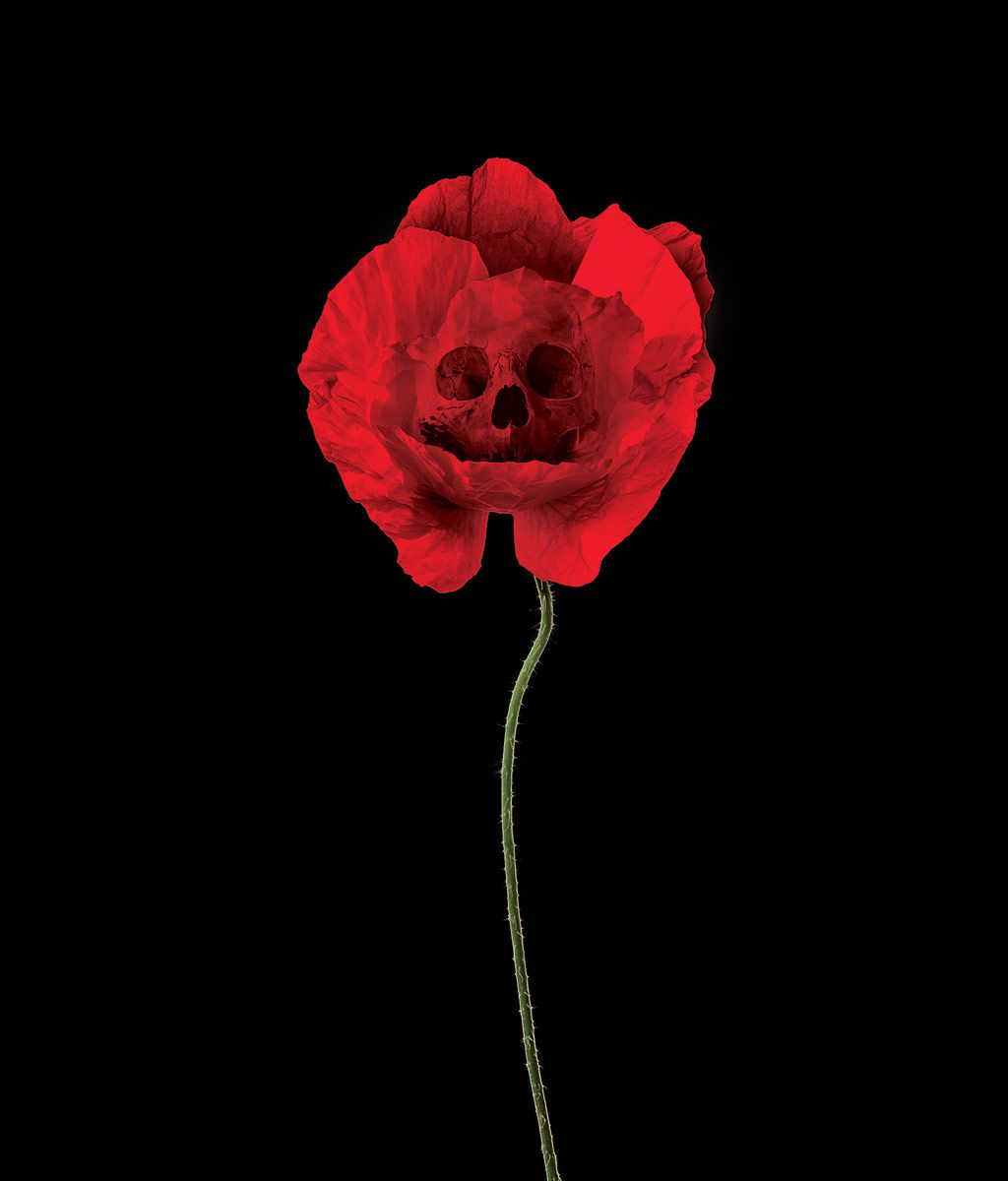
Photo Illustration by Joe Darrow

It is a beautiful, hardy flower, Papaver somniferum, a poppy that grows up to four feet in height and arrives in a multitude of colors. It thrives in temperate climates, needs no fertilizer, attracts few pests, and is as tough as many weeds. The blooms last only a few days and then the petals fall, revealing a matte, greenish-gray pod fringed with flutes. The seeds are nutritious and have no psychotropic effects. No one knows when the first curious human learned to crush this bulblike pod and mix it with water, creating a substance that has an oddly calming and euphoric effect on the human brain. Nor do we know who first found out that if you cut the pod with a small knife, capture its milky sap, and leave that to harden in the air, you’ll get a smokable nugget that provides an even more intense experience. We do know, from Neolithic ruins in Europe, that the cultivation of this plant goes back as far as 6,000 years, probably farther. Homer called it a “wondrous substance.” Those who consumed it, he marveled, “did not shed a tear all day long, even if their mother or father had died, even if a brother or beloved son was killed before their own eyes.” For millennia, it has salved pain, suspended grief, and seduced humans with its intimations of the divine. It was a medicine before there was such a thing as medicine. Every attempt to banish it, destroy it, or prohibit it has failed.

The poppy’s power, in fact, is greater than ever. The molecules derived from it have effectively conquered contemporary America. Opium, heroin, morphine, and a universe of synthetic opioids, including the superpowerful painkiller fentanyl, are its proliferating offspring. More than 2 million Americans are now hooked on some kind of opioid, and drug overdoses — from heroin and fentanyl in particular — claimed more American lives last year than were lost in the entire Vietnam War. Overdose deaths are higher than in the peak year of AIDS and far higher than fatalities from car crashes. The poppy, through its many offshoots, has now been responsible for a decline in life spans in America for two years in a row, a decline that isn’t happening in any other developed nation. According to the best estimates, opioids will kill another 52,000 Americans this year alone — and up to half a million in the next decade.

We look at this number and have become almost numb to it. But of all the many social indicators flashing red in contemporary America, this is surely the brightest. Most of the ways we come to terms with this wave of mass death — by casting the pharmaceutical companies as the villains, or doctors as enablers, or blaming the Obama or Trump administrations or our policies of drug prohibition or our own collapse in morality and self-control or the economic stress the country is enduring — miss a deeper American story. It is a story of pain and the search for an end to it. It is a story of how the most ancient painkiller known to humanity has emerged to numb the agonies of the world’s most highly evolved liberal democracy. Just as LSD helps explain the 1960s, cocaine the 1980s, and crack the 1990s, so opium defines this new era. I say era, because this trend will, in all probability, last a very long time. The scale and darkness of this phenomenon is a sign of a civilization in a more acute crisis than we knew, a nation overwhelmed by a warp-speed, postindustrial world, a culture yearning to give up, indifferent to life and death, enraptured by withdrawal and nothingness. America, having pioneered the modern way of life, is now in the midst of trying to escape it.

How Marketing — and Medicine — Spurred the Opioid Crisis

How does an opioid make you feel? We tend to avoid this subject in discussing recreational drugs, because no one wants to encourage experimentation, let alone addiction. And it’s easy to believe that weak people take drugs for inexplicable, reckless, or simply immoral reasons. What few are prepared to acknowledge in public is that drugs alter consciousness in specific and distinct ways that seem to make people at least temporarily happy, even if the consequences can be dire. Fewer still are willing to concede that there is a significant difference between these various forms of drug-induced “happiness” — that the draw of crack, say, is vastly different than that of heroin. But unless you understand what users get out of an illicit substance, it’s impossible to understand its appeal, or why an epidemic takes off, or what purpose it is serving in so many people’s lives. And it is significant, it seems to me, that the drugs now conquering America are downers: They are not the means to engage in life more vividly but to seek a respite from its ordeals.

The alkaloids that opioids contain have a large effect on the human brain because they tap into our natural “mu-opioid” receptors. The oxytocin we experience from love or friendship or orgasm is chemically replicated by the molecules derived from the poppy plant. It’s a shortcut — and an instant intensification — of the happiness we might ordinarily experience in a good and fruitful communal life. It ends not just physical pain but psychological, emotional, even existential pain. And it can easily become a lifelong entanglement for anyone it seduces, a love affair in which the passion is more powerful than even the fear of extinction.

Perhaps the best descriptions of the poppy’s appeal come to us from the gifted writers who have embraced and struggled with it. Many of the Romantic luminaries of the early-19th century — including the poets Coleridge, Byron, Shelley, Keats, and Baudelaire, and the novelist Walter Scott — were as infused with opium as the late Beatles were with LSD. And the earliest and in many ways most poignant account of what opium and its derivatives feel like is provided by the classic memoir Confessions of an English Opium-Eater, published in 1821 by the writer Thomas De Quincey.

De Quincey suffered trauma in childhood, losing his sister when he was 6 and his father a year later. Throughout his life, he experienced bouts of acute stomach pain, as well as obvious depression, and at the age of 19 he endured 20 consecutive days of what he called “excruciating rheumatic pains of the head and face.” As his pain drove him mad, he finally went into an apothecary and bought some opium (which was legal at the time, as it was across the West until the war on drugs began a century ago).

An hour after he took it, his physical pain had vanished. But he was no longer even occupied by such mundane concerns. Instead, he was overwhelmed with what he called the “abyss of divine enjoyment” that overcame him: “What an upheaving from its lowest depths, of the inner spirit! … here was the secret of happiness, about which philosophers had disputed for many ages.” The sensation from opium was steadier than alcohol, he reported, and calmer. “I stood at a distance, and aloof from the uproar of life,” he wrote. “Here were the hopes which blossom in the paths of life, reconciled with the peace which is in the grave.” A century later, the French writer Jean Cocteau described the experience in similar ways: “Opium remains unique and the euphoria it induces superior to health. I owe it my perfect hours.”

The metaphors used are often of lightness, of floating: “Rising even as it falls, a feather,” as William Brewer, America’s poet laureate of the opioid crisis, describes it. “And then, within a fog that knows what I’m going to do, before I do — weightlessness.” Unlike cannabis, opium does not make you want to share your experience with others, or make you giggly or hungry or paranoid. It seduces you into solitude and serenity and provokes a profound indifference to food. Unlike cocaine or crack or meth, it doesn’t rev you up or boost your sex drive. It makes you drowsy — somniferum means “sleep-inducing” — and lays waste to the libido. Once the high hits, your head begins to nod and your eyelids close.

When we see the addicted stumbling around like drunk ghosts, or collapsed on sidewalks or in restrooms, their faces pale, their skin riddled with infection, their eyes dead to the world, we often see only misery. What we do not see is what they see: In those moments, they feel beyond gravity, entranced away from pain and sadness. In the addict’s eyes, it is those who are sober who are asleep. That is why the police and EMS workers who rescue those slipping toward death by administering blasts of naloxone — a powerful antidote, without which death rates would be even higher — are almost never thanked. They are hated. They ruined the high. And some part of being free from all pain makes you indifferent to death itself. Death is, after all, the greatest of existential pains. “Everything one achieves in life, even love, occurs in an express train racing toward death,” Cocteau observed. “To smoke opium is to get out of the train while it is still moving. It is to concern oneself with something other than life or death.”

This terrifyingly dark side of the poppy reveals itself the moment one tries to break free. The withdrawal from opioids is unlike any other. The waking nightmares, hideous stomach cramps, fevers, and psychic agony last for weeks, until the body chemically cleanses itself. “A silence,” Cocteau wrote, “equivalent to the crying of thousands of children whose mothers do not return to give them the breast.” Among the symptoms: an involuntary and constant agitation of the legs (whence the term “kicking the habit”). The addict becomes ashamed as his life disintegrates. He wants to quit, but, as De Quincey put it, he lies instead “under the weight of incubus and nightmare … he would lay down his life if he might get up and walk; but he is powerless as an infant, and cannot even attempt to rise.”

The poppy’s paradox is a profoundly human one: If you want to bring Heaven to Earth, you must also bring Hell. In the words of Lenny Bruce, “I’ll die young, but it’s like kissing God.”

Photo-Illustration: Joe Darrow

No other developed country is as devoted to the poppy as America. We consume 99 percent of the world’s hydrocodone and 81 percent of its oxycodone. We use an estimated 30 times more opioids than is medically necessary for a population our size. And this love affair has been with us from the start. The drug was ubiquitous among both the British and American forces in the War of Independence as an indispensable medicine for the pain of battlefield injuries. Thomas Jefferson planted poppies at Monticello, and they became part of the place’s legend (until the DEA raided his garden in 1987 and tore them out of the ground). Benjamin Franklin was reputed to be an addict in later life, as many were at the time. William Wilberforce, the evangelical who abolished the British slave trade, was a daily enthusiast. As Martin Booth explains in his classic history of the drug, poppies proliferated in America, and the use of opioids in over-the-counter drugs was commonplace. A wide range of household remedies were based on the poppy’s fruit; among the most popular was an elixir called laudanum — the word literally means “praiseworthy” — which took off in England as early as the 17th century.

Mixed with wine or licorice, or anything else to disguise the bitter taste, opiates were for much of the 19th century the primary treatment for diarrhea or any physical pain. Mothers gave them to squalling infants as a “soothing syrup.” A huge boom was kick-started by the Civil War, when many states cultivated poppies in order to treat not only the excruciating pain of horrific injuries but endemic dysentery. Booth notes that 10 million opium pills and 2 million ounces of opiates in powder or tinctures were distributed by Union forces. Subsequently, vast numbers of veterans became addicted — the condition became known as “Soldier’s Disease” — and their high became more intense with the developments of morphine and the hypodermic needle. They were joined by millions of wives, sisters, and mothers who, consumed by postwar grief, sought refuge in the obliviating joy that opiates offered.

Based on contemporary accounts, it appears that the epidemic of the late 1860s and 1870s was probably more widespread, if far less intense, than today’s — a response to the way in which the war tore up settled ways of life, as industrialization transformed the landscape, and as huge social change generated acute emotional distress. This aspect of the epidemic — as a response to mass social and cultural dislocation — was also clear among the working classes in the earlier part of the 19th century in Britain. As small armies of human beings were lured from their accustomed rural environments, with traditions and seasons and community, and thrown into vast new industrialized cities, the psychic stress gave opium an allure not even alcohol could match. Some historians estimate that as much as 10 percent of a working family’s income in industrializing Britain was spent on opium. By 1870, opium was more available in the United States than tobacco was in 1970. It was as if the shift toward modernity and a wholly different kind of life for humanity necessitated for most working people some kind of relief — some way of getting out of the train while it was still moving.

If industrialization caused an opium epidemic, deindustrialization is no small part of what’s fueling our opioid surge. It’s telling that the drug has not taken off as intensely among all Americans — especially not among the engaged, multiethnic, urban-dwelling, financially successful inhabitants of the coasts. The poppy has instead found a home in those places left behind — towns and small cities that owed their success to a particular industry, whose civic life was built around a factory or a mine. Unlike in Europe, where cities and towns existed long before industrialization, much of America’s heartland has no remaining preindustrial history, given the destruction of Native American societies. The gutting of that industrial backbone — especially as globalization intensified in a country where market forces are least restrained — has been not just an economic fact but a cultural, even spiritual devastation. The pain was exacerbated by the Great Recession and has barely receded in the years since. And to meet that pain, America’s uniquely market-driven health-care system was more than ready.

The great dream of the medical profession, which has been fascinated by opioids over the centuries, was to create an experience that captured the drug’s miraculous pain relief but somehow managed to eliminate its intoxicating hook. The attempt to refine opium into a pain reliever without addictive properties produced morphine and later heroin — each generated by perfectly legal pharmaceutical and medical specialists for the most enlightened of reasons. (The word heroin was coined from the German word Heroisch, meaning “heroic,” by the drug company Bayer.) In the mid-1990s, OxyContin emerged as the latest innovation: A slow timed release would prevent sudden highs or lows, which, researchers hoped, would remove craving and thereby addiction. Relying on a single study based on a mere 38 subjects, scientists concluded that the vast majority of hospital inpatients who underwent pain treatment with strong opioids did not go on to develop an addiction, spurring the drug to be administered more widely.

This reassuring research coincided with a social and cultural revolution in medicine: In the wake of the AIDS epidemic, patients were becoming much more assertive in managing their own treatment — and those suffering from debilitating pain began to demand the relief that the new opioids promised. The industry moved quickly to cash in on the opportunity: aggressively marketing the new drugs to doctors via sales reps, coupons, and countless luxurious conferences, while waging innovative video campaigns designed to be played in doctors’ waiting rooms. As Sam Quinones explains in his indispensable account of the epidemic, Dreamland, all this happened at the same time that doctors were being pressured to become much more efficient under the new regime of “managed care.” It was a fateful combination: Patients began to come into doctors’ offices demanding pain relief, and doctors needed to process patients faster. A “pain” diagnosis was often the most difficult and time-consuming to resolve, so it became far easier just to write a quick prescription to abolish the discomfort rather than attempt to isolate its cause. The more expensive and laborious methods for treating pain — physical and psychological therapy — were abandoned almost overnight in favor of the magic pills.

Continue reading “The Poison We Pick” by Andrew Sullivan

Panicked Billy Graham Realizes He Took Wrong Turn Into Heaven’s Largest Gay Neighborhood

THE HEAVENS—As he entered the Pearly Gates and walked the gold-paved streets of God’s Eternal Kingdom, the late Rev. Billy Graham was reportedly so overwhelmed Wednesday by the great majesty before him that he did not at first notice he had taken a turn leading him down the main thoroughfare of heaven’s largest gay enclave. “Oh no, oh—Where am I, exactly?” said the celebrated evangelist, who witnessed numerous same-sex couples making out upon Heaven’s lush green pastures and became disoriented when a crowd of shirtless, muscular homosexual men poured out of a nearby nightclub and streamed past him on every side. “This can’t possibly be right. I am in Heaven, aren’t I?” According to heavenly sources, Graham, who during his life referred to homosexuality as “a sinister form of perversion,” shrugged, smiled, and continued walking straight into the neighborhood’s largest bath house.

Consciousness, spirituality, biography, sexuality, androgyny, futurism, space, the arts, science, astrology, democracy, humor, books, movies and more