
Happy Holidays from Alonzo King LINES Ballet! from LINES Ballet on Vimeo.
Monthly Archives: December 2016
God on money (per Dorothy Parker)

“If you want to know what God thinks of money, just look at the people he gave it to.”
― Dorothy Parker (August 22, 1893 – June 7, 1967) was an American poet, short story writer, critic, and satirist, best known for her wit, wisecracks and eye for 20th-century urban foibles. Wikipedia
Scientists are One Step Closer to Reversing the Aging Process Entirely

by
Imagine a medication that could take years off of your looks.
I’m determined to age gracefully. Though my wife plucks every gray hair she finds, I’d be bald if I did. Even so, I’ve kept myself up over the years, prompting my college girlfriend, whom I recently reconnected with to exclaim, “You haven’t aged at all!” Except for more gray hair, that is. Perhaps it’s just good genes. I’ve always chalked it up to stress-free living. So what can be done to overcome the aging process? Creams, lotions, and other products fill pharmacy shelves, but few have a truly substantial impact.
Now, researchers at the Salk Institute in La Jolla, California have discovered a way to turn back the hands of time. Juan Carlos Izpisua Belmonte led this study, published in the journal Cell. Here, elderly mice underwent a new sort of gene therapy for six weeks. Afterward, their injuries healed, their heart health improved, and even their spines were straighter. The mice also lived longer, 30% longer.
Today, we target individual age-related diseases when they spring up. But this study could help us develop a therapy to attack aging itself, and perhaps even target it before it begins taking shape. But such a therapy is at least ten years away, according to Izpisua Belmonte.
Many biologists now believe that the body, specifically the telomeres—the structures at the end of chromosomes, after a certain time simply wear out. Once degradation overtakes us, it’s the beginning of the end. This study strengthens another theory. Over the course of a cell’s life, epigenetic changes occur. This is the activation or depression of certain genes in order to allow the organism to respond better to its environment. Methylation tags are added to activate genes. These changes build up over time, slowing us down, and making us vulnerable to disease.

Chromosomes with telomeres in red.
Though we may add life to years, don’t consider immortality an option, at least not in the near-term. “There are probably still limits that we will face in terms of complete reversal of aging,” Izpisua Belmonte said. “Our focus is not only extension of lifespan but most importantly health-span.” That means adding more healthy years to life, a noble prospect indeed.
The technique employs induced pluripotent stem cells (iPS). These are similar to those which are present in developing embryos. They are important as they can turn into any type of cell in the body. The technique was first used to turn back time on human skin cells, successfully.
By switching around four essential genes, all active inside the womb, scientists were able to turn skin cells into iPS cells. These four genes are known as Yamanaka factors. Scientists have been aware of their potential in anti-aging medicine for some time. In the next leg, researchers used genetically engineered mice who could have their Yamanaka factors manipulated easily, once they were exposed to a certain agent, present in their drinking water.
Since Yamanaka factors reset genes to where they were before regulators came and changed them, researchers believe this strengthens the notion that aging is an accumulation of epigenetic changes. What’s really exciting is that this procedure alters the epigenome itself, rather than having the change the genes of each individual cell.

The mechanics of epigenetics.
In another leg of the experiment, mice with progeria underwent this therapy. Progeria is a disease that causes accelerated aging. Those who have seen children who look like seniors know the condition. It leads to organ damage and early death. But after six months of treatment, the mice looked younger. They had better muscle tone and younger looking skin, and even lived around 30% longer than those who did not undergo the treatment.
Luckily for the mice, time was turned back the appropriate amount. If turned back too far, stem cells can proliferate in an uncontrolled fashion, which could lead to tumor formation. This is why researchers have been reticent to activate the Yamanaka factors directly. However, these scientists figured out that by intermittently stimulating the factors, they could reverse the aging process, without causing cancer. The next decade will concentrate on perfecting this technique.
Since the threat of cancer is great, terminally ill patients would be the first to take part in a human trial, most likely those with progeria. Unfortunately, the method used in this study could not directly be applied to a fully functioning human. But researchers believe a drug could do the job, and they are actively developing one.
“This study shows that aging is a very dynamic and plastic process, and therefore will be more amenable to therapeutic interventions than what we previously thought,” Izpisua Belmonte said. Of course, mouse systems and human one’s are far different. This only gives us an indication of whether or not it might work. And even if it does, scientists will have to figure out how far to turn back the clock. But as Izpisua Belmonte said, “With careful modulation, aging might be reversed.”
To learn more about anti-aging medicine, click here:
How Does Marijuana Affect Your Memory?
Art Deco art by Erté
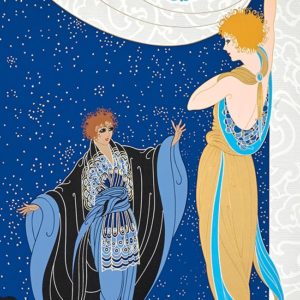
Romain de Tirtoff (November 23, 1892 – April 21, 1990) was a Russian-born French artist and designer known by the pseudonym Erté, from the French pronunciation of his initials. Wikipedia
Ask Mick LaSalle (sfgate.com)

Dear Mick: Say there’s scale of belief, where would you fit in? Do you believe, on the one side, like Sartre, that the world is absurd, or on the other end, that everything is saturated with meaning, like Jung?
—Kevin Steed, Oakland
Dear Kevin: I would say that everything is saturated with meaning, and though the meaning might be absurd, it’s still meaning, not anti-meaning, so that would place me with Jung. One of the things that fascinates me is the idea that everything in a cultural moment is related. It’s easy to see a connection, for instance, between, say, the Reagan era and “Rambo” and “Top Gun.” But those elements also might be related to things like big lapels on Armani suits, or drum machines in music. It seems that the farther we get from a period, the more we can see its elements as part of some larger vision, which, depending on how you see the world, you could call the mind of God, or the turning of the universe, or some mass consciousness coming into being. As for this particular cultural moment, the one we’re in, I’d try reading the mass consciousness, except I’m afraid I’d end up peeking through my fingers with both hands covering my face, like a modified Munch’s “The Scream.”
“Yes, Donald Trump’s America is full of idiots. But not in the way you think.”
The ancient Greek origins of an insult.

Nick Romeo is a critic and journalist based in Palo Alto, Calif.

President-elect Donald Trump speaks during a rally in Hershey, Pa. (Evan Vucci/AP)
The word “idiot” is enjoying something of a renaissance. Searching “Donald Trump idiot” on Google yields nearly 10 million results, and the epithet has become a regular feature in the national media. A recent New York Times op-ed blasted Trump’s “agents of idiocracy,” while a headline from Salon asked, “Who are these idiot Donald Trump supporters?” Celebrities from Judd Apatow to Cher have denounced Trump as an idiot, and even data from polls have been used to claim that his supporters are idiotic.
It’s absolutely true that America is full of idiots — but not in the usual sense of the word.
The term “idiot” derives from the ancient Greek “idios” — an adjective often translated as “personal” or “private.” The earliest recorded use of the word dates to Homer’s “Odyssey.” When Odysseus’s son, Telemachus, meets the old warrior Nestor, he says that he has come on a private matter — to seek information about his father — and not with a purpose that concerns the people of Ithaca, his home. The distinction is important enough that he clarifies the nature of his visit right away.
[We think our enemies are idiots, and that’s a problem]
As the Persian army invaded Greece in 490 BC, they besieged the small city of Eritrea on the island of Euboea. In exchange for “private advantages,” a small group of nobles betrayed the city to the Persians. The word that the Greek historian Herodotus uses to modify advantages is “idios.” The prospect of private enrichment prompts a subset of already wealthy citizens to accept Persian bribes and undermine their own city’s defense. The siege was broken, the city plundered and the population enslaved.
The original meaning located a position on the private-to-public spectrum, not a ranking on a scale of intelligence. In fact, as the story from Herodotus suggests, those who prioritize the private can be quite shrewd.
The term “idios” also appears at a climactic moment of Thucydides’s “History of the Peloponnesian War.” As the Athenian statesman Pericles delivers his funeral oration at the common grave of Athenian soldiers killed fighting the Spartans, he exhorts his audience to cease grieving for “private afflictions” and turn instead to the safety of the community. Here, private sorrow rather than private gain threatens the welfare of the broader group, but the passage again highlights a political meaning of idiocy as a force that threatens the common good.
Plato and other ancient authors used the word “idios” to distinguish between the knowledge levels of laymen and experts. Its meaning eventually changed from a neutral designation of a private individual unskilled in a particular domain — such as medicine or warfare — to a general condemnation of an individual’s intelligence.
A spiteful focus on the absence of intelligence now defines both the English word “idiot” and many recent characterizations of vast sectors of the American public. But imagine a term that instead designates people who are overly committed to their own private advantages. The map of American idiocy would shift dramatically.
A first group of idiots would comprise those who did not vote. This category cuts across the political spectrum — people of all political persuasions rejected the archetypal gesture of public engagement. The consequences of this myopic private focus may not seem as dire as those in Herodotus, but the ancient historian suggests the right evaluative framework — not voting is a moral choice to privilege the private over the public. It a way of doing harm to a broader group.
A second set of idiots are those who voted based on narrow, sectarian interests. This group also scrambles the standard categories: At least some of the supporters of Trump and Hillary Clinton were motivated to support their candidate by the hope of some particular benefit to a small category with which they identify — a tax bracket, an industry, a religious or ideological group. It’s worth asking whether more supporters of one candidate or the other fit this class of idiots, but it includes supporters of both major parties.
A third sort of idiots are those who use a public office for private gain. Trump and many of his appointees show every indication of belonging to this group. Some estimates have placed the combined net worth of Trump’s cabinet at about $35 billion. This suggests a group of people who have spent their lives in wildly successful idiocy. One problem with Trump’s extensive international business interests is that he can’t easily clarify, as Telemachus does, the nature of his meetings with foreign leaders.
[How President Trump could use the White House to enrich himself and his family]
The final category of idiots includes potentially everyone. The ancient origins of the word highlight the fact that humans are imperfect political actors, frequently torn between the competing lures of private and public goods. It also reminds us that political survival depends on successfully calibrating the balance of public and private interests. The 21st century threats of climate change, global inequality and extremism, combined with the instantaneous rippling of impacts across countries, ecosystems and financial markets, makes provincial self-interest less tenable than ever before. There are many ways to avoid the pull of the parochial: donate time and money to worthy charities; organize and lobby elected officials at all levels of government; subscribe to a newspaper; urge your employers to make ethical corporate decisions. But to hunker down, to ignore the public sphere, to move to Canada — this is idiocy in every sense of the word.

Views from the Real World: Early Talks of G.I. Gurdjieff
The Lord’s Prayer: An interpretation by Emmet Fox
Sunday Night Translation Group: December 18
Translation is a 5-step process using syllogistic reasoning to transform man and the universe back into Being. Being is the perfect, essential nature of all, and through the process of Translation, reality is uncovered and thus revealed. Through word tracking, getting to the essence of the words we use to express our current view of reality, we are uncovering essence, which is the only true reality.
Sense testimony:
Our lives are based on what we believe emotionally, not what we affirm intellectually.
Conclusions:
- Life believes Itself emotionally, intelligently and affirmatively.
- Truth Consciousness I Am is Universally Instantaneously Self Evidently Agreeably Powerfully Abundantly Soundly moving all being choosing all there is, all I Am.
- I AM THAT I AM, Spirit’s Love of One Consciousness; the law of beingness is the discernment of Higher Mind.
- To come (see Comments).