

Monthly Archives: December 2016
Book: “The Power of Decision” by Raymond Charles Barker
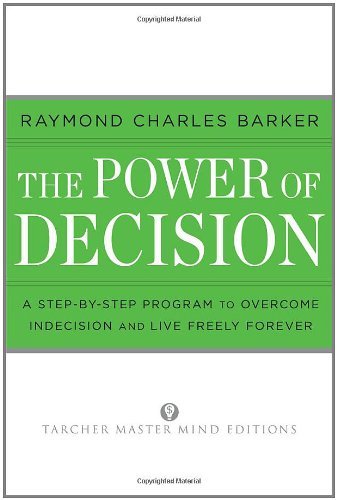
Introducing the first book in a powerful new series, The Tarcher Master Mind Editions: Essential Books of Inspiration, Instruction, and Motivation.
What mind can conceive, man can achieve.
Our decisions impact every area of our lives. Making better decisions means living a better life. But how can we develop the habit of making great decisions?
Every noteworthy achievement the world has ever seen was born with a single thought; and every great man who ever lived has been a man of decision. Raymond Charles Barker’s The Power of Decision reveals this principle of success and illustrates the process of choice that all of us must take-and that all of us are capable, this very second, of taking-to change our lives and make our dreams come true.
Indecisive people are failure prone, and Dr. Barker examines this basic truth while exploring the decision-making process in the individual, and the role of the subconscious mind in either abetting or thwarting each of our conscious decisions. He provides specific steps to shift the balance of decision-making power in your favor, and he brings to light the constant, ever-present power of will to change a situation- and yourself-for the better.
Picking up The Power of Decision is the moment; and reading it is the decision that will change your life forever.
Zorba the Greek on “the full catastrophe” and dolphins
Balzac on the relationship between fortune and crime

Balzac (or Tom Friedman from the New York Times?)
En francais: Le secret des grandes fortunes sans cause apparente est un crime oublié, parce qu’il a été proprement fait.
–Balzac in “Le Père Goriot” (1834)
In English: The secret of a great fortune made without apparent cause is soon forgotten, if the crime is committed in a respectable way.
Popular translation: Behind every great fortune is a great theft.
Honoré de Balzac (May 20, 1799 – August 18, 1850 was a French novelist and playwright. The novel sequence La Comédie Humaine, which presents a panorama of post-Napoleonic French life, is generally viewed as his magnum opus. Wikipedia
History of the gesture “flipping the bird” — from Robert McEwen, H.W., M.

The Romans did not invent this gesture, however. The earliest recorded mention is a play “The Clouds”, written by the Greek Aristophanes in 423 B.C. Even then, the middle finger has a clear, obscene and sexual use. It is unlikely that the ancient Greeks were the founders for flipping the birdie. More likely, flipping someone off goes back into prehistory.
Here’s a 20th century translation of The Clouds:
SOCRATES: Well, to begin with,
they’ll make you elegant in company—
and you’ll recognize the different rhythms,
the enoplian and the dactylic,
which is like a digit.STREPSIADES: Like a digit!
By god, that’s something I do know!SOCRATES: Then tell me.STREPSIADES: When I was a lad a digit meant this![Strepsiades sticks his middle finger straight up under Socrates’ nose]SOCRATES: You’re just a crude buffoon!
The Magic of admitting, “I Don’t Know!” by Robert McEwen, H.W., M.

Most of the time we are in the dark. That is where real intimacy is. When we admit this simple fact, we open a portal for real growth. We don’t know! Not until then can we really Translate the sense testimony in the 5 steps of Translation. If we think and feel we all ready know the answer, there can be no opening in our Totality Field. We have made it into a “closed ended system”.
Consciousness, our awareness and interpretation of reality can be open, or we reduce down to whatever we decide; consciously or unconsciously. When I am not in charge, when I admit I don’t know…then I can be in an open ended Translation.
Are you ready, willing and available? Do you realize you don’t really know the answer? That is a necessity for growth, expansion and opportunity. This openness will allow us to learn and unlearn… and to BE the process of awareness. The ego must be put aside for Mind to operate at all. Most of us live in a box we created by our fear of admitting we don’t really know. Our translations then don’t work. Translation is not predicting the outcome. What questions are your currently asking? What ones do you want and need to ask? This will help you identify what second step to put in our Translations! Think about it! True creativity can grab hold
of you! This open ended system can really guide your direction for 2017. Let’s do it!
Say OUT LOUD NOW I don’t know!
Try it out. It works wonders and frees you up. Please take a minute. Try it now!
“I don’t know the answer!” then you can be open to listening to the infinite possibilities that await us! There is no one answer. It opens up infinite questions to ask. Life is then an adventure. What questions do you want to ask, and then ask new ones after that opens a new question of sense testimony.
It is at that point Translation is fun. Play! This open listening, new questions we dare to ask and let the axiom challenge its reality. We are being translated at that point. We are not translating as a human equation, but have entered into Universal Mind. This is where the real action is. We are in the zone!
Allow yourself this gift in 2017. Have a very fun time letting Translation translate you!
Aloha,
Robert McEwen, H.W., M.
Robert McEwen on Facebook
Tony Schwartz: The Truth About Trump | Oxford Union Q&A
Announcing his candidacy for the Republican nomination back in June 2015, Donald Trump stated “We need a leader that wrote ‘The Art of the Deal’ “. Tony Schwartz was the ghostwriter of the book Trump calls ‘his proudest achievement’. Schwartz has been vocal about his regrets in working on the piece, but, having worked intimately with Trump, provides a fascinating perspective into the personality and idiosyncrasies of the Republican nominee
ABOUT THE OXFORD UNION SOCIETY: The Oxford Union is the world’s most prestigious debating society, with an unparalleled reputation for bringing international guests and speakers to Oxford. Since 1823, the Union has been promoting debate and discussion not just in Oxford University, but across the globe.
Why The Field of Economics Is Bullshit and Shouldn’t Be Studied
If you appreciate this channel and what it represents please support me and buy my book
https://goo.gl/xVCdaW
Terminolgy: Gaslighting

Ingrid Bergman in the 1944 film “Gaslight”
Gaslighting or gas-lighting is a form of psychological abuse in which a victim is manipulated into doubting their own memory, perception, and sanity. Instances may range from the denial by an abuser that previous abusive incidents ever occurred up to the staging of bizarre events by the abuser with the intention of disorienting the victim. The term owes its origin to Gas Light, a 1938 play and 1944 film, and has been used in clinical and research literature.
The term originates in the systematic psychological manipulation by the main character on a victim in the 1938 stage play Gas Light, known as Angel Street in the United States, and the film adaptations released in 1940 and 1944. In the story, a husband attempts to convince his wife and others that she is insane by manipulating small elements of their environment and insisting that she is mistaken, remembering things incorrectly, or delusional when she points out these changes. The original title stems from the dimming of the gas lights in the house that happened when the husband was using the gas lights in the attic while searching for hidden treasure. The wife accurately notices the dimming lights and discusses the phenomenon, but the husband insists she just imagined a change in the level of illumination.
The term “gaslighting” has been used colloquially since the 1960s to describe efforts to manipulate someone’s sense of reality. In a 1980 book on child sexual abuse, Florence Rush summarized George Cukor’s 1944 film version of Gas Light, and writes, “even today the word [gaslighting] is used to describe an attempt to destroy another’s perception of reality.”
Clinical examples:
Sociopaths and narcissists frequently use gaslighting tactics. Sociopaths consistently transgress social mores, break laws, and exploit others, but typically are also convincing liars, sometimes charming ones, who consistently deny wrongdoing. Thus, some who have been victimized by sociopaths may doubt their perceptions.
Some physically abusive spouses may gaslight their partners by flatly denying that they have been violent.
Gaslighting may occur in parent–child relationships, with either parent, child, or both, lying to each other and attempting to undermine perceptions.
Gaslighting describes a dynamic observed in some cases of marital infidelity: “Therapists may contribute to the victim’s distress through mislabeling the woman’s reactions. […] The gaslighting behaviors of the spouse provide a recipe for the so-called ‘nervous breakdown’ for some women [and] suicide in some of the worst situations.”
Psychotherapy and psychiatry have been described as forms of gaslighting wherein the therapist or psychiatrist is characterized by the patient to be of a more sound, all-knowing mind (i.e. an expert). This can potentially create a conflict where the patient is unable to trust their immediate sense of their feelings and surroundings in favor of the interpretations offered by the therapist, which come in the form of doubt or skepticism at the patient’s appraisals and perceptions of the world. Furthermore, gaslighting has been observed between patients and staff in inpatient psychiatric facilities.
Introjection:
In an influential 1981 article Some Clinical Consequences of Introjection: Gaslighting, Calef and Weinshel argue that gaslighting involves the projection and introjection of psychic conflicts from the perpetrator to the victim: “this imposition is based on a very special kind of ‘transfer’… of painful and potentially painful mental conflicts.”
The authors explore a variety of reasons why the victims may have “a tendency to incorporate and assimilate what others externalize and project onto them”, and conclude that gaslighting may be “a very complex highly structured configuration which encompasses contributions from many elements of the psychic apparatus.” Dorpat (1994) describes this as an example of projective identification.
Resisting:
With respect to women in particular, Hilde Lindemann argued emphatically that in such cases, the victim’s ability to resist the manipulation depends on “her ability to trust her own judgments”. Establishment of “counterstories” may help the victim reacquire “ordinary levels of free agency.”
In the media:
British film-maker Adam Curtis has suggested that “nonlinear” or “asymmetric” war (as described by Vladislav Surkov, political advisor to Vladimir Putin) is a form of gaslighting intended for political control.
The film What Became of Jack and Jill? concerns a murder-by-gaslight plot by two young mods, who attempt to induce a heart attack in an elderly woman by convincing her that she is being targeted by a fictional youth-supremacist movement.
During the 2016 United States presidential campaign, presidential candidate Donald Trump.
(Wikipedia.org)