“Blowing Smoke Up Your Ass” Used to Be Literal

smoke

by Terynn Boulton (gizmodo.com)

When someone is “blowing smoke up your arse” today, it is a figure of speech that means that one person is complimenting another, insincerely most of the time, in order to inflate the ego of the individual being flattered.

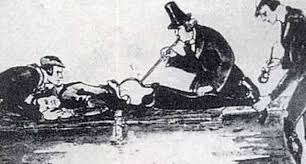
Back in the late 1700s, however, doctors literally blew smoke up people’s rectums. Believe it or not, it was a general mainstream medical procedure used to, among many other things, resuscitate people who were otherwise presumed dead. In fact, it was such a commonly used resuscitation method for drowning victims particularly, that the equipment used in this procedure was hung alongside certain major waterways, such as along the River Thames (equipment courtesy of the Royal Humane Society). People frequenting waterways were expected to know the location of this equipment similar to modern times concerning the location of defibrillators.

Smoke was blown up the rectum by inserting a tube. This tube was connected to a fumigator and a bellows which when compressed forced smoke into the rectum. Sometimes a more direct route to the lungs was taken by forcing the smoke into the nose and mouth, but most physicians felt the rectal method was more effective. The nicotine in the tobacco was thought to stimulate the heart to beat stronger and faster, thus encouraging respiration. The smoke was also thought to warm the victim and dry out the person’s insides, removing excessive moisture.

So how did this all get started? The Native Americans were known to have used tobacco in a variety of ways, including treating various medical ailments, and the European doctors soon picked up on this and began advocating it for treatments for everything from headaches to cancer.

In 1745, Richard Mead was among the first known Westerners to suggest that administering tobacco via an enema was an effective way to resuscitate drowning victims.

By 1774, Doctors William Hawes and Thom­as Cogan, who practiced medicine in London, formed The Institution for Affording Immediate Relief to Persons Apparently Dead From Drowning. This group later became the Royal Hu­mane Society. Back in the 18th century, the society promoted the resuscitation of drowning people by paying four guineas (about £450 today by purchasing power, or $756) to anyone who was able to successfully revive a drowning victim.

Volunteers within the society soon began using the latest and greatest method of reviving such half-drowned individuals, via tobacco smoke enemas. Artificial respiration was used if the tobacco enema did not successfully revive them. In order that people could easily remember what to do in these cases, in 1774 Dr. Houlston published a helpful little rhyme:

Tobacco glyster (enema), breathe and bleed.
Keep warm and rub till you succeed.
And spare no pains for what you do;
May one day be repaid to you.

The practice of using tobacco smoke enemas on drowning victims quickly spread as a popular way to introduce tobacco into the body to treat an array of other medical conditions including: headaches, hernias, respiratory ailments and abdominal cramps, among many other things. Tobacco enemas were even used to treat typhoid fever and during cholera outbreaks when patients were in the final stages of the illnesses.

 In their most rudimentary form, tobacco smoke enemas were not always administered with the aide of bellows. Originally, the smoke was blown up the victim’s rectum with whatever was handy, such as a smoking pipe. Of course, such close contact wasn’t ideal and if the rescuer accidentally inhaled instead of blew, let’s just say things that one should not aspirate could be inhaled. If the person jerked around, mouth contact was also a risk, even more risky considering the person being administered too was sometimes diseased.

In fact, one of the earliest documented references of using such a tobacco enema to resuscitate someone came from someone using a smoking pipe in 1746. In this case, the man’s wife had nearly drowned and was unconscious. It was suggested that an emergency tobacco enema might revive her, at which point the husband of the woman took a pipe filled with burning tobacco, shoved the stem into his wife’s rectum and then covered the other end of the pipe with his mouth and blew. As one would imagine, hot embers of tobacco being blown up her rectum had the intended effect and she was, indeed, revived.

This practice quickly spread, reaching its peak in the early 20th century before, in 1811, English scientist Ben Brodie via animal testing discovered that nicotine was toxic to the cardiac system. Over the next several decades, the popularity of literally “blowing smoke up someone’s arse” gradually became a thing of the past. Figuratively, though, this practice is still alive and well.

“The Residents” on Dylan

theresidents

“Those not busy being born are busy lying.”
–“The Residents”‘s take on Bob Dylan’s famous line.

The Residents are an American art collective best known for avant-garde music and multimedia works. Since their first official release, Meet the Residents, the group has released over sixty albums, … Wikipedia

Mozart – Clarinet Concerto

Soloist: Sharon Kam – Basset Clarinet
Performers: Czech Philharmonic Orchestra / Manfred Honeck

Recorded live at the Estates Theatre, Prague, 27 January 2006

With the excellent Sharon Kam on the clarinet – since emerging as the most exciting young clarinetist on the international scene when she won the top prize at the Munich (ARD) International Competition, she has performed with many renowned orchestras all over the world.

Forgotten Keepsakes & Misplaced Memories By Calvin Harris, H.W., M.

Calvin profile

It had been a low hum and then it grew into a strumming guitar and then a voice that faded in and out of what seemed to be a troubling sleep. Slowly I became aware of the voice Tim McGraw then lyrics from the song- “One of these days” ….” I chase that boy home from school…he wasn’t cool…”Yeah I remember that fool kid running passed meStrange what he said… ‘you’re gonna love me

Wow must be some bleed off of the song, which keeps waffling in and out of my thoughts … “small town beauty…I promised the world… left her standin’…. but she says … you’re gonna love me.” ….

Hmm… I remember a girl, giving her a watch with a strand of hair in it why did I leave…The song trailing off now I hear  “I’m gonna…feel… release…to rise above me…smile a little…laugh a little… one of these days I’m gonna love me” ….

In this space of twilight consciousness, waffled with my thoughts of music, peppered in with these disconnected or misplaced memories… yes, waffle a good word for it, meaning to be unable or unwilling to make a clear decision about what to do.  In the midst of these honeycomb thoughts, pierced a modulated voice both authoritative and yet soothing – was it male? No, female? No, some combination of each? It said:

Welcome to the future, you are in a reentry state and once fully revived you will find yourselves in the year 2045 of the Common Earth Era.

Our vision for each of you is to successfully assimilate as a sentient being into the present culture as quickly as possible. Some of you were put in containment in the early 1960’s and have a lot to do to catch up.

With nanorobotic medicine, we have been able to diagnose, treat, repair and prevent future disease and traumatic injury to your soma or what you call your body. Your body, who you are, is much, much more than a skin enclosed bag of blood, bones, and organs. For success in your new life in the HERE & NOW, we will need for you to upgrade your concept of thoughts, attitudes, and emotional responses of the body to be a successfully functioning Somatic Unit, which entails body, mind, and soul working in one accord. This is a crucial demand of this Society. We could have intervened and reworked your thoughts & feeling but then you would be no better than an android 

When we intervene, the interventions that are best, are those that intervene in the least. Your complex infrastructure, that marriage of high tech natural science and machine produced your cyborg shell, this would all be for nothing without you reworking your mammalian fears, aggressive attitudes, and prejudices. Your job then is the recreation of yourself.  Know that whatever your core essence is, it will not be lost.   Gender and sexual attitudes are considered to be like clothing – in this Society people put them on and take them off at will.  Thus, what you were yesterday may not be what you are tomorrow. No one cares what you wear at any given time other than if it’s appropriate for the occasion. We care who you are, not what you wear. With that understood, many will find the hidden thrills of your once forbidden past tantalizing … until you find Your Uniqueness. Then that creative gift is the contribution Society want from you.

The extraordinary abilities of humanity to create are within you. Be willing to go beyond your current perceptions and be open to the greater possibilities of Agape.  Be warned – there is danger and courage needed to Educate yourself … Educate an ancient Greek word meaning “To draw forth from within” know that danger comes as the price for the greater sense of Somatic Awakening to have a deeper sense of community, of acceptance, maturity, wisdom, empathy, and gratitude.  – This danger is the Face to Face encounter with Oneself in memories of other times and on other worlds and in other dimensions. It’s a fierce contest, but you can overcome – Prepare.  

As the voice fades, I hear the song lyrics “Sweet release…to rise above me…… I’m gonna love me”

-END-

John McWhorter: 4 reasons to learn a new language – Ted Talk 2016

English is fast becoming the world’s universal language, and instant translation technology is improving every year. So why bother learning a foreign language? Linguist and Columbia professor John McWhorter shares four alluring benefits of learning an unfamiliar tongue.
John McWhorter
Linguist
Linguist John McWhorter thinks about language in relation to race, politics and our shared cultural history.

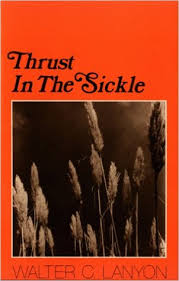
“Thrust in the Sickle” by Walter C. Lanyon

thrustinthesickle

In his inimitable style, Walter Lanyon urges the reader to obey the command from the Source to “Thrust in the Sickle.” He says, “suddenly the harvest … But the laborers are few. What a command to contemplate for a moment, for an hour, or until you have a brief encounter with the Father.”

This book is filled with similar images and challenges.  (amazon.com)

“My grace is sufficient for thee; for my strength is made perfect in weakness.”