
“Life is the sum of all your choices.”
–Albert Camus (November 7, 1913 – January 4, 1960) was a French philosopher, author, and journalist. His views contributed to the rise of the philosophy known as absurdism. Wikipedia

“Life is the sum of all your choices.”
–Albert Camus (November 7, 1913 – January 4, 1960) was a French philosopher, author, and journalist. His views contributed to the rise of the philosophy known as absurdism. Wikipedia
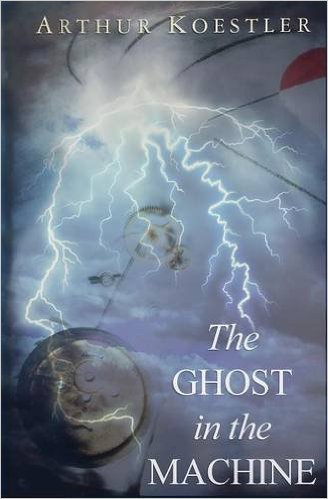
In The Sleepwalkers and The Act of Creation, Arthur Koestler provided pioneering studies of scientific discovery and artistic inspiration, the twin pinnacles of human achievement. The Ghost in the Machine looks at the dark side of the coin: our terrible urge to self-destruction…
Could the human species be a gigantic evolutionary mistake? To answer that startling question Koestler examines how experts on evolution and psychology all too often write about people with an ‘antiquated slot-machine model based on the naively mechanistic world-view of the nineteenth century. His brilliant polemic helped to instigate a major revolution in the life sciences, yet its ‘glimpses of an alternative world-view’ form only the background to an even more challenging analysis of the human predicament. Perhaps, he suggests, we are a species in which ancient and recent brain structures – or reason and emotion – are not fully co-ordinated. Such in-built deficiencies may explain the paranoia, violence and insanity that are central strands of human history. And however disturbing we find such issues, Koestler contends, it is only when we face our limitations head-on that we can hope to find a remedy.
(Amazon.com)


Student News:
Robert McEwen has been given a column in PQ Monthly [PQ (Proud Queer) is a monthly print and daily online newspaper committed to representing LGBTQ communities in all their diversity.] He will be writing a monthly column on astrology.
Suzanne Deakins is on the paper’s staff and contributes a monthly column centered on consciousness and mindfulness.
(Source: Suzanne Deakins, H.W., M.)
The French celebrating after World Cup victory in 1998: “Les images de tout un peuple réuni” (Images of a reunited people). There are mostly images in this video, but if you watch the entire 8 minutes, there is some commentary in French toward the end. The jist of the commentary is that – people in every village and in every city celebrated this win. It was the biggest, most unified celebration in France since liberation. It was a wonderful moment for the French nation with all its people unified.
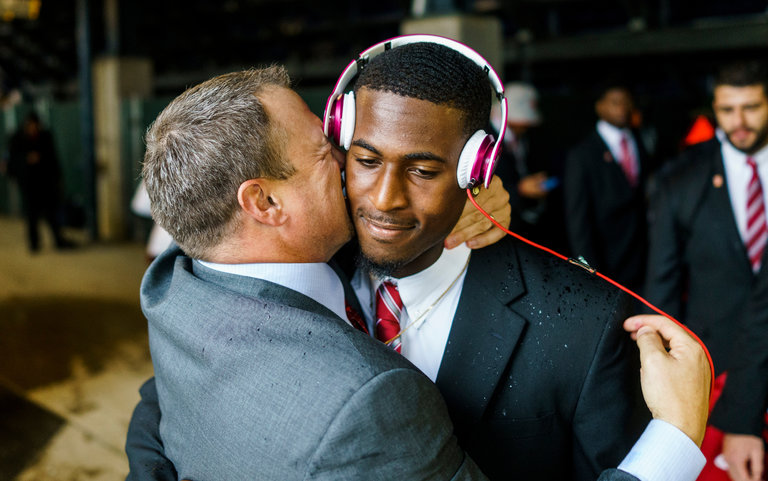
Houston Coach Tom Herman kissing wide receiver Isaiah Johnson before a game. Any player who scores a touchdown must hug an offensive lineman. CreditMatt Roth for The New York Times
ANNAPOLIS, Md. — When the University of Houston’s football players arrive for a game, they know what to expect as a prelude to the coming hours of brutality as they file into the stadium: a kiss on the cheek from their head coach, Tom Herman.
It is an unusual ritual in a sport that embodies America’s most rigid ideals of manhood.
“A kiss on the cheek is when he shows his love for us,” Houston safety Garrett Davis said, adding, “No one here is thinking, ‘Oh, I shouldn’t let him kiss me.’”
Physical expressions of affection certainly exist in big-time sports. Nothing says “Good job!” in baseball like a firm pat on the behind from a coach, and in international soccer it is not uncommon to see teammates peck each other on the cheek after a big play.
But kisses in football’s gladiatorial culture seem as incongruous as a Gatorade shower at the ballet.
For Herman, 41, there is no better way to demand the painful sacrifices of the game than to forthrightly convey his affection for his players.
“How do you motivate a human being to do things against his own nature?” Herman said in an interview. “There’s two things: love and fear. And to me, love wins every time.”
Davis said the players were taken aback early last season, Herman’s first as the head coach, when Herman planted a kiss on the strength coach Yancy McKnight during practice. Then he extended the ritual to all his players before their first game.

“I was not expecting it, but knowing him, I was not surprised at all,” tight end Tyler McCloskey said.
Alluding to that first game, a 52-24 victory over Tennessee Tech, Davis said, “If kissing us on the cheek before games gets us wins, then it works.”
Certainly something is working. Houston, a member of the American Athletic Conference, concluded last season at 13-1 and ranked eighth nationally, the program’s highest end-of-season ranking since 1980. This year’s team was ranked 13th before its home game Saturday night against Tulsa, which Houston beat, 38-31, to bring its record to 6-1. The program also hopes it is on the verge of an invitation to the Big 12 Conference.
Herman’s rite has earned praise from psychologists for its frank articulation of the emotion that inevitably develops on teams and glues together the best of them.
“He’s disrupting a stereotype about boys and men, a notion of masculinity that says boys and men are only driven by the desire for competition and autonomy,” said Niobe Way, a psychology professor at New York University. “All the research — not just mine — emphasizes that humans are actually not driven by competition and autonomy. What we’re driven by is the desire to be in connected communities.”
McCloskey, a senior and a team captain, said the practice fit comfortably into a program where “any day you walk into the facility, you have no idea what’s coming down the pipe.”
At Houston, coaches knight players with swords. Game-day breakfasts have been known to feature random smoke bombs — part of what is known in the program as “training for chaos.” Before last season, Herman promised to get a diamond grill — dental jewelry popular in hip-hop circles — if his Cougars won their conference. When they did, he kept his word.
The kisses are part of a larger message of brotherhood that Herman has made the core of his coaching style. The players have responded to a story he has shared — one also told by Herman’s former boss at Ohio State, Urban Meyer — about a soldier who confided that what most compelled him to fight was not self-preservation or hatred or patriotism, but love for his comrades.
As at Ohio State, Herman said, Houston players who score touchdowns are instructed to find an offensive lineman and hug him. “We require a two-handed embrace,” Herman said.
Herman reckoned he has kissed his players for more than a decade, going back to his days as the wide receivers coach at Sam Houston State.
“I’m a bit confused as to why it’s garnered so much attention and why it’s seemed so odd,” he said, “because I think most college coaches would tell a young man in recruiting — or his parents — ‘Hey, I’m going to love you’ or ‘treat you like my son.’”
In fact, Herman expressed sadness that the ritual seems so uncommon.
“I can tell you I was disappointed — they said it was the first time they’ve ever been kissed by a man,” Herman said, noting that several of his players grew up fatherless.
“Which,” he added, “is a shame in our society.”
Scholars of masculinity in contemporary America agree.
An academic paper first published in 2010 called “Men’s Tears: Football Players’ Evaluations of Crying Behavior” described a correlation between emotional openness and self-esteem in college football players.

In one instance of what psychologists label pluralistic ignorance, the authors found that many players falsely assumed that most of their teammates tolerated less emotional display than they themselves privately did.
“Men struggle with the perception that they are somehow less manly when they reveal their emotions,” said Joel Wong, an author of the essay who teaches psychology at Indiana University.
“That’s related to a lot of problems,” he added, “because it actually inhibits the ability for interpersonal connections, it restricts your ability to be vulnerable” and it prevents the expression of “your full human potential.”
Way’s book “Deep Secrets” describes how American boys migrate during adolescence from close friendships with other men to fears that shows of such intimacy will stigmatize them as gay, prompting a “crisis of connection.”
“What we’re driven by is the desire to be in connected communities,” she said. “That you would funnel this into a competitive spirit — that’s the way sports should be played. That’s how you’re going to get the best players.”
When Herman greeted the Cougars as they walked single file into the visitors’ locker room at Navy last weekend, only a handful of players appeared bashful before stepping into his embrace. The kisses came with a hug and, in some cases, words whispered into one ear or boisterous greetings such as, “And this guy!” and “I love you, buddy!”
“From what I can gather,” McCloskey said, “your importance to the team is directly related to the duration of your kiss. If you stay more than five seconds there, you’re a ‘dude,’ as he calls it.”
He added, “As it’s gone on longer and longer, I’ve somewhat looked forward to it.”

“A people that elect corrupt politicians, imposters, thieves and traitors are not victims… but accomplices.”
–Eric Arthur Blair, who used the pen name George Orwell (June 25, 1903 – January 21, 1950), was an English novelist, essayist, journalist and critic. Wikipedia
Translation is Dr. Thane Walker’s love child, expressed, manifested to his belief’s, all of us<3.
Error about the truth, sense testimony; People are confused and afraid of consciousness, God, infinite mind, because they don’t know what it is and it’s intimidating?
Conclusion’s; 1) Truth is one dweller, certain, unaffrayed, unafraid, God being all or nothing at all, being Infinite Mind or no mind at all, knowing Itself exactly for what it is.Truth is one dweller, certain, unaffrayed, unafraid, God being all or nothing at all, being Infinite Mind or no mind at all.
2) There is One I We Thou Universal Integrity, the Al Powerful, All Knowing All Presence Truth Consciousness in agreement being all there is.
3) Truth being intimately organic heritage, inherent omnipresence, omniscience, omnipotencey, self observing, self aware consciousness radically focused on it’s own universal all encompassing love expressly manifested.
October in the Railroad Earth: Jack Kerouac and Steve Allen
by G. Jack Urso
In another installment at our look at the recordings of Jack Kerouac, Aeolus 13 Umbra turns its attention to this little gem, “October in the Railroad Earth,” yet another pairing of Jack Kerouac and Steve Allen (see Jack Kerouac: Readings From On the Road and Visions of Cody). In this short piece, cut one from the 1959 album Poetry for the Beat Generation, Kerouac teams up with the talk show host to paint an aural portrait of San Francisco in the classic Beat style – spoken word and jazz. Allen’s accompaniment to Kerouac’s readings have been described as “cocktail music” by some, but that really does a disservice to both Allen and Kerouac. Kerouac, in fact, selected Allen for this piece, and it is easy to see why. Allen’s work both establishes the mood and underscores the emotional temper of the text.
Listening to piece, one can grasp the passion and frenetic nature of Kerouac’s stream-of-conscious narrative. Contemporary critics of his style dismissed Kerouac’s writing as undisciplined, yet very much the opposite was true. Kerouac’s early style owed much to the influence of Hemingway, but it was his passion for life that influenced his work. Much in the same way Picasso’s early critics dismissed his abstract work while being unaware that he was also trained in the more realistic classical style. Life, however, inspired Picasso’s art very much in the same way it also affected Kerouac’s – it compelled them to leap beyond their training and embrace a new form of expression that both reflected and influenced the era that gave them birth.
Kerouac wrote his drafts on rolls of paper with the ends taped together so that his pacing wouldn’t be interrupted by the turning of pages (something he managed to overcome for public readings). His description of San Francisco and the marginal and forgotten characters that he encountered on the docks and in back alleys is so evocative one can easily imagine oneself at Kerouac’s side as he takes us on a hipster’s two-dollar tour of the City by the Bay. Kerouac’s creative word play – amply demonstrated here – is not simple riffing; it is analogous to Allen’s piano as it establishes the mood as well as provides subtext.
“October in the Railroad Earth” was also included on volume two of the three-disc set The Beat Generation released in 1992 by Rhino Records. It is presented below from my archives: http://www.aeolus13umbra.com/2015/03/october-in-railroad-earth-jack-kerouac.html
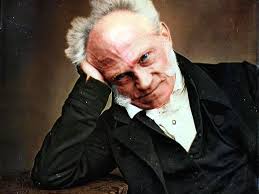
Arthur Schopenhauer (22 February 1788 – 21 September 1860) was a German philosopher. He is best known for his 1818 work The World as Will and Representation, in which he characterizes the phenomenal world as the product of a blind, insatiable, and malignant metaphysical will. Proceeding from the transcendental idealism of Immanuel Kant, Schopenhauer developed an atheistic metaphysical and ethical system that has been described as an exemplary manifestation of philosophical pessimism, rejecting the contemporaneous post-Kantian philosophies of German idealism. Schopenhauer was among the first thinkers in Western philosophy to share and affirm significant tenets of Eastern philosophy (e.g., asceticism, the world-as-appearance), having initially arrived at similar conclusions as the result of his own philosophical work. His writing on aesthetics, morality, and psychology would exert important influence on thinkers and artists throughout the 19th and 20th centuries.
Though his work failed to garner substantial attention during his life, Schopenhauer has had a posthumous impact across various disciplines, including philosophy, literature, and science. Those who have cited his influence include Friedrich Nietzsche, Richard Wagner, Leo Tolstoy, Ludwig Wittgenstein, Erwin Schrödinger, Sigmund Freud, Gustav Mahler, Joseph Campbell, Albert Einstein, Carl Jung, Thomas Mann, Jorge Luis Borges, and Samuel Beckett, among others.
Something profound is changing our concept of trust, says Rachel Botsman. While we used to place our trust in institutions like governments and banks, today we increasingly trust others, often strangers, on platforms like Airbnb and Uber and through technologies like the blockchain. This new era of trust could bring with it a more transparent, inclusive and accountable society — if we get it right. Who do you trust?
Rachel Botsman, Trust researcher:
Rachel Botsman is a recognized expert on how collaboration and trust enabled by digital technologies will change the way we live, work, bank and consume.