
Jan 21, 2026 (reddit.com)
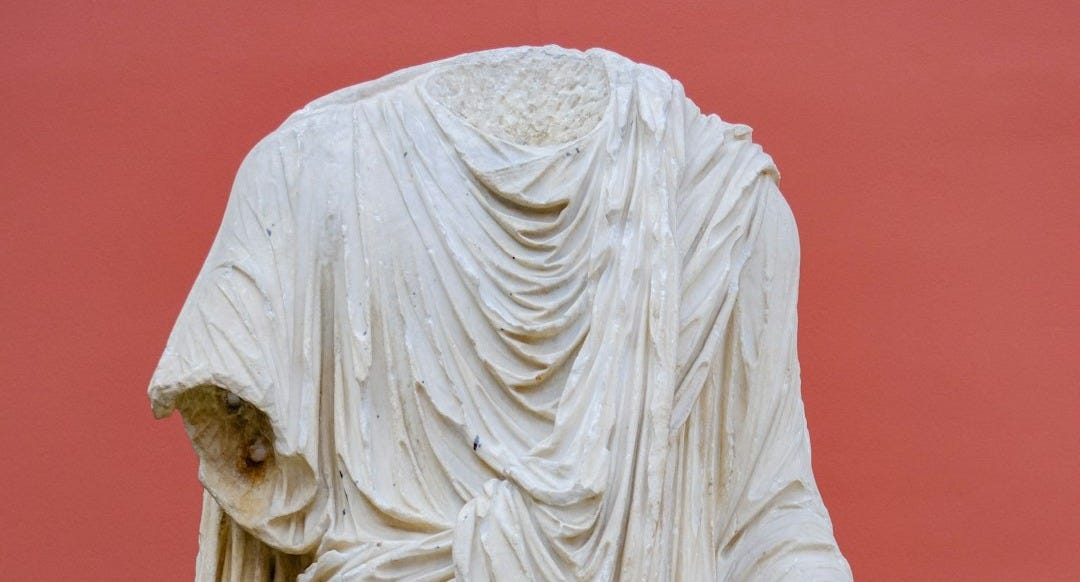
Scroll through any social media platform these days and you will eventually encounter the bearded visage of Marcus Aurelius. He is usually rendered in high-contrast black and white, perhaps superimposed with a quote about enduring pain or ignoring the opinions of sheep. The Roman Emperor has become the unlikely patron saint of a very specific digital subculture, but the ‘philosophy’ being peddled under his name bears only a ghostly resemblance to the complex ethics of the Stoa—it has essentially been strip-mined as a mental gym membership for the aspiring alpha. We are living in the age of ‘Broicism’, a hollowed-out version of Stoic philosophy that serves as the theological backbone for performative masculinity and right-leaning individualism (with a good dash of the hustle culture of Silicon Valley).
To understand how a school of Hellenistic philosophy centred on virtue and cosmopolitanism became the operating system for the manosphere, one must look to what has been discarded. The original Stoics, from Zeno to Epictetus, were deeply concerned with physics and logic, viewing the world as a coherent, divinely ordered web of cause and effect. Their ethics were inextricably bound to a sense of civic duty. To be a Stoic was to recognise one’s role in the cosmopolis, the universal city of gods and men. It was a philosophy of radical interdependence. The modern iteration strips away the physics and the civic obligation, leaving behind only the psychological mechanism of emotional suppression. In this reduced form, Stoicism becomes a toolkit for resilience in the service of capitalism, asking ‘how can I ignore the critics while I build my empire?’ rather than ‘how can I live virtuously among my neighbours?’
This utility makes it uniquely attractive to the tech elite and the self-optimisation crowd. If you view your brain as software, Stoicism is represented as a firewall, a philosophy that, if followed, promises an impermeable emotional fortress. But this focus on individual endurance aligns neatly with a particular strain of right-wing political thought. If the locus of control is entirely internal—if, as the distorted maxim goes, you cannot control the world, only your reaction to it—then structural critique becomes obsolete. Inequality and systemic injustice are rebranded as external circumstances to be endured with stiff-lipped dignity, and the onus for change shifts from the state to the individual’s mindset.
It is here that the philosophy merges with the aesthetics of the modern far-right and the ‘trad’ masculine revival. Online communities fixated on returning to a mythical past of patriarchal order have adopted the marble statues of antiquity as their avatars. They see in Stoicism a validation of emotional repression, mistaking the Stoic ideal of apatheia (freedom from disturbing passions) for the modern toxicity of simply not feeling anything. This reading validates a hard-edged, dominance-based masculinity. The ‘Stoic’ man of the Instagram reel is solitary, uncomplaining, and fiercely competitive, conquering his emotions so he can conquer his environment.
Nowhere is this distortion more acute than in the treatment of Marcus Aurelius himself. To the modern acolyte of Broicism, the Emperor is cast as the ultimate patriarch, a conquering general who ruled the world with an iron fist and a frozen heart. His Meditations are read as a tactical manual for alpha dominance, a sort of Art of War for the soul. But this caricature, for anyone who actually engages with the text, is a fantasy. The Meditations were never intended for publication. They were private notes, originally titled To Himself, written by an exhausted man trying to talk himself down from the ledge of despair. When the ‘stoic’ influencers quote him, they often select lines that sound like aggressive affirmations. They often seize upon the famous maxim: ‘The impediment to action advances action. What stands in the way becomes the way.’ In the hands of the tech-bro, this becomes a slogan for aggressive disruption, a command to smash through obstacles in pursuit of a Series B funding round or a personal best deadlift.
But Aurelius was not suggesting that one should bulldoze reality to satisfy personal ambition—he was arguing for a radical acceptance of defeat. The ‘way’ he speaks of is not the path to external success, but the path of virtue. If you are blocked from doing your job, you exercise patience; if you are sick, you exercise endurance. The obstacle does not help you get what you want, the obstacle replaces what you want with a new opportunity to be good. It is a philosophy of resignation, not conquest.
The contemporary fetishisation of Aurelius ignores his palpable hatred of the violence he was forced to oversee. He spent much of his reign on the Danube frontier, fighting the Marcomanni, but his journals are filled with reminders of the transience of military glory. He compared the procession of armies to ‘puppy dogs snapping at each other’. While the YouTube montages set his statues against backdrops of Spartans and Navy SEALs, the man himself was writing about the pointlessness of posthumous fame and the tedious monotony of war.
Perhaps the most damaging misinterpretation concerns his emotional life. The contemporary revival sells a Marcus Aurelius who is unfeeling, but the text itself reveals a man deeply sensitive to pain and grief, constantly struggling to regain his composure. He writes repeatedly about how difficult it is to get out of bed, how annoying he finds the people at court, and how terrified he is of losing his children. He does not suppress these feelings, but examines them and attempts to reintegrate them into a cosmic perspective. By erasing his struggle, the modern movement erases his humanity. They replace a complex, suffering philosopher with a two-dimensional action figure. This fictional Aurelius validates a rigid, impermeable masculinity that the real man spent a lifetime trying to dismantle within himself.
The political utility of this distortion is significant. By convincing a generation of young men that their unhappiness is a result of a weak mindset rather than a fractured society, this brand of Stoicism atomises political grievances. If you are struggling to pay rent or find community, the Broic answer is not to organise or demand policy change, but to retreat into the ‘inner citadel’ and harden your mind. It transforms citizens into islands, heavily fortified and utterly alone—it’s a to hell with everyone else but me and my own mantra.
But real Stoicism is hard. It requires a constant interrogation of one’s own impressions and a commitment to the common good that borders on the saintly. What is being sold today by the Broics—the fantasy that if you just ignore the needs of wider society while also repressing your own anxieties, you too can be an emperor—is much easier to get on board with.
- Google AI Overview
Broicism is a modern, often critical term used to describe a “watered-down” or distorted version of Stoic philosophy that has gained popularity in the “manosphere,” “hustle culture,” and Silicon Valley.
Coined by philosopher Massimo Pigliucci in 2019, it characterizes an interpretation of Stoicism that strips away its ethical and community-focused foundations in favor of personal gain and emotional suppression.
Key Characteristics of Broicism
- Emotional Suppression: Unlike traditional Stoicism, which teaches the management of emotions through reason, Broicism often advocates for “bottling up” feelings to appear “tough” or “unaffected”.
- Focus on Material Success: It frequently reframes Stoic principles as “life hacks” or “productivity systems” to achieve external wealth, status, or romantic conquest.
- Hyper-Masculinity: It is often associated with “alpha male” or “sigma” mindsets, emphasizing individual dominance and physical strength while ignoring the original Stoic belief in the equality of all rational beings.
Contrast with Traditional Stoicism
| Feature | Traditional Stoicism | Broicism |
|---|---|---|
| Primary Goal | Developing virtue (wisdom, justice, courage, temperance) | Achieving wealth, status, or “toughness” |
| View on Emotions | Understanding and transforming emotions through reason | Suppressing emotions to avoid looking weak |
| Social Focus | Service to the common good and human family | Self-centered success and personal dominance |
| Material Wealth | A “preferred indifferent”—nice to have but irrelevant to virtue | A primary metric of success and a goal of the philosophy |
AI can make mistakes, so double-check responses
Incredibly important. Unfortunately, those who need most to heed it probably won’t read it.
Your philosophic comparsion and contrast of the Characteristics of Broicism vs say a school of Hellenistic Stoic philosophy is important. The matter of culture, values, and view of sexual practices are all part and parcel of the differences between them.