
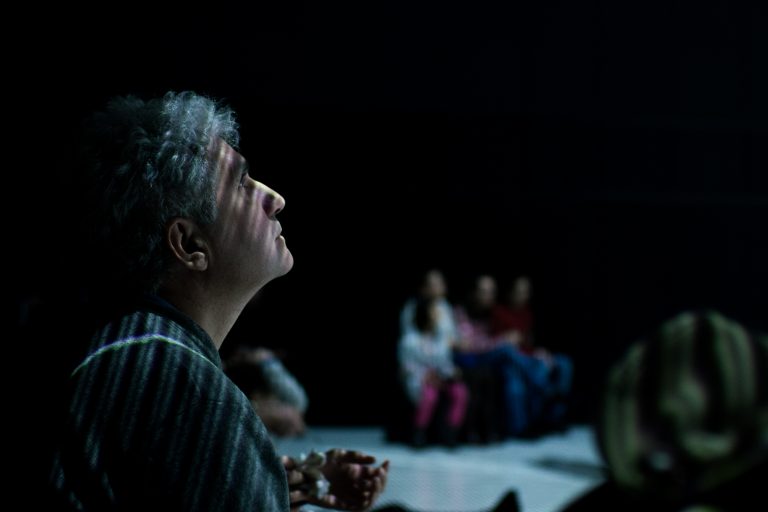
Image by Ars Electronica/Flickr, Attribution-NonCommercial-NoDerivs.
Published February 20, 2017 ((onbeing.org)
The Prophet Muhammad was once asked what was the one essential quality for prayers to be valid. Many in the community thought they knew the right answer. Some thought the Prophet would say proper recitation of Arabic. Others thought the answer would be lovely memorization of Qur’anic chapters. Yet others expected the answer would be perfect ritual observation of prayer.
Muhammad’s answer was: Presence in the heart.
What is this presence?
It is not so much presence of God.
God is always present.
It is we humans who are absent from our own heart.
Presence means to have the fullness of who we are with us.
What does it mean to pray with this Presence?
So much of our lives are spent in a fractured state of heart.
We are, too often, scattered.
We speak about being scatterbrained. The truth of the matter is that the scatteredness is much more systematic. We are scattered at every level: body, soul, mind, spirit.
We do this to ourselves.
We throw ourselves to the past, often clinging to a past pain and trauma.
Or, we hurl ourselves towards the future, attaching ourselves to a hope for the future, or fear of losing something.
We are in the past, or in the future, everywhere but here.
To pray with the heart, to have presence in the heart, is a remedy.
It is a healing, an un-scattering.
Presence is simply to have our heart be where our feet are.
This starts with a mindfulness, with an awareness of the breath.
When we monitor our breath, simply observe the breath enter into the heart, and emerge from the heart, our breathing slows down.
The heart rate slows down.
Here is where we become whole: our body, our breath, our spirit become One.
When we become one, The One is Here with us.
Here and Now.
In that moment, in this breath, we are healed, and whole.
And what a prayer there is in this breath.
What Presence.
God has always been present, waiting for us.
We ourselves become present, meeting God.
This is the Prayer of the Heart.
This is the Eternal Now (waqt), where Muhammad is to have said:
“I have an Eternal Now with my Loving Lord.”
This is the reason why mystics are Children of the Moment.
To pray the prayer of the Heart we cannot be anxious about the past, or hopeful/fearful about the future.
We have to be Present to our own heart’s state.
The Prayer of the Heart starts with us where we are: broken, fractured, and dis-united.
It takes us by the breath, and moves us along to unity, wholeness, and healing.
This is ultimately the very promise of Islam, and of every spiritual tradition.
To speak about Oneness is not about God. God is One, and has always been One.
As the Bible says, even the Devil knows that God is one:
You believe that there is one God. Good! Even the demons believe that — and shudder.
God is One, and has always been One.
It is we humans who have to become One.
This is when we realize that tawhid (Unity) is not just about God, but about our own hearts becoming One and unified.
We have to become One, become united.
Our inner division, being disconnected from our own bodies, our own breath, our own heart is only one part of our lack of unity.
That inner division is reflected in how we as a human community are divided. When we are not one with our own heart, we cannot see the full humanity of others.
The inner and the outer are reflected in each other.
When we are internally divided, we will be externally divided.
If we wish to be united as a human community, we have to strive for unity and healing at the heart level.
We need the prayer of the heart.
By whatever form we pray, we need to become whole.
May it begin one breath at a time.
May it begin with me.
Contributors
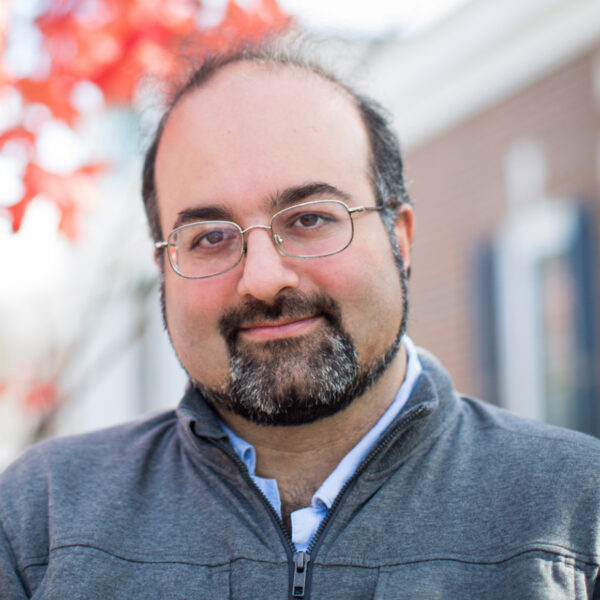
Omid Safi teaches online courses on spirituality through Illuminated Courses, and leads spiritual tours every year to Turkey, Morocco, and other countries, to study the rich multiple religious traditions there. The trips are open to everyone, from every country. More information is available at Illuminated Tours.
He is a professor of Islamic Studies at Duke University. He specializes in the study of Islamic mysticism and contemporary Islam and frequently writes on liberationist traditions of Dr. King, Malcolm X, and is committed to traditions that link together love and justice. He has delivered the keynote for the annual Martin Luther King commemoration at the National Civil Rights Museum.
He has written many books, including Progressive Muslims: On Justice, Gender, and Pluralism; Cambridge Companion to American Islam; Politics of Knowledge in Premodern Islam; and Memories of Muhammad. His most recent book is Radical Love: Teachings from the Islamic Mystical Traditions and has a forthcoming book on the famed mystic Rumi.
Omid is among the most frequently sought out speakers on Islam in popular media, appearing in The New York Times, Newsweek, Washington Post, PBS, NPR, NBC, CNN, BBC, and other international media. He can be reached regarding speaking engagements at omidsafi@gmail.com.