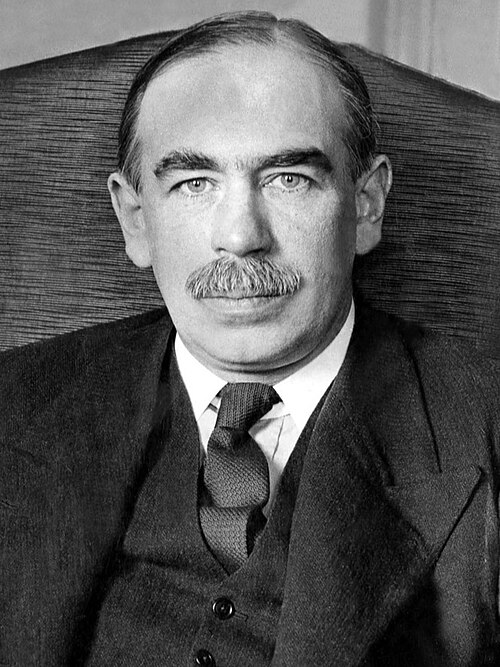
“When the accumulation of wealth is no longer of high social importance, there will be great changes in the code of morals. We shall be able to rid ourselves of many of the pseudo-moral principles which have hag-ridden us for two hundred years, by which we have exalted some of the most distasteful of human qualities into the position of the highest virtues. We shall be able to afford to dare to assess the money-motive at its true value. The love of money as a possession — as distinguished from the love of money as a means to the enjoyments and realities of life — will be recognized for what it is, a somewhat disgusting morbidity, one of those semi-criminal, semi-pathological propensities which one hands over with a shudder to the specialists in mental disease.” ― John Maynard Keynes, Economic Possibilities for Our Grandchildren
John Maynard Keynes, 1st Baron Keynes, was an English economist whose writings are considered the basis for the school of thought known as Keynesian economics, as well as its various offshoots. Originally trained in mathematics, he built on and refined earlier work on the causes of business cycles. Wikipedia
Johnathan Bi Jun 29, 2026 An interview with Thomas Pangle on the American Founding. Subscribe to my newsletter if you want content updates, invitations to events, and to support my work: https://greatbooks.io Transcript: https://www.johnathanbi.com/p/transcr… Companion interviews: What All Great Men Want (But Won’t Admit To) | UT Philosopher Thomas Pangle: • What All Great Men Want (But Won’t Admit T… Timestamps: 00:00 0. Introduction 00:34 1. Commerce and the Republic 22:26 2. Human Nature and the Life of the Mind 55:27 3. Religion and the Founding 01:07:04 4. America’s Political Innovations 01:23:45 5. Has America Betrayed Its Founding Principles? 01:31:54 6. The Great Thinkers that Influenced America
We’ve got our mind on our money and our money on our mind. And while we’re mulling over all this moolah, we’re also thinking about the many words we use to refer to cash. Don’t believe us? We’ll put our money where our mouth is and show you all the words we could find. (And best of all, it won’t cost you a dime! … Feeling lucky yet?)
cash
The English word cash was first recorded in the late 1500s and comes through the French casse (“case, box”) from the Latin capsa (“case” or “coffer”), which both refer to things you keep money in.
green
In the US, money is often referred to as greenor the green because paper bills are—wait for it—green!
greenbacks
The slang greenbacks for US paper bills dates back to the Civil War when the government began using green ink on the reverse side of banknotes to attempt to thwart counterfeiters.
lettuce and cabbage
These two vegan-friendly words for money date all the way back to the early 1900s and yet again reference the green color of dollar bills.
coin
The slang coin is used in both the United States and the United Kingdom to refer generally to money, and not just the varieties of metal coins that have been used as currency for thousands of years.
bills
Dollar bills have been issued by the US government since 1862, but the slangbillis often used to specifically mean $100.
cheddar
There are several theories as to why the cheesy slang cheddar is used to refer to money. According to the most popular theory, cheddar referred to government cheese found in welfare packages. From there, it was used to refer to money (i.e., benefits) from the government rather than the cheese.
scratch
The American slangscratchfor money can be traced back to 1914, but nobody knows why this itchy word was first used to refer to cash.
bank
The term bank has been used to refer to money—and not just the place we keep it—since the 1500s. Its use to indicate a large sum of money can be traced back to at least the 1990s.
bread
The word bread has been used as American slang for money since at least the 1930s. Food is among the most important reasons people need money, and the slang bread likely refers to the fact that bread is one of the most commonly eaten (and purchased) foods.
dough
Interestingly, the slangdough for money predates the slang bread, as it has been used in this sense since at least the 1830s. However, it is commonly thought that using dough for money is related to the use of bread as “livelihood” (“to earn one’s bread”) that has been attested since the 1700s.
bacon
The wordbacon is used to refer to money or wealth in phrases such as bring home the bacon. This phrase has been recorded since 1924, and it is widely believed to refer to a game played at county fairs in which a person would be awarded a greased pig if they could successfully catch it.
Benjamin Franklin has been on the $100 bill since 1914, and the slang Benjamins for $100 bills obviously references this fact. Less commonly, other dollar bills may also be referred to by the people depicted on them, such as Washingtons, Lincolns, Hamiltons, and Jacksons.
moolah
The slang moolah has been used to refer to money since at least 1936, but it is another word with unknown origins.
big ones
The phrase big ones is used both in the US and UK to refer to dollar bills/pounds or to large amounts of money such as a thousand dollars/pounds or a million dollars/pounds. Big ones has been used in this sense since at least 1863.
bucks
The word buck has been used as American slang for a dollar since at least 1856. It is possible the word buck refers to the deerskins that were used as currency in the 1700s.
fiver and tenner
The slang words fiverandtenner are used in the US and UK to refer to five dollars/pounds and ten dollars/pounds, and it seems likely that they have been ever since these bills have been in circulation.
cha-ching
The words cha-ching, ka-ching, or ker-ching have been used to refer to money since at least 1969. They’re onomatopoeic expressions based on the sound of a cash register.
simoleons
The word simoleon has been used as US slang for a dollar since the 1880s, and it is yet another word with an unknown origin—though it’s possible the word is a blend of Simon and Napoleon.
shekels
The word shekels can be traced back to at least the 1820s, and it is clearly based on the shekel (sheqel in Hebrew) coins used by the Hebrews, Babylonians, and Phoenicians during Biblical times. The currency of Israel is also known as the New Israel Shekel or shekel, for short.
chump change
The phrase chump change to refer to a small amount of money emerged from Black slang during the 1960s.
Monopoly money
The slang phrase Monopoly money is often used to refer to small amounts of money or something that is worthless. Obviously, the phrase references the fake paper money used in the popular(ly infuriating) board game Monopoly.
bones
The slang bone has been used to mean a dollar since at least 1889, and it is another slang term with unclear origins.
K
The letter K is used as shorthand to mean a thousand dollars; if someone has 50K, they have $50,000. A K represents the Greek prefix kilo-, which is used in many words that refer to a thousand of something.
grand
The word grand is used in US and UK slang to mean a thousand dollars or a thousand pounds. There are several theories where this term came from, including the possibility that it refers to $1,000 being a grand (“large”) sum of money.
C-note
The slang C-note refers to a $100 bill, and the letter C refers to the Roman numeral for 100 that was printed on early $100 banknotes.
clams
Beginning a run of old-timey slang that would have been popular among 1920s bootlegging gangsters, the word clam was probably used as a term for a dollar based on the practices of using shells as currency seen in ancient societies and some Native American tribes.
ducats or duckets
The slang ducats or duckets is based on the gold coins and silver coins of the same name that were once used in parts of Europe.
smackers and smackeroos
Smackers has been used to refer to money since the 1920s, and the sillier smackeroos(or smackarolas, smackeroonies, smackerolas, smackeroonyos, and smackolas) emerged in the 1940s. While we don’t know for sure, it is possible that the term references “smacking” dollar bills into someone’s hand.
large
The slang large, meaning a thousand dollars, likely comes from the fact that thousands of dollars would be a large amount of money for most people.
spondulix
The slang word spondulix (and its many spelling variations: spondees, spondles, spondools, spondooli, spondooliks, and spondulix) is unfortunately another one whose origin we simply do not know.
dead presidents
Returning to modern times, we’re looking at the term dead presidents. While most denominations of US paper money do feature images of dead presidents on them, dollar bills also feature influential people who were never president, such as Benjamin Franklin and Alexander Hamilton.
stacks
Stacks, or fat stacks, refers to towering stacks a person would have if they were rich. A stack can also mean specifically $1K or $10K.
paper
Unlike most paper, US paper money is made out of cotton and linen rather than the wood pulp used in paper you can buy at the store.
bands
The slang bands references the currency bands that people and banks can use to store and transport large amounts of dollar bills.
rack
The slang rack means a thousand dollars and was popularized by rapper Yung Chris in his 2011 song “Racks.”
fetti
Fetti is said to have emerged from Black slang in the Bay Area and, according to popular theory, comes from feria, a Spanish slang word for money.
guap
The slang guap has been used in rap music since the 2000s, but nobody is exactly sure where this word originally came from.
skrilla or scrilla
Skrilla, also spelled scrilla, has been used in rap music since the 1990s, but it is another word whose exact origin is unclear.
From K-pop to Korean dramas, learn some key words so you can stay on top of the “Korean Wave.”
lucci
Lucci is another slang word that can be found in 1990s rap music. A common theory suggests it is based on the word lucre.
C.R.E.A.M.
The acronym C.R.E.A.M., which stands for “Cash Rules Everything Around Me,” was created by the hip hop group Wu-Tang Clan in their 1994 song “C.R.E.A.M.” In an interview, Raekwon the Chef revealed that the slang cream for money was invented by children from his neighborhood and was inspired by, of all things, Tom and Jerry cartoons.
Gouda
The slang Gouda for money was popularized by rapper E-40, who is known for his creative wordplay. According to E-40, Gouda was inspired by the older terms cheese and cheddar and—he admits—the credit for using this specific type of cheese really belongs to his wife.
dosh
Among Brits, dosh is a popular slang term for money, and it can be traced back to the 1950s. Sadly, it is another word with an unknown origin.
quid
The slang quid is used by Brits, Australians, and New Zealanders to refer to a pound sterling or an Australian pound. Quid is recorded back to the 1600s and possibly comes from the Latin quid used in phrases such as quid pro quo.
Australian slang
Australians use some fun slang words to refer to their colorful paper money. Some of these terms include prawn for the pink five dollar bill, blue swimmer for the blue 10, lobster for the red 20, and pineapple for the yellow 50.
The Temple of Juno Moneta (Latin: Templum Iunonis Monetæ) was an ancient Roman temple that stood on the Arx or the citadel on the Capitoline Hill overlooking the Roman Forum.[2] Located at the center of the city of Rome, it was next to the place where Roman coins were first minted, and probably stored the metal and coins involved in this process, thereby initiating the ancient practice of associating mints with temples.[3] In addition, it was the place where the books of the magistrates were deposited.
Juno Moneta, the second name associating the Roman goddess Juno with the goddess Moneta who was worshiped at some locations outside Rome, was regarded as the protectress of the city’s funds. Money was coined in her temple for over four centuries, before the mint was moved to a new location near the Colosseum during the reign of emperor Domitian.[1] Thus, moneta came to mean “mint” (mint itself being a corruption of moneta) in Latin, which was used in written works of ancient Roman writers such as Ovid, Martial, Juvenal, and Cicero, and was the origin of the English words “monetary” and “money”.
Cicero suggests that the name Moneta derived from the verb “monere” (to warn) because during an earthquake, a voice from this temple had demanded the expiatory sacrifice of a pregnant sow, connecting to the old Roman legend that Juno’s sacred geese warned the Roman commander Marcus Manlius Capitolinus of the approach of the Gauls in 390 BC.[2] But modern scholars reject this explanation, because it is clear that “Moneta” was the name of a goddess who was worshiped in some places outside Rome, and when her worship was transferred to Rome, she was equated with Juno.
Moneta is also a name used for Mnemosyne, mother of the Muses, by Livius Andronicus in his translation of the Odyssey, and Hyginus’ citation of Jupiter and Moneta as parents of the muses. The name Mnemosyne or Memory was connected to Juno Moneta who maintained in her temple an unimpeachable record of historical events.[2]


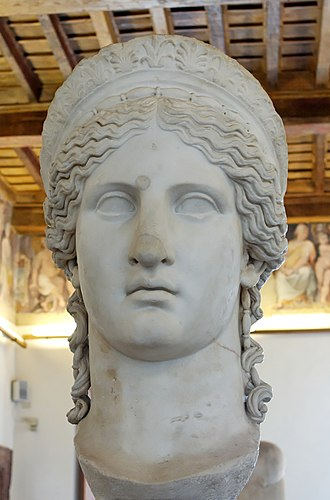
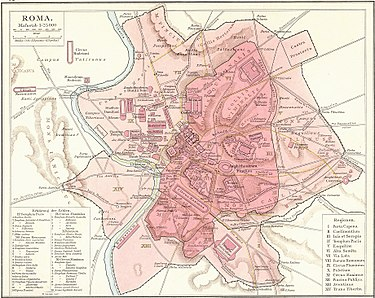
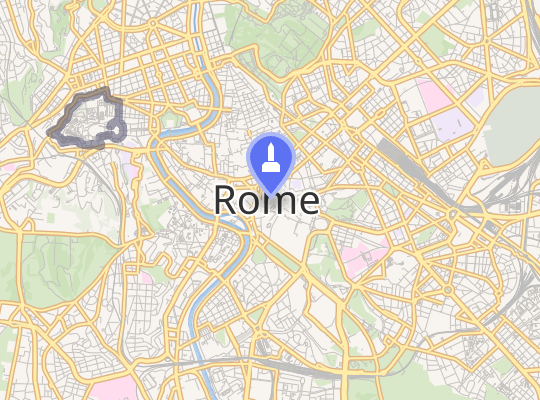
 Juno Moneta Shown within Rome


