
Patron Saints

Jan 10, 2023 (judedoyle.medium.com)
Last year, I realized that if I want to keep learning, I’ve got to treat myself like I’m in school. I am obsessive by nature; my inclination is to keep gnawing away at one or two questions until I’ve either perfected a solution or ground the material to dust. If I want diverse interests, I have to force them. So, every month, I choose something I want to learn. I take the most relevant books from my bookshelves; if I don’t have any relevant books, I buy them. I make a little stack, my syllabus, and I work my way through it. At the end of the month, the books I haven’t finished get put away to make room for the next stack.
Recently, I’ve been studying saints. Monks, specifically; transgender monks, even more specifically, and there were more of those than you’d think. There is a long and barely hidden tradition of transmasculine sainthood within the Catholic Church, lurking just to the side of acknowledged history.
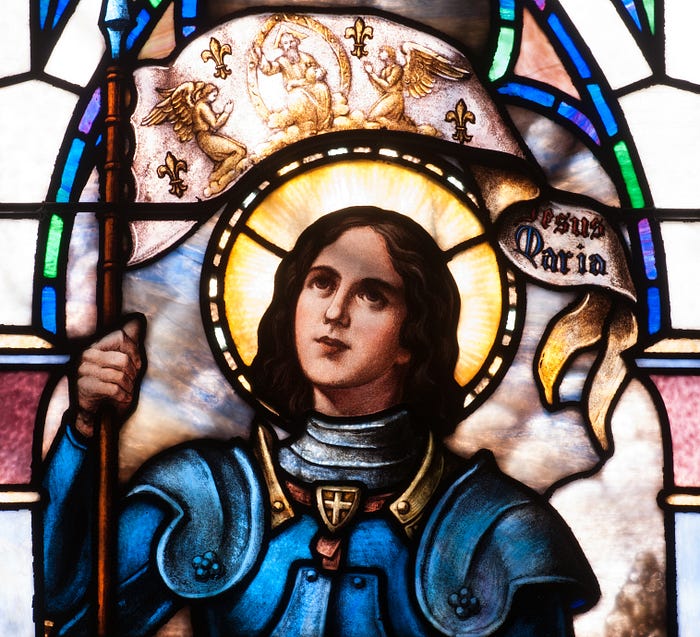
Some of this history is widely known. Lots of people know, for example, that Joan of Arc was executed for wearing men’s clothing. Leslie Feinberg loved Joan of Arc. I love Joan, too; at confirmation, Catholics have to choose a “patron saint,” someone to watch over their souls and provide spiritual guidance, and Joan was the one I chose. Long before I knew about trans readings, or trans people, I felt that Joan and I were on the same team.
Joan of Arc also entered history in the way many Catholics and queer people do: She (????) got murdered. Burned at the stake, in fact. She was a martyr, to God or gender or both, which gives her story a moving element of tragedy, but which also safely confines her to the margins. The lessons of her life and death are familiar: Conform or die.
The straight world likes queer people with tragic endings, because they reassure us that the house always wins. This might be why we hear so much about Joan, and so little about her contemporaries — who actually did transition, who lived as men, and who died of old age after long and happy lives, many of them spent in positions of authority within the Church.
There are so many of these stories that the Calendar of Lesbian, Gay, Bisexual and Transgender Saints is forced to give them their own category, referring to:
The large number of saints who were famous for their holy cross-dressing. All of these were women, and the stories, largely but not exclusively fictional, generally have them escaping marriage or some other dreaded end by dressing as monks. This is no short term ploy, however. The women then live their lives as men (in direct contradiction to the Levitical Law which calls cross-dressing an “abomination”), some of them becoming abbots of monasteries. In such positions it is hard to imagine that they would not perform roles such as confessor. Their biological sex is only discovered after they die. It is sometimes argued that these transvestite saints did not cross-dress because they wanted to but because they had to, and so calling them “transvestites” is wrong. It is true that we know nothing of the psychology of these women, but when they dressed as man [sic] for 20 years and became abbots of monasteries, it is hard to know in what way they were being “forced” to cross-dress.
This was written in 1997, and it reads like it was written in 1997, but the point stands. At least one man, Benjamin de la Cartuja, came out to his curate before his death; the curate told him that he could not stay in the monastery, but they would keep providing for him if he agreed to live in a nearby cave and tend their sheep. This he did, for the rest of his life, wearing a monk’s habit and going by “Benjamin” all the while.
Even alone, on a mountain full of sheep, Benjamin was Benjamin, and — as was evidently custom — it was only during funeral preparations that the curate disclosed his assigned sex to his brothers. It’s fun to dissect individual stories and their increasingly preposterous rationalizations (one of my favorites, Joseph of Schonau, has an innocent 12-year-old donning boys’ clothes to evade “bandits” and then just never taking them off for the next fifty years) but when you take into account the sheer number of stories like this, and how similar they all are, this begins to look less like trivia and more like a way of life.
Even in a society that steadfastly denied trans people existed, or that they could be anything but “abominations,” there was a place for trans men to go, if they were desperate or brave enough. That place was beloved by God.
Itshould not be surprising that there were trans monks in the medieval Church, in the same way that it’s not surprising so many monks throughout history have slept together. (One trans saint, Smaragdos, was so handsome he had to be placed in his own cell, lest he rile up the other monks; some monasteries had specific rules about “beardless men,” who were known to inspire these situations.) Monasteries and nunneries were places where you could remain unmarried, and where you would live exclusively with your own gender; that arrangement was bound to appeal to queer people, especially in a time where there were few other options. For trans monks, the promise of abandoning one’s worldly identity and living in relative privacy must have been nice.
Escaping into the church was a privilege, and a gendered privilege at that; we know of dozens of transmasculine monks, but there are no transfeminine nuns on record. Trans girls who ran away from home, fleeing “bandits” or marriage or parents, did not have this option.
I do know a lot of trans women who talk about being priestesses, drawing on ancient transfeminine orders like the Galli, devoted to Cybele, or the servants of Inanna (a goddess who “could turn a man into a woman, or a woman into a man”) or the Scythian shamans who supposedly took estrogen via mare urine (though this last one is debated). When you’ve been reviled your whole life, it is useful to know that you were once holy; that you are still holy, though not in a way everybody can understand.
This is not quite how I feel when contemplating the trans monks. I feel relief and affirmation from knowing that trans people have existed throughout history; I feel a sense of ancestry and connection to the past, knowing that my fervent childhood desire to be a saint, or at least a priest, is something people like me have done before. I admit to occasional fantasies about the monastic life: To spend all day in silence, gnawing obsessively away at that one question, how to serve God, with breaks for baking and maybe managing a microbrewery; if I didn’t have a kid to raise, I’d sign up.
Yet Jesus is a more complicated deity than Inanna or Cybele. He has more to answer for, in terms of the present-day political situation. The Catholic Church does not merely enforce archaic gender roles; the Catholic Church substantially created the gender binary as we know it, and exported it around the world, violently suppressing gender diversity in the cultures it colonized. The belief that there are only two genders, and that one is inherently superior to the other, was not “natural,” let alone universal; it was learned at the point of a sword, and the Catholics were holding it.
There was a home for transmasculine people, in medieval Europe, but it was within the very institution that was busy making trans life impossible outside the confines of the monastery. White trans men baked bread and brewed beer and tended sheep on the mountainside, and transfeminine people, Black and brown trans people, indigenous trans people, were killed.
The monastic life was not an escape from the world. It was not freedom. It was a compromise, and a compromise offered only to the privileged. You can call that kind of thing devout, but you can’t call it holy — not even when it’s the only chance at holiness you have.
The history of transmasculine sainthood did not end in the medieval period. At least one saint was alive within my lifetime — Pauli Murray, the Black civil rights activist, feminist, and priest, who died in 1985 and was canonized (by the Episcopal church, not the Catholic one) in 2012.
Murray’s pronouns are a vexed question. We know that Murray was assigned female at birth, and that he insisted, from childhood on, that he was a man. He repeatedly asked doctors for testosterone, publicly declared that he would “gladly change his sex,” and asked for exploratory surgery in the hopes doctors would discover that he was intersex, or that some “metabolic imbalance” explained why his body didn’t look masculine. He went in and out of psychiatric wards as his failures to procure testosterone produced crises of despair; he was once threatened with a schizophrenia diagnosis due to his “delusion” that he was male. At the time, that diagnosis carried a potential for lifelong institutionalization. Pauli Murray learned that calling himself female was the price of freedom.
In his younger years, Murray intermittently passed as a cis man — intentionally, and sometimes unintentionally. He took part in one of the first bus boycotts with his then-girlfriend; in a testament to the timelessness of certain transmasculine problems, witnesses reported that a Black woman had given a wonderful speech, but they were puzzled as to why she’d brought a teenage boy with her, and why he had insisted on speaking too. The arrest booking for that incident gives Pauli’s name as “Oliver.” Maybe the officers misheard “Pauli,” or maybe that was his name.
Yet even though he lived through Stonewall, Pauli Murray was never public about his relationships with women. Even though he lived through the very public transition of Reed Erickson, amongst others, he stopped trying for a testosterone prescription by midlife. Maybe he changed his mind. Maybe his gender was more complicated than he could easily describe. Or maybe, as his biographer Rosalind Rosenberg writes, the most obvious answer is the saddest one — by the time HRT was a real option, Pauli Murray had become a nationally recognized figure in the civil rights and feminist movements, and he did not want to damage those movements with the “scandal” of his transition.
So I use “he” for Murray, following Naomi Simmons-Thorne, because it reflects the reality he knew throughout his life, and because that reality was violently denied to him. Not all people, not even all trans people, feel the same way.
Murray’s late-in-life turn to the priesthood baffled many who knew him. He had always been religious. On his first date with Renee Barlow, the woman he spent his life with, he recognized her quoting the Episcopalian Book of Common Prayer; their subsequent courtship consisted mostly of Pauli escorting Renee to mass. (One of the many reasons I am fond of Murray, as a historical figure, is that he was a total dork.) Yet, by the time he decided he was called to the priesthood, he had a tenured job as a law professor; he had fought, hard, to get tenure. He himself admitted that no-one was going to hire a sixty-three-year-old priest, and that he was likely to experience financial hardship. There was no clear reason for him to walk away.
The reason was Renee. She had died, after a long and ugly struggle with cancer, and Pauli was the only person in the room with her when it happened; he was forced to administer last rites as a layperson. The same thing had happened at the death of his Aunt Pauline, who raised him. Renee’s death had been particularly wrenching, because he essentially had to watch his wife die without asking for support — “because of the confidentiality of the situation, I could not share my anxieties over her illness with anyone,” Murray wrote, in his memoir, the legal tic of “confidentiality” papering over a lifetime — and, upon realizing that he had ministered to the two most important people in his life during their last moments, Murray began to wonder if God had appointed him to serve that function.
There was the matter of his assigned sex to contend with, but Murray had already been fighting that battle — or, really, Renee had. The ordination of women had been a particular cause of hers, and Murray had co-attended a whole lot of church meetings and debates on the subject. Murray’s own feelings were passionate; “the church was losing its authority as a Christian body and [it] was no longer speaking with an authentic voice if women were treated as outcasts when they sought to answer God’s call to priesthood,” he wrote. In the memoir, he tells the story of a day when “in the middle of a celebration of the Holy Eucharist an uncontrollable anger exploded inside me, filling me with such rage I had to get up and leave.” He wandered the streets “full of blasphemous thought, feeling alienated from God.”
“I had been taught all my life to revere the church and its teachings; now I could only condemn the church as sinful when it denied me the right to participate as fully and freely in the worship of God as my brethren,” he wrote. “If the present church customs were justified, then I did not belong in the church.”
I have had that explosion of rage while the voices around me praised Jesus; I have walked that walk, stewing in blasphemy, knowing I don’t belong. I did not know any saints had done likewise, until I read Pauli Murray.
Still, it was Renee’s memory that ultimately pushed Pauli into service: “You and your friend Renee were engaged in a Christian ministry,” her pastor told him. “Now that she is gone, you can carry it on for both.” No longer joined to Renee, Pauli joined her cause; they became one person, as Christian spouses are supposed to do.
Pauli Murray was the first Black person assigned female to be ordained to the Episcopalian priesthood. Coincidentally, this happened around the same time that the Church ordained its first openly gay minister. The headline announcing the news read “EPISCOPALS TO ORDAIN BLACK WOMAN, LESBIAN.” In one of many stories from Murray’s life that would be funny if it were not so sad, Murray panicked and called the paper to clarify that the “Black woman” and the “lesbian” were not the same person. Of course, neither one was him, but he had stopped telling people that.
Iwas at the barbershop when it finally happened: The guy cutting my hair, a kindly man in his sixties at least, tilted my skull to look into my face and squinted.
“Have I cut your hair before?” he asked.
He had, last year, and he’d spent the entire time politely informing me that “this is usually for guys.” The whole thing had been so embarrassing that I’d gone through a year of horrific home haircuts before I let a stranger touch my hair again. I shrugged at him, having decided that using my voice was going to open up a can of worms.
“I have,” he said, leaning down to examine me while I fidgeted. “You’re the new pastor, right?”
There’s a new pastor at the church down the street. Evidently he and I wear the same glasses. I’d never been read as a cis guy, at least not at close range, and apparently, when you read me that way, the vibe is “clergy.” It is true that a whole lot of priests, throughout history, have looked somewhat like me. It is not the strangest guess you could make, all things considered.
It may have helped that I was wearing a cross around my neck. I got it for $15 at the state fair, and every time I wear it around my mother, I can feel her tensing up, hoping against hope that I’m being brought back into the fold. I’m not. The ugly parts of being a trans saint are still too much on my mind. Being conditionally accepted by an organization that is working to eliminate everybody else like you, praising a God that kills what he can’t absorb: Who wants that?
No: I am not a churchgoer. I had the cross that night because I was scared, and I wear it when I want to remember Pauli Murray.
Even now, some part of me cannot conceive of life without a patron saint: Someone better than me, and deader than me, who nonetheless agrees to take an interest in my education. Of all the historical trans lives I’ve studied, Pauli Murray is the one I feel closest to; Lou Sullivan is more fun than I am, and Leslie Feinberg is much, much tougher, but Pauli, awkward and earnest and upright, seems like he might make time to answer some of my questions.
“It is easier to rationalize and dismiss Jesus than [Saint] Francis,” writes Murray Bodo, a Franciscan monk who has spent his life studying his order’s founding saint. “Jesus, after all, is divine and so far above us. But Francis is only human like us. What he is, we can become.”
This is the function of a saint: To prove that holiness is not only desirable, it is possible, and that people like us have achieved it already. This is what the trans saints show me: My own possibility, including the possibility of being good.
“I hear that you have been making ‘tut’ ‘tut’ remarks about my sexuality,” Pauli Murray wrote to his bishop shortly before his death:
If you go around putting such words about fellow clergy in the ‘street,’ you are going to fall flat on your face. So let me raise a question with you: 1. What do you really know about sexuality — heterosexuality, bi-sexuality, homosexuality, transsexuality, unisexuality? 2. What do you know about metabolic imbalance? The varieties of approach to mental health? When you become an expert in these matters, you can speak with authority. Otherwise, please keep your mouth shut!
The letter, for understandable reasons, remained unsent. But at the end, struck out by Murray’s own hand, is the final question: “God made me as I am,” Pauli Murray wrote. “Are you, Bishop of the Church, questioning God’s handiwork?”
This is what I can tell you about trans sainthood: To the end of his life, Pauli Murray knew that he was a man, and maybe even that he was “transsexual.” But, by the end of his life, he understood that God knew it, too.
Written by Jude Ellison S. Doyle
Author of “Trainwreck” (Melville House, ‘16) and “Dead Blondes and Bad Mothers” (Melville House, ‘19). Columns published far and wide across the Internet.