
From Wikipedia, the free encyclopedia
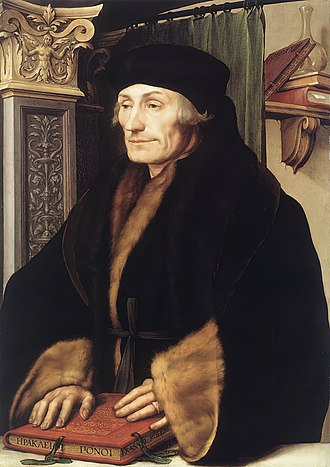

Desiderius Erasmus Roterodamus (/ˌdɛzɪˈdɪəriəs ɪˈræzməs/; Dutch: [ˌdeːziˈdeːriʏs eˈrɑsmʏs]; English: Erasmus of Rotterdam or Erasmus;[note 1] 28 October 1466 – 12 July 1536) was a Dutch philosopher and Catholic theologian who is considered one of the greatest scholars of the Northern Renaissance.[2][3][4]
A Catholic priest, he was an important figure in classical scholarship who wrote in a spontaneous and natural Latin style.[5] Among humanists he was given the sobriquet “Prince of the Humanists”, and has been called “the crowning glory of the Christian humanists“.[6] Using humanist techniques for working on texts, he prepared important new Latin and Greek editions of the New Testament, which raised questions that would be influential in the Reformation and Counter-Reformation. He also wrote On Free Will,[7] In Praise of Folly, Handbook of a Christian Knight, On Civility in Children, Copia: Foundations of the Abundant Style and many other works.
Erasmus lived against the backdrop of the growing European religious Reformation. He remained a member of the Catholic Church all his life, remaining committed to reforming the Church and its clerics’ abuses from within.[8][9] He also held to the doctrine of synergism, which some Reformers (Calvinists) rejected in favor of the doctrine of monergism. His middle-road (via media) approach disappointed, and even angered, scholars in both camps.
Erasmus died in Basel in 1536 while preparing to return to Brabant and was buried in Basel Muenster, the former cathedral of the city.[10]
Early life
Desiderius Erasmus is reported to have been born in Rotterdam on 28 October in the mid-1460s, probably 1466.[11] He was named after Erasmus of Formiae, whom Erasmus’ father Gerard personally favored.[12][13]
Although associated closely with Rotterdam, he lived there for only four years, never to return afterwards. Information on his family and early life comes mainly from vague references in his writings. His parents could not be legally married: his father, Gerard, was a Catholic priest and curate in Gouda.[14] His mother was Margaretha Rogerius (Latinized form of Dutch surname Rutgers),[15] the daughter of a doctor from Zevenbergen. She may have been Gerard’s housekeeper.[11][14][16] Although he was born out of wedlock, Erasmus was cared for by his parents until their early deaths from the plague in 1483.
Erasmus was given the highest education available to a young man of his day, in a series of monastic or semi-monastic schools. In 1475, at the age of nine, he and his older brother Peter were sent to one of the best Latin schools in the Netherlands, located at Deventer and owned by the chapter clergy of the Lebuïnuskerk (St. Lebuin’s Church),[11]. During his stay there the curriculum was renewed by the principal of the school, Alexander Hegius. For the first time in Europe north of the Alps, Greek was taught at a lower level than a university[17] and this is where he began learning it.[18] His education there ended when plague struck the city about 1483, and his mother, who had moved to provide a home for her sons, died from the infection.[11]
In 1484 he and his brother went to a grammar school at ‘s Hertogenbosch[8] run by the Brethren of the Common Life. He was exposed there to the Devotio moderna movement and the Brethren’s famous book The Imitation of Christ but eschewed the harsh rules and strict methods of the religious brothers and educators.[11]