
From Wikipedia, the free encyclopedia
| Adi Da Samraj | |
|---|---|
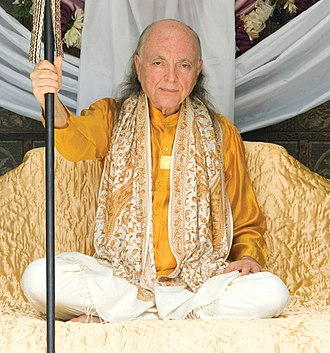
| Adi Da Samraj in 2008 | |
| Born | Franklin Albert Jones November 3, 1939 New York, New York, U.S. |
| Died | November 27, 2008 (aged 69)[1][2] Naitauba, Lau Islands, Fiji |
| Other names | Bubba Free John, Da Free John, Da Love-Ananda, Da Avabhasa, Adi Da Love-Ananda Samraj |
| Alma mater | Columbia University Stanford University |
| Occupation(s) | Spiritual teacher, writer, and artist |
| Known for | Founder of Adidam |
| Children | Four, including Shawnee Free Jones |

Adi Da Samraj (born Franklin Albert Jones; November 3, 1939 – November 27, 2008)[1] was an American-born spiritual teacher, writer and artist.[3] He was the founder of a new religious movement known as Adidam.
Adi Da became known in the spiritual counterculture of the 1970s for his books and public talks and for the activities of his religious community. He authored more than 75 books, including those published posthumously, with key works including an autobiography, The Knee Of Listening, spiritual works such as The Aletheon and The Dawn Horse Testament, and social philosophy such as Not-Two Is Peace.[2]
Adi Da’s teaching is closely related to the Indian tradition of nondualism.[4]: 197 He taught that the ‘ego’—the presumption of a separate self—is an illusion, and that all efforts to “attain” enlightenment or unity with the divine from that point-of-view are necessarily futile.[5] Reality or Truth, he said, is “always already the case”:[4]: 198 it cannot be found through any form of seeking, it can only be “realized” through transcendence of the illusions of separate self in the devotional relationship to the already-realized being.[6] Distinguishing his teaching from other religious traditions, Adi Da declared that he was a uniquely historic avatar and that the practice of devotional recognition-response to him, in conjunction with most fundamental self-understanding, was the sole means of awakening to seventh stage spiritual enlightenment for others.[7]: 99
Adi Da founded a publishing house, the Dawn Horse Press, to print his books.[8] He was praised by authorities in spirituality, philosophy, sociology, literature, and art,[9][10][11][12] but was also criticized for what were perceived as his isolation[13][14] and controversial behavior.[15][16] In 1985, former followers made allegations of misconduct:[17][18] two lawsuits were filed, to which Adidam responded with threats of counter-litigation.[19] The principal lawsuit was dismissed and the other was settled out of court.
In his later years, Adi Da focused on creating works of art intended to enable viewers to enter into a “space” beyond limited “points of view”. He was invited to the 2007 Venice Biennale to participate through a collateral exhibition, and was later invited to exhibit his work in Florence, Italy, in the 15th century Cenacolo di Ognissanti and the Bargello museum.[20][21] His work was also shown in New York, Los Angeles, Amsterdam, Miami, and London.
Biography
Youth and formal education (1939–1964)[edit]

Born in Queens, New York and raised on Long Island,[22] his father was a salesman and his mother a housewife. Adi Da claimed in his autobiography, The Knee Of Listening, that he “was born in a state of perfect freedom and awareness of ultimate reality”, which he called the “Bright”, and that he “sacrificed that reality at the age of two, so that he could completely identify with the limitations and mortality of suffering humanity” in order to discover ways to help others “awaken to the unlimited and deathless happiness of the Heart”.[23] A sister, Joanne, was born when he was eight years old. He served as an acolyte in the Lutheran church during his adolescence and aspired to be a minister, but after leaving for college in the autumn of 1957,[24] expressed doubts about the religion to his Lutheran pastor. Adi Da attended Columbia University where he graduated in 1961 with a bachelor’s degree in philosophy. He went on to complete a master’s degree in English literature at Stanford University in 1963, under the guidance of novelist and historian Wallace Stegner.[24][7]: 86–88 [25]: 80 [2] His master’s thesis was “a study of core issues in modernism, focused on Gertrude Stein and the leading painters of the same period”.[26]
During and after his postgraduate studies, Adi Da engaged in an experiment of exhaustive writing, a process in which he wrote continuously for eight or more hours daily, as a kind of “yoga” where every movement of conscious awareness, all experiences, internal or external, were monitored and recorded. In this exercise, he felt that he discovered a structure or “myth” that governed all human conscious awareness, a “schism in Reality” that was the “logic (or process) of separation itself, of enclosure and immunity, the source of all presumed self-identity”.[27]: 94 He understood this to be the same logic hidden in the ancient Greek myth of Narcissus, the adored child of the gods, who was condemned to the contemplation of his own image and suffered the fate of eternal separateness. He concluded that the “death of Narcissus” was required to fulfill what he felt was the guiding purpose of his life, which was to awaken to the “Spiritually ‘Bright’ Condition of Consciousness Itself” that was prior to Narcissus, and communicate this awakening to others.[27]: 94
In the context of this exploration of consciousness in 1963, Adi Da experimented with various hallucinogenic and other drugs.[28][29] For 6 weeks he was a paid test subject in drug trials of mescaline, LSD, and psilocybin conducted at a Veterans Administration hospital in California.[30] He wrote later that he found these experiences “self-validating” in that they mimicked ecstatic states of consciousness from his childhood, but problematic as they often resulted in paranoia, anxiety, or disassociation.[31][32][33] While living with the support of his girlfriend, Nina Davis, in the hills of Palo Alto,[34] he continued to write, meditated informally, and studied books by C.G. Jung, H.P. Blavatsky, and Edgar Cayce, in order to make sense of his experiences.[35][36]
Spiritual exploration (1964–1970)
In June 1964, Adi Da responded to an intuitive impulse to leave California in search of a spiritual teacher in New York City.[37] Settling in Greenwich Village, he became a student of Albert Rudolph, also known as “Rudi”, a dealer in Asian art who had been a disciple of the Indian guru Bhagavan Nityananda. When Nityananda died in 1961, Rudi became a student of Siddha Yoga‘s founder Swami Muktananda, who gave him the name “Swami Rudrananda”. Having studied a number of spiritual traditions, including “The Work” of G.I. Gurdjieff and Subud, Rudi taught an eclectic blend of techniques he called “kundalini yoga”[38][39] (although it was not related to the Indian tradition by that name).[40]: 88 [15]: 81
Feeling that Adi Da needed better grounding, Rudi insisted that he marry Nina, find steady employment, improve his physical health, end his drug use, and begin preparatory studies to enter the seminary.[25]: 81 [41] As a student at Philadelphia’s Lutheran Theological Seminary in 1967, Adi Da described undergoing a terrifying breakdown. Taken to a hospital emergency room, a psychiatrist diagnosed it as an anxiety attack.[42] It was the first of a number of such episodes, each followed by what he described as profound awakenings or insights.[25]: 81 [43] He described the episodes as a kind of “death” or release from identity with the presumed separate persona, after which there was only “an Infinite Bliss of Being, an untouched, unborn Sublimity—without separation, without individuation. There was only Reality Itself … the unqualified living condition of the totality of conditionally manifested existence”. A comparable pre-awakening process had been described by the renowned Indian sage Ramana Maharshi.[44] Feeling none of his Lutheran professors understood this experience, Adi Da left and briefly attended St. Vladimir’s Russian Orthodox Seminary in Tuckahoe, New York.[45] Disillusioned, he moved back to New York City and found employment with Pan American Airlines, hoping this might help him fulfill his desire to visit Swami Muktananda’s ashram in India.
Swami Muktananda, a disciple of Bhagavan Nityananda, was a well-known guru who had brought his tradition of Kashmir Shaivism to the West, establishing meditation centers around the world. Adi Da received formal permission to visit the ashram for four days in April 1968. Muktananda encouraged him to end his studies with Rudi and study with himself directly.[7]: 85 In his autobiography, Adi Da related how he was granted shaktipat initiation, the awakening of the Kundalini Shakti that is said to reside at the base of the spine, which deepens the practice of Siddha Yoga meditation. Adi Da described experiencing an awakening to the Witness consciousness, beyond identification with the point of view of bodily consciousness. He began to study formally with Swami Muktananda.[46]
After returning to New York, Adi Da and Nina became members and then employees of the Church of Scientology,[47] leaving after a little more than a year of involvement. Adi Da returned to India for a month-long visit in early 1969, during which he received a handwritten (and formally translated) letter from Swami Muktananda, granting him the spiritual names Dhyanananda and Love-Ananda,[27]: 221–227 and authorizing him to initiate others into Siddha Yoga.[48][15]: 81–82 In May 1970, Adi Da, Nina, and a friend named Pat Morley traveled to India for what they believed would be an indefinite period living at Swami Muktananda’s ashram. However, Adi Da was disappointed by his experience there, especially by the institutionalization of the ashram and the large numbers of westerners who had arrived since his previous visit.[27]: 122, 264–267 Three weeks after arriving, he visited the burial place of Bhagavan Nityananda and, by his account, received an immense transmission of the Shakti-Force. According to his autobiography, he began—to his great surprise—to see visions of the Virgin Mary (which he interpreted as a personification of the divine feminine power, or shakti). The vision of Mary directed him to make a pilgrimage to Christian holy sites. After embarking on a two week pilgrimage to holy places in Europe and the Middle East, he, Nina and Pat returned to New York. In August 1970, they moved to Los Angeles.[24][15]: 82 [27]: 131
Becoming a spiritual teacher (1970–1973)

Adi Da wrote in his autobiography that in September 1970, while sitting in the Vedanta Society Temple in Hollywood,[15]: 82 he awakened fully into the state of perfect spiritual enlightenment that he called “The Bright”.[15]: 82 [40]: 91 [49] He wrote that although he had been born with full awareness of “the Bright”, this awareness became obscured in childhood, and his subsequent spiritual journey had been a quest to recapture it, and share it with others.[50][51]: 146–147 The autobiography, entitled The Knee Of Listening, was published in 1972. It included a foreword by the well-known spiritual philosopher Alan Watts,[52] who on studying Adi Da’s teachings had reportedly said, “It looks like we have an avatar here. I’ve been waiting for such a one all my life”.[53] In the foreword, he wrote: “It is obvious, from all sorts of subtle details, that he knows what IT’s all about… a rare being”.
In The Knee Of Listening and subsequent books, Adi Da spoke of “Consciousness Itself” as the ultimate nature of Reality.[54] This Consciousness is “Transcendent and Radiant”, “the Source-Condition of everything that is”, “the uncaused immortal Self”, “a Conscious Light utterly beyond the limited perspective of any ego, any religion, or any culture.”[55] Everything in the physical universe, he claimed, is a modification of this Conscious Light. Expressed in more conventional language, Adi Da’s realization was that there is only God, and that everything arises within that One.[55] In later years this was summed up in the three “great sayings” of Adidam:
There is no ultimate “difference” between you and the Divine.
There is only the Divine.
Everything that exists is a “modification” of the One Divine Reality.[4]: 200
When Swami Muktananda stopped in California on a worldwide tour in October 1970, Adi Da visited him and related his experience the previous month of “The Bright”. He felt that the swami did not understand or properly acknowledge the full importance of his realization of “Consciousness Itself”, prior to visions and yogic phenomena and indeed all experiences in the context of the body-mind. During the visit Adi Da reconciled with Rudi.[27]: 101–102
In 1972, Adi Da opened Ashram Books (later Dawn Horse Books), a spiritual center and bookshop in Los Angeles. He began with a “simple and traditional” teaching method, sitting formally with a small group in the meditation hall and simply transmitting his state of “perfect Happiness” to them. He began giving discourses, soon attracting a small following due in part to his charismatic speaking style.[56][57] He taught in a traditional Indian style, speaking from a raised dais surrounded by flowers and oriental carpets, with listeners seated on the floor. He incorporated many elements of the guru-devotee relationship associated with the Kashmir Shaivite and Advaita Vedanta schools of Hinduism, but also expressed original insights and opinions about both spirituality and secular culture.[58][40]: 88–89 As the gathering grew, he introduced disciplines related to money, food, sex, and community living.[23] He was one of the first westerners to become well known as a teacher of meditation and eastern esoteric traditions at a time when these were of growing interest.[40]: 88 Some early participants stated that Adi Da demonstrated an ability to produce alterations in their consciousness, likening the effect to shaktipat of Indian yoga traditions.[59] In 1972, he began to teach “radical understanding”, described as “a combination of discriminative self-observation and guru-devotion”.[23] With the number of followers increasing, a formal religious community—”The Dawn Horse Communion”—was established.
In 1973, Adi Da traveled to India to meet a final time with Swami Muktananda. They disagreed on a series of questions which Adi Da had prepared, creating a rupture in their relationship. They later criticized each other’s approach to spiritual matters.[60] Adi Da nevertheless stated that he continued to appreciate and respect his former guru, and to express his “love and gratitude for the incomparable service” Muktananda had performed for him.[27]: ch. 13 [40]: 90–91 [61]

Upon returning to Los Angeles, Adi Da (then Franklin Jones) assumed the name “Bubba Free John”, based on a nickname meaning “friend” combined with a rendering of “Franklin Jones”. He and Nina divorced, although she remained a follower.[15]: 87, 94 In January 1974, Adi Da told his followers that he was “the divine lord in human form”.[62] Later that year, the church obtained an aging hot springs resort in Lake County, California, renaming it “Persimmon” (it is now known as “The Mountain of Attention”). Adi Da and a group of selected followers moved there and experimented in communal living.[24][58][15]: 83 Most followers relocated from Los Angeles to San Francisco, where Dawn Horse Books also moved.
“Crazy Wisdom” (1973–1983)

In 1973, Adi Da began to use more unconventional means of instruction, which he called “crazy wisdom“, comparing it to a tradition of yogic adepts who employed seemingly un-spiritual methods to awaken disciples.[63] Some followers reported having profound metaphysical experiences in Adi Da’s presence, attributing these phenomena to his spiritual power.[64] Others present remained skeptical, witnessing nothing supernatural.[16]
Adi Da initiated a series of teachings and activities that came to be known as the “Garbage and the Goddess” period, based on the title of his fourth book, Garbage and the Goddess: The Last Miracles and Final Spiritual Instructions of Bubba Free John. The text recounts a four-to-five-month “teaching demonstration” by Adi Da, in which he initiated and freely participated in a cycle of activities of a “celebratory” wild and ecstatic nature – an overturning of previous restrictions and conventional behaviours that was often accompanied by spontaneous displays of “spiritual power”.[65] Many of his devotees spoke of experiencing visionary states of consciousness, kundalini phenomena, blissful states and so forth. However, Adi Da constantly reiterated that such experiences were only manifestations of the Goddess and her phenomenal world: they were not spiritually auspicious and had no bearing on the realization of Consciousness itself.[4] The book’s central message, that true spiritual life has nothing to do with extraordinary experiences (hence the “garbage” reference in the title), did not stop people from showing up, looking for both such experiences and the extravagant parties and activities portrayed in the book. This was not the message Adi Da wanted to send. Despite the book’s commercial success, the community ultimately chose to withdraw it from the market.[4][66]
Over a period of years, Adi Da entered into what he called “emotional-sexual reality consideration” with his formal devotees. It included “sexual theater”, a form of psychodrama that sometimes involved the switching of partners, the making of pornographic movies, orgies and other intensified sexual practices, with the aim of revealing and releasing emotional and sexual neuroses.[67][68] Adi Da spoke of the cultish and contractual nature of conventional relationships, particularly marriage, as being a form of reinforcement of the ego-personality and an obstacle to spiritual life. Many couples were initially encouraged to switch partners and experiment sexually.[69][15]: 84 [70] Drug and alcohol use were sometimes encouraged, and earlier proscriptions against meat and “junk food” were no longer adhered to for periods of time.[15]: 90 Adi Da said that the emotional-sexual consideration was part of a radical overturning of conventional moral values and social contracts,[15]: 84–86, 89 [71] obliging devotees to confront their habitual patterns and emotional attachments. According to his teaching, little of spiritual value can be accomplished until the “emotional-sexual nature of the human being” is understood, incorporated into spiritual practice, and transcended.[72] Human sexuality, he said, always deeply encodes social practices, identity formation, and the most secret and important truths about individuals. He said that his present work in this area could not have been as effective without the earlier cultural and philosophical groundwork laid by Freud‘s depth psychoanalysis.[4]
After years of consideration about sexuality with students, Adi Da summarized his instruction about sexuality and spiritual practice. Contrary to various tantric practices aimed at the transformation of sexual energy into spiritual energy, Adi Da maintains that sex, like everything to do with the body, is “not causative” relative to spirituality; at most, sex and a disciplined practice of emotional-sexual intimacy, can be made compatible with the spiritual process. The spiritual process, he emphasized, involves transcendence of identification with the body-mind altogether.[73]
In 1979, Adi Da changed his name from “Bubba Free John” to “Da Free John” (“Da” being a Sanskrit syllable meaning “the One Who Gives”),[23] signifying to his devotees the divine nature of his revelation as guru. He also established a second ashram in Hawaii, now called Da Love-Ananda Mahal. Over the next decade, Adi Da changed his name several times, saying it reflected differences or changes in the nature of his message and relationship to followers. Subsequent names included Da Love-Ananda, Dau Loloma, Da Kalki, Hridaya-Samartha Sat-Guru Da, Santosha Da, Da Avadhoota, Da Avabhasa, and from 1994, Adi Da Love-Ananda Samraj, or Adi Da.[24][40]: 85, 105 [74]
“Divine Emergence” and final years (1983–2008)

Even before Adi Da opened the ashram bookstore in Los Angeles in 1972, he stated that people need holy places where Spiritual Force is alive. In 1983, having established such “empowered” places in Northern California and Hawaii, Adi Da moved with a group of about 40 followers to the Fijian island of Naitauba, purchased by a wealthy follower from the actor Raymond Burr.[75][76] His intention was to establish a “set-apart” hermitage for his spiritual work in the world.[76] Adi Da Samraj became a citizen of Fiji in 1993. It was his primary residence until the end of his life.[1]
On Naitauba Island on January 11, 1986, while expressing deep distress at what he felt was the futility of his work, Adi Da described the feeling of the life-force leaving his body, before collapsing, going into convulsions and losing consciousness. Doctors found his vital signs to be present, although his breathing was almost imperceptible. They eventually succeeded in resuscitating him. He later described the episode as a “literal death experience” with a special significance for his teaching work. His reassociation with the body was accompanied, he said, by a profound impulse of love and compassion for suffering beings. This impulse initiated a complete descent of the “Bright” into his human body, so that the divine became incarnated in human form in an unprecedented manner. The event became known in the Communion as his “Divine Emergence”.[77]
After this event, Adi Da expressed an impulse to enable people everywhere to meditate on his image or body in order to “participate in his enlightened state”.[78] He began a period of intensive fasting, before leaving Fiji for California. At The Mountain Of Attention Sanctuary he sat silently with over a thousand people, read from his book The Lion Sutra, and gave discourses calling on devotees to embrace the inherently renunciate, ego-transcending nature of the way he had given. He later traveled to New York City, London, Paris and Amsterdam, silently giving his blessing to all who came visibly into his sphere.[79]
Following the death of spiritual teacher Frederick Lenz (Zen Master Rama) in 1998, some followers of Lenz joined Adidam. Adi Da actively supported Lenz’s followers joining his organization; according to religious studies professor Eugene V. Gallagher, Adi Da claimed to have been Swami Vivekananda in a past life, with Lenz having been Vivekenanda’s disciple Rama Tirtha.[80]
In the late 1990s Adi Da often spoke of dark forces that were becoming increasingly powerful in the world, telling devotees of his constant engagement with these forces and his unarmoured receptivity to the pain and misery of the countless people suffering. These processes, he said, had a devastating effect on his body, and in April 2000, while traveling in Northern California under the care of devotees, he became almost completely physically incapacitated. On April 12, at Lopez Island, in the presence of a number of devotees, he again experienced a process of disassociation from the physical resembling death. In this event, he said, he became fully established as the “Bright” Itself, in a living demonstration of what he calls “Divine Translation”. Only the knowledge that his work in human form had not yet been completed, he said, maintained his connection to the world and drew him back into embodiment. Adidam later acquired the property on Lopez Island where this had taken place, renaming it “Ruchira Dham Hermitage”: the event itself, which Adi Da discusses in detail in part 19 of The Aletheon, is referred to as “The Ruchira Dham Event”.[81] He wrote that it marked the definitive end of his “active” teaching work: from now on he would simply transmit his state, requiring devotees to become responsible for their reception of that. He nonetheless continued to write books, make art, and give discourses, but with an increased emphasis on what he called “silent Darshan“.[40]: 96
In the last years of his life, Adi Da began to exhibit his digital art and photography.[40]: 96 Followers reported that he died of cardiac arrest on November 27, 2008, at his home in Fiji, while working on his art.[1][82]
Adi Da had four children: three biological daughters with three different women, and one adopted daughter.[83]
More at: https://en.wikipedia.org/wiki/Adi_Da