
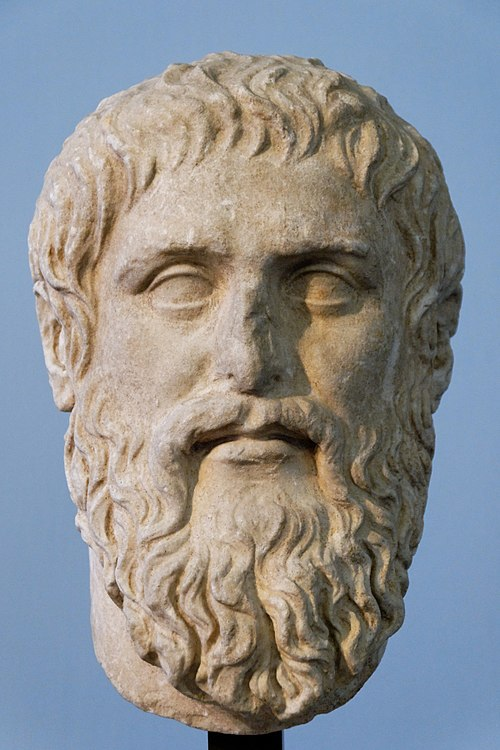
Roman copy of a portrait bust c. 370 BC
“…each living creature is said to be alive and to be the same individual– as for example someone is said to be the same person from when he is a child until he comes to be an old man. And yet, if he’s called the same, that’s despite the fact that he’s never made up from the same things, but is always being renewed, and losing what he had before, whether it’s hair, or flesh, or bones, or blood, in fact the whole body. And don’t suppose that this is just true in the case of the body; in the case of the soul, too, its traits, habits, opinions, desires, pleasures, pains, fears– none of these things is ever the same in any individual, but some are coming into existence, others passing away.”
― Plato, The Symposium
Plato (c. 428-347 B.C.) was an Athenian philosopher and student of Socrates who is considered a founder of Western philosophy. His influential writings on politics, philosophy, and mathematics laid the groundwork for Euclid’s mathematical approach. Plato’s philosophical teachings are presented in his dialogues, which combine drama, dialectic, and doctrine. His characters, often Socrates, debate questions of ethics, knowledge, metaphysics, and politics.
The Symposium is a Socratic dialogue by Plato, dated c. 385 – 370 BC. It depicts a friendly contest of extemporaneous speeches given by a group of notable Athenian men attending a banquet. The men include the philosopher Socrates, the general and statesman Alcibiades, and the comic playwright Aristophanes. Wikipedia
Author: Plato
Characters: Alcibiades, Phaedrus, Socrates, Aristodemus · See more
Date: c. 385 BC