The Day I Learned I Was Nobody

And it felt like the most liberating feeling ever.

Rene Volpi Jr.

Rene Volpi Jr.

Published in The Taoist Online

Dec 3, 2023 (thetaoist.online)

Photo by Christian Buehner on Unsplash

I learned young that self-examination is one of the hardest things humans can do.

It takes a lot of effort to recognize and accept our faults.

I felt invincible when growing up. Many of us think that way.

What could go wrong when you’re 19?

Incredibly, my solace was partly the knowledge that I have my entire life ahead of me; therefore, why worry?

I took more chances than anyone I knew. I lived for the thrills. And came out the other side relatively unscathed.

Only later did I start questioning not only my life but also my purpose.

The thrills ceased to be what they once were, and I became increasingly disappointed in myself and everyone around me. I felt confused and anxious.

I was looking for something that I couldn’t name. Something that would satisfy my search for something I didn’t know where to find.

An old friend I grew up with turned me into the Krishna temple, as he was already a member, but I refused to adopt their methods. They required head-shaving and begging for alms in the streets, all dressed like Hindu monks.

But since the ideas were great, I decided it was something worth exploring. So, I went at it alone.

I started reading Eastern philosophy, the Vedas, The Mahabharata, and the Bhagavad Gita.

I met a guru while wondering who turned out to be the most educated man I’d ever encountered up to that point. As we started a conversation, I told him of my predicament.

He pointed out that it would be best to let go of whatever I identified my persona with, considering my inquiry.

“Just let it go,” he said.

“Become no one.”

“That’s your path.”

I tried to understand, but I couldn’t.

It was above my perception.

How could I do that?!?

He explained that I was already nobody.

I am nothing but a walking pretense.

All I do is repeat what someone else says. Nothing about me is original except 2 things.

So I asked, already semi-offended, “Well, what are they?”

He leaned forward and uttered, “That I can not tell you; you will have to find them yourself.”

“You are young and silly, thinking you are something or someone. You are nobody.”

“Let it go”.

I complained that that wasn’t true.

I affirmed that I have thoughts, ideas, and intentions. I stupidly added, “People recognize me for my gifts, my presence, all that makes me who I am.”

“You are a parrot, he continued. A boy like any other, except that you are curious, that’s all.”

I was stunned at his blatant honesty.

“You discover something, and you think it’s you. You hear something and believe you have created it yourself. And you repeat it as such.”

“But is it yours to claim?” He continued.

“Think. Who gave you your name? It wasn’t you. Who gave you an ID or a number? Not you.

“Did you school yourself? No, you went to a place of learning. Could you go after your own ideas? No, you followed others’ behaviors. And you settle for standards.”

“These are the results,”

“You are a carbon copy of millions like you, who follow the rules and think they have agency.”

“You don’t.”

He said that we, in this society, label ourselves compulsively. It’s demanded that we do. It’s been taught since birth that we must “become something important” to show our value.

“But you already ARE. You don’t have to ‘become’ anything. You are the essence of divinity itself. Just like everybody else.”

“They teach you that to be somebody, you must train, pay a fortune; the more degrees, the better, and don’t ask questions, or you’ll be singled out and mocked. It’s a game, a trick, and a trap.”

More confused than ever, I interrupted him to ask, “Why is it a trap?” Those degrees will help me with my future, better opportunities, and great jobs that pay well.

He smiled and said, “You see those people working at fast-food places? If you ask them, they’ll tell you they have all kinds of titles and degrees. And a massive amount of debt that will undoubtedly carry on until midlife or later. But in society’s eyes, they’ve become “somebody”.

“It’s a trap”, he concluded.

My head was spinning at that point. I needed to breathe badly.

The man was right. I was a fool.

“One good thing, though. You’re searching, which should tell you you’re yet to be born. Born into you.”

I wanted to argue, deny his words, shout, and show him he was wrong, but my brain stopped me.

I needed to digest what this wise man just told me carefully. I had enough presence to recognize that much.

I said goodbye, frustrated but refreshed. I wanted to find a place alone to meditate on his advice. Was he right? Why did the last thing he said resonate so much?

It was devastating to contemplate that I was a “walking lie”!

How could that be? I thought: So what if I was like everyone else? I liked that idea, but why does it matter?

And then it hit me. That’s the last thing I ever wanted, to be like the rest.

I returned to him to tell him that I always felt special, one of a kind, and appreciated.

“Special?” He asked

“Are you empty?”

Not knowing what he meant, I asked, confused, “Empty of what?”

“That’s another secret you have to find out for yourself.”

“Ok, just please, give me a hint,” I begged.

“I said you’re nobody, but you think that’s a bad thing.” He said

“It’s the opposite; it’s liberation, releasing all you believe you are.”

“What, “nothing”? Do you want me to be happy about realizing I’m nothing? I asked.

“I didn’t say ‘nothing.’ I said “nobody”.

“So, an empty nobody? Is that it?

His face suddenly illuminated like a full moon on the most transparent lake, and a smile crowned his expression.

His silent response was all I needed to see.

I walked away, comfortable that, finally, I had said the right thing.

Looking back to see if he was still there, he waved.

Much later in life, I found out what he hinted at by saying that I already had those 2 original traits. He implied I harbored a humble heart and an easygoing soul. He told me so, some 20 years later. Couldn’t believe he remembered.

I’ve always heard of enlightened masters who come into this realm to help humanity. We rarely pay attention and dismiss them as charlatans. Although there are many who fit that description, there are others who are the real thing. The latter have nothing to sell you for a cash payment.

I’ll always remember my first guru. And I didn’t even know his name.

He was probably “Nobody.”

Photo by Marios Kefalas on Unsplash
Rene Volpi Jr.

Written by Rene Volpi Jr.

·Writer for The Taoist Online

Storytelling, true adventures and essays. I tame lions & sharks 🙂 Sailed from Argentina and I’ll change the world with my pen. https://renegvolpi.substack.com

The Most Wonderful Time – for Self Observation!

 It’s the Most Wonderful Time – for Self Observation!

The Prosperos invites you to experience the 12 Days of Christmas in a new way, through a specially designed practice of self observation.

This offer is completely free, but you need to register to receive the instructions on the practice.Want to learn more about the 12 Days of Christmas as 12 Days of Self Observation? Or even register right away?

You can do so here: https://theprosperos.org/12-days-self-observation

Happy Holidays and Much Good Cheer!

The Vampire Problem: A Brilliant Thought Experiment Illustrating the Paradox of Transformative Experience

By Maria Popova (themarginalian.org)

To be human is to suffer from a peculiar congenital blindness: On the precipice of any great change, we can see with terrifying clarity the familiar firm footing we stand to lose, but we fill the abyss of the unfamiliar before us with dread at the potential loss rather than jubilation over the potential gain of gladnesses and gratifications we fail to envision because we haven’t yet experienced them. Emerson knew this when he contemplated our resistance to change and the key to true personal growth“People wish to be settled; only as far as they are unsettled is there any hope for them.” Rilke, too, knew it when he considered how great upheavals bring us closer to ourselves“That is at bottom the only courage that is demanded of us: to have courage for the most strange, the most singular and the most inexplicable that we may encounter.”

When faced with the most transformative experiences, we are ill-equipped to even begin to imagine the nature and magnitude of the transformation — but we must again and again challenge ourselves to transcend this elemental failure of the imagination if we are to reap the rewards of any transformative experience.

In Transformative Experience (public library), philosopher L.A. Paul illustrates this paradox and examines how we are to unbind ourselves from it in a simple, elegant thought experiment: If you were offered the chance to become a vampire — painlessly and without inflicting pain on others, gaining incredible superpowers in exchange for relinquishing your human existence, with all your friends having made the leap and loving it — would you do it?

Art by Edward Gorey from his special illustrated edition of Dracula

Paul writes:

The trouble is, in this situation, how could you possibly make an informed choice? For, after all, you cannot know what it is like to be a vampire until you are one. And if you can’t know what it’s like to be a vampire without becoming one, you can’t compare the character of the lived experience of what it is like to be you, right now, a mere human, to the character of the lived experience of what it would be like to be a vampire. This means that, if you want to make this choice by considering what you want your lived experience to be like in the future, you can’t do it rationally. At least, you can’t do it by weighing the competing options concerning what it would be like and choosing on this basis. And it seems awfully suspect to rely solely on the testimony of your vampire friends to make your choice, because, after all, they aren’t human any more, so their preferences are the ones vampires have, not the ones humans have.
This hypothetical situation, she points out, is an apt analogue for our most important life decisions:

When you find yourself facing a decision involving a new experience that is unlike any other experience you’ve had before, you can find yourself in a special sort of epistemic situation. In this sort of situation, you know very little about your possible future, in the same way that you are limited when you face a possible future as a vampire. And so, if you want to make the decision by thinking about what your lived experience would be like if you decided to undergo the experience, you have a problem… You find yourself facing a decision where you lack the information you need to make the decision the way you naturally want to make it — by assessing what the different possibilities would be like and choosing between them. The problem is pressing, because many of life’s big personal decisions are like this: they involve the choice to undergo a dramatically new experience that will change your life in important ways, and an essential part of your deliberation concerns what your future life will be like if you decide to undergo the change. But as it turns out, like the choice to become a vampire, many of these big decisions involve choices to have experiences that teach us things we cannot know about from any other source but the experience itself.

Our minds, lest we forget, are prone to misleading us — just as people’s confidence in their beliefs is not a measure of the quality of evidence upon which those beliefs are founded, the cost-benefit estimations we make of an as-yet unknown state reflect the suppositions drawn from our current state and not the actual features of the potential and wholly unfamiliar state. When faced with a choice on one side of which lies life as we know it and on the other a transformative experience, we can’t imagine what life on the other side would be like — what we are currently missing — until after we’ve undergone the transformation. (Interestingly, an intuitive awareness of this is at the root of the psychology of our fear of missing out.) Paul writes:

You know that undergoing the experience will change what it is like for you to live your life, and perhaps even change what it is like to be you, deeply and fundamentally.

It seems, then, that there is an equivalent to Gödel’s incompleteness theorem about the limits of logic in consciousness and its vassal, the imagination.

In consonance with psychologist Daniel Gilbert’s memorable assertion that “human beings are works in progress that mistakenly think they’re finished,” Paul adds:

In many ways, large and small, as we live our lives, we find ourselves confronted with a brute fact about how little we can know about our futures, just when it is most important to us that we do know. For many big life choices, we only learn what we need to know after we’ve done it, and we change ourselves in the process of doing it. I’ll argue that, in the end, the best response to this situation is to choose based on whether we want to discover who we’ll become.

North Pacific Giant Octopus by photographer Mark Laita from his project Sea

In a sentiment that calls to mind the deaf-blind Helen Keller’s touching account of her first experience of dance and affirms the value of marine biologist Rachel Carson’s pioneering invitation to imagine Earth from the perspective of nonhuman creatures, Paul writes:

Unless you’ve had the relevant experiences, what it is like to be a person or an animal very different from yourself is, in a certain fundamental way, inaccessible to you. It isn’t that you can’t imagine something in place of the experience you haven’t had. It’s that this act of imagining isn’t enough to let you know what it is really like to be an octopus, or to be a slave, or to be blind. You need to have the experience itself to know what it is really like.

This brings out another, somewhat less familiar fact about the relationship between knowledge and experience: just as knowledge about the experience of one individual can be inaccessible to another individual, what you can know about yourself at one time can be inaccessible to you at another time.

How to access that invaluable perspective — what Seamus Heaney called “your own secret knowledge” — is what Paul explores in the remainder of her immensely insightful Transformative Experience.

You Are Infinite Being Clothed in Human Experience

Rupert Spira • Dec 15, 2023 • What is a human being and why is that different from pure being? When can something be considered to be conscious? And can this be verified experientially? Rupert explains that if you go to your experience of yourself now without referring to the past — if this was the first experience you had ever had — you would not know that you were a human being. We have the experience of ‘I am’ or of being. That is our primary experience. But we don’t have the experience of being a human being. When we say I am, we are not referring to a person’s experience of itself. We are referring to beings’ awareness of itself. The phrase ‘I am’ refers to the awareness of being, not the awareness of being a person.

(Contributed by Steve Hines)

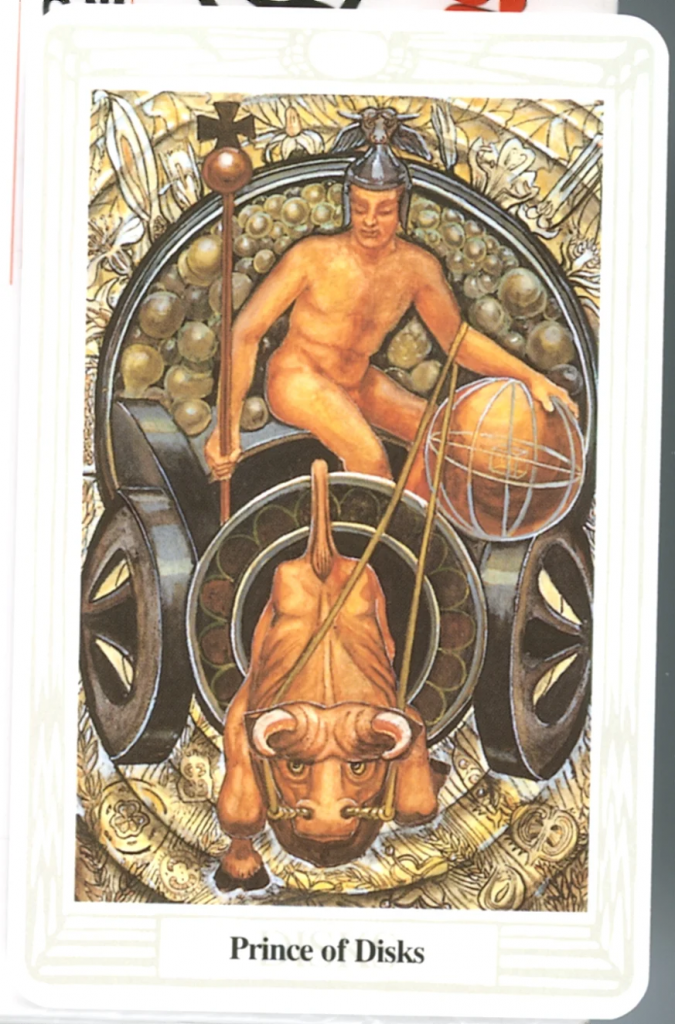
Tarot card for December 18: Prince of Disks

The Prince of Disks The man represented by the Prince of Disks is a quiet and meditative man, who works with unfailing determination towards the goals he sets himself. He is reliable and resourceful, unswerving and creative in his dedication.He is more imaginative than the Knight of Disks, though he has the same quiet strength and gentleness. His quality of contemplation often yields fruit in surprising ways, generating a deep and broad-sweeping understanding about the inner workings of life.If he is ill-dignified, the Prince of Disks can become stubborn and short-sighted – even bloody-minded in his attitudes. Faithful and loyal himself, he will not tolerate faithlessness in others. Neither will he accept lack of integrity, nor dishonesty.He is hard-working, trustworthy and inventive, often producing unusual yet practical solutions which resolve otherwise intractable problems. As a friend he is non-judgemental and supportive, though capable of shedding new perspectives on situations. He’s generally a good listener, though he has little patience with histrionics and manipulation.His approach to life overall is one of industrious practicality. He believes that all things yield to a determined will and well-directed activity.Though emotionally he at first gives the impression that he is solid and perhaps even a little unimaginative, when his feelings are roused, he can be deeply passionate and sensual.He rarely comes up to indicate a change of mood in a person, though sometimes he will appear to indicate some-one learning to take responsibility in everyday life.

(via angelpaths.com and Alan Blackman)

Nine illustrated Confucius quotes that will change your life

Follow Alex’s Instagram for art and more

Timeless wisdom to refresh and entertain:

Alex Mathers

Alex Mathers

3 days ago (iamalexmathers.medium.com)

‘Respect yourself and others will respect you.’

‘Better a diamond with a flaw, than a pebble without.’

‘Men’s natures are alike, it is their habits that carry them far apart.’

‘Everything has beauty, but not everyone sees it.’

‘It does not matter how slowly you go, as long as you don’t stop.’

‘Our greatest glory is not in never falling, but in rising every time we fall.’

‘Life is really simple, but we insist on making it complicated.’

‘If you hate a person, then you are defeated by them.’

‘Wheresoever you go, go with all your heart.’

Alex Mathers

Written by Alex Mathers

Helping you develop mental strength, write better, and grow your brand. Regular tips: https://www.masteryden.com/Follow

Mark Twain on health books

Mark Twain

“Be careful about reading health books. You may die of a misprint.”

― Attributed to Mark Twain

Samuel Langhorne Clemens, known by the pen name Mark Twain (November 30, 1835 – April 21, 1910), was an American writer, humorist, essayist, entrepreneur, publisher, and lecturer. He was praised as the “greatest humorist the United States has produced”, and William Faulkner called him “the father of American literature”. Wikipedia

Consciousness, sexuality, androgyny, futurism, space, the arts, science, astrology, democracy, humor, books, movies and more