Posted by Clint Sabom | Apr 10, 2018 (contemplativelight.org)
An Experiential Meditation on Evelyn Underhill’s 5 Stages Of Awakening. What is life like after awakening? What are some of the signposts of this process and the shifts of spirit that happen along the way? The stages, while laid out in the most helpful model I’ve seen, are still only that, a model. They are not set in stone, nor is it essential to locate yourself in the exact phase: growth is rarely linear.
Drawing on the tradition Benedictine model of Christian mysticism [1. Purgatio 2. Illuminatio 3. Unitio], Underhill expanded the Holy Road home to God into five territories that usually overlap:
1. Awakening 2. The Purgative Way 3. The Illuminative Way 4. The Dark Night Of The Soul 5. The Unitive Way
Her writings in her masterpiece work, Mysticism, utilize quotes from the saints and mystics of the past to illustrate the shifts and turns in consciousness that occur as our inner being awakens to the Presence of God everywhere all the time here NOW. Ultimately, it is a journey where Grace takes over our individual egos, and The Holy Spirit wakes up to Itself within us. We are only the vessels in which the transpersonal God makes Himself manifest in this earthly domain.
127,085 views • Jul 1, 2023A documentary on George Gurdjieff with Armenian sub-titles. Contains original and rare footage of the Gurdjieff movements and music from the 1920’s and covers the basis of his teaching in his own words. George Gurdjieff was born in 1867 in Gyumri (formerly Alexandropol) in Armenia. His father Ivan was Greek and his mother Yeva was Armenian. The film was made by Jean-Claude Lubtchansky, a close associate of Madame de Salzmann, with the support of the Gurdjieff Institute in France and is best viewed in full screen on a television or laptop. Osho described Gurdjieff as one of the most significant spiritual masters of this era and indeed this is a film well worth watching. Gurdjieff’s teaching is fully described in the book called “In Search of the Miraculous” which can be read at http://www.gurdjieff.am Your comments are welcome. We live on a wonderful and possibly unique planet in the universe and can only be grateful for every second of life that is granted to us.
ARIES (March 21-April 19): Aries educator Booker T. Washington advised us, “Do the common thing in an uncommon way.” That’s a useful motto for you in the coming months. If you carry out ordinary activities with flair, you will generate good fortune and attract excellent help. As you attend to details with conscientious enthusiasm, you will access your finest inner resources and exert constructive influences on the world around you. Be thorough and unique, persistent and imaginative, attentive and innovative. Adore your chores in 2024!
TAURUS (April 20-May 20): Taurus philosopher John Stuart Mill (1806–1873) was among the smartest people who ever lived. As is often the case with geniuses, he believed in the supreme value of liberty for all. He was a feminist long before that word existed. Like another genius, architect Frank Lloyd Wright, he thought that “individuality realized is the supreme attainment of the human soul, the master-master’s work of art. Individuality is sacred.” I nominate Mill to be a role model for you in 2024, Taurus. This could be a time when you reach unprecedented new heights and depths of unique self-expression and liberation. PS: Here’s a quote from Mill: “Eccentricity has always abounded where strength of character has abounded; and the amount of eccentricity in a society has been proportional to the amount of genius, mental vigor, and moral courage which it contained.”
GEMINI (May 21-June 20): Emotionally and spiritually, you will ripen at a robust rate in 2024. Your intelligence will mature into wisdom in surprising and gratifying ways. Harvesting rich lessons from long-smoldering confusions and long-simmering mysteries will be your specialty. PS: Some of you Geminis joke around and say you never want to grow up. But I hope you minimize that attitude in the coming months.
CANCER (June 21-July 22): Indigenous people study the intelligence of animals and incorporate it into their own lives. If you’re game to do that in 2024, I suggest you choose elephants as a source of teaching and inspiration. Have fun studying and meditating on their ways! Here are a few facts to get you started. Problem-solving is one of their stengths. They are experts at learning how to get what they need and passing that knowledge on to their offspring. They seldom suffer from sickness, but if they do, they often self-medicate with plants in their environment. Elder females are the knowledge keepers, retaining inner maps of where food, drink and other resources are located.
LEO (July 23-Aug. 22): Writer Janet Champ speaks about the joy of locating “the big wow, the big yesyesyes.” It happens when you find something or someone you regard as “better, greater, cuter, wiser, more wonderful than anything you have ever known.” I’ll be lavish and predict you will encounter a big wow and yesyesyes like this in 2024. Will you know what to do with it? Will you be able to keep it? Those possibilities are less certain, but I have high hopes for you. For best results, cultivate a vivid vision of how the big wow and big yesyesyes will benefit others as well as you.
VIRGO (Aug. 23-Sept. 22): In 1916, most women in the world could not vote. Many men considered women to be inferior—lacking in courage and initiative. It was the Dark Ages! That summer, two sisters named Augusta and Adeline Van Buren rebelled against the stereotypes by riding their motorcycles across America. Roads were poor, rains were frequent, and police arrested them frequently for wearing men’s clothes. Male-dominated media derided them, with one newspaper criticizing their escape from “their proper roles as housewives.” I nominate them to be your role models in 2024, no matter what gender you are. It will be a favorable time to transcend conventional wisdom, override decaying traditions and be a cheerful rebel.
LIBRA (Sept. 23-Oct. 22): For hundreds of years, European nations stole land and resources from Indigenous people all over the world. Among the thefts were art, ritual objects, cultural treasures and human skeletons. Museums in the West are still full of such plunder. But in recent years, some museums have begun to return the loot. Germany sent back hundreds of artifacts to Nigerian museums. France restored many objects to the African country of Benin. Let’s apply this scenario as a useful metaphor for you in 2024, Libra. Is there a part of your past that was hijacked? Your memories appropriated or denied? Your rightful belongings poached, or your authentic feelings infringed upon? It’s time for corrections and healing.
SCORPIO (Oct. 23-Nov. 21): I suggest we choose the brilliant Scorpio physicist and chemist Marie Curie (1867–1934) as your role model in 2024. She is the only person to win a Nobel Prize in two different fields. She managed to pursue a rigorous scientific career while raising two children and having a fulfilling marriage. Being of service to humanity was a central life goal. She grew up in poverty and sometimes suffered from depression, but worked hard to become the genius she aspired to be. May the spirit of Marie Curie inspire you, dear Scorpio, as you make dramatic progress in expressing your unique soul’s code.
SAGITTARIUS (Nov. 22-Dec. 21): In my fairy tale about your year ahead, I see you searching for treasure. It’s not a wild and wandering exploration, but a diligent, disciplined quest. You are well-organized about it, carefully gathering research and asking incisive questions. You ruminate on the possibilities with both your logical and intuitive faculties. You meditate on how you might make adjustments in yourself so as to become fully available for the riches you seek. Your gradual, incremental approach gives you strength. You draw inspiration from your sheer persistence and relentless inquiry. And it all pays off by the second half of 2024.
CAPRICORN (Dec. 22-Jan. 19): “All the things I really like to do are either illegal, immoral or fattening,” quipped Capricorn author Alexander Woollcott (1887–1943). Since he was never arrested, I conclude he didn’t get to enjoy some of the activities he relished. Was he immoral? Not exactly, though he could be caustic. Offering his opinion about a famous pianist, he said, “There is absolutely nothing wrong with Oscar Levant that a miracle couldn’t fix.” The good news for you, Capricorn, is that 2024 will be mostly free of the problems Woollcott experienced. You will be offered an abundance of perfectly legal and moral enjoyments. They may sometimes be fattening, but so what?
AQUARIUS (Jan. 20-Feb. 18): Author Augusten Burroughs is a devoted urban dweller. He says, “When I get a craving for nature, I turn on TV’s Discovery Channel and watch bear-attack survivors recount their horror.” Martial arts master Morihei Ueshiba had a different perspective. “Mountains, rivers, plants and trees should be your teachers,” he advised. “Study how water flows in a valley stream, smoothly and freely between the rocks.” I recommend Ueshiba’s approach to you in 2024, Aquarius—not Burroughs’. Here are my predictions: 1. You will have no dangerous encounters with nature. 2. You will learn more than ever from the wild world. 3. To the degree that you wander in the outdoors, your spiritual life will thrive.
PISCES (Feb. 19-March 20): A study done at Union College in New York found that being fraternity members raised students’ future income by thirty-six percent, but lowered their grade point average by 0.25 points. Would you make a similar trade-off, Pisces? Would you pursue a path that made you more successful in one way but less successful in another? I suspect you will encounter unusual decisions like this in 2024. My job is not to advise you what to do, but to make you alert for the provocative riddles.
Young people on TikTok learn about what’s happening from a hodgepodge of alternative sources, from news commentary influencers to purportedly on-the-ground “citizen journalists.”
Kelsey Russell, a 23-year-old TikToker in New York, is on a mission to pull off what media executives have struggled to do for decades: Persuade young people to buy newspapers.
The grad student posts several videos a week in which she flips through print pages of The New York Times, The Atlanta Journal-Constitution, and other legacy publishers to summarize stories. The broadsheets, blanketed with Russell’s notes and highlights, are something of a nostalgic prop for her roughly 88,000 followers, some of whom may have watched their parents flip through physical papers but never touched one themselves.
Before finding a news niche, Russell spent years building a TikTok following by posting restaurant reviews and travel vlogs. Today she often blends her peppycommentary on news she thinks young people care about — such as healthcare and climate — with lifestyle content. In a November post, for example, she began by showing off her ribeye steak dinner, before diving into an Athens Banner-Herald article about criminal-justice reform.
“The newspaper is such a slay,” a user commented on one of Russell’s August videos where she talked about bombs in Syria.
Persuading young adults to pay for the news is a daunting task. Fourteen percent of US adults in a September survey from the Pew Research Center said they regularly get news from TikTok, up from 3% in 2020. Among 18- to 29-year-olds, that number jumped from 9% to 32%.
“News” on TikTok, however, rarely comes from mainstream outlets like The Washington Post or NBC News, both of which are trying to build audiences there. The app’s recommendation algorithm rarely pushes users toward these accounts, an August study from researchers at Northwestern determined. “We find almost no evidence of proactive news exposure on TikTok’s behalf,” the study concludes.
Instead, young people on TikTok learn about what’s happening from a hodgepodge of alternative sources, from commentary accounts like Russell’s, to non-news influencers who occasionally dabble in current events when they enter the mainstream, to posts from people purporting to offer on-the-ground videos from breaking news events like a war or protest.
On TikTok’s recommendation feed, there is little distinction between a report from ABC News and a rant about that report from a lifestyle influencer. That chaotic democratization is by design. A TikTok representative told Business Insider that the company treats all accounts the same when it comes to policing misinformation and promoting content.
What happens when a generation of Americans gets its news from an infinitely scrolling video app? What happens when the 24-hour news cycle collapses to a 24-second news cycle? In conversations with more than two dozen TikTok users, creators, researchers, and other media stakeholders, it became clear that Kelsey Russell filming herself flipping through the paper at her kitchen table is part of a paradigm shift. There are the high-stakes financial repercussions: TikTok’s growing news influence could further batter an already severely wounded media industry. Then there’s the potential dramatic effect on an informed republic. The app’s ability to provide accurate information on current events is being tested in real time, with conflicts like the Israel-Hamas war stretching TikTok’s content-moderation bandwidth.
“Platforms don’t seem to be that interested in making a space for news,” said Nick Hagar, a coauthor of the Northwestern report who now works as a data scientist at The New York Times. This “new dynamic,” he said, is “going to impact what people see and what people think of as important.”
Influencers read the news so their followers don’t have to
One of the core pillars of TikTok’s news ecosystem is what you might call the “news influencer” — creators like Russell who distill and interpret the news for their followers.
Though they’re usually not affiliated with the outlets they talk about, these people may actually serve as better spokespeople for the industry than journalists at traditional publications. Some users told BI they found TikTokers more authentic and relatable than journalists, whom they believed had built-in biases tied to politics or corporate owners.
“I really liked this idea of somebody who’s a generalist giving me my news rather than somebody who’s always a specialist,” said Tejas Sekhar, a 24-year-old medical student in Chicago. “I feel like sometimes that hits closer to home in terms of what I can glean from it that’s relevant to my personal or daily life.”
Any TikToker who is doing news communication has to have respect for traditional media.Vitus “V” Spehar
“What I’m providing people is a near-peer model of education,” said Russell, who wants to parlay her master’s in sociology and education policy into a job that mixes entertainment with media literacy (much like what she does on TikTok today). “Somebody that looks like you, that talks like you, that acts like you, that is around your age, is able to explain a topic that you might not be able to understand.”
The share of US adults under 30 in Pew surveys who said they trusted information from national news outlets fell to 56% in 2022 from 62% in 2016, with trust in local news outlets falling to 62% from 71%. By contrast, trust in information from social media rose to 50% from 44%.
Traditional media brands that have been successful on TikTok often build their videos through individual reporter personalities. The Washington Post‘s Dave Jorgensen, for example, did an entire video series around working from his apartment during a pandemic, while Jack Corbett of “Planet Money” also filmed TikToks at his home using a bedsheet as a green screen.
For TikTok’s emerging class of news influencers who have created their own niche, reading traditional media is still very much a part of their daily habits, even if it’s absent from some of their followers’ media diets.
With 3 million followers, Vitus “V” Spehar’s @underthedesknews account is particularly effective at bridging the divide between traditional media and TikTok news. The 41-year-old describes their role on TikTok as a news communicator and civics explainer — a blend of Stephen Colbert, an after-school special on PBS, and “Schoolhouse Rock!“
Spehar’s videos often include screengrabs from news articles to help credit sources when talking about topics like Sam Altman’s temporary ousting from OpenAI or a House ethics report on Rep. George Santos. Spehar says they monitor anywhere from 12 to 15 news sources with the goal of finding stories that haven’t become oversaturated.
A.B. Burns-Tucker, a 34-year-old recent law-school grad, has a similar approach to her legal commentary account @iamlegallyhype. She broke into TikTok news after posting a video in which she tried to explain what was happening in the Russia-Ukraine war to her followers as if she were talking to friends. The video took off, and she now walks through topics like an Israel-Hamas cease-fire or Mike Johnson’s election as House speaker to an audience of about 700,000 followers.
“Your post is the only way I fully understand what’s happening,” one user commented on her October video about the Israel-Hamas war.
“Translators like you are so important,” another user wrote.
Burns-Tucker, like Spehar and Russell, leans on professional news outlets for sourcing, even if her videos make it seem as if she’s speaking off-the-cuff.
“Any TikToker who is doing news communication has to have respect for traditional media,” said Spehar, who has done freelance work on TikTok for outlets like The Washington Post and the Los Angeles Times. “You don’t have to like all of it. But you’ve got to find one piece that you do like and recognize that that is what’s giving you power.”
Not all TikTok news influencers cite their sources, of course.As has long been the case with other platforms, sensational retellings of the news that omit sourcing details are often the most popular.
“Welcome to ridiculous shit going on around the world right now,” a TikTok creator named David Justinn with about 9 million followers said in a late-2020 video. “A frozen dragon was just discovered in Canada,” he notes. The video garnered about 31 million views and about 6 million “likes.”
And on hot-button issues like the Israel-Hamas war, for example, some creators have felt pressured to offer opinions on the matter even if they lack expertise, leading some to distrust information from the app.
Even though Pew’s research showed that US adults broadly distrust information found on social media, TikTok faces an uphill battle given its resonance with younger adults who are more inclined to trust social apps. The company said it enlists fact-checking partners globally to help verify claims about misinformation. But other social apps have had similar partners and have failed, sometimes spectacularly and dangerously, to serve as effective news conduits. A 2020 Pew report found that US consumers who turned to social media for news tended to be less informed on topics like politics or the COVID-19 pandemic than their counterparts who engaged with traditional media like radio or news websites.
“I am worried and have a fear that the fragmentation that we see is going to cause problems for the body politic. That maybe people will pay less attention to politics and to traditional news and go off into their own corners on their own ‘For You’ page,” said Gerry Lanosga, the director of the journalism program at Indiana University in Bloomington.
“To survive,” he said, traditional media “has to be less traditional, of course, but needs to figure out a way to find inroads into these platforms, exist on them, and even thrive in them by making news products that are more obtrusive to people and interesting.”
Some prefer TikTok news that cuts out influencers and traditional media entirely
Some users steer clear of news commentary altogether, preferring to get information from on-the-ground, “citizen journalism” footage of live events or firsthand testimonials. These videos, which can be difficult for a casual TikToker to authenticate, are nevertheless often viewed as more genuine or authentic than information delivered by a traditional journalist.
“Being able to see into someone’s day-to-day and having them tell a story does feel so much more trustworthy or real than something that feels so far away,” said Sanya Chaudhry, a 25-year-old TikTok user in Toronto. If there’s a way traditional media could make news “feel real,” she continued, “like it’s real people telling the stories on the ground, if they can find a way to make it more personable, maybe that’s a way that more people can get engaged with it.”
And challenging as these videos are to verify, some TikTok users told BI that they believed the app had built-in tools to keep bad actors in check. The app’s community of users can turn to features like the comments section of videos, video stitching, and dueting to call out videos that contain misinformation, they said.
“There’s this kind of peer policing community that exists within TikTok, especially for things that are related to social and political matters,” Sekhar said. “Sometimes creators will call each other out and say, ‘Hey, that’s actually incorrect, because of this.'”
Other platforms such as Reddit and X, formerly Twitter, have leaned on community features to help identify misinformation, with mixed results. A Bloomberg review of X’s “Community Notes” in November found that the feature struggled to keep up with a relentless volume of misinformation about Israel and Gaza, with moderators taking more than seven hours on average to append corrective notes to false posts. In social-media time, that may as well be seven years.
All the news that’s fit to rizz: How the media industry can use TikTok
There is one form of traditional news media that TikTok is proving useful for, and it happens to be the type of journalism most crushed by the news industry’s shift to digital: local journalism.
“TikTok is a better place for local stories than national because people log into social media to look at content specifically tailored for them,” said Matt Shearer, a Boston-area reporter who helped launch WBZ NewsRadio’s TikTok account. The company won a regional Edward R. Murrow Award for innovation based on its work on the app this year. “Any time I post a video about a small town in Massachusetts, everybody in that small town and the surrounding towns shares that,” Shearer said.
Vibrant as TikTok’s news ecosystem is, the app hasn’t done much to help the news industry make money. Publishers aren’t holding their breath.
“The only way that radio is going to continue to flourish is if you have programmers and news directors who are brave enough to innovate, and try something a little different,” Shearer said. “Nothing should be formulaic.”
Other radio hosts like iHeart’s Jeffrey Ramsey in Denver or Shannon Burns in Canada told BI in November of last year that they had successfully used the app to draw in a broader audience.
But so far, these local journalists and a handful of savvy creators at national brands have been exceptions to the rule.
And as vibrant as TikTok’s news ecosystem is, the app hasn’t done much to help the news industry make money. Publishers aren’t holding their breath that it will.
News has long been a major headache for platforms like Facebook and Instagram, and it’s a uniquely controversial topic for TikTok, which has a China-based owner and is under immense scrutiny over the way it handles the flow of news and other information.
TikTok, which operates more like an entertainment platform akin to YouTube or Netflix than a social network like Facebook, can try to avoid some of the mistakes in news delivery that its predecessors flubbed. Ultimately, it may end up re-creating the same information bubbles that plagued social-media apps throughout the 2010s, but this time for Gen Z.
For news publishers, betting on the app as a source to make money would be a mistake, even as TikTok gobbles up more and more user attention time, said Brian Morrissey, who founded the media newsletter The Rebooting and was previously the president and editor in chief at Digiday.
Unlike Google or Facebook, where links to news sites can fuel publishers’ ad revenue, linking is almost nonexistent on TikTok. It’s a closed ecosystem with limited monetization options, and TikTok hasn’t expressed any interest in prioritizing professional publishers. The company also usually doesn’t pay publishers for their content, though it is testing an ad-revenue share program.
“The idea of depending on platforms for ad revenues is a nonstarter,” Morrissey said. “The idea that these tech platforms will help news publishers in any way, shape, or form to me would be a ridiculous bet.”
But persuading US teens who by one estimate spend an average of 4.8 hours a day on social media to log off of TikTok and go directly to a news website they increasingly distrust is also a long-shot bet.
KelseyRussell’s advice to the industry is to imitate what she and her TikTok peers have done intuitively: Make the news relatable. Like any TikToker’s, her videos are drawing eyeballs away from the very news organizations she hopes to promote. But her approach could also offer a model for how those news organizations can win over the next generation of consumers.
“Any time that you can bring in the younger voice, you can bring them to the table, you can make them visible, that’s what people want,” Russell said. “You’ve got to meet the people where they are.”
Dan Whateley is a senior media reporter at Business Insider covering TikTok and social media.
To become precious — that is the work of love, the task of love, the great reward of love. The recompense of death. The human miracle that makes the transience of life not only bearable but beautiful.
It is heartbreaking enough that we do lose everything that exists, everything and everyone we love, until we lose life itself — for we are a function of a universe in which it cannot be otherwise. But it is our singular human-made heartbreak that we often cope with our terror of loss — that deepest awareness of our own mortality — by losing sight of just how precious we are to each other, squandering in less-than-love the chance-miracle of our time alive together, only to recover our vision when entropy has taken its toll, when it is too late. We write poems and pop songs about our self-made tragedy — “The art of losing isn’t hard to master“; “Don’t it always seem to go that you don’t know what you’ve got till it’s gone.” — and we go on living it.
Eight centuries before Mueller lived and died, an impassioned invitation to transcend our self-made tragedy took shape in another short, stunning poem by another poet of uncommon contact with the deepest strata of life-truth: Rumi (September 30, 1207–December 17, 1273), who believed that you must “gamble everything for love, if you are a true human being.” Rumi, ancient and eternal. Magnetic in his eloquent devotion and his soulful intelligence. Majestic in his whirling silk robe and his defiant disdain for his culture’s worship of status. Volcanic with poetry.
In his sixty-six years, Rumi composed nearly sixty-six thousand verses, animated by an ecstatic devotion to living more fully and loving more deeply. Having mastered the mathematical musicality of the quatrain, he became a virtuoso of the ghazal with its series of couplets, each invoking a different poetic image, each crowned with the same refrain — a kind of kinetic sculpture of surprise, rapturous with rhythm.
A dazzling selection of his poetry, including some never previously alive in English, appears in Gold (public library), newly translated and inspirited by poet and musician Haleh Liza Gafori.
Reflecting on the creative challenge of invoking the poetic truth of one epoch and culture into another, she writes:
The languages of Farsi and English possess quite different poetic resources and habits. In English, it is impossible to reproduce the rich interplay of sound and rhyme (internal as well as terminal) and the wordplay that characterize and even drive Rumi’s poems. Meanwhile, the tropes, abstractions, and hyperbole that are so abundant in Persian poetry contrast with the spareness and concreteness characteristic of poetry in English, especially in the modern tradition. I have sought to honor the demands of contemporary American poetry and conjure its music while, I hope, carrying over the whirling movement and leaping progression of thought and imagery in Rumi’s poetry… I have chosen poems that seem to me beautiful, meaningful, and central to Rumi’s vision, poems that I felt I could successfully translate and that speak to our times.
Here is Haleh Liza Gafori reading for us her translation of Rumi’s lens-clearing invitation to step beyond our self-made tragedy and into the deepest, perhaps the only, truth of life:
LET’S LOVE EACH OTHER by Rumi (translated by Haleh Liza Gafori)
Let’s love each other, let’s cherish each other, my friend, before we lose each other.
You’ll long for me when I’m gone. You’ll make a truce with me. So why put me on trial while I’m alive?
Why adore the dead but battle the living?
You’ll kiss the headstone of my grave. Look, I’m lying here still as a corpse, dead as a stone. Kiss my face instead!
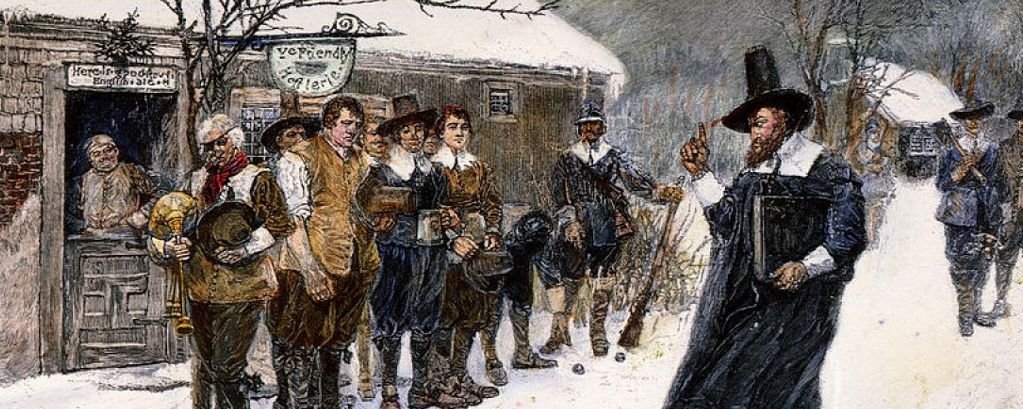
In 1659, the Massachusetts Bay Colony enacted a law called Penalty for Keeping Christmas. The notion was that such “festivals as were superstitiously kept in other countries” were a “great dishonor of God and offence of others.” Anyone found celebrating Christmas by failing to work, “feasting, or any other way… shall pay for every such offence five shillings.” [This would be about $48 today].
You can find an interesting discussion of the evolution of opinion on Christmas in the region at Wikipedia’s Christmas in Puritan New England.
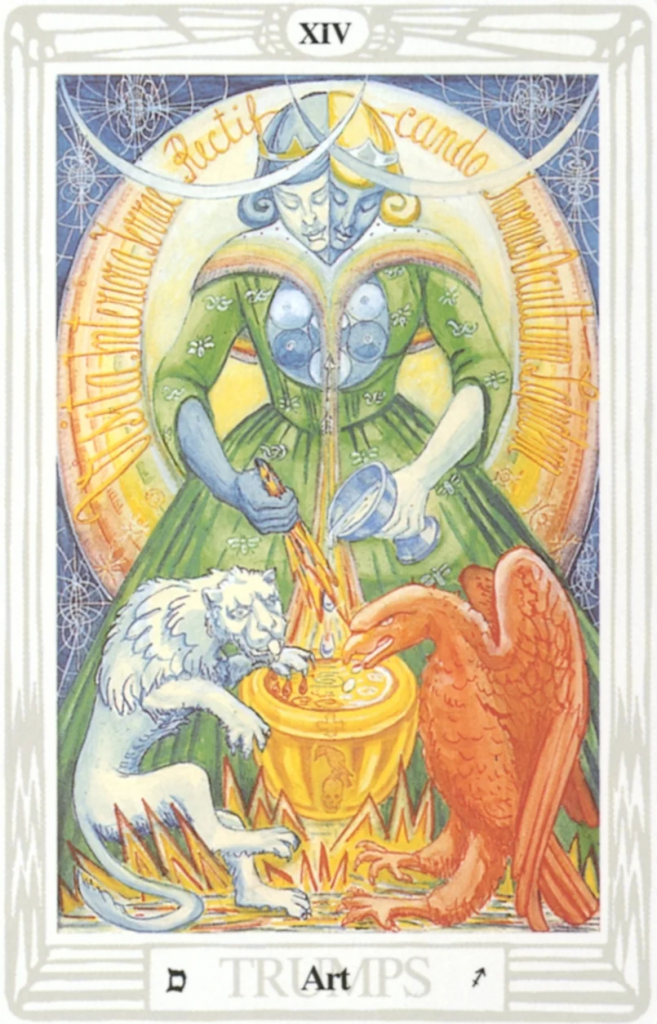
Art (or Temperance) is numbered fourteen and usually shows the figure of a young woman or angelic being, who is pouring water from one vessel into another. Not a single drop is spilt. This card is related to the union and harmonisation of opposites.
Art shows us that those among us who allow a free flow of life force use it the most effectively, wasting the least and achieving most. If we are thoughtful, receptive and in harmony, we allow the Higher Powers to run unhindered through our spirits and emotions – and finally into our daily lives.
Life is a river. Instead of clinging on to a rock let go and become part of the water. Find the still point within and live from that point and by doing that our hopes and dreams come closer.
It was a great year of reading once again. Not because the titles published this year were particularly great–as always, my reading is usually rooted in stuff that’s older, in a more serendipitous process than catching titles as they come out. It was great because I found so many books that were new to me and in their own way, helped form a new me. I learned about perspectives I didn’t have before, learned things I didn’t know, and even connected with people I otherwise wouldn’t have known. It was wonderful and I feel so lucky to have so many more books I still want to read.
At the end of every year, I try to narrow down all the books I read and recommended in this email list to just a handful of the best. The kind of books where if they were the only books I’d read that year, I’d still feel like it was an awesome year of reading. You can check out the best of lists from 2022, 2021, 2020, 2019, 2018, 2017, 2016, 2015, 2014, 2013, 2012 and 2011… I can’t believe it’s been 13 years of these roundups!
My reading list is now ~270,000 people, which means I hear pretty quickly when a recommendation has landed well. I promise you — you can’t go wrong with any of these.
Before we get into them, speaking of new me’s, if you want to be a new you this New Year… Join me in The Daily Stoic New Year New You Challenge 2024–21 challenges designed to create the momentum and confidence you need to make 2024 your best year yet. Learn more and sign up here.
You never know why a book is going to jump out at you or why it will speak to you. I found this one at a Barnes and Noble on the Gulf Coast of Florida on vacation with my family. How could I have known that this epic Western–one of the greatest I’ve ever read–was largely based in Bastrop, where I live and where my bookstore, The Painted Porch, is? How cool is that? As it happens, Philipp came out and was the first in-person episode of The Daily Stoic Podcast–recorded in a building that dates roughly to the period of the book. And then just a few weeks ago, I was at a small rural grocery store in Red Rock, Texas and in a bin of used books, I found a pristine 1st edition hardcover of The Son (which I am going to have him sign for me when we go deer hunting later this month). Again, the magic of books! Anyway, on the little sign I put next to the book in the bookstore, I say that The Son is on par with the show Yellowstone, but better. If you’re looking to read more fiction this year, start here. It’s an epic book that spans multiple generations, from the Comanche raids of the 1800s to the border raids of the early 1900s and the oil booms of the 20th century. I also recommend Philipp’s other novel, American Rust,which reminded me of one of my absolute favorite books last year, Jessica Bruder’s Nomadland. Meyer is so in tune with the themes that we see ruminating in our country every day–the dignity of work, the despair of not being able to get ahead, the terrible cost of so many shortsighted economic decisions by American industry. But all of that is subsumed here in a great novel with great characters. It pairs nicely with Cormac McCarthy’s border trilogy as well (All The Pretty Horses is an all-time favor for me). But back to the topic of Texas, two amazing Texas books are Empire of the Summer Moon by S.C. Gwynne and Comanches: The History of a People by T.R. Fehrenbach.
How did I find this book? No recollection–but I feel so much gratitude for having found it. Ann Wroe’s biography of Pontius Pilate, the Roman governor of Judaea–the man who sentenced Jesus to his gruesome death–was so overwhelmingly good that I could only read a couple pages at a time. How on earth did Wroe manage to produce such a rich and fascinating, 432-page book about a guy for which the historical record is not more than a couple artifacts and inscriptions? I don’t know… but it makes it a masterwork. Fitzgerald said genius was the ability to hit a target no one else could see…that’s what happened here. What so captivated me about this book is that although it is of course about the most seminal moment of the Christian world, it is happening inside the Roman world–the world of Seneca, literally. Seneca’s brother is in this book (he adjudicates a case involving St. Paul). Lucilius, who Seneca is writing his famous letters to, has the same job in a different province as Pontius. And by the way, that’s the most radical thing about this book: That you get to look at Pontius Pilate, the man who sentenced Christ to death, as a guy with a job. Did he do it well? How did it go so sideways? He said several times that he did not think Christ was guilty…he tried several times to get out of sentencing him to be crucified…yet in the end, he relented and did what he knew was wrong. What can that teach us? This was one of the most interesting and creative books I’ve read in a very long time. I also had Ann Wroe on The Daily Stoic Podcast earlier this year (listen here).
I know how I found Dr. Becky’s work–my wife recommended it. I should know by now to put such books at the very top of my to-read pile, but this one took a while to get to. I regret that because WOW this book is good! It’s another that I could make it a couple pages at a time before I had to just stop and think. And then to go back through it for my notecard system took equally long, there was just so much stuff I had to get down. I’ve already written close to a dozen Daily Dad emails about lessons from the book–from parenting anxieties and frustrations to being present and asking tough questions. But as much as this is a parenting book, it’s also just classic Stoic principles applied toward being a person–because what is parenting but stress, situations you don’t control, worry, anxiety, fear, fatigue and frustration? I took so much out of this book. I just interviewed Dr. Becky too but I don’t think it will come out until January. Stay tuned and in the meantime, you just HAVE to read this book.
More…
As much as I tried, I really can’t leave it at just three books. As you’ve seen in the list this year, I published a book myself in May, The Daily Dad. I quite enjoyed The Book of Charlie: Wisdom from the Remarkable American Life of a 109-Year-Old Man by David Von Drehle. It’s a short, great read. I even got to talk to David about Charlie on The Daily Stoic Podcast (listen here). The Past That Would Not Die by Walter Lord is a riveting, must read narrative nonfiction thriller about James Meredith’s brave and bold campaign to integrate Ole Miss in 1962. An equally moving and related book was Three Lives for Mississippi by William Bradford Huie. I’m not sure you can fully understand America or the darkness that humanity is capable of without reading these books. I found Jan Morris’ Conundrum to be an honest, eye-opening, and just very human memoir from someone who is trans (and also an amazing historian, veteran and fascinating person). The world would be a better place if more people read this book. I loved Joan Didion’s Blue Nights even more than I loved The Year of Magical Thinkingas it is much more about parenting and one’s own mortality. If you’re a Joan Didion fan, check out The Daily Stoic Podcast on Youtube, the table we sit at is hers. Deliver Me From Nowhere: The Making of Bruce Springsteen’s Nebraska by Warren Zanes is a great insight into not just the creative process but also the business and branding and career process. It’s fantastic and almost unbelievable. Edith Hamilton’s The Greek Way is a wonderful discussion of what made the Greeks so special, what they can teach us and how they thought about life. I was lucky enough to interview Arnold Schwarzenegger twice for his new book, Be Useful. We metonce in Los Angeles in his Bavarian-themed office (listen here) and then again on stage in NYC. And finally, Robert Greene released a 25th anniversary edition of The 48 Laws of Power. It’s one of the coolest designed books I’ve ever seen. If you flip the gold pages in one direction, you see Machiavelli’s hidden face…and if you flip them in the other direction, Robert’s face appears. It’s an amazing version of an amazing book which I continue to think everyone needs to read. And if you don’t want to read it because you think it’s ‘immoral,’ well then you definitely need to read it.
Children’s Books
My oldest is obsessed with Minecraft and so we were very excited when we found out that Max Brooks wrote a novel about Minecraft called The Island (the audiobook is narrated by Jack Black). It’s so funny to see him absorb and get excited by what are effectively Stoic lessons but be open to them because it’s fictionalized through a video game. If I were to say any of the same things, he’d roll his eyes. I missed out on Harry Potter as a kid (just a tad old when they came out) and I never saw the movies so having kids was my first time interacting with the stories at all. We’ve loved making our way through the Illustrated Editions of Harry Potter this year. It’s a great way to read them and they’re beautiful books (if only JK Rowling could go read Jan Morris’ memoir and shut up). For my youngest, who is obsessed with bunnies, I read The Velveteen Rabbit for the first time and we both fell in love with the story. It inspired two Daily Dad emails that you can read here and here. If you haven’t read either The Boy Who Would Be King or The Girl Who Would Be Free, I would love for you to check them out. Stoicism is a philosophy I wish I had found earlier…and I wrote these books to help kids do exactly that.
As always, I appreciate you supporting my bookstore, The Painted Porch. Please note that because a lot of the books we sell are backlist titles, there can sometimes be delays in stocking/sourcing. And with that, I hope that you’ll get around to reading whichever of these books catch your eye and that you’ll learn as much as I did. Whether you buy them at The Painted Porch or on Amazon today, or at your nearest independent bookstore six months from now makes no difference to me. I just hope you read!
You’re welcome to email me questions or raise issues for discussion. Better yet, if you know of a good book on a related topic, please pass it along. And as always, if one of these books comes to mean something to you, recommend it to someone else.
I promised myself a long time ago that if I saw a book that interested me I’d never let time or money or anything else prevent me from having it. This means that I treat reading with a certain amount of respect. All I ask, if you decide to email me back, is that you’re not just thinking aloud.
Enjoy these books, treat your education like the job that it is, and let me know if you ever need anything.


 The languages of Farsi and English possess quite different poetic resources and habits. In English, it is impossible to reproduce the rich interplay of sound and rhyme (internal as well as terminal) and the wordplay that characterize and even drive Rumi’s poems. Meanwhile, the tropes, abstractions, and hyperbole that are so abundant in Persian poetry contrast with the spareness and concreteness characteristic of poetry in English, especially in the modern tradition. I have sought to honor the demands of contemporary American poetry and conjure its music while, I hope, carrying over the whirling movement and leaping progression of thought and imagery in Rumi’s poetry… I have chosen poems that seem to me beautiful, meaningful, and central to Rumi’s vision, poems that I felt I could successfully translate and that speak to our times.