Perhaps of imitative origin. Earliest documented use: 1398.
USAGE:
“Her house became the refuge of young men puling in puberty, mourning over lost virtue, and aching to lose some more.” John Steinbeck; East of Eden; Viking; 1952.
See more usage examples of pule in Vocabulary.com’s dictionary.
A THOUGHT FOR TODAY:There is no terror in the bang, only in the anticipation of it. -Alfred Hitchcock, film-maker (13 Aug 1899-1980)
For nearly two thousand years, Mary Magdalene has been miscast. Not as the spiritual leader she clearly was, not as the companion of Christ or a transmitter of wisdom, but as a prostitute, a cautionary tale, or worse, a footnote. That wasn’t an accident. It was a misogynistic erasure.
But what if the earliest followers of Jesus saw her differently? What if, in the first generations of the Jesus movement, Mary wasn’t just respected but she was revered? And what if her teachings, long buried by institutional patriarchy, contain the very message our modern world is crying out for?
That’s what the Gospel of Mary suggests. Not a gospel “according to” someone else’s retelling, but one that claims to record Mary’s own words, her own experiences, and her direct conversations with the risen Christ.
In it, Jesus tells Mary that true knowledge doesn’t come from the law or from outer authority, it comes from within. The soul, he says, is capable of rising through the realms of fear, desire, ignorance, and wrath to return to its divine source. Salvation isn’t earned through obedience; it’s realized through awakening.
The Gospel of Marywas lost for over 1500 years. Discovered in fragments in the late 19th and mid-20th centuries, it was long dismissed as a “Gnostic heresy” by church historians. But that word—Gnostic—has become a theological garbage bin, used to dismiss anything that doesn’t fit within the clean, hierarchical, male-dominated box of orthodoxy. In reality, the Gnostics were mystics. They didn’t reject Christ; they sought to live Christ from the inside out.
And in their writings, especially those found in the Nag Hammadi library and the Berlin Codex, Mary Magdalene is more than just a follower. She is the one who “understood everything,” the one the risen Christ chooses to reveal deeper mysteries to, even as Peter and Andrew argue that a woman can’t be trusted to teach. It’s not hard to see the early seeds of misogyny in their protest, and it’s even easier to see why this gospel was suppressed.
To read the Gospel of Mary today is to hear a voice that refuses to be silenced. “The Son of Man is within you,” she tells the disciples. “Follow him.” That line alone dismantles centuries of clericalism. No need for a priest. No need for a male mediator. Christ is within. The true temple is the awakened heart.
That message resonates now more than ever. As millions leave the institutional church, not in rejection of Christ but in search of a more authentic, compassionate, and inclusive spirituality, Mary’s voice breaks through like a lighthouse. She speaks of inner freedom, spiritual equality, and direct experience. Her gospel isn’t about sin and sacrifice, it’s about the soul’s journey home.
And make no mistake: the suppression of Mary was never about theology. It was about control by men.
As scholar Karen King has shown, the early church fought bitter internal battles about who had the right to teach, to lead, and to speak with authority. The voices of women—especially visionary, mystical women—were seen as dangerous. Not because they were wrong, but because they couldn’t be controlled.
So their stories were rewritten. Their teachings buried. And their presence erased.
It wasn’t until Pope Gregory the Great, in the year 591, that Mary Magdalene was officially labeled a prostitute. That slander had no basis in scripture—it was a political act, a theological smear job. And for over a thousand years, it stuck.
Only in 2016 did the Vatican quietly correct the record, declaring her “Apostle to the Apostles” and restoring her to a place of honor. But even then, they didn’t mention the gospel attributed to her. They didn’t address why her voice had been suppressed. And they certainly didn’t affirm her as a bearer of divine revelation.
But the truth is out now. And the church doesn’t own the narrative anymore.
Across the world, people are rediscovering Mary Magdalene as a spiritual teacher in her own right. Not just as a “strong woman” in a male-led story, but as a mystic who embodied what Christ came to teach. Some even see her as the embodiment of the feminine Christ, a counterpart to Jesus, not just in gender, but in archetype.
If Jesus represents Logos, the incarnate Word, Mary represents Sophia, the embodied Wisdom. Together, they offer a whole gospel: one of union, not domination.
The implications are profound. Reclaiming Mary means reclaiming the sacred feminine, not just in religion, but in ourselves. It means honoring the intuitive, the relational, the embodied aspects of spirituality that have been exiled in favor of dogma, doctrine, and male control. It means healing the split between spirit and matter, mind and body, heaven and earth.
It also challenges us to rethink what it means to follow Christ. If the Son of Man is within us, as Mary says, then salvation isn’t about believing the right creed; it’s about becoming what we already are. It’s about awakening to the divine spark within and helping others do the same.
That is the essence of mystical Christianity. That is the message the church feared. And that is the invitation we now face.
We live in a moment of great unraveling. Institutions are failing. Old hierarchies are cracking. People are hungry; not for more control, but for more connection. Not for answers, but for depth.
The rediscovery of Mary Magdalene isn’t just a historical curiosity. It’s a prophetic gift. Her gospel survived because it needed to. And now, in this age of awakening, it speaks again.
Not with thunder or lightning. But with quiet authority. With wisdom. With love.
She reminds us that the kingdom isn’t up there, or out there, or reserved for a chosen few. It’s already within us. We just have to remember.
“All suffering is personal.In the absence of the person,Where can suffering alight?”
~ Wu Hsin
Wu Hsin is a pseudonym of Roy Melvyn. Although Melvyn presents himself as the “translator” of the supposedly lost writings of Wu Hsin, the character is in reality entirely fictional. According to his biography, Wu Hsin was a Chinese sage who lived about one hunMore.
NOVA PBS Official Aug 4, 2025 A young astronomer set out to study binary stars—and stumbled on something invisible, massive, and groundbreaking. In 1970, Paul Murdin noticed a star in the constellation Cygnus that appeared to orbit a massive invisible object. He later identified the unseen companion as one of the earliest known black holes.
Comedian and writer Athena Kugblenu has a hot take: we’re all liars, and that’s OK. Exploring the line between the little lies that do no harm and the big, self-serving whoppers you’d best avoid, she offers a crucial question to ask yourself to help determine if honesty is the best policy — or if a fib might best fit the situation.
God quickly trapped the 8.1 billion pests, but His next move remains unclear.
Published: August 13, 2025 (TheOnion.com)
THE HEAVENS—Moments after spotting hordes of the minuscule creatures skittering across the face of the earth, the Lord, Our Holy Father, reportedly became disgusted Thursday and placed a giant overturned glass atop humanity.
Heavenly sources confirmed the Almighty cursed in surprise when He first spotted the massive swarm of human beings crawling through Creation, but He soon scrambled to overturn a 70-million-foot-tall drinking vessel and contain the planet’s infestation, trapping the enormous mass of 8.1 billion squirming pests inside.
“Gross, gross, gross, they’re getting all over the place!” said the visibly nauseated deity, who after a short search around His Kingdom retrieved a 10,000-mile-wide paper plate He could slide beneath the glass to ensure the scampering throngs didn’t escape. “Ugh, I hate the twitchy way they move. And the tiny hairs all over their bodies. Plus, they’re always kind of moist. Totally creeps me out.”
“Seriously, I might puke just looking at them,” the Lord continued.
According to witnesses, God discovered the human colony late at night after turning over a cloud in heaven’s sanctum sanctorum to find billions of the creatures writhing on the planet below. Several reports confirmed that after trapping humanity, the Almighty Creator exhibited a wide range of coping responses that included wincing in stunned silence as He gazed at the humans from afar, audibly gagging at the sight of saliva dripping from their jaws, and even shouting “Get out! get out!” at the tiny noncomprehending beings for over a minute.
Though he momentarily regained His composure by taking some deep breaths, the Lord is said to have fallen into a fit of dry-heaving after He spotted several humans in Central Europe expelling bodily fluids as they copulated. After recovering once more, He was seen rolling up an ancient scroll and approaching the glass with the papyrus brandished in His Divine Hand.
“If I let them out they’ll infest all of Creation—they breed like crazy,” said He Who Divided the Heavens and Earth, tapping on the side of the glass as several million inhabitants of the North American continent scurried helplessly away inside the cup. “I used to think the ethical thing was to release them, but they always seem to find their way back to me. Then they get into my shit and start eating through everything in sight. Plus, they stink up the place.”
Official records confirmed this is far from the first time the Eternal One has struggled with a human incursion. Once, as a younger deity, the Lord reportedly placed a pair in His garden, gave them fruits and herbs, and even named them, only to grow bored after several months. When He remembered them several years later, Our Heavenly Father was frustrated to discover an out-of-control population scuttling all over the globe.
Since then, God is believed to have grown far more impatient with humanity’s tendency to decimate forests, contaminate food supplies, and spread disease. A small number is enough to send Him stomping on the fleeing beings, and sources said on one occasion He leapt onto His Heavenly Throne and refused to get down until the Holy Ghost exterminated them.
“You can smite a few of these fuckers, but there will always be more on their way,” said the Almighty, grimacing as the appearance of His Eternal Face outside the glass sent huge quantities of the miniscule beings scattering for cover in South America. “You can set them on fire, crush them, even throw them out into space—they always bounce back and start breeding like nothing happened. Maybe I’ll just put a bunch of water in there and see if they drown.”
“Although, that’s never worked before,” the Creator of All Things added.
At press time, God was seen spraying a massive bottle of Axe Body Spray over the entirety of Creation in a final attempt to wipe out the human infestation once and for all.
“It’s a bit of an obscenity that I’m asked so much to speak on this subject because I happen to be Jewish and because I happened, as an infant, to have survived the Holocaust…Why aren’t we listening to the Palestinians?”
Physician and writer Gabor Mate participates in a meeting entitled ‘Reflections on Individual and Collective Trauma. Palestine and Zionism.’ at the National Old Theatre in Krakow, Poland, on June 9, 2025. Photo by Klaudia Radecka/NurPhoto via Getty Images
Get fearless, uncompromising truth in your inbox. Subscribe to The Real News.SIGN UP
“Iwas in Auschwitz 6-7 weeks ago,” world-renowned author and physician Dr. Gabor Maté says, “at the very spot where my grandparents landed, before they were sent to the gas chambers, where my mother and I almost ended up in June of 1945. We came very close. And nothing in the world ever resembles the horror of Auschwitz, but the spirit of it, the inhumanity, the cruelty of it, the starving of people, the killing of starving people—that’s going on right now, and the world is watching.” In this urgent installment of our ongoing series “Not in Our Name” on The Marc Steiner Show, Marc speaks with Dr. Maté about growing up Jewish in the wake of the Holocaust and being Jewish in the midst of Israel’s genocide of Palestinians in Gaza.
The following is a rushed transcript and may contain errors. A proofread version will be made available as soon as possible.
Marc Steiner:
Welcome to the Marc Steiner Show here on The Real News. I’m Marc Steiner. It’s great to have you all with us once again.
My guest today is Dr. Gabor Maté. He’s a physician that was born in Hungary amidst the Holocaust. Family members were killed, imprisoned, and he was sent to live with others to save his young life. His life is dedicated as a physician, a healer, an author, a speaker, an activist addressing the trauma of life, war, and oppression. He’s the author of numerous books, which we’ll link to, and we’re going to talk a bit about an essay he wrote in 2014: “Beautiful Dream of Israel has Become a Nightmare”, and he’s written a more recent one for Toronto Star, and joins us now this conversation.
And Gabor, welcome back. Good to have you on The Real News.
Gabor Maté:
Hi, Marc. Hi.
Marc Steiner:
So one of the things that I was thinking a lot about with your coming on the program today and the work that you’ve done in the past is something I’ve been wrestling with, which is how the oppressed become the oppressor. And there’s no better example in our world today than Israel, a place you and I both grew up loving as young Zionists, but switched. What is that dynamic that allows us to become one of the most vicious oppressors on the planet?
Gabor Maté:
There’s nothing unusual about that. It happens all the time. People that are severely traumatized often become traumatizers themselves. Men who are abused in childhood often become abusers. Women who are abused often become abusers of their children. So when that trauma is not worked through, not grieved, and not healed, then it’s very common for it to be passed on then to somebody else who’s vulnerable. People then try to deal with their own vulnerability that they’re terrified by by becoming powerful and inflicting pain on somebody else.
Marc Steiner:
And this becomes a collective trauma. I mean, right?
Gabor Maté:
It can happen both individually, it can happen collectively. Now, it’s certainly true that in 1948, some of the Israeli soldiers who massacred Palestinians, they perceived themselves as fighting against just another antisemitic enemy, one such as they just escaped from in Europe. But you know, Marc, there’s only so far that I want to go in ascribing psychological causes only by themselves to a historical phenomenon.
Now, it’s certainly true that we have the sad spectacle not just of what’s happening over there, but around the world, how our fellow Jews are not believing it, denying it, or even justifying it. And yes, the psychological base of that is a traumatized, victimized sense of self. And so that the support for Israel and the denial of Israel’s brutal oppression of the Palestinians come out of deep Jewish pain and kind of a transference of that pain outward. That’s true. But that by itself does not explain what’s happening in the Middle East. You can’t understand what’s happening there without also looking at the larger question of Western colonialism, Western imperialism, and the force of the imperial powers without which Israel would not even exist. And, as The Wall Street Journal quoted an American official saying two or three days ago, that without the United States, Israel is nothing. And so that we’re not just talking about psychological dynamics here. That explains some of the attitudes, but it doesn’t by itself explain the events.
Marc Steiner:
So let’s talk about that for a moment, though. So, we are witnessing, there’s something that came out post Holocaust, Jews denied but then allowed entry into Palestine, took over the country. And, as I think people have described earlier, Jews were made into a beachhead for American imperialism, in many ways, in the Middle East.
Gabor Maté:
It did not begin after the Holocaust, it began in the 19th century. The Zionist movement first arose, it actually began with Christian Zionists. Before there were Jewish Zionists, there were Christians who believe that the Jews need to go back to Palestine to fulfill the prophecies. And that was very powerful in Britain, number one. Number two, the Jewish colonization, the modern Jewish, there have always been Jews living in the Holy Land, in Palestine, always, but they’re living in peace with the local population. They were part of the Middle East, the Mizrahi Jews.
But in terms of Western Jews from Europe coming there, that started in the 19th century, late 19th century. It was called colonial. They called themselves colonists, and [did] what colonists do. And so they bought land from absentee landlords, and then they kicked off the population of those lands. And there were Jews who then said, there were Jewish thinkers who [in the] late 19th century said that if this continues, all we’re going to do is create one small Levantine people tormenting another Levantine people. So this process goes back to the 19th century.
As far as the imperial interference is concerned, it was 1917 that the antisemitic British foreign secretary [Arthur] Balfour, who, in 1905, when Jews were being massacred in Ukraine and Russia, who was against Jewish immigration to save these Jews, the same guy, in 1917, issues the Balfour Declaration. And in 1920, Winston Churchill, that great democrat imperialist, says that the establishment of a Jewish entity in Palestine accords with the best interest of the British Empire. And that’s what allowed the Jews to come in from Europe before the Holocaust. After the war, as the British Empire wanes and the American empire waxes, rises, then that becomes the dominant. But the imperial project was one without which Israel could never have been established.
So what I’m talking about here is not just the question of antisemitism and the horrors of the Holocaust and the reaction to that. It goes back to Eastern European antisemitism, but it also goes back to the interests of the great powers that was served by the Jewish colonial movement. That’s why I’m hesitant just to explain everything in terms of trauma and trauma response. Yeah, that’s there, and it explains a lot about attitudes, but it doesn’t explain the events, not by themselves.
Marc Steiner:
That historical perspective is critical. That takes us to what we face today at this very moment. I interviewed earlier today doctors in Gaza, and what they’re describing. And I think this, in some ways — And maybe you’ll dissuade us or take it even deeper — I think we’re facing a very dangerous, critical moment, probably the most I’ve seen in my lifetime when it comes to Israel-Palestine and what this right-wing Israeli government is doing, what’s happening in Gaza, the absolute slaughter that’s taking place in Gaza now. So I’m curious where you think, in your analytical perspective, where this could be taking us.
Gabor Maté:
Well, you have a situation today where 31 leading Israeli figures, including a former attorney general, a former speaker of the Knesset, are calling for dire sanctions against their own country.
Marc Steiner:
I saw that just before I walked into the studio to talk to you.
Gabor Maté:
To stop the horror.
And then we have Jewish figures in America denying that the starvation is even taking place, and non-Jewish figures. So on the one hand, we have this horrible reality, and then we have even the denial of that reality. So, it’s such a strange situation, and it is the worst thing I’ve seen in my whole life.
I was in Auschwitz six weeks, six, seven weeks ago, at the very spot where my grandparents landed before they were sent to the gas chambers where my mother and I, me as an infant, and my mother and I almost ended up in June of 1945. We came very close. And nothing in the world ever resembles the horror of Auschwitz, but the spirit of it, the inhumanity, the cruelty of it, the starving of people, the killing of starving people, that’s going on right now and the world is watching now.
Where’s this going? Everybody talks about Netanyahu and the right-wing government. It’s not about Netanyahu. Netanyahu didn’t start the settlements. Netanyahu didn’t start the project of expansion. Netanyahu didn’t start the occupation. That was started by the left wing of the Zionist strain in Israel, by the labor movement. And so it’s not about Netanyahu, it’s not about this particular right-wing government. This right-wing government is just a logical extension, the logical outcome of the inevitable progression of the Zionist project.
Once you decide that this country belongs to me and not to the people that live here or have lived here for hundreds of years, once you decide that Marc Steiner and Gabor Maté have the right to go there tomorrow and get land on the West Bank the day after and be citizens and be given rights and the people living there have no rights whatsoever, once you make that decision, Gaza is inevitable.
And Primo Levi, the great Jewish writer, and he writes in his book, If This is a Man, or the American title is Survival in Auschwitz, he said that once you decide that the other is the enemy, then the lager is inevitable, the concentration camp is inevitable. What are they doing in Gaza right now, Gaza has been called, by Israelis, the world’s largest concentration camp.
So where is this going depends very much on what the world, and particularly the United States, is willing to put up with. Because the Zionist logic is driving the Palestinians out of the West Bank, out of Gaza, out of their homes. This happens every day in the West Bank. We barely even talk about it. We keep talking about Gaza, as we should, we don’t talk about it enough, but in the West Bank is going on every day as well. So where’s that going? That’s where it’s going. It’s going to ethnic cleansing and, if necessary, mass killing. And that’s been going on for 80 years now. That’s where it’s going unless somebody stops it.
The only people in a position to stop it are the Americans, and so far they have funded it, cheerleaded, it justified it, protected it, denied it, enabled it. So it all depends on what the US is willing to put up with and what it’s not willing to put up with, and right now the outlook is not good. So I don’t have high hopes for any kind of a just resolution.
Marc Steiner:
It seems to me, clearly the Democrats said nothing, what’s in the White House now will clearly not do anything to stand in the way of what Israel is doing. It makes me think that we are on a really dangerous international precipice for this beyond Israel-Palestine.
Gabor Maté:
What makes you say that?
Marc Steiner:
Because you see across the globe a right-wing surge politically, and this is one of the pinnacles, and one of the ones that’s [inaudible] of life at the moment. And it’s this weird, to me, confluence of this absolute oppression that Israelis are perpetrating on Palestinians that also bubbles up the hidden antisemitism that’s always there underneath just waiting to arise. And as I wrote the other day, this may be the first time in the history of Jews that we have caused it to bubble up.
Gabor Maté:
Well, there have been studies that have shown every time the Israeli defense forces, so-called, go into action, anti-Jewish sentiment rises. And now the Israelis say that’s because Jews are not supposed to defend themselves. No, it isn’t. It’s because when you massacre people and you torture them and you jail them, and when you starve them, and when you oppress them, when you demolish their homes, when you destroy their wells, when you burn down their olive trees, and then you send in the army… There was an article in Haaretz, the Israeli newspaper, yesterday. During the Iran war, the brief war with Iran, the Israeli army occupied some homes in the West Bank — Not Jewish homes, of course, Palestinian homes.
We know that “to every thing there is a season,” that everything changes, everything passes, transitions from one state to another, from one stage to another — and yet, in our irrational longing for permanence, we try and try to hedge against change, denounce it as deterioration, dread it as a prelude to death.
Living through one of the profoundest changes a human body-soul can undergo — menopause, long cottoned in the euphemism “change of life” — she writes:
The woman who is willing to make that change must become pregnant with herself, at last. She must bear herself, her third self, her old age, with travail and alone. Not many will help her with that birth.
Although biologically particular to female bodies, Le Guin goes on to observe, menopause is a lens on the universal experience of change and our civilizational bias against old age. With her characteristic largehearted, vast-minded, mischievous wisdom, she writes:
If a space ship came by from the friendly natives of the fourth planet of Altair, and the polite captain of the space ship said, “We have room for one passenger; will you spare us a single human being, so that we may converse at leisure during the long trip back to Altair and learn from an exemplary person the nature of the race?” — I suppose what most people would want to do is provide them with a fine, bright, brave young man, highly educated and in peak physical condition… There would surely be hundreds, thousands of volunteers, just such young men, all worthy. But I would not pick any of them. Nor would I pick any of the young women who would volunteer, some out of magnanimity and intellectual courage, others out of a profound conviction that Altair couldn’t possibly be any worse for a woman than Earth is.
What I would do is go down to the local Woolworth’s, or the local village marketplace, and pick an old woman, over sixty, from behind the costume jewelry counter or the betel-nut booth. Her hair would not be red or blonde or lustrous dark, her skin would not be dewy fresh, she would not have the secret of eternal youth. She might, however, show you a small snapshot of her grandson, who is working in Nairobi. She is a bit vague about where Nairobi is, but extremely proud of the grandson. She has worked hard at small, unimportant jobs all her life, jobs like cooking, cleaning, bringing up kids, selling little objects of adornment or pleasure to other people.
The trouble is, she will be very reluctant to volunteer. “What would an old woman like me do on Altair?” she’ll say. “You ought to send one of those scientist men, they can talk to those funny-looking green people. Maybe Dr. Kissinger should go. What about sending the Shaman?” It will be very hard to explain to her that we want her to go because only a person who has experienced, accepted, and acted the entire human condition — the essential quality of which is Change — can fairly represent humanity. “Me?” she’ll say, just a trifle slyly. “But I never did anything.”
But it won’t wash. She knows, though she won’t admit it, that Dr. Kissinger has not gone and will never go where she has gone, that the scientists and the shamans have not done what she has done. Into the space ship, Granny.

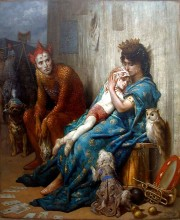








 The woman who is willing to make that change must become pregnant with herself, at last. She must bear herself, her third self, her old age, with travail and alone. Not many will help her with that birth.