Silicon Valley entrepreneurs are obsessed with prolonging life – but they could be deluded in what they wish for.
BY ADRIAN MOORE
GETTY IMAGES Brain power
There are some people who find the prospect of death so abhorrent they arrange for their corpses to be frozen, in the hope that one day they can be resurrected. Others, such as the director of engineering at Google, Ray Kurzweil, think they might achieve immortality by having their consciousness uploaded to a computer. Some have invested vast sums in the research needed to develop such technologies. These people may or may not be deluded about the scientific prospects of immortality. But are they perhaps deluded in other ways? Are they deluded in what they wish for?
If there were an elixir of life, would you choose to take it? Let’s assume immortality is an attractive prospect. If you wanted to live perpetually as a healthy twenty-year old, for example, then you could; if you wanted your loved ones to be immortal as well, then they would be; or if you preferred to have a never-ending supply of new loved ones, then you could have. But there’s one catch. The elixir isn’t reversible, and suicide isn’t an option. If you choose to take the elixir, there will be no going back. Now would you choose to take it?
The British philosopher Bernard Williams addressed this issue in his article, “The Makropulos Case”, whose title was taken from a play by Karel Čapek. The play is about a woman named Elina Makropulos, who is the beneficiary of an elixir of life. She finds, after some three hundred and fifty years, that “her unending life… has come to a state of indifference, boredom, and coldness.” For Makropulos, though, death remains a possibility if she doesn’t take the elixir again. The play ends with Makropulos welcoming her own death.
The subtitle of Williams’ article is “Reflections on the Tedium of Immortality”. For Williams, Makropulos’ case illustrates a general truth about life, and what gives it meaning and value. Without death, he argues, life would eventually become tedious – and unbearable.
Williams’ contention is that for any life to count as the life of one person, there are limits to how much change it can undergo; too much change and it eventually becomes the life of another person. On the other hand, for a life to be worth living and sustain interest for the person living it, there are limits to how little change it can undergo: too little and it eventually becomes unbearable. According to Williams, this balance can’t ever be struck. No life can have enough constancy to count as one person’s while at the same time having enough variety to count as worth living.
But many people disagree with Williams. One of these is the American philosopher Thomas Nagel. He writes that, given the choice between living for another week and dying in five minutes, he would always choose to live for another week, so long as there were no even worse catastrophes that his death could avert, such as endless suffering. Nagel treats this as tantamount to saying that he would be glad to live forever.
Williams thinks Nagel’s life would eventually become wretched – to the point that his death would be a blessed relief. This divide between philosophers who find immortality abhorrent and philosophers for whom death is abhorrent may be as much a temperamental divide as an intellectual one. In fact, Nagel himself asks, “Can it be that [Williams] is more easily bored than I?” Perhaps it can – but Nagel is offering an argument rather than a declaration of his own preferences, so we can still challenge him.
Suppose that given a choice between living for another week and dying in five minutes, I would always choose to live for another week. My weekly choices would keep me alive forever. But this isn’t tantamount to saying that I would be glad to live forever. I might have a clear preference not to live forever. In fact, I might be appalled at the prospect of living forever – perhaps because I see my inevitable death as a source of urgency and meaning in life. Yet I still might never want these to be my last five minutes.
This last point shows that there is no conflict between thinking mortality is preferable to immortality, and thinking that death is—as Nagel puts it—“a great curse”. In other words, there is no conflict between the idea that mortality is a precondition of life having value and meaning, and the idea that whatever value and meaning life has is bound to be destroyed by death.
But although there is no conflict between thinking these things, there may be an emotional conflict between living in the light of each of these thoughts. After all, if life without death has no value and meaning, and if life with death has a value and meaning that death itself eventually takes away, then this signals one of the greatest tragedies of human existence. And it is a tragedy that no amount of technological innovation will enable us to escape.
This article is part of the Agora series, a collaboration between the New Statesman and Aaron James Wendland, Professor of Philosophy at the Higher School of Economics. He tweets @ajwendland.
Courage is the measure of our heartfelt participation with life, with another, with a community, a work; a future. To be courageous is not necessarily to go anywhere or do anything except to make conscious those things we already feel deeply and then to live through the unending vulnerabilities of those consequences. To be courageous is to seat our feelings deeply in the body and in the world: to live up to and into the necessities of relationships that often already exist, with things we find we already care deeply about: with a person, a future, a possibility in society, or with an unknown that begs us on and always has begged us on.
With an eye to Albert Camus, that supreme shaman of courage who so staunchly believed that one must “live to the point of tears,” Whyte adds:
Courage is what love looks like when tested by the simple everyday necessities of being alive.
[…]
On the inside we come to know who and what and how we love and what we can do to deepen that love; only from the outside and only by looking back, does it look like courage.
Crisis is unavoidable. Every human life seems to be drawn eventually, as if by some unspoken parallel, some tidal flow or underground magnetic field, toward the raw, dynamic essentials of its existence, as if everything up to that point had been a preparation for a meeting, for a confrontation in an elemental form with our essential flaw, and with what an individual could until then, only receive stepped down, interpreted or diluted.
This experience … where the touchable rawness of life becomes part of the fabric of the everyday, and a robust luminous vulnerability, becomes shot through with the necessary, imminent and inevitable prospect of loss, has been described for centuries as the dark night of the soul: La noche oscura del alma. But perhaps, this dark night could be more accurately described as the meeting of two immense storm fronts, the squally vulnerable edge between what overwhelms human beings from the inside and what overpowers them from the outside.
[…]
Walking the pilgrim edge between the two, holding them together, is the hardest place to stay, to breathe of both and make a world of both and to be active in their exchange: aware of our need to be needed, our wish to be seen, our constant need for help and succor, but inhabiting a world of luminosity and intensity, subject to the wind and the weather, surrounded by the music of existence, able to be found by the living world and with a wild self-forgetful ability to respond to its call when needed; a rehearsal in fact for the act of dying, a place where inside and outside can reverse and flow with no fixed form.
Whyte’s Consolations remains one of the most beautiful and consolatory books I’ve ever encountered, the kind with which each repeated encounter is always new and always regenerative. (I recently had the honor of composing the introduction to the new English edition of this quiet, deeply resonant gem.) Complement this particular portion with Rebecca Solnit on resisting the defeatism of despair and Albert Camus on what it means to be a rebel.
The Gemini Full Moon spotlights duality, movement, and communication. Gemini is a flexible and dexterous sign; with the Moon here, we may be able to attend to several projects at once, without losing a beat. The Sun and Moon are nevertheless making a t-square to Neptune, which adds potential confusion into the mix, so we need to be wary of getting our wires crossed. There is also the possibility of going down a path, believing that it is uncharted territory or ours alone, only to discover that someone else has been working in parallel to us. This could relate to an interest where it seemed important to prove ourselves, but we realized that we must partly rely on others to get the end result we seek.
Neptune’s ability to soften hard boundaries could also allow creative forces to be channeled more freely. The combined creative and intuitive qualities of the Sun and Moon can be beneficially brought together, despite their polar positions at the Full Moon. We may need to be open to compromise with others, though, if we are to avoid squabbles or blowups. Square aspects often represent internal conflict, so it might help to gently self-talk ourselves through any difficult patches. It may also be helpful to borrow techniques from subtle, Neptune-themed spirituality and lifestyle models which link the mind and body, such as those in some of the Eastern traditions, particularly meditation and massage practices.
The Gemini Moon is governed by Mercury in Sagittarius, a placement which traditional astrology classifies as “ill-dignified” — another way of saying that the planet is a little lost there. Sagittarian thinking tends to be wide-ranging and visionary, encompassing the bigger picture. The Mercurial mind can be scattered by so many options at hand, and may prefer busy, immediate engagement to the lofty aims of rainbow-reaching expansiveness. Mercury trines Chiron in Aries, however, offering personal healing. The lesson here is to trust our own intuition and ideas. Even though someone may seem to have a finger on the pulse of something “big,” we should remember that it does not mean that their entire assessment is automatically, completely accurate.
A speculative deal can be inflated to seem promising, but the reality turns out to be far from the goal we seek. A key to success, therefore, is to stay connected with how the mind functions, particularly when we are faced with ideas and agendas that are distant from our own. For example, it might be easy for us to think that another view is “wrong” when it merely poses a “different” approach. Jupiter is almost as far out of its most favorable places as Mercury is, since Jupiter is said to be in its “fall” in Capricorn. Jupiter rises to the heights of exaltation in Cancer, but in Capricorn, it can fall to earth with a resounding thud. We can only hope that, should this occur, we witness no broken bones!
Any threatened tumble could be softened through redirection to a “safety net.” With Jupiter trine Uranus, this could manifest as a last-minute option or an unexpected development which somehow saves the day. But we can take advantage of this only if we spot the opportunity and run with it. Jupiter in Capricorn tends to feel restricted, whilst the trine to Uranus appears to offer breathing space. Musician Steve Winwood famously sang, “If you see a chance, take it!” In other words, do not hesitate to grasp an opportunity to breathe more easily within any situation that has come to feel too confining.
The Moon is also quincunx Venus, Saturn, and Pluto in their Capricorn stellium, suggesting the potential for missing something in our peripheral vision, perhaps because our sights are so closely set on a current target. Where this represents illness, it might have been a slow-burning development. Whilst we may not have spotted its arrival, we may nonetheless still be able to take positive action. Since Venus is involved, contact with and support from others may be invaluable
This article is from the Mountain Astrologer, written by Diana Collis.
TEDx Talks TEDxMiddlebury 2013 Polly Young-Eisendrath discusses the idea that we can control and manage our lives as counter to our happiness. After considering the true meaning of happiness, Polly highlights several uniquely human emotions—shame, guilt, envy, and jealousy—that pose as obstacles to this happiness and offers solutions to overcome these emotions.
Polly Young-Eisendrath is a speaker, writer, Jungian analyst and mindfulness teacher. She is a long-time practitioner of Zen Buddhism and Vipassana in the tradition of Shinzen Young (in which she is a certified teacher). She has published many chapters and articles on Buddhism, psychotherapy, spirituality, resilience and Jung’s psychology. She is also Clinical Associate Professor of Psychiatry at the University of Vermont and in independent clinical practice in central Vermont. Her 14 published books have been translated into more than 20 languages, including “The Self-Esteem Trap,” “The Resilient Spirit,” “Women and Desire,” and “The Cambridge Companion to Jung.” Polly is working on a spiritual memoir called “Love Broken Open.”
In the spirit of ideas worth spreading, TEDx is a program of local, self-organized events that bring people together to share a TED-like experience. At a TEDx event, TEDTalks video and live speakers combine to spark deep discussion and connection in a small group. These local, self-organized events are branded TEDx, where x = independently organized TED event. The TED Conference provides general guidance for the TEDx program, but individual TEDx events are self-organized.* (*Subject to certain rules and regulations)
TEDx Talks Dada Gunamuktananda: Yogi and Meditation Teacher Bio: Dada Gunamuktananda has trained in meditation, yoga and natural health sciences in Australia, the Philippines and India. He has been a meditation teacher of Ananda Marga since 1995 and has taught and lectured on meditation in New Zealand, Australia, Europe, the Middle East, and the Far East. www.anandamarga.org Title: Consciousness : The Final Frontier Synopsis: The exploration of inner space, our own consciousness, is ultimately connected to our discovery of outer space. Just as the world becomes a smaller place with increase in communication and transport technology, so the universe becomes a smaller place with the increase in meditation technology!
In the spirit of ideas worth spreading, TEDx is a program of local, self-organized events that bring people together to share a TED-like experience. At a TEDx event, TEDTalks video and live speakers combine to spark deep discussion and connection in a small group. These local, self-organized events are branded TEDx, where x = independently organized TED event. The TED Conference provides general guidance for the TEDx program, but individual TEDx events are self-organized.* (*Subject to certain rules and regulations)
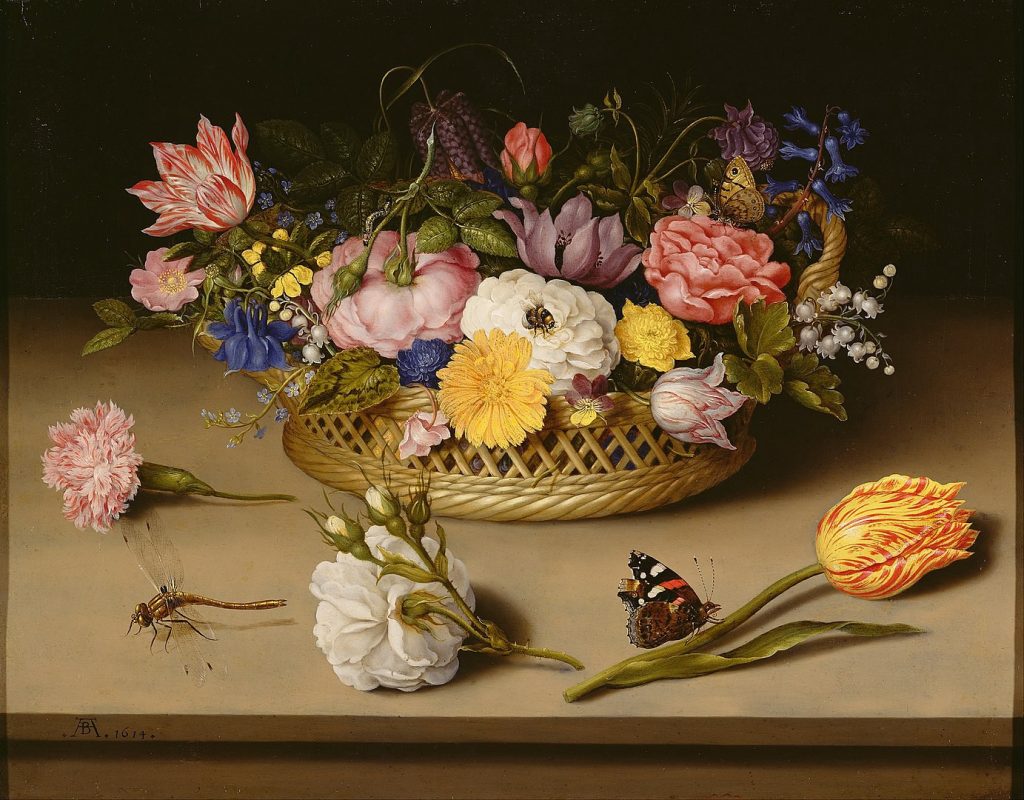
In the Protestant Dutch Republic, religious commissions for art were few and far between. Instead, artists were patronised by a wealthy middle class created by the economic miracle that followed independence from the Spanish Empire. Secular forms of visual art flourished, and the Dutch Golden Age is famous for its still lives composed of flowers, food and precious objects. Painting: Ambrosius Bosschaert the Elder Still Life of Flowers, 1614. (Public Domain, source: Wikipedia)
Imagine if somebody told you that everything is composed of the same one thing, that all the difference and the change you see in the world is ultimately an illusion. Not only is everything composed of one thing, but that one thing is God. God is in everything you can think of.
This is how Baruch (later Benedict de) Spinoza saw the universe. It’s an idea that’s strange for many, and shocking for some, especially those who think of God as a great bearded patriarch watching over us from Heaven. But it’s an idea that Spinoza thought was the only way to explain God.
Spinoza is one of the three great European “Rationalists” of the seventeenth century along with Gottfried Wilhelm Leibniz and René Descartes. Descartes was the first of the three. The older philosopher’s work had a revolutionary impact on European intellectual history. His influence on Spinoza was so profound that many simply saw Spinoza as a disciple of Descartes. Spinoza taught Cartesian philosophy, borrowed much of its terminology, and published a guide to Descartes’ ideas.
But Spinoza built on Descartes’ innovations to create his own all-encompassing philosophical system that constructs a picture of the reality around us and how we should live in it. The system was radically different from Descartes’ idea of reality but propounded in the same rational way.
Rationalism holds that many truths are self-evident and not dependent on the senses to be known to us. In effect, the human being can know many things independently of, or before, experience.
This is known in philosophy as “a priori” knowledge, meaning “from the earlier” (or “before”) in Latin. An example of an a priori truth would be that the angles on a triangle add up to 180 degrees since this truth is self-evident by the very definition of a triangle. You can understand that theoretically before experiencing a triangle as a real object.
But it was not just logic and geometry that the Rationalists were interested in. Spinoza was a deeply religious thinker. It could be said that his great philosophical project, completed late in life — The Ethics — was an attempt to understand the nature of God in order to find tranquillity.
For Spinoza freedom and happiness derived from understanding. He took the idea of rationalism as far as he could take it, arguing that sufficient knowledge of God is possible purely through reasoning. To understand God is to find a blissful state of mind.
The Ethics is composed of five parts. Each part is structured logically in a way that mimics Euclid’s Elements, the ancient handbook of geometry. They begin with definitions of terms, then axioms (self-evident truths) then Spinoza moves on to theorems. It is in The Ethics that we find Spinoza’s comprehensive explanation for God, existence and living a virtuous life.
The deliberate parallel drawn between his own thesis on reality and God and Euclid’s Elements was to show that understanding our world and our place in it was a matter of reason, not knowledge. Spinoza believed that God could be understood through reason in the same self-evident way the angles of a triangle add up to 180 degrees.
The definitions, axioms and theorems are building blocks that demonstrate truths. In keeping with his rationalist ethos, these truths are necessarily true, according to Spinoza, by virtue of reason, not observation.
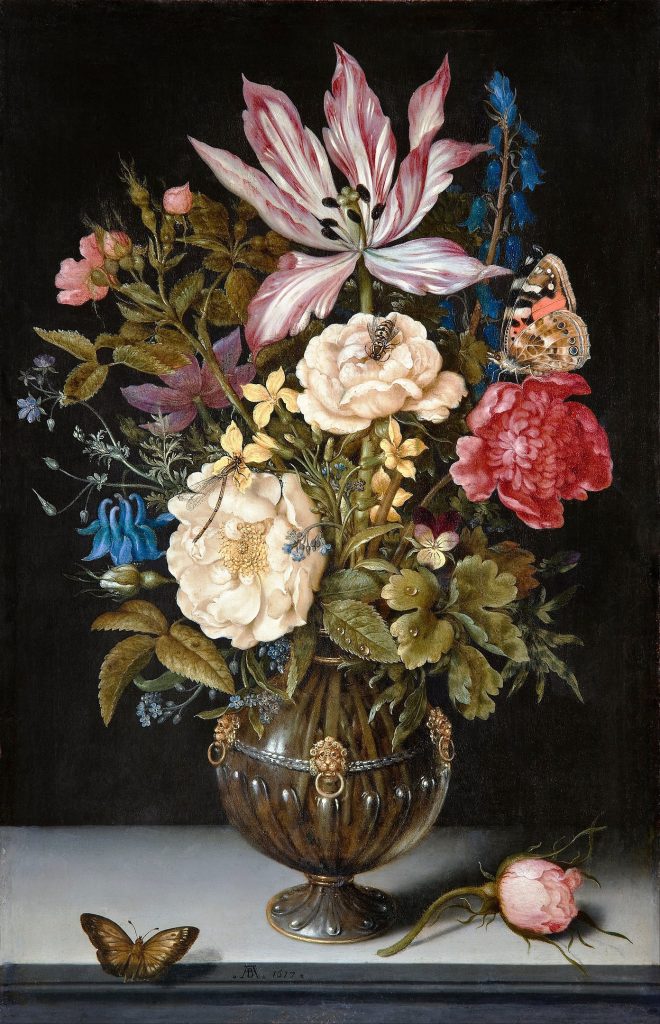
While these paintings seem purely decorative, their subject matter is often loaded with symbolism. The Republic’s immense power as a centre of trade is reflected in the exotic specicies of flowers, shells and foodstuff. These assortments imply a vast world with an enormous variety of species and cultures. Paintings: Ambrosius Bosschaert the Elder, Still-Life with Flowers, 1617 and Willem van Aelst, Still-Life With a Watch, 1665 (both public domain, source: Wikipedia)
A Golden Age
It is ironic that Spinoza pitched his philosophy as self-evident and independent of human affairs since his philosophy could be seen by historians as a product of its time. Spinoza’s ideas were incubated and saw the light of day thanks, to a large extent, to his residence in the seventeenth-century Dutch Republic.
Formerly part of the Spanish Empire, the Republic had won liberation in 1581 after a long struggle for self-determination. The Dutch Republic became immensely wealthy, powerful and — bucking the trend of post-Reformation Europe — very liberal. The “Dutch Golden Age” followed in the seventeenth century as the arts and sciences flourished in its rich cosmopolitan cities.
Spinoza was part of a Jewish community that found sanctuary in the Dutch Republic having fled from the Spanish and Portuguese Inquisitions. These Jews were known by the derogatory word “Marranos” in Iberia.
The jewish ancestors of Spinoza had flourished under the tolerant Islamic rule of the Iberian peninsula (Al-Andalus) but were forced to convert to Christianity when the Spanish regained control. As the religious atmosphere in Iberia became more oppressive, many of the Marranos escaped to the Dutch Republic where they could once again practice their ancestral faith in peace.
But peace, especially for Jews, was fragile. The small but significant community of Amsterdam were tolerated but not necessarily welcomed by the more traditionalist protestants that followed the Orangist Party (named after the aristocratic House of Orange) and opposed the more liberal Republicans that held political control over the small commonwealth of states.
Those militant Protestant Royalists sought to impose religious restrictions that would stifle the science and culture that was flourishing in the liberal polity. So controversial were Spinoza’s ideas that The Ethics was published and circulated after his death in secret.
Spinoza’s explorations of the divine stirred a controversy that dogged him his entire adult life, even in the liberal Dutch Republic. As a young man, the philosopher landed himself in trouble with his own religious community for questioning the authorship of the Torah.
The philosopher was excommunicated from his Jewish community, hounded by conservative Christians and it is written in one biography that he survived an assassination attempt at the steps of a synagogue. This is all because Spinoza’s findings recognised a different idea of God to that received in tradition.
The Rabbis, perhaps fearful of their fragile position in a Christian country, publicly cursed Spinoza – a very harsh action to take – for his outspoken unorthodox religious views.
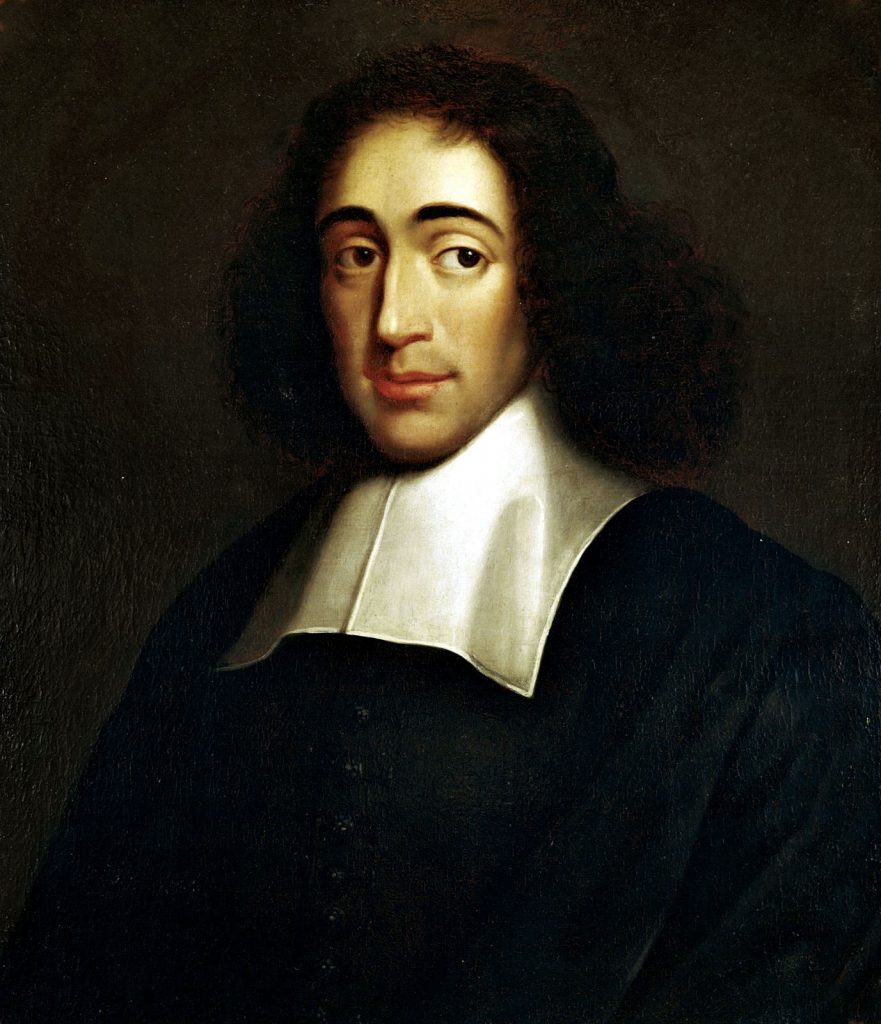
Benedict de Spinoza by unkown artist (Public Domain, source: Wikipedia)
Immanence
In developing his ideas, Spinoza tackled the paradox of God’s limits. If God were infinite and perfect, how could He stand apart from creation? For Spinoza, the God of the Torah is a God with limits, as far as he was concerned an imperfect God. In his own search for God Spinoza rediscovered the ancient idea that has revolutionised modern philosophy: immanence.
Immanence is the idea that the divine is manifested in the material world. That really does mean everything: clouds, insects, plants, people and the ground beneath our feet. Some ancient European and Asian creeds and philosophies are also based on immanence. The Stoic system, for example, held that a divine logos was in all the world. But the idea of divine immanence faded away as Christendom rose in Europe.
The Judeo-Christian understanding of God is as a transcendent being. By a “transcendent” God it is meant that God is separate, above and outside of the universe and creation. Judeo-Christian texts clearly state that God made the decision to create the universe from nothing, God is the first cause of all causes in the universe.
The word “transcendent” when used in philosophy usually means “beyond our understanding”, and God is often held up as the ultimate example of what is beyond our understanding.
Throughout the middle ages, many philosophers sought to prove the existence of God. One of those proofs is known as the “Ontological Argument” (the word “ontological” derives from the Greek “ontos” (real) and “logia” (study) and pertains to the study of what is real and what is not real).
In a very basic form, the Argument works like this: a perfect being must exist, if it doesn’t then it is not perfect. God is perfect and therefore must exist.
But Spinoza pushed the ontological argument further, beyond proving the existence of God to actually reflect on God’s nature. Spinoza wondered, if God were infinitely wise, why would He make a decision? If God was infinite, how could He not be in everything? Surely, if God is not in the world, then God has limits. Spinoza reasoned that if God is perfect, God must not have limits. If God is limitless, God must be immanent.
It was not a new idea at the time Spinoza was writing, but had been neglected for centuries and was considered blasphemous to Christians and Jews. Spinoza began to assert that God was immanent at great personal risk.
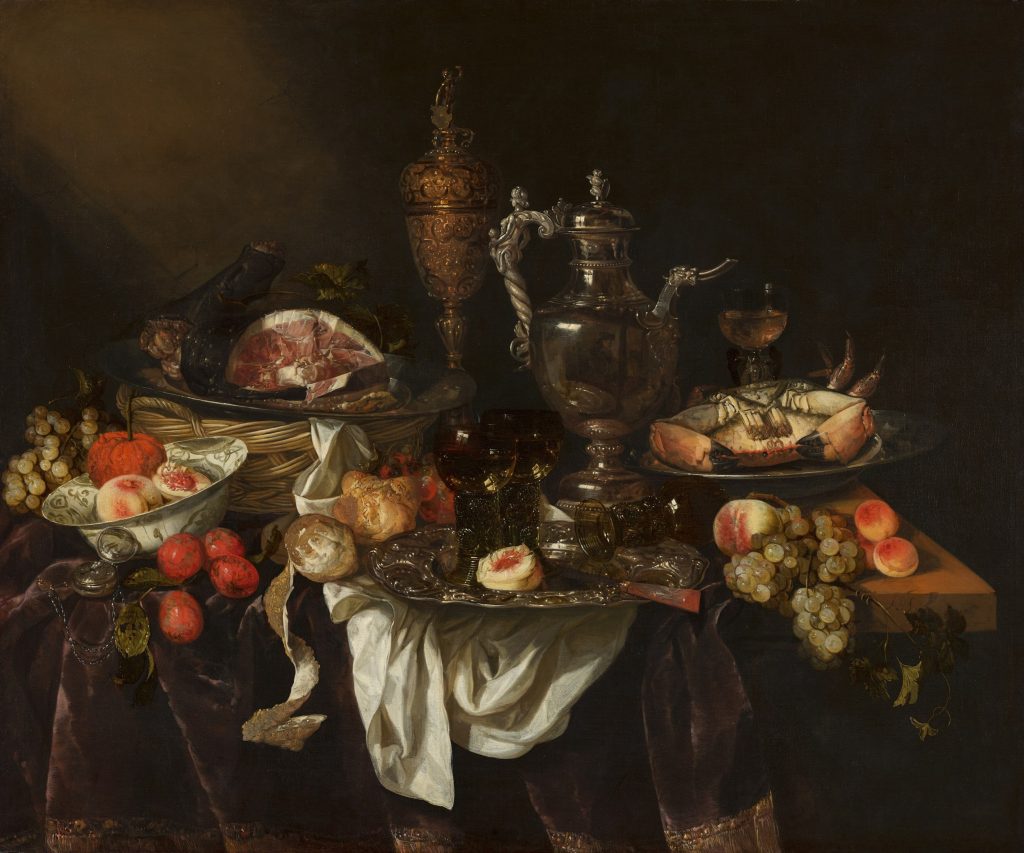
The world on a table. Painting: Abraham van Beijeren, Ostentatious, Still Life, 1655 (public domain, source: Wikipedia)
Substance
When a child is told that God created the universe the first thing they tend to ask is “but who created God?” The problem of “an uncaused cause” is not solved without eternity. God must be eternal and therefore self-caused.
Spinoza wrote:
“God, or a substance consisting of infinite attributes each of which expresses eternal and infinite essence, necessarily exists. If God didn’t exist, then God’s essence wouldnot involve existence; and that is absurd. Therefore God necessarily exists.”
This statement is the junction station of Spinoza’s immanence. According to Spinoza, for God to be self-caused necessarily means that God must be infinite and eternal. To be infinite and eternal, God cannot be transcendent, God must be immanent. Spinoza defined God and substance as the same thing.
Spinoza developed the idea of “substance” from Descartes, who in turn inherited the term from Aristotle. The word “substance” derives from the latin substantia which pertains to that which stands under things.
Substance is that which can endure change. The example that Descartes gave was of wax. Wax held to a fire can change shape, texture, size, colour and smell, it will even disintegrate to liquid when placed beside the fire, but it is ultimately the same thing despite these changes.
The wax did not become something else when it liquified because of the heat, it remained constant in a limited number of ways: extension, movability and changeability.
Many philosophers conjectured on what is beneath the appearance of real things, and none placed as much importance on substance as Spinoza. For Spinoza, substance can endure through every change and therefore cannot be created nor destroyed.
Spinoza defines substance as follows: “what is in itself and is conceived through itself, i.e. that whose concept doesn’t have to be formed out of the concept of something else.”
With a similar definition, Descartes developed the notion of two substances: extension (i.e. tangible things that can be felt) and thought (i.e. the intangible world of mind). For Descartes, (the transcendent) God had created two separate orders of being, but the philosopher struggled to account for how the two domains are related.
Descartes could give no account for what unifies our body and mind. In philosophy, this is known as the “mind-body problem”: two linked but seemingly incompatible views of both reality and personhood.
Spinoza believed that he had solved the problem that Descartes couldn’t. He was more radical in his interpretation of substance, in that substance had to necessarily exist beyond difference entirely. For Spinoza, everything could be abstracted to the point that you could no longer abstract, you would reach a bedrock of being, a fundamental “one” that constitutes all things.
Attributes
To account for thought and extension or mind and body, Spinoza posited the idea of “attributes”. Attributes are different ways in which the one substance is conceived of (how substance is experienced). Spinoza believed that there is an infinity of attributes of substance, but only two are available to human comprehension: thought and extension.
Firstly, all thoughts have a corresponding extension and vice versa. For Spinoza, our mind and our body are aspects of the same thing.
Consider a piece of music. A physicist could describe the sound waves at different frequencies emanating from the vibrations of musical instruments. A critic could describe the beautiful notes of a melody. The piece of music could be described in physical and mental terms but the music would be the same thing.
Both are descriptions of the same thing but are nevertheless incompatible. If we mixed up these descriptions into one, it would be senseless. This is because there are no causal relations between thought and extension or mind and body. What can be described in thought can be described analogously as a physical phenomenon.
Spinoza believed the mind and the brain to be two separate things that were nevertheless analogous. Do thoughts in the mind cause physical changes in the brain, or do physical changes in the brain cause thoughts in the mind?
Spinoza’s answer to that question is “neither”. These attributes are the same thing yet can only be described separately like the melody and the series of vibrations are the same thing.
The attributes are unified in the one substance, our understanding of thought and things are just aspects of this oneness of being. This defines Spinoza as a “monist”, that is a philosopher who believes there is a unified and independent oneness behind the difference we perceive.
That oneness, according to Spinoza, is what he referred to as “God or Nature”. Since God is in everything, and Nature is everything, Spinoza conflated the two. Spinoza wrote:
“Whether we say […] that all things happen according to the laws of nature, or are ordered by the decree and direction of God, we say the same thing.”
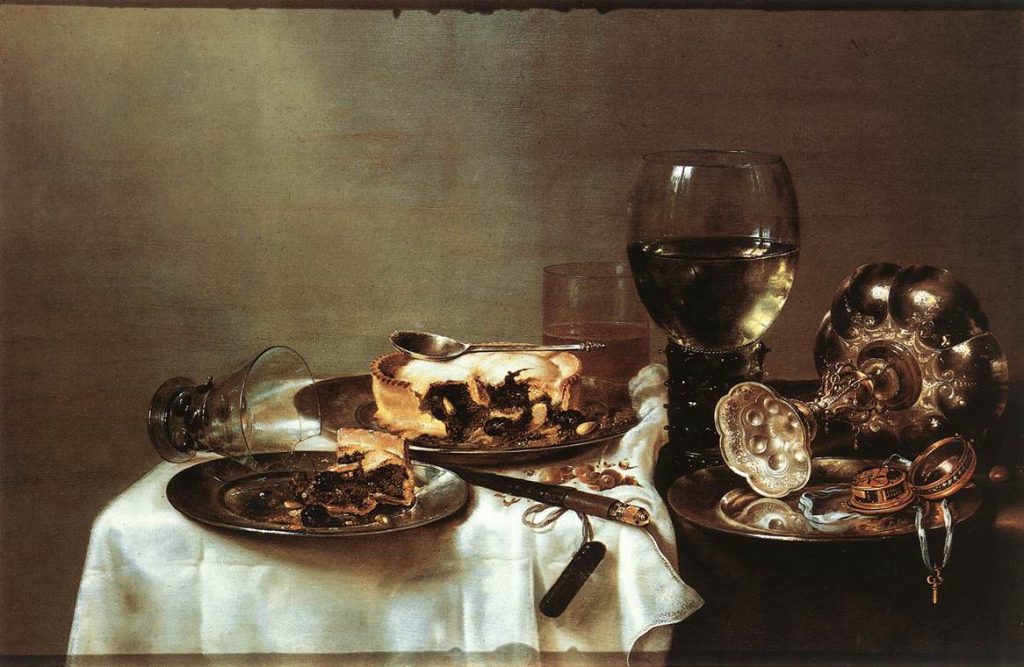
Heda Willem Claeszoon, Breakfast Table with Blackberry Pie, 1631 (Public Domain, source: Wikipedia)
Determinism
The implications of this conclusion are enormous. For one thing, it would mean that we have no control over our destiny. According to Spinoza’s system, everything is determined because God is perfect.
If God is everything and God is perfect, then nothing could be otherwise, it must necessarily be the way it is. God has no plans or purpose for the world. If He did, he wouldn’t be perfect because reasons are caused and God is not caused at any moment because God is perfect. The natural order is the unfolding of God’s nature in accordance with the eternal laws which constitute God.
Spinoza compared the changing nature of the universe to a face. The face can take on an infinite amount of expressions yet be the same face all the time. Everything that happens in the universe, including our lives, according to Spinoza, are expressions of the one substance: God or Nature.
Spinoza’s determinism undermines the traditional ethics of Christianity which holds that human beings have free will. If we did not have free will, we would not be rewarded or punished in the afterlife as described in the scriptures of Christianity. Spinoza rejects this idea, believing instead that we have no control over our fate.
Our “freedom” lies not in the self-determination of our physical body to seek our own destiny, but our understanding of the way the universe really is. To understand the workings of nature is to find peace with it.
Was Spinoza an Atheist?
The philosopher’s God is so radically different from the Abrahamic God that it’s difficult to recognise anything divine in its being at all. In Spinoza’s view of the universe, there is no transcendence — no other realm occupied by God, no moral certainty, no free will and certainly no afterlife.
Spinoza does not seem to be convinced by his own argument, why use the words “God or Nature” after all? If God is generalised to the point of being everything, what’s the point in “God”? God is evacuated of content if God is everything. Spinoza denied being an atheist, but he was often accused of being so.
Rather than revealing God to us, is Spinoza simply recasting the deity as “Nature”? If we were to subtract “God” from Spinoza’s “God or Nature” and leave only “Nature”, where would perfection come into it? God is perfect by definition, but nature isn’t.
“God or Nature” in effect describes God through the two attributes that human beings can access: extension and thought. Adding the word “Nature” to God was his way of illustrating that God was in absolutely everything physically and mentally. What is certain is that God, according to Spinoza, is not exhaustive.
God is eternal and limitless. Therefore, the universe may be an infinitesimally small part of God, which has an infinite number of attributes, not just the two human beings can comprehend. At best, Spinoza can be described as a pantheist holding the view that the world is in God, but God is not limited to the world.
Whatever we think of Spinoza’s ideas, they are certainly built on a logical clarity and with a scope that few philosophers have achieved. Even if Spinoza was wrong about substance and God, his theories on ethics and freedom are principles that people could live by.
Contemporary Influence
Spinoza’s immanence has had an enormous influence on many scientists and philosophers, from Gottfried Leibniz in the seventeenth century to Albert Einstein in the twentieth. But the philosopher’s ideas fell out of favour soon after his death. Many philosophers after Spinoza, like Immanuel Kant and Georg Hegel, believed that Spinoza was too theoretical in his approach. Transcendence came back in the secular guise of “the ideal” or consciousness.
According to these later “Idealist” philosophers, we comprehend the world through a transcendental synthesis of mind and world (thought and reality) to which we do not have any access to fully understand.
Most recently Spinozan ideas have been reappraised by the French philosopher Gilles Deleuze. For Deleuze, transcendence has always been a tempting compromise for philosophers, an easy way to bypass a total ontological explanation of the universe. Deleuze’s project made immanence secular by supplanting Spinoza’s “God or Nature” with his own idea of “Being”.
The French philosopher believed that all transcendental theories — from a religious transcendent God, to a secular transcendent idealism — were dogmas. Spinoza’s equal and parallel emphasis on extension and thought — the body and the mind — provides an explanation of everything without recourse to anything that is unexplainable or beyond experience.
Spinoza’s theory of being was “univocal”, or singular. The singular substance through which everything is only a modulation and perceived through attributes is all that there is, it is experienced and graspable to us.
For Deleuze, this is revolutionary, since with Spinoza’s way of thinking about the world we no longer need to recourse to anything that is unknowable.
The implications for ethics, society and politics is enormous. Even if we discount or discredit Spinoza’s philosophical system, his way of thinking has opened up a new frontier in philosophical thought.
Thank you for reading. I hope you learned something new.
There’s a simple fact that I don’t think Americans are reckoning with. That Americans are maybe even capable of reckoning with. It’s this. They’re living in what’s becoming a fascist society. And that fact raises the simple question: how do you live in a fascist society?
Yes, really. There’s little doubt that America’s becoming a fascist society by now. It’s developing all the institutions, norms, and values of one. Concentration camps? Check. Kids tortured in them? Check. Gestapos checking papers and detaining citizens? Check, check. Demagogue as head of state? Check. Dehumanization and demonization? Check. Expropriation and the denial of personhood? A supine, appeasing opposition? Check, check, check.
America has all the budding institutions, norms, and values of a fascist society now, and they grow in power, size, and strength by the day. That’s a fact — not an opinion. The UN recently noted, for example, that America has the largest number of kids in the world in concentration camps. The last living Nuremberg Prosecutor has called that a crime against humanity. None of that is ever reported on the nightly news, and it’s not part of impeachment — both are forms of appeasement. The average American simply shrugs and looks away politely — that’s normalization. I could go on endlessly with eerie, shocking, disturbing parallels to history’s darkest moments. But if you don’t get it by now — you’ll never get it.
That’s the first way to live in a fascist society. In denial. That’s where the good Americans are, mostly. It’s much, much easier to deny such a terrible truth than it is to face it. Than to allow the shame and guilt and anxiety it would involve. Who’s in that kind of denial? Who isn’t? There are the usual suspects — the junior members of America’s patriarchy: Chris Hayes and Ezra Klein and Nate Silver and so forth. They’re good guys. They’re good guys who can’t say the word fascism. They’re good guys who’ve failed the test of the moment. How many Americans are like them? The vast majority, it seems to me.
Denial, as easy as it is to understand psychologically, is still a kind of cowardice. And that is where the good American is. “My God!”, he or she cries, day after day, “What even is this? Why are they doing?” — the same old rhetorical question. Yet the answers couldn’t be more obvious. This is fascism, and they are fascists. They are bona fide fascists, from the advisors who dreamed up policies of “family separation”, to the minions who enforce them. What else is history going to call them? What else do you think the world calls them? The good American is displaying in a kind of profound cowardice — what Arendt called the banality of evil, shrugging it away — and that’s the first way to live in a fascist society. To never the say the words you’re not supposed to say — so they don’t come after you, too. To LOL at it. To make it a joke. To quip about it on Twitter. Yet Arendt’s banality rules that way. Wait — isn’t that the good American, almost exactly?
But cowardice verges on complicity. And that’s the second way to live in a fascist society: to be complicit, either through silence, or appeasement . I make fun of Morning Joe — that useful dope — on Twitter a lot. The reason is that he supported Trump all election long. And he hasn’t really owned up to the moral horror of it. That, my friends, is complicity. Complicity doesn’t just mean that around the dinner table you say: “My God! They’re fascists, aren’t they!” — and then in public, you go on in the polite social pretense that all is well. Complicity is exactly failing the test of using what power one has to fight fascism.
We all have different levels of power. I can write. I have “an audience”, as they say. So I do. Morning Joe has a bigger audience. Ezra Klein and Chris Hayes and whatnot do, too. But they fail the test of using their power not just responsibly — but in the way that it’s necessary to use it. To first point out that this is fascism, and then to remind people how dangerous and repugnant it really is. Cowardice verges on complicity. The junior pundits of America’s intellectual class are cowards — who remain silent. The senior members, though, I think are all too often genuinely complicit. They enabled these horrors — and still do. Take impeachment, for example. Why isn’t the Prez being impeached for…crimes against humanity? Because the Democrats are appeasing fascism. That’s not my opinion — at this point, it’s more or less an objective fact, that the world is aghast at.
Complicity’s a nice way to live, though. When you’re complicit in a fascist society, you don’t lose what power you have. So complicity is a kind of strategy to keep your power, by toeing the line. Hence, Morning Joe still has his dopey show, and so do the rest of the MSNBC gang. They’ve got their million dollar salaries and their adoring fans and whatnot. And yet…
Why is it that all the 20th century’s great thinkers were vehement anti-fascists? Have you ever wondered? From Einstein to Orwell to Camus to Sartre. Every single one knew fascism was the most repugnant attitude, thought, action, idea, in modern history. That is because they understood that for a human being to dehumanize another is the truest moral crime of all. Once that happens — then anything is possible. Our thinkers are not great thinkers. They are not even thinkers at all, really. What they are, mostly — if we are frank — is cowards and appeasers, who have chosen the comfort of complicity over the discomfort of telling or knowing life and history’s difficult truths.
That brings me to the third way to live in a fascist society: enthusiastically. Relatively speaking, though, the Morning Joes and Ezra Kleins and Nancy Pelosis aren’t the bad guys. They’re just cowards who can’t stand up to bullies. There’s worse. The Megyn Kellys and the Bill O’Reillys and so on. The Faux News gang, the Trumpists who are their zombie fascist army, and so on. Their strategy isn’t just complicity. It’s participation.
I think that many Americans are effectively fascists — only they don’t know it. Oh no! Am I allowed to say that? LOL. Imagine a person who thinks all the following things aren’t just grudgingly OK — but good and proper and just and noble:
Concentration camps
Kids in cages in them
Gestapos separating them from their parents
States who make it all happen
Demagogues who dream these horrors up
If that’s not the precise definition of a fascist…then what is? Surely a person doesn’t need to be a member of the Nazi Party to be a genuine and enthusiastic fascist. One just needs to endorse the idea that some people are humans, and others are subhumans, and the role of the state is to eliminate the subhumans, and elevate the humans. Yet surely being a member of the Republican Party these days is something very, very close to the razor’s edge of being a member of the Nazi Party. Why do I say that?
America isn’t at the stage of full-blown fascism yet. It’s more like Nazi Germany in the early to mid 1930s. The time when the infrastructure for true horror was built. When the new laws were passed. When the Gestapos and SS’s were populated with eager young things. When the government was reshaped. When the Jews were terrorized. When the good German began to learn how to look the other way.
Do you see the parallel? In the early to mid 1930s, Weimar Germany became Nazi Germany proper. The institutions of a truly fascist society were built. Social institutions, like teaching the good German never to cross the Nazis, obedience, punishment, conformity, surveillance. Government institutions — like the law becoming a weapon. Economic institutions — like good and fine jobs for party members. Military institutions — all those new paramilitaries with strange and now all too familiar names, like Gestapo. And soon.
That is exactly the stage America is at now: the stage where fascists institutions are built, solidified, invested in, made real. Hence, a network of concentration camps that grows by the day. Hence, increasing surveillance. Hence, hate becoming normalized, and the state increasingly becoming an arbiter of violence, not justice.
That brings me to the fourth way to live in a fascist society. You don’t. You go into exile. Either of the body, or the mind. You resist — genuinely. Of the body: you leave. Of the mind: you resist with your moral core, with your ideas, with your social power, with your network, what resources and means you have. Maybe you see all the above coming. Where it’s going. What it points to. And you decide this can’t happen — and you write, act, speak, organize, whatever. Or you get the hell out before it’s too late. I know many people who are making that choice. Many of them are women and minorities.
I myself made that choice — both ways — long ago. I went into a kind of self-imposed exile in Europe, knowing with a kind of utter certainty that a fascist collapse was coming in America. That was simply by reading the economic tea leaves — middle class implosion, next stop, fascism. And I began to write about it, which cost me my career in America — I was never published in America again, the precise second I crossed that line.
In those days, there was a poem by Brecht — that great chronicler of Germany’s fascist implosion — that haunted me, especially. It was about the grief he felt, and the anger he felt at himself for feeling even that grief, because he’d gone into exile, and it had made him feel lost and alienated from his own country, people, history, society. I’d read it, over and over again, crying. I was baffled at myself. I didn’t know why this little poem seemed to see straight into my heartbreak, when no one and nothing else could.
Now I do. I was a lost and lonely boy becoming a man in exile. In exile from fascism. Just like Brecht. He was telling me about my future. About what it feels like to be the kind of person who can’t live in a fascist society. Who must refuse. And turn his back on it. Even if doing so means not being a part of your society at all, ever again. I was haunted by a memory of what was to come to pass.
I knew what was coming then. I’d see it every night, sometimes. Concentration camps and kids and mothers torn apart spinning through my head. That was a decade ago. Would you like to know what spins through my head now? Don’t ask, my friend, don’t ask.
I know what’s coming next, too. You do, too. Or at least I do if nothing much changes. Not because I’m a genius. But because it’s obvious. America is Nazi Germany in the early to mid 1930s right now. In eerie, precise, exacting ways. No, the death camps haven’t been built. But the concentration camps have. But the Gestapos are. But the papers are being checked. But the intellectuals pretend none of that’s happening. But the opposition appeases it and lets it happen. But the good American is learning to look the other way.
America is becoming a fascist society. So how do you live in one? Ah, my friend. In denial. In cowardice. In complicity. With cheerful enthusiasm. Or you don’t, because you can’t live with yourself that way at all. You resist, in exile. Whether the exile of the body, or the mind, or both — but it will cost you everything.
Those are your choices. There are no others.
I say that gently, with love. Not to condemn you. But to help you make the difficult decisions that lie ahead, for each and every one of us, in this lost and wounded nation that once used to be an idea called America.
As jobs are automated out of existence, the division between the very wealthy and the very poor will grow — and any notion of a comfortable middle class will vanish.
That’s according to Roey Tzezana, a future studies researcher at Israel’s Tel Aviv University, according to Haaretz. That stands in contrast to the common argument that new jobs will emerge as others vanish, painting a grim picture for the workforce and global economy.
Survival Wages
Tzezana argues that the jobs that tend to survive automation are lower-paying, according to Haaretz, meaning that as companies generate increased wealth, almost none of it ends up in the pockets of workers. Instead, more people are stuck living paycheck to paycheck, even if unemployment rates are technically low.
“This figure is the end of the world for the average people,” Tzezana said, speaking about the growing gap between labor productivity and wages. “It reflects a rather depressing picture: The state and the economy are advancing by storm — but the workers are almost not benefitting from this progress and are left behind. It is almost a catastrophe.”
The end result? A society defined by pockets of extreme wealth but otherwise dominated by people who barely have enough to get by.
THE GENERAL NATURE OF THE OBJECTS OF THE CORPORATION ARE:
. . . The fostering and encouragement of a higher degree of spiritual enlightenment and understanding, the basis of true Spiritual Democracy as interpreted in terms of the self-evident Truth that Being is the equality of man; the cultivation of friendship and fellowship among its members; to safeguard the future welfare of the youth of America and the world; to build them up to a high plane, mentally, morally and spiritually; to foster, guard and protect them that they may grow and develop into upright cosmopolite citizens; to provide healthful recreation that they may develop perfect healthy bodies; to educate them in the better class of art and literature that their minds may only absorb that which is of the best, and to encourage them to study the latest scientific matter; to give them a moral and spiritual background in keeping with the Atomic Age so that they will be able to meet the world’s problems with poise and Intelligence and create a solution of affairs with peace, equity and justice; to so encourage and train them that they will exercise a spirit of liberty and tolerance toward all whom they may contact; to instill in them a reverence and knowledge of the Spiritual reality and resource of Democracy as envisioned by our forefathers and thus be prepared to oppose and be immune to any propaganda or agitation, either from within or without, which has as it object the destruction of Democracy as a way of life.
–Articles of Reincorporation dated February 14, 1975 of original Charter dated May 22, 1956