The Japanese Skill Copied by the World

Mindfulness has become trendy around the world in recent years – but in Japan, it’s been ingrained into the culture for centuries.

BBC Travel|

  • Steve John Powell (getpocket.com)
p051ycvp.jpg

Even moss is appreciated by the mindful Japanese. Credit: Andrew Whitehead/Alamy.

As the sleek shinkansen bullet train glided noiselessly into the station, I watched a strange ritual begin. During the brief stop, the conductor in the last carriage began talking to himself. He proceeded to perform a series of tasks, commenting aloud on each one and vigorously gesticulating at various bits of the train all the while.

So what was he up to? You could say he’s practicing mindfulness. The Japanese call it shisa kanko (literally ‘checking and calling’), an error-prevention drill that railway employees here have been using for more than 100 years. Conductors point at the things they need to check and then name them out loud as they do them, a dialogue with themselves to ensure nothing gets overlooked.

p051ycx5.jpg

Japanese train conductors practice shisa kanko, pointing at what they need to check and then naming it out loud. Credit: Trevor Mogg/Alamy.

And it seems to work. A 1994 study by Japan’s Railway Technical Research Institute, cited in The Japan Times, showed that when asked to perform a simple task workers typically make 2.38 mistakes per 100 actions. When using shisa kanko, this number reduced to just 0.38 – a massive 85 percent drop.

Mindfulness is moment-to-moment awareness.

This may seem a long way from mindfulness, which in recent years has become synonymous with what the Japanese call zazen – meditating cross-legged on a cushion. But according to Jon Kabat-Zinn, Professor of Medicine emeritus at the University of Massachusetts Medical School, where he founded its renowned Mindfulness-Based Stress Reduction Clinic in 1979, mindfulness is “not really about sitting in the full lotus… pretending you’re a statue in the British Museum. Simply put, mindfulness is moment-to-moment awareness.”

And this present-moment awareness has been deeply ingrained into the Japanese psyche for centuries. You don’t hear people talk about it, but it manifests itself in myriad ways.
p051ydl7.jpg

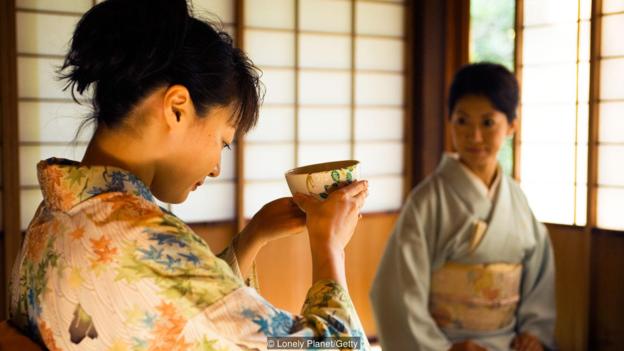
In tea ceremony, participants take time to notice the design of the cup. Credit: Lonely Planet/Getty.

Tea ceremony, haiku and cherry-blossom viewing, for instance, all share a heightened appreciation of the moment. In tea ceremony, participants take time to notice the design of the cup before drinking and appreciate the decoration of the tea room, which reflects the foliage and blooms of the month. But beyond that, the ceremony celebrates the fact that this moment with this person in this place will never happen again.

This moment with this person in this place will never happen again.

Haiku poetry, a Japanese literary tradition dating back to the 17th Century, elevated this celebration of the present moment to a world-renowned art form. Haiku poets attempt to capture the moment’s essence in just 17 syllables, using evocative images from nature to convey a Zen-like sense of sudden enlightenment. The most famous one is Matsuo Basho’s frog haiku, which translated from Japanese reads:

An old pond
a frog jumps
the sound of water

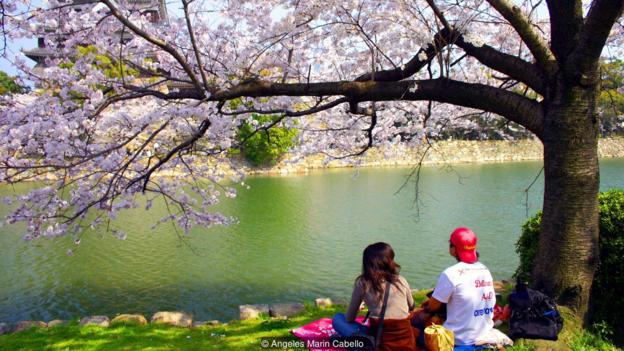
And nowhere is this celebration of the moment more evident than in cherry-blossom viewing, which sweeps the nation like a fever every spring. Why such excitement? Precisely because the blossoms are so fleeting, lasting only a week or so. “Transience forms the Japanese sense of beauty,” said Zen priest and garden designer Shunmyo Masuno.

Transience is celebrated in dozens of lesser-known practices too, such as moon viewing. You can’t help but admire a country that sets aside a special evening in September for contemplating the full moon. Or that holds lavish festivals to give thanks for the work done by inanimate objects, including everything from old kitchen knives to calligraphy brushes and even used sewing needles.

Transience forms the Japanese sense of beauty.

And there are the growing ranks of Moss Girls. Inspired in part by Hisako Fujii’s best-selling book, Mosses, My Dear Friends, moss-viewing has become increasingly trendy, especially with young women, who go on guided tours to Japan’s lush moss-carpeted forests. This goes way beyond just stopping to smell the roses: Moss Girls get down on hands and knees with a loupe to contemplate the lovely growths.
p051ycq9.jpg

Nowhere is this celebration of the moment more evident than in cherry-blossom viewing. Credit: Angeles Marin Cabello.

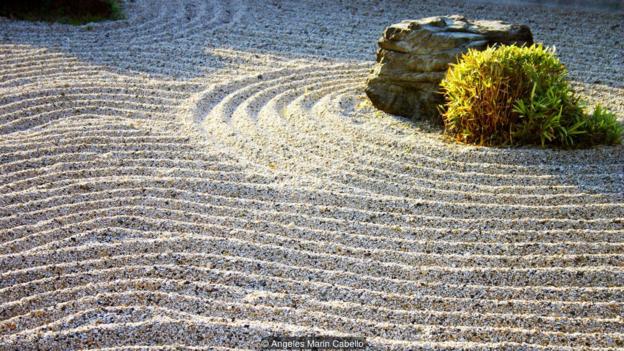
And while to the less mindful among us moss may seem insignificantly small, no Zen garden is complete without its moss-covered rock or stone lanterns. It’s the living embodiment of wabi-sabi – the spirit of humble, rustic impermanence that defines Japanese aesthetics.

But there’s more to Japanese mindfulness than gazing at bugs and blooms. Countless practical applications govern virtually every aspect of daily life, all designed to help you ‘be in the now’. At school, days begin and end with a short ceremony, where greetings are exchanged and the day’s events are announced. Before and after each class, students and teacher stand, bow and thank each other. And before starting the lesson, students are asked to close their eyes to focus their concentration.

Similarly, construction workers engage in collective stretches to limber up for the day’s work. In the office, a colleague will tell you ‘Otsukaresama‘, (literally ‘you’re tired’), as a way of saying thanks for the work you’ve done. At meetings, hand someone your meishi (business card) and they’ll examine it carefully and make a comment, never dreaming of just sticking it in their pocket.

These practices are a way of what Kabat-Zinn calls ‘purposefully paying attention to things we ordinarily never give a moment’s thought to’. They help keep you conscious of where you are and what you are doing throughout the day, rather than stumbling from one hour to the next on autopilot, focused only on going-home time.
p051ycpl.jpg

Zen gardens embody wabi-sabi, the spirit of humble, rustic impermanence. Credit: Angeles Marin Cabello.

Like so much of Japanese culture, the roots of all these customs lie in Zen. “Mindfulness has been part of the Buddhist tradition for centuries,” said Takafumi Kawakami, priest at Kyoto’s Shunko-in temple. In the Kamakura Era (1185-1333), Zen became popular among the samurai class and had a formative influence on the arts, including tea ceremony, flower-arranging and landscape gardening. In the Edo Era (1603-1868), a time of peace, Zen found its way into the education of common people.

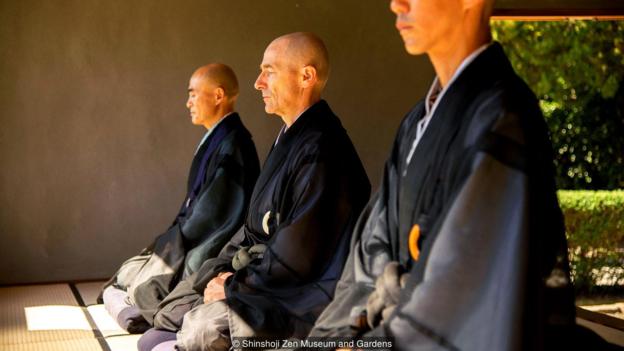
For its practitioners, Zen is an attitude that permeates every action: bathing, cooking, cleaning, working. “Every activity and behaviour in daily life is a practice [of Zen],” said Eriko Kuwagaki of Shinshoji Temple in Fukuyama, Hiroshima Prefecture.

A delightful old Zen story, collected in Paul Reps’ 1957 anthology of Zen texts, Zen Flesh, Zen Bones, illustrates this point. After studying to be a Zen teacher for many years, Teno went to visit Nan-in, an old Zen master. It was raining heavily and, as is customary, Teno left his clogs and umbrella in the entrance before entering Nan-in’s house.

Every activity and behaviour in daily life is a practice [of Zen].

After greeting each other, Nan-in asked Teno: “Did you leave your umbrella to the left or right of your clogs?” Unable to answer, Teno realised he was still a long way from attaining Zen, and went away to study for six more years.
p051ycrw.jpg

For its practitioners, Zen is an attitude that permeates every action. Credit: Shinshoji Zen Museum and Gardens.

Most of us might not want to take things quite so far. Nevertheless, Nan-in’s question remains relevant, as more and more researchers are discovering that present-moment awareness not only boosts stress resilience and well-being, but also lowers levels of anxiety and depression.

Leah Weiss, a senior teacher at Stanford University’s Compassion Cultivation Program, is one of a growing number of experts who advocate ‘mindfulness in action’. This is something to be practiced throughout the day, rather than just for 10 minutes’ meditation. Weiss described it as “becoming mindfully aware of your thoughts, feelings, and surroundings even while you’re engaged in some other activity.”

So how can we put a little more mindfulness into our lives? Start with something simple, like a bit of pointing and calling before you leave home in the morning. Lights off? Check. Windows closed? Check. Money? Check. Phone? Check. You’ll never forget your keys again.

Then maybe you’ll have time to stop and notice the moss.

Correction: A previous version of this article misidentified moss as lichen. We regret the error.

This article was originally published on May 9, 2017, by BBC Travel, and is republished here with permission.

Democracy is good!

Furious protesters call for Iran’s Supreme Leader to step down in wake of downed Ukrainian plane

Issued on: 1/12/2020 – France24.com

Iranian protesters and newspapers piled pressure on the country’s leadership and riot police stepped up their presence in Tehran on Sunday after Iran’s military admitted that it had mistakenly shot down a Ukrainian airliner.

Riot police fired teargas at thousands of Iranians who had taken to the streets late on Saturday in the capital and other cities, many chanting “Death to the dictator”, directing their anger at Iran’s top authority, Supreme Leader Ali Khamenei.

Images and reports of the protests were carried by state-affiliated news agencies, alongside videos on social media.

Tehran residents told Reuters that police had stepped up their presence in the capital on Sunday morning.

“Apologise and resign,” Iran’s moderate Etemad daily wrote in a banner headline on Sunday, saying the “people’s demand” was for those responsible for mishandling the plane crisis to quit.

All 176 people aboard the flight, many of them Iranians with dual citizenship, were killed.

Protests erupted after Saturday’s admission that the military accidentally shot down the Ukraine International Airlines plane minutes after take-off on Wednesday, when Iranian forces were alert for U.S. reprisals after tit-for-tat strikes.

For days, Iranian officials had vigorously denied it was to blame, even as Canada, which had 57 citizens on the flight, and the United States said their intelligence indicated an Iranian missile was to blame, albeit probably fired in error.

Iran’s president said it was a “disastrous mistake” and apologised. But a top Revolutionary Guards commander added to public anger about the delayed admission, when he said he had told the authorities a missile hit the plane the day it crashed.

Challenges

Another moderate daily Jomhuri-ye Eslami, or Islamic Republic, wrote in an editorial: “Those who delayed publishing the reason behind the plane crash and damaged people’s trust in the establishment should be dismissed or should resign.”

Criticism of the authorities in Iran is not unusual, but it tends to stay in narrow boundaries.

The press attacks and protests add to challenges facing the establishment, which in November faced the country’s bloodiest unrest since the 1979 Islamic revolution.

As Saturday’s protests spread across Iran, including major cities such as Shiraz, Isfahan, Hamedan and Orumiyeh, U.S. President Donald Trump said on Twitter: “We are following your protests closely, and are inspired by your courage.”

“There cannot be another massacre of peaceful protesters, nor an internet shutdown. The world is watching,” he said, posting his tweets in both Farsi and English.

Britain said its ambassador in Iran had been briefly detained on Saturday by the authorities in Tehran. A news agency said he was detained outside a university for inciting protests.

Britain’s Foreign Secretary Dominic Raab called it “a flagrant violation of international law.”

“The Iranian government is at a cross-roads moment. It can continue its march towards pariah status with all the political and economic isolation that entails, or take steps to de-escalate tensions and engage in a diplomatic path forwards,” he said.

Protests inside Iran followed a build-up of tension between Iran and the United States, which withdrew from Tehran’s nuclear pact with world powers in 2018 and then re-imposed sanctions that have steadily crippled the Iranian economy.

‘Horrific’

On Jan. 3, a U.S. drone strike in Iraq killed prominent Iranian commander Qassem Soleimani, responsible for building up Iran’s network of regional proxy armies in Iraq and beyond, and Tehran responded with missile strikes on U.S. targets in Iraq.

No U.S. soldiers were killed, but in the tense hours after that, the Ukrainian Boeing 737 was cleared to take off from Tehran airport and then brought down by a missile fired in error by an operator who mistook the plane for an attacker.

“Shooting down a civilian aircraft is horrific. Iran must take full responsibility,” Canadian Prime Minister Justin Trudeau said.

Trudeau said Iranian President Hassan Rouhani had committed to collaborating with Canadian investigators, working to de-escalate tensions in the region and continuing a dialogue.

Public fury at Iran’s authorities grew as questions about the plane crash mounted. Iranians on social media asked why officials were busy fending off criticism from abroad rather than sympathising with grieving families. Others asked why the plane was allowed to take off at a time of high tension.

Amirali Hajizadeh, a senior commander of the Revolutionary Guards, a parallel military set up to defend the nation and the system of theocratic rule, said he had asked for civilian planes to be grounded but his request was not heeded.

Soleimani’s death in a U.S. drone strike had drawn huge crowds of mourners on to the streets in Iran, which Iranian officials said showed public support for the leadership.

But Saturday’s protests and the public reaction to the downed airliner have shattered the image of national solidarity.  Demonstrators tore up pictures of the slain general.

(AFP)

Kahlil Gibran on Befriending Time

By Maria Popova (brainpickings.org)

kahlilgibran_theprophet.jpg?fit=320%2C462

I have been thinking about time lately, as I watch the seasons turn and wait for a seemingly endless season of the heart to set; I have been thinking about Ursula K. Le Guin’s lovely “Hymn to Time” and its kaleidoscopic view of time as stardust scattered in “the radiance of each bright galaxy” and the “eyes beholding radiance,” time as a portal that “makes room for going and coming home,” time as a womb in which “begins all ending”; I have been thinking about Seneca, who thousands of seasons ago insisted in his Stoic’s key to living with presence that “nothing is ours, except time.”

And yet there is something odd about this notion of time as property. We are asked to give things time; we speak of taking time — time off of something, time toward something. But how do we give or take this fine-grained sand that slips through the fingers the moment we try to cup it? Perhaps time is not so much the substance in the hand as the substance of the hand; perhaps Borges was right in his sublime refutation of time: “Time is a river which sweeps me along, but I am the river; it is a tiger which destroys me, but I am the tiger; it is a fire which consumes me, but I am the fire.”

How, then, do we befriend the thing that both destroys us and is us?

That is what poet, painter, and philosopher Kahlil Gibran (January 6, 1883–April 10, 1931) explores with great subtlety of sentiment in a passage from his timelessly rewarding 1923 classic The Prophet (public library), which also gave us his abiding wisdom on the building blocks of true friendshipthe courage to weather the uncertainties of love, and what may be the finest advice ever offered on parenting and on the balance of intimacy and independence in a healthy relationship.

kahlilgibran.jpg?resize=615%2C758

Kahlil Gibran, self-portrait

When an astronomer beckons Gibran’s protagonist to speak of time, the Prophet responds:

2e292385-dc1c-4cfe-b95e-845f6f98c2ec.png

You would measure time the measureless and the immeasurable.
You would adjust your conduct and even direct the course of your spirit according to hours and seasons.
Of time you would make a stream upon whose bank you would sit and watch its flowing.
Yet the timeless in you is aware of life’s timelessness,
And knows that yesterday is but today’s memory and tomorrow is today’s dream.
And that that which sings and contemplates in you is still dwelling within the bounds of that first moment which scattered the stars into space.

Velocity_LiaHalloran.jpg?resize=680%2C865

Art by Lia Halloran from A Velocity of Being: Letters to a Young Reader. Available as a print.

In a sentiment that calls to mind Patti Smith’s elegant meditation on time, transformation, and the seasons of the heart, he adds:

2e292385-dc1c-4cfe-b95e-845f6f98c2ec.png

And is not time even as love is, undivided and paceless?
But if in your thought you must measure time into seasons, let each season encircle all the other seasons,
And let today embrace the past with remembrance and the future with longing.

Complement with Gibran on silence, solitude, and the courage to know yourself, then time travel a century ahead with the fascinating contemporary neuropsychology of how time perception modulates our experience of self and a touching recording of Neil Gaiman reading Le Guin’s ode to timelessness to his 100-year-old cousin.

Facing the Pressure for Change

January 12, 2020 (hniizato.com)

Transit Saturn-Pluto Conjunction in Capricorn

As I write this, transiting Saturn and Pluto are conjoined overhead. This is a major astrological event, especially if you have planets or points near 22 degree of Cardinal signs (Capricorn, Aries, Cancer or Libra). You can probably feel the force of change building up momentum in your life.

Transiting Saturn: Breaking Down and Rebuilding.

The transit of Saturn is a time to test the integrity of your life structure: Anything that is weak, or not built on stable foundation, tends to get broken down, so you can rebuild.

A strong response to a Saturn transit would show you achieve a kind of mastery that comes from years of hard work. Outwardly this can manifest as an advancement in your field, while inwardly you might recognize a kind of maturity that you’ve grown into at this stage in life.

Saturn transit is also a time of passage. A time you go from one state of being to the next. Or a time to let go of one phase of your life, so you can open the door to the next one.

Like autumn leaves falling, you might experience the passing of a season of your life in a literal or figurative sense. A relationship might reach an end of life, if it is no longer serving either party. A career might come to an end, if you realize you’re no longer growing and thriving in it.

“Ending” and “loss” are serious words, but Saturn transits may bring these experiences to you as part of life. If this is your experience, then this might be a period to let yourself grieve, so the tears you shed now will reach down into your soul, and sprout new seeds of hope for the future at some point.

Saturn is stern, but his cycles are continuous. After an ending, there is always a new beginning. When the fruit of old harvest is gone, the time to sow a new seed will soon arrive.

Transiting Pluto: The Threat and the Sense of Being Alive

Transiting Pluto can bring you close to your reason for being. As Pluto has to do with the deep essense of the matter, whenever it touches a part of your psyche via a planetary aspect, an intense reaction can occur.

Some people feel threatened during a Pluto transit. Barring actual threats present in life, this could be an unconscious effort by your psyche to recover the sense of being alive. What is threatened is your sense of stability and perfect order – which can become a way of defending yourself against life.

It’s like stage fright: Your body feels threatened and in danger for something you’d like to do (i.e. perform or speak in front of people about things you’re passionate about). If you go past the stage fright and perform or speak, chances are you’ll feel more alive at that moment than ever before.

So if you have a big goal or ambition, maybe you’ll feel excited, but feel afraid of it at the same time. With Pluto transit, you might encounter this feeling of “I am meant to do this, but I’m scared.”

Transit of Saturn-Pluto Conjunction: Powerful Changes and New Beginnings

When the two heavyweights Saturn and Pluto conjoin to impact your natal planet or point, the pressure for change can be overwhelming.

Some of you may feel this as increased responsibility and workload, as you work to fulfill your life’s ambitions. Some of you might be experiencing literal endings in some area of your life.

More than ever, it’s important to focus on the essence, or essentials, of your life:

  • What is the purpose of your work and relationships? What type of life are you trying to build for yourself and those you care about? Are your goals aligned with what you want to create?

  • Are your actions consistent with the goals you’ve identified? What old things do you need to let go of, that are no longer serving you?

  • Are you thriving physically, mentally and emotionally? Or do you feel a sense of weakening in any area that needs to be attended to?

Transiting Jupiter in Capricorn: Reward Following the Change

Transiting Jupiter will pass through Capricorn later this year, going over the degrees affected by the Saturn-Pluto conjunction multiple times. If you do have planets in this degree area, it’s a hopeful signal.

This Jupiter transit suggests a period of new growth, which will be even better when built on a stronger foundation. Think, the necessary changes you make now, will begin yielding positive results fairly quickly.

Capricorn, like Saturn, is about self-discipline – so rather than getting overwhelmed with the pressure for change, it’s time to delve deeply into your purpose, and begin implementing plans for advancing your goals.

Sending you best wishes for the upcoming year,

–Hiroki Niizato

ASSEMBLY 2020

September 4-7, 2020 (Labor Day Weekend)

Marriott Westin Hotel
866-547-5334
10600 Westminister Boulevard
Westminister, Colorado 80020

Yep, you guessed it – this is to promote Assembly 2020. Please feel free to

send this to anyone you wish. At a later date, we will include Assembly and

room costs as well as pre-enrollment information. In the meantime, please enjoy this article by Janet Cornwell

The 5 “Ws” and the “H” for Assembly 2020

WHAT IS AN ASSEMBLY?

A Prosperos Assembly is a gathering of students from all over the country—and the world. We spend a weekend together listening to talks and lessons, and having discussions, about the School’s teachings and their practical applications. Along the way we reconnect with old friends, welcome new friends, and enjoy the shared spirit of Aloha that infuses all our activities.

WHO COMES TO ASSEMBLIES?

As we noted, our students come from all over. Longtime members of the School, many of whom have achieved the designations of High Watch and Mentor (teacher/counselor), bring years of experience to share. New students bring questions and added perspectives that enlarge our collective understanding. Everyone brings something to offer, and everyone takes home new ideas and warm memories.

WHY SHOULD I ATTEND AN ASSEMBLY?

There’s something about being in the same space with fellow students that brings out people’s energy in ways no other form of communication can match. All five ordinary physical senses—plus the more subtle senses like intuition—find expression and exercise as we talk, listen, question, laugh, reminisce, help each other with lessons and tasks, share meals, and enjoy each other’s company. You’ll be able to talk over interesting points from our presentations, and get helpful advice for putting learning into practice, in a caring, supportive community dedicated to spiritual growth. Many of our instructors will be there, as well, so you can get to know them, and find out about classes and workshops they may be planning in your area. You’ll also be able to “test drive” our books, and peruse audio recordings you may want to take home.

WHEN IS THE NEXT ASSEMBLY?

The next Prosperos Assembly will take place over the Labor Day weekend of September 4-7, 2020. Activities will begin with a welcoming social gathering on Friday evening, and will conclude with a wrap-up and farewell on Monday morning.

WHERE IS THE NEXT ASSEMBLY?

Assembly 2020 will be held in beautiful Colorado, not far from Denver. There is much to see and do nearby, so if you can take the time, work in a side trip or two to local attractions! Our meeting venue is the Westin Westminster; you can check their website (https://www.marriott.com/hotels/travel/denww-the-westin-westminster/?scid=bb1a189a-fec3-4d19-a255-54ba596febe2) to learn more about the hotel. More information is also available through The Prosperos website (https://theprosperos.org/community/uplook/first-blog-post), where you can find out about our group discount on room reservations, as well as travel suggestions and information about shuttle service to and from the airport once we have finalized that information.

HOW DO I BECOME PART OF ASSEMBLY 2020?

You will want to make travel and hotel arrangements as soon as possible, to get the best rates. (As noted above, you’ll want to check our Assembly Fact Sheet [link to follow] for more details.) The event registration fee may be paid in advance (yes, there is an “Early Bird” discount!), or it may be settled at the door. If you will be attending alone and would like to find a roommate to share expenses, we may be able to help; please ask.

We look forward to seeing you at The Prosperos Assembly 2020!

God Struggling To Feign Happiness After Jesus Announces He Marrying Exotic Dancer From Place Off I-95

God Almighty

January 13, 2020 (theonion.com)

THE HEAVENS—Straining to react to the surprising engagement announcement with a measure of enthusiasm, God, Our Heavenly Father and the Creator of the Universe, reportedly struggled to feign happiness Monday after Jesus Christ informed Him that He would be marrying an exotic dancer from a place off I-95. “I should have paid more attention when He kept making earthly appearances at some place off the Jersey turnpike called Centerfolds, but I never expected He’d suddenly be telling me He proposed to some stripper He barely knows,” said Our Lord, stressing that while He held nothing against the 22-year-old beauty school graduate and had always encouraged His son to reach out to those at the margins of society, there was “no way in hell” that He would be allowing Christ to get married to someone named Cinnamon. “All I could do was keep smiling and nodding while He went on about how artistic she was and how He already felt like a father to her two kids. I can tell you this much, though: There is no goddamn way I’m letting the son I sent to die for humanity’s sin throw away His life like this.” At press time, He Who Commanded the Light to Shine Forth From The Darkness went on to note that He would be changing His will in the next few days just in case His son disobeyed His wishes.

Why This Weekend Is So Important In Astrology

ERIKA W. SMITH JANUARY 10, 2020 (refinery29.com)

PHOTO: GETTY IMAGES.

Has this past week seemed particularly chaotic to anyone else? From international news (rising tensions between the U.S. and Iran) to celebrity gossip (Megxit), the headlines are so OTT that all I can think of is that infamous @Horse_ebooks tweet: “Everything happens so much.”There’s a reason for this, says astrologer Lisa Stardust. Mercury, Saturn, and Pluto are all in Capricorn, and on Sunday, January 12th, they’ll align in what’s called a conjunction — meaning they’re all lined up in the same sign. During this day, we can expect big things to happen all over the world.

“On January 12th, we have a series of events that will shake up our lives due to the stellium (a cluster of planets in the same sign) of planets linking up in Capricorn,” Stardust explains. “First, we start off the day with Mercury aligning with Saturn and then Pluto.”Related StoriesHere’s When Mercury Will Be In Retrograde In 2020Your X-Rated Horoscope For 2020 Is HereYour January Horoscope, RevealedThe fact that it’s these three particular planets lined up matters. “Whenever Mercury and Saturn come together, there’s a big story with authority and power. This sentiment is exemplified by Pluto’s connection to Mercury,” Stardust says. “These planets, especially in the cardinal sign of Capricorn, will force us to take action against those who aim to control us or hold us back. Finally, later in the day, Saturn and Pluto come together.”This Saturn-Pluto conjunction is particularly important. “This is the fight. The rage against the machine. This is where we will unchain ourselves from the constraints or status quo of society and speak our minds,” Stardust says. “With the political climate being super heated, we can expect protests against the government and the patriarchy. This energy will set off the birth chart of the U.S.A., and force voices throughout the country to be heard.”Pay attention to the headlines this weekend. “All of these planets want to expose the abuses of power in order to transform the world,” Stardust says.ADVERTISEMENT

SATURN-PLUTO CONJUNCTION JANUARY 2020 ASTROLOGY MEANING ORIGINALLY PUBLISHED ON JANUARY 10, 2020, 7:23 AMWELLNESS • THE LATEST • HOROSCOPES • SPIRIT WRITTEN BYERIKA W. SMITH PHOTO: GETTY IMAGES.

SUNDAY NIGHT TRANSLATION GROUP – 1/12/20

Translators:  Mike Zonta, Melissa Goodnight, Richard Branam, Hanz Bolen

SENSE TESTIMONY:  Powerful people abuse power and disrupt and corrupt democracy.

5th Step Conclusions:

1)  The whole population rules the whole population through the indomitable utilization of omnipotent Truth, orderliness, honesty and honor.

2)  The One Perfect Infinite, is the only True Source of all performative authority and capacity, and is always sharing and distributing, absolutely equally, the measureless fullness of Itself; therefore, every individuation is a pristine exemplar, Being expressed as Such.

3) I We Thou, All One Mind being the essence, expression and identity, ability, usefulness and value of all there is: is abundant, harmonious, sound and well in the True Presence of Trust Evidenced in All, which is Only Rightly Used. Only Right Use-Ness exists.

4) Truth is the Essence of Moral Power, Being Eloquence in Reasoning, the Effects are Omnipotence of Energetic Force, this Fashionable, Facilitating proficiency is Universally Principled assembly, Being Fashionably Democratic utility, this Powerful Force is the Abrupt Eruption of Enlightenment.

All Translators are welcome to join this group.  See Weekly Groups page/tab.

Consciousness, sexuality, androgyny, futurism, space, the arts, science, astrology, democracy, humor, books, movies and more