“All journeys have secret destinations of which the traveler is unaware. The real struggle is not between East and West, or capitalism and communism, but between education and propaganda. And pressing forward honor reality.”
–Martin Buber
Martin Buber (February 8, 1878 – June 13, 1965) was an Austrian philosopher best known for his philosophy of dialogue, a form of existentialism centered on the distinction between the I–Thou relationship and the I–It relationship. Wikipedia
In the final years of the eighteenth century, the radical political philosopher and novelist William Godwin (March 3, 1756–April 7, 1836) entered into a pioneering marriage of equals with another radical political philosopher and novelist: Mary Wollstonecraft, founding mother of what later ages termed feminism. While Wollstonecraft was pregnant with their daughter — future Frankenstein author Mary Shelley, a Romantic radical in her own unexampled right — Godwin began channeling their nightly conversations about how to raise happy, intelligent, and morally elevated children in a series of essays later published as The Enquirer: Reflections on Education, Manners, and Literature (public library) — a title that gives it a deceptive air of politeness and dated propriety; it is in fact a radical work, scandalous to Georgian and Victorian sensibilities, centuries ahead of its time, anticipating the conclusions of modern social science and psychology, neither of which existed as a formal field of study in Godwin’s time, about some of the fundamentals of optimal parenting.
William Godwin. Portrait by James Northcote. (National Portrait Gallery, London.)
Godwin writes:
The true object of education, like that of every other moral process, is the generation of happiness. Happiness to the individual in the first place. If individuals were universally happy, the species would be happy.
At the heart of this happiness-generating education, Godwin places the importance of instilling in children an early love of literature, which would “inspire habits of industry and observation” that by young adulthood would ferment into “a mind well regulated, active, and prepared to learn.” Although his language is bound in the era’s biases — an era far predating Ursula K. Le Guin’s brilliant unsexing of man as the universal pronoun — Godwin’s ideas soar with timelessness, on the wings of poetically articulated truth:
There is perhaps nothing that has a greater tendency to decide favourably or unfavourably respecting a man’s future intellect, than the question whether or not he be impressed with an early taste for reading… He that loves reading, has every thing within his reach. He has but to desire; and he may possess himself of every species of wisdom to judge, and power to perform.
He considers how books not only enrich us with the wisdom of the ideas contained in them, but also sprinkle upon us some the splendor of mind that originated them, producing in us a quickening of both sense and sensibility:
Books gratify and excite our curiosity in innumerable ways. They force us to reflect. They hurry us from point to point. They present direct ideas of various kinds, and they suggest indirect ones. In a well-written book we are presented with the maturest reflections, or the happiest flights, of a mind of uncommon excellence. It is impossible that we can be much accustomed to such companions, without attaining some resemblance of them. When I read Thomson, I become Thomson; when I read Milton, I become Milton. I find myself a sort of intellectual camelion, assuming the colour of the substances on which I rest. He that revels in a well-chosen library, has innumerable dishes, and all of admirable flavour. His taste is rendered so acute, as easily to distinguish the nicest shades of difference. His mind becomes ductile, susceptible to every impression, and gaining new refinement from them all. His varieties of thinking baffle calculation, and his powers, whether of reason or fancy, become eminently vigorous.
Having thus outlined the invaluable lifelong benefits of reading, Godwin endeavors to lay out the elementals of raising a reader. Building on the most central, most radical ethos of his Enquirer essays — the countercultural idea that children ought to be treated not as subjects to authoritarian rule but as equal citizens of life, endowed with intellect and sensitivity, and must be granted the dignity of truth rather than being bamboozled with hypocrisies and shielded from the world’s disquieting realities — he writes:
The child should early begin in some degree to live in the world, that is, with his species; so should he do as to the books he is to read. It is not good, that he should be shut up for ever in imaginary scenes, and that, familiar with the apothegms of philosophers, and the maxims of scientifical and elevated morality, he should be wholly ignorant of the perverseness of the human heart, and the springs that regulate the conduct of mankind. Trust him in a certain degree with himself. Suffer him in some instances to select his own course of reading… Suffer him to wander in the wilds of literature.
In consonance with what every wholehearted reader knows — that we bring ourselves to the books we read and what we take out of them depends on what we bring — Godwin adds:
The impression we derive from a book, depends much less upon its real contents, than upon the temper of mind and preparation with which we read it.
Complement with A Velocity of Being: Letters to a Young Reader — an illustrated collection of testaments to Godwin’s impassioned insistence on the life-shaping value of reading by 121 of the most visionary humans of our own time — then revisit Rebecca Solnit, modern-day cultural descendant of Mary Wollstonecraft, on how books solace, empower, and transform us.
Bertrand Russell’s quip prefigured the scientific discovery of a cognitive bias—the Dunning–Kruger effect—that has been so resonant that it has penetrated popular culture. Photo from Wikicommons.
On this past International Holocaust Remembrance Day, I reread a bit of Bertrand Russell. In 1933, dismayed at the Nazification of Germany, the philosopher wrote “The Triumph of Stupidity,” attributing the rise of Adolf Hitler to the organized fervor of stupid and brutal people—two qualities, he noted, that “usually go together.” He went on to make one of his most famous observations, that the “fundamental cause of the trouble is that in the modern world the stupid are cocksure while the intelligent are full of doubt.”
Russell’s quip prefigured the scientific discovery of a cognitive bias—the Dunning–Kruger effect—that has been so resonant that it has penetrated popular culture, inspiring, for example, an opera song (from Harvard’s annual Ig Nobel Award Ceremony): “Some people’s own incompetence somehow gives them a stupid sense that anything they do is first rate. They think it’s great.” No surprise, then, that psychologist Joyce Ehrlinger prefaced a 2008 paper she wrote with David Dunning and Justin Kruger, among others, with Russell’s comment—the one he later made in his 1951 book, New Hopes for a Changing World: “One of the painful things about our time is that those who feel certainty are stupid, and those with any imagination and understanding are filled with doubt and indecision.” “By now,” Ehrlinger noted in that paper, “this phenomenon has been demonstrated even for everyday tasks, about which individuals have likely received substantial feedback regarding their level of knowledge and skill.” Humans have shown a tendency, in other words, to be a bit thick about even the most mundane things, like how well they drive.
Stupidity is not simply the opposite of intelligence.
Russell, who died in 1970 at 97 years of age, probably would not be surprised to hear news of this new study, published in Nature Human Behaviour: “Extreme opponents of genetically modified foods know the least but think they know the most.” The researchers, led by Philip Fernbach, cognitive scientist and co-author of The Knowledge Illusion: Why We Never Think Alone, analyzed survey responses from a nationally representative sample of U.S. adults. They obtained similar results, they write, “in a parallel study with representative samples from the United States, France and Germany, and in a study testing attitudes about a medical application of genetic engineering technology (gene therapy).”
Fernbach called their result “perverse.” It was nevertheless consistent with prior work exploring the Dunning–Kruger effect and the psychology of extremism, he said. “Extreme views often stem from people feeling they understand complex topics better than they do.” Now as ever, societies need to know how to combat this.
But what exactly is stupidity? David Krakauer, the President of the Santa Fe Institute, told interviewer Steve Paulson, for Nautilus, stupidity is not simply the opposite of intelligence. “Stupidity is using a rule where adding more data doesn’t improve your chances of getting [a problem] right,” Krakauer said. “In fact, it makes it more likely you’ll get it wrong.” Intelligence, on the other hand, is using a rule that allows you to solve complex problems with simple, elegant solutions. “Stupidity is a very interesting class of phenomena in human history, and it has to do with rule systems that have made it harder for us to arrive at the truth,” he said. “It’s an interesting fact that, whilst there are numerous individuals who study intelligence—there are whole departments that are interested in it—if you were to ask yourself what’s the greatest problem facing the world today, I would say it would be stupidity. So we should have professors of stupidity—it would just be embarrassing to be called the stupid professor.”
Brian Gallagher is the editor of Facts So Romantic, the Nautilus blog.
This article was originally published on January 30, 2019, by Nautilus, and is republished here with permission.
Who are we when we, to borrow Hannah Arendt’s enduring words, “are together with no one but ourselves”? However much we might exert ourselves on learning to stop letting others define us, the definitions continue to be hurled at us — definitions predicated on who we should be in relation to some concrete or abstract other, some ideal, some benchmark beyond the boundaries of who we already are.
One of the most important authors of our time, Ursula K. Le Guin has influenced such celebrated literary icons as Neil Gaiman and Salman Rushdie. At her best — and to seek the “best” in an altogether spectacular body of work seems almost antithetical — she blends anthropology, social psychology, and sheer literary artistry to explore complex, often difficult subjects with remarkable grace. Subjects, for instance, like who we are and what gender really means as we — men, women, ungendered souls — try to inhabit our constant tussle between inner and outer, individual and social, private and performative. This is what Le Guin examines in an extraordinary essay titled “Introducing Myself,” which Le Guin first wrote as a performance piece in the 1980s and later updated for the beautifully titled, beautifully written, beautifully wide-ranging 2004 collection The Wave in the Mind: Talks and Essays on the Writer, the Reader, and the Imagination (public library). To speak of a subject so common by birth and so minced by public discourse in a way that is completely original and completely compelling is no small feat — in fact, it is the kind of feat of writing Jack Kerouac must have had in mind when he contemplated the crucial difference between genius and talent.
Le Guin writes:
I am a man. Now you may think I’ve made some kind of silly mistake about gender, or maybe that I’m trying to fool you, because my first name ends in a, and I own three bras, and I’ve been pregnant five times, and other things like that that you might have noticed, little details. But details don’t matter… I predate the invention of women by decades. Well, if you insist on pedantic accuracy, women have been invented several times in widely varying localities, but the inventors just didn’t know how to sell the product. Their distribution techniques were rudimentary and their market research was nil, and so of course the concept just didn’t get off the ground. Even with a genius behind it an invention has to find its market, and it seemed like for a long time the idea of women just didn’t make it to the bottom line. Models like the Austen and the Brontë were too complicated, and people just laughed at the Suffragette, and the Woolf was way too far ahead of its time.
Illustration from ‘The Human Body,’ 1959. Click here for details.
Noting that when she was born (1929), “there actually were only men” — lest we forget, even the twentieth century’s greatest public intellectuals of the female gender used the pronoun “he” to refer to the whole lot of human beings — Le Guin plays with this notion of the universal pronoun:
That’s who I am. I am the generic he, as in, “If anybody needs an abortion he will have to go to another state,” or “A writer knows which side his bread is buttered on.” That’s me, the writer, him. I am a man. Not maybe a first-rate man. I’m perfectly willing to admit that I may be in fact a kind of second-rate or imitation man, a Pretend-a-Him. As a him, I am to a genuine male him as a microwaved fish stick is to a whole grilled Chinook salmon.
Le Guin turns to the problem of the body, which is indeed problematic in the context of this Generic He:
I admit it, I am actually a very poor imitation or substitute man, and you could see it when I tried to wear those army surplus clothes with ammunition pockets that were trendy and I looked like a hen in a pillowcase. I am shaped wrong. People are supposed to be lean. You can’t be too thin, everybody says so, especially anorexics. People are supposed to be lean and taut, because that’s how men generally are, lean and taut, or anyhow that’s how a lot of men start out and some of them even stay that way. And men are people, people are men, that has been well established, and so people, real people, the right kind of people, are lean. But I’m really lousy at being people, because I’m not lean at all but sort of podgy, with actual fat places. I am untaut.
Illustration by Yang Liu from ‘Man Meets Woman,’ a pictogram critique of gender stereotypes. Click here for details.
For an example of someone who did Man right, Le Guin points to Hemingway, He with “the beard and the guns and the wives and the little short sentences,” and returns to her own insufficient Manness with a special wink at semicolons and a serious gleam at the significance of how we die:
I don’t have a gun and I don’t have even one wife and my sentences tend to go on and on and on, with all this syntax in them. Ernest Hemingway would have died rather than have syntax. Or semicolons. I use a whole lot of half-assed semicolons; there was one of them just now; that was a semicolon after “semicolons,” and another one after “now.”
And another thing. Ernest Hemingway would have died rather than get old. And he did. He shot himself. A short sentence. Anything rather than a long sentence, a life sentence. Death sentences are short and very, very manly. Life sentences aren’t. They go on and on, all full of syntax and qualifying clauses and confusing references and getting old. And that brings up the real proof of what a mess I have made of being a man: I am not even young. Just about the time they finally started inventing women, I started getting old. And I went right on doing it. Shamelessly. I have allowed myself to get old and haven’t done one single thing about it, with a gun or anything.
But between the half-assed semicolons and the guns lies the crux of the gender-imitation problem — the tyranny of how we think and talk about sex:
Sex is even more boring as a spectator sport than all the other spectator sports, even baseball. If I am required to watch a sport instead of doing it, I’ll take show jumping. The horses are really good-looking. The people who ride them are mostly these sort of nazis, but like all nazis they are only as powerful and successful as the horse they are riding, and it is after all the horse who decides whether to jump that five-barred gate or stop short and let the nazi fall off over its neck. Only usually the horse doesn’t remember it has the option. Horses aren’t awfully bright. But in any case, show jumping and sex have a good deal in common, though you usually can only get show jumping on American TV if you can pick up a Canadian channel, which is not true of sex. Given the option, though I often forget that I have an option, I certainly would watch show jumping and do sex. Never the other way round. But I’m too old now for show jumping, and as for sex, who knows? I do; you don’t.
Le Guin parlays this subtle humor into her most serious and piercing point, partway between the tragic and the hopeful — the issue of aging:
Here I am, old, when I wrote this I was sixty years old, “a sixty-year-old smiling public man,” as Yeats said, but then, he was a man. And now I am over seventy. And it’s all my own fault. I get born before they invent women, and I live all these decades trying so hard to be a good man that I forget all about staying young, and so I didn’t. And my tenses get all mixed up. I just am young and then all of a sudden I was sixty and maybe eighty, and what next?
Not a whole lot.
I keep thinking there must have been something that a real man could have done about it. Something short of guns, but more effective than Oil of Olay. But I failed. I did nothing. I absolutely failed to stay young. And then I look back on all my strenuous efforts, because I really did try, I tried hard to be a man, to be a good man, and I see how I failed at that. I am at best a bad man. An imitation phony second-rate him with a ten-hair beard and semicolons. And I wonder what was the use. Sometimes I think I might just as well give the whole thing up. Sometimes I think I might just as well exercise my option, stop short in front of the five-barred gate, and let the nazi fall off onto his head. If I’m no good at pretending to be a man and no good at being young, I might just as well start pretending that I am an old woman. I am not sure that anybody has invented old women yet; but it might be worth trying.
People keep asking me to talk more about codependency because it has a pernicious hold on us and influences all that we feel and do.
As I have said, codependency happens when we come out of our own centre for another’s perceived needs and then become ungrounded. This process starts in childhood when we perceived the need to abandon our true selves to be approved of and be given love.
A codependent feels “I am OK if you are Ok.”
A non-codependent says “I am OK, I can see you are not OK and I am here to keep space for you and to help you help yourself if you would like that.”
A nutritionist came to see me today that eats pure food and has a very good diet, but frustratingly still has irritable bowel syndrome and a painful gut which she realised was “stress” related. This word “stress” is used a lot, but where does it come from?
What I have learnt in my practice and in my own life experience is that a lot of stress comes from codependency and a resultant lack of boundaries. Often, the response to our perceived transference onto others is to keep them “happy” by coming out of our own needs. We then get lost in our suppressed emotions and lack of boundaries as we want to maintain connection at all costs. We can’t bear the lonely feeling of losing the other, so we abandon ourselves.
If another is perceived as not Ok, we personalise their not OK-ness as somehow our responsibility and try to fix it with mostly with 3 Methods:We rescue them by promising things we can’t perhaps deliverWe justify our position with apology or explanation We find the atmosphere of another’s feelings overwhelming so we disassociate and stop being present to the situation All 3 methods make us feel at odds with our gut feeling (our true feeling) over that which our brain is saying we may feel. We then feel unwell and our digestion stops working and we get frustrated and stressed that our new “diets” don’t work and we still feel off-centre!
In order to rid ourselves of codependency and all the stresses that it causes, we must allow others to feel not OK and keep space in a kind but detached way. We must focus on staying in our own centre and to feel our own feelings, and from this place, lasting connections can be made that don’t “stress” us out, and therefore will get better and better along with our health!
Before I sign off, I wanted to invite you to an intimate event on the 03rd March in London where I will be discussing some of the topics I’m covering in these newsletters. The capacity is very limited, but if you’d like to come please click on this link for more information and to reserve your place.
FRANCE 24 English Pakistan’s pop culture has seen better days. The combined effects of censorship, religious conservatism and economic crisis have all but obliterated a once flourishing film industry. However, so-called “dirty theatre” has been thriving lately. Tolerated by the authorities, these lucrative vaudeville plays are based on heavy sexual innuendo, misogynistic dialogue and lascivious dances. While this creates a novel distraction, exclusively for male audiences, it does nothing to improve the image of women or boost freedom of speech. Our correspondents report.
From the New York Times bestselling authors of Abundance and Bold comes a practical playbook for technological convergence in our modern era.
In their book Abundance, bestselling authors and futurists Peter Diamandis and Steven Kotler tackled grand global challenges, such as poverty, hunger, and energy. Then, in Bold, they chronicled the use of exponential technologies that allowed the emergence of powerful new entrepreneurs. Now the bestselling authors are back with The Future Is Faster Than You Think, a blueprint for how our world will change in response to the next ten years of rapid technological disruption.
Technology is accelerating far more quickly than anyone could have imagined. During the next decade, we will experience more upheaval and create more wealth than we have in the past hundred years. In this gripping and insightful roadmap to our near future, Diamandis and Kotler investigate how wave after wave of exponentially accelerating technologies will impact both our daily lives and society as a whole. What happens as AI, robotics, virtual reality, digital biology, and sensors crash into 3D printing, blockchain, and global gigabit networks? How will these convergences transform today’s legacy industries? What will happen to the way we raise our kids, govern our nations, and care for our planet?
Diamandis, a space-entrepreneur-turned-innovation-pioneer, and Kotler, bestselling author and peak performance expert, probe the science of technological convergence and how it will reinvent every part of our lives—transportation, retail, advertising, education, health, entertainment, food, and finance—taking humanity into uncharted territories and reimagining the world as we know it.
As indispensable as it is gripping, The Future Is Faster Than You Think provides a prescient look at our impending future.
Supervisor Shamann Walton announced Friday he wants The City to come up with a plan to provide reparations to African Americans in San Francisco.
Walton announced the plan on the steps of City Hall Friday, days before Martin Luther King Jr. Day, where he was joined by other African American officials like San Francisco Unified School Board member Stevon Cook, former District 10 Supervisor Sophie Maxwell and City College Trustee Shanell Williams.
“Reparations can be defined as providing what is owed to the descendants of slaves who were trafficked to and enslaved here in the United States,” Walton said. “The injustices and racism during the time of slavery still resonate in some of the policies and systems that exist today.”
He said that “we’ve been having a conversation about reparations for far too long in this city.”
Walton said he will introduce legislation in the coming weeks that would establish a working group that would have the task of drafting a reparations plan. The plan, he said, could take about six months to develop.
It’s not exactly clear what it could look like.
Walton said that one example of reparations would be the basic income trial program that Stockton Mayor Michael Tubbs launched last year to provide some low-income residents with $500 a month. Another possibility would be grants, not loans, to African American business owners.
“Financial reparations are definitely in order and a piece of what needs to be done,” Walton said. “But that’s not the only thing. There are things that we need to do that are going to change some of the systems that are in place that continue to keep black folks in poverty.”
About 5 percent of San Francisco’s population is black, according to the U.S. Census. In 1970, blacks made up 13.4 percent of the city’s population.
Maxwell pointed to continued inequities, such as a disproportionate number of black people in jails and health outcomes.
“The problem is the bill is still going up,” she said.
“Four hundred years of free labor. You owe big time,” she said. “We are a very wealthy city. Let’s see that wealth. Let’s see it invested in the people that have helped you build that wealth.”
Pastor Raynard Hillis of Bayview’s Double Rock Baptist Church said that African Americans are San Francisco’s poorest demographic with a median income of $28,000 compared to median income of white residents at $111,000.
“That gap is too large,” Hillis said. “Something has to be done.”
Walton has not committed yet to the date when he would introduce the legislation to form the working group but he said it could take weeks. He said he first wanted to hold a community meeting to discuss details, such as who should serve on the working group and the number of seats.
“I am going to work with the community and let the community decide how we set up the working group,” Walton said.
He said he wants the work to focus on “all the injustices in the black community.”
“It will be about black businesses. It will be about education. It will be about housing. It will be about over-policing. It will be about mass incarceration,” Walton said.
Walton has a majority of the Board of Supervisors supporting the formation of the working group.
“The term reparations is not an easy pill for some people to swallow, and it is a tough conversation that is going to have to be had as we do this work,” Walton said.
“We can put together the appropriate reparation plan,” he added.
“Boys & Sex” author Peggy Orenstein at her home in Berkeley.Photo: Scott Strazzante, The Chronicle
Peggy Orenstein never thought she’d write about boys.
Over the past 25 years, in her New York Times Magazine articles, numerous opinion pieces and best-selling books — including the now-classic “Schoolgirls” (1994) about girls’ plummeting confidence in the middle school years and “Cinderella Ate My Daughter” (2011) which addressed the marketing of sexualized femininity — the popular Berkeley journalist has been focused on young women’s experiences and how they’re shaped by stifling gender norms.
“I write about girls. That’s what I’ve always done,” Orenstein said during an interview at her hillside home near Tilden Park.
So she surprised herself, as well as many of her devoted readers, by deciding that after decades spent looking at the world through the female lens it was time to immerse herself in teenage boys’ lives.
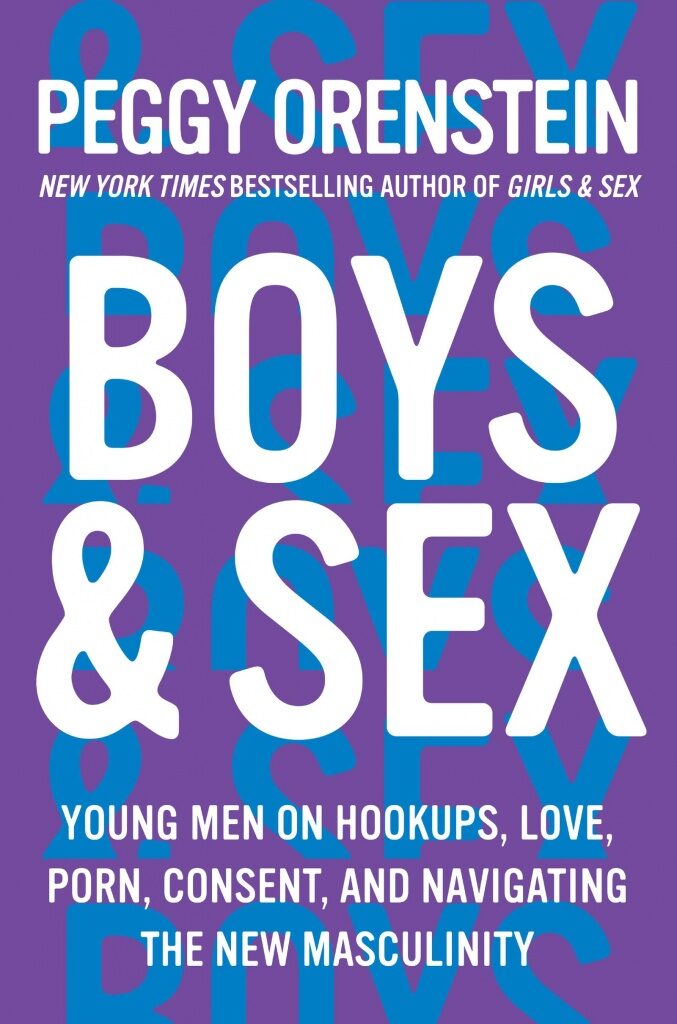
Her new book, “Boys & Sex: Young Men on Hookups, Love, Porn, Consent, and Navigating the New Masculinity,” has received glowing reviews since its publication on Jan. 7, and is being acknowledged as joining Orenstein’s provocative 2016 hit “Girls & Sex” as another game changer when it comes to encouraging much-needed dialogue between parents and teens.
Orenstein, sitting barefoot on the couch, talked with the same candor, empathy and easy humor that animate her reporting, about what she learned over the two years she spent interviewing well over 100 young men, ages 16-22.
“Boys & Sex” distills her many insights drawn from the raw and frequently poignant conversations she had with college or college-bound boys from diverse backgrounds, sexual orientations and gender identities. They opened up to an astonishing degree about their early sexual experiences, expectations of intimacy and, maybe most importantly, about their complex and too-often unexpressed interior emotional lives.
Orenstein, who is married to filmmaker Steven Okazaki, comes across in person as a deeply curious thinker with a terrific sense of humor, someone who cares deeply about young people’s well-being. She talked about developing rapports with some boys she interviewed over an extended period of time, texting and Skyping with them. “A handful have probably become friends,” she said.
The book is an engrossing, at times shockingly frank, exploration of some of the confounding contradictions facing boys today. “Bro culture” still holds sway, porn is ubiquitous (and, Orenstein says, is most young boys’ “de facto sex ed”), drunken hookups, casual homophobia and bragging about sexual conquests are the college norm, and yet adolescent boys are growing into men in a rapidly evolving world of “yes means yes” mutual consent (made California law in 2014), #MeToo awareness and a spate of public cases of sexual misconduct.
“We’re asking boys to navigate contradictory messages about what it means to be male,” said Orenstein, “to on the one hand be better men, to behave with integrity and responsibility in intimate relationships, to value mutuality and egalitarianism, while that’s in direct conflict with some pretty entrenched messages guys get, telling them that being a ‘real man’ means exactly the opposite.”
Among Orenstein’s striking findings was that even among educated, progressive Bay Area boys she spoke with, “On the one hand, the guys saw girls as equals in the classroom, on the playing field, as perfectly worthy of leadership positions,” she said. “But when I would say, ‘So what’s the ideal man?’ They would start saying things that sounded like 1955. It was stoicism, dominance, sexual conquest, athletics and this weird combination of having to be aggressive and chill at the same time which I could never quite understand.”
Orenstein said a central theme that emerged in her interviews was how damaging and pervasive “emotional suppression” is among boys.
She heard repeatedly from young men that they had conditioned themselves not to cry. “They’d say, ‘I trained myself not to feel.’ ‘I felt a wall go up.’
“It was heartbreaking. It’s really hard to see people cut off, not able to express their full humanity,” she said.
One of Orenstein’s biggest takeaways was that boys feel as constrained by traditional expectations of manhood (what she calls the “man box”) as girls feel hemmed in by outdated notions of femininity.
Peggy Orenstein was surprised by the pervasive emotional suppression among boys and how constrained they feel by traditional notions of manhood.Photo: Scott Strazzante, The Chronicle
So what’s a boy, and the adults in his life, to do?
“We have to start talking to boys with a great deal of compassion,” Orenstein said. We need to broach important subjects like calling out sexism in the media, the ways porn “eroticizes gender inequality” (“It’s less the sex than the sexism that’s the problem,” she writes) and how calling something like a vile rape meme “hilarious” strips boys of empathy, “becomes another way they disconnect from their feelings.”
Orenstein says we underestimate boys’ ability to engage with mature issues around physical and emotional intimacy, and in that conversational vacuum boys suffer.
“Peggy honors the complexity of boys’ experience in all its different layers,” says nationally recognized San Francisco teen educator Shafia Zaloom, who teaches at the Urban School and is the author of the 2019 book “Sex, Teens, and Everything in Between.”
“She reminds us that so much of our culture assumes that young boys are actively perpetuating a patriarchy, when they’re just reading from a cultural script.”
With its complementary two-tone cover, “Boys & Sex” looks like a logical companion volume to Orenstein’s 2016 bestseller “Girls & Sex” now that they’re side by side on bookstore shelves, but it wasn’t at all planned that way.
When Orenstein finished writing “Girls & Sex,” her groundbreaking investigation into girls’ sexual identities, and their right to agency and reciprocal pleasure, she found that “everywhere I went, people said, ‘When are you going to write about boys?’ Adults said it. Parents said it. Kids said it.
“So I started thinking about it, but I was pretty resistant. I was worried that boys wouldn’t talk to me because they don’t really have a reputation for chattiness. And, I look like their mom.”
In fact, Orenstein found that being a 50-something feminist Berkeley mom of an adolescent herself, someone who isn’t squeamish talking about hookup culture, porn or crude TikTok memes, as well as old-fashioned core values like emotional intimacy, vulnerability and trust actually helped.
She said reporting “Boys & Sex” was filled with surprises, but the first was that “if anything, boys were more forthcoming” than girls. “They were super eager to talk, and a lot of times they were telling me things that they had not told any adult before. I ended up feeling that being a woman doing this was actually, strangely, an advantage.”
The last chapter in “Boys & Sex” is titled “Deep Breath: Talking to Boys.” It reads like a manifesto, Orenstein’s direct plea to parents to swallow their own discomfort and engage the boys in their lives in open, nonjudgmental, ongoing conversations about sex, “even if you would rather poke yourself in the eye with a fork, and he would probably rather poke himself in the eye too,” she said.
“The fact is that if you don’t educate your boys, the media is going to do it for you, and you’re not going to like how that comes out,” she said.
If that’s not direct enough, Orenstein added this subhead: “You must, you simply must, talk about porn.”
After all, 93% of boys are exposed to internet porn before the age of 18. And male porn users report less satisfaction with their sex lives. “If you’re imagining they’re looking at Playboy, or what porn looked like decades ago, you’re wrong,” Orenstein said. Especially since the 2007 launch of PornHub, which has no paywall, “Anything you can imagine, and many things you’d rather not imagine, are there, for free.”
“Peggy’s book shook me to my core,” said Orenstein’s good friend and fellow Berkeley author Ayelet Waldman. “It was utterly fascinating, and it was also terrifying. I’m a parent of two boys, 16 and 22, and two girls. I didn’t have any language to help my kids navigate this perilous moment, and Peggy gave it to me.”
Orenstein said being this direct with her readers is new for her. “As a journalist, I don’t like to prescribe. I usually keep things more visual, reported. But, after nine years focused intensely on adolescence, I stepped out from behind the curtain because I really do have a few important things to say.”
After a lengthy adapted excerpt from “Boys & Sex” ran in the Atlantic online in December (it’s in the Jan/Feb print issue), Orenstein said, “I was deluged with mail from guys of all ages. I had not expected that because I know from my earlier books that most of my readers are female, and I don’t tend to hear from men as much, but I got letters from young guys, and long expressive letters from older men in their 50s, 60s, even 70s. It was amazing, just an outpouring.”
What reason did they share for feeling compelled to reach out to Orenstein, whose article ran with the headline “Toxic Masculinity and the Brokenness of Boyhood?”
“That they felt seen,” she said. “That they finally felt seen.”
Jessica ZackJessica Zack is a Bay Area freelance writer.
JANUARY 17TH 2020 by VICTOR TANGERMANN (futurism.com)
Going Multiplanetary
In a series of Thursday evening tweets, SpaceX CEO Elon Musk revealed new details about his plans to colonize Mars.
In theory, 1,000 Starships could eventually send “maybe around 100k people per Earth-Mars orbital sync,” Musk tweeted. “That’s the goal,” he added.
Musk envisions these ships departing Earth orbit over a 30-day period, the window of time when Earth and Mars are best aligned to make the trip, every 26 months.
When a Twitter user asked him if that would equate to one million people on Mars by 2050, Musk responded with a simple “yes.”
1000 Starships
According to Musk, you’ll need a crazy amount of cargo capacity to build a human colony on a faraway planet.
“Megatons per year to orbit are needed for life to become multiplanetary,” he tweeted.
Each Starship could deliver more than 100 tons per flight, meaning that every ten ships could “yield one megaton per year to orbit,” Musk calculated.
Martian Society
And once humans arrive, there will be plenty to do.
“There will be a lot of jobs on Mars!” Musk tweeted.
It’s a fun thought experiment — and needless to say, SpaceX has its work cut out to realize Musk’s ambitious vision.