Human sexuality is fascinating. It’s not merely a black and white cookie, but a layered cake that’s a little of this for some people, and a lot of that for others. Because of this, there is no “right” or “wrong” way to enjoy pleasure because, simply, there is no one way to enjoy pleasure. And, honestly, if there were, how dreadfully boring human sexuality would be. It’s the complexities of desire and the complications that come with the vastness of what arouses people that makes it truly beautiful. In other words, yes, fetishes are incredible and have a very important place on the spectrum of human sexuality.
What Is A Fetish Exactly?
So what does fetish mean? In the simplest of terms, a sexual fetish is something that’s considered a bit “off-beat” that arouses a person. That something could be a place, a body part, a feeling, an inanimate object, or even a bodily function. Sexual fetishes run the gamut. From being aroused by having sex in public (exhibitionism) to oculolinctus, the fetish for licking eye balls for sexual arousal, it’s safe to assume that for anything one can imagine, there’s very likely a fetish for it. And, as long as everyone participating in a sex act that includes a fetish can consent, then no one is in any place to judge.Did you know? – According to a 2016 survey by erotic retailer Ann Summers, the majority of people report having at least one sexual fetish. Of the 2,300 UK residents who responded to the survey, a whopping 75% of them have fetishes. So, if you were thinking you were in the minority with your fetish — no matter what it is — you’re absolutely in the majority for having one.
What Are the Main Causes Of Fetishes?
Like human sexuality itself, the psychology behind sexual fetishes isn’t cut and dry. Some say that fetishes are steeped in childhood experiences. For example, if you were spanked a lot as a child, your fetish to be spanked as an adult might be a result of that. It’s the brain’s way of processing or reconciling with the past by having a say in the spanking you receive on a sexual level. But for those who weren’t spanked as children, but love a good spanking, then that childhood experience theory doesn’t hold much water.
Other experts report that fetishes arise from wiring in the brain. As Nichi Hodgson, sex expert and former dominatrix, explained to Independent: “There’s actually a scientific theory that says there’s some cross-wiring in the brain of foot fetishists — the areas of the brain that are associated with the genitalia and the brain are next to one another.”
The same can be suggested in regards to BDSM, as philosophers like Descartes found that pain and pleasure are linked as a continuum because of their placement in the brain. There’s also the psychological processing of the reward-punishment system: you will eventually feel pleasure for your pain.
Ultimately, there is no single reason as to why people have fetishes and even those who have them, can’t explain the why or how of them. They just know they like what they like and what’s going to arouse them and eventually take them to orgasm, if that’s their end goal.
Most Common Sexual Fetishes
Although there are hundreds, if not thousands of types of sexual fetishes, even if not every one of them has been recognized or labeled, there tends to be a handful that are more common than others. One thing is for sure, some fetishes can be very strange indeed.
For the most part, the following list of fetishes, in no particular order, are the top 5 that come up most often on most lists:
Mariott Westin Hotel 866-547-5334 10600 Westminister Boulevard Westminister, Colorado 80020
“Welcome
Home”
For some,
home is an escape from the outside world. For others, home is the
place into which the outside world is invited. The Prosperos
Community Weekend allows you to epitomize both – to create for
yourself a beautiful environment aligned to enhance your true sense
of Beingness in the best possible way, to be all about your journey
to self- awareness and to let every life experience in daily living
become just a little more inviting and exciting! Welcome home !!!
Created
for active seekers of Truth, the Prosperos Community
Assembly Weekend is designed to provide a beautiful, welcoming, safe,
and inclusive experience for living life fully, that celebrates
the vibrancy of living authentically. In short, the Prosperos
Community is the home you have always wanted in a community that
Truth seekers deserve!
The
pictures will be rolling out each month in this promo piece. See if
you can guess who they all are. More to come….
(Please send your pictures and any
Assembly blogs you wish to create, to me (prodolph@gmail.com)
and I’ll send them out in our monthly Assembly promo piece.)
Encore + Manufacturing Consent explores the political life and ideas of world-renowned linguist, intellectual and political activist Noam Chomsky. Through a collage of biography, archival material and various graphics and illustrations, Mark Achbar and Peter Wintonick’s 22-award-winning documentary highlights Chomsky’s probing analysis of mass media and his critique of the forces at work behind the daily news. Manufacturing Consent examine la vie politique et les idées du réputé linguiste, intellectuel et militant Noam Chomsky. Ce documentaire vingt-deux fois primé de Mark Achbar et Peter Wintonick allie éléments biographiques, documents d’archives et illustrations diverses pour mettre en lumière l’analyse approfondie que Chomsky a faite des médias de masse et sa critique des forces qui influent sur les nouvelles quotidiennes.
The fountains mingle with the river And the rivers with the ocean, The winds of heaven mix for ever With a sweet emotion; Nothing in the world is single; All things by a law divine In one spirit meet and mingle. Why not I with thine?—
See the mountains kiss high heaven And the waves clasp one another; No sister-flower would be forgiven If it disdained its brother; And the sunlight clasps the earth And the moonbeams kiss the sea: What is all this sweet work worth If thou kiss not me?
W ord on the street is that gossip is the worst. An Ann Landers advice column once characterized it as “the faceless demon that breaks hearts and ruins careers.” The Talmud describes it as a “three-pronged tongue” that kills three people: the teller, the listener, and the person being gossiped about. And Blaise Pascal observed, not unreasonably, that “if people really knew what others said about them, there would not be four friends left in the world.” Convincing as these indictments seem, however, a significant body of research suggests that gossip may in fact be healthy.
It’s a good thing, too, since gossip is pretty pervasive. Children tend to be seasoned gossips by the age of 5, [1] and gossip as most researchers understand it—talk between at least two people about absent others—accounts for about two-thirds of conversation. [2] In the 1980s, the journalist Blythe Holbrooke took a stab at bringing rigor to the subject, tongue firmly in cheek, by positing the Law of Inverse Accuracy: C = ( TI ) ^v – t , in which the likelihood of gossip being circulated ( C ) equals its timeliness ( T ) times its interest ( I ) to the power of its unverifiability ( v ) minus the reluctance someone might feel about repeating it out of taste ( t ). [3]
Despite gossip’s dodgy reputation, a surprisingly small share of it—as little as 3 to 4 percent—is actually malicious. [4] And even that portion can bring people together. Researchers at the University of Texas and the University of Oklahoma found that if two people share negative feelings about a third person, they are likely to feel closer to each other than they would if they both felt positively about him or her. [5]
Gossip may even make us better people. A team of Dutch researchers reported that hearing gossip about others made research subjects more reflective; positive gossip inspired self-improvement efforts, and negative gossip made people prouder of themselves. [6] In another study, the worse participants felt upon hearing a piece of negative gossip, the more likely they were to say they had learned a lesson from it. [7] Negative gossip can also have a prosocial effect on those who are gossiped about. Researchers at Stanford and UC Berkeley found that once people were ostracized from a group due to reputed selfishness, they reformed their ways in an attempt to regain the approval of the people they had alienated. [8]
By far the most positive assessment of gossip, though, comes courtesy of the anthropologist and evolutionary psychologist Robin Dunbar. Once upon a time, in Dunbar’s account, our primate ancestors bonded through grooming, their mutual back-scratching ensuring mutual self-defense in the event of attack by predators. But as hominids grew more intelligent and more social, their groups became too large to unite by grooming alone. That’s where language—and gossip, broadly defined—stepped in. [9] Dunbar argues that idle chatter with and about others gave early humans a sense of shared identity and helped them grow more aware of their environment, thus incubating the complex higher functioning that would ultimately yield such glories of civilization as the Talmud, Pascal, and Ann Landers.
So the next time you’re tempted to dish the dirt, fear not—you may actually be promoting cooperation, boosting others’ self-esteem, and performing the essential task of the human family. That’s what I heard, anyway.Ben Healy is a writer and former Atlantic deputy managing editor.
The Studies
Engelmann et al., “Pre-schoolers Affect Others’ Reputations Through Prosocial Gossip” (British Journal of Developmental Psychology, Sept. 2016)
Nicholas Emler, “Gossip, Reputation, and Social Adaptation,” in Good Gossip (University Press of Kansas, 1994)
Blythe Holbrooke, Gossip (St. Martin’s, 1983)
Dunbar et al., “Human Conversational Behavior” (Human Nature, Sept. 1997)
Bosson et al., “Interpersonal Chemistry Through Negativity” (Personal Relationships, June 2006)
Martinescu et al., “Tell Me the Gossip” (Personality and Social Psychology Bulletin, Dec. 2014)
Baumeister et al., “Gossip as Cultural Learning” (Review of General Psychology, June 2004)
Feinberg et al., “Gossip and Ostracism Promote Cooperation in Groups” (Psychological Science, March 2014)
Robin Dunbar, Grooming, Gossip, and the Evolution of Language (Harvard University Press, 1998)
This article was originally published on June 12, 2018, by The Atlantic, and is republished here with permission.
COULD STONED SUSPECTS BE CONFESSING TO CRIMES THEY DIDN’T COMMIT?
BY DAN ROBITZSKI / FEBRUARY 11 2020 (FUTURISM.COM)
It’s a common trope of stoner comedies that smoking weed makes users forgetful — but now it turns out it can also make them “remember” things that never happened.
New research showed that people who vaped THC were more susceptible to developing false memories than those who didn’t, Inverse reports. The finding is troubling, and not just from the existential angst of knowing one’s memories aren’t perfect: Experts told Inverse that the phenomenon could lead to wrongful criminal convictions resulting from inaccurate eyewitness testimonies or confessions.
An international team of researchers, most affiliated with theNetherlands’ Maastricht University, tested the impact of weed on 64 participants’ memories. They found the participants experienced both spontaneous false memories and those that the researchers actively suggested.
In other words, if a witness was high during whatever event they’re being questioned about, they may believe — or become convinced — that things that never happened actually did.
As the team’s research paper, published Monday in the journal PNAS, reads, “the current study shows that intoxicated individuals might be at high risk to form all kinds of memory errors, which can be perilous in investigative interviewing settings.”
“The next step for us is to investigate the effects of cannabis in a ‘false confession’ paradigm,” lead researcher and Maastricht University psychopharmacology expert Lilian Kloft told Inverse. “False confessions are a major contributing cause to wrongful convictions and we cannot exclude that drug influence can magnify vulnerability for making a false confession.”
The Prosperos exhibit at Conscious Life Expo in L.A. on February 7 thru 9, 2020 at LAX Hilton Hotel. Pictured are Rick Thomas, HughJohn Malanaphy and Anne Bollman.
“Peace is the result of an inner state of harmony. It is not obtained by eliminating anything external, it is inside ourselves that we must find and suppress the causes of war.”
–Omraam Mikhaël Aïvanhov (January 31, 1900 – December 25, 1986) was a Bulgarian philosopher, pedagogue, mystic, and esotericist. A leading 20th-century teacher of Western Esotericism in Europe, he was a disciple of Peter Deunov, the founder of the Universal White Brotherhood. Wikipedia
The phone’s screen turns a serene blue, and Calm, the leading mindfulness application, opens. At the very center, without capitalization or punctuation, small and faint, are the words “take a deep breath”.
That gives way to a menu. “What brings you to Calm?”
The app offers options to “reduce anxiety,” “develop gratitude,” “build self esteem,” even “increase happiness.”
The next screen offers a seven-day free trial. Once the trial has ended, the annual rate is $69.99, a small price for happiness.
Somewhere around 2010, according to experts and Google search data, the practice of mindfulness began an upward swing. In less than a decade, it has become the fastest-growing health trend in the United States, according to the federal Centers for Disease Control and Prevention. Mindfulness rules the online app store. The San Francisco-based Calm is valued at $1 billion, and its competitor Headspace at $350 million. (The industry as a whole has been estimated to be worth as much as $4 billion.) Meditation retreats are en vogue. Corporations offer access to mindfulness in the same way they do for gyms. Even the military uses mindfulness breathing techniques to boost soldiers’ performance.
But as with any Next Big Thing, there are reasons to be cautious. Some say this rush into mindfulness has outpaced the science and stripped it of its cultural context. All of this threatens to turn a tool for well-being, for situating oneself in the current moment, into a tool for standard American commercialism.
Around the same time mindfulness began its upward trajectory, Ronald Purser, a management professor at San Francisco State University, started to feel the familiar weight of doubt. He’d been doing a fair amount of corporate management training and consulting — redesigning the workplace to work better, at least in theory, for everybody. “I became somewhat disillusioned and disenchanted,” he says. “Even when we were making progress, trying to redesign work so employees would have more autonomy and decision-making, the management sort of pulled the plug on some of those experiments.”
It was around this time, too, that Chade-Meng Tan, a software engineer at Google, gained notoriety for integrating mindfulness into Google’s corporate culture through a series of in-house mindfulness seminars. In 2012, Tan turned those courses into a blockbuster book, “Search Inside Yourself: The Unexpected Path to Achieving Success, Happiness (and World Peace),” and Purser found himself attending Tan’s very first public offering.
“I became very disappointed by what I saw, just in terms of what the program was and how superficial it was,” Purser says. “I just saw this as part of the interest in behavioral science techniques as a way of yoking the interest or subjectivity of employees to corporate goals.”
A year later, Purser published an essay with the Huffington Post. It was titled “Beyond McMindfulness.” Mindfulness meditation, he wrote, “was making its way into schools, corporations, prisons, and government agencies including the U.S. military.” Purser, a student of mindfulness for 40 years, wasn’t knocking the practice but was wary of its growing reputation as “a universal panacea for resolving almost every area of daily concern.” Last year, Purser expanded on the essay and published a book titled “McMindfulness: How Mindfulness Became the New Capitalist Spirituality.”
Early on in his book, he writes this: “I do not question the value of adapting mindfulness for therapeutic use, nor do I deny that it can help people. What bothers me is how its promoters want things both ways: one minute, mindfulness is science, since that’s what sells; the next, it stands for everything in Buddhism, since that’s what makes it sound deep.”
The issues Purser called out eight years ago have only grown with time. Rhetoric, he says, still outpaces results. The practice becomes increasingly decontextualized, meme-ified and gamified. Mindfulness becomes a cure for more and more — our happiness, our anxiety, our pain, even world peace.
It’s worth pausing a moment to define — or at least try to define — “mindfulness.”
At its very core, its deepest and truest roots, mindfulness is a Buddhist meditation technique. “There are hundreds, probably thousands of different meditative techniques. This is only one of them,” says Mushim Ikeda, a Buddhist meditation teacher. “Traditionally, in the Buddhist scriptures, it is said that what we call ‘mindfulness meditation’ was one of 40 different techniques that the historical Buddha, the one we call the Buddha, talked about. So it wasn’t even his one and only meditation technique according to those scriptures.”
She knows those scriptures well. Ikeda, who primarily teaches at the East Bay Meditation Center, describes herself as a socially engaged teacher — a “social justice activist, author, and diversity and inclusion facilitator.”
She describes “mindfulness meditation” as a “secular term in Buddhism,” one that’s also called “insight meditation.” This is a sort of awareness, she says, that is different from the awareness that “we might call everyday awareness” — the sort we need to drive a car, or maintain a conversation, or use an ATM. She and others describe mindful awareness as “spacious and nonjudgmental.” Ikeda says, “It’s been said mindfulness only sees. It does not judge.”
The most common technique involves closing the eyes and focusing on the breath and only the breath, moving other thoughts, and the thoughts that come with those thoughts, away and out.
Mindfulness as a secular, western therapeutic intervention did not begin in Silicon Valley. Rather, you’d have to go back to 1979 and a man named Jon Kabat-Zinn and the founding of the Stress Reduction Clinic at the University of Massachusetts Medical School. Kabat-Zinn has studied the effects of what he dubbed mindfulness-based stress reduction (MBSR for short), on everything from brain function to skin disease.
Still, it’s hard to ignore Silicon Valley’s latest role in spreading and expanding mindfulness in the pursuit of a different tech culture value, peak performance. There is “Search Inside Yourself,” the book that coincided with the movement’s growth spurt. There are Twitter co-founder Jack Dorsey’s much-publicized meditation retreats. (“Black Mirror,” the dystopian science fiction show, seemed to parody both him and the now-ubiquitous apps.) Recently, there was the dopamine fast, a pseudo-scientific dopamine reset by way of doing nothing. (One originator said he drew directly from Buddhist Vipassana meditation when he crafted the fast.)
The voices are soothing and smooth — soft, but not quite a whisper. The cadence and diction perfect, gently pulling you along. Birds chatter in the background. Waves move gently to meet a beach. Or maybe a brook babbles as it pushes over and under and between river rocks.
“Breathing in … I am calm.”
“Breathing out … I am at peace.”
A chime rings, a signal that this 90-second meditation to calm anger has ended. Calm offers its congratulations.
The danger in this rapid evolution is that it threatens to turn a very old practice into a fad that overpromises and underdelivers.
Helen Weng has practiced Buddhist meditation for more than two decades. “I was reading a lot of books about psychology because I was unhappy because high school is horrible,” she says. And her father, who, along with her mother, had immigrated to the United States from Taiwan, could offer her books about Buddhist philosophy. The two came together. The Dalai Lama’s teachings offered her an opportunity to cultivate her own well-being. “I don’t like the word ‘happiness’ anymore, but you can use mental exercises to become more aware of your feeling states and your thoughts.”
Now Weng works as a clinical psychologist with the psychiatry department at UCSF and a neuroscientist with the Osher Center for Integrative Medicine and the Neuroscape Center, both at UCSF as well. Her scientific work uses magnetic resonance imaging to measure the amount of oxygen in the blood that flows to the brain as people meditate. Essentially, she can track whether the meditator is actually focused on their breath or if their attention has wandered. And in her clinical work, she offers meditation as one of many possible therapeutic interventions.
Still, she calls the recent spread of mindfulness “very freaky.”
“I’m very proud that practices from eastern cultures and religions generate so much interest,” she says. At the same time, mindfulness and its results are “super hard to study. So much so that I just thought I was a bad scientist for a long time.” What’s more, she says, meditation isn’t always the right sort of behavioral therapy.
“I’m very disturbed by these messages that meditation basically cures everything or it’s good for everyone or there’s universally very good positive effects. The effects are really moderate and subtle. It’s not any better than any other kind of psychotherapy,” she says. “Part of it is cultural appropriation where it’s this magical, mystical thing that then people can say does all these things, and I think we’re still in the height of that and it’s going to take some time for things to settle down.”
Medical students, she says, inevitably ask her how much time they have to commit to mindfulness to make it work. There are studies that show clear benefits to mindfulness. Weng points to one that indicated 30 minutes a day of compassion meditation for two weeks increased “altruistic giving to strangers and brain responses to pictures of people suffering.”
But the key here is consistency. “What happens if you work out for 30 minutes just once?” she asks. “It benefits you a little bit. That’s good. But if you just do it once, it’s not going to have a long-term effect.”
After the chime and the congratulations, the waves keep moving in and out, and a quote appears onscreen. “Insanity is doing the same thing over and over again expecting different results.” (A quote sometimes attributed to Albert Einstein, but probably more correctly attributed to Narcotics Anonymous.) And in that moment, Calm reminds you that you really should turn on push notifications, “in order to fully experience Calm.” Decline and it’ll ask one more time about its “mindfulness reminders.”
“Are you sure? It’s hard to set aside time for yourself in our busy world without a little help.”
Farrah Fawcett and Lee Majors are jogging. They’re tan, of course. Their shorts are short. Her blond hair is fanned out, so are his brown curls. She has a broad, blindingly white smile and a red handkerchief tied around her neck. His jacket is zipped down almost to his navel; his chest is hairy. And right beside them, a headline: Farrah & Lee & Everybody’s Doing It: Stars Join The Jogging Craze.
This is the cover of the July 4, 1977, issue of People magazine. Alex Will, the chief strategy officer for Calm, the industry-leading mindfulness meditation app, likes to reference this cover when he talks about mindfulness. (There’s even a copy of the issue at the office.) To understand the future of mindfulness, just look to the past.
“Mindfulness is becoming mainstream,” Will says. “People are starting to understand that taking care of the mind is just as important as taking care of the body. Meditation and mindfulness is one way to do that.”
In some respects, Calm isn’t doing anything that hasn’t already been done. Before smartphones, one could buy a meditation CD, slip it into a home stereo and start counting breaths. The app just makes it more portable and more accessible than ever before. “I think one of the reasons I’ve been so successful is that it is a very low bar for someone to try and get into,” Will says. There are short, two-minute long meditations, narrations to help with sleep, even a beginner’s guide to mindfulness. “Similarly, if you want to go deeper, we have a 30-minute master class where you can learn how to break bad habits.”
All of the content, Will says, is vetted by mindfulness instructors, and, now that the app is available in more than 100 countries, the programming is also run by people to make sure translations work. “This is very nuanced,” he says. “Language really matters.” The Calm app has also been part of various clinical studies in an attempt to back up the application’s rhetoric.
Mindfulness, by the way, has already had its magazine-cover moment. Not quite 37 years after the jogging craze, Time magazine featured the “Mindfulness Revolution” on its Feb. 3, 2014, issue. A blond, fair-skinned model stands straight, hands at her sides, eyes closed, face slightly upward. And the headline: The science of finding focus in a stressed-out multitasking culture.
Mindfulness began to trend in large part because corporations embraced the practice as a way to help employees relieve stress. This is one of the cruxes of Purser’s concerns — that mindfulness is just a way to wring more productivity from employees, a sleight of hand that shifts the onus from the company to the worker.
In 2012, the year Chade-Meng Tan published “Search Inside Yourself,” the idea of offering mindfulness courses to employees still felt novel. The New York Times featured Tan and the course he’d developed for Google employees — a course that involved meditation, Tibetan brass bowls, stream-of-consciousness journaling and lots of emotional openness. Even then the course was framed as a way to help employees deal with their “intense” workplace — no mention of toning down the intensity.
Eight years later, mindfulness courses are the rule, not the exception. Apple, Nike, HBO and Target have all offered some form of mindfulness training to employees. Aetna, the insurance provider, decided to offer mindfulness and other stress-relief activities (including dog petting) after an internal study found that the most stressed-out employees spent $1,500 more a year on health care. And if a company can’t bring a trained expert on board, well, they can always give employees memberships to Calm or Headspace.
“The Buddha taught that almost everything comes and goes,” says Mushim Ikeda, the East Bay Meditation Center instructor. “It’s called ‘impermanence’ or ‘change.’ And health trends famously come and go. It’s a product of our capitalist system.
“One year, it’s a certain kind of berry that’s going to cure everything. Another year, it’s mindfulness meditation that’s going to cure everything. Five years from now, heaven only knows, it’ll be something else. Burnt toast — who knows?”
Ikeda offers a path forward, a path separate from capitalism, a path that encourages students to cultivate a practice in which they care for themselves so that they may, in turn, care for their communities. It’s an approach based in social justice and altruism. And yet, she isn’t dogmatic.
Mindfulness, Ikeda says, does not judge.
A person might use mindfulness to lower their blood pressure or achieve “peak performance.” A corporation might use mindfulness to paper over “an inherently unjust and healthy system.” All this, she says, is like using a Swiss Army knife for just one thing. “It’s not what the tool was intended to do, and it’s not all it can do.
“Mindfulness is always mindful awareness of something,” Ikeda says. “Who knows what a given individual is going to do with it? Or what it will do for them?”
An individual might, for instance, become mindfully aware of a broken system.Ryan Kost is a San Francisco Chronicle staff writer. Email: rkost@sfchronicle.com. Twitter: @RyanKost
Ryan Kost writes for The San Francisco Chronicle’s Culture Desk. He’s always on the look out for unexpected and untold story and loves covering the people and communities that don’t always get a lot of press — the stuff we miss, the stuff we look past. Sometimes we miss whole worlds and communities, even though we live right alongside them. A big part of what he tries to do is make all that a little more visible for our readers.
He loves getting tips and story ideas from readers, so don’t hesitate to reach out. Previously, he lived in Portland, Ore. where he wrote for The Oregonian and The Associated Press, covering national, state and city politics. He helped launch PolitiFact Oregon, a fact-checking website aimed at keeping politicians truthful. He’s also worked at The Boston Globe, The Arizona Republic and The Tampa Tribune. He’s won a number of state and national awards.
By Michelle Villegas Threadgould Feb. 10, 2020 Comments 3
(SFChronicle.com)
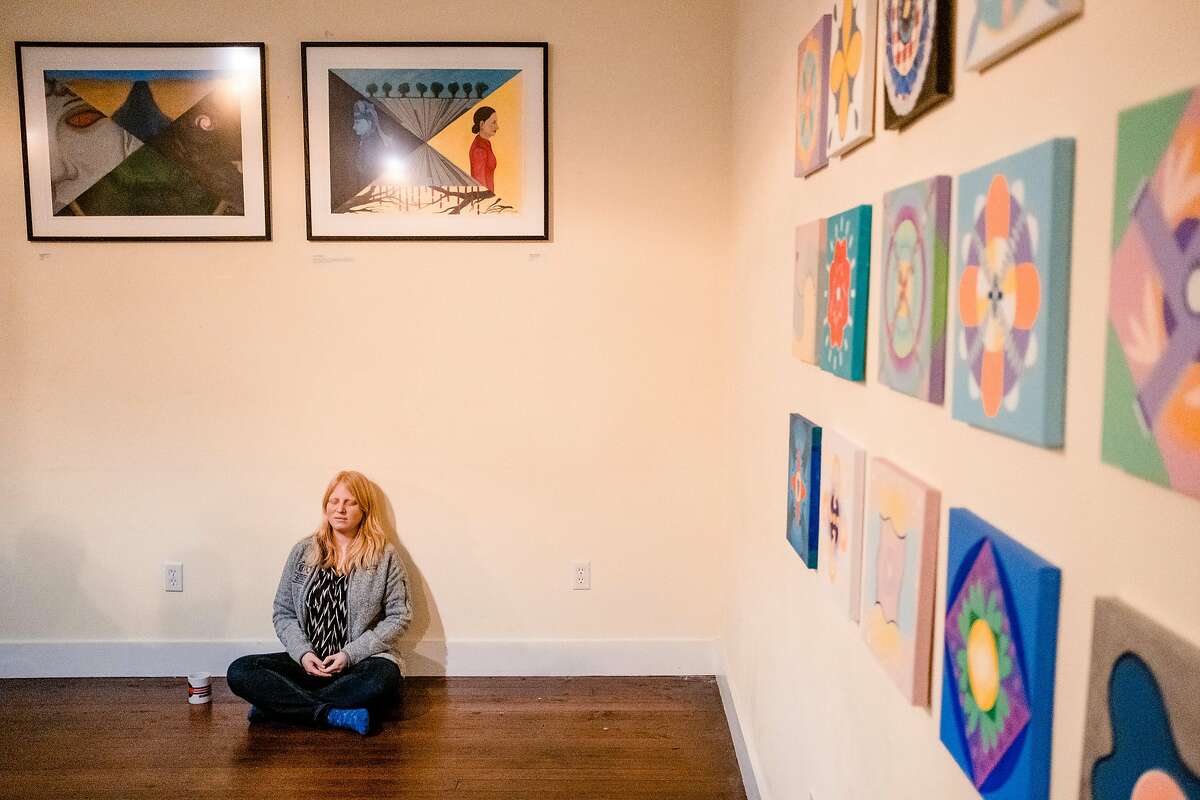
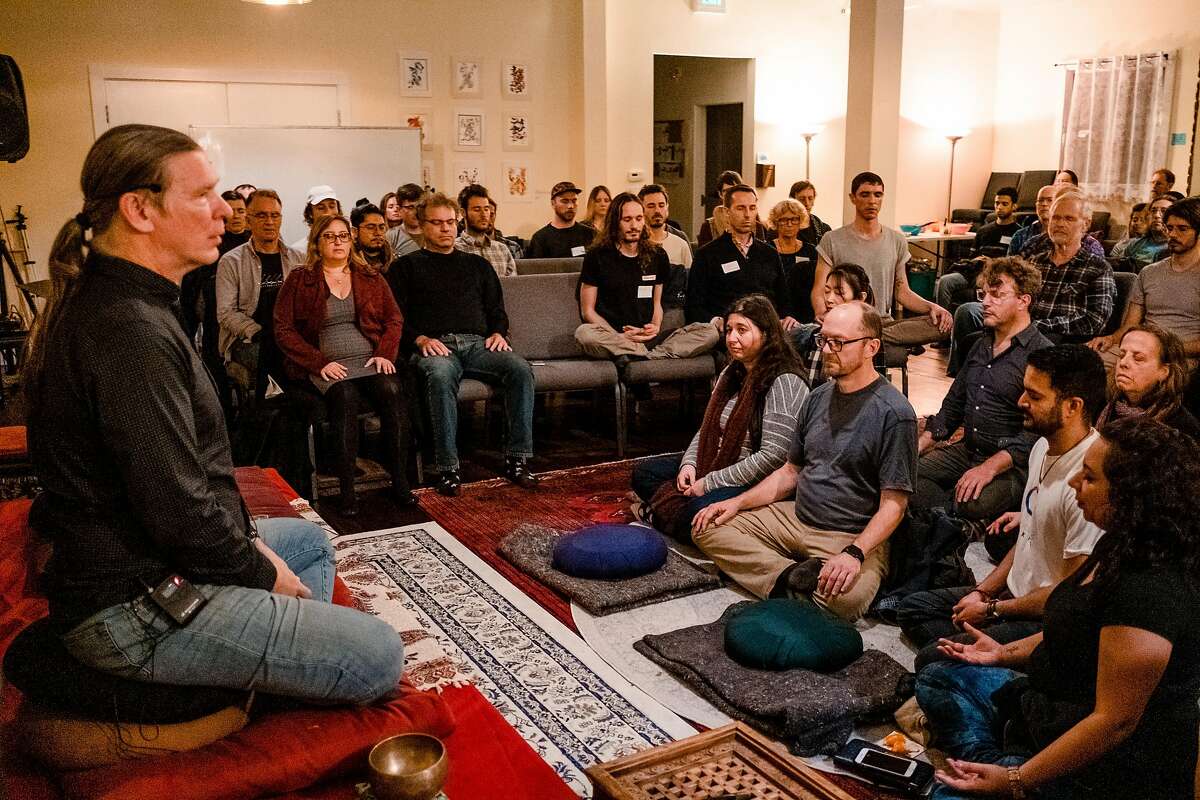
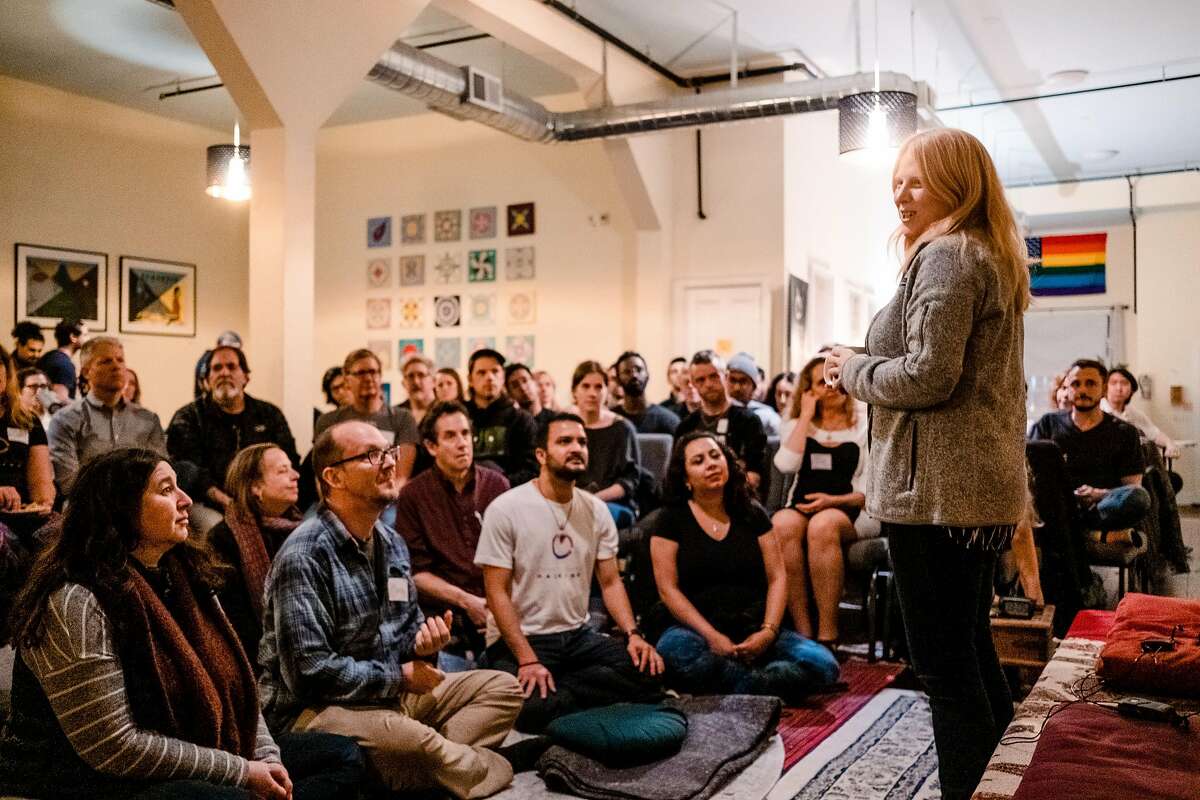
Kati Devaney of SF Dharma Collective meditates at the beginning of an event at the collective in January.Photo: Nick Otto / Special to The ChronicleMichael Taft, a teacher at SF Dharma Collective, leads a meditation before an event at the collective.Photo: Nick Otto / Special to The ChronicleThe SF Dharma Collective’s Kati Delvaney speaks at a recent event.Photo: Nick Otto / Special to The Chronicle
Growing up punk, you live by your own moral code. I was a vegetarian, I believed in anarcho-socialism, and I had strict rules about the businesses I supported. Then, in 2012, to pay my rent, I broke them: I worked as a copywriter for a tech startup run by Stanford bros in San Francisco. It was the type of company responsible for the displacement of artists and communities where I had grew up. My co-workers were the type of yes-men and bootlickers I despised. I felt like I had betrayed my community and myself.
That same year, I came across Noah Levine’s memoir, “Dharma Punx,” which chronicles how Levine, a Santa Cruz native, went from punk-rock drug addict to punk-rock meditation teacher. In the back of the book was the address of the San Francisco chapter of Dharma Punx: a weekly meditation group for punks, people in recovery and anyone who wanted to commune in silence over a shared sense of what we weren’t and who we wanted to be.
I went. In the small space in the Inner Richmond, I found people with tattoos and anti-authority attitudes — people who reminded me of the kids I grew up with. That was also the first time I heard the meditation teacher Vinny Ferraro speak. His style was old-school punk, and tattoos peeked out of his long-sleeve plaid shirt.
His subject that day was compassion and the Buddhist principle of loving kindness. He translated a lifetime of Buddhist scholarship into a 30-minute talk. I remember one line: No one has ever hated themselves into being a better f—ing person. Ferraro was saying exactly what I needed to hear, and I wasn’t alone — when he spoke, hundreds of people grew silent.
Seven years later, Ferraro is part of a Dharma Punx community that has had its faith and compassion tested in more ways than one. In 2018, Noah Levine was accused of sexual misconduct by several women.
What happens when a spiritual leader is accused of being morally bankrupt? Can you continue a spiritual practice without the very leader who taught you your precepts?
Teacher Erik Davis (standing) talks to a collective attendee. The group formed in the former Against The Stream space in S.F.Photo: Nick Otto / Special to The Chronicle
In September 2018, as news of the allegations became public, Levine initially wrote an open letter apologizing to “the women who have come forward and expressed a sense of suffering because of interpersonal experiences with me.” Since then, he has repeatedly denied all allegations. Following an investigation, the Los Angeles Police Department (in whose jurisdiction one alleged assault was said to have occurred) declined to bring charges against Levine.
But for the followers of the movement he helped to spark, the fallout was far from over. The meditation centers that had grown out of Dharma Punx — an international network of meetings and retreats that became known as Against The Stream — conducted an internal investigation, and ended their affiliation with Levine within a year.
“I was just devastated,” says Leilani Clark, a writer and editor who was a member of a chapter of Refuge Recovery in Santa Rosa. She said that at first, all that was known was that Levine had slept with a student; slowly, a few murky allegations emerged. Eventually, four allegations were made public, which included rape and assault.
Members of Clark’s sangha, or meditation group, could no longer avoid dealing with the issue, especially since the group used the Dharma Punx-inspired workbook, Refuge Recovery, for those in recovery.
“Being in early sobriety, I just didn’t have the stomach to sit through” (readings of the workbook), Clark says. “And the book is heavily used (in the practice); Refuge Recovery has Noah’s name on it. I was like, is this a sexual predator who wrote these things? I don’t know.”
One reason that the destruction of Against The Stream and Refuge Recovery was particularly painful for meditation practitioners was because so many of them already saw themselves as outside traditional Buddhism. Dharma Punx was a refuge for those who had lost their community and no longer knew whom to trust or where to practice. Worse, for some Refuge Recovery members, losing faith in Levine meant losing faith in the very methodology Levine had developed — and therefore in the support group that kept them sober.
“People were scared and hurt and felt betrayed, and so much processing needed to happen,” says Cassandra Millspaugh, a Bay Area teacher in recovery. Millspaugh was a member of Against The Stream since its inception. “It’s a thing with power dynamics. It happens a lot with men in positions of power — this kind of stuff comes out.”
Many meditation teachers at Against The Stream felt a sense of personal responsibility in addressing the sexual misconduct allegations. But with the threat of lawsuits from Levine, those teachers legally could not make public comments.
A meditation session at SF Dharma Collective on Folsom in S.F.Photo: Nick Otto / Special to The Chronicle
Vinny Ferraro not only co-founded Dharma Punx, he led meetings at Against The Stream for over 15 years. “Trying to navigate the complexities of confidentiality, my role as the guiding teacher and a 28-year relationship (with Levine) was extraordinarily difficult,” he says. “As internal questions about loyalty arose, my work was to clearly know: What was I being loyal to … my friend, our community, my own knowing?”
In the aftermath of the allegations, Ferraro reached out to the members of his community. “I felt an immense amount of responsibility for the ways that I contributed to harm being caused,” he says. “When we started ATS we were so young and cocky — we wanted to create a dharma community for people like us, folks that swear and are tattooed and hurting. (A place where) we could be ourselves without the formality of traditional meditation groups. But we really had no idea that along with the energy of rebellion, we were also bringing unexamined toxic masculinity.”
Since the demise of Against The Stream, Ferraro and many of its teachers and community members have gone on to form their own meditation groups. Ferraro runs a group called Big Heart City that meets on Fridays at the Episcopal Church of St. John the Evangelist, near 15th and Valencia in the Mission. And 16 months ago, the SF Dharma Collective formed in the former Against The Stream space on 23rd and Folsom, with dharma talks every night of the week.
I still practice what I learned in Dharma Punx. To this day, when I feel the beginning of an anxiety attack or I start to have self-hating, depressive thoughts, I remember a meditation Levine wrote:
May you learn to care about suffering and confusion.
May you respond to pain with mercy and empathy.
May you be filled with compassion.
But in the wake of the allegations, I don’t know if I should still use this prayer. I think of a time I felt deeply lost, of how many others have felt the same way, and what it means to take advantage of people at their most vulnerable. I also think about who is granted the luxury of redemptive narratives and who isn’t. In a practice rooted in compassion and forgiveness, what does self-preservation look like?
A statue inside SF Dharma Collective in S.F.Photo: Nick Otto / Special to The Chronicle
Reflecting on these questions, I revisited the former Against The Stream space at the end of last year. I attended a class based on a text by the Dalai Lama, led by the teachers Lopön Chandra Easton and Eve Ekman of SF Dharma Collective.
Easton and Ekman led their class differently from Dharma Punx. There was no swearing, less irreverent humor, and not as many punks in the crowd. Nevertheless, Easton and Ekman were engaging, asking the meditators questions and breaking down hierarchies between teachers and students.
“One of the conditions that permits sexual misconduct and abuses of power,” says Kati Devaney, a member of SF Dharma Collective, “is when one or a small group of people at the top of a hierarchy disconnect from feedback and accountability from folks at the bottom.”
With this in mind, the collective is run by 10 people who have a system of checks and balances to prevent abuses of power. The SF Dharma Collective is not the second coming of Dharma Punx, and it doesn’t want to be.
“We aim to be a place where everyone can experience the benefits of meditation,” Devaney says. “The idea is that, whether you’re just starting or you’ve been practicing for years, if you come here every day for a week, you’re going to … find something that really resonates with you.”
Ferraro, for his part, has found a new beginning since the decimation of Dharma Punx. “After leading the S.F. group for 15 years, I questioned what continuing actually meant — what should continue and what should be left behind,” he says, about starting his group with members of the Against The Stream sangha. “So I felt deeply inspired because I watched the folks that continued to show up. Sometimes when a community goes through some s— together, there’s a possibility of getting closer.”
In the reincarnation of Dharma Punx, there are no gurus. Removing an idol from the movement, as it turns out, may keep its spirit alive. As the zen koan states: If you meet the Buddha in the street, kill him.
Michelle Villegas Threadgould is a Bay Area freelance writer. Email: culture@sfchronicle.com