Michael McClure, famed Beat poet who helped launch the SF Renaissance, dead at 87

Sam Whiting May 5, 2020 Updated: May 7, 2020 (SFChronicle.com)

Beat poet Michael McClure is seen on his deck with sculptures by his wife, artist Amy Evans McClure, at their home in Oakland in 2010.Photo: Paul Chinn / The Chronicle 2010

Michael McClure, the young poet recruited to put together the famed Six Gallery readings in 1955 that launched the San Francisco Renaissance and the legend of the Beats, died Monday, May 4, at his home in the Oakland hills. He was 87.

McClure died from the lingering effects of a stroke he suffered in spring 2019, Garrett Caples, a close friend and editor at City Lights Publishers, told The Chronicle the day after McClure’s death.

“Michael was incredibly gracious, erudite, and totally dedicated to the poet’s calling,” said Elaine Katzenberger, publisher of City Lights, which put out McClure’s works going all the way back to 1963’s “Meat Science Essays.” “He was a sometimes-trickster, most definitely a provocateur, and yet, quite solicitous and patient, a sage who was beautiful inside and out.”

That first public reading for McClure, then 22 years old, was overshadowed by the introduction of “Howl,” by Allen Ginsberg. But McClure outlasted all of the Beats in a career that spanned more than 60 years. He published more than 30 books of poetry, plays and anthologies, most recently 2017’s “Persian Pony” and 2016’s “Mephistos and other Poems,” the latter anchored by a poem that took him 16 years to write.

“The poems dive through time and space like dolphins through the waves,” McClure said at the time of publication of “Mephistos,” released by City Lights.

With his cinematic looks and mod three-piece suits, McClure made it onto stages far bigger than those offered at poetry readings. He read at the Human Be-In at Golden Gate Park that launched the Summer of Love in 1967  and at the Band’s “Last Waltz” at Winterland in 1976.

“Without the roar of McClure, there would have been no ’60s,” actor Dennis Hopper once said.

Poet Michael McClure, photographed on Feb. 5, 1967.Photo: Chronicle archives 1967

An article in the Los Angeles Times described him as the role model for Jim Morrison of the Doors. He later had a long association with another member of the Doors, Ray Manzarek. They recorded together and toured together, with McClure reading to the accompaniment of Manzarek on keyboards.

“Michael was one of the most significant American poets of the latter half of the 20th century,” Caples said. “He had a place in popular culture in addition to literary culture that not many poets have been able to occupy.”

McClure also wrote novels, plays and songs, most famously “Mercedes-Benz,” which he co-wrote for Janis Joplin. With Manzarek, he played 200 gigs across America, Mexico and Japan. This helped McClure buy the home at the base of Butters Canyon in the Oakland hills, where he lived for 20 years with his second wife, sculptor Amy Evans McClure.

Michael McClure in the Oakland hills where he lived.Photo: Penni Gladstone / The Chronicle

“I never got any poetry to make a cent,” he told The Chronicle in 2003. But teaching paid, and for 43 years he was a professor of poetry at California College of the Arts. He started there in 1963 and was still teaching when he was bestowed an honorary doctorate degree, in 2005, as the longest-tenured faculty member at the art college.

“There is no way that you can read a poem by Michael McClure without experiencing some kind of connection with something primal and cosmic,” Juvenal Acosta, dean of Humanities and Sciences and professor of writing and literature at CCA, told The Chronicle in 2018. “He has changed the way we speak and read American poetry.”

Well into his 80s, McClure remained a poet in demand, both for his current work and for his association with the Beats. He and Gary Snyder were the only poets still alive who had read at Six Gallery on Oct. 7, 1955.

McClure was living at Scott and Haight streets and coming over the hill to Six Gallery, which had sculptures hanging from the rafters and a plank stage on the floor, on Fillmore at Greenwich streets. He had been asked to organize the reading, but his time was tight, with a wife who was expecting. He foisted the organizational duty on Ginsberg, who recruited Gary Snyder, Philip Whalen, Philip Lamantia and Kenneth Rexroth. Each of the poets read several works. Lawrence Ferlinghetti was in the room, but did not read. Neither did Jack Kerouac, busy as he was with his drinking.

In his nonfiction account of that night, “Scratching the Surface of the Beats,” published in 1982, McClure sets the stage for the revolution that was to follow in the mid-1950s:

“The world that we tremblingly stepped out into in that decade was a bitter, gray one. But San Francisco was a special place. Rexroth said it was to the arts what Barcelona was to Spanish Anarchism. Still, there was no way, even in San Francisco to escape the pressure of the war culture. we were locked in the pressure of the Cold War and the first Asian debacle — the Korean War.  My self image in those years was of finding myself — young, high, a little crazed, needing a haircut, in an elevator with burly crew-cutted, square jawed eminences, staring at me like I was misplaced cannon fodder. … We saw that the art of poetry was essentially dead — killed by war, by academies, by neglect, by lack of love, and by disinterest. We knew we could bring it back to life.”

Each of the poets was given about 10 minutes to read and McClure’s contributions were “Point Lobos: Animism,” “Night Words: the Ravishing,” and one simply titled “Poem.” (“There was no other title because it was as far as I had been able to go in poetry.”)

Poet Michael McClure reading.Photo: Nat Farbman / LIFE Picture Collection via Getty Images

His final reading that night was “For the Death of 100 Whales,” which is credited with launching the concept of eco-poetics and presaged the “Save the Whales” movement by Greenpeace by about 20 years. Put together, the works read that night brought verse out of the rigid form and into the free-form literature most commonly associated with Kerouac’s 1957 novel “On the Road.”

“It was the critical moment for the Beat Generation, the grouping together of five young proto-anarchists and Buddhists,” said McClure of the Six Gallery Reading. “As we spoke, we realized from the results that we were speaking for the people. We were saying what they needed and wanted to hear, and that encouraged us. We drew a line in the sand and decided not to back off that line.”

In addition to his own books, McClure figured as a character in others. In Kerouac’s autobiographical novel, “Big Sur,” he is portrayed as Pat McLear.

“McLear is the handsome young poet who’s just written the most fantastic poem in America, ‘Dark Brown,’ which is every detail of his and his wife’s body described in ecstatic union and communion and inside out and everywhichaway and not only that he insists on reading it to us,” exults Kerouac’s own fictional character, Jack Duluoz.

McClure was a literary bridge between the Beats, the hippies, and the animals in the zoo he once read to.

“Michael was the youngest of the poets that became known as the Beats,” Ferlinghetti told The Chronicle three years ago, at 99. “He was not only the youngest, he was completely different than anyone else. He spoke in beast language.”

Poets of San Francisco in front of City Lights Bookstore Dec. 3, 1965. According to the back of the photo: Upper top row: Stella Levy, Lawrence Ferlinghetti; 2nd standing row: 1. Donald Schenker, 2. Michael Grieg, 3. ?, 4. Mike Gibbons, 5. David Miltzer, 6, Michael McClure, 7. Allen Ginsburg, 8. Dan Langton, (. Steve Broston, 10. Gary Goodrow and son Homer, 11. Richard Brautigan (behind Goodrow), 12. Andrew Hoyem (on stretcher), 13. Lee Meyerzaw. Seated: 1. ?, 2., Shig Murao, 3. Lew Welch, (4) Peter OrlovskyPhoto: Peter Breinig, San Francisco Chronicle

McClure was born Oct. 20, 1932, in Marysville, Kan. His parents divorced when he was young and he moved to Seattle. After graduating from high school, he attended Wichita State and the University of Arizona before finally earning his bachelor of arts at San Francisco State University in 1955, shortly before the Six Gallery reading.

His first book of poetry, “Passage,” was published in 1956, and he hustled to earn a living, with his first wife and fellow poet Joanna, and daughter, Jane, to support, until 1963 when he was hired at CCA.

By the time Acosta came to the faculty in 1998, McClure was semiretired.

“He was always the cool cat. He always wore black,” Acosta said. One time, Acosta ventured to ask why. “Those of us who wear black are in mourning for ourselves,” he was told by McClure.

A practicing Buddhist, he liked to start his day with meditation and a hike in the redwood forest uphill from his house. At age 83, he slipped on slick footing under the redwoods and his legs went out from under him. “I was temporarily suspended in the air like Wile E. Coyote and then dropped,” he recalled.

He required hip surgery and it took a long recovery, which left him with a tremor and unable to read poetry off the page. But it didn’t stop him.

Beat poet, novelist and songwriter Michael McClure in San Francisco in 1970.Photo: Harold Adler / Underwood Archives 1970

For one of his last Bay Area events, a 2015 reading in Palo Alto, he had his poems written on the wall, as captions for a series of horse paintings done by his wife, Amy. He walked around the room repeating the words and horse whinny sounds, and the audience was entranced.

At the end, the audience wanted more, so he reached for his book, “Ghost Tantras,” published in 1964 and reprinted by City Lights in a 50th anniversary edition. His hands were so shaky they could barely turn the page, but they found their way to tantra 39.

“This poem comes from 1962,” he announced before beginning the reading.

“MARILYN MONROE, TODAY THOU HAS PASSED THE DARK BARRIER — diving in a swirl of golden hair. I hope you have entered a sacred paradise for full warm bodies, full lips, full hips, and laughing eyes!”

In June 2016, McClure appeared at a six-day festival in Manhattan called “Beat & Beyond.” The hipsters who organized the event called McClure “El Authentico,” and asked him to portray himself in a poem-by-poem reenactment. He declined and instead played the role of Kenneth Rexroth, who was the emcee of the affair.

The house was full and it was filmed for a documentary, further evidence that the Six Gallery readings will live on and on, just like the legend of the Beats.

So will McClure’s journals, which are now in the collection of the Bancroft Library at UC Berkeley. McClure’s last book of new poems, “The Persian Pony,” was released by Ekstasis Editions of Victoria, B.C., in 2017.

Beat poet Michael McClure in 2008.Photo: Penni Gladstone / The Chronicle 2008

“Just driving around with Michael was an amazing experience,” said Acosta, who often picked up McClure to attend matinees at the movies. “He would tell you stories about Ginsberg, about Jim Morrison, about Richard Brautigan. He wasn’t a name dropper. He was talking about the people he loved.”

McClure’s first marriage, to Joanna McClure, ended in divorce. Survivors include his second wife, Amy Evans McClure of Oakland, a daughter, Dr. Jane McClure, of Bethel, Alaska, her husband, William Eggimann, and grandsons James Eggimann and Michael Eggimann.

A memorial service is being planned for the fall.

“Michael’s genius, passion, wit, and compassion were equaled only by his great love for all beings,” said Evans McClure.

In his words: “I am a mammal patriot.”

  • Sam Whiting is a San Francisco Chronicle staff writer. Email: swhiting@sfchronicle.com. Instagram: sfchronicle_art

©Copyright 2020 Hearst Communications, Inc.

Full Moon in Scorpio – We’re in this together

If you are on Facebook, perhaps you’ve seen the new reaction emoticon that has been added to the repertoire: “Care” with the message “Even apart, we’re in this together

And this made me think of Thursday’s Full Moon in Scorpio. The Full Moon on May 7th is at 17° Scorpio, right in the heart of the Scorpio.

The Full Moon is trine Neptune in Pisces. Both Scorpio and Pisces are water signs, and both the Moon and Neptune are “water” planets, so we will get a 4x dose of “water” or emotional intensity, creativity, intuition and empathy.

Even if Scorpio has a hard shell, it is still a softie inside. Not that it will show it! But (the very few) people who get to know a Scorpio know that deep down, Scorpio deeply cares.

Scorpios don’t just say they care, they DO care. Their emotions are intense. Their love is real.

The Moon is in detriment in Scorpio, and that’s because the Moon qualities don’t naturally blend with Scorpio’s qualities. The Moon brings light into darkness and has a quality of illumination, reflection, and openness. Scorpio prefers dark corners, and it doesn’t open up easily.

That’s why Scorpio’s number one lesson is that of trust. Scorpios don’t trust easily, because they know that the world can be a dangerous place to live in. People can let you down. A disaster can strike at any time. And because of that, they are always on guard.

We can better understand Scorpio if we look at the opposite sign, Taurus. Taurus is what we have as a result of our own efforts. Scorpio is what we have as a result of merging with others.

And that place of merging is dark and scary – it is filled with mystery, secrets, and danger. But it is the only place where true intimacy can happen. In total surrender. When we know that something can hurt us, yet we surrender because surrender, trust, and intimacy are an inherent part of the human experience.

And it is in that dark, invisible and mysterious place that true connections are formed. Invisible, yet indestructible ties.

The Full Moon in Scorpio is here to tell us that we don’t have to be physically together to care for each other. We don’t have to be together because we’re in this together anyway.

And it is in the deep knowing that trust is all we really have, that we can ultimately burst the bubble of separation and find true connection with one another.

–Astro Butterfly – May 6, 2020

Sooner or later we all face death. Will a sense of meaning help us?

By Warren Ward

is an associate professor of psychiatry at the University of Queensland. He is the author of the forthcoming book, Lovers of Philosophy (2021). 

Brought to you by Curio, an Aeon partner

Edited by Nigel Warburton REPUBLISH FOR FREE (aeon.co)

<p>Detail from the <em>Dance with Death</em> by Johann Rudolf Feyerabend. <em>Courtesy the Basel Historical Museum, Switzerland/Wikipedia</em></p>

Detail from the Dance with Death by Johann Rudolf Feyerabend. Courtesy the Basel Historical Museum, Switzerland/Wikipedia

‘Despite all our medical advances,’ my friend Jason used to quip, ‘the mortality rate has remained constant – one per person.’

Jason and I studied medicine together back in the 1980s. Along with everyone else in our course, we spent six long years memorising everything that could go wrong with the human body. We diligently worked our way through a textbook called Pathologic Basis of Disease that described, in detail, every single ailment that could befall a human being. It’s no wonder medical students become hypochondriacal, attributing sinister causes to any lump, bump or rash they find on their own person.

Jason’s oft-repeated observation reminded me that death (and disease) are unavoidable aspects of life. It sometimes seems, though, that we’ve developed a delusional denial of this in the West. We pour billions into prolonging life with increasingly expensive medical and surgical interventions, most of them employed in our final, decrepit years. From a big-picture perspective, this seems a futile waste of our precious health-dollars.

Don’t get me wrong. If I get struck down with cancer, heart disease or any of the myriad life-threatening ailments I learnt about in medicine, I want all the futile and expensive treatments I can get my hands on. I value my life. In fact, like most humans, I value staying alive above pretty much everything else. But also, like most, I tend to not really value my life unless I’m faced with the imminent possibility of it being taken away from me.

Another old friend of mine, Ross, was studying philosophy while I studied medicine. At the time, he wrote an essay called ‘Death the Teacher’ that had a profound effect on me. It argued that the best thing we could do to appreciate life was to keep the inevitability of our death always at the forefront of our minds.

When the Australian palliative care nurse Bronnie Ware interviewed scores of people in the last 12 weeks of their lives, she asked them their greatest regrets. The most frequent, published in her book The Top Five Regrets of the Dying (2011), were:

  1. I wish I’d had the courage to live a life true to myself, not the life others expected of me;
  2. I wish I hadn’t worked so hard;
  3. I wish I’d had the courage to express my feelings;
  4. I wish I had stayed in touch with my friends; and
  5. I wish that I had let myself be happier.

The relationship between death-awareness and leading a fulfilling life was a central concern of the German philosopher Martin Heidegger, whose work inspired Jean-Paul Sartre and other existentialist thinkers. Heidegger lamented that too many people wasted their lives running with the ‘herd’ rather than being true to themselves. But Heidegger actually struggled to live up to his own ideals; in 1933, he joined the Nazi Party, hoping it would advance his career.

Despite his shortcomings as a man, Heidegger’s ideas would go on to influence a wide range of philosophers, artists, theologians and other thinkers. Heidegger believed that Aristotle’s notion of Being – which had run as a thread through Western thinking for more than 2,000 years, and been instrumental in the development of scientific thinking – was flawed at a most fundamental level. Whereas Aristotle saw all of existence, including human beings, as things we could classify and analyse to increase our understanding of the world, in Being and Time (1927) Heidegger argued that, before we start classifying Being, we should first ask the question: ‘Who or what is doing all this questioning?’

Heidegger pointed out that we who are asking questions about Being are qualitatively different to the rest of existence: the rocks, oceans, trees, birds and insects that we are asking about. He invented a special word for this Being that asks, looks and cares. He called it Dasein, which loosely translates as ‘being there’. He coined the term Dasein because he believed that we had become immune to words such as ‘person’, ‘human’ and ‘human being’, losing our sense of wonder about our own consciousness.

Heidegger’s philosophy remains attractive to many today who see how science struggles to explain the experience of being a moral, caring person aware that his precious, mysterious, beautiful life will, one day, come to an end. According to Heidegger, this awareness of our own inevitable demise makes us, unlike the rocks and trees, hunger to make our life worthwhile, to give it meaning, purpose and value.

While Western medical science, which is based on Aristotelian thinking, sees the human body as a material thing that can be understood by examining it and breaking it down to its constituent parts like any other piece of matter, Heidegger’s ontology puts human experience at the centre of our understanding of the world.

Ten years ago, I was diagnosed with melanoma. As a doctor, I knew how aggressive and rapidly fatal this cancer could be. Fortunately for me, the surgery seemed to achieve a cure (touch wood). But I was also fortunate in another sense. I became aware, in a way I never had before, that I was going to die – if not from melanoma, then from something else, eventually. I have been much happier since then. For me, this realisation, this acceptance, this awareness that I am going to die is at least as important to my wellbeing as all the advances of medicine, because it reminds me to live my life to the full every day. I don’t want to experience the regret that Ware heard about more than any other, of not living ‘a life true to myself’.

Most Eastern philosophical traditions appreciate the importance of death-awareness for a well-lived life. The Tibetan Book of the Dead, for example, is a central text of Tibetan culture. The Tibetans spend a lot of time living with death, if that isn’t an oxymoron.

The East’s greatest philosopher, Siddhartha Gautama, also known as the Buddha, realised the importance of keeping the end in sight. He saw desire as the cause of all suffering, and counselled us not to get too attached to worldly pleasures but, rather, to focus on more important things such as loving others, developing equanimity of mind, and staying in the present.

The last thing the Buddha said to his followers was: ‘Decay is inherent in all component things! Work out your salvation with diligence!’ As a doctor, I am reminded every day of the fragility of the human body, how closely mortality lurks just around the corner. As a psychiatrist and psychotherapist, however, I am also reminded how empty life can be if we have no sense of meaning or purpose. An awareness of our mortality, of our precious finitude, can, paradoxically, move us to seek – and, if necessary, create – the meaning that we so desperately crave.

The Sound of One Buttock Playing: Benjamin Zander on the Transformative Power of Classical Music

A short while back, I came upon this very funny and inspiring TED talk by conductor/cellist/composer/pianist/educator/comedian Benjamin Zander:

Some thoughts of my own:

One of the several reasons “the c makes the b sad” is that, in the symbolic language of Classical Music, the descending semitone figure (in this instance, c” to b’) signifies a sigh – probably a kind of musical onomatopoesis.  Another sadness-related interval in this piece is the descending tritone (here, c” to f#’), symbolic of a sob (more musical onomatopoesis, more than likely…); though filled in, and somewhat obscured by the emphasis on b’, this interval is still pretty prominent, since c” is the highest tone of the opening section, and since it’s on the arrival at f#’ that the first section ends, and the melody turns around and starts over. 

Even more striking is something that the composer (that would be Frédéric Chopin) leaves out, namely the picardy third at the very end of the piece.  In Classical Music, compositions in the minor modes will often end on a major chord, both for a better resolution (from a purely acoustic point of view, that is, since major chords more closely track the overtone series), and for a slight sense of uplift in spite of all the preceding dolorosity.  But Chopin concludes this piece on a very dark e-minor chord, voiced in the mid-range of the piano but, with the root reinforced in an octave much deeper down, probably symbolizing a kind of deep rest in sadness.  All of which is particularly poignant, since e-major (the chord on which the music would have ended up had Chopin deployed the aforementioned picardy third) is generally used as a symbol of heaven. 

(For more on this symbolic musical language, mostly skipped over in musicological discourse and pedagogy on this side of the Atlantic – though I’m sure Zander is cognizant of it, due to his having been born, brought up, and educated in England – see The Language of Music, by the British musicologist/critic/composer Deryck Cooke; there is also what a very interesting-looking series of twenty-four articles about the the closely-related subject of the feelings and emotions generally associated with the various keys of Classical Music, as derived from the theories of Austrian pianist/composer/educator Ernst Pauer, at a website called Interlude.)

Also note how, in this piece, the slow, ultra-simple, almost oscillating, melodic figures in the right hand seem to subtly change pitch as the underlying chords played by the left hand shift slowly downward.  Said shifting is also worthy of note, since, rather than going from one discrete chord to another, the harmonic texture transforms gradually, almost one tone at a time (I’ve sometimes heard this referred to as “the creepy-crawly technique”…). 

Finally, if this music sounds familiar, it’s because just about everybody who studies piano under conventional pedagogy learns it at some point or another. Since popular music is full of people who’ve studied piano that way, various bits and pieces of this composition have been percolating out into the wider world for at least the past century. 

(The piece under discussion here is Chopin’s Prelude, Opus 28, Number 4 (often known as the E Minor Prelude or Prelude in E Minor), for more on which, click here and here; for the score, click here.  For Benjamin Zander’s own website, click here; for more Benjamin Zander on YouTube, click here.)

I Am Waiting

I am waiting for my case to come up
and I am waiting
for a rebirth of wonder
and I am waiting
for someone to really discover America
and wail
and I am waiting
for the discovery
of a new symbolic western frontier
and I am waiting
for the American Eagle
to really spread its wings
and straighten up and fly right
and I am waiting
for the Age of Anxiety
to drop dead
and I am waiting
for the war to be fought
which will make the world safe
for anarchy
and I am waiting
for the final withering away
of all governments
and I am perpetually awaiting
a rebirth of wonder

I am waiting for the Second Coming
and I am waiting
for a religious revival
to sweep through the state of Arizona
and I am waiting
for the Grapes of Wrath to be stored
and I am waiting
for them to prove
that God is really American
and I am waiting
to see God on television
piped’ onto church altars
if only they can find
the right channel
to tune in on
and I am waiting
for the Last Supper to be served again
with a strange new appetizer
and I am perpetually awaiting
a rebirth of wonder

I am waiting for my number to be called
and I am waiting
for the Salvation Army to take over
and I am waiting
for the meek to be blessed
and inherit the earth
without taxes and I am waiting
for forests and animals
to reclaim the earth as theirs
and I am waiting
for a way to be devised
to destroy all nationalisms
without killing anybody
and I am waiting
for linnets and planets to fall like rain
and I am waiting for lovers and weepers
to lie down together again
in a new rebirth of wonder

I am waiting for the Great Divide to ‘be crossed
and I am anxiously waiting
for the secret of eternal life to be discovered
by an obscure general practitioner
and I am waiting
for the storms of life
to be over
and I am waiting
to set sail for happiness
and I am waiting
for a reconstructed Mayflower
to reach America
with its picture story and tv rights
sold in advance to the natives
and I am waiting
for the lost music to sound again
in the Lost Continent
in a new rebirth of wonder

I am waiting for the day
that maketh all things clear
and I am awaiting retribution
for what America did
to Tom Sawyer
and I am waiting
for the American Boy
to take off Beauty’s clothes
and get on top of her
and I am waiting
for Alice in Wonderland
to retransmit to me
her total dream of innocence
and I am waiting
for Childe Roland to come
to the final darkest tower
and I am waiting
for Aphrodite
to grow live arms
at a final disarmament conference
in a new rebirth of wonder

I am waiting
to get some intimations
of immortality
by recollecting my early childhood
and I am waiting
for the green mornings to come again
youth’s dumb green fields come back again
and I am waiting
for some strains of unpremeditated art
to shake my typewriter
and I am waiting to write
the great indelible poem
and I am waiting
for the last long careless rapture
and I am perpetually waiting
for the fleeing lovers on the Grecian Urn
to catch each other up at last
and embrace
and I am waiting
perpetually and forever
a renaissance of wonder

Lawrence Ferlinghetti

(Contributed by Sarah Flynn)

How many have recovered from coronavirus in Bay Area? Why we may never know

‘Most ignored’ metric: Why coronavirus recoveries aren’t being reported across Bay Area

By Kellie Hwang May 6, 2020 (SFChronicle.com)

Amid last week’s coronavirus statistics came one piece of seemingly good news: Globally, the number of people who have recovered has risen to more than 1 million. So what does the data on COVID-19 recoveries look like for the Bay Area?

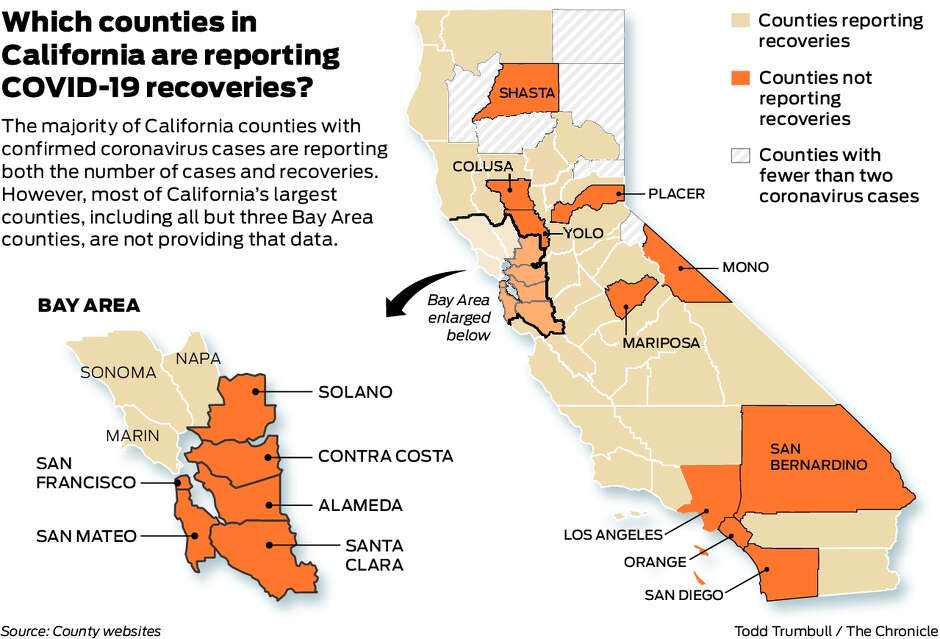
Many readers have asked The Chronicle this question, seeking a hopeful counterpoint to the case counts, hospitalizations and deaths updating every day in The Chronicle’s Coronavirus Tracker. But many of California’s largest counties, including most in the Bay Area, are not providing data on how many people have recovered from the virus.

“It’s probably the most ignored of the public metrics that are out there,” said Jeffrey Martin, professor of epidemiology and biostatistics at UCSF. Martin says the reason counties are deprioritizing this data is simple: “In short, it isn’t telling us that much.”

One key issue with data on recovered patients is that counties are defining what it means to be “recovered” in different ways. Martin lays this at the feet of the federal Centers for Disease Control and Prevention, which has issued “vague” criteria for the term. The CDC says a “recovered” person is someone whose fever goes away without the use of fever-reducing medications, whose respiratory symptoms have improved and whose symptoms first appeared more than seven days ago.

Neetu Balram, public information manager for the Alameda County Public Health Department, said that public health agencies including the CDC and the World Health Organization do not offer guidance for reporting this data.

“Recovery is not systematically recorded by health care providers or reported to health departments the way that new cases, hospitalizations and deaths are,” Balram said.

She said that data is more important to health departments because those numbers show the direct impact of COVID-19 on the health system.

While the majority of California counties are reporting data on recovered cases to the public, only three are doing so in the Bay Area: Marin (185 recovered, as of Saturday), Napa (32 recovered, as of Sunday) and Sonoma (128 recovered, as of Saturday night). Sacramento County displays recoveries as “likely recovered,” and was reporting 803 on Sunday.

Molly Rattigan, deputy county CEO for Napa, said her county is defining recovered cases as individuals diagnosed with COVID-19 who meet the following criteria: At least seven days have passed since the onset of symptoms, or at least 14 days have passed since the diagnosis, and they no longer have symptoms. Individuals who were hospitalized must be discharged and no longer in isolation, she said.

To determine recovered cases requires quite a bit of legwork.3

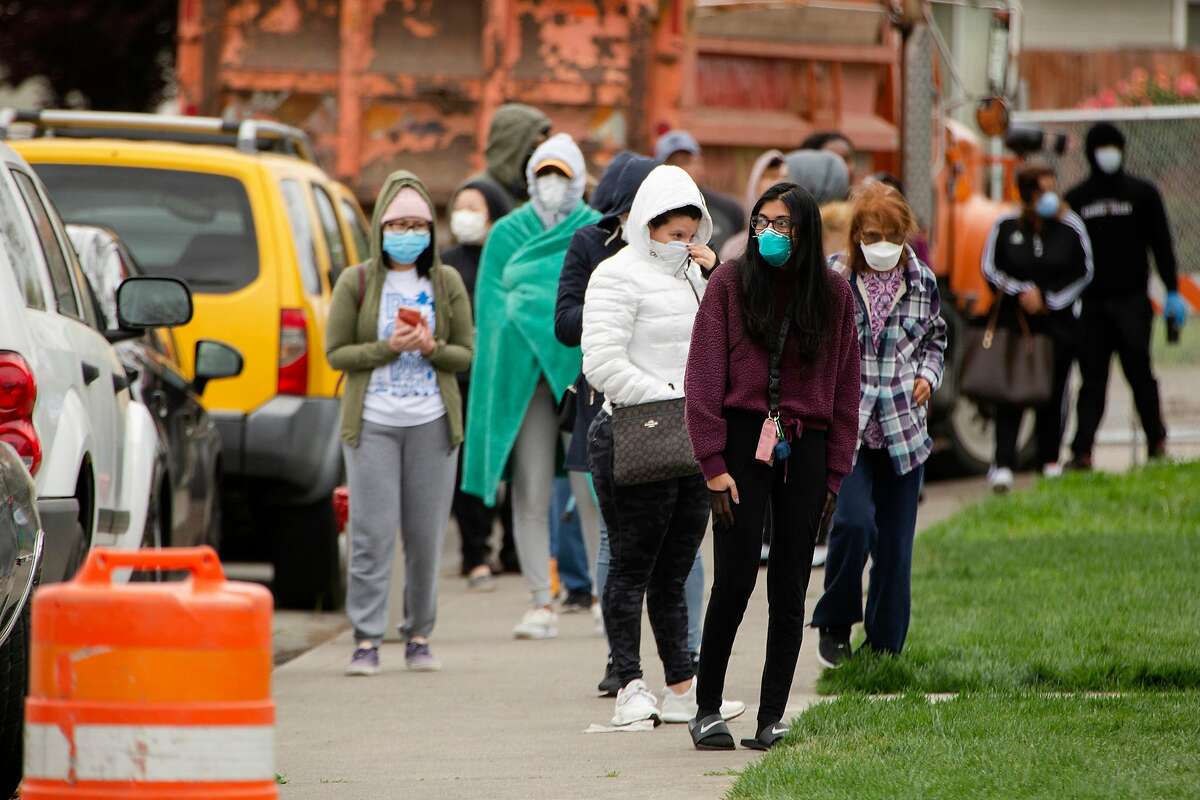
A crowd lines up for coronavirus tests in Hayward. Alameda is among the counties not reporting virus recovery data.
1of3A crowd lines up for coronavirus tests in Hayward. Alameda is among the counties not reporting virus recovery data.Photo: Brittany Hosea-Small / Special to The Chronicle
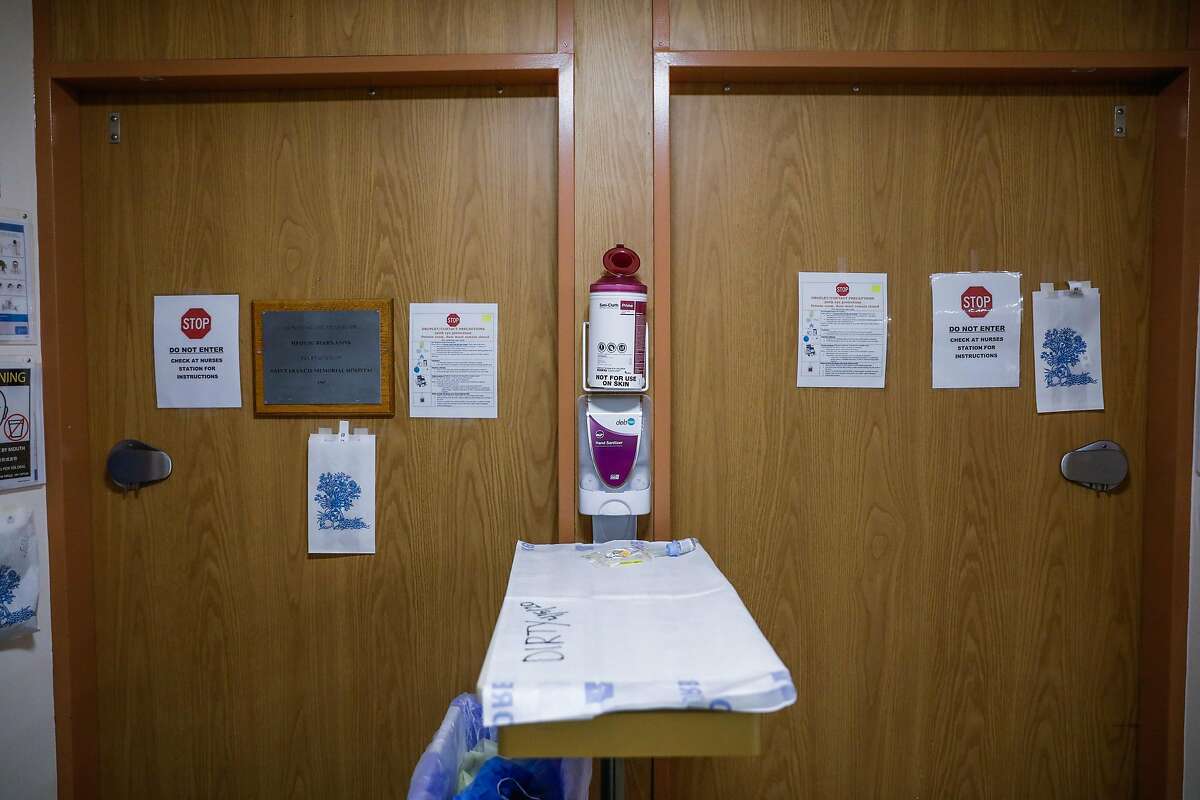
These doors lead to patients’ rooms on the COVID-19 floor at St. Francis Hospital in San Francisco.
3of3These doors lead to patients’ rooms on the COVID-19 floor at St. Francis Hospital in San Francisco.Photo: Gabrielle Lurie / The Chronicle

“Our case and contact team follows up daily with those that are at home,” Rattigan said.

Santa Cruz County also lists recoveries on its health department website. Jason Hoppin, communication manager for the county, said officials follow CDC guidelines to determine the number based on patient contacts.

“Our health officer reports all positives and negatives to us, and we have patient information through that process,” he said. “We follow up with the positives and check in on symptoms.”

Once the patient’s condition matches the guidelines, they are able to list that person as recovered.

San Francisco, Contra Costa, Alameda, Santa Clara, San Mateo and Solano do not share recovered cases on their websites. In Southern California, Los Angeles, Orange and San Diego counties do not report the data, either.

Experts say especially for larger counties, the process is too time-consuming and would require resources that could be better spent elsewhere.

“To actually ascertain it, you need to track down patients and ask them how they’re doing, have they been tested?” Martin said. “Many people are choosing to not actually bother to test people once they are feeling better, and even if not, there’s no point clinically to do it.”

John Swartzberg, an infectious disease expert at UC Berkeley, said in theory, tracking recoveries seems simple. A person is confirmed to have gotten the virus, and then they get better. But he said it’s more complicated than that.

“So they’ve clinically recovered, but are they still shedding the virus?” Swartzberg said. “Most of the data we have is not robust enough. … They may have recovered clinically but can’t answer that they are 100% recovered from the contagion.”

Another way to determine recoveries is via antibody tests, but Swartzberg said only a handful of companies offer accurate testing, and the rest have gone through little verification.

“We’re seeing a lot of false positives where the test was positive, but the person never was positive,” he said. “It’s a big problem that has to be ironed out. We have to have tests that are very specific.”

Martin said the recovery data being provided is “too crude” based on the CDC’s definition and is underestimated. He said counties shouldn’t spend time trying to gather it.

“It will never be done for everyone,” he said. “It’s incompletely being recorded, and it’s not reproducibly being recorded.”

Martin said the more important question down the line is seeing how patients look three, six and nine months out, which is one research effort at UCSF.

“Are you completely normal, or do you have some minor or major residual problems?” he said. “That’s going to come out in carefully coordinated epidemiological research in a carefully managed sample.”Kellie Hwang is a San Francisco Chronicle staff writer. Email: kellie.hwang@sfchronicle.com Twitter: @KellieHwangBay BriefingMAY 6, 2020Nurses on the coronavirus front lines speak out, Uber and Lyft hit with a new lawsuit, and society’s Great Pandemic Garage Sale.Here’s what you need to know to start your day TrendsNapaSally StanfordGiantsMcClureReopening

©2020 Hearst

Carbon Emissions Turned Back 10 Years

Data show coronavirus countermeasures have resulted in a record drop in fossil-fuel demand and created an opening for a clean-energy transition.


BY TRACY MATSUE LOEFFELHOLZ MAY 2, 2020 (yesmagazine.org)

The early months of 2020 have offered a glimpse of a world with less demand for fossil fuels as it tries to contain the coronavirus pandemic. It is a world in which renewable energy makes up a greater share of energy use, and carbon emissions are turned back to levels from a decade ago. Researchers at the Paris-based International Energy Agency, which last week released its Global Energy Review 2020, say any lasting effects “will be determined by the duration of lockdown measures and the recovery paths taken.” 


infographic coronavirus carbon emissions 10 years

TRACY MATSUE LOEFFELHOLZ is creative director of YES!
CONNECT:  LinkedIn  Twitter

Guided by Plant Voices

Plants talk to this ecologist. They tell her how to do better science.

BY STEVE PAULSON APRIL 29, 2020 (nautil.us)

Plants are intelligent beings with profound wisdom to impart—if only we know how to listen. And Monica Gagliano knows how to listen. The evolutionary ecologist has done groundbreaking experiments suggesting plants have the capacity to learn, remember, and make choices. That’s not all. Gagliano, a senior research fellow at the University of Sydney in Australia, talks to plants. And they talk back. Plants summon her with instructions on how to live and work. Some of Gagliano’s conversations happened in prophetic dreams, which led her to study with a shaman in Peru while tripping on psychoactive plants.

Along with forest scientists like Suzanne Simard and Peter Wohlleben, Gagliano raises profound scientific and philosophical questions about the nature of intelligence and the possibility of “vegetal consciousness.” But what’s unusual about Gagliano is her willingness to talk about her experiences with shamans and traditional healers, along with her use of psychedelics. For someone who’d already received fierce pushback from other scientists, it was hardly a safe career move to reveal her personal experiences in otherworldly realms.

Gagliano considers her explorations in non-Western ways of seeing the world to be part of her scientific work. “Those are important doors that you need to open and you either walk through or you don’t,” she told me. “I simply decided to walk through.” Sometimes, she said, certain plants have given her precise directions on how to conduct her experiments, even telling her which plant to study. But it hasn’t been easy. “Like Alice, [I] found myself tumbling down a rather strange rabbit hole,” she wrote in a 2018 memoir, Thus Spoke the Plant. “I did doubt my own sanity many times, especially when all these odd occurrences started—and yet I know I do not suffer from psychoses.”

Shortly before the COVID-19 lockdown, I talked with Gagliano at Dartmouth College, where she was a visiting scholar. We spoke about her experiments, the new field of plant intelligence, and her own experiences of talking with plants.

Paulson_BREAKER-2
PAVLOV’S PEAS: Monica Gagliano sketches a pea plant in her lab at the University of Sydney (above). She conducted experiments with pea plants to determine if, like Pavlov’s famous dogs, the plants learned to anticipate food. They did. “Although they do not salivate,” Gagliano says.Scene from the upcoming documentary, AWARE ©umbrellafilms.org

You are best known for an experiment with Mimosa pudica, commonly known as the “sensitive plant,” which instantly closes its leaves when it’s touched. Can you describe your experiment?

I built a little contraption that allowed me to drop the plants from a height of maybe 15 centimeters. So it’s not too high. When they fall, they land in a softly padded base. This plant closes its leaves when disturbed, especially if the disturbance is a potential predator. When the leaves are closed, big, spiny, pointy things stick out, so they might deter a predator. In fact, they not only close the leaf, but literally droop, like, “Look, I’m dead. No juice for you here.”

You did this over and over, dropping the plants repeatedly.

Exactly. It makes no sense for a plant or animal to repeat a behavior that is actually useless, so we learn pretty quick that whatever is useless, you don’t do anymore. You’re wasting a lot of energy trying to do something that doesn’t actually help. So, can the plant—in this case, Mimosa—learn not to close the leaves when the potential predator is not real and there are no bad consequences afterward?

After how many drops did they stop closing their leaves?

The test is for a specific type of learning that is called habituation. I decided they would be dropped continuously for 60 times. Then there was a big pause to let them rest and I did it again. But the plants were already re-opening their leaves after the first three to six drops. So within a few minutes, they knew exactly what was going on—like, “Oh my god, this is really annoying but it doesn’t mean anything, so I’m just not going to bother closing. Because when my leaves are open, I can eat light.” So there is a tradeoff between protecting yourself when the threat is real and continuing to feed and grow. I left the plants undisturbed for a month and then came back and repeated the same experiment on those individuals. And they showed they knew exactly what was going on. They were trained.

This is who I am. And nobody has the right to tell me that it’s not real.

You say these plants “understand” and “learn” that there’s no longer a threat. And you’re suggesting they “remember.” You’re not using these words metaphorically. You mean this literally?

Yes, that’s what they’re doing. This is definitely memory. It’s the same kind of experiment we do with a bee or a mouse. So using the words “memory” and “learning” feels totally appropriate. I know that some of my colleagues accuse me of anthropomorphizing, but there is nothing anthropomorphic about this. These are terms that refer to certain processes. Memory and learning are not two separate processes. You can’t learn unless you remember. So if a plant is ticking all the boxes and doing what you would expect a rat or a mouse or a bee to do, then the test is being passed.

Do you think these plants are actually making decisions about whether or not to close their leaves?

This experiment with Mimosa wasn’t designed to test that specific question. But later, I did experiments with other plants, with peas in particular, and yes, there is no doubt the plants make choices in real decision-making. This was tested in the context of a maze, where the test is actually to make a choice between left and right. The choice is based on what you might gain if you choose one side or the other. I did one study with peas that showed the plants can choose the right arm in a maze based on where the sound of water is coming from. Of course, they want water. So they will use the signal to follow that arm of the maze as they try to find the source of water.

So plants can hear water?

Oh, yeah, of course. And I’m not talking about electrical signals. We have also discovered that plants emit their own sounds. The acoustic signal comes out of the plant.

What kind of sounds do they make?

We call them clicks, but this is where language might fail because we are trying to describe something we’re not familiar enough with to create the language that really describes the picture. We worked out that, yes, plants not only produce their own sound, which is amazing, but they are listening to sounds. We are surrounded by sound, so there are studies, like my own study, of plants moving toward certain frequencies and then responding to sounds of potential predators chewing on leaves, which other plants that are not yet threatened can hear. “Oh, that’s a predator chewing on my neighbor’s leaves. I better put my defenses up.” And more recently, there was some work done in Israel on the sound of bees and how flowers prepared themselves and become very nice and sweet, literally, to be more attractive to the bee. So the level of sugars gets increased as a bee passes by.

Paulson_BREAKER-3
SECRET LIFE OF PLANTS: Monica Gagliano says her experiences with indigenous people, such as the Huichol in Mexico (above), informed her view that plants have a range of feelings. “I don’t know if they would use those words to describe joy or sadness, but they are feeling bodies,” she says.Scene from the upcoming documentary, AWARE ©umbrellafilms.org

You are describing a surprising level of sophistication in these plants. Do you have a working definition of “intelligence?”

That’s one of those touchy subjects. I use the Latin etymology of the word and “intelligere” literally means something like “choosing between.” So intelligence really underscores decision-making, learning, memory, choice. As you can imagine, all those words are also loaded. They belong in the cognitive realm. That’s why I define all of this work as “cognitive ecology.”

Do you see parallels between this kind of intelligence in plants and the collective intelligence that we associate with social insects in ant colonies or beehives?

That kind of intelligence might be referred to as “distributed intelligence” or “collective intelligence.” We are testing those questions right now. Plants don’t have neurons. They don’t have a brain, which is often what we assume is the base for all of these behaviors. But like slime molds and other basal animals that don’t have neural systems, they seem to be doing the same things. So the short answer is yes.

What you’re saying is very controversial among scientists. The common criticism of your views is that an organism needs a brain or at least a nervous system to be able to learn or remember. Are you saying neurons are not required for intelligence?

Science is full of assumptions and presuppositions that we don’t question. But who said the brain and the neurons are essential for any form of intelligence or learning or cognition? Who decided that? And when I say neurons and brains are not required, it’s not to say they’re not important. For those organisms like ourselves and many animals who do have neurons and brains, it’s amazing. But if we look at the base of the animal kingdom, sponges don’t have neurons. They look like plants because when they’re adults, they settle on the bottom of the ocean and pretty much just sit there forever. Yet if you look at the sponge’s genome, they have the genetic code for the neural system. It’s almost like from an evolutionary perspective, they simply decided that developing a neural system was not useful. So they went a different way. Why would you invest that energy if you don’t need it? You can achieve the same task in different ways.

Your food is psychedelic. It changes your brain chemistry all the time.

Your critics say these are just automatic adaptive responses. This is not really learning.

You know, they just say plants do not learn and do not remember. Then you do this study and stumble on something that actually shows you otherwise. It’s the job of science to be humble enough to realize that we actually make mistakes in our thinking, but we can correct that. Science grows by correcting and modifying and adjusting what we once thought was the fact. I went and asked, can plants do Pavlovian learning? This is a higher kind of learning, which Pavlov did with his dogs salivating, expecting dinner. Well, it turns out plants actually can do it, but in a plant way. So plants do not salivate and dinner is a different kind of dinner. Can you as a scientist create the space for these other organisms to express their own, in this case, “plantness,” instead of expecting them to become more like you?

There’s an emerging field of what’s called “vegetal consciousness.” Do you think plants have minds?

What is the mind? [Laughs] You see, language is very inadequate at the moment in describing this field. I could ask you the same question in referring to humans. Do you think humans have a mind? And I could answer again, what is the mind? Of course, I have written a paper with the title “The Mind of Plants” and there is a book coming called The Mind of Plants. In this context, language is used to capture aspects of how plants can change their mind, and also whether they have agency. Is there a “person” there? These questions are relevant beyond science because they have ethical repercussions. They demand a change in our social attitude toward the environment. But I already have a problem with the language we are using because the question formulated in that way demands a yes or no answer. And what if the answer cannot be yes or no?

Let me ask the question a different way. Do you think plants have emotional lives? Can they feel pain or joy?

It’s the same question. Where do feelings arise from, and what are feelings? These are yes or no questions, usually. But to me, they are yes and no. It depends on what you mean by “feeling” and “joy.” It also depends on where you are expecting the plant to feel those things, if they do, and how you recognize them in a human way. I mean, plants might have more joy than we do. It’s just that we don’t know because we’re not plants.

We have only talked about this from the scientific perspective, which is the Western view of the world. But I’ve also had a close relationship with plants from a very different perspective, the indigenous world view. Why is that less valuable? And when you actually do explore those perspectives, they require your experience. You can’t just understand them by thinking about them. My own personal experience tells me that plants definitely feel many things. I don’t know if they would use those words to describe joy or sadness, but they are feeling bodies. We are feeling bodies.

Science is full of assumptions and presuppositions that we don’t question.

You’ve studied with shamans in indigenous cultures and you’ve taken ayahuasca and other psychoactive plants. Why did you seek out those experiences?

I didn’t. They sought me. So I just followed. They just arrived in my life. You know, those are important doors that you need to open and you either walk through or you don’t. I simply decided to walk through. I had this weird series of three dreams while I was in Australia doing my normal life. By the time the third dream came, it was very clear that the people that I was dreaming of were real people. They were waiting somewhere in this reality, in this world. And the next thing, I’m buying a ticket and going to Peru and my partner at the time is looking at me like, “What are you doing?” [laughs] I have no idea, but I need to go. As a scientist, I find this is the most scientific approach that I’ve ever had. It’s like there is something asking a question and is calling you to meet the answer. The answer is already there and is waiting for you, if you are prepared to open the door and cross through. And I did.

What did you do in Peru?

The first time I went, I found this place that was in my dream. It was just exactly the same as what I saw in my dream. It was the same man I saw in my dream, grinning in the same way as he was in my dream. So I just worked with him, trying to learn as much as I could about myself with his support.

This was a local shaman whom you identify as Don M. And there was a particular plant substance, a hallucinogen, that you took.

I did what they call a “dieta,” which is basically a quiet, intense time in isolation that you do on your own in a little hut. You are just relating with the plant that the elder is deciding on. So for me, the plant that I worked with wasn’t by itself a psychedelic in the normal way of thinking about it. But of course, all plants are psychedelic. Even your food is psychedelic because it changes your brain chemistry and your neurobiology all the time you eat. Sugars, almonds, all sorts of neurotransmitters are flying everywhere. So, again, even the idea of what a psychedelic experience is needs to be revised, because a lot of people might think that it’s only about certain plants that they have a very strong, powerful transformation. And I find that all plants are psychedelic. I can sit in my garden. I don’t have to ingest anything and I can feel very altered by that experience.

You’ve said the plant talked to you. Did you actually hear words?

When you’re trying to describe this to people haven’t had the experience, it probably doesn’t make much sense because this kind of knowledge requires your participation. I don’t hear someone talking to me as if from the outside, talking to me in words and sound. But even that is not correct because inside my head it does sound exactly like a conversation. Not only that, but I know it’s not me. There is no way that I would know about some of the information that’s been shared with me.

Are you saying these plants had specific information to tell you about your life and your work?

Yeah, I mean, some of the plants tell me exactly how wrong I was in thinking about my experiments and how I should be doing them to get them to work. And I’m like, “Really?” I’m scribbling down without really understanding. Then I go in the lab and try what they say. And even then, there is a part of me that doesn’t really believe it. For one experiment, the one on the Pavlovian pea, I was trying to address that question the year before with a different plant. I was using sunflowers. And while I was doing my dieta with a different tree back in Peru, the plant just turned up and said, “By the way, not sunflowers, peas.” And I’m like, “what?” People always think that when you have these experiences, you’re supposed to understand the secrets of the universe. No, my plants are usually quite practical. [laughs] And they were right.

Do you think you are really encountering the consciousness of that plant? Maybe your imagination has opened up to see the world in new ways, but it’s all just a projection of your own mind. How do you know you are actually encountering another intelligence?

If you had this experience of connecting with plants the way I have described—and there are plenty of people who have—the experience is so clear that you know that it’s not you; it’s someone else talking. If you haven’t had that experience, then I can totally see it’s like, “No way, it must be your mind that makes it up.” But all I can say is that I have had exchanges with plants who have shared things about topics and asked me to do things that I have really no idea about.

What have plants asked you to do?

I’m not a medical scientist, but I’ve been given information by plants about their medical properties. And these are very specific bits of information. I wrote them in my diary. I would later check and I did find them in the medical literature: “This plant is for this and we know this.” I just didn’t know. So maybe I’m tapping into the collective consciousness.

What do you do with these kinds of personal experiences? You are a scientist who’s been trained to observe and study and measure the physical world. But this is an entirely different kind of reality. Can you reconcile these two different realities?

I think there are some presuppositions that a scientist should just explore the consensus reality that most of us experience in more or less the same way. But I don’t really have a conflict because I find this is just part of experimenting and exploring. If anything, I found that it has enriched and expanded the science I do. This is a work in progress, obviously, but I think I’m getting better at it. And in the writing of my book, which for a scientist was a very scary process because it was laying bare some parts of me that I knew would likely compromise my career forever, it also became liberating because once it was written, now the world knows. And it’s my truth. This is how I operate. This is who I am. And nobody has the right or the authority to tell me that it’s not real.

Steve Paulson is the executive producer of Wisconsin Public Radio’s nationally syndicated show “To the Best of Our Knowledge.” He’s the author of Atoms and Eden: Conversations on Religion and Science. You can subscribe to TTBOOK’s podcast here.

Find Death Before Death Finds You

Eckhart Tolle Death is a stripping away of all that is not you. The secret of life is to “die before you die” and find that there is no death.” For Eckhart, the only ‘real’ death is never knowing who you really are, never understanding your true ‘being’. When you have a true sense of self, this can never die. Subscribe to find greater transcendence in life: http://bit.ly/EckhartYT “Staying Conscious In The Face of Adversity” A free teaching series on how crisis propels awakening with Eckhart Tolle. Sign up for free here: https://bit.ly/freecoursesignup Want to watch and hear more of Eckhart’s Teachings? Become a member today and join our growing community! http://bit.ly/ETmembership Interested in diving deeper into Eckhart Tolle’s work? Enjoy a FREE 10-DAY TRIAL to Eckhart Tolle Now: https://www.eckharttollenow.com/v9/join/ Check out some of our other playlist: Meditation – https://bit.ly/2QkG5uU Our True Identity – https://bit.ly/2COKGTo Supporting Awakening – https://bit.ly/2O4M6dW Daily Life – https://bit.ly/2O70SRp Conversations with Guests – https://bit.ly/2MiB2Ig Connect with us elsewhere: http://www.EckhartTolleNow.comhttps://www.facebook.com/Eckharttollehttp://www.instagram.com/eckharttollehttps://twitter.com/EckhartTollehttp://pinterest.com/eckharttolle Eckhart Tolle is widely recognized as one of the most original and inspiring spiritual teachers of our time. He travels and teaches throughout the world. Eckhart is not aligned with any particular religion or tradition, but excludes none. His profound yet simple and practical teachings have helped thousands of people find inner peace, healing and greater fulfillment in their lives. At the core of his teachings lies the transformation of individual and collective human consciousness – a global spiritual awakening. Eckhart Tolle is the author of The Power of Now, a #1 New York Times Bestseller, which has been translated into over 52 languages and become one of the most influential spiritual books of our time. In his most recent book, A New Earth, he shows how transcending our ego-based state of consciousness is not only essential to personal happiness, but also the key to ending conflict and suffering throughout the world.

Are We Living in a Computer Simulation?

High-profile physicists and philosophers gathered to debate whether we are real or virtual—and what it means either way.

Scientific American (getpocket.com)

  • Clara Moskowitz
GettyImages-677252683.jpg

Photo by Yagi Studio / Getty Images.

If you, me and every person and thing in the cosmos were actually characters in some giant computer game, we would not necessarily know it. The idea that the universe is a simulation sounds more like the plot of “The Matrix,” but it is also a legitimate scientific hypothesis. In 2016, researchers pondered the controversial notion at the annual Isaac Asimov Memorial Debate here at the American Museum of Natural History.

Moderator Neil deGrasse Tyson, director of the museum’s Hayden Planetarium, put the odds at 50-50 that our entire existence is a program on someone else’s hard drive. “I think the likelihood may be very high,” he said. He noted the gap between human and chimpanzee intelligence, despite the fact that we share more than 98 percent of our DNA. Somewhere out there could be a being whose intelligence is that much greater than our own. “We would be drooling, blithering idiots in their presence,” he said. “If that’s the case, it is easy for me to imagine that everything in our lives is just a creation of some other entity for their entertainment.”

Virtual Minds

A popular argument for the simulation hypothesis came from University of Oxford philosopher Nick Bostrum in 2003, when he suggested that members of an advanced civilization with enormous computing power might decide to run simulations of their ancestors. They would probably have the ability to run many, many such simulations, to the point where the vast majority of minds would actually be artificial ones within such simulations, rather than the original ancestral minds. So simple statistics suggest it is much more likely that we are among the simulated minds.

And there are other reasons to think we might be virtual. For instance, the more we learn about the universe, the more it appears to be based on mathematical laws. Perhaps that is not a given, but a function of the nature of the universe we are living in. “If I were a character in a computer game, I would also discover eventually that the rules seemed completely rigid and mathematical,” said Max Tegmark, a cosmologist at the Massachusetts Institute of Technology (MIT). “That just reflects the computer code in which it was written.”

Furthermore, ideas from information theory keep showing up in physics. “In my research I found this very strange thing,” said James Gates, a theoretical physicist at the University of Maryland. “I was driven to error-correcting codes—they’re what make browsers work. So why were they in the equations I was studying about quarks and electrons and supersymmetry? This brought me to the stark realization that I could no longer say people like Max are crazy.”

Room for Skepticism

Yet not everyone on the panel agreed with this reasoning. “If you’re finding IT solutions to your problems, maybe it’s just the fad of the moment,” Tyson pointed out. “Kind of like if you’re a hammer, every problem looks like a nail.”

And the statistical argument that most minds in the future will turn out to be artificial rather than biological is also not a given, said Lisa Randall, a theoretical physicist at Harvard University. “It’s just not based on well-defined probabilities. The argument says you’d have lots of things that want to simulate us. I actually have a problem with that. We mostly are interested in ourselves. I don’t know why this higher species would want to simulate us.” Randall admitted she did not quite understand why other scientists were even entertaining the notion that the universe is a simulation. “I actually am very interested in why so many people think it’s an interesting question.” She rated the chances that this idea turns out to be true “effectively zero.”

Such existential-sounding hypotheses often tend to be essentially untestable, but some researchers think they could find experimental evidence that we are living in a computer game. One idea is that the programmers might cut corners to make the simulation easier to run. “If there is an underlying simulation of the universe that has the problem of finite computational resources, just as we do, then the laws of physics have to be put on a finite set of points in a finite volume,” said Zohreh Davoudi, a physicist at MIT. “Then we go back and see what kind of signatures we find that tell us we started from non-continuous spacetime.” That evidence might come, for example, in the form of an unusual distribution of energies among the cosmic rays hitting Earth that suggests spacetime is not continuous, but made of discrete points. “That’s the kind of evidence that would convince me as a physicist,” Gates said. Yet proving the opposite—that the universe is real—might be harder. “You’re not going to get proof that we’re not in a simulation, because any evidence that we get could be simulated,” said David Chalmers, a professor of philosophy at New York University.

Life, the Universe and Everything

If it turns out we really are living in a version of “The Matrix,” though—so what? “Maybe we’re in a simulation, maybe we’re not, but if we are, hey, it’s not so bad,” Chalmers said.

“My advice is to go out and do really interesting things,” Tegmark said, “so the simulators don’t shut you down.”

But some were more contemplative, saying the possibility raises some weighty spiritual questions. “If the simulation hypothesis is valid then we open the door to eternal life and resurrection and things that formally have been discussed in the realm of religion,” Gates suggested. “The reason is quite simple: If we’re programs in the computer, then as long as I have a computer that’s not damaged, I can always re-run the program.”

And if someone somewhere created our simulation, would that make this entity God? “We in this universe can create simulated worlds and there’s nothing remotely spooky about that,” Chalmers said. “Our creator isn’t especially spooky, it’s just some teenage hacker in the next universe up.” Turn the tables, and we are essentially gods over our own computer creations. “We don’t think of ourselves as deities when we program Mario, even though we have power over how high Mario jumps,” Tyson said. “There’s no reason to think they’re all-powerful just because they control everything we do.” And a simulated universe introduces another disturbing possibility. “What happens,” Tyson said, “if there’s a bug that crashes the entire program?”

Clara Moskowitz is a senior editor at Scientific American. She covers space and physics.

Consciousness, sexuality, androgyny, futurism, space, the arts, science, astrology, democracy, humor, books, movies and more