Theories of Everything with Curt Jaimungal July 30, 2020 Donald Hoffman a cognitive psychologist and Professor in the Department of Cognitive Sciences at the University of California, Irvine. The interviewer is Curt Jaimungal, who has a background in mathematical physics, making this an eminently scholarly and technical talk (relative to what exists with Donald Hoffman). Familiarize yourself with the fundamentals of his theory before watching this in order to be maximally edified. Patreon for conversations on Theories of Everything, Consciousness, Free Will, and God: https://patreon.com/curtjaimungal Help support conversations like this via PayPal: https://bit.ly/2EOR0M4 Twitter: https://twitter.com/TOEwithCurt iTunes: https://podcasts.apple.com/ca/podcast… Pandora: https://pdora.co/33b9lfP Spotify: https://open.spotify.com/show/4gL14b9… Google Podcasts: https://play.google.com/music/listen?… 0:00 Introduction 0:35 Hoffman’s thought on the state of the country during COVID and what it entails about his theories 2:51 Why he meditates for 3 hours daily, and what type of practice it is 7:26 Hoffman’s diet and health habits 9:52 On computational psychology (Hoffman’s initial background) 13:05 Outlining (technically) the conscious agent model, and the motive force behind the lettering 16:41 Consciousness as primary to Being, as the impediment for rationalists 26:50 Why neural correlates aren’t *just* correlates, but instead can play causal role (playing devil’s advocate) and the limits of the “virtual reality” metaphor 38:44 Nima Armani Hamed’s amplituhedron, and consciousness 40:23 Local hidden variables / realism may be saved, via loopholes in Bell’s theorem 47:46 The assumption of uniform probability of fitness functions on cyclic groups, etc. is a problem for a theory that says our perceptions are non-veridical (ie. that they don’t match “reality”) 1:01:44 Evolution entails that we don’t see the truth / reality as it is 1:05:10 On the over simplification of evolutionary models (outputting down to the Real Line of dimension 1 without further structure) 1:09:17 The intensity of meditation, and fear of letting go / fear of the unknown 1:15:25 “Illusions are failures to guide adaptive behavior.” 1:16:41 The various philosophical theories on truth (correspondence, pragmatic, deflationary, etc.) 1:27:20 Spacetime as a data compression tool for conscious agents 1:32:39 On the nature of causality 1:37:50 How is reality objective, when in Hoffman’s model it’s predicated exclusively on subjective agents 1:40:00 What is “you”? What is “identity”? What is the “self”? (Eastern religions vs Western religions) 1:50:15 How does Free Will fit into a stochastic model? 1:58:59 Douglas Hofstadter’s “strange loop” model of consciousness & Tononi’s Integrated information theory vs. Donald Hoffman’s 2:14:37 Where God fits into all of this, as well as Hoffman’s definition of God 2:21:22 What happens when you die? 2:28:38 Gödel’s incompleteness theorem’s implications for Hoffman’s model 2:34:35 John Vervaeke’s other forms of knowledge which aren’t “propositional” 2:37:45 Landauer’s limit (fastidious critiques) 2:41:29 On the moon not existing when you don’t look at it 2:48:06 Do you see the same color red that I see? (and other experiences / qualia) 2:51:31 The paradox of pursuing truth, though truth is inimical (relative to fitness) 2:56:44 Where does Deepak Chopra take Hoffman’s message too far + what Jesus meant by “I am the truth / the way / the life” * * * I’m producing an imminent documentary Better Left Unsaid http://betterleftunsaidfilm.com on the topic of “when does the left go too far?” Visit that site if you’d like to contribute to getting the film distributed (in 2021) and seeing more conversations like this.
Join Braver Angels National Ambassador, John Wood, Jr., to discuss how we can bridge the partisan divide and co-create community online.
EVENT BY Center for Humane Technology….It’s Online through Air Meet (not Zoom)– (tip: best to use Google Chrome, not Firefox)
April 2, 2021
START TIME
10:00 AM – 10:30 AM PDT
Register and create your profile with Center for Humane Technology prior to Friday, April 2 (see link below), to receive your log-in codes/access.
A Tip: Enter the platform a bit before this event starts, if you want to sign up to be in one of the discussion groups following this talk. Some groups are more for the techie, some groups more for educators, etc. They can get filled up.
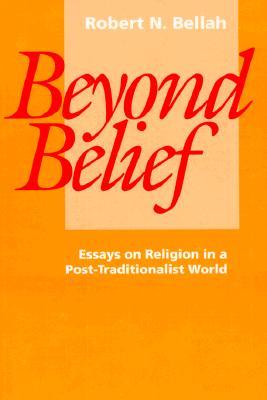
Beyond Belief collects fifteen celebrated, broadly ranging essays (including Religious Evolution) in which Robert Bellah interprets the interplay of religion and society in concrete contexts from Japan to the Middle East to the United States. First published in 1970, Beyond Belief is a classic in the field of sociology of religion.
“All students of man and society who possess that first requisite for so difficult a study, a due sense of its difficulties, are aware that the besetting danger is not so much of embracing falsehood for truth, as of mistaking part of the truth for the whole. It might be plausibly maintained that in almost every one of the leading controversies, past or present, in social philosophy, both sides were in the right in what they affirmed, though wrong in what they denied; and that if either could have been made to take the other’s views in addition to its own, little more would have been needed to make its doctrine correct.”
John Stuart Mill (May 20, 1806 – May 7, 1873) was an English philosopher, political economist, Member of Parliament, and civil servant. One of the most influential thinkers in the history of classical liberalism, he contributed widely to social theory, political theory, and political economy. Wikipedia
There are a few things that we all need: fresh air, water, food, shelter, love … and a safe place to pee. For trans people who don’t fit neatly into the gender binary, public restrooms are a major source of anxiety and the place where they are most likely to be questioned or harassed. In this poetically rhythmic talk, Ivan Coyote grapples with complex and intensely personal issues of gender identity and highlights the need for gender-neutral bathrooms in all public places.
This talk was presented to a local audience at TEDxVancouver, an independent event. TED’s editors chose to feature it for you.
ABOUT TEDX: TEDx was created in the spirit of TED’s mission, “ideas worth spreading.” It supports independent organizers who want to create a TED-like event in their own community.
About the talk: For a long time, Amrou Al-Kadhi struggled to negotiate the intersections between their queer and Islamic heritage. These identities felt completely polarized, as if their identity were founded on a tectonic fault at constant risk of rupture. Yet, it was the unlikely world of quantum physics that allowed Al-Kadhi to find the magic of contradictions — and to revel in their intersectional identity. Listen and subscribe to TEDx SHORTS and more podcasts from the TED Audio Collective at audiocollective.ted.com.
ABOUT THE SPEAKERS: Atossa Leoni is the host of the TEDx SHORTS. She is an actress and performer who has been working since childhood in film, television, theater and audiobooks, and she’s fluent in five languages.Amrou Al-Kadhi
Amrou Al-Kadhi is a writer, performer and filmmaker whose work explores queer intersectionality.
Sun conjunct Chiron represents the instinct of the human spirit to manifest itself and leave something immaterial behind. Our spirit seeking manifestation represents our “gift to the world”.
The Sun is our individuality, what makes us unique, our divine mission in this lifetime.
Chiron orbits between Saturn and Uranus, and is the link between the world as we know it (Saturn) and the mysteries and infinite possibilities of the heavens (Uranus).
Chiron is the archetype of the Wounded Healer because this process of moving from one realm (Saturn) to another (Uranus) requires a certain vulnerability and exposure. When you get out of your comfort zone (Saturn) something has to break.
Chiron’s orbit is very elliptical. Chiron can spend as little as one year and a half in some signs (Libra) and as long as 8 years in others (Aries). Chiron is a non-conformist and Chiron in your chart shows where you are a non-conformist, too (even if this lack of conformism makes you feel odd at times).
Sun conjunct Chiron is the compelling drive to push beyond your existing boundaries to find your true zone of genius.
The process of learning about your true self, the process of becoming who you are meant to be, cannot be an easy one. Hence the wound.
Let’s take the example of pearls. Do you know how they are made? A parasite tries to work its way into the oyster. As a defense mechanism, a fluid is used to stop the intruder. Layer upon layer of coating is deposited, until a lustrous pearl is formed.
The process takes years. For years and years, the mussel has to fight an endangering force. And after years of struggling, something amazingly beautiful emerges.
So many times we fail to see that it is our wound, our “handicap”, that is the source of our greatest gift.
The path to self-mastery always begins with embracing the wound. You cannot become a master if you don’t get in touch with the pain.
Chiron – the Link Between Heaven and Hell, the Conscious and the Unconscious
Ultimately, Chiron’s purpose is to restore wholeness. Sun conjunct Chiron will re-actualize all the Chironic themes in your life, asking you to (re)connect with the inner shaman.
The shaman’s role is to travel to hell, to heaven, and then back to earth.
In the same way, in his orbit, Chiron is the connecting link between the conscious archetypes represented by the planets visible to the naked eye (all planets up to Saturn), and the unconscious aspects represented by Uranus, Neptune and Pluto.
Chiron orbits between Saturn and Uranus and brings together these two worlds, connecting us with the whole universe.
Chiron And Your Greatest Gift
“Once upon a time there was a prince who wanted to stay forever young. Because no one in the court could help him figure out how, he made a decision to wander through the whole world to find that secret land where life is eternal.
The prince started to prepare for the journey. He went to his father’s stable to choose one fearless horse for his initiatic journey. For days and nights, he tried to find the right horse without success. No horse seemed to be strong enough for such a demanding endeavor.
Finally, when the prince loses all hope, he sees a thin, sick-looking, hungry horse, covered with sores. When he comes closer, the horse starts talking:
“If you want to fulfill your wish, you must ask your father for the sword, lance, bow, arrows, and garments he used to wear when he was young; AND you must take care of me and feed me with your own hands for six weeks and give me oats boiled in milk.”
So, feeding the hungry horse, wearing the father’s clothes and the prince’s desire to reach to “the other side” are the successful resources that bring eternal life.
The father’s clothes represent our genetic upbringing. In astrology, Chiron rules our genetic upbringing and DNA. We can only fulfill our mission when we build on our genetic heritage.
Sun Conjunct Chiron – Feed the Hungry Horse
What about the hungry horse? The horse represents the wound you choose to heal. The ‘handicap’ you choose to embrace. The undesirable side of yourself which if acknowledged, transforms into your greatest gift.
The horse represents those resources you choose to cultivate, even when there is no indication that you will ever succeed.
The man who unleashes the horse’s greatness and goes on an initiatic journey is a beautiful expression of Sun conjunct Chiron.
The horse is the wound (Chiron). The prince is the Sun, the spirit who unleashes the wound.
Sun conjunct Chiron represents the alchemical process of transforming the wound into a gift.
The hungry horse may get overlooked, or even despised, but he is in your stable for a reason. He has survived time and hardship because he has something to offer, and he can offer something no one else can, IF you take care of him.
The horse is a symbol for what is immortal, for what it cannot be destroyed, is what you leave behind for eternity, your contribution to the world, your legacy.
The hungry horse is that skill, that gift that only you have. It is your duty (Sun) to bring this gift (Chiron) to the highest possible form of manifestation.
Like any great piece of art, your skills and attributes will outlive you, to feed many more generations to come.
Who Wants to Live Forever?
“After a long trip, the prince finds what he is looking for, and reaches the land of eternal youth. Over there he marries a beautiful princess and lives a life of bliss.
He does not know how much time has passed, as he stays forever young. But one day he remembers his parents and the house where he grew up, and the longing for his family, for his roots, overwhelms him.
He decides to go back to see his parents and the people he grew up with one more time. On his way back home, he notices that everything has changed.
The forests have turned into cities and he could not recognize anything anymore. When he finally reaches the place where he grew up, he notices with sorrow that everything is now a ruin, and everyone in the court has been dead for a long time.
And then the horse tells him:
“I brought you here master, but now I will go back from where I came from”.
The man decides to stay there and lets nature take its course. Mortality finally catches up with him and he dies”
No human being is immortal, and sooner or later we will all turn to dust, but our gifts to the world (the horse) will always stay.
Our duty in this lifetime is to take notice of the hungry horses, to feed them and unleash their greatness.
Sun conjunct Chiron will ask you to pay attention to the wounded, hungry horses.
They might be hard to notice somewhere in the corner of your stable full of beautiful and healthy horses.
Take care of them and feed them with your “own hand” because it is only through them that you have the chance of eternal life.
Need a break from mindlessly scrolling through Twitter while commuting on BART? Grab a piece of flash fiction from any one of the rapid transit agency’s newly installed “Short Story Dispensers” — free of charge.
As mass transit begins to slowly recover from the pandemic — mind you: we’re not likely to see pre-pandemic levels of traffic on buses and passenger trains for some time — BART on Wednesday revealed it’s launching a test run of flash-fiction-dispensing machines in an effort to evoke some COVID-19-free nostalgia.
“Reading a book on the train is a tale-old tradition many BART riders partake in,” reads a tweet from the agency announcing the new pilot program. “To encourage reading for those even without a book, BART is piloting touchless [Short Edition] Short Story Dispensers, which print out short stories, at 4 BART stations.”
The futuristic machines —which are currently located at the Richmond, Fruitvale, and Pleasant Hill stations; one is also coming to Montgomery Street Station soon — each serve riders one- to five-minute-long short stories in a touchless manner; over 400 stories have since been served to readers over the past two days.
While these machines appear novel, this isn’t the first time they’ve graced the Bay Area. Filmmaker Francis Ford Coppola’s North Beach restaurant Café Zoetrope was first in the Bay Area (and country, for that matter) to install these literary vending machines — “anything that brings people together..which art can do, is clearly desirable,” Coppola had previously told BART.
“I read about it and thought it was a wonderful idea,” Coppola, who’s an investor in Short Edition, added. “Art dispensed by machine, and for free!”
BART staff, too, hopes to expand and create opportunities for Bay Area writers to be featured with their short stories in a bid to welcome back flocks of riders. For families keen on taking their young ones to snag a piece of flash fiction — the works of Franz Kafka and Joyce Carol Oates are among those presently available to read — don’t worry: all the stories are family-friendly and suitable for all ages.
The one-year pilot is sponsored by BART’s Communications Department and its Art Program; each story is printed on recycled paper and readers are encouraged to, themselves, dispose of the prints properly; due to the pandemic, it’s suggested that readers not share the physical stories with anyone not in their immediate circle or those not in their household to mitigate the risk of contracting COVID-19.
In modern America, it feels like you have an unlimited variety of entertainment and media options right at your fingertips.
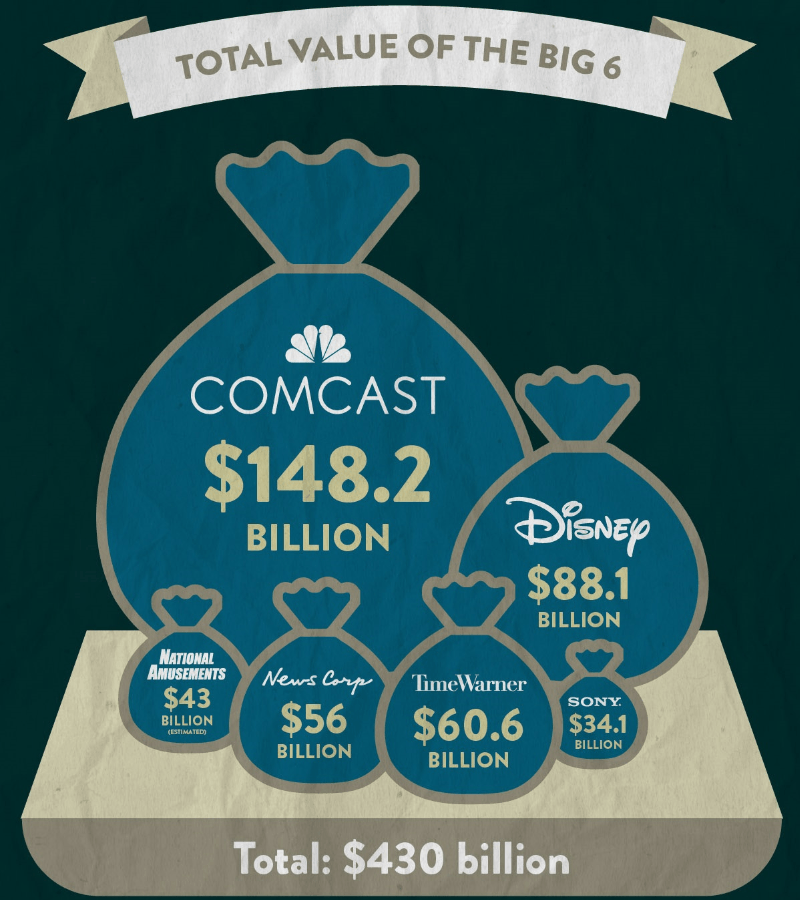
Television, film, and video game companies seem to come out of the woodwork in today’s startup-centric economy. Who knows what they’ll do next? But while it may seem like you have limitless options, most of the media you consume is owned by one of six companies. These six media companies are known as The Big 6.
While independent media outlets still exist (and there are a lot of them), the major outlets are almost all owned by these six conglomerates. To be clear, “media” in this context does not refer just to news outlets — it refers to any medium that controls the distribution of information. So here, “media” includes 24-hour news stations, newspapers, publishing houses, Internet utilities, and even video game developers.
With that in mind, let’s take a look at each of The Big 6, who control them, and what they own.
Media Conglomerate #1: National Amusements
Unless you’re directly involved in business and / or entertainment, you’ve probably never heard of National Amusements before.
The company owns movie theaters throughout the world — about 950 total — but it owns much more than just movie theaters.
NA’s huge collection of properties is staggering. Whether they own a company entirely, possess majority shares, or even own minority voting shares, the scope of NA’s reach is enormous for a company that’s known less than its subsidiaries.
To start our look at NA, let’s check out one of the biggest names in modern business — Sumner Redstone.
Head: Sumner Redstone
Sumner Redstone is the current owner of National Amusements and all of its properties. While his daughter Shari has the title of President, Sumner Redstone retains most of the control over the company.
NA was first founded by Sumner Redstone’s father Michael Redstone, making National Amusements one of the most powerful and successful corporate dynasties in the United States.
None of the Redstones publish their salaries. After all, National Amusements is a private company.
However, finance experts can guess at Sumner Redstone’s overall net worth.
His net worth refers to the total financial value of what Sumner Redstone owns, minus any outstanding debts.
As he nears his 94th birthday in 2017, Sumner Redstone (and his estate) is worth an estimated $4.6 billion, according to Forbes.While a decent amount of that value comes from his stake in National Amusements, much more of it comes from the companies that he owns.
TV and Film Assets
The most famous assets of National Amusements are almost all Viacom and CBS properties.
Combined, they make up the lion’s share of NA’s television and film acquisitions.Still, that’s only a portion of what NA owns.
Print Assets
National Amusements has a modest collection of print publishers, but they’re pretty well-known.
The most well-known is Simon and Schuster, which National Amusements acquired when it purchased Viacom in 1999.
Video Game Assets
Along with other entertainment assets, National Amusements controls CBS Games.
Since its acquisition, CBS Games has rebranded to CBS Interactive, which now controls well-known gaming websites that we’ll look at next.
Internet Assets
With CBS Interactive, National Amusements controls giant chunks of the video game news and sports news industries.
These brands include GameSpot, Metacritic, c|net, and 247-Sports.
Media Conglomerate #2: Disney
Disney is probably the most well-known media name on this list.
The company has a hand in just about every medium in the world from children’s cinema to sports.
When it comes to television and film, there’s a good chance you’re watching something owned by the Disney company — even if it doesn’t have Disney’s name.
Why?
They own so, so much.
Let’s start with the company’s leader.
Head: Bob Iger
Disney announced Bob Iger as CEO on March 13, 2005, following the departure of Michael Eisner.
Since then, Iger has run a campaign of mergers and acquisitions to expand Disney into an even greater media powerhouse, especially with the acquisition of Marvel ($4 billion) and Lucasfilm ($4 billion).
His published salary is $44.9 million. That breaks down to:
$1.73 million per paycheck
$172,692.32 per day
$21,586.54 per hour
Why does Iger make so much money?
He (technically) oversees all of the following companies.
TV and Film Assets
First, let’s look at the bread and butter of Disney — television, and film.
Considering they have theme parks built to their entertainment assets, it’s clear that Disney is best known for its TV and film properties.
There are so many different companies that you really just have to see it for yourself.
Print Assets
Disney’s print assets are a mix of proprietary publishers, Lucasfilm acquisitions, and Marvel properties.
The mix gives Disney a controlling interest in massive publishing niches, especially comic books, and science fiction novels.
Disney also owns ESPN, which has its own publishing arm for all things sports.
Video Game Assets
Finally, Disney owns a few video game assets.
They’re not huge, but they’re enough to keep Disney mildly competitive and up-to-date in the video game industry (especially mobile gaming).
GameStar, a subsidiary of Disney Interactive Studios, is one of the best-known video game developers bought by Disney.
Media Conglomerate #3: TimeWarner
At the time of publication (11/7/16), it’s possible that ATandT will soon buy TimeWarner for around $80 billion.
If that happens, ATandT will acquire everything below and more.
In the meantime, let’s take a more in-depth look at TimeWarner and what it owns.
Head: Jeff Bewkes
Jeff Bewkes is the CEO of TimeWarner. He makes $32.5 million per year.
As the head of TimeWarner, he’s responsible for all of the following companies.
TV and Film Assets
TimeWarner owns an incredible amount of television and film properties.
The most famous is probably Warner Brothers Animation Studios, which owns properties like Looney Tunes.
Along with that, TimeWarner has joint ventures in The CW and Hulu, along with ultra-niche TV programming for medical waiting rooms.
TimeWarner has also played a big role in comic book adaptations into movies, most notably with Batman.
Last, TimeWarner’s HBO branch achieved global renown with its runaway fantasy drama Game of Thrones, an adaptation of George R. R. Martin’s A Song of Ice and Fire.
Needless to say, TimeWarner’s television and film branches — including joint ventures like Hulu and CW — are doing pretty well these days.
Print Assets
On top of its incredible TV and movies, TimeWarner also controls several big-name print assets, including TIME (obviously).
Investments
TimeWarner has one of the most diverse investment portfolios of any media company.
Their investments act as controlling interests in lots of companies, some of which aren’t related to media.
But no matter what they are, each investment gives TimeWarner a stronger foothold in media.
Video Game Assets
As the owner of DC Comics, Looney Tunes, and tons of other fictional characters, it makes sense that TimeWarner owns a list of accomplished video game studios.
The most well-known is probably NetherRealm, which owns and publishes the controversial (and popular) Mortal Kombat series.
They also own Rocksteady, which is responsible for many of the latest Batman games.
Music Assets
TimeWarner doesn’t own a lot in music, but they have enough to ensure musical support for their other properties.
WaterTower Music might be the better-known business of the two enterprises, but Warner Music Group is still an essential part of the TimeWarner brand.
Internet Assets
Finally, TimeWarner is the first company on our list that also acts as an Internet service provider.
TimeWarner Cable is a major ISP in the United States, and it regularly competes with Comcast.
While its reputation differs from person to person, TimeWarner Cable is wildly profitable, and it’s become a major pillar of TimeWarner’s success.
Media Conglomerate #4: Comcast
Comcast is one of the few remaining Internet service providers in the United States. They also provide cable television and phone services to residential and business customers.
In 2013, Comcast expanded its reach into entertainment by purchasing NBC and pretty much all of its properties.
While most people know NBC as just a television station, it also has major stakes in media companies around the world.
That makes Comcast a major contender in global media, especially in the United States.
That may sound like a ridiculous figure to use with the term “only,” but under Roberts’ leadership, the company now earns $74.5 billion annually.
As a result, Roberts is compensated well. He earns $40.8 million per year, which works out to:
$1.57 million per paycheck
$156,923.04 per workday
$19,615.38 per hour
That salary may be exclusive to Comcast’s utilities subscriptions. But that’s not the only way the ISP megalith earns money.
TV and Film Assets
With the acquisition of NBC, Comcast expanded its repertoire of TV and film assets many times over.
TV programming from NBC, cinema from Universal Pictures, and next-gen publishers like AwesomenessTV are all integral to Comcast’s growth and sustainability over the next few decades.
Even their religious niche branch — Big Idea — plays an important part in Comcast’s continued success and increased competitiveness in the media world.
Internet Assets
Most famously, Comcast is known as an Internet provider.
It’s a direct competitor to TimeWarner Cable, and it’s the primary (or only) ISP in dozens of regions in the United States.
Ventures
Last, Comcast has a laundry list of ventures that it launched (or helped launch).
This gives Comcast an interest in dozens of seemingly-unrelated companies as an investor and potentially a future shareholder for the most successful branches.
Media Conglomerate #5: News Corp
News Corp is the media conglomerate best known for its line of Fox companies.
Those include Fox News, FX, and pretty much every other company with the name “Fox” in it.
The company generated more than $33 billion in 2012, and it controls a huge number of print products compared to other media conglomerates.
To get a better grasp of News Corp, let’s check out their CEO Rupert Murdoch.
Head: Rupert Murdoch
While News Corp underwent a split in 2013, Rupert Murdoch remains the head of most of News Corp’s current assets.
With a hand in television, film, music, and print, Murdoch is perhaps the most successful Australian entrepreneur to build an international empire.
As a result, Murdoch earns something to the tune of $22.3 million per year, which is roughly:
$857,692 per paycheck
$85,769.20 per workday
$10,721.15 per hour
So what do Murdoch and his world-famous News Corp control?
TV and Film Assets
News Corp owns the Fox brand, which means they control a borderline-unreasonable amount of media outlets via television and film.
There’s not much more to say about it — News Corp just owns a lot of outlets.
Music Assets
On top of TV and film, News Corp also owns a handful of music assets.
It’s not News Corps’s biggest branch, but it works for their needs, which is typically supporting the TV and film divisions with music (Fox Music).
Wireless Group PLC, on the other hand, is an Irish radio broadcast corporation — one of the biggest in the country.
Print Assets
News Corps’s foundational asset is print.
The company owns hundreds of national, regional, and local newspapers around the world.
The most famous is probably the Wall Street Journal, which fits the mold of News Corps’s focus on financial information.
News Corp also owns HarperCollins, which owns the Christian-niche Zondervan, making News Corp a major player in retail books as well.
Media Conglomerate #6: Sony
Sony is one of the oldest companies on this list since it was founded in 1946.
It also has one of the most recent CEO changes.
In 2012, Kazuo Hirai became CEO of the entire corporation, which might be the most well-known electronics brand on the planet.
But Sony is so much more than an electronics company. They have interests across almost all media industries, and Hirai has helped keep the company current and competitive.
Head: Kazuo Hirai
“Kaz” Hirai started work at Sony Music Entertainment Japan in 1984, and he’s been with the company ever since.
He climbed Sony’s corporate ladder quickly, eventually culminating with his CEO appointment on April 1, 2012.
Since then, Sony has had some problems, but it’s also had some successes. Most notably, Sony recently posted a 666% increase in profit as it launched a turnaround plan. The announcement came almost exactly four years after Hirai become CEO.
At 55, Hirai is one of the youngest leaders of a global conglomerate. But still, he clearly knows what he’s doing.
For his vision, Hirai earns about $4.9 million every year.
Compared to the other CEOs and presidents on this list, that’s pretty modest. But it’s still life-changing money for 99% of the world.
Hirai’s salary breaks down to:
$161,540.80 per paycheck
$16,154.08 per work day
$2019.23 per hour
Let’s check out the scope of Hirai’s responsibilities.
TV and Film Assets
Sony has a hand in dozens of television and cinema companies. Sony works in production, distribution, and just about every other phase of the television and film processes.
So it makes sense that Sony owns media outlets in lots of different countries, most notably Japan and the United States.
Music Assets
Sony’s music arm is well-known throughout the world.
Their music arms work in both support for their television and film production branches, but they also publish music from artists.
That’s enough money to give every American $1348.39.
These companies are probably here to stay for the next decades — or even centuries.
The only way they’ll disappear is if they’re bought by another megalithic company or run out of business by a major market shakeup that leaves them no time to adapt.
This phenomenon is called “too big to fail,” and it’s often applied to worldwide banks like Citi or Bank of America.
But it also applies here. These companies are profit engines that keep growing.
And when they can’t grow, they buy the smaller businesses that do.
Update: At the time of publication, AT&T is attempting to acquire TimeWarner for roughly $80 billion. The deal is still in negotiations, and the FCC may block it to prevent monopolization.
Do you publish your own media?
The beautiful part of the Internet is that every company has the ability to be its own media company — but maybe not on the same scale as TimeWarner.
Do you publish blogs? Videos? Articles? Graphics? Guides?
Whatever you post to your site, you’re in control of your company’s media. You may not be involved in a multi-billion dollar enterprise, but you still control your company’s publications.
How do you use media to your advantage? Let us know on Twitter or Facebook!