How to Be Animal

MELANIE CHALLENGER

A New History of What It Means to Be Human

(orionmagazine.org)

The following is an excerpt from How to Be Animal
(Penguin Random House, March 2021).

THE IDEA IS THAT we were not human and then we became human. And when we became fully human, we could no longer be understood as animals. This idea gained popularity in the decades after the publication of On the Origin of Species. As evidence of our early ancestors was found, thinkers and scientists started to focus their energies on defining the moment when we became human as we understand it today. The desire was for unique biological characteristics that could be dated after the emergence of our species.

By the early twentieth century it was widely considered among scholars that around 40,000 years ago, in an era referred to as the Upper Paleolithic, a cognitive leap occurred whereby groups of Homo sapiens in Western Europe began acting and behaving in a way that marked them out as human. The “Human Revolution,” as it became known, was talked about as an almost miraculous span of time in which a suite of skills such as abstract thinking, sophisticated tool use, language, and symbolic image-making arose among men and women, transforming people in an extraordinarily short timescale from an ape to a superbeing. If God hadn’t brought forth humans in a state of completeness, at least evolution had very nearly done so. But this source of reassurance soon hit difficulties.

If it was biological proofs of difference that mattered, how could we separate out biology from cultural behavior? In an age of smartphones, it is obvious to most of us now that cultural innovations can accumulate suddenly without any physical change to the people inventing them. It’s perfectly plausible that there was no human revolution, only some phases of rapid evolution and many phases of slow evolution. It’s also possible that the underlying cognitive abilities that gave rise to the cultural manifestations we’ve since labelled as “human modernity” were present tens of thousands of years before the speciation of Homo sapiens, let alone the arrival of the Neolithic era. As American archaeologist Sally McBrearty has since said: “The search for revolutions in Western thought has been, in part, a search for the soul, for the inventive spark that distinguishes humans from the rest of the animal kingdom.”

Alfred Wallace, who arrived at his own theories of evolution at more or less the same time as Darwin, understood the advantages of this for human psychological wellbeing. To revive our hopes for salvation, we could explain away the body as a natural event, but single out some essence that is the source of “a higher intelligence.” It is because of notions like this that modern secular individuals don’t need a unique soul. It is enough to believe that our elaborate cognition sets the boundary. The boundary in this sense is not between an immortal being and its physical body but consists of the superior qualities of human rationality. Human mental life consists of a range of capabilities that lift us out of nature.

This was particularly appealing to those who had inherited humanist ideas, sometimes of deeply compassionate intent, to place the interests of human persons at the center of judgement. According to secular humanism, perhaps other animals are sentient, even conscious by some measures, but they lack a sense of self, any knowledge of right or wrong. They lack a soulful mind. Experiences like pleasure were to be given intrinsic value, so that we could point to the duties that arise from this. In practice, all this did was to isolate human things and then use this to argue we only have duties to humans. It was a neat trick. Humanists had carved our statue and hidden the chisels with which it was made. While Enlightenment humanism did much to argue for science as the true expression of human power, science in its pursuit of minutiae has refused to toe the line. The evidence from science has continued to tell us that there’s no such thing as a human in this sense. The traits and appearances that define animals come about through processes. They’re neither an end point nor a scale. Most of the capacities we prize evolved gradually and would have been at least partially present in ancestors that today we would consider as without any special status whatsoever.

Ian Tattersall, a veteran taxonomist and curator emeritus at the American Museum of Natural History, is acutely aware that “biology doesn’t permit neat boundaries.” Yet history has proven many of us to be “reluctant to admit diversity.” It is more than possible that biological architecture can come before the behavior kicks in. Take language, for instance. For humanists, language is often held up as one aspect of the unique essence that makes us more than animal. Yet there’s great disagreement about the origins of language. Some of this comes down to how we define language. Among language specialists, Derek Bickerton sees true language as something that only emerged in Homo sapiens and as a “catastrophic event.” Tim Crow argues it was a speciation event, and Richard Klein that it may have come even later. But American linguist Ray Jackendoff is among a group of scholars that believe language developed incrementally, beginning around two million years ago at the onset of the Homo evolutionary branch.

For a long time, it was also presumed that other hominin species like Neanderthals died out because they didn’t possess skills like human language. Yet in I983 a hyoid bone was discovered among Neanderthal remains. The hyoid bone is a funny little horseshoe-shaped bit of our anatomy believed to be essential for complex speech. Some have argued that the bone might have come in handy for singing rather than speaking. But others believe the evidence points to speech. If possessing language is that which justifies our special status, then we must at least acknowledge it now looks likely that this wasn’t a Homo sapiens thing but a hominin thing. This is much more confusing. It may place the evolution of language back to a common ancestor. Recent analysis on dental specimens suggests that the two species diverged at least 800,000 years ago. Although gene flow continued between the two species, it muddies the waters if we hope for a pure source of exception. If we were to travel back in time to observe the first of our ancestors chatting together around a fire, we might see a bunch of hairy, heavily browed animals.

And there would probably be more humanlike animals than historians have cared to admit. In 20I9, a complete hominin cranium was recovered from Woranso-Mille in Ethiopia by African anthropologist Yohannes Haile-Selassie. It caused upset because, up to this point, it had been assumed that modern humans evolved in a direct line from Australopithecus anamensis and then Australopithecus afarensis. Yet the specimen revealed the likelihood that these two intelligent, upright primates overlapped with each other as separate species. Human evolution appears to be highly branched, not a straight arrow of descent. Haile-Selassie and others see this as evidence that our ancestors belonged to more general evolutionary trends to adapt to changes in climate and shortages of food. The same year, Russell Ciochon’s team successfully dated skeletal remains of Homo erectus in Ngandong in Java to around I08–II7,000 years ago. A human ancestor once thought to be a direct ancestor now looks to have overlapped with our own species too.

Nobody knows the full story yet, but the idea of revolutions softens a reality that is strange and disturbing to us. If language, as argued by someone like prehistorian Robert Bednarik, evolved gradually throughout the Pleistocene period, when did we suddenly cross some unbreachable line between us and other animals? Most of what we can see in the fossil record points to the slow stages that have led to everything we esteem in ourselves. The controversial jasperite cobble is a small piece of rock that looks like a human face. What makes it of interest is that it was found with the bones of an Australopithecus africanus individual in a cave in South Africa. It isn’t evidence for art, and we can’t prove it was deliberately in this animal’s possession. But how else did it get there? Jasperite isn’t found anywhere near this region. What if it was noticed by a being that wasn’t in the Homo branch of primates, and what if it was an object that meant something to this creature: a treasure?

This piece of jasperite is millions of years old. But by at least 800,000 years ago, it looks like hominins were discriminating between ordinary items and more exciting ones, like crystals. At this time, there are also possible signs of the symbolic use of pigment. Another compelling but uncertain object is the Tan Tan figurine from around half a million years ago. This seems to exploit visual ambiguity. A semi-weathered bit of a stone, it looks like a voluptuous woman. The shape is natural, but those who have studied it believe there’s evidence that the grooves that give it a human form were artificially exaggerated.

Photo: Ekkehart Malotki

The least controversial of such early indications of a more assertive consciousness comes from the creation of cupules around the world in the Lower Paleolithic. These are depressions in a rock surface, as if a small bowl has been set into it. They are made deliberately by percussion, using a hard object. Some specimens in the Kalahari Desert date from more than 400,000 years ago. Some may be even earlier. They are widely regarded by specialists in rock art as among the first efforts made by animals to express themselves symbolically. Often there are hundreds of them grouped together, like a close-up of the skin of a strawberry. A single cupule might require thousands of blows to make on hard rock. Pounding on stone takes time and energy. Why on earth did these beings do it?

Art historian Ellen Dissanayake believes these ritual marks stimulated the opioids in the brain that produce feelings of trust and security among small groups of individuals. Did the hammering sound like thunder or the hooves of a stampede? Did our ancestors sing along with the rhythm? Nobody knows. But these creatures would not only have been powerful predators themselves; they would also have been prey. Although they were not modern humans, whatever kind of mind they had was supple enough to begin ritual.

These glimmers of a complex truth matter. They matter because they show us that we are part of a gradual metamorphic act of life. The search for revolutions or for natural traits that belong exclusively to Homo sapiens is certainly of interest. But it is also a compulsion among those who need a solution to Darwinism. Gradualism makes morality less absolute, weakening the confident basis of our exclusive moral status. That the generations after Darwin hunted for signal markers so assiduously only exposes a deeper psychological basis to the search.

None of this is to say that we shouldn’t answer to the specific capacities of humans as we are today. In whatever way it was that we evolved, humans are remarkable and it seems right that we should respond to our particular needs. But why doesn’t it follow for the needs of other species too? How often do we dismiss the culture or language in other species as diverse as scrub jays and bottlenose dolphins? The work of evolutionary biologists like Andrew Whiten has revealed the extent to which other animals use social learning to mitigate nutritional stress. Chimpanzees, who have been known to use over thirty different kinds of tools, exploit natural hammer materials when their fruit diet is depleted in the dry season. Orangutans use a look-and-learn method between mothers and their children to pass along important survival tools, like using stems for getting at termites. Chimpanzees also fish for termites and have been seen donating tools to teach less able youths in their group, at a cost to themselves.

Photo: Mark Higgins

This is worth bearing in mind given that more than 60 per cent of primates are endangered because of our behavior. Since the I960s, populations of chimpanzees have dropped by a half. In the end, we do little to halt these losses because we believe in an absolute border between us and them. Their deaths are but a candle snuffed out. We forget that the recent ancestors to whom we owe our life would be dismissed by the same measures today. 

Melanie Challenger works as a researcher on the history of humanity and the natural world, and on environmental philosophy. She is the author of On Extinction: How We Became Estranged from Nature (Counterpoint). She received a Darwin Now Award for her research among Canadian Inuit and the Arts Council International Fellowship with the British Antarctic Survey for her work on the history of whaling. She lives with her family in England.

More Resources: 

(Contributed by Gwyllm Llwydd)

Lil Nas X – MONTERO (Call Me By Your Name)

Lil Nas X Official video for “MONTERO (Call Me By Your Name)” by Lil Nas X. Listen + Download: “MONTERO (Call Me By Your Name)” out now https://lilnasx.lnk.to/Montero​ – Put headphones on for a simulated 360 Reality Audio experience. Amazon Music – https://lilnasx.lnk.to/Montero/amazon…​ Apple Music – https://lilnasx.lnk.to/Montero/applem…​ Audiomack – https://lilnasx.lnk.to/Montero/audiomack​ Deezer – https://lilnasx.lnk.to/Montero/deezer​ iTunes – https://lilnasx.lnk.to/Montero/itunes​ Soundcloud – https://lilnasx.lnk.to/Montero/soundc…​ Spotify – https://lilnasx.lnk.to/Montero/spotify​ YouTube Music – https://lilnasx.lnk.to/Montero/youtub…​ Song Produced By Denzel Baptiste, David Biral, Omer Fedi, Roy Lenzo Director: Tanu Muino & Lil Nas X Written By: Lil Nas X Creative Director/Stylist: Hodo Musa Producer: Saul Levitz, Frank Borin, Marco De Molina & Ivanna Borin Production Company: UnderWonder Content Visual FX: Mathematic Choreography: Kelly Yvonne #LILNASX#MONTERO#CALLMEBYYOURNAME​ “MONTERO (Call Me By Your Name)” was mixed with an immersive #360RA​ experience in mind, use headphones for the full effect. Stream “MONTERO (Call Me By Your Name)” in full 360 Reality Audio, now available on Tidal, Amazon and Deezer. Register at the link below to redeem your 3-month free trial! Visit: https://cutt.ly/music_com_LilNasX​ *Quantities are limited, while supplies last* Follow Lil Nas X Facebook – https://www.facebook.com/LilNasX/​ Instagram – https://www.instagram.com/lilnasx/​ Twitter – https://twitter.com/LilNasX​ TikTok – http://tiktok.com/@lilnasx

Astrology of April 2021- Forward Momentum

by Astro Butterfly (contact@astrobutterfly.com)

If March 2021 was quite a mixed bag of water and fire, of confusion and clarity, or action and confusion – April is pretty straightforward.

April keywords are clarity, spark and forward momentum. Time to get your mojo back and start living your life on your terms!

The first half of the month is very Aries, with the Sun, Mercury, Venus, Chiron (and for a few days, the Moon) all in Aries! This will infuse all of us with much-needed confidence to break free from the previous 12-month cycle and start afresh!

In the 2nd half of the month things get even more interesting. Mercury, Venus and the Sun will conjunct Uranus in Taurus… so we’re talking about a quadruple conjunction that involves Uranus, the planet of surprises. Change is on the horizon!

But let’s have a look at the most important transits of the month:

April 4th, 2021 – Mercury Enters Aries

On April 4th, 2021 Mercury leaves Pisces and enters Aries.

Mercury in Aries will bring much-needed clarity and intellectual firepower. If you felt a bit lethargic while Mercury was in Pisces, Mercury in Aries will help you become more assertive and confident.

April 9th, 20201 – Mercury Conjunct Chiron

On April 9th, 2021 Mercury is conjunct Chiron at 9° Aries.

Some old memories of past hurts may resurface during this transit; instead of hiding away from them, take this opportunity to understand yourself at a deeper level. These old hurts do not define you, yet they are part of you, and of your personal story.

April 11th, 2021 – New Moon In Aries

On April 11th, 2021 we have a New Moon at 22° Aries.

The New Moon is very “Aries”, featuring 5 planets in the first sign on the zodiac. The New Moon is sextile Mars in Gemini, sextile Saturn in Aquarius and square Pluto in Capricorn.

All the planets involved in this lunation have a “let’s do it” vibe. And of course, when we have a New Moon in Aries, we want to do Aries stuff: pioneer, explore, take a stand and get involved in projects that define the truth of who we are.

April 12th, 2021 – Venus Square Pluto

On April 12th, 2021 Venus (at (26° Aries) is square Pluto (at 26° Capricorn). When we have a Venus-Pluto transit, our emotions run deeper than usual. We feel more vulnerable, but also more “alive” than usual.

Venus square Pluto is not the most accessible transit out there, but we do need to dive into Pluto’s emotional depths from time to time, to face some dark emotions.

The good news is that once you purge what’s dead and decayed, you will reconnect with your heart from a more authentic place.

April 14th, 2021 – Venus Enters Taurus

On April 14th, 2021 Venus enters Taurus, the sign of her domicile. While Venus is in Taurus, you will find it easier to connect and honor your feelings – without guilt or self-doubt.

Venus in Taurus is here to tell you that it’s ok to be you. This is a great transit for everyone, so take advantage of the upcoming weeks, and make sure you “do” Venus things.

April 17th, 2021 – Mercury Square Pluto

On April 17th, 2021 Mercury (at 26° Aries) is square Pluto (at 26° Capricorn).

Mercury square Pluto can come with obsessive thoughts and power struggles. The positive manifestation of Mercury square Pluto is a depth of thought, introspection and a healthy concern with uncovering the truth. This is a great time to do deep intellectual work, investigation or research.

April 18th, 2021 – Mercury Conjunct Sun

On April 18th, 2021 Mercury is conjunct Sun at 29° Aries. Mercury-Sun conjunctions (when Mercury is direct) happen in the middle of the Mercury cycle.

They are similar to a “Full Moon”, and we can well call them a “Full Mercury”. This is when we manifest what we have started at the beginning of the Mercury cycle on February 8th, 2021.

April 19th, 2021 – Mercury And Sun Enter Taurus

On April 19th, 2021 Sun and Mercury both enter Taurus, so we will experience a sudden energetic shift from Aries energy to Taurus energy.

Taurus is all about concrete steps and concrete results. If in the Aries season we felt inspired and came up with many ideas, now is the time to make things happen. Taurus will give us the practical intelligence and stamina we need to make our ideas a reality.

April 22nd, 2021 – Venus Conjunct Uranus

On April 22nd, 2021 Venus is conjunct Uranus at 10° Taurus.

When have you been truly ‘true’ to your heart lately? We may think we are true to ourselves, that we listen to our feelings etc… but sometimes it takes a Uranus transit to shake us and show us what we really want.

April 23rd, 2021 – Mars Enters Cancer

On April 23rd, 2021 Mars enters Cancer.

Mars is the planet of action, and Cancer is the sign of privacy and security – our comfort zone. Mars in Cancer may seem emotional and fragile, but he’s hard as a rock and he will not hesitate to claw you if he feels threatened.

Cancer is a cardinal sign after all! The upcoming 6 weeks are a good time to draw stronger boundaries and fight for what is important to you.

April 24th, 2021 – Mercury Conjunct Uranus

On April 24th, Mercury is conjunct Uranus at 10° Taurus. When the planet of communication meets the planet of surprises, we can expect insights and breakthroughs, a-ha moments, and important announcements.

And Mercury is not the only planet that is paying a visit to Uranus. Exciting times!

April 25th, 2021 – Mercury Conjunct Venus

On April 25th, Mercury is conjunct Venus at 13° Taurus. The mind and the heart become one. Your communication is more persuasive than usual, and you will find it easier to articulate your feelings. This transit is great for creative expressions of any kind.

April 26th, 2021 – Full Moon In Scorpio

On April 27th, 20219 we have a Full Moon at 7° Scorpio. The Full Moon is opposite Uranus in Taurus and trine Mars in Cancer.

All Full Moons in Scorpio are intense by definition (we are dealing with Scorpio energy after all) and this one is no exception. Mars in a water sign will fuel our emotions even more, while Uranus will seek an outlet for them.

April 27th, 2021 – Pluto Goes Retrograde

On April 27th, 2021 Pluto goes retrograde at 26° Capricorn. Pluto is most powerful when it stations, so around this date, we can expect Plutonic events, issues around power, transformation, and surrender to greater forces than ourselves.

You will be especially influenced by Pluto’s station if you have planets or angles around 26° Capricorn.

April 30th, 2021 – Sun Conjunct Uranus

On April 30th, 2021 Sun is conjunct Uranus at 10° Taurus.

This aspect screams “freedom” because Uranus is the planet of freedom… but what kind of freedom are we talking about here? Will all jump in the next plane and start it all over? Not necessarily.

The freedom of a Sun-Uranus transit is the freedom to be yourself. And that means different things to different people.

To some, it means starting a new career or taking some bold action. To others, it means watching more Netflix. There is no freedom that is ‘superior’ to other types of freedom. The only freedom that matters is to be unapologetically yourself.

March 29th-April 1st, 2021: Age Of Aquarius Community is open!

At the end of the month, we open the doors to the Age Of Aquarius!

Each month we cover one topic in-depth. This is not conventional astrology you can find on the internet, but really interesting information that will help you look at your chart and at yourself from a new angle.

In March, the topic of the month was “Venus” so we talked about the Venus cycle (Venus morning star and Venus evening star, as well as other 10 Venus sub-types).

Yesterday, when we had the Venus-Chiron conjunction, we had a member Zoom call on the topic of “Chiron” where we not only talked astrology, but experienced it through E.F.T, visualization, exercises and breakout sessions. Many members said this was the most inspiring Zoom meeting they ever attended!

In April, the topic of the month is “the Sun”. We are in the Aries season after all! But we won’t be talking about Sun signs, or other regular astrology topics.

We will go deep, and explore the Sun, and the concept of light from an astrological, astronomical and philosophical perspective.

We will offer a mini-training on how to cast your Solar Return chart, and we will launch a new thread in our Community where, in the month of your birthday, you can post your Solar Return chart and get our resident astrologers’ eyes on it!

The April Zoom Community call is on the topic of Astro-Chi, where you will learn real-time how to use the natural energy of the universe in alignment with the 12 signs of the zodiac. Live demonstrations included!

When you join the Age Of Aquarius, you get instant access to all the content, including the previous months’ training and webinars.

Watch the Age Of Aquarius behind-the-scenes video and join hundreds of happy members here:

https://www.ageofaquarius.com/join

Astro Butterfly

Book: “The Case Against Reality: Why Evolution Hid the Truth from Our Eyes”

The Case Against Reality: Why Evolution Hid the Truth from Our Eyes

The Case Against Reality: Why Evolution Hid the Truth from Our Eyes

by Donald D. Hoffman (Goodreads Author) 

Challenging leading scientific theories that claim that our senses report back objective reality, cognitive scientist Donald Hoffman argues that while we should take our perceptions seriously, we should not take them literally. How can it be possible that the world we see is not objective reality? And how can our senses be useful if they are not communicating the truth? Hoffman grapples with these questions and more over the course of this eye-opening work.

Ever since Homo sapiens has walked the earth, natural selection has favored perception that hides the truth and guides us toward useful action, shaping our senses to keep us alive and reproducing. We observe a speeding car and do not walk in front of it; we see mold growing on bread and do not eat it. These impressions, though, are not objective reality. Just like a file icon on a desktop screen is a useful symbol rather than a genuine representation of what a computer file looks like, the objects we see every day are merely icons, allowing us to navigate the world safely and with ease.

The real-world implications for this discovery are huge. From examining why fashion designers create clothes that give the illusion of a more “attractive” body shape to studying how companies use color to elicit specific emotions in consumers, and even dismantling the very notion that spacetime is objective reality, The Case Against Reality dares us to question everything we thought we knew about the world we see.

(Goodreads.com)

“This sentence is false”

IYERSUCHIT29 (factinate.wordpress.com)

Ever heard about the Liar Paradox?

The liar paradox, also known as the liar sentence, states “this sentence is false.” If that statement makes you go a little crazy, you’re not the first one. The liar paradox first came about in ancient Greece, and philosophers have been puzzling over it ever since. It’s even said that the gravestone of scholar Philetas of Cos, from the third century B.C.E., is engraved with the words “‘Twas the Liar who made me die, And the bad nights caused thereby.” 

Here’s why the liar paradox causes philosophers so much grief: if the sentence is true, then it must be false. But if the sentence is false, then it must be true. That’s what makes it a paradox. It’s an argument that leads to a self-contradictory conclusion. There are probably as many schools of thought on how to solve this paradox as there are philosophers in the world, but one thing is true (not false!): it highlights the limitations of classical logic.

Random thoughts during a meditation

Random thoughts during mediation can be defense mechanisms against the unknown in the unconscious mind.

–Paraphrasing Donald Hoffman

Donald David Hoffman (born December 29, 1955) is an American cognitive psychologist and popular science author. He is a professor in the Department of Cognitive Sciences at the University of California, Irvine, with joint … Wikipedia

Book: “How the Mind Works”

How the Mind Works

How the Mind Works

by Steven Pinker (Goodreads Author) 

In this extraordinary bestseller, Steven Pinker, one of the world’s leading cognitive scientists, does for the rest of the mind what he did for language in his 1994 book, The Language Instinct. He explains what the mind is, how it evolved, and how it allows us to see, think, feel, laugh, interact, enjoy the arts, and ponder the mysteries of life. And he does it with the wit that prompted Mark Ridley to write in the New York Times Book Review, “No other science writer makes me laugh so much. . . . [Pinker] deserves the superlatives that are lavished on him.”  The arguments in the book are as bold as its title. Pinker rehabilitates some unfashionable ideas, such as that the mind is a computer and that human nature was shaped by natural selection, and challenges fashionable ones, such as that passionate emotions are irrational, that parents socialize their children, and that nature is good and modern society corrupting. Winner of the Los Angeles Times Book Prize A New York Times Notable Book of the Year and Publishers Weekly Best Book of 1997 Featured in Time magazine, the New York Times MagazineThe New YorkerNature, Science, Lingua Franca, and Science Times Front-page reviews in the Washington Post Book World, the Boston Globe Book Section, and the San Diego Union Book Review

(Goodreads.com)

The truth about lying

You can’t spot a liar just by looking — but psychologists are zeroing in on methods that might actually work

By Jessica Seigel 03.25.2021 (knowablemagazine.com)

Police thought that 17-year-old Marty Tankleff seemed too calm after finding his mother stabbed to death and his father mortally bludgeoned in the family’s sprawling Long Island home. Authorities didn’t believe his claims of innocence, and he spent 17 years in prison for the murders.

Yet in another case, detectives thought that 16-year-old Jeffrey Deskovic seemed too distraught and too eager to help detectives after his high school classmate was found strangled. He, too, was judged to be lying and served nearly 16 years for the crime.

One man was not upset enough. The other was too upset. How can such opposite feelings both be telltale clues of hidden guilt?

They’re not, says psychologist Maria Hartwig, a deception researcher at John Jay College of Criminal Justice at the City University of New York. The men, both later exonerated, were victims of a pervasive misconception: that you can spot a liar by the way they act. Across cultures, people believe that behaviors such as averted gaze, fidgeting and stuttering betray deceivers.

In fact, researchers have found little evidence to support this belief despite decades of searching. “One of the problems we face as scholars of lying is that everybody thinks they know how lying works,” says Hartwig, who coauthored a study of nonverbal cues to lying in the Annual Review of Psychology. Such overconfidence has led to serious miscarriages of justice, as Tankleff and Deskovic know all too well. “The mistakes of lie detection are costly to society and people victimized by misjudgments,” says Hartwig. “The stakes are really high.”

Tough to tell

Psychologists have long known how hard it is to spot a liar. In 2003, psychologist Bella DePaulo, now affiliated with the University of California, Santa Barbara, and her colleagues combed through the scientific literature, gathering 116 experiments that compared people’s behavior when lying and when telling the truth. The studies assessed 102 possible nonverbal cues, including averted gaze, blinking, talking louder (a nonverbal cue because it does not depend on the words used), shrugging, shifting posture and movements of the head, hands, arms or legs. None proved reliable indicators of a liar, though a few were weakly correlated, such as dilated pupils and a tiny increase — undetectable to the human ear — in the pitch of the voice.

Three years later, DePaulo and psychologist Charles Bond of Texas Christian University reviewed 206 studies involving 24,483 observers judging the veracity of 6,651 communications by 4,435 individuals. Neither law enforcement experts nor student volunteers were able to pick true from false statements better than 54 percent of the time — just slightly above chance. In individual experiments, accuracy ranged from 31 to 73 percent, with the smaller studies varying more widely. “The impact of luck is apparent in small studies,” Bond says. “In studies of sufficient size, luck evens out.”

This size effect suggests that the greater accuracy reported in some of the experiments may just boil down to chance, says psychologist and applied data analyst Timothy Luke at the University of Gothenburg in Sweden. “If we haven’t found large effects by now,” he says, “it’s probably because they don’t exist.”

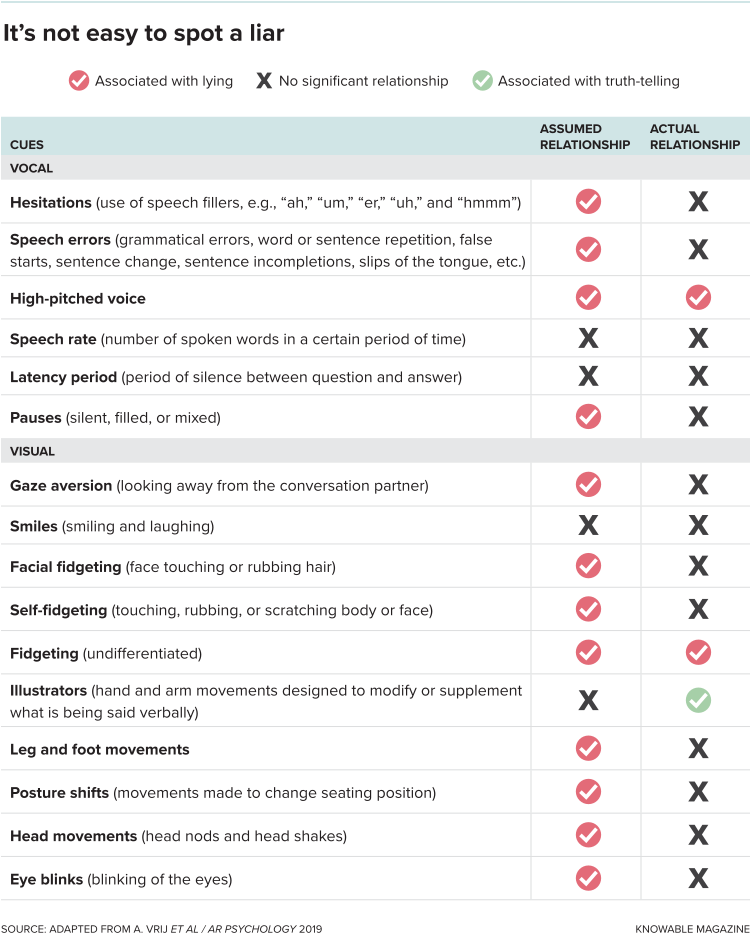
Table showing that many behavioral indicators are assumed to signal lying, but very few in fact do.
Common wisdom has it that you can spot a liar by how they sound or act. But when scientists looked at the evidence, they found that very few cues actually had any significant relationship to lying or truth-telling. Even the few associations that were statistically significant were not strong enough to be reliable indicators.

Police experts, however, have frequently made a different argument: that the experiments weren’t realistic enough. After all, they say, volunteers — mostly students — instructed to lie or tell the truth in psychology labs do not face the same consequences as criminal suspects in the interrogation room or on the witness stand. “The ‘guilty’ people had nothing at stake,” says Joseph Buckley, president of John E. Reid and Associates, which trains thousands of law enforcement officers each year in behavior-based lie detection. “It wasn’t real, consequential motivation.”

Samantha Mann, a psychologist at the University of Portsmouth, UK, thought that such police criticism had a point when she was drawn to deception research 20 years ago. To delve into the issue, she and colleague Aldert Vrij first went through hours of videotaped police interviews of a convicted serial killer and picked out three known truths and three known lies. Then Mann asked 65 English police officers to view the six statements and judge which were true, and which false. Since the interviews were in Dutch, the officers judged entirely on the basis of nonverbal cues.

The officers were correct 64 percent of the time — better than chance, but still not very accurate, she says. And the officers who did worst were those who said they relied on nonverbal stereotypes like “liars look away” or “liars fidget.” In fact, the killer maintained eye contact and did not fidget while deceiving. “This guy was clearly very nervous, no doubt,” Mann says, but he controlled his behavior to strategically counter the stereotypes.

Five Black men on stage at an ACLU awards luncheon.
In 1990, five young men were convicted of raping a jogger in New York’s Central Park the year before, after police disbelieved their claims of innocence. The men, popularly known as the Central Park Five, were completely exonerated of the crime and released in 2002 after years in prison. Here, they appear at an awards luncheon of the American Civil Liberties Union in 2019.CREDIT: MARIO TAMA / GETTY IMAGES

In a later study, also by Mann and Vrij, 52 Dutch police officers did no better than chance at distinguishing true and false statements given by family members who’d murdered their relatives but denied it in anguished displays during televised press conferences used in the study. Notably, officers who performed the worst were those who felt that the emotional displays were genuine. But what did that signify? “If a husband killed his wife, he could be upset for all kinds of reasons, like remorse or getting caught,” says Mann. “Nonverbal behavior is so idiosyncratic. If you focus on the nonverbal behavior like emotions, you will trip up.”

Confirming these results on a large scale years later, Hartwig and Bond reviewed the literature for studies comparing people’s abilities to detect high- and low-stakes lies. They found no evidence that people were any better at detecting lies told by criminals or wrongly accused suspects in police investigations than those told by laboratory volunteers.

Something to hide

From serial killers to students fibbing in laboratory experiments, the lies in all these experiments were spoken. In a study published in 2019, Mann examined nonverbal deceit, such as when someone is trying to conceal illicit activity — a type of deception relevant to detecting bombers or smugglers. She recruited 52 university student volunteers and asked half of them to transport a laptop said to contain sensitive photographs on a ferry ride between two cities. The volunteers were told to try to blend into the crowd and not look “suspicious,” because people would be trying to identify them. The other half of the group were given a regular cell phone to transport, with no instructions to conceal what they were doing.

When Mann showed videos of the ferry rides to 104 other volunteers and asked them to pick out the “smugglers,” the spotters did no better than chance. In interviews afterward, the “smugglers” said they were nervous, but they consciously tried to act normal and control their nerves with tactics such as listening to music or using their phones.

Next, Mann raised the stakes. Half of a new group of 60 volunteers were given an envelope of Russian, Egyptian and Korean currency to conceal, while the other half didn’t “smuggle” anything. But this time, Mann sent two researchers onto the ferry to pace around and scrutinize the passengers, appearing to compare their faces to photos on a cell phone.

This time, 120 observers trying to pick out the “smugglers” on video guessed correctly just 39.2 percent of the time — well below chance. The reason, Mann says, is that the “smugglers” consciously made an effort to look normal, while the “innocent” control volunteers just acted naturally. Their surprise at the unexpected scrutiny looked to the observers like a sign of guilt.

The finding that deceivers can successfully hide nervousness fills in a missing piece in deception research, says psychologist Ronald Fisher of Florida International University, who trains FBI agents. “Not too many studies compare people’s internal emotions with what others notice,” he says. “The whole point is, liars do feel more nervous, but that’s an internal feeling as opposed to how they behave as observed by others.”

Studies like these have led researchers to largely abandon the hunt for nonverbal cues to deception. But are there other ways to spot a liar? Today, psychologists investigating deception are more likely to focus on verbal cues, and particularly on ways to magnify the differences between what liars and truth-tellers say.

A man in a white sweater leaving jail after his release, accompanied by several others.
Marty Tankleff, in white sweater, being released from prison after serving 17 years wrongfully convicted of murdering his parents. Officials thought that Tankleff’s claims of innocence must have been lies because he didn’t show enough emotion. There is no good evidence that you can reliably spot a liar by the way they act.CREDIT: ANDREW THEODORAKIS / NY DAILY NEWS VIA GETTY IMAGES

For example, interviewers can strategically withhold evidence longer, allowing a suspect to speak more freely, which can lead liars into contradictions. In one experiment, Hartwig taught this technique to 41 police trainees, who then correctly identified liars about 85 percent of the time, as compared to 55 percent for another 41 recruits who had not yet received the training. “We are talking significant improvements in accuracy rates,” says Hartwig.

Another interviewing technique taps spatial memory by asking suspects and witnesses to sketch a scene related to a crime or alibi. Because this enhances recall, truth-tellers may report more detail. In a simulated spy mission study published by Mann and her colleagues last year, 122 participants met an “agent” in the school cafeteria, exchanged a code, then received a package. Afterward, participants instructed to tell the truth about what happened gave 76 percent more detail about experiences at the location during a sketching interview than those asked to cover up the code-package exchange“When you sketch, you are reliving an event — so it aids memory,” says study coauthor Haneen Deeb, a psychologist at the University of Portsmouth.

The experiment was designed with input from UK police, who regularly use sketching interviews and work with psychology researchers as part of the nation’s switch to non-guilt-assumptive questioning, which officially replaced accusation-style interrogations in the 1980s and 1990s in that country after scandals involving wrongful conviction and abuse.

Slow to change

In the US, though, such science-based reforms have yet to make significant inroads among police and other security officials. The US Department of Homeland Security’s Transportation Security Administration, for example, still uses nonverbal deception clues to screen airport passengers for questioning. The agency’s secretive behavioral screening checklist instructs agents to look for supposed liars’ tells such as averted gaze — considered a sign of respect in some cultures — and prolonged stare, rapid blinking, complaining, whistling, exaggerated yawning, covering the mouth while speaking and excessive fidgeting or personal grooming. All have been thoroughly debunked by researchers.

With agents relying on such vague, contradictory grounds for suspicion, it’s perhaps not surprising that passengers lodged 2,251 formal complaints between 2015 and 2018 claiming that they’d been profiled based on nationality, race, ethnicity or other reasons. Congressional scrutiny of TSA airport screening methods goes back to 2013, when the US Government Accountability Office — an arm of Congress that audits, evaluates and advises on government programs — reviewed the scientific evidence for behavioral detection and found it lacking, recommending that the TSA limit funding and curtail its use. In response, the TSA eliminated the use of stand-alone behavior detection officers and reduced the checklist from 94 to 36 indicators, but retained many scientifically unsupported elements like heavy sweating.

A security officer in uniform stands and watches a traveler, who is shown blurred in the foreground.
An officer of the US Transportation Security Administration watches travelers at an airport. The agency still uses behavioral indicators to pick out suspicious people, even though this has little scientific basis.CREDIT: SCOTT OLSON / GETTY IMAGES

In response to renewed Congressional scrutiny, the TSA in 2019 promised to improve staff supervision to reduce profiling. Still, the agency continues to see the value of behavioral screening. As a Homeland Security official told congressional investigators, “common sense” behavioral indicators are worth including in a “rational and defensible security program” even if they do not meet academic standards of scientific evidence. In a statement to Knowable, TSA media relations manager R. Carter Langston said that “TSA believes behavioral detection provides a critical and effective layer of security within the nation’s transportation system.” The TSA points to two separate behavioral detection successes in the last 11 years that prevented three passengers from boarding airplanes with explosive or incendiary devices.

But, says Mann, without knowing how many would-be terrorists slipped through security undetected, the success of such a program cannot be measured. And, in fact, in 2015 the acting head of the TSA was reassigned after Homeland Security undercover agents in an internal investigation successfully smuggled fake explosive devices and real weapons through airport security 95 percent of the time.

In 2019, Mann, Hartwig and 49 other university researchers published a review evaluating the evidence for behavioral analysis screening, concluding that law enforcement professionals should abandon this “fundamentally misguided” pseudoscience, which may “harm the life and liberty of individuals.”

Hartwig, meanwhile, has teamed with national security expert Mark Fallon, a former special agent with the US Naval Criminal Investigative Service and former Homeland Security assistant director, to create a new training curriculum for investigators that is more firmly based in science. “Progress has been slow,” Fallon says. But he hopes that future reforms may save people from the sort of unjust convictions that marred the lives of Jeffrey Deskovic and Marty Tankleff.

For Tankleff, stereotypes about liars have proved tenacious. In his years-long campaign to win exoneration and recently to practice law, the reserved, bookish man had to learn to show more feeling “to create a new narrative” of wronged innocence, says Lonnie Soury, a crisis manager who coached him in the effort. It worked, and Tankleff finally won admittance to the New York bar in 2020. Why was showing emotion so critical? “People,” says Soury, “are very biased.”

Editor’s note: This article was updated on March 25, 2021, to correct the last name of a crisis manager quoted in the story. Their name is Lonnie Soury, not Lonnie Stouffer.

Jessica Seigel is an award-winning journalist and New York University adjunct journalism professor. Her work has appeared in the Washington Post, the New York TimesSalon and National Geographic Traveler, on NPR, and more. Follow her on Twitter at @Jessicaseagull

Nondual Awareness: Science & Meditation Techniques

SEPTEMBER 17, 2020 (fitmind.co)

nondual awareness meditation science blog article.jpg

What is nonduality?

You may have heard of this concept that’s expressed in all of the world’s major meditation traditions, from Advaita Vedanta and Sufism to Buddhism and Kabbalah, that claims we’re “one with everything.”

It sounds nice, but what does that actually mean?

Nondualism is pointing to the direct first-person experience, upon careful inspection, revealing that the mind contains no separate observer from its contents. The result is a feeling of unity and connection to the world.

When living from a place of nondual recognition, you don’t see the computer in front of you but rather feel as if you are the computer. It’s as if the world appears to be occurring inside of “you.” That is to say, inside of nondual awareness. The duality of separation between self and other disappears.

You realize nonduality when your sense of being a witness, or subject, looking out at the world disappears. If you don’t think this is possible, try the reverse – locate the part of you that appears to be the witness right now…

And you’ll quickly realize that you can’t locate one. It’s just a mental construct.

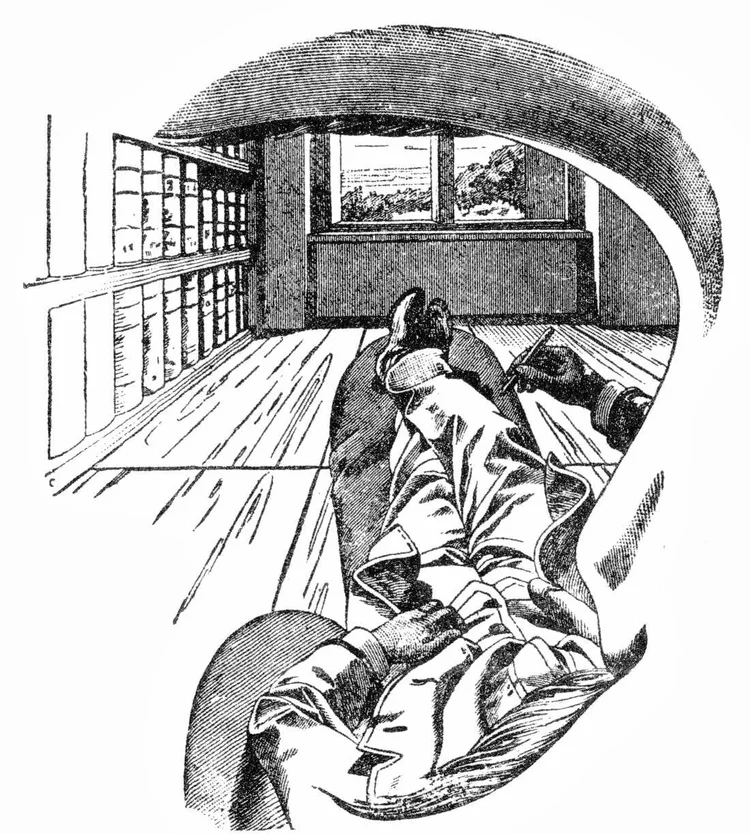
This is a drawing by Ernst Mach that led English philosopher Douglass Harding to perceive the world in a nondual way. Harding developed the popular “Headless Way” meditation, a technique for realizing nonduality. Notice that from your first-person perspective, this is how your world appears. There’s no separate self unless you image there to be one and give it a name, “I.”

We spend all of our lives walking around and thinking we’re a tiny mini-me located somewhere in our heads. But, upon further inspection, it becomes clear that the feeling of being a subject looking at objects is an illusion.

It’s likely that a baby experiences the world in a nondual way before they’re given a name and create models of selfhood. Now, you might wonder why we’d want to “regress” into a toddler’s view of the world.

The key is that an adult who recognizes nonduality will still be able to operate fully, but will no longer be burdened by the mental baggage of “I, me, mine” stories running in their head. It turns out that most of our mental suffering comes from this dualistic mentality. We feel like a mini-me in the head that always has to uphold its dignity, figure out its identity, and solve some problem that it concocts.

Nonduality isn’t making metaphysical claims that, “Hey this is the way the Universe works.” Rather, it’s useful in so far as it’s something that you, and everyone else, can directly experience for themselves as an enhanced mode of being, like a flow state. By recognizing the nondual state you’re upgrading your mental software.

For nondual guided meditations and in-depth instruction, try FitMind.

Nonduality and Science

Nonduality is compatible with modern science. The materialist scientific worldview states that your entire experience of the world is being generated by a brain. Therefore, it stands to reason, you’ve never actually seen the real world. What you think is “real” had to enter your eyes, ears, and other senses and then get projected in your brain somewhere.

Following that logic, everything you experience in your brain is a part of you. The world as you experience it is inside of you. Even your feeling of having a head is, according to science, appearing inside your head. Where that head is exactly, is a matter of philosophical debate without an answer.

Where are “you” located? Upon careful observation, it becomes clear that there’s no “you” that exists separate from the field of nondual awareness.

One of the leading theories of consciousness, called Multimodal User Interface (MUI) Theory, was developed by cognitive psychologist Donald Hoffman. MUI suggests that you’re not experiencing reality at all, just projecting a user interface that helps you navigate the world. As an analogy, take the icons on your computer screen. A trashcan on your desktop computer is not a real trashcan, but it’s useful for discarding unwanted files so that you don’t have to deal with the tangle of underlying code and wires in your computer. Similarly, your projection of the world is a mental simulation to help you navigate a vastly complex amount of “real world” data.

But thinking about the metaphysics and philosophy of nonduality, while interesting, isn’t necessarily useful. All of this is just to say that nonduality does not contradict modern science. In fact, theories like Hoffman’s are starting to support the concept as a closer picture of reality.

What’s important here is that if you notice your experience of the world very carefully it’s all occurring in the same place – your field of nondual awareness.

What is nondual meditation?

Nonduality is available at any moment if you learn to direct your awareness in a particular way. Meditation is one way of predictably revealing nonduality.

There are meditation techniques designed specifically to uncover nondual awareness. If you’ve been practicing the methods taught on the FitMInd meditation app, you may have already experienced this.

It’s important to note that nondual meditation doesn’t strive for a particular state. Rather, it’s trying to point out and uncover the true nature of mind as it already is. Unlike many “effortful” techniques, the nondual meditations are often trying to relax the very part of the mind that’s striving.

Neuroscientist and philosopher Sam Harris gives a clear analogy. Picture someone tapping on a window through which you’re staring and trying to get you to see the pane of glass itself rather than just the objects that appear through the glass.

When you perceive the world such that there is no constructed observer and instead you appear to be everything in your awareness, that’s nonduality. What matters is your direct experience of this, which can be glimpsed if you pay careful attention and are able to drop your conditioned ideas and conceptions about how the world works.

For example, you know that you have a head but the Headless Way exercise (see below) gets you to reexamine your direct experience. What does it feel like? And that’s a pointer toward nonduality.

This is such a big part of meditation because it’s completely liberating. You’ll notice that as you glimpse nondual awareness in practice it’s very enjoyable and, in fact, a life-changing perspective.

Nondual Meditation Techniques

The primary traditions that were focused on uncovering nonduality with direct “pointing out” methods were Advaita Vedanta and Tibetan Buddhist Mahamudra and Dzogchen.

Here are a few of the popular nondual meditation techniques, primarily derived from these traditions:

  • Just Being – A practice in which you rest the mind without intentions, effective for revealing the nondual nature of mind when it’s not striving to solve problems.
  • Self-Inquiry – A method of meditation in which you inquire deeply into the nature of “I.” For straightforward instruction in this method, check out Ramana Maharshi’s explanation in this online pdf.
  • Headless Way – Richard Lang, a disciple of Douglas Harding and the primary teacher of the Headless Way meditation technique, came on The FitMind Podcast to discuss it in more detail.
  • Glimpse – Glimpses are a broad name (possibly coined by Loch Kelly) for short practices that can give us a “glimpse” of nonduality.
  • Awareness of Awareness – Another type of meditation meant to reveal nonduality by directing attention toward the context, rather than the contents, of experience.

Some of these have many names or are broad terms for a category of nondual practice. For example, there are many forms of self-inquiry.

Below are two nondual guided meditation from famous teachers Loch Kelly and Diana Winston, who led these meditations on The FitMind Podcast.

After years of striving in her “deliberate mindfulness” practice, Diana discovered the nondual meditation practices. She calls the state they lead to “natural awareness,” but it has traditionally been called advaita, anatta, shunyata, rigpa, or tathagatagarbha. The very fact that this has so many names across cultures should clue us into the fact that it is a universal human experience.

Similar to Diana, Loch Kelly practiced traditional mindfulness meditation for years before discovering stabilizing nondual meditation techniques like Tibetan Mahamudra and Dzogchen. He calls these “glimpse practices” that can help you shift you into nondual awareness with repeated use.

Here’s Loch demonstrating a couple of his glimpses, or pointers.

Once you’ve glimpsed nonduality, the practice becomes to continue to glimpse it until this becomes a new, default way of living.

And if you haven’t tasted nondual awareness yet, there’s no need to worry. It can take some time and repeated practice of the techniques. The key is not to strive for any result, but rather just to do the practices with curiosity and an open mind and let things unfold.

Summary of Nondual Awareness

In this blog post, we’ve covered the key facts about a timeless and simple (yet hard to grasp in words) subject. Ultimately, however, philosophizing about nondual awareness won’t help; it’s an experience you have to have for yourself.

Thankfully, there are meditation techniques, like Mahamudra and Dzogchen, devised over thousands of years of people experimenting with their minds, that can predictably induce nondual experiences.

For nondual guided meditations and in-depth instruction, try FitMind. Below is a video summarizing much of what’s written above and also giving further guided nondual instruction, similar to what you’d find on the FitMind meditation app.

Consciousness, sexuality, androgyny, futurism, space, the arts, science, astrology, democracy, humor, books, movies and more