
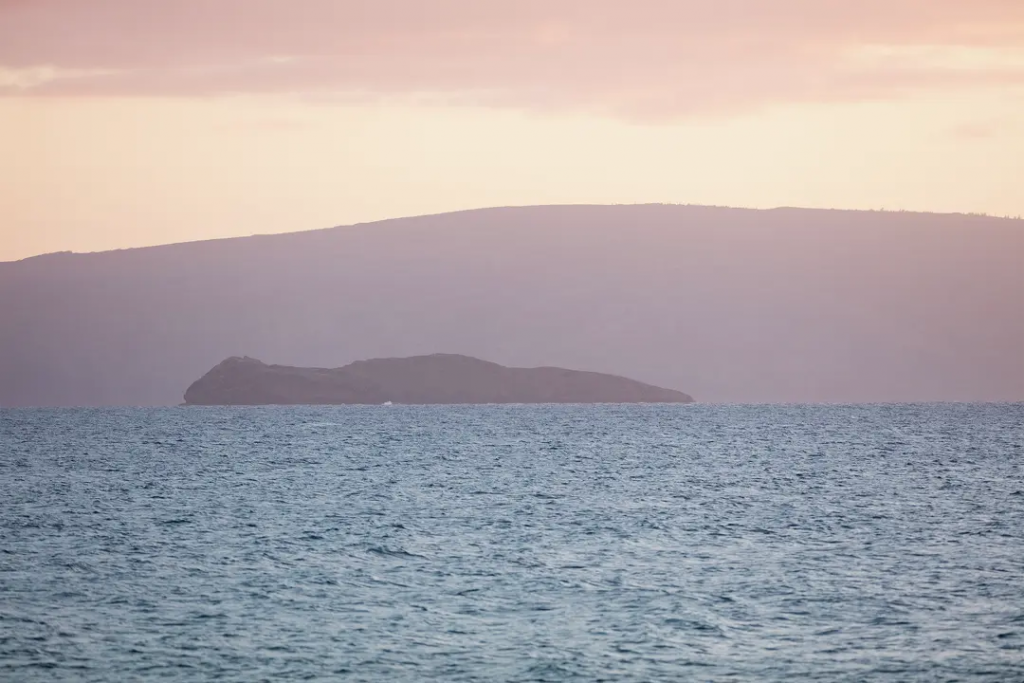
The Hawaiian Islands at sunset.Johner Images/Getty Images/Johner RF
By Christine Hitt, Hawaii Contributing Editor April 26, 2026 (SFGate.com)
In Hawaii, there are islands not found on any map that are said to appear and then disappear, often around sunrise or sunset.
Over a century ago, Hawaiian-language newspapers recorded eyewitness reports of offshore sightings. Hawaii had more than 100 Hawaiian-language newspapers, beginning in 1834. They documented everything from politics to daily life and largely remain untranslated, holding a wealth of information.
One of the most striking reports placed one vanishing island between Maui and Molokai. In an article from Dec. 1, 1900, in Ke Aloha Aina, a writer relayed a sighting of Kanehunamoku, which was visible offshore before fading from view.
“At five minutes past 5 on the early morning of Friday the 23rd, the mysterious supernatural land of Kanehunamoku was seen standing proudly between Maui and Kahoolawe. It seemed, in the arrangement of the islands, Maui, Kanehunamoku, Kahoolawe, and Lanai sat together to the eye. It was truly beautiful,” Moses Kaulahea wrote from Molokai. “Certain features on that wondrous land were clearly visible … At 6:20 [a.m.], when the sun rose, it began to disappear” and the space between Kahoolawe and Maui was empty again.
The hidden islands
In English, Kanehunamoku can be translated as the “hidden land of Kane,” Kane being one of the major deities in Hawaiian tradition. In some accounts, it is described as one of 12 islands of Kane, a group of sacred and elusive islands associated with spiritual beings.
In her book “Hawaiian Mythology,” Martha Beckwith writes, “Today they are called the ‘lost islands’ or ‘islands hidden by the gods.’ At sunrise or sunset they may still be seen on the distant horizon, sometime touched with a reddish light. They may lie under the sea or upon its surface, approach close to land or be raised and float in the air according to the will of the gods.”
Beckwith noted that there are ancient chants and stories about these hidden islands going as far back as the 12th century. Kanehunamoku also appears in the Kumulipo, the ancient Hawaiian creation chant. She also describes stories of when Kanehunamoku appears, where “one can hear cocks crowing, pigs grunting, see flickering of lights and waving of sugar cane and persons moving about the island.”
In a Feb. 23, 1912 article of Ka Nupepa Kuokoa, another eyewitness account reads less like folklore and more like a modern-day paranormal sighting. (Hawaii, in particular, is today known as a hotspot for UFO sightings.)
A husband and wife were fishing from shore, when they noticed the sea behaving strangely 3 miles south of Mahukona off the Kohala coast of Hawaii Island. “The sea seemed to boil, exactly as if there were fire beneath it, boiling like a cooking pot,” S.D. Kehena Boy wrote from North Kohala. Later that night, they described seeing “something like moving lights or lanterns, not just one but many lights coming in a line from the ocean, heading straight toward where they sat.”
The lights eventually went out. In their place, “there stood in the sea a great dark thing, like a piece of land” about 100 to 200 yards offshore. They said they could make out what looked like trees and vegetation and even figures moving across the island, though no voices could be heard. The couple overwhelmed with fear, covered themselves and waited through the night.
By morning, it was gone.
“Well, then, was this Kanehunamoku? Or was it a supernatural being?” the writer asked. “These new things we are seeing are quite extraordinary.”
Theories behind the sightings
Not everyone thought Kanehunamoku was a mystery. Some writers in Hawaiian-language newspapers tried to explain what people were seeing.
In 1865, D.M. Collegiate wrote a letter to the editor of Ka Nupepa Kuokoa, suggesting that reports of a physical island were due to a visual phenomenon, comparing it to other optical effects reported at sea, like ships in the sky or other mirrored or refracted images. He calls them wailiula, the Hawaiian word for mirage.
Modern references similarly liken the phenomenon to being an atmospherically related mirage.
One type of mirage, a Fata Morgana, has resulted in illusions of ships floating in the air. In his journal via the University of Hawaii at Manoa, Scott Kikiloi also suggested that the ancient stories of vanishing islands relate to how Hawaiians saw the erosion of islands down to islets and atolls, disappearing over time or reappearing later. Moku Papapa is an example of a low-lying island last seen southwest of Niihau that has disappeared and is still a mystery today.
Whether believed to be a real land or a mirage, Kanehunamoku’s story and connection to Kane endures, preserved in Hawaiian-language records as both explanation and experience. That’s not something that will ever disappear.
Editor’s note: SFGATE recognizes the importance of diacritical marks in the Hawaiian language. We are unable to use them due to the limitations of our publishing platform. The Hawaiian language newspapers were translated with the help of AI and reviewed by fluent Hawaiian language speaker and journalist Kuuwehi Hiraishi.
Hawaii Contributing Editor
Christine Hitt is the Hawaii contributing editor for SFGATE. She is part-Native Hawaiian from the island of Oahu, and a Kamehameha Schools and University of Hawaii graduate. She’s the former editor-in-chief of Hawaii and Mana magazines.