
How Everything Collapsing Teaches Us What Kind of People the 21st Century Needs Us to Be

When I look around the world these days, the very first thing that strikes me, whenever I scan the headlines, is just how fast everything’s collapsing. Yes, everything. The planet, democracy, economies, societies, lives. Then I’m struck by how it’s pretty astonishing we’re just sleepwalking into all these collapses — we don’t have a plan for stopping, reversing, or mitigating them. Then I ruminate on how just how strangely, tragically human that is — we’re lost in denial and escapism and outrage and make-believe, pleasing delusions and comforting lies, at the precise moment we need to face up to the difficult, unforgiving realities of collapse. But facing reality’s rarely been harder than now, has it?
What lies beneath this strange pattern of collapse, chaos, and delusion? I think it has to with a mindset, a certain kind of attitude, that’s a relic, perhaps, of the industrial age — or perhaps it has deeper roots. I’ll come to all that. First, let me try to describe it — and probably fail. I’d put it like this.
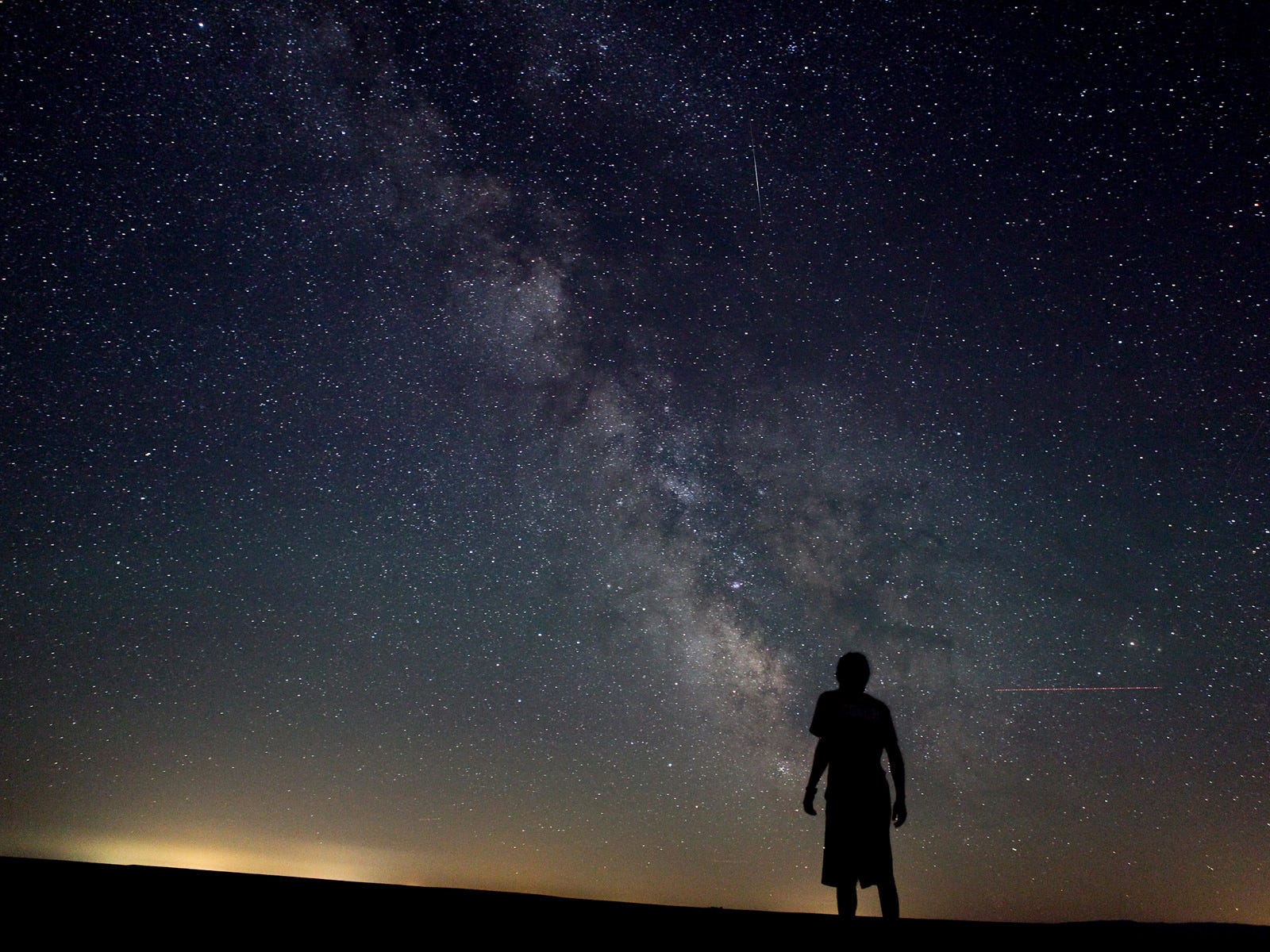
We’re taught to believe we’re the biggest things in a little world. But the truth is that we’re little things in a big universe. I told you I’d fail, didn’t I? Very well, let me try to explain that curious sentence or two.
What I’d call a predatory, individualist, greedy, exploitative, abusive mindset has come to rule us — what you might call utilitarian individualistic materialism, a mindset of pure maximization of robotic self-interest. We’ve become entitled things, us humans, who think of ourselves as apex predators — entitled to destroy and consume and ruin whatever stands in the way. The way of satisfying our most evanescent, selfish, and useless desires — to be the most powerful and mighty of all. Having learned this mindset in everything, from school to advertising to work, we think of ourselves as big fish with great teeth and huge stomachs, hovering at the top of a little pond. All the littler fish, plants, and snails are there for us to eat, consume, toy with, ultimately destroy. By “fish”, I don’t just mean animals and plants and so on — it’s just an imperfect metaphor.
I mean that we think of ourselves as superior, at the top, above and beyond. We think we have our escape. From what? From being a part of everything. From being a part of the world, a part of nature, a part of each other, too. We think of ourselves as pure atoms, ultimate individualists, whose sole goal is to rise to the top of the very haze that chokes us. Is that beginning to make a little sense? It’s a complicated thing to explain. I mean something like “we think of ourselves as above and beyond who and what we really are” or maybe “above and beyond our true condition and predicament as human beings.”
I suppose that raises the question: who are we really — and who am I to say? Who we are really isn’t a matter of my opinion. We are finding out the hard way who we really are. We are a part of the natural world — we cannot just inflict damage on it: it will lash back at us. We are a part of each other, as much as we might not like to admit it, having bought into macho myths of selfhood and so on — what else is a democracy, a society, a social contract? We are all a part of the world, too — when I deny you basic things like healthcare, I am only really turning you towards fanatics and extremists, in your despair and rage. We are a part of ourselves — which sounds like a foolish thing to say, until you consider how alienated and self-destructive many people have become these days.
The idea that we are only here to predatory, exploitative, abusive things — meant to prey, consume, conquer, and loot, and then preen and strut and gloat and rub in it each others’ faces — is badly, badly wrong. It’s a product, if you ask me, of industrial-age thinking, when we suddenly discovered how to produce a multitude of things, using simple technologies. But that revolution changed our attitudes and perspective of ourselves, too.
All the problems the world has today are linked by one single thing: this predators’ mindset, the perspective of seeing ourselves as above and beyond everything else, even each other. It is what connects climate change to inequality to stagnation to division to fascism. All these things are connected through us, my friends. The problem is that we don’t understand it.
(Even if we are relative nobodies in human society — middle managers, salespeople, corporate drones (that’s OK, everyone has to make a living) — we still see ourselves as above and beyond. Enough of us, anyways. Above and beyond what? Better than the animals, better than the forests, better than the stars. Better than those filthy poor people. Better than those distant, bedraggled ancestors. Better than, above, beyond.
Do you see how deep this mindset goes? I don’t just mean it in a casual way — I mean that is always operating in us, at an unconscious level, three particular thoughts. First, that we are better than some other people or beings or things. Second, that we are not as powerful as some others, still. Third, that we must be as superior to other things as we possibly can be. The point of our lives has become to become above and beyond, and my guess is this internal logic is always operating in most of us at a deep level, where we don’t really notice it. We are always seeking to be the biggest, grandest, most powerful things — the ones we imagine we should be.)
Now here is the irony. What do little things do? They do just what we do — if we look at ourselves a little more carefully. Don’t you think it’s funny that by day we think of ourselves as mighty and savage and powerful things — even if we are nobodies in human society — and yet the moment the night falls, we are clinging desperately to those we love? Like the very stars are turning to dust? Like our hearts are on fire? They are, my friends. We come face to face with the truth of ourselves, our condition, when we are naked— our mortality, our fragility, our impossible smallness, that vulnerability is the deepest thing in us.
The 21st century is going to require a fundamental and formative shift in our mindsets and attitudes. We can no longer think of ourselves as the biggest, strutting, preening, voracious things, in a little world, exploiting, abusing, rubbing our power and might in everything’s face. We can pretend, for a little while longer, I suppose — until the glaciers melt, the insects die, and our democracies implode. Then what? Better for us to learn the lesson our own collapse is trying to teach us.
We must understand ourselves as the littlest things of all, in a big, big universe — not as the biggest things in a little world. You see, when we think of ourselves as big things in a little world, we imagine that we don’t have to take care of anything at all — from the world to the glaciers to our democracies to ourselves. “It’ll fix itself! Stop being an alarmist!!”, generations of pundits who’ve never left the bubble of an office have cried. It hasn’t fixed itself, has it? Our problems as a world have only gone from bad to worse. But that’s hardly surprising. Big things in a little world don’t have to worry about anything at all — except maybe being feared the most. And from that moral imperative — being feared the most — come all the problems we face today, fascism, inequality, greed, Brexits and Trumpisms, climate change, and so on.
When we think of ourselves as the littlest things in a big universe, our attitude couldn’t be more different — because our perspective changes completely. Suddenly, we see ourselves as equals. Everyone is in just the same position as us — little things made of dust, on a spinning rock lit by a flame, never knowing why they were put here, not knowing where they will go. There is no reason whatsoever to try to exploit, abuse, hurt, or harm another.
When I say “littlest”, I mean littlest. Aren’t we littler not just than the trees and mountains — which is obvious — but littler even than the grass and the waves? They aren’t afraid of dying and loving and grieving. We are. We spend our days in denial of the abject fear that will come at night — which is why daytime is a time when we pretend we are superior. But the truth is that we are the littlest things of all — the most frightened, desperate, and confused things, by virtue of our terrible knowledge. That is what the story of the fruit of the tree, of the fall from grace, of the exile from the garden, should have taught us — but didn’t.
Yet if we ourselves are the littlest things of all, then the next mental breakthrough is even truer and more beautiful. If we are littler than the grass and the insects and the waves — then it isn’t our job to destroy and consume and ruin them, is it? What is the job of little things? It is to nourish and tend and cultivate. To support and renew. To hold greater things together. To let many things be. To allow vaster things to flourish and grow — by expanding and unfurling themselves, just as the seed nourishes the whole forest, just as the raindrop finds its way to the sea. Little things are there to hold and connect big things, just as the thread weaves the cloth. Little things teach big things the truth, meaning, and might of grace — and if you have ever held a sleeping child, you will feel it in whispering right down in your bones.
But we are to the universe what that little sleeping child is to you. We are here to teach it the meaning of grace, of love, of truth, too, by revealing it to one another. We are not what the hurricane is to the harvest, or what the drought is to the sea. If that is all we are — then what meaning is there left, what purpose, what reason, is there to us at all? Aren’t we just blind things — who destroy and shatter the very place where we live, whether we call them societies or countries or planets? Haven’t we failed to understand, in that way, who and what we really are?
The moral logic, the attitude, the presence, the perspective, of these two stances — that we’re the biggest things in a little world, or the littlest things in a big universe — couldn’t be more different. One has led us to live in an age of hubris, of arrogance, of imbecility marching proudly down the avenues — it has led squarely to climate change, fascism, inequality, and billionaires hoping to escape to Mars while the world burns.
The other attitude asks some of these things — very different qualities — from us. The humility to kneel. The gentleness to hold something fragile tight. The wisdom to let it go. And the courage, nobility, and strength to grieve for all that will never be, with all the love and fury in our beating hearts. It asks us to see the beauty in sorrow, too — not just the cheap pleasure of power — just like every breath a sleeping child takes teaches us what fragility, what grief, what love is.
We are to the universe what that little sleeping child is to us, when we carry it in our arms, and our hearts seem to sing, explode, burst, stop. We are meant to teach it just the very same things, my friends. Where will that kind of mindset lead? Who will develop and cultivate the attitude that we are the littlest things in a big universe? Those, my friends, are, if you ask me, the great questions of now.
Umair
February 2019