
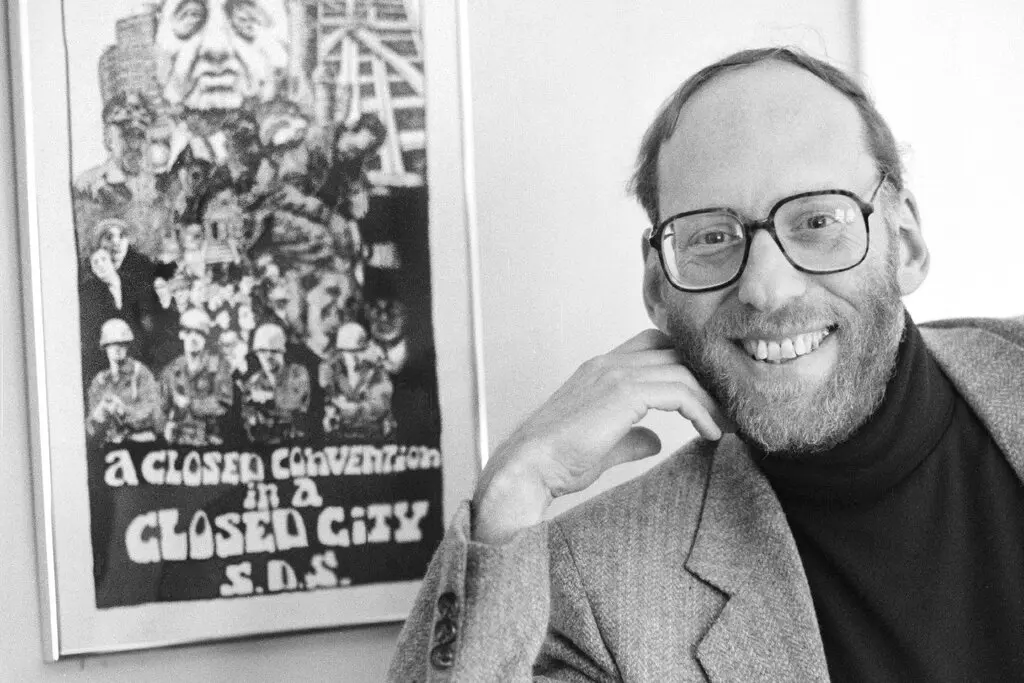
The author and cultural historian Todd Gitlin in his office in Berkeley, Calif., in 1988. He personified the cultural and political ambitions of the ’60s, with a readiness to confront orthodoxies of whatever stripe.Credit…Terrence McCarthy
By Katherine Bishop
- Jan. 8, 1989
Credit…The New York Times Archives
SITTING IN a movie theater a few years ago, Todd Gitlin had another of his frequent out-of-culture experiences. He was watching the movie ”The Big Chill,” about a group of college friends who had abandoned their 1960’s political and social commitment in favor of 1980’s affluence and personal striving. ”Everyone around me was loving it,” he said of the film, ”and I was just hating it!”
The current popular myth about the 60’s – that students once active in the political left have ”sold out” and become stockbrokers leaving no lasting achievements – is one that much of his work is aimed at dispelling. As he argues in his memoir and history of the era, ”The Sixties: Years of Hope, Days of Rage,” the ”reformation” of the 60’s continues today despite the intervening years of conservatism.
Dr. Gitlin has had his work cut out for him in recent months as that tumultuous decade is being reprised in every possible forum, from films like ”Mississippi Burning,” ”Running on Empty” and ”1969” to television documentaries and books. So saturated has the culture become with the icons of the era that teen-agers wear their mothers’ old peace-symbol jewelry without any understanding of how it is connected to the Vietnam War. How Do They See the 60’s?
How does this professor of sociology, who was a national leader of students during the protests of the 60’s, view his students on the Berkeley campus of the University of California? It was here that the 1964 Free Speech Movement galvanized the dormant political sensibilities of thousands of children of the Silent Generation, and here that they found their collective voice and helped spark a decade of student activism across the nation.
”They have no faith that history is something people do, of culture changing radically, not just a fad,” Dr. Gitlin said. And turning to the way today’s America looks at the 60’s, he added: ”But that’s the way the culture works. Everything from peace symbols to the Bonnie and Clyde look were turned into fashion statements. There’s no way this culture can convey historical content except in the most politically alert families.”
Dr. Gitlin has attempted to demystify the 60’s to students who are largely unaware of the struggle that achieved such broad social gains as fuller racial integration and an expanded role for women. His courses also must decipher the methods by which that decade’s culture has been reduced to mood music to hawk everything from cars to politicians.
One way Dr. Gitlin works to overcome a media impression that his generation, in his words, ”had moved en masse from ‘J’Accuse’ to Jacuzzi,” is by presenting models, if not heroes. He says that when he asks students who their heroes are, they sometimes respond, ” ‘What’s a hero?’ ” When pressed, they frequently name celebrities such as rock musicians, often Madonna. ”I try to point to exemplary people and to the fact of that ordinariness of the 60’s people.” Rich With Ordinary People
The history of the Berkeley campus is rich with them, those ordinary people from the Free Speech Movement: people like Jack Weinberg, whose arrest for violating a campus ban on distributing literature and soliciting funds for political organizations sparked the Free Speech Movement, and who became a steelworker in Gary, Ind.; like Jackie Goldberg, an F.S.M. leader who became a high school teacher; like Michael J. Smith, who was arrested at a Sproul Hall sit-in and went on to become a nurse and the business representative of his hospital workers’ union, Local 250, in nearby Alameda.
Even on the Berkeley campus where it happened, it can be difficult to separate the F.S.M. from the mythology surrounding it. ”The Free Speech Movement has something of a halo around it,” Dr. Gitlin said. ”My sense of it is that there’s a vacuous pride, a feeling that whatever it was, it was good for us. It’s our glory. But the attitude is disconnected from knowledge.
”There’s a temptation to say that our crowd was better than you – that we were more moral,” Dr. Gitlin added. ”It’s not true. I try to convey that nobody was walking on water.”
Today, Dr. Gitlin and the woman with whom he lives – a history professor at another campus – share a home in Oakland, a few miles from the Berkeley campus. In a tiny purple house in Berkeley that he uses for research and writing, the only apparent concession to the 80’s is the burglar-alarm system. Otherwise, it could serve as a movie set for 1968 graduate-student housing: a rocking chair, a daybed covered with an Indian-print spread and an orange foam-rubber sling chair.
Get the best of The Times in your inbox
- Sign up for For You:A round-up of the best stories personalized to you.
- Sign up for Opinion Today:Get expert analysis of the news and a guide to the big ideas shaping the world every weekday morning.
- Sign up for The Morning:Make sense of the news, every day, with David Leonhardt.
A photo pinned to one wall shows him as a young man talking to I. F. Stone, the leftist journalist who wrote about the 60’s student movement. Today Dr. Gitlin wears a beard, and a wool cap to keep the chill from a balding head. He speaks deliberately so as not to appear glib about the matters that count to him.
During his years at Berkeley, he has written many essays and book and movie reviews and published poetry for more than 20 years. Much of his prolific output is a part of his commitment to social change and the understanding of the continuity of history. And there is television, about which Dr. Gitlin has written two books: ”Inside Prime Time” and ”The Whole World Is Watching,” and edited a third, ”Watching Television.” Growing Up With TV
Growing up in front of a TV set is one thing that separates his students from their parents. He has described himself and his contemporaries as a ”transitional generation” that reached the age of 10 or so before television was in their homes. When it did arrive, the children growing up in the 50’s already had an experience that was in stark contradiction to that on TV.
Recalling the bomb drills of the 50’s – schoolchildren crawling under their desks to avoid fallout – Dr. Gitlin said they were influential in shaping 60’s activists. The dissonance between the threat of atomic war and the carefree sit-coms on the golden age of television was too grating, provoking many to reassess their world. ”It’s that down-under-the-desk experience that was our sign that ‘Ozzie and Harriet’ was a lie,” he said.
Todd Gitlin grew up in the Bronx, in a family of modest means and liberal politics. He read newspapers, took it for granted that Senator Joseph R. McCarthy of Wisconsin was evil, and hung out with youngsters like himself, children of Jewish civil servants and craftsmen. Graduating as valedictorian, at the age of 16, from the Bronx High School of Science in 1959, he went off to Harvard. Clean-cut, wearing a blue blazer and a ”Stevenson for President” button, he continued to believe that marijuana was a ”demon narcotic” until after he graduated with honors in mathematics in 1963.
At Harvard he became involved in the ban-the-bomb movement with other campus ”organizer-intellectuals.” Before beginning a 1963 graduate program in political science at the University of Michigan, he was elected national president of the Students for a Democratic Society in June of that year, succeeding Tom Hayden, now a State Assemblyman in California.
Over the next few years Mr. Gitlin organized or participated in dozens of protest and civil rights activities. In 1963 he was arrested during a demonstration in Baltimore trying to integrate a whites-only amusement park. In 1964 he organized a sit-in to protest loans to South Africa by the Chase Manhattan bank. That same year he spent time going door-to-door in ghetto neighborhoods in Chicago organizing the poor. And in 1965 he participated in a march against the Vietnam War in Washington, D.C.
He completed his master’s degree in 1966 and went to northern California, where he taught at several universities. After completing his doctoral program in sociology at Berkeley, he became an assistant professor there in 1978.
Professor Gitlin has searched for a way to mark off the decade that really began with the civil rights movement of the 1950’s. He has settled on marking it from the February 1960 sit-ins by black students from North Carolina Agricultural and Technical College at the whites-only lunch counter of the Woolworth’s in Greensboro, N.C. Those incidents led to the formation of the Student Nonviolent Coordinating Committee that April.
The era ends, by his calendar, with either the fatal 1970 shootings by National Guard troops at Kent State University in Ohio and Jackson State College in Mississippi, or the day the vision of the loving, cooperative society of the ”Woodstock Nation” turned into the nightmare at Altamont, Calif., in 1970 when a black man was killed by a Hell’s Angel while Mick Jagger sang ”Sympathy for the Devil” during a rock concert. The two events ”have the same thump,” Dr. Gitlin said. ”The gate comes down.”
Required reading for his courses includes what he calls ”ground-level books that recreate the sensibilities of the time.” These include Norman Mailer’s ”Armies of the Night,” about the October 1967 antiwar march on the Pentagon, and John Schultz’s ”No One Was Killed,” on the 1968 Democratic Convention in Chicago.
When he returns to teaching this year after a brief leave of absence, Dr. Gitlin will have students read the 1962 Port Huron Statement, the 64-page manifesto of the Students for a Democratic Society that was promulgated at its founding.
WHAT DOES he believe they will think of its declaration: ”Loneliness, estrangement, isolation describe the vast distance between man and man today. These dominant tendencies cannot be overcome by better personnel management, nor by improved gadgets, but only when a love of man overcomes the idolatrous worship of things by man”?
”The dominant attitude will be that it is pious and idealistic, which is not a compliment,” Dr. Gitlin predicted. ”And some people will be moved by it.”
Tom Hayden, who has written his own book about the era, ”Reunion: A Memoir,” published in 1988, said that while he believed Dr. Gitlin was ”a natural teacher,” he would not want his job. ”I don’t like to talk to students about the 60’s,” Mr. Hayden said. ”It’s a trap. If you just spur them on, you’re not being responsible to the need to be self-critical. And if you don’t, they think you’re going soft. It’s a no-win situation.”
One way that Dr. Gitlin has found to teach about the 60’s is to focus on certain ”pivotal moments” – turning points such as the Chicago convention. One such moment occurred in Berkeley nearly 20 years ago: People’s Park, by which people here mean the series of events in May 1969 that began with the takeover by students and others of a small piece of university-owned property and the communal building of a park on it. The occupation of the park ended with a confrontation with National Guard troops and county sheriff’s deputies, who shot dozens and killed one person.
The park, Dr. Gitlin has written, ”amounted to the spirits of the New Left,” the student political movement, ”and the counterculture in harmonious combination” that touched ”some deep hunger for a common life.” But in the end, it demonstrated that for all its tough rhetoric, the movement was ”apparently a paper tiger,” because there was nothing it could do about the authorities shooting and killing.
That pivotal moment is difficult to conjure up in the face of current reality, Dr. Gitlin said. While the land remains vacant, students who venture by the site of People’s Park today find it occupied by a group of hardened street people and transient panhandlers, the scene of muggings, drug deals and assaults.
But there are also positive changes that result directly from the 60’s struggles that make his students’ lives both richer and more complex. At Berkeley, the makeup of the student body has changed profoundly over the last 20 years, making the campus the best-integrated setting most students have likely ever experienced. The fall 1988 semester was the first time in the history of the campus that no single racial or ethnic group represented a majority among undergraduates. Non-Hispanic whites make up 48.5 percent of undergraduate students, with Asians the second-largest group, at 26.5 percent. In the mid-1960’s, Asian, black and Hispanic students totaled only about 7 percent of the undergraduate population.
AS A RESULT, the opportunity for racial conflict has moved onto the campus from the community, forcing students to deal with racial issues where they live. Like public and private universities around the nation, Berkeley is now struggling with issues such as how to deal with racial incidents on campus and whether course requirements should be altered to better reflect the contributions of minorities.
Dr. Gitlin said he had not come to a conclusion as to whether ”ethnic studies” classes should be required, but he added, ”I have a foot in the camp that’s appalled by the ignorance.” That ignorance encompasses many black students who do not understand that in their parents’ generation segregation was a part of life. And even many of those who have experienced racism do not understand the civil rights movement or the role of black leaders like Dr. Martin Luther King Jr. and Malcolm X. Some ask, Dr. Gitlin said, ” ‘Who was this guy Malcolm the Tenth?’ ”
The most difficult thing to explain to today’s students, he said, is the rise of feminism in the 1960’s. ”Structurally, it’s very difficult to incorporate,” he said. ”It’s difficult to write or film because consciousness-raising groups were central,” in which women met privately in small discussion groups. ”It is, for them, the most mysterious because it’s the least photogenic. It was so much a transformation in self-understanding.” To the extent that today’s students comprehend it, he said, ”it tends to be read through the movement of the 70’s as self-improvement, not collectivity. It’s the Virginia Slims woman with a briefcase.”
As Dr. Gitlin has written, many women in the New Left who had grown up in Old Left homes ”influenced by the Communist Party’s opposition to what it called ‘male chauvinism’ ” were the first to feel ”the pinch of a discrepancy between their potential and their position in the movement.”
By the end of 1968, Dr. Gitlin said, many political activists were suffering from what he has called ”violence shock.” Disagreeing with the rhetoric of the time, he does not believe that ”violence is as American as cherry pie” – as the 60’s black activist H. Rap Brown declared – for the middle-class youth that made up much of the civil rights and antiwar movements. ‘Fury to Violence’
But teaching about violence means not only teaching about attack dogs turned loose against nonviolent, unarmed civil rights demonstrators and armed policemen beating unarmed antiwar protesters, but also about violence being perpetrated by some in the movement who had abandoned hope of nonviolent solutions. ”I try not to explain it away as a function of context, which is an evil, intellectual thing to do,” Dr. Gitlin said. ”I try to show how some people leaped from fury to violence, and to establish that fury is easy.”
Asked how he explains to today’s students how there came to be radicals from upper-middle-class families building bombs in their parents’ town houses, Dr. Gitlin said he used a quotation from ”The Great Gatsby”: ”They were careless people, Tom and Daisy – they smashed up things and creatures . . . and let other people clean up the mess they had made.”
”I try to show the sense of desperation and bravado,” Dr. Gitlin said, ”the sense that you were entitled to do what you will and the enormous arrogance in that.” He uses the film ”Bonnie and Clyde” to get the point across that for those two Depression-era outlaws ”only a small part was getting back at the bankers. They were in it for the rush.”
Professor Gitlin was not among them. By the early 70’s he had taken down his political posters and joined a men’s consciousness-raising group, an attempt to talk to other men about the confinement of male roles. ”It was a holding action, a way of soothing wounds and greasing our withdrawal from politics. In truth our political will was sapped,” he has written.
For today’s students, Dr. Gitlin said, ”there’s an allergy to any sense that one is part of a larger enterprise. It’s more desperate because there’s a sense that something else was tried and failed. Underneath that, there’s a fear of getting off the treadmill. There’s a lot of anxiety now, but it’s played out privately, not collectively. While the process of making collective decisions was by turns frustrating, wrenching, boring and exhilarating, it was an antidote for isolation, terror and the fear of feeling ‘different’ than everyone around you.”
What continues to stun him is the ignorance students have of the decade in which they were born. ”The 60’s seem completely other to them – unfathomable,” he says. ”Until now, they’ve never heard of it except in lurid images – Jerry Rubin, hippies. . . . It’s very odd to them.” But, he adds, ”it’s odd enough even if you lived through it.”
Katherine Bishop contributes often to The Times from San Francisco.