
Last time around was 80,000 years ago
From Wikipedia, the free encyclopedia
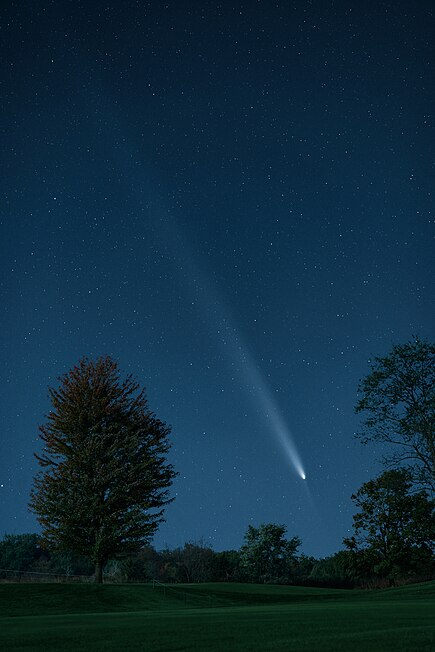
| Comet C/2023 A3 (Tsuchinshan–ATLAS) on 17 October 2024 | |
| Discovery | |
|---|---|
| Discovered by | Purple Mountain Observatory ATLAS South Africa |
| Discovery date | 9 January 2023[1] |
| Designations | |
| MPC designation | C/2023 A3 |
| Alternative designations | A10SVYR |
| Orbital characteristics[4] | |
| Observation arc | 1.37 years (502 days) |
| Earliest precovery date | 9 April 2022 |
| Number of observations | 2060 |
| Aphelion | ≈ 270,000 AU (inbound)[2] ≈ 3,800 AU (outbound)[2] |
| Perihelion | 0.3914 AU (58.6 million km)[3] |
| Eccentricity | 0.9999985 (epoch 1800)[2] 0.9998981 (epoch 2200) |
| Orbital period | ≈ 110 million years (inbound)[2] ≈ 235,000 years (outbound)[2] |
| Max. orbital speed | 67.33 km/s @ perihelion[3] |
| Inclination | 139.1° |
| Longitude of ascending node | 21.56° |
| Argument of periapsis | 308.5° |
| Last perihelion | 27 September 2024 18:00 ± 20 minutes (3-sigma)[3][4] |
| Earth MOID | 0.275 AU (41.1 million km; 107 LD)[4] |
| Physical characteristics | |
| Mean diameter | ~3.2 km[5] |
| Comet total magnitude (M1) | 4.3 ± 0.3[4] |
| Comet nuclear magnitude (M2) | 9.2 ± 0.3[4] |
.jpg)
C/2023 A3 (Tsuchinshan–ATLAS) (or Comet Tsuchinshan–ATLAS or simply Comet A3) is a comet from the Oort cloud discovered by the Purple Mountain Observatory in China on 9 January 2023 and independently found by ATLAS South Africa on 22 February 2023. The comet passed perihelion at a distance of 0.39 AU (58 million km; 36 million mi) on 27 September 2024,[1][3] when it became visible to the naked eye.[6][7][8] Tsuchinshan-ATLAS peaked its brightest magnitude shortly after passing the Sun at 9 October, with a magnitude of −4.9 per reported observations at the Comet Observation Database (COBS).[6]
Observational history
Discovery

The systematic search performed by the Asteroid Terrestrial-impact Last Alert System detected an asteroidal object with an estimated magnitude of 18.1 in images taken on 22 February 2023 using the 0.5 m f/2 Schmidt reflector at the Sutherland Observatory in South Africa, when the comet was about 7.3 AU (1.09 billion km; 680 million mi) from the Sun.[9] After the first orbit calculations, it was noticed that it was the same as an 18.7 magnitude object reported to the Minor Planet Center by the Purple Mountain Observatory (Zijinshan in Pinyin, Tsuchinshan in postal romanization, the latter form being traditional for discoveries from this observatory[9]) which was detected in images taken on 9 January 2023. It had been entered in the objects awaiting confirmation list, but had been removed on 30 January 2023 after no follow up observations were reported and the uncertainty on its predicted position grew to the point that it was considered lost.[9] Based on the naming conventions for comets, it received the name of both observatories.[9]
The object was subsequently detected in older images taken by the Zwicky Transient Facility (ZTF) in Palomar Observatory on 22 December 2022, when it had a magnitude of 19.2–19.6. These deeper and better resolved images also revealed it had a very condensed coma and a small straight tail 10 arcseconds in length, indicating it was a comet.[1] More evidence of cometary activity was later reported by Hidetaka Sato, M. Mattiazzo and Cristóvão Jacques.[9]
Towards perihelion

By January 2024, the comet had brightened to an apparent magnitude of 13.6 and according to Bob King, author in Sky & Telescope magazine, was visible through 15-inch telescopes at ×142 magnification.[10] The comet was then moving through the constellations of Libra and Virgo.[10] By the end of April it had brightened to about magnitude 10 and could be observed through small telescopes, showing a short tail.[11] The spectrum of the comet on 31 May 2024, when the comet was 2.33 AU from the Sun, indicated strong cyanide emission and that the comet is carbon depleted.[12] The comet had a large dust-to-gas ratio.[13]
In May and June the brightening rate of the comet slowed, with the comet staying between magnitudes 10 and 11, while a dusty tail measuring 5 to 15 arcminutes long was observed visually to extend eastwards.[14] Astronomer Zdenek Sekanina suggested that this indicates that the comet nucleus has been fragmenting, with the fragmentation starting in late March, as indicated by an increase in the brightening rate and the subsequent decrease in dust production, the narrow teardrop-shaped dust tail, and non-gravitional changes in the orbit. He predicted that the comet would disintegrate before perihelion.[15] Observations of the comet with TRAPPIST robotic telescope indicate that dust production reached a minimum in May, when the comet was near a phase angle of zero, and started to increase again one month later, while gas production rates increased slowly throughout that period.[13] In mid June the comet entered the constellation of Leo, in the evening sky.[10] In early July, a faint ion tail measuring about one and half degree in length was observed photographically.[16] After mid July the comet was lost in the Sun’s glare until September.[10] In August the comet was observed by STEREO spacecraft to brighten steadily to an apparent magnitude of 7.[17][18]
Perihelion

The comet was recovered by Terry Lovejoy in the morning twilight on 11 September 2024, when it was located in the constellation of Sextans, at a magnitude of 5.5.[19] The comet was spotted with the naked eye and photographed by astronaut Matthew Dominick on board the ISS on 20 September, followed by fellow astronaut Donald Pettit two days later.[20] The first naked eye observation of the comet from Earth was reported on 23 September, with the comet having an estimated magnitude of 3.3, while its tail was reported to be 2.5 degrees long when it was observed with binoculars.[6]
During the last week of September it was located in the dawn sky, better visible from the Southern Hemisphere, and it was predicted to have brightened to second magnitude. Perihelion took place on 27 September.[10] By 1 October the comet had brightened to magnitude 2[6] and its tail was estimated to be 10–12 degrees long.[21] After that it moved again in conjunction with the Sun.[10] On 7 October the comet entered the field of view of the SOHO Coronagraph,[22] and continued to be visible until 11 October.[23] Petr Horálek managed to photograph the comet in broad daylight on 8 October.[24] On 9 October 2024, the comet was 3.5 degrees from the Sun.[25] The comet was seen to brighten to a magnitude of −4.9 on that day,[6] becoming one of the brightest comets of the past century. It was the second brightest comet viewed by SOHO since its launch in 1995, after comet McNaught in 2007.[23]
The comet was recovered in the evening sky on 10 October[16] and the next days became visible with the naked eye.[10][26][27] It made its closest approach to Earth on 12 October at a distance of 71 million km (44 million mi).[28] The comet after that became dimmer, as it moves away from both the Earth and the Sun, however as the elongation becomes higher, it becomes easier to spot.[16] Earth crossed the orbital plane of the comet on 14 October and as a result an anti-tail was observed.[29][30] After that the comet faded quickly and by 20 October it had dimmed to 4th magnitude.[31]
Brightness predictions
When first discovered, the comet was predicted to reach a total magnitude of +3 during perihelion, assuming an absolute magnitude (H) of 7 and 2.5n = 8, when it would have a small solar elongation.[9] Better visibility was predicted about three weeks after perihelion, in mid-October, when it would be around fourth magnitude.[9] Gideon van Buitenen estimated that the comet would reach a magnitude of 0.9 during perihelion and −0.2 at the time of closest approach to Earth, assuming H = 5.2 and 2.5n = 10, and would benefit from the effects of forward scattering.[32][33]
Revised data from June 2024 suggested that the comet would brighten to an apparent magnitude of 2.2, assuming H = 6 and 2.5n = 7.5, which is the average brightening rate of long-period comets in the inner Solar System. However, the comet is expected to be at least one magnitude brighter due to the effects of forward scattering, which could boost the brightness by several magnitudes around the peak of the effect on 9.8 October 2024.[14] More calculations from early September indicate that accounting for forward scattering, the comet will be brighter than magnitude 0 between 5 and 13 October and peaked at over −4 on 9 October, when it brightened by almost 6 magnitudes due to forward scattering.[34]
Orbit

C/2023 A3 · Sun · Mercury · Venus · Earth · Mars
The comet has a retrograde orbit, lying at an inclination of 139°. Τhe comet had its perihelion on 27 September 2024, at a distance of 0.391 AU. Τhe closest approach to Earth was on 12 October 2024, at a distance of 0.47 AU. The comet does not approach close to the giant planets of the Solar System.[9] The orbit is weakly bound to the Sun before entering the planetary region of the Solar System.[2] Due to planetary perturbations, the outbound orbit will have a smaller eccentricity than the inbound orbit. So the orbital period and aphelion distance become much shorter.[2] The weakly hyperbolic trajectory may or may not result in the comet being ejected from the Solar System. It is expected to be 200 AU from the Sun in the year 2239.[35]
| Date and time of closest approach | Earth distance(AU) | Sun distance(AU) | Velocity relative to Earth(km/s) | Velocity relative to Sun(km/s) | Uncertainty region(3-sigma) | Constellation | Moon illumination | Reference |
|---|---|---|---|---|---|---|---|---|
| 2024 October 12, 15:18 ± 15 min | 0.47241 AU (70.672 million km; 43.913 million mi; 183.85 LD) | 0.55619 AU (83.205 million km; 51.701 million mi; 216.45 LD) | 80.5 | 56.5 | ±7 thousand km | Virgo | 70% | [36] |
- Positions of the comet C/2023 A3 near 2024 perihelion
- The position of comet C/2023 A3 in August and September 2024 with the expected apparent magnitudes. The comet is located in the constellation Leo between the two stars 55 and 57 Leonis about six degrees south of the ecliptic at the beginning of August and then moves towards the constellation Sextans. With increasing apparent brightness, it turns back toward the constellation Leo in the second half of September at maximum southern ecliptic latitude (just under 14 degrees of arc).
- The position of comet C/2023 A3 in October 2024. The comet is located in the southernmost tip of the constellation Leo about ten degrees south of the ecliptic and moves in the first half of the month with decreasing apparent brightness across the constellation Virgo. It then moves into the western head of the constellation Serpens Caput, and then moves across the constellation Ophiuchus. By the end of the month, the comet reaches a northern ecliptic latitude of just over 27 degrees of arc. Therefore, in the second half of October the comet should be well visible on the western horizon after sunset.


Gallery
[edit]
All timestamps are in their local timezone and 2024 unless stated otherwise.
- On 10 June, as seen through a 20 cm reflector f/4 telescope
- On 22 September from the ISS
- On 25 September at 05:24 from Chile
- On 28 September at 06:39 from Gran Canaria, Spain
- On 2 October at 05:00 from Victoria, Australia
- On October 12th 2024 from Tucson, AZ.
- On 12 October at 19:54 from the Grand Canyon, Arizona, United States.
- On October 13th 2024 Zoomed in from Tucson, AZ
- On 14 October at 20:00 with a prominent “anti-tail”, from Tucson, AZ
- On 14 October at 19:35 from Mountain View, California
- On 14 October from Ukrainian Carpathians, Ukraine
- On 15 October at 19:44 from Drøbak, Norway
- On 20 October at 20:16 from Yellowstone National Park

.jpg)
_from_Chile_(IMG_4135-CC).jpg)
.jpg)


