
From Wikipedia, the free encyclopedia
|
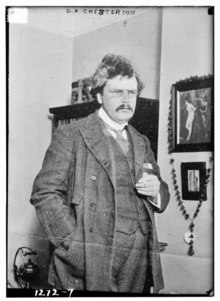
G. K. Chesterton
|
|
|---|---|
 |
|
| Born | Gilbert Keith Chesterton 29 May 1874 Kensington, London, England |
| Died | 14 June 1936 (aged 62) Beaconsfield, Buckinghamshire, England |
| Resting place | Roman Catholic Cemetery, Beaconsfield |
| Occupation | Journalist, novelist, essayist, poet |
| Citizenship | British |
| Education | St Paul’s School |
| Alma mater | Slade School of Art |
| Period | 1900–1936 |
| Genre | Essays, Fantasy, Christian apologetics, Catholic apologetics, Mystery, poetry |
| Literary movement | Catholic literary revival[1] |
| Notable works | The Napoleon of Notting Hill(1904) Charles Dickens: A Critical Study (1906) The Man Who Was Thursday (1908) Orthodoxy (1908) Father Brown stories (1910–1935) The Everlasting Man (1925) |
| Spouse | Frances Blogg |
| Relatives | Cecil Chesterton (brother) |
|
|
|
| Signature |  |
Gilbert Keith Chesterton, KC*SG (29 May 1874 – 14 June 1936), was an English writer,[2] poet, philosopher, dramatist, journalist, orator, lay theologian, biographer, and literary and art critic. Chesterton is often referred to as the “prince of paradox“.[3] Time magazine has observed of his writing style: “Whenever possible Chesterton made his points with popular sayings, proverbs, allegories—first carefully turning them inside out.”[4]
Chesterton is well known for his fictional priest-detective Father Brown,[5] and for his reasoned apologetics. Even some of those who disagree with him have recognised the wide appeal of such works as Orthodoxy and The Everlasting Man.[4][6]Chesterton routinely referred to himself as an “orthodox” Christian, and came to identify this position more and more with Catholicism, eventually converting to Catholicism from High Church Anglicanism. George Bernard Shaw, his “friendly enemy”, said of him, “He was a man of colossal genius.”[4] Biographers have identified him as a successor to such Victorian authors as Matthew Arnold, Thomas Carlyle, Cardinal John Henry Newman, and John Ruskin.[7]
Early life

Chesterton was born in Campden Hill in Kensington, London, the son of Marie Louise, née Grosjean, and Edward Chesterton.[8][9] He was baptised at the age of one month into the Church of England,[10] though his family themselves were irregularly practising Unitarians.[11] According to his autobiography, as a young man Chesterton became fascinated with the occult and, along with his brother Cecil, experimented with Ouija boards.[12]
Chesterton was educated at St Paul’s School, then attended the Slade School of Art to become an illustrator. The Slade is a department of University College London, where Chesterton also took classes in literature, but did not complete a degree in either subject.
Family life
Chesterton married Frances Blogg in 1901; the marriage lasted the rest of his life. Chesterton credited Frances with leading him back to Anglicanism, though he later considered Anglicanism to be a “pale imitation”. He entered full communion with the Catholic Church in 1922.[13]
Career
In September 1895 Chesterton began working for the London publisher Redway, where he remained for just over a year.[14] In October 1896 he moved to the publishing house T. Fisher Unwin,[14] where he remained until 1902. During this period he also undertook his first journalistic work, as a freelance art and literary critic. In 1902 the Daily News gave him a weekly opinion column, followed in 1905 by a weekly column in The Illustrated London News, for which he continued to write for the next thirty years.
Early on Chesterton showed a great interest in and talent for art. He had planned to become an artist, and his writing shows a vision that clothed abstract ideas in concrete and memorable images. Even his fiction contained carefully concealed parables. Father Brown is perpetually correcting the incorrect vision of the bewildered folks at the scene of the crime and wandering off at the end with the criminal to exercise his priestly role of recognition and repentance. For example, in the story “The Flying Stars”, Father Brown entreats the character Flambeau to give up his life of crime: “There is still youth and honour and humour in you; don’t fancy they will last in that trade. Men may keep a sort of level of good, but no man has ever been able to keep on one level of evil. That road goes down and down. The kind man drinks and turns cruel; the frank man kills and lies about it. Many a man I’ve known started like you to be an honest outlaw, a merry robber of the rich, and ended stamped into slime.”[15]

Caricature of Chesterton, by Max Beerbohm
Chesterton loved to debate, often engaging in friendly public disputes with such men as George Bernard Shaw,[16] H. G. Wells, Bertrand Russell and Clarence Darrow.[17][18] According to his autobiography, he and Shaw played cowboys in a silent film that was never released.[19]
Visual wit
Chesterton was a large man, standing 6 feet 4 inches (1.93 m) and weighing around 20 stone 6 pounds (130 kg; 286 lb). His girth gave rise to a famous anecdote. During the First World War a lady in London asked why he was not “out at the Front“; he replied, “If you go round to the side, you will see that I am.”[20] On another occasion he remarked to his friend George Bernard Shaw, “To look at you, anyone would think a famine had struck England.” Shaw retorted, “To look at you, anyone would think you had caused it.”[21] P. G. Wodehouse once described a very loud crash as “a sound like G. K. Chesterton falling onto a sheet of tin”.[22]
Chesterton usually wore a cape and a crumpled hat, with a swordstick in hand, and a cigar hanging out of his mouth. He had a tendency to forget where he was supposed to be going and miss the train that was supposed to take him there. It is reported that on several occasions he sent a telegram to his wife Frances from some distant (and incorrect) location, writing such things as “Am in Market Harborough. Where ought I to be?” to which she would reply, “Home”.[23] (Chesterton himself tells the story, omitting, however, his wife’s alleged reply, in ch. XVI of his autobiography.)
Radio
In 1931, the BBC invited Chesterton to give a series of radio talks. He accepted, tentatively at first. However, from 1932 until his death, Chesterton delivered over 40 talks per year. He was allowed (and encouraged) to improvise on the scripts. This allowed his talks to maintain an intimate character, as did the decision to allow his wife and secretary to sit with him during his broadcasts.[24]
The talks were very popular. A BBC official remarked, after Chesterton’s death, that “in another year or so, he would have become the dominating voice from Broadcasting House.”[25]