All posts by Ben Gilberti

When I took LSD

I took LSD in my senior year at Fordham University. I was very lucky because it was an incredibly beautiful day, in May. Because the quality of an LSD trip depends mostly on the environment in which you take it. And the grounds at Fordham University were about as great as can be. So I had an exquisitely beautiful trip.

It took about 45 minutes to take effect. I had no idea what to expect. I remember looking at the sidewalk near my feet, and suddenly the stones in the sidewalk became unspeakably beautiful jewels! Amazing! And then I looked up and I was overwhelmed by heavenly beauty all around.

I spent most of the rest of the day in awe of the beauty of reality, the beauty of my particular area of the universe.

But a few hours into the trip I remember holding my head in my hands and exclaiming, “I AM NOT ME! I AM NOT ME!”

It was not an idea. It was an experience, the experience of rising up out of everything that constituted Ben Gilberti, into the pure awareness that was outside and above my previous identity. It was one of my most important experiential realizations I’ve ever had. I’ve since been free of all the stuff that made up Ben Gilberti; Ben was still perfectly available to experience, but I’d nevermore be stuck in it.

Then the most amazing thing happened. I got the idea of giving a lecture on “The Revolution in Linguistic/Conceptual Framework Brought About by Recent Discoveries in Field Physics and Quantum Mechanics.” It was an original idea and the whole of the lecture stood before me, ready to be expressed.

So, incredibly, I went to one of my professors before his class started and asked him if I could teach his class for him that day. He asked about what. And I told him the title of the talk I just wrote above. He was intrigued and allowed me to do it. He introduced me and up I went to the front of the class and for 50 minutes delivered a stupendous lecture. And then at the very end, I told them that the talk was so good because I was tripping my ass off on LSD.

Everyone was stunned.

I gave the lecture two more times that day, and gradually the trip came to an end.

Ben Gilberti

Image may contain: 1 person

The Faceless Absolute

All of our sense of lack, separation, limitation and sorrow is based on the idea that we are a person inside of a body inside of a world.

The sense of being a person is founded on the sense of location, as in “I am over here, and the world is over there.”

The sense of location is because of the act of Seeing, or perceiving. Without perceiving or seeing form, there would be no sense of location, and thus no me at the center of perception.

If you drop or dis-identify completely from any and all forms of Seeing, Awareness will drop inward into pure Being devoid of a body, mind, location and world. Bliss, Clarity and Peace reign supreme here. This is Self-Realization.

Then when you drop or dis-identify from even this pure Being, by realizing that even this Beingness appears to YOU, a great void will open up which is the gateway, tunnel, or bridge into realizing the Absolute. Continue to recede. Not this, not this. (Neti-Neti)

The distance that is generated between the Great I Am, or Pure Being (God)–which is the formless essence of All That Is–may generate this sense of void or nothingness, which is in and of itself not the goal. Its only real use is to function as a space that can show the difference between the Great I Am and yourself as the Absolute.

Like the space between your body and the mirror which reflects the body; it is not helpful to become too enamored with the space in between if your intention is to learn about your reflection. Rather, look in the mirror and Realize that your real face is not in the mirror.

In the same way, use pure, thoughtless, wordless Beingness as this mirror to realize the Faceless Absolute which cannot ever appear: You. You have never appeared and shall never appear. Awareness appears to you, you do not appear to Awareness. Not even God knows you, God appears unto you.

The true you is older than God, older than Awareness. Older than Beingness. Older than timeless Presence.

Nothingness is merely the ocean between Beingness and the Absolute. You want to realize the Absolute, not merely drown in Nothingness. You are beyond/free from even Nothingness/the Void.

Bentinho Massaro

Image may contain: 1 person, closeup


Benedicite

What about Jesus?

Well, I was brought up on in a Catholic family, so I started off believing the story of Jesus.

But it eventually dawned on me that it made no sense. Now Christian believers will be quick to tell me that God’s Word (the bible) isn’t obliged to make sense, it’s just to be believed.

Well, the idea that the bible is the inerrant word of God, also didn’t make any sense. So I reviewed the story on its own merits.

The general idea is that God punishes man for sin, and that punishment is in the form of some kind of pain, the pain being “the price you pay” for your sin. So there is a price of pain to be paid to God for your sins.

Alright, but then God decided that that is hard on people, so he sends his only son to Earth in a human body to suffer and die on a cross to pay for our sins.

So in other words, God has to get paid with pain. If you sin, someone has to pay God for your sin. God absolutely demands this payment, but it doesn’t matter if someone else suffers pain on your behalf, that still would pay God just as much as if the sinner himself paid.

And the only way someone could pay for ALL of humanity’s sins is if his own precious Son suffered to such an extreme that enough pain was experienced by his Son so as to pay up on all the suffering that God absolutely demands for human sins.

Alright, it’s a fascinating story, but it just doesn’t add up, it just doesn’t make sense.

“Yeah but God said it so you should believe it!!”

Well as I say, I don’t believe the bible is God’s inerrant word. It’s got some good stuff in it, but most of it doesn’t make sense to me either.

God is perfectly capable of speaking to me directly, he doesn’t need a book to do it, especially a book that is ridiculous in so many ways.

If you ask me, (and by this time many of you would never ask me), the only reason why so many people believe in all this nonsense is because the story of Hell is the torture of fire for all eternity. They may not be sure whether the story of Hell is true or not, but they figure they better not take their chances. Best to be on the safe side and go along with the religion.

But only if you’re born into the religion. If you were born into a Muslim home, then the Koran is what you’ll need to go along with. Or any of the other places on Earth where religious books other than the bible are believed.

~ Ben Gilberti

Mandelbrot Fractal Zoom

I haven’t posted a Mandelbrot Fractal Zoom in quite a while. I was eager to check out what’s new in this area because computers are much more powerful now. It takes extreme computer power to make one of these. And even then the calculations take about a month.

The entirety of what you’ll see here is the result of 750,000,000 iterations of the famous Mandelbrot equation Z=Z^2 + C on the complex plane. “Complex plane” means it uses the number “i” which is the square root of -1. Because there’s no such thing as the square root of -1, it’s called an “imaginary number,” and imaginary though it may be, it’s essential to make a Mandelbrot and zoom into it. It’s considered to be the most fantastic thing ever discovered in the world of mathematics.

Here, we’re going to zoom into one tiny piece of the Mandelbrot Fractal, and as you’ll see, the detail that shows up is fabulous, and, in fact, it could go on forever. But we’ll just do it for 5 minutes. Bump it up to full screen. Focus on the center of the screen as it unfolds, relax, and enjoy!!

The Great ATLAS Experiment at the Large Hadron Collider

ATLAS

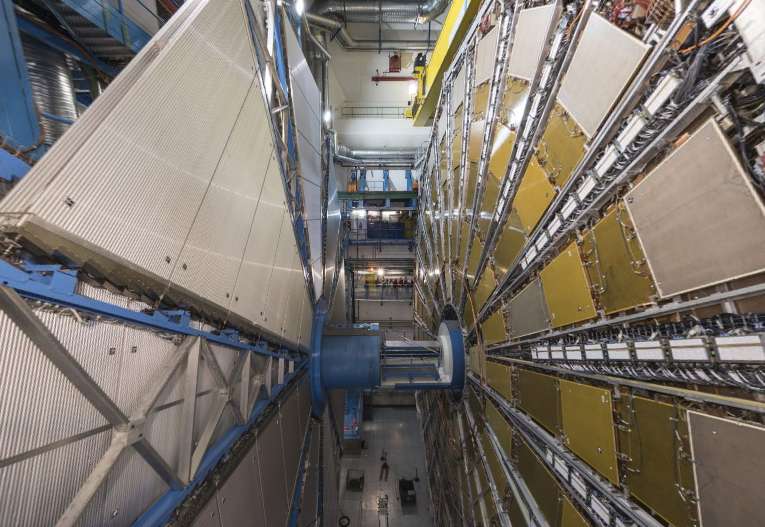
From a cavern 100 metres below a small Swiss village, the 7000-tonne ATLAS detector is probing for fundamental particles

ATLAS(link is external) is one of two general-purpose detectors at the Large Hadron Collider (LHC). It investigates a wide range of physics, from the search for the Higgs boson to extra dimensions and particles that could make up dark matter. Although it has the same scientific goals as the CMS experiment, it uses different technical solutions and a different magnet system design.

Beams of particles from the LHC collide at the center of the ATLAS detector making collision debris in the form of new particles, which fly out from the collision point in all directions. Six different detecting subsystems arranged in layers around the collision point record the paths, momentum, and energy of the particles, allowing them to be individually identified. A huge magnet system bends the paths of charged particles so that their momenta can be measured.

The interactions in the ATLAS detectors create an enormous flow of data. To digest the data, ATLAS uses an advanced “trigger” system to tell the detector which events to record and which to ignore. Complex data acquisition and computing systems are then used to analyze the collision events recorded. At 46 m long, 25 m high and 25 m wide, the 7000-tonne ATLAS detector is the largest volume particle detector ever constructed. It sits in a cavern 100 m below ground near the main CERN site, close to the village of Meyrin in Switzerland.

More than 3000 scientists from 174 institutes in 38 countries work on the ATLAS experiment (February 2012).


ATLAS

Virtual tour

Take a virtual tour of ATLAS

Voir en français

Updates related to ATLAS

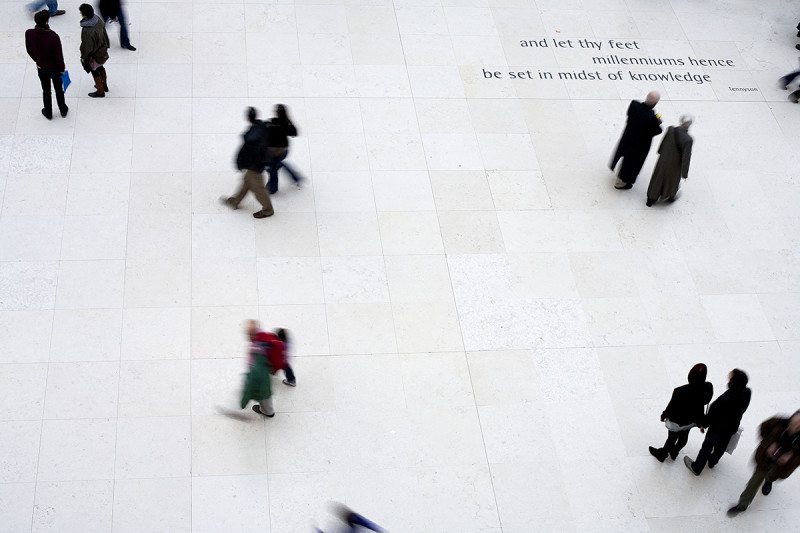
Philosophers of Knowledge, Your Time Has Come

Philosophers of knowledge, your time has come

philosophers
Philosophers may be reluctant to enter the public square

Millennium Images

A COMMON refrain heard around New Scientist‘s offices in recent weeks has been “episte… what?!” Even among educated and well-informed people, epistemology – the study of knowledge – is neither a familiar word nor a well-known field of inquiry. But it has never been more important.

Much has been written about the post-truth world in which facts have ceased to exist, or at least to matter. All kinds of forces have been blamed, but one that goes unremarked is that sorting truth from falsehoods is actually very difficult. In an increasingly complex world, it is largely an exercise in taking somebody else’s word for it (see “Knowledge: What separates fact from belief“).

One obvious example is climate change. The majority of climate scientists say that the world is warming and that human activity is to blame. How do they know? Should we agree with them?

One person might say that we should: the scientific method is a reliable guide to reality, and climate scientists are trustworthy. But another might argue that science sometimes gets things wrong, pointing to occasions in the past when scientists have fallen prey to groupthink or have been caught hiding data. The line of argument that seems most plausible to someone depends more on their cultural and political affiliation than on knowledge. Rigorous epistemological analysis tends not to come into it.

And herein lies a problem. In the current crisis over truth, epistemology is nowhere to be seen. Instead, we rely on intuition and common sense – what might be called “folk epistemology”. The argument thus resembles a debate about medical ethics to which nobody remembered to invite a bioethicist.

Philosophers may be reluctant to enter the public square, afraid of being derided by the post-truthers as yet more “fake news” or tarred with that pejorative term “expert”. But epistemology has become one the most relevant and urgent philosophical problems facing humanity. Philosophers really need to come out – or be coaxed out – of the shadows.

Excerpted from: www.newscientist.com/article/mg23431194-000


Ontological Mysticism

I’m gonna try talking about something that is very risky.

What? You may ask?

Ontological Mysticism

I wrote a book with that title which is available from Amazon if you’re interested.

The basic premise is that the primary substance of the universe is consciousness. And all that appears to be something other than consciousness is actually vortex of thought within consciousness. All the atoms, molecules, organisms, people, stars, rocks, stars and galaxies, all are made of specific vortices of thought in consciousness.

The next premise is that consciousness is actually whole, perfect, complete, absolute and infinite.

So why then do we often see stuff that is far less that perfection: illness, war, hatred, pain, suffering, death and so on?

Well, the reason is that we hold beliefs that are contrary to the Truth about what consciousness (the sole substance of the universe) actually is.

All the imperfection ever perceived by anyone is an out-picturing of their beliefs.

To correct this problem there is a process called Translation (taught by The Prosperos, where there are many Mentors who teach Translation), whereby one shines the light of absolute truth on our beliefs about the world in such a way that the errors in our beliefs melt away, leaving the beautiful Truth that those erroneous beliefs were hiding.

Whole, perfect, complete, absolute, infinite consciousness is actually all there is and all there can be, all else being the manifestation of our beliefs in something less than or other than that.

So, relax, all is well, always, no matter how much it may appear otherwise. Relaxing in that Truth will gradually melt away those appearances and leave your life more and more in alignment and harmony with Truth.

M-Theory, String Theory, and Parallel Worlds, by Dr. Michio Kaku

Originally Published on Mar 13, 2017

Subscribe to Dr. Michio Kaku’s Universe at https://goo.gl/nFNsv0
More of Dr. Michio Kaku at:
Website: http://mkaku.org/
Facebook: https://www.facebook.com/michiokaku
Twitter: https://twitter.com/michiokaku
==========================================
Copyright Disclaimer Under Section 107 of the Copyright Act 1976, allowance is made for “fair use” for purposes such as criticism, comment, news reporting, teaching, scholarship, and research.

Consciousness, sexuality, androgyny, futurism, space, the arts, science, astrology, democracy, humor, books, movies and more