
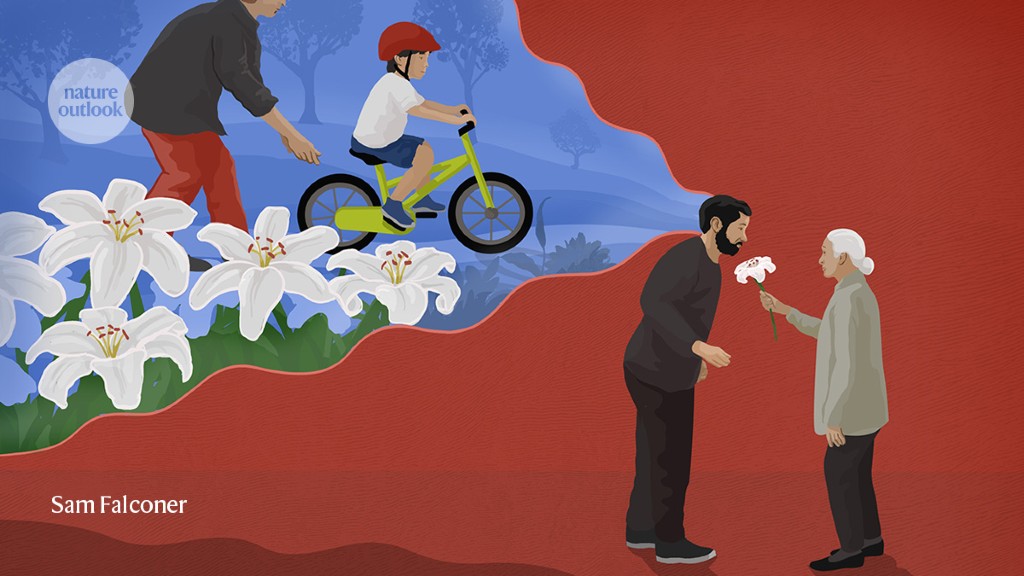
The intriguing link between smells and memories stored by the
brain raises the possibility of using odours to improve recall and
overcome trauma.
By Roxanne Khamsi
23 June 2022 (media.nature.com)
A bite of a madeleine cake and a sip of
tea is all it took to send Marcel Proust
tumbling back into the childhood
memory of Sunday mornings with
his aunt. “No sooner had the warm
liquid, and the crumbs with it, touched my
palate, a shudder ran through my whole body,
and I stopped, intent upon the extraordinary
changes that were taking place,” the French
novelist wrote in 1913.
This experience of a smell sparking a vivid
memory will be familiar to many people. As
Proust said, “the smell and taste of things
remain poised a long time, like souls, ready
to remind us.” But how smells cause us to time
travel in our minds and evoke emotion is not
just of literary interest — it’s something that
scientists are trying to decipher.
“Smell is very deeply ingrained in our emotional memory,” says Eric Vermetten, a clinical
psychiatrist and trauma researcher at Leiden
University Medical Center in the Netherlands.
For him and many other researchers, the architecture of the brain itself is a clue to how tightly
connected odours are to memories. When we
hear a sound, the signal is conveyed from our
ears to the brainstem, then up to a part of the
brain called the thalamus, before finally reaching the auditory cortex. But when it comes to
sensing smells, the connection to the brain is
less circuitous. Smell-sensing neurons in the
nose extend directly to the olfactory bulb of
the brain, from which they can be passed on to
other brain regions — including areas involved
in memory.
The sense of smell is specific, which helps
to explain how our smell memories can be so
precise. Humans have more than 400 types
of olfactory receptor. This affords us a tremendous amount of olfactory detail, and our
nervous system needs to categorize all of that
smell input. In 2013, one group of scientists
suggested that just as there are five senses of
taste (sweet, salty, sour, bitter and umami),
there are ten basic dimensions of smell, such
as fruity, nutty, woody and citrus1
. However,
the researchers gave participants in their study
only 144 scents to profile — a tiny fraction of
the full spectrum of smells, which might have
limited the number of odour dimensions that
the volunteers picked up.
Knowing how our brains keep track of
the smells we encounter has been a source
of fascination for Sandeep Robert Datta, a
neuroscientist at Harvard Medical School in
Boston, Massachusetts. In the past two years,
he and his colleagues have published two
studies that show how short-term and longterm odour memories function in the brain.
In one experiment, published in the journal
Cell last December, they tried to understand
how short-term neural memories of scents
affected the sense of smell in mice2
. It was previously thought that all olfactory sensory neurons had the same genetic inner workings, even
though they have different odour receptors.
But when the team exposed mice to odours
and then looked at the gene-activity signatures
of their odour receptor cells two hours later,
they noticed that different olfactory sensory
neurons had different patterns of gene activity. The key discovery was that exposure to
odours would trigger smell-sensing cells to
boost the activity of genes that attenuated
their responses to those same odours. In other
words, when neurons pick up a scent, they
become less sensitive to it in the short term —
“filtering out the expected to emphasize the
new,” as Datta puts it. Many people experience
this as getting used to a smell in their environment and becoming temporarily unaware of it.
The second paper from Datta’s group,
published in Nature, addresses how smell
memories are coded in the brain over the long
term3
. The group exposed mice to different
smells while recording their responses to those
scents in the olfactory cortex — the region of
the brain where smell signals are often sent
from the olfactory bulb. Initially, scents that
were chemically similar were transmitted to
nearby places in the olfactory cortex. But the
researchers worked out that, over the long
term, exposing mice to two dissimilar smells
simultaneously could change where in the
cortex the smell signals would map to. The
researchers could get two radically different
scents to map to a similar region of the cortex,
which could explain why our unique personal
smell memories can be a concoction of various
odours — the smells of sunscreen and the ocean
evoking a holiday, say, or the scent of bug spray
mixed with smoke bringing to mind summer
campfires. This also suggests that experience
can shape the association of smell memories.
“What is crazy, is as your experience changes,
the actual relationships that are encoded in
your brain move around,” Datta says.
The study of how smells influence memory in humans has long been a niche area of
research. However, around a century after
Proust wrote about his madeleine-and-teainduced flashback, olfaction is beginning to
attract more interest from researchers, who
are starting to understand the mechanics
of odour memory. “It’s getting more popular,” says Kei Igarashi, a neuroscientist at the
University of California, Irvine.
By watching rodents navigate mazes
guided by memories of odours, scientists
are getting a sense of how neurons in the
brain store this information. And there are
also insights into the psychological elements
of odour memories in humans. Smells can
stir up cherished nostalgia, but there are
also times when odours can cause anguish:
researchers have shown that certain smells
can trigger physiological stress in people
with post-traumatic stress disorder (PTSD).
Thanks to a flurry of research in the past decade, we might be on the cusp of understanding
the lasting power of smells — and how odour
memories might be used to boost and heal
our brains.
Early recollections
Even before babies can see well, they have
a robust sense of smell. An infant’s ability to
detect odours is so strong that newborns will
prefer the scent of their mother’s breast and
clothes over those of other people4
. One idea
for why this preference develops so early is that
human amniotic fluid seems to contain individualized chemical signatures that prime the
developing fetus to be attracted to their parent.
The memory and attachment to these smells
in early life is so powerful that scientists have
even explored ways to harness it therapeutically. In one experiment involving babies who
were about to be vaccinated against hepatitis B
(ref. 5), researchers exposed some babies to the
smell of their mother’s milk, whereas others
were exposed to the scent of another woman’s
milk or to water. The infants who were exposed
to the odour of their own mother’s milk were
less likely to show signs of pain or an elevated
heart rate when receiving the immunization.
Even as adults, the tight connection between
smell and memory persists. One brain-scan
study6
published in June last year found that
when people are resting, the activity of their
olfactory brain centres is in sync with that of
another brain region called the hippocampus
— which is deeply involved in memory. The
activities of other sensory systems such
as sight and touch were significantly less
correlated with the hippocampus. The finding
suggests that olfaction is more-continuously
connected to certain memory processes in the
brain than are those other senses.
Rodent studies are also giving us clues to
the pull that smell memories can exert. Female
mice, for example, will keep returning to the
place where they smelt urine pheromones
of potential mates for at least a couple of
weeks7
. And there’s even a suggestion that
smell memories can be passed down through
generations. Mice whose grandfathers were
exposed to a scent similar to cherry blossom
in conjunction with an electric shock are more
anxious around that smell than are their control counterparts8
, for example. The scientists
who conducted the study suggested that this
learnt fear might be passed to future generations through chemical markers on DNA
sequences known as epigenetic modifications.
In addition to amassing data underscoring that smell and memory are linked in the
brain, scientists have sought to understand
what is happening at the neuronal level when
odour memories form. Earlier this year, Cindy
Poo, a neuroscientist at the Champalimaud
Foundation in Lisbon, and her colleagues
reported the results of an experiment in
which rats were trained to follow four distinct smells — citrus, grass, banana or vinegar
— to specific locations in a maze to receive a
reward9
. They found that as the rats learnt to
remember certain smells and their association
with specific locations, there was activity in the
hippocampus and a lesser-known brain region
just beneath it called the entorhinal cortex.
But, surprisingly, they also found that some
neurons in the piriform cortex — thought to
be involved in odour recognition — were doing
double-duty: the neurons responded to both
specific smells and locations. “They’re telling
you what odour you’re smelling and also telling you where you are,” Poo says. “It basically
shows that our sense of smell is very intimately
connected with our spatial memory at the level
of individual neurons in the brain.”
Igarashi also conducted a rodent experiment,
published in 2014, to gain insight into how smell
and memory are coded together in the brain. He
and his colleagues designed a challenge for rats
in which the animals were trained to navigate
a maze using scent. One odour would indicate
that the animal would need to turn right to
find food, whereas another odour indicated
the animal had to turn left. After three weeks of
training, the rodents were choosing the correct
direction on the basis of the odours more than
85% of the time10. Igarashi and his colleagues
looked at brain recordings from the animals
and noticed that as the rats learnt to respond to
the scent cues, cells in three brain regions — the
entorhinal cortex, the lateral entorhinal cortex
and the hippocampus — would emit electrical
signals in sync.
Igarashi wanted to know more about what
kind of molecular changes were aiding memory consolidation at the cellular level. So he
and his colleagues designed a follow-up study11
in which they looked at the brain activity of
mice that were trained to associate various
smells with either sugar water or bitter water.
“Smell is very deeply
ingrained in our
emotional memory.”
The group trained the animals using a range
of scents, including fruity odours and other
non-food-related odours, such as pine.
When the mice were learning to associate
odour with the sugar water, the cells in their
entorhinal cortex were releasing dopamine.
This proved to be a key molecule in consolidating the association. When the scientists
blocked that dopamine release it impaired the
animals’ learning — they would not remember
to lick for the sweet reward following exposure
to the associated scent.
The work could have implications for
Alzheimer’s disease, because the entorhinal
cortex is among the first brain regions to show
deterioration in people with the condition, and
olfactory dysfunction is thought to sometimes
be an early sign of cognitive decline.
The odorous past
Often, smell memories are associated with positive recollections of the past, but smells can
also trigger traumatic memories. Vermetten
recalls that when he was living in Connecticut
years ago, he provided psychiatric help for a
Vietnam War veteran who was affected by
the smells of the Asian-food restaurant that
he lived above. The fragrance of the food
brought the man back to his time in Vietnam.
“He couldn’t sleep at night,” Vermetten says.
“It bothered him, and he couldn’t put it aside.”
To better understand the role of smell in the
surfacing of traumatic memories, Vermetten
recruited 16 Vietnam War combat veterans,
half of whom had PTSD and half of whom
did not12. He and his team then exposed the
veterans to three smells: the scent of diesel,
which was tightly associated with traumatic
experiences during the veterans’ time fighting in the war; the pleasant smell of vanilla;
and the stinky odour of hydrogen sulfide,
which, although unpleasant, had no specific
association with war. The scientists measured
the brain activity of the participants, using a
method called positron emission tomography,
and noticed that the smell of diesel caused a
rise in blood flow to a brain region associated
with fear, known as the amygdala, in the veterans with PTSD but had less effect in the others.
The former group also rated the diesel smell
as more distressing than did the latter group.
Vermetten has advocated for scientists to
look at how certain smells might be able to
calm or ‘reset’ people who are in treatment for
trauma. For example, when someone is recounting a traumatic war memory, he says, they can be
given coffee grounds to sniff, which can help to
bring them back to the present moment.
An evolving research area
The study of smell and recollections of the past
continue to offer insights. Coincidentally, it
was in 1973, around the time that the war in
which Vermetten’s veterans were fighting
was ending, that the study of lasting smell
memories intensified. Interest in the ties
between olfaction and memory grew after a
study published that year13 demonstrated that
participants who sniffed certain odours in a
laboratory were able to identify those same
odours when they encountered them again
three months later. Further research showed
that people exposed to smells and pictures
had a better recall of the odours than of the
images several months later.
More-recent studies have tried to harness the
power of smell to help people recall information.
In one 2019 study, volunteers were shown
pictures — some of which were paired with
unpleasant odours. When participants were
tested on their recall 24 hours later, they were
able to recall the images that were shown in
tandem with the scent better than those shown
without a smell14. And it’s not just stinky odours
that boost memory: a study published the following year showed that smelling the scent of
rose while learning, and at night before a test,
boosted participants’ performance in exams15.
Working out why smells and memory
evolved to be so intertwined is of interest to
researchers. Poo wonders if there could have
been an evolutionary advantage to leveraging scent memories. She speculates that our
ancestors might have oriented themselves
and their migration by discerning the wafting
smells of places such as the desert or the coastline. “Theoretically, for our human ancestors
who were navigating across different landscapes, this would be a kind of long-distance
way to navigate, whereas visual and auditory
[senses] are very local,” she says.
Although the reasons smell and memory
have evolved to be connected are difficult to
pin down, the flurry of data about how they
interact on a neuronal level is heartening to
scientists in the field. Thanks to faster and
more-refined genetic sequencing approaches
and brain-imagining technologies, studies are
yielding new insights. “I’m a long-time olfaction
researcher and I think we’re going through a
little bit of a renaissance in terms of the tools
that we have available to understand the sense
of smell,” Datta says. With these tools in the
hands of scientists, we might finally get more
answers to why smells of the past linger in our
brains long after the first whiff has wafted away.
Roxanne Khamsi is a science journalist in
Montreal, Canada.
- Castro, J. B., Ramanathan, A. & Chennubhotla, C. S.
PLoS ONE 8, e73289 (2013). - Tsukahara, T. et al. Cell 184, 6326–6343 (2021).
- Pashkovski, S. L. et al. Nature 583, 253–258 (2020).
- Vaglio, S. Commun. Integr. Biol. 2, 279–281 (2009).
- Rad, Z. A., Aziznejadroshan, P., Amiri, A. S., Ahangar, H. G.
& Valizadehchari, Z. BMC Pediatr. 21, 61 (2021). - Zhou, G. et al. Prog. Neurobiol. 201, 102027 (2021).
- Roberts, S. A., Davidson, A. J., McLean, L., Beynon, R. J. &
Hurst, J. L. Science 338, 1462–1465 (2012). - Dias, B. G. & Ressler, K. J. Nature Neurosci. 17, 89–96
(2014). - Poo, C., Agarwal, G., Bonacchi, N. & Mainen, Z. Nature
601, 595–599 (2022). - Igarashi, K. M., Lu, L., Colgin, L. L., Moser, M.-B. &
Moser, E. I. Nature 510, 143–147 (2014). - Lee, J. Y. et al. Nature 598, 321–326 (2021).
- Vermetten, E., Schmahl, C., Southwick, S. M. &
Bremner, J. D. Psychopharmacol. Bull. 40, 8–30 (2007). - Engen, T. & Ross, B. M. J. Exp. Psychol. 100, 221–227 (1973).
- Cohen, A. O. et al. Learn. Mem. 26, 272–279 (2019).
- Neumann, F., Oberhauser, V. & Kornmeier, J. Sci. Rep. 10,
1227 (2020).
pdf of this article: https://media.nature.com/original/magazine-assets/d41586-022-01626-x/d41586-022-01626-x.pdf
(Submitted by Michael Kelly, H.W.)
Being able to concoct “odours to improve recall and overcome trauma” would be a wonderful achievement!