
‘It’s not coming back’
By Anna FitzGerald Guth, Science and climate reporter
Dec 17, 2025 (SFGate.com)
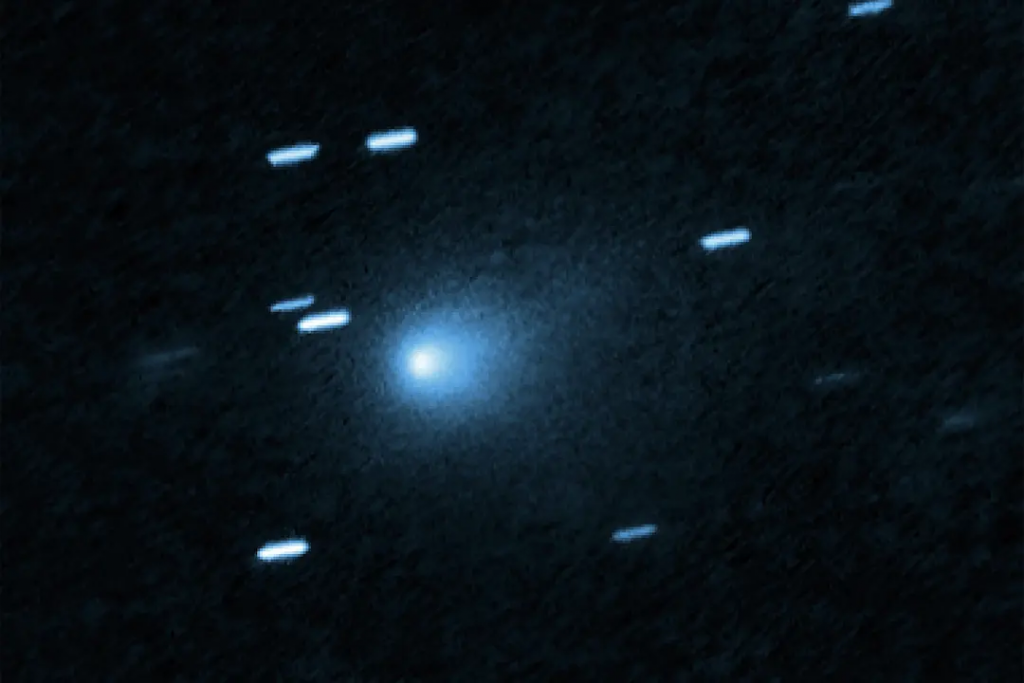
A view of the interstellar comet 3I/ATLAS on July 21, 2025, as it traveled 277 million miles from Earth.NASA/European Space Agency/AP
Californians can now glimpse a unique comet, dubbed 3I/ATLAS, that has captivated astronomers worldwide and sparked speculation of aliens.
The comet, which hails from outside our solar system, is expected to speed closest to Earth on Friday, Dec. 19, before streaking back toward interstellar space. The exact origin of this ball of ice, rock and dust is mysterious but, according to NASA, it does not pose a threat to Earth.
Anyone with a backyard telescope should be able to view the comet — which will appear as something between a bright star and a faint smudge — from now until January, especially in the two hours before sunrise.
“It’s the last chance to see this one,” Joe Masiero, a solar system scientist for the California Institute of Technology’s IPAC, told SFGATE. “It’s not coming back.”
The NASA-funded ATLAS survey telescope in Chile found the comet on July 1. The comet was not visible as it raced behind the sun, getting as close as 130 million miles, for about a month before reappearing in December. After it passes Earth on Friday, the comet is expected to journey back out of the solar system.
The comet is the third known interstellar object to visit, following 2I/Borisov in 2019 and ‘Oumuamua in 2017. Scientists have raced to file papers documenting 3I/ATLAS.
“These comets are not coming from the Oort cloud, which provides most of the comets we see orbiting the sun,” Matthew Graham, an astronomy professor at Caltech, told SFGATE. “Instead, these comets originated elsewhere and are coming from outside of our solar system. They’re really interesting because they have the imprint of both other solar systems and the interstellar medium potentially on them.”
Graham is the project scientist for the Zwicky Transient Facility, a robotic survey camera based at Caltech’s Palomar Observatory in San Diego County that scans the entire night sky every few days. Although the survey telescope in Chile discovered the comet on July 1, it turned out that the Zwicky Transient Facility had already observed it on June 28 and 29.
There will likely be many more finds like this now, Graham said, thanks to big sky surveys.
“We’ve only found three in the last five years, but these things must be going through the solar system quite regularly,” he said. “Now that we’ve begun to detect them, I think that the whole field is going to explode. It will tell us about the origins of our solar system, the surrounding environments and other solar systems.”
The comet has caused a stir.
Harvard astrophysicist Avi Loeb has publicly questioned whether aliens spying on Earth sent the object, among his other theories. Loeb wrote: “Is 3I/ATLAS wearing a costume of a comet or is it a truly icy rock of natural origin?”
Graham said that there’s no evidence he’s aware of linking the comet to aliens, despite the speculation. Many other scientists share his view.
The Virtual Telescope Project is set to livestream the comet’s approach starting at 8 p.m. PST on Dec. 18.
More News
— Strava fires woman in viral San Francisco restaurant video
— Death of 4-year-old boy tied to California religious cult
— After nearly 50 years, a Bay Area staple is calling it quits
— Body found on Mount Whitney may be missing hiker
Sign up for daily SFGATE breaking news alerts here. Google now allows you to add preferred news sources. Set SFGATE as one of yours to see more of us when you search.
Dec 17, 2025 | Updated Dec 17, 2025 2:42 p.m.
Science and climate reporter
Anna FitzGerald Guth is a science and climate reporter with SFGATE. She grew up in Berkeley and previously worked as a staff reporter and editor for the Point Reyes Light. Her work has also appeared in in Science, KQED, Mongabay, Eos and Civil Eats. She holds an M.S. in science communication from UC Santa Cruz and a B.A. in English and environmental studies from Wesleyan University. She is currently a California Local News Fellow through UC Berkeley’s School of Journalism.