
To break unhealthy patterns of thinking and acting, managers need to pay special attention to how they communicate, collaborate and get work done.

Published in Code Like A Girl
Mar 20, 2024 (code.likeagirl.io)
All managers make mistakes. However, some mistakes are avoidable, costly to the business, and hinder the team’s development and growth.
Most managers are so busy playing catch-up—handling unexpected issues, filling calendars with meetings, and pacifying unhappy stakeholders—that they ignore harmful practices that harm their team’s productivity and performance.
These repeated mistakes can become habits—they start creeping into everything they say and do. However, unconscious habits like these are hard to detect and even more challenging to break. Once your brain learns how things must be done, it runs on autopilot and makes most of the decisions for you.
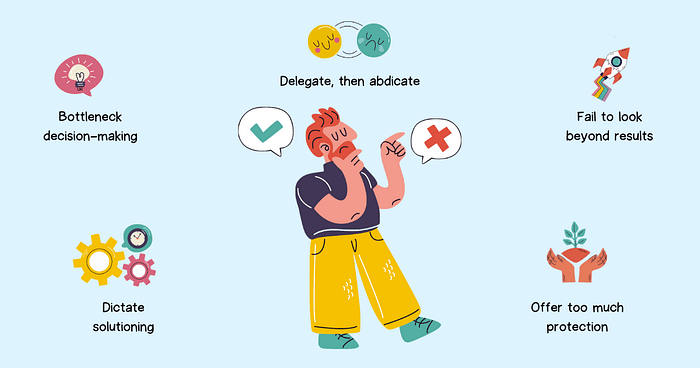
To break unhealthy patterns of thinking and acting, managers need to pay special attention to how they communicate, collaborate and get work done. In particular, they must pay attention to these five mistakes that other good managers don’t make:
Mistake 1: Delegate, then Abdicate
“If you want to do a few small things right, do them yourself. If you want to do great things and make a big impact, learn to delegate.” — John C. Maxwell
Learning to delegate well is the most crucial part of a manager’s job, but doing it right is a big struggle.
When managers delegate work and leave their people struggling to figure out everything independently, lack of support at crucial moments leads to frustration, confusion, and helplessness and can even be demotivating.
“Delegation without follow-through is abdication. You can never wash your hands of a task. Even after you delegate it, you are still responsible for its accomplishment, and monitoring the delegated task is the only practical way for you to ensure a result. Monitoring is not meddling, but means checking to make sure an activity is proceeding in line with expectations.”— Andy Groove
Good managers understand this very well — empowerment is not boundaryless freedom.
The big challenge here is knowing how much to be involved. If you are involved too much, you run the risk of micromanagement. If you are involved too little, you can miss those critical moments where your support or advice could have made a difference. The magic is in the balance.
To avoid making this mistake:
- Set upfront expectations on the intermediate milestones.
- Align on the frequency of updates. Discuss how and when you can touch base to keep things moving.
- When your team faces challenges or setbacks, help them find their own solutions by asking questions instead of spoon-feeding solutions. Coach, don’t solve is the mantra. Ask relevant questions to develop their critical thinking skills.
Don’t be the manager who delegates and forgets. Be around to guide, support and be their force to help them stay resilient when faced with setbacks and challenges.
Mistake 2: Bottleneck decision-making
“Lead with context, not control. When you give low-level employees access to information that is generally reserved for high-level executives, they get more done on their own. They work faster without stopping to ask for information and approval. They make better decisions without needing input from the top.” — Reed Hastings
Managers who don’t trust their team to make their own decisions get involved in every decision — they think it’s part of their job.
Getting involved in every small detail, in every small problem, is no joke. It takes a lot of energy and often leads to decision fatigue, exhaustion, and burnout.
There’s another problem. Exhaustion from attending to surface-level problems leaves less mental space to think about complex issues. More time spent on small decisions leaves less time for crucial decisions — which is critical for business and organizational growth.
Reliant on their boss to do all the thinking for them, employees fail to think for themselves. Dependent on their boss for every small decision and every small action stagnates their growth — it slows them down, prevents them from developing critical thinking skills, and leaves them feeling uninspired and unmotivated.
“This conscious or unconscious internal response is incredibly expensive both for the organization and for the individual. Trying to build leaders by regularly exposing them to your brilliance guarantees a lack of development. You will not have allowed anyone around you to show up with solutions outside the reach of your own personal headlights. If your employees believe their job is to do what you tell them, you’re sunk.”— Susan Scott
Good managers don’t make this mistake. They build their employees’ confidence by enabling them to make their own decisions, thereby putting their knowledge and experience into practice.
Being empowered to make their own decisions also increases their motivation to do better because they feel accountable for their choices.
To avoid this mistake:
- Shift from control to context.
- Give clarity to your team on the decisions they can make independently from the ones that require your attention.
Don’t be the manager who thinks that your team will screw up if you aren’t involved in the decision-making process. Give them a chance to earn your trust.
Mistake 3: Dictate Solutions
“Don’t tell people how to do things, tell them what to do and let them surprise you with their results.” — General George S. Patton
Yet, most managers do precisely the opposite.
They give their team the right opportunities but refuse to give them the autonomy that goes with it. They want things done and want them done their way, which frustrates their team members, especially the high performers.
Good managers don’t make this mistake.
They empower their team to find their own solutions by focusing on the results without laying down the specific steps needed to achieve them.
To avoid this mistake:
Show them the destination, but let them steer their ship. Share the “what” — the specific outcome that needs to be achieved. Support it with “why” — how it fits into the big picture and define what success looks like; what looks like a job well done. Knowing the “Why” of doing something is both motivating and inspiring. It opens the door to creativity and innovation.
Don’t let your ego or desire for perfectionism obstruct others from getting work done. Accept different approaches. Let your team know that some failure is acceptable, but that doesn’t permit them to be careless or lazy. Talk to them about what’s acceptable and what’s not. You can keep the bar high while leaving room for learning and growth.
“People often want autonomy over the four T’s “their task, their time, their technique, and their team…In an economy that demands nonroutine, creative, conceptual abilities — as any artist or designer would agree. Autonomy over task has long been critical to their ability to create. And good leaders (as opposed to competent “managers”) understand this in their bones.” — Daniel Pink
Don’t be the manager who doesn’t let their team determine their own solutions. You aren’t being helpful; you’re simply being annoying.
Mistake 4: Fail to look beyond results
“The best bosses do more than charge up people, and recruit and breed energizers. They eliminate the negative, because even a few bad apples and destructive acts can undermine many good people and constructive acts.” — Robert Sutton
Many managers, though, ignore these bad apples when it comes to eliminating them, especially if these people are high performers who have an uncanny ability to produce outstanding work.
Tolerating their toxic behaviour—getting agitated when others make mistakes, expecting them to work at their pace, passing sarcastic remarks, challenging their intelligence, belittling their skills, or demeaning them when things don’t work out the way they expected—conveys the message that such behavior is acceptable and anybody can get away with it.
This can happen in two ways:
- Passive enabler: Passively enabling these behaviours by failing to notice them and staying ignorant of their effect on your team.
- Active enabler: You actively contribute to it by delaying action—waiting for more proof, ignoring the conflict, or worrying about losing them. You may also try to rationalize the situation by convincing yourself that things aren’t that bad after all or that they are too minor to be noticed.
“Sometimes really talented people have heard for so long how great they are, they begin to feel they really are better than everybody else. They might smirk at ideas they find unintelligent, roll their eyes when people are inarticulate, and insult those they feel are less gifted than they are. In other words, these people are jerks. Many may think, “This guy is so brilliant, we can’t afford to lose him.” But it doesn’t matter how brilliant your jerk is. The cost of jerkiness to effective teamwork is too high. Jerks are likely to rip your organization apart from the inside.”— Reed Hastings
Focusing too much on results can also make you ignore poor performers in the team with the attitude that they don’t deserve your attention. But doing nothing about their poor performance is not harmless — it impacts morale in the team as others feel dragged down to make up for their slack and find lack of accountability as a sign that their manager doesn’t care about fairness or building excellence in the team.
Good managers don’t make this mistake. They know the overall damage to the team by tolerating bad behaviour or poor performance, which is highly expensive.
To avoid this mistake:
- Don’t delay difficult conversations — especially when it involves toxic behaviour or poor performance. It will only get worse and won’t disappear on its own.
- Be careful about the words you choose. Emotionally charged words can trigger negative emotions and put them on the defensive.
- Share your observations, discuss the impact and invite them to devise a solution.
- Leave the feedback with clear expectations on the desired changes, timeline and repercussions of not taking the feedback seriously.
Don’t be the manager who only cares about results. You can build an excellent team without compromising on your team’s well-being.
Mistake 5: Offer too much protection
“The ability to perform deep work is becoming increasingly rare at exactly the same time it is becoming increasingly valuable in our economy. As a consequence, the few who cultivate this skill, and then make it the core of their working life, will thrive.” — Cal Newport
Work environments can be brutal, especially when people lack respect for others’ time and productivity. Too many meetings, conflicting requests, and information overload can damage a team’s productivity. Without an opportunity to focus for long durations without interruptions, employees can’t produce quality work.
Interruptions are destructive to productivity. The more a manager can absorb trivial and unnecessary disruption, the better work their team can produce.
It’s natural for good managers in such environments to act as shields for their people—protecting them from being overwhelmed by requests, blocking information that doesn’t concern them, and keeping them away from anything that might distract them from doing their work.
However, what starts as healthy protection can often turn into toxic behaviour that destroys a team’s growth. Managers who don’t know where to draw the line tend to go overboard.
By not knowing how to separate healthy interactions from unhealthy ones:
- They block their people from getting the necessary exposure.
- Their team may acquire technical excellence but need to learn other valuable skills like effective communication, conflict resolution or delegation.
- They create strict team boundaries with a “my team” vs “your team” attitude by treating their team’s goals as primary and everything else as secondary. This breaks down the collaboration necessary to achieve common goals.
Good managers don’t make this mistake. Instead of trying to over-protect their teams from unnecessary distractions and interruptions, they coach them to manage their time well.
To avoid this mistake:
- Explain the benefits of healthy collaboration and show what it looks like.
- Empower them to say no to requests that do not align with their goals.
- Encourage them to go beyond team boundaries to learn about other teams and functions.
- Tell them to make decisions aligned with the more significant interest of the organization and not just their teams.
Don’t be the manager who acts as a gatekeeper — spending more and more time shielding people while spending less on doing work that will move your team forward.
Summary
- Managers can’t do it alone. They need their team to fulfill goals and achieve business targets. Effective delegation helps them achieve that. However, many managers go wrong when they delegate without providing the necessary support to their team to do well in their jobs. Delegate, then follow through. Don’t leave your people struggling by expecting them to figure everything out independently.
- Managers who like to be involved in every decision don’t help their teams make better decisions; they make them worse. Being involved in every small detail, issue, and problem bottlenecks decision-making and prevents their team from developing the critical thinking skills required to learn, grow, and do well at work.
- It is critical to provide the team with specific goals and outcomes they need to achieve. However, some managers take this too far by not only defining what must be done but also dictating how to achieve those results. Not letting your team determine their own solutions limits their ability to learn, adapt, and course-correct if necessary.
- It’s important for a manager to be outcome-oriented, but not at the cost of their team’s mental health and well-being. Toxic high performers and poor performers can have a huge negative impact on the performance and productivity of the entire team. Don’t ignore them and let the problem spiral out of control.
- Trying to protect your team from unnecessary time-wasting activities or other distractions at work is a good thought process. But it can’t be achieved by acting as a shield for your team. Taken too far, this protection can prevent them from getting the right information and building the right skills. Instead, coach them to manage their own time well.
Follow me here and on LinkedIn for more stories. This story was originally published at https://www.techtello.com.

Written by Vinita
·Writer for Code Like A Girl
Author: Books on Mindset, Imposter Syndrome. Scaling products → Scaling thinking (⊙_⊙) Former AVP Engineering, Swiggy. I write about work, progress and success.