
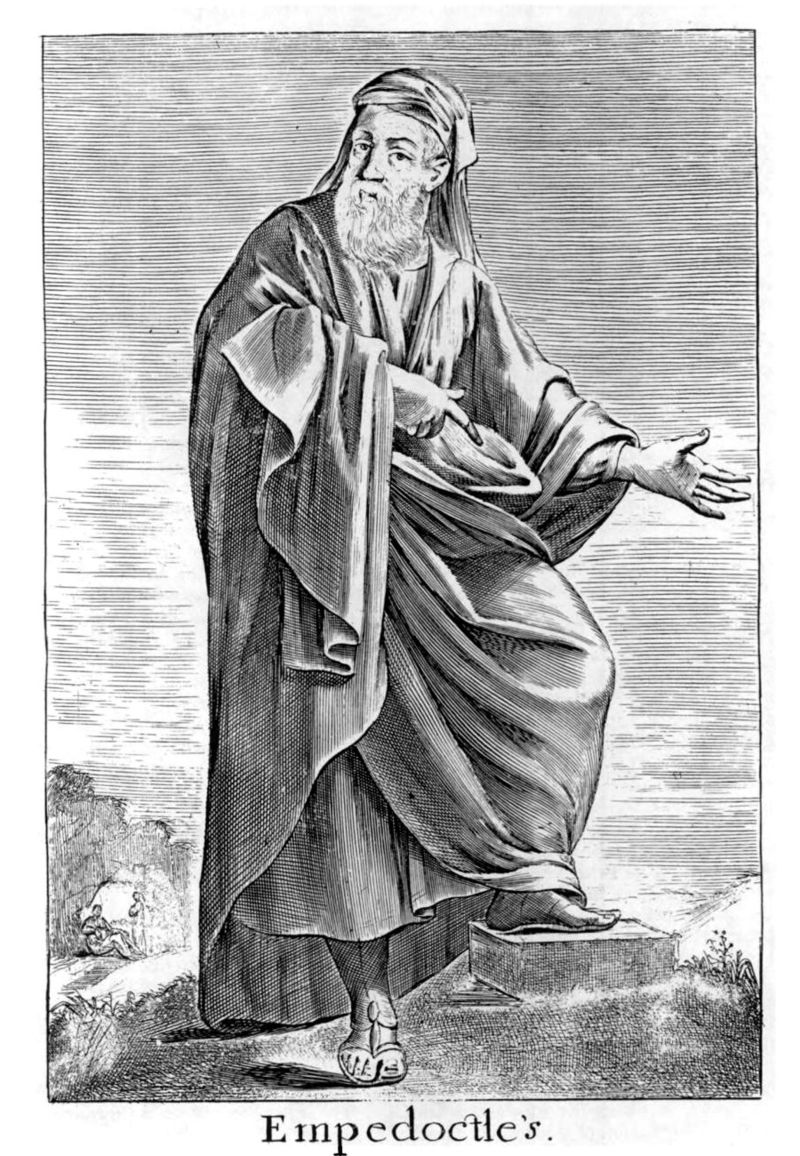
Empedocles (c. 490 – c. 430 BC) was a Greek pre-Socratic philosopher and a citizen of Acragas (Agrigentum), a Greek city in Sicily. Empedocles’ philosophy is best known for originating the cosmogenic theory of the four classical elements. He also proposed forces he called Love and Strife which would mix as well as separate the elements. These physical speculations were part of a history of the universe which also dealt with the origin and development of life.
Influenced by the Pythagoreans, Empedocles was a vegetarian who supported the doctrine of reincarnation. He is generally considered the last Greek philosopher to have recorded his ideas in verse. Some of his work survives, more than is the case for any other pre-Socratic philosopher. Empedocles’ death was mythologized by ancient writers, and has been the subject of a number of literary treatments.
Life

The temple of Hera at Agrigentum, built when Empedocles was a young man, c. 470 BC.
Empedocles was born, c. 490 BC, at Acragas (Agrigentum) in Sicily to a distinguished family. Very little is known about his life. His father Meto seems to have been instrumental in overthrowing the tyrant of Agrigentum, presumably Thrasydaeus in 470 BC. Empedocles continued this tradition by helping to overthrow the succeeding oligarchic government. He is said to have been magnanimous in his support of the poor; severe in persecuting the overbearing conduct of the oligarchs; and he even declined the sovereignty of the city when it was offered to him.
His brilliant oratory, his penetrating knowledge of nature, and the reputation of his marvellous powers, including the curing of diseases, and averting epidemics, produced many myths and stories surrounding his name. He was said to have been a magician and controller of storms, and he himself, in his famous poem Purifications seems to have promised miraculous powers, including the destruction of evil, the curing of old age, and the controlling of wind and rain.
Empedocles was acquainted or connected by friendship with the physicians Pausanias (his eromenos) and Acron; with various Pythagoreans; and even, it is said, with Parmenides and Anaxagoras. The only pupil of Empedocles who is mentioned is the sophist and rhetorician Gorgias.
Timaeus and Dicaearchus spoke of the journey of Empedocles to the Peloponnese, and of the admiration, which was paid to him there; others mentioned his stay at Athens, and in the newly founded colony of Thurii, 446 BC; there are also fanciful reports of him travelling far to the east to the lands of the Magi.
According to Aristotle, he died at the age of sixty (c. 430 BC), even though other writers have him living up to the age of one hundred and nine. Likewise, there are myths concerning his death: a tradition, which is traced to Heraclides Ponticus, represented him as having been removed from the Earth; whereas others had him perishing in the flames of Mount Etna.
The contemporary Life of Empedocles by Xanthus has been lost.