
(bantarleton.tumblr.com)
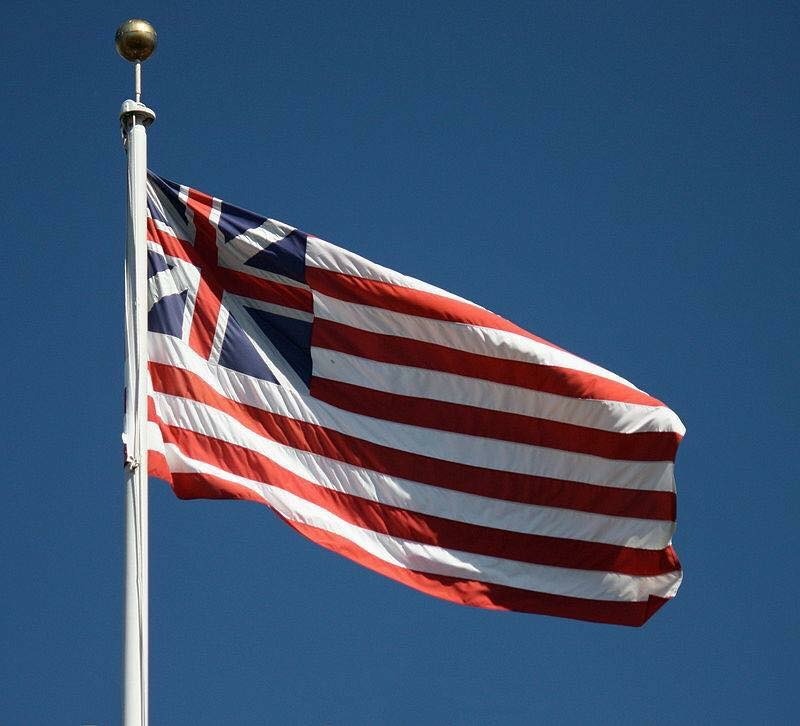
The flag of the English (later British) East India Company was first created in 1600, using thirteen red and white stripes with a Saint George’s cross in the upper canton. The number thirteen was supposedly chosen because of its close relationship with Freemasonry (many of the Company’s early members were Masons). Later in the 17th century the English cross was replaced by the “King’s Colours” – the Union Flag representing the union of Great Britain, the political binding of Scotland and England. In 1775, when Whig colonists in America first began their rebellion against the British government, there was a desire among the rebels to show that their grievances were more with Parliament than either Great Britain as a whole, or King George in particular. In order to make this clear the first flag adopted by American Revolutionaries used the British Union Flag in the upper canton of thirteen red and white stripes, one for each colony. It was known as the Grand Union Flag. Here it is in question;

And here is the East India Company’s flag;

The similarities are obvious – they’re the same flag. Nor was it mere coincidence. A number of the Founding Fathers of the United States were aware of the East India Company’s activities and of their free administration of India under Company rule, rather than direct British authority.Benjamin Franklin once gave a speech endorsing the adoption of the Company’s flag by the United States as their national flag. He said to George Washington, “While the field of your flag must be new in the details of its design, it need not be entirely new in its elements. There is already in use a flag, I refer to the flag of the East India Company.” This was a way of symbolising American loyalty to the Crown as well as the United States’ aspirations to be self-governing, as was the East India Company. Some colonists also felt that the Company could be a powerful ally in the American War of Independence, as they shared similar aims and grievances against the British government tax policies. Colonists therefore flew the Company’s flag, to endorse the Company.By 1776 the war had escalated a great deal, and most rebelling Americans no longer identified themselves as British or sympathised with the Crown. The Union Flag was replaced by the stars we’re more familiar with today, but the stripes – and the EIC’s legacy – remained.