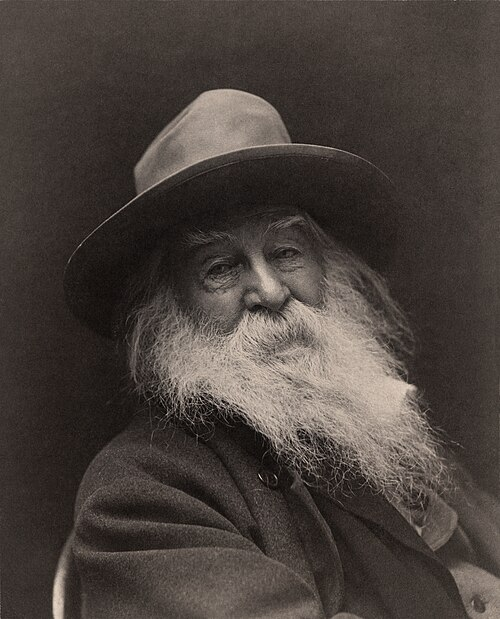
“God is a mean-spirited, pugnacious bully bent on revenge against His children for failing to live up to his impossible standards.”
~ Walt Whitman
Walter “Walt” Whitman was a poet, journalist, and essayist who is considered one of the most influential American poets. Born on Long Island, New York, Whitman is often called the “father of free verse” for his expansionist style that rejected the rigid structures of European poetry. His most well-known work is Leaves of Grass, a collection of poems he revised until his death. (Wikipedia.org)
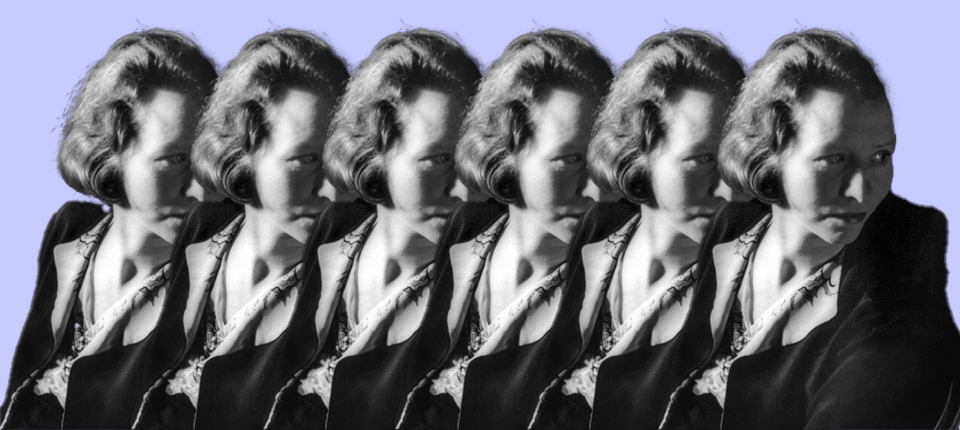
It was love at the very first line. I got off the bus in a strange neighborhood, a winter afternoon and already dark. It was after school and I was visiting my friend, Carolyn, to beg for help with math, at which I was hopeless. While taking off my coat in her bedroom, I spotted a thin paperback in the light on the nightstand, The Collected Sonnets of Edna St. Vincent Millay. I picked it up and read,
I too beneath your moon, almighty Sex Go forth at nightfall crying like a cat . . .
Forget algebra. This was shocking. This was a woman talking about sex with a capital “S,” no bones about it. Not only that, in another poem it was clear that she didn’t give a damn about the boy-girl conventions we’d grown up with: basically that girls were not allowed to initiate a date, or much of anything:
I shall forget you presently, my dear So make the most of this, your little day, Your little month, your little half a year, Ere I forget, or die, or move away, And we are done forever
What a possibility. You mean we had a choice? We didn’t have to wait by the phone, or freak out in the high school corridors, obsessing over signs and signals from the male sex as to our worthiness? We could just toss all of that to the winds?
Whether or not we find what we are seeking Is idle, biologically speaking.
Sex for the sake of sex? There is such a thing as female satisfaction?
It was contrary to everything we believed. We knew nothing about our anatomy and heard only horror stories about the other. Understand this was 1965, when girls were not permitted to wear pants to public school, and we’d be sent home if our skirts were half an inch above the knee. We’d practically sworn to remain virgins until we were married, and anyone who wasn’t was a tramp.
But this was poetry. This was authoritative, like Emily Dickinson and Shakespeare, who we were studying. In the Bronx High School of Science, a school of National Merit Scholars and future M.D.s, I was one of the few “creative” types. They dug quantum theory, but poetry was my language. I heard what Millay was saying, in a rebellious, free-spirited voice. Two years later in freshman year at college, everything would go to hell, but for now I was living with my parents, walled up like a prisoner inside their “middle-class values.” All I could do to express my frustration was to go around dramatically reciting revolutionary verse. Not many understood except our beloved English teacher, Ted Rifkin, who showed me a textbook with the famous Arnold Genthe photograph of Millay among the magnolia blossoms at Vassar. Mr. Rifkin kindly said I even looked like her. That was it. The thrill of my life. She was my idol and the bond was sealed.
Millay was not simply a voice for female sexuality and freedom. I found her life to be a blueprint for how to fully engage in the literary world I aspired to, and what it would demand: courage, confidence, mastery, anarchy, and appetite. She embodied all of it.
As a child, Edna St. Vincent Millay (named for the hospital where her uncle’s life was saved) insisted on being called Vincent. She and her two sisters were raised by an independent woman they adored (“Dearest Mumbles” in her letters) who divorced their father and supported them by being a nurse. Millay was gifted; she won her first medal for poetry age 14, the Pulitzer Prize at 31, and the Frost Medal for lifetime contribution to American poetry 20 years later.
At Vassar, which was then women-only, she had affairs with classmates, and in later years was openly bisexual. She moved to New York City where she helped found the Cherry Lane Theater. Famous for her red hair, green eyes and unabashed sensuality, she was known as “the gamine of Greenwich Village.” Despite proposals from luminaries such as Floyd Dell and Edmund Wilson, Millay chose to marry a Dutch coffee importer, Eugen Jan Boissevain, 12 years her senior. They were married for 26 years, and although both carried on flamboyant affairs, they remained devoted to each other. They lived the most romantic lifestyle—on a farm in upstate New York where they raised their own vegetables, and an island off the coast of Maine, where they swam naked in the icy water.
Millay was a celebrity poet. She was a riveting performer, which is not surprising, given her years with experimental theater in the Village, and an interest in drama that would lead her to write radio plays and opera lyrics. At the age of 20, it had been her dramatic reading of her poem, “Renascence” at the Whitehall Inn in Camden, Maine, that caught the attention of Caroline B. Dowd, a wealthy patron of the arts, who paid for her education at Vassar. In her prime, Millay traveled widely and drew big crowds, the superstar mystique enhanced by Eugen’s handling of her as if she were a precious doll, covering her shoulders with a sable cape and murmuring, “We’ve got to get you out of here,” as he protected her from fans.
Michael Ryan, Director of the MFA Program in Poetry at UC Irvine, describes the unique appeal of those performances:
The character Edna St. Vincent Millay invented to speak her poems was very much of her time and acquired for her a fame it’s hard to imagine a poet having today. She was adored by many readers who felt she was speaking what they really felt from a life that they both wanted and did not want to have but were happy to live through her.
In this she was precursor to the requirement of writers today that we be outsized public personalities, managing websites, newsletters, Twitter, and festivals, teaching aspirants by perfect example, while dedicating ourselves to our craft—a proposition that requires a split personality—one side nimble and responsive to trends, the other steeped in isolated work. For most of her life, Millay had the ability to integrate both, but at the height of her popularity she suffered the fickleness of critical opinion. Biographers say the “propaganda” poetry she wrote during WWII, denouncing the Nazi destruction of the Czechoslovak city Lidice, for example, hurt her reputation as a serious poet:
The whole world holds in its arms today The murdered village of Lidice, Like the murdered body of a little child.
I imagine the harshness of the critics contributed to her decline in the later years. Plagued by accidents and ill health, she grew isolated and afraid. She and Eugen drank too much. He died of lung cancer in 1949. Millay died the following year, in truly theatrical fashion. She had been been up all night correcting proofs, written a note for the housekeeper, and at dawn apparently started up the stairs. Eight hours later her body was discovered by a handyman, the wine glass and bottle still intact where she had placed them on the step above. She died of a heart attack at age 58.
I am grateful to have had Edna St. Vincent Millay as a model of inspiration, and happy to report that her influence is alive and well. When I tracked down my friend, Carolyn, for this essay, 50 years after we graduated high school, she not only remembered our shared delight in The Collected Sonnets of Edna St. Vincent Millay—she still owns the original book.
April Smith is the author of six previous novels, including her first best seller, North of Montana. She is also an Emmy-nominated television writer and producer. She lives in Santa Monica, CA, with her husband.
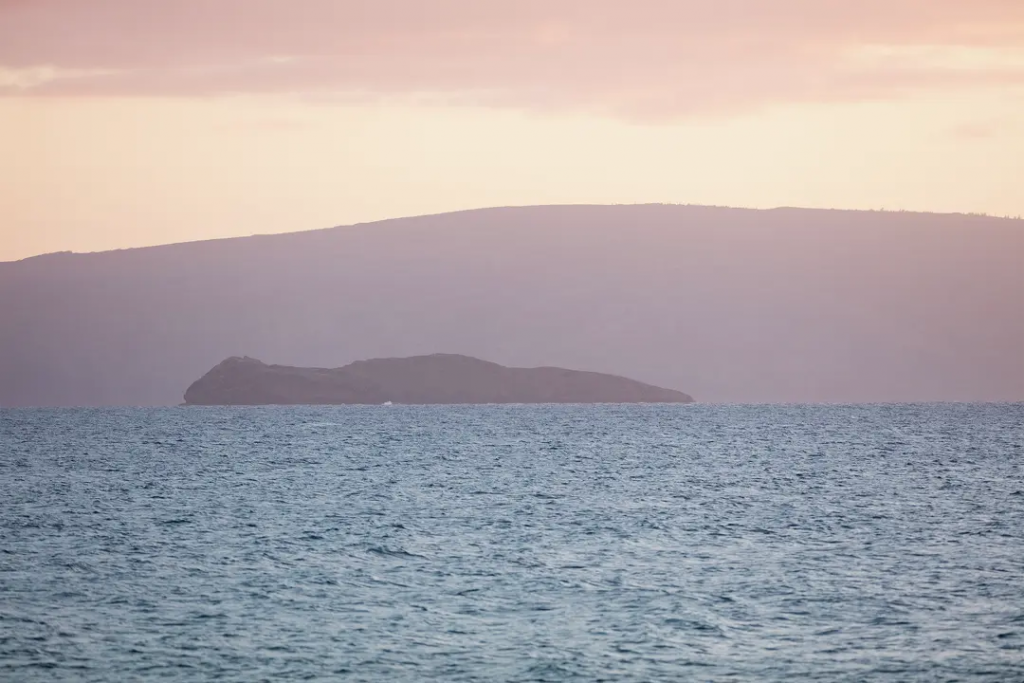
The Hawaiian Islands at sunset.Johner Images/Getty Images/Johner RF
By Christine Hitt, Hawaii Contributing Editor April 26, 2026 (SFGate.com)
In Hawaii, there are islands not found on any map that are said to appear and then disappear, often around sunrise or sunset.
Over a century ago, Hawaiian-language newspapers recorded eyewitness reports of offshore sightings. Hawaii had more than 100 Hawaiian-language newspapers, beginning in 1834. They documented everything from politics to daily life and largely remain untranslated, holding a wealth of information.
One of the most striking reports placed one vanishing island between Maui and Molokai. In an article from Dec. 1, 1900, in Ke Aloha Aina, a writer relayed a sighting of Kanehunamoku, which was visible offshore before fading from view.
“At five minutes past 5 on the early morning of Friday the 23rd, the mysterious supernatural land of Kanehunamoku was seen standing proudly between Maui and Kahoolawe. It seemed, in the arrangement of the islands, Maui, Kanehunamoku, Kahoolawe, and Lanai sat together to the eye. It was truly beautiful,” Moses Kaulahea wrote from Molokai. “Certain features on that wondrous land were clearly visible … At 6:20 [a.m.], when the sun rose, it began to disappear” and the space between Kahoolawe and Maui was empty again.
The hidden islands
In English, Kanehunamoku can be translated as the “hidden land of Kane,” Kane being one of the major deities in Hawaiian tradition. In some accounts, it is described as one of 12 islands of Kane, a group of sacred and elusive islands associated with spiritual beings.
In her book “Hawaiian Mythology,” Martha Beckwith writes, “Today they are called the ‘lost islands’ or ‘islands hidden by the gods.’ At sunrise or sunset they may still be seen on the distant horizon, sometime touched with a reddish light. They may lie under the sea or upon its surface, approach close to land or be raised and float in the air according to the will of the gods.”
Beckwith noted that there are ancient chants and stories about these hidden islands going as far back as the 12th century. Kanehunamoku also appears in the Kumulipo, the ancient Hawaiian creation chant. She also describes stories of when Kanehunamoku appears, where “one can hear cocks crowing, pigs grunting, see flickering of lights and waving of sugar cane and persons moving about the island.”
In a Feb. 23, 1912 article of Ka Nupepa Kuokoa, another eyewitness account reads less like folklore and more like a modern-day paranormal sighting. (Hawaii, in particular, is today known as a hotspot for UFO sightings.)
A husband and wife were fishing from shore, when they noticed the sea behaving strangely 3 miles south of Mahukona off the Kohala coast of Hawaii Island. “The sea seemed to boil, exactly as if there were fire beneath it, boiling like a cooking pot,” S.D. Kehena Boy wrote from North Kohala. Later that night, they described seeing “something like moving lights or lanterns, not just one but many lights coming in a line from the ocean, heading straight toward where they sat.”
The lights eventually went out. In their place, “there stood in the sea a great dark thing, like a piece of land” about 100 to 200 yards offshore. They said they could make out what looked like trees and vegetation and even figures moving across the island, though no voices could be heard. The couple overwhelmed with fear, covered themselves and waited through the night.
By morning, it was gone.
“Well, then, was this Kanehunamoku? Or was it a supernatural being?” the writer asked. “These new things we are seeing are quite extraordinary.”
Theories behind the sightings
Not everyone thought Kanehunamoku was a mystery. Some writers in Hawaiian-language newspapers tried to explain what people were seeing.
In 1865, D.M. Collegiate wrote a letter to the editor of Ka Nupepa Kuokoa, suggesting that reports of a physical island were due to a visual phenomenon, comparing it to other optical effects reported at sea, like ships in the sky or other mirrored or refracted images. He calls them wailiula, the Hawaiian word for mirage.
Modern references similarly liken the phenomenon to being an atmospherically related mirage.
One type of mirage, a Fata Morgana, has resulted in illusions of ships floating in the air. In his journal via the University of Hawaii at Manoa, Scott Kikiloi also suggested that the ancient stories of vanishing islands relate to how Hawaiians saw the erosion of islands down to islets and atolls, disappearing over time or reappearing later. Moku Papapa is an example of a low-lying island last seen southwest of Niihau that has disappeared and is still a mystery today.
Whether believed to be a real land or a mirage, Kanehunamoku’s story and connection to Kane endures, preserved in Hawaiian-language records as both explanation and experience. That’s not something that will ever disappear.
Editor’s note: SFGATE recognizes the importance of diacritical marks in the Hawaiian language. We are unable to use them due to the limitations of our publishing platform. The Hawaiian language newspapers were translated with the help of AI and reviewed by fluent Hawaiian language speaker and journalist Kuuwehi Hiraishi.
Christine Hitt is the Hawaii contributing editor for SFGATE. She is part-Native Hawaiian from the island of Oahu, and a Kamehameha Schools and University of Hawaii graduate. She’s the former editor-in-chief of Hawaii and Mana magazines.
I have been working in the field of Gender-Specific Medicine and Men’s Health for more than fifty years. One of the most important lessons I’ve learned is that men’s health and women’s health cannot be separated. If we improve men’s health, we will also improve the health of women and vice versa.
There are many reasons a man might become interested in the actress Sharon Stone. It is a surprising fact of my professional life that seeing Sharon featured on the cover of Vanity Fair magazine, led me to write my best-selling books, Male Menopause and Surviving Male Menopause. Here’s how it happened.
While browsing through my local bookstore, I was drawn to a copy of Vanity Fair magazine. Well, to be absolutely honest, I was drawn to the cover photo of Sharon Stone, nude to the waist, with her hands cupping, but only partially covering, her breasts. Sharon was staring seductively into the eyes of the reader, with two-inch letters emblazoned across her bare midriff proclaiming, ‘WILD THING!’ I was sure there was something important Sharon had to tell me.
However, I never read the article to find out, because just to the left of Sharon’s blond hair, right below the April 1993 dateline, were the words that grabbed me by the throat (actually a bit farther south than my throat) — “Male Menopause: The Unspeakable Passage by Gail Sheehy.” Those words spoke in a quiet but insistent voice.
I had already been dealing with menopause issues as my midlife wife was going through the change. At first I was skeptical about the possibility that men might go through hormonal changes, but I decided to do the research.
Male Menopause was published in 1997 and soon became an international best-seller. It has since been translated into more than fifteen foreign languages. My follow up book, Surviving Male Menopause: A Guide for Women and Men, was published in 2000. Although we have learned a great deal about the “change of life” for women, there continues to be a great deal of confusion and controversy surrounding the whole concept of what goes on at mid-life for men.
As Sheehy recognized in the 1993 article, “
If menopause is the silent passage, ‘male menopause’ is the unspeakable passage. It is fraught with secrecy, shame, and denial. It is much more fundamental than the ending of the fertile period of a woman’s life, because it strikes at the core of what it is to be a man.”
I was one of the early researchers who was speaking out about Male Menopause (also called Andropause or Manopause). Here are a few of the important things I’ve learned over the years and have shared in my books and articles.
What is Male Menopause?
Male Menopause begins with hormonal, physiological, and chemical changes that occur in all men generally between the ages of forty and fifty-five, though it can occur as early as thirty-five or as late as sixty-five. These changes affect all aspects of a man’s life. Male Menopause is, thus, a physical condition with psychological, interpersonal, social, and spiritual dimensions.
What is The Purpose of Male Menopause?
“The purpose of Male Menopause is to signal the end of the first part of a man’s life and prepare him for the second half. Male Menopause is not the beginning of the end, as many fear, but the end of the beginning. It is the passage to the most passionate, powerful, productive, and purposeful time of a man’s life.”
What Are The Most Common Symptoms of Male Menopause?
Loss of libido and sexual desire, particularly with the partner you are with.
Increased fantasy about having sex with others.
Difficulty developing and maintaining erections.
Increased irritability and anger.
Taking longer to recover from injuries and illness.
Having less endurance for physical activity.
Increased anxiety and worry.
Loss of self-confidence and joy.
What I Have Learned About Male Menopause
Over the years, I have found two common views: (1) Male Menopause doesn’t exist. Only women go through a hormonally driven change of life. (2) If men do go through a change, it is only a hormonal change and can be “cured” by giving men supplemental testosterone.
I’ve learned that neither of these views are true. Men do experience a change of life, whether we call it Male Menopause, Andropause, or Manopause. I called it Male Menopause because I believe there are more similarities than differences between what women and men experience. I also believe, as does Gail Sheehy, that it is much more complex than simply a loss of hormones but impacts all aspects of a man’s life.
For most of human existence our lifespan was quite limited to around forty years. Men and women rarely lived long enough to experience a “change of life.” Life was a climb up a mountain and we reached the peak when we were in our 20s and had produced children to keep our species going. Then, it was a quick decline down the mountain once the children were old enough to survive.
But now humans can live into our 80s, 90s, and beyond. There is another mountain to climb and what we call Male Menopause is simply the transition to the second mountain. If top of the first mountain is called “Adulthood,” the peak of the second mountain, is “Super-Adulthood” or “Elderhood.” That is why I say that “Male Menopause is not the beginning of the end, as many fear, but the end of the beginning.”
Too Many Men Are Dying Before Their Time
These are confusing and challenging times for most people, but particularly for men. It has been said that “Old age is not for sissies.” While many men are embracing the later years, too many are losing hope and giving up. The suicide rate for men is much higher than the rate for women and gets even worse the older we get.
Take a look at this chart from the Centers for Disease Control (CDC):
Suicide rate among adults age 55 and older, by age group and sex: United States, 2021
We see the men’s death rates on the left and women’s on the right for four different age groups, along with the different rate for all ages 55-85+ in black. Death by suicide is a huge problem for men as we age, particularly after retirement age.
For those ages 55-64, the suicide rate is 3.4 times higher for males compared to females. 65-74 the suicide rate is 4.6 times higher for males. Between the ages of 75-84 the male/female ratio is 8 times higher for males. And for those 85 and older the suicide rate is nearly 17 times higher for males than females. There are challenges men and women face as we age, but clearly older men are feeling pressures that women do not experience and are losing hope for a better future. This needs to change.
Welcome to the Second Mountain and an Expanded Understanding of Midlife and Aging
My friend and colleague, Chip Conley, is transforming our understanding of midlife and what we can look forward to as we prepare for and climb the second mountain of life. Says Conley,
“The midlife crisis is the butt of many jokes, but this long-derided life stage has an upside.”
In his new book, Learning to Love Midlife: 12 Reasons Why Life Gets Better with Age, he expands our vision.
“What if we could reframe our thinking about the natural transition of midlife not as a crisis, but as a chrysalis: a time when something profound awakens in us, as we shed our skin, spread our wings, and pollinate the world with our wisdom?“
We know midlife and aging is not all sweetness and light. It isn’t easy letting go of old ways that no longer work for us. We all know what happens to the caterpillar. As Conley reminds us,
“When it is fully grown, it uses a button of silk to fasten its body to a twig and then forms a chrysalis. Within this protective chrysalis, the transformational magic of metamorphosis occurs. While it’s a bit dark, gooey, and solitary, it’s a transition, not a crisis. And, of course, on the other side is a beautiful, winged butterfly.”
Learning About Men’s Health, Male Menopause, and How to Live Well in the Second Half of Life
There is a lot we need to learn about life in the second half. Chip Conley suggests that there are three stages of midlife:
1. Early midlife (Age 35-50)
During early midlife we tend to experience some of the challenging physical and emotional transitions — a bit like adult puberty. We realize we are no longer young, but not yet old.
2. The second stage of midlife (50-59)
This is the core of midlife in our fifties when we’ve settled into this new era and are seeing some of the upside. We begin to see opportunities for growth and finding passions we never knew we had.
3. Later midlife (60-75)
We are still young enough to see and plan for what’s next, our senior years. Says Chip,
“At 63, I am just getting acquainted with this third stage, but I do know it’s also when our body reminds us it doesn’t want to be forgotten.”
I turned 82 last December and am well into the stage of Eldership. It’s a time when we are called to share what we know and have learned over our lifespan. Three years ago, I started the MenAlive Academy for Gender-Specific Healthcare. The Academy offers programs for both men and women who want to learn about the unique mental, emotional, and relational issues that men face. It also offers programs for healthcare providers who are working with men and their families.
As my colleague Marianne J. Legato, M.D., Founder of the Foundation for Gender-Specific Medicine says,
“Everywhere we look, the two sexes are startingly and unexpectedly different not only in their normal function but in the ways they experience illness.”
If you would like more information about the MenAlive Academy for Gender-Specific Healthcare, drop me a note to Jed@MenAlive.com and put “MenAlive Academy” in the subject line. If you’d like to read more articles like these, I invite you to subscribe to our free weekly newsletter.
Best Wishes,
Jed Diamond
Founder and VHS (Visionary Healer Scholar) of MenAlive
By Katie Dowd, Managing editor April 26, 2026 (SFGate.com)
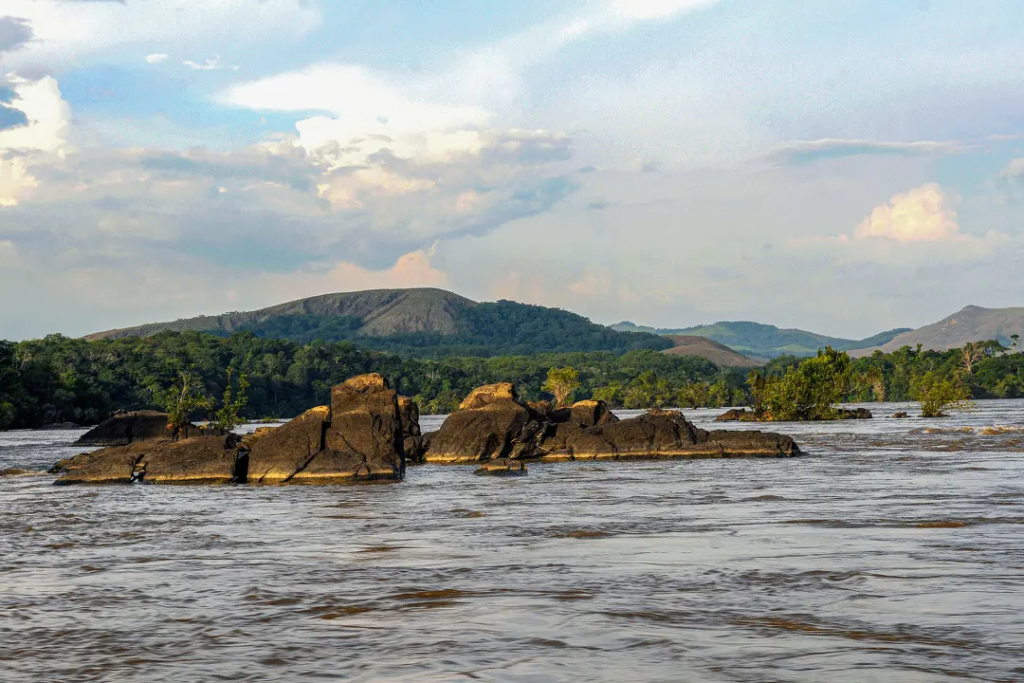
A file photo of the view of Lope National Park located in Central Gabon, April 13, 2013. Desirey Minkoh/AfrikImages Agency/Universal Images Group via Getty Images
A California man was killed by a herd of elephants during a hunting trip in Africa, his family confirmed. Ernie Dosio, 75, was the owner of a Central Valley farm management company.
Dosio, who was a well-known big game hunter affiliated with the Sacramento Safari Club, was on a trip with Collect Africa, the New York Times reported. The travel company bills itself on its site as an “African Species Collecting Concierge.” According to family friends, Dosio was hoping to kill a yellow-backed duiker, an antelope known for its timid personality, in the Lope-Okanda rainforest area of Gabon.
While hunting on April 17, Dosio and two other hunters unexpectedly came upon a small herd of female elephants and their calves. The adult elephants charged repeatedly, and Dosio was killed when he was gored by one of the elephant’s tusks, the Times reported. His remains are awaiting repatriation to California; he lived in Lodi at the time of his death.
The news came as a shock to loved ones in the Central Valley, where Dosio was the millionaire owner of Pacific AgriLands, a farm management company that works with wineries. The Central District Elks posted on Facebook that he was a “pillar of our Community,” and Dosio’s son told the Daily Mail that the family was thrown into chaos by the news.
“The day it happened we heard it was buffalos — and different crazy things,” Jeff Dosio told the outlet. “The lawyers got called before the family. There’s just some things that just don’t make sense.”
A close family friend who spoke with the Times said Dosio had been on many hunts in Africa and “knew the risks.” Photos of Dosio’s home attest to his controversial hobby: trophies of a rhino, lion and numerous deer and antelope species can be seen.
Katie Dowd is the SFGATE managing editor. She started her career at SFGATE in 2011 shortly after graduating from UC Berkeley. She was born and raised in the Bay Area.
The word opulent is etymologically related to opus through a shared Proto-Indo-European root that connects the concepts of “work” and “abundance”.
Shared Root: Both words derive from the Proto-Indo-European (PIE) root *op-, which means “to work, produce in abundance”.
Latin Evolution:
Opus (Latin): Means “a work, labor, exertion”.
Opulentus (Latin): The adjective from which “opulent” is derived, meaning “wealthy, rich; splendid, noble”. It is rooted in ops (“wealth, power, resources”), which is a sibling word to opus.
The Connection: The connection between them suggests that, in a classical sense, opulence is the result of accumulated work, labor, or productive ability.
Dissimilation:Opulent developed from a suffixed form, likely op-en-ent-, which changed to opulent- to avoid repeating the ‘n’ sound, a linguistic process called dissimilation.
Word Family: Through the same opus root, opulent is related to other terms like opera, operate, cooperate, and magnus opus. Sesquiotica +6
Marie Watts was born in 1896, and passed on in 1983. She had an illumination at the age of seven. As a very little girl, Marie often stood in the yard at night with her hands reaching for the sky. She felt that God was the universe, and if she could only touch a star, she could find God.
She was raised in a Methodist Church, but eventually moved onto Christian Science. Marie studied all the major religions of the world, and especially the many translations of the bible. She also read the writings of Lillian De Waters, and Joel Goldsmith for a while. Believing her thirst for God could be quenched through music, she embarked on a career as a concert pianist and, at one point, decided to teach piano for an extensive period of time.
In 1957, in a small town in Nevada, “Just Be Yourself” and the textbook to this approach, “Your Self Revealed”, were written, and the Ultimate Absolute was born. The name of her teaching is “The Ultimate”, and its major thesis is that God is All. Many writings, tapes and lecture/class tours followed until well into the 1970’s.
Madman Films May 1, 2024 Now showing Australian cinemas. Find cinemas and session times here: http://mad.mn/wilding Based on Isabella Tree’s best-selling book by the same title, #Wilding tells the incredible story of a young couple that bets on nature for the future of their failing, four-hundred-year-old estate. They set to work with their groundbreaking vision, battling entrenched tradition and major forces along the way, daring to place the fate of their farm in the hands of nature. Ripping down the fences, they set the land back to the wild and entrust its recovery to a motley mix of animals both tame and wild. It is the beginning of a grand experiment that will become one of the most significant rewilding experiments in Europe and beyond.
Apr 3, 2020 James Brown – Cold Sweat (Live Zaire ’74)
“Cold Sweat”
Come on, bring it! Lay it on me! I don’t care, alright, about your past, dig it I just want, hey! My love to last, come on I don’t care, hit me band, about your faults, huh! I just want to satisfy your thoughts, hey!
Come on! When you kiss me, hold my hand Make me understand, hey! One more time I break out, huh! In a cold sweat, yiii!
Get down, uh! Get on down, get on down! Come on! I don’t care, alright, about your wants I just want to tell you, baby, about the do’s and don’ts Huh! I don’t care about the way you treat me, darlin’
Uh! Ahhh, when you kiss me, yeah, and ya miss me Hold my hand, it makes me understand I break out… in a cold sweat, hey!
Get down, come on! Get it, get it, get it! Baby baby baby, come on! Do it, do it, do it, uh! Go right home, come on! Get it, get it! Come on…
(AZLyrics.com)
Consciousness, sexuality, androgyny, futurism, space, the arts, science, astrology, democracy, humor, books, movies and more