The word “bad” (c. 1300) has an uncertain, likely Germanic origin, possibly stemming from the Old English bæddel (“hermaphrodite, effeminate man”) or related to bædan (“to defile”). It replaced evil as the common opposite of “good” around 1700 and historically meant worthless, wicked, or counterfeit. Online Etymology Dictionary +3
Key Aspects of “Bad” Etymology:
Uncertain Origins: The origin is debated and not definitively traced, appearing late in Middle English (13th-14th century).
Potential Source: Many etymologists suggest it derives from the Old English derogatory term bæddel or bædling, which meant “effeminate man,” “hermaphrodite,” or “pederast”.
Alternative Roots: It may be related to the Old English bædan (“to defile”) or, as suggested by Wiktionary, related to Old Norse/Norwegian terms for “damage, effort, or trouble”.
Phonetic Evolution: The transition from bæddel to bad is phonetically possible but not universally accepted as direct, per Merriam-Webster.
Semantic Shift: Originally, it meant inadequate or vicious, but by the 1890s, it developed an ironic slang meaning of “good” or “impressive,” particularly in Black American slang.
Debased Coinage: It was frequently used to describe counterfeit or “debased” money, notes this Reddit post.
*Note: The German word “Bad” (bath) is unrelated, originating from a different Germanic root (baþą), as explained on Wiktionary.
“Often when he was teaching me to write in Greek the Fox would say, ‘Child, to say the very thing you really mean, the whole of it, nothing more or less or other than what you really mean; that’s the whole art and joy of words.’ ”
~ C.S.Lewis
Clive Staples Lewis was a British scholar, writer, and prominent Christian apologist. A professor of Medieval and Renaissance English literature at Oxford and Cambridge, Lewis was a key figure in literary studies. He wrote prolifically in both fiction and nonfiction, and his works are known for their Christian allegory, moral lessons, and rich symbolism. Wikipedia.org
It was a mere 500 years ago that Europeans realized that the Strait of Hormuz was a trade choke point, when Portuguese Admiral Afonso de Albuquerque seized the Island of Hormuz to control trade in and out of the Persian Gulf. It was the first armed European conquest of Arabia meant to control international water routes and trade.
In other words, Trump and Hegseth didn’t know the importance of securing the Strait, although every ship captain has known about this chokepoint for centuries. Oh, well. As the philosopher George Santayana once said, “Those who cannot remember the past are condemned to repeat it, or at the least get their asses kicked and watch gasoline prices go through the roof.” I’m not sure about the authenticity of the last phrase, but you get the idea.
The British, who are pretty good at the imperial power thing, grabbed Hormuz in 1622 from the Portuguese, with Iran’s help. Empires knew about Hormuz without the help of Google Maps.
Somehow, Hormuz’ strategic stranglehold on shipping seems to have slid by unnoticed by Trump’s trillion-dollar defense/intelligence combine.
Well, as Civil War journalist Ambrose Bierce said, “War is God’s way of teaching Americans geography.”
But now that Trump has learned the hard way about the Hormuz choke point, he’s suggesting he might turn it into a profit center. He has suggested that an end to the war might include Iran and the US sharing the power to charge tolls to pass through the Strait (about $2 million per tanker!).
There is nothing new under the sun. Five centuries ago, the Portuguese conquistadors imposed a toll (“cartaz”) for ships trying to get through the Strait. Then, after the capture of Hormuz by the Shah of Iran and the mercenaries of the British East India Company, Persia and Britain agreed to split the loot from the cartaz.
The wee problem with Trump’s plan to collect passage tolls is that it violates international laws against piracy.
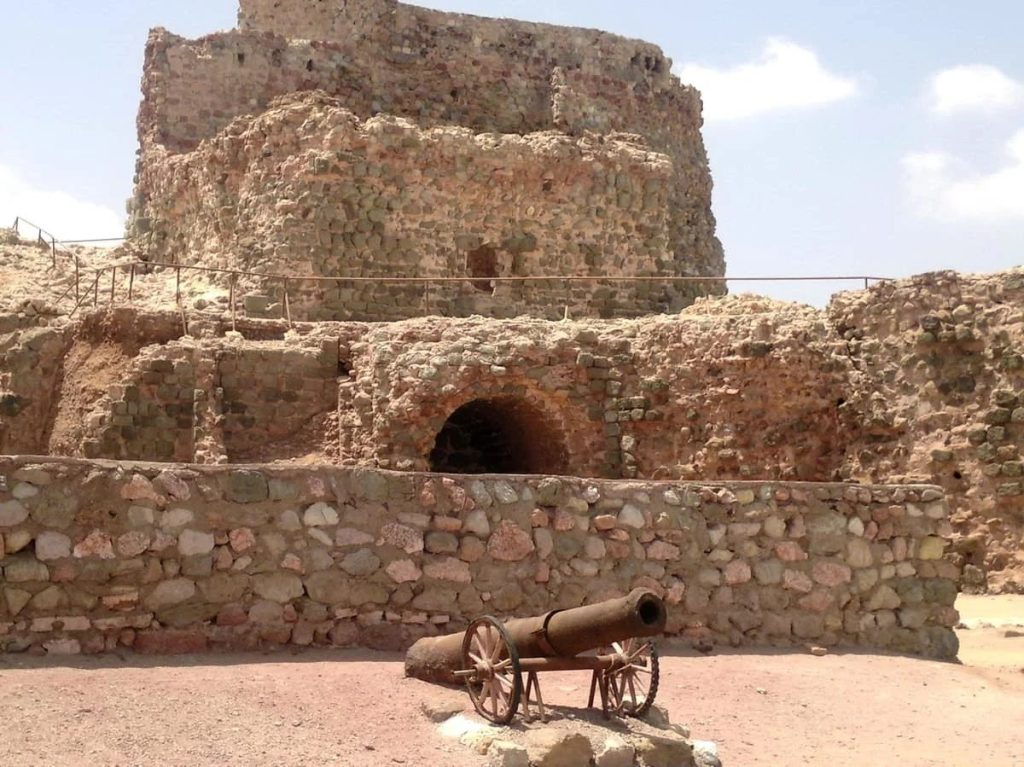
Above: The interior of the Portuguese castle on Hormuz, still standing today, a tourist attraction; though you may want to postpone that vacation to the Strait until the end of Operation Fast and Furious or whatever Agent Orange calls it.
In 1801, a “new nation conceived in liberty,” the United States of America, declared all such tolls by trolls a crime against humanity. President Thomas Jefferson declared that henceforward, the US would be world’s protector of open seas. And he meant business. Jefferson sent the US Marines into Libya to defeat the Barbary pirates who were exacting tolls from ships passing along Africa’s Mediterranean coast.
Few Americans today know about Jefferson’s war against piracy. It survives mostly in the Marine Anthem, “From the Halls of Montezuma to the shores of Tripoli,” the pirates’ capital.
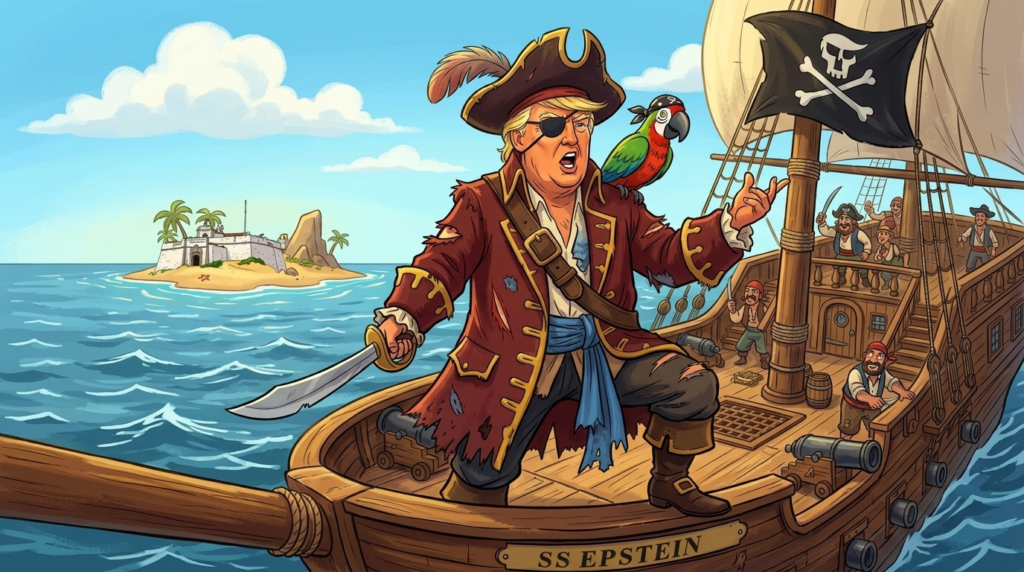
But now, Donald “Bluebeard” Trump wants in on the extortion racket. When asked who would operate this new toll booth in the Gulf, Trump said, “Maybe me. Me and the Ayatollah, whoever the Ayatollah is, whoever the next Ayatollah.”
How interesting: Trump recently called Iran’s Ayatollahs “deranged scumbags” and “lunatics” — which, apparently, he thinks qualifies them as perfect business partners.
So, in the end, the ultimate goal of Trump’s war is not to end the Iranian regime’s murderous rule, but to go into business with them to shake down the planet.
Bluebeard Trump’s only remaining problem is that the parrot on his shoulder keeps saying, “That one’s hot, Jeffrey.”
My final concern: Trump’s latest post on Truth Social ordered the Ayatollahs to, “Open the Fuckin’ Strait, you crazy bastards,” his affectionate way of speaking to his would-be partners. Given that Trump renamed the Gulf of Mexico as the Gulf of America, are we now going to have to change our maps to replace, “Strait of Hormuz” with “Fuckin’ Strait”?
THE WORLD—Ready for the moment when they will rise up as one and fight to free themselves from tyranny, the world’s persecuted, exploited masses confirmed Monday they were only waiting for the right hot guy to emerge and lead them in revolution. “For too long we have been kept down, but no more: We are prepared to overthrow our oppressors just as soon as the mantle of liberator is taken up by the perfect man, who should be tall, well-built, and totally sexy,” said a representative speaking on behalf of the world’s poor, hungry, imprisoned, and enslaved, all of whom agreed they would stand up, throw off their shackles, and revolt when a broad-shouldered and thrillingly attractive leader came along and told them it was time. “The one thing that can unite us is a guy who has thick, gorgeous hair that is long but not too long and who has the ripped torso needed to look good without a shirt. In fact, this leader should never wear a shirt. Then, and only then—with a leader who knows it would be a shame to cover up a hot body like that—will the fundamental inequalities of our global society will finally be dismantled.” The masses went on to state that if the hot guy could also be a straight white guy most of them would be a lot more comfortable with that.
“I found myself noticing not only the beauty of the Earth, but how much blackness there was around it.”
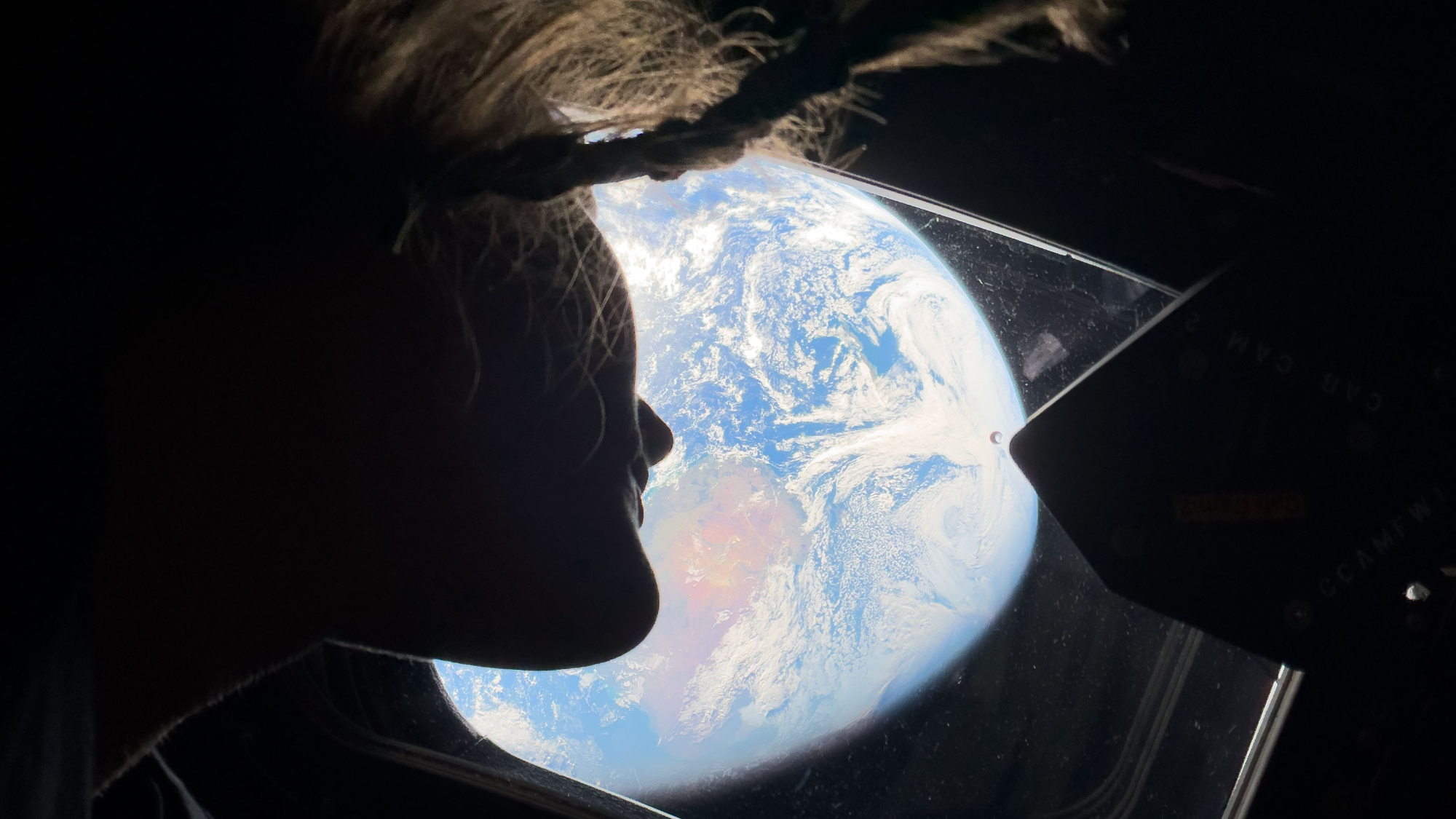
Artemis 2 astronaut Christina Koch of NASA looks at Earth as her Orion spacecraft heads toward the moon in April 2026. (Image credit: NASA)
Traveling far from her home planet helped Artemis 2 astronaut Christina Koch appreciate it even more.
Koch and her crewmates talked with some of their International Space Station (ISS) counterparts on Tuesday (April 7), a day after Artemis 2‘s epic flyby of the moon. And the station astronauts had lots of questions for the deep-space explorers.
The first one came from NASA’s Jessica Meir, who knows Koch well: The duo performed the first-ever all-female spacewalk outside the ISS back in 2020.You may like
“We know how fortunate all of us are as humans to come up here and look down at the Earth from above; every astronaut that comes to space remarks on that,” Meir said.
She was referring to the “overview effect,” the often life-changing shift in perspective that comes from seeing our planet as it truly is — a fragile world that looks very alone in a vast and dark cosmos.
“We really wanted to hear what that felt like, and how different that felt now from your new perspective around the moon,” Meir continued.
“I’ll start by saying we do miss the ISS,” Koch responded. (Wiseman and Glover have also lived aboard the station; Hansen is a spaceflight rookie.) “The views there are awesome, being able to see specific places — being able to see your home, specifically. So y’all’s views are absolutely incredible, and I miss them every day, almost.”
Get the Space.com Newsletter
Breaking space news, the latest updates on rocket launches, skywatching events and more!By signing up, you agree to our Terms of services and acknowledge that you have read our Privacy Notice. You also agree to receive marketing emails from us that may include promotions from our trusted partners and sponsors, which you can unsubscribe from at any time.
Then she described the difference, as Meir requested.
“The thing that changed for me looking back at Earth was that I found myself noticing not only the beauty of the Earth, but how much blackness there was around it, and how it just made it even more special,” Koch said.
“It truly emphasized how alike we are, how the same thing keeps every single person on planet Earth alive,” she added. “We evolved on the same planet, we have some shared things about how we love and live that are just universal, and the specialness and preciousness of that really is emphasized when you notice how much else there is around it.”What to read next
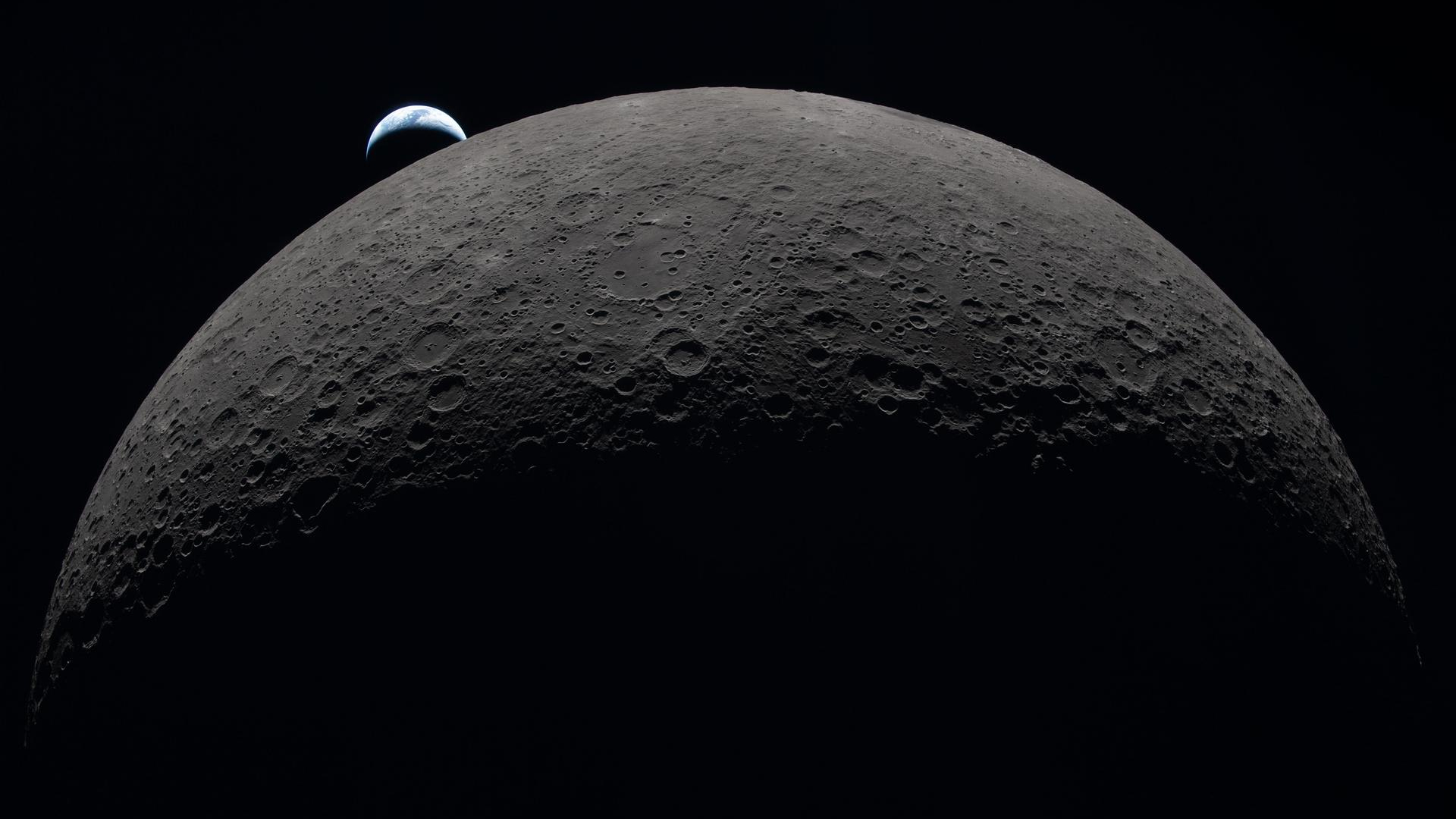
Earth sets at 6:41 p.m. EDT, April 6, 2026, over the moon’s curved limb in this photo captured by the Artemis 2 crew during their journey around the far side of the moon. (Image credit: NASA)
All four Artemis 2 crewmates — Koch, fellow NASA astronauts Reid Wiseman and Victor Glover, and Jeremy Hansen of the Canadian Space Agency — took part in the 15-minute call.
On the ISS, Meir shared the microphone with NASA’s Chris Williams and Jack Hathaway, and Sophie Adenot of the European Space Agency. The three cosmonauts currently living on the orbiting lab — Sergey Kud-Sverchkov, Sergei Mikaev and Andrey Fedyaev — did not participate.
Adenot asked the Artemis 2 astronauts what has surprised them during their mission so far.
“I don’t mean to give you such a short answer, but I can truly say ‘everything,'” Glover replied.
He cited many of the mission’s major milestones, from its April 1 liftoff atop a Space Launch System rocket to its maneuvers in Earth orbit to its journey to, and flyby of, the moon.
“This entire journey has been interesting,” Glover said.
Artemis 2 — the first crewed mission beyond Earth orbit since Apollo 17 in 1972 — is now headed back to Earth. The four astronauts will get here on Friday (April 10), splashing down that evening off the coast of San Diego.
NASA will then start gearing up for Artemis 3, which will test docking and rendezvous technologies in Earth orbit in 2027. After that will come Artemis 4, which aims to land astronauts near the moon’s south pole in late 2028.
Michael Wall is the Spaceflight and Tech Editor for Space.com and joined the team in 2010. He primarily covers human and robotic spaceflight, military space, and exoplanets, but has been known to dabble in the space art beat. His book about the search for alien life, “Out There,” was published on Nov. 13, 2018. Before becoming a science writer, Michael worked as a herpetologist and wildlife biologist. He has a Ph.D. in evolutionary biology from the University of Sydney, Australia, a bachelor’s degree from the University of Arizona, and a graduate certificate in science writing from the University of California, Santa Cruz. To find out what his latest project is, you can follow Michael on Twitter.
The cancer is in America’s bones at this point, much deeper than any one man or even one political movement. We’re in a period of epic change and systems collapse, neither of which can be navigated by the superficial thinking of our political status quo.
Our power to rise from this lies on the level of values. We can’t just fight off bad guys forever; we need a renewed dedication to the good.
Change occurs when enough of us are willing to atone for the fact that the wealthiest and most powerful nation in the world so strayed from dedication to our own First Principles, in too many cases even to human decency, for over half a century. As citizens we abided that. We have not been the nation we like to think we are.
Too many of us were willing to surrender our critical thinking to a crass and corrupt political industry, many thinking only of their own pocketbooks, and stood by while our democracy imploded from within. Dedication to the profundity of our Declaration of Independence and the responsibility to teach its principles to our children, both fell away like unimportant dead leaves. We countenanced obvious military adventurism, systems of increasing economic injustice, and ever-increasing destruction of the earth and its inhabitants.
This dark night of America’s soul need not be the end of our democracy, however, if we use it as a time for rethinking and regreening. The answer lies first on the level of the heart. Genuine contrition is what activates the power of redemption. Atonement for our national arrogance and recklessness. Humility before our Creator, Whomever or whatever we perceive that to be. All the powers of the world won’t put us back together again, if we’re not willing to look in the mirror. We had only two choices: to fall to our knees, or be brought to our knees. Obviously we chose the latter. But the good news is, we’re there now.
This is a time of destruction, but also a time of new creation. It’s time of fundamental recalibration… a great fever that had to occur.
“Begotten” and “created” differ primarily in that begotten implies producing something of the same nature or substance (e.g., humans begetting humans), while created refers to making something of a different kind or essence (e.g., a human making a table). In theology, the distinction highlights that Jesus is divine, sharing the same substance as the Father, not a created being. Reddit +3
Begotten (Procreation):
Nature: Produces offspring that share the same essence or kind as the parent.
Theology: Used in the Nicene Creed to indicate that the Son is of the same divinity as the Father (“God from God, Light from Light”).
Example: A human parent begets a human child. Reddit +4
Created (Making):
Nature: Produces something that is different in kind or essence from the creator.
Theology: Refers to things made ex nihilo (out of nothing), such as angels, the universe, and humans.
Example: A human makes a table, or a bird makes a nest. Catholic Answers +4
Key Takeaways:
Shared Essence: The core difference is that begetting transfers the essence of the parent, while creating does not.
Divine vs. Creature: In Christian theology, the Son is “begotten, not made,” meaning He is eternally existing and not a creature.
Alternative Conceptions: Some viewpoints argue that begetting implies a temporal birth, while others, like CS Lewis, argue it refers to a relationship outside of time, notes. CSLewis.com +5
Michael Moore Apr 7, 2026 A scene from Michael Moore’s 2018 film, “Fahrenheit 11/9.” This sequence maps the rise of fascism in Nazi Germany onto the rise of fascism in the United States.
The Independent Apr 7, 2026 Pope Leo has said threats against the population of Iran are “unacceptable”, in an unusual appeal hours after President Trump’s latest threat shocked world leaders. Leo, an outspoken critic of the war, called on citizens across the world to contact their political representatives and ask them to bring the expanding regional conflict to an end. Watch more on Independent TV: https://tinyurl.com/yc7ukx9n
Consciousness, sexuality, androgyny, futurism, space, the arts, science, astrology, democracy, humor, books, movies and more