New Thinking Allowed with Jeffrey Mishlove Apr 8, 2026 Debashish Banerji, PhD, is is Haridas Chaudhuri Professor of Indian Philosophies and Cultures and Chairman of the East West Psychology Department at the California Institute of Integral Studies in San Francisco. He is author of Seven Quartets of Becoming: A Transformative Yoga Psychology Based on the Diaries of Sri Aurobindo and also The Alternate Nation of Abanindranath Tagore, a book about his great grandfather. He edited an anthology about his great uncle, Rabindranath Tagore in the Twenty-First Century. In this video, recorded in 2015, he describes the Indo-European family of languages and the relationship between Sanskrit and other languages of Europe and Asia. In India, Sanskrit developed a unique life as a language used in ritual and as a language for the sacred texts of the Vedanta tradition. Sanskrit became a language for contemplation. The very sounds of the language were thought to have the power of altering consciousness. Of particular interest is the mantra, AUM. It is considered to be the primordial sound of the universe that, when repeated, gives access to the entire spectrum of consciousness. New Thinking Allowed host, Jeffrey Mishlove, PhD, is author of The Roots of Consciousness, Psi Development Systems, and The PK Man. Between 1986 and 2002 he hosted and co-produced the original Thinking Allowed public television series. He is the recipient of the only doctoral diploma in “parapsychology” ever awarded by an accredited university (University of California, Berkeley, 1980). He is also the Grand Prize winner of the 2021 Bigelow Institute essay competition regarding the best evidence for survival of human consciousness after permanent bodily death. He is Co-Director of Parapsychology Education at the California Institute for Human Science. (Recorded on December 19, 2015)
Monthly Archives: April 2026
Always Look on the Bright Side of Life (Full Song) | Monty Python’s Life of Brian
Turner Classic Movies Dec 31, 2025 Eric Idle leads the catchy musical number “Always Look on the Bright Side of Life” as Brian (Graham Chapman) and a group of convicts face crucifixion. Watch Monty Python’s Life of Brian (1979) on TCM.
Translation Saturday Meeting April 11

April 11: 11:00 AM – 12:00 PM PST
Mike Zonta, H.W., M.
In a crisis — any crisis — The Prosperos offers Translation. Translation Saturday Meetings is a weekly series of Translation presentations by veteran Translators, live and up to date on the issues of the day.
It is not a Translation workshop, It is not a Translation class. It is not a group Translation in the usual sense, though group participation is encouraged.
It is, however, restricted to those who have taken Translation class. So if you have never taken Translation class, check the calendar tab on The Prosperos website (TheProsperos.org) or get in touch with us and we will schedule a class.
Last week our sense testimony was: Brain bleed and strokes are life threatening. And our conclusion was: The condition of Life is living well.
– – – – – – – – – – – – – – See you there!!! – – – – – – – – – – – – – –
Here’s the link: https://us02web.zoom.us/j/81749347119
For more info and link to join please email Mike Zonta at:
Weekly Invitational Translation: Fungal infections on my feet and crotch make me feel dirty and ashamed.
Translation is a 5-step process of “straight thinking in the abstract” comparing and contrasting what seems to be truth with what you can syllogistically, axiomatically and mathematically (using word equations) prove is the truth. It is not an effort to change, alter or heal anything other than our consciousness.
The claims in a Translation should be outrageous and mind-blowing, but they are always (or should always be) based on self-evident syllogistic reasoning. Here is one Translation from this week.
1) Truth is that which is so. That which is not truth is not so. Therefore Truth is all that is. Truth being all, there can be nothing other than all, therefore Truth is one. Truth being one is therefore indivisible, therefore whole, therefore complete, therefore present. I think therefore I am. Since I am and since truth is all that is, therefore I, being, am Truth. Since there is no beingness without awareness of it, therefore Truth is awareness.
2) Fungal infections on my feet and crotch make me feel dirty and ashamed.
Word-tracking:
fungal: sponge
sponge: leech, parasite
infect: stain, taint, morally corrupt, bad
bad: baeddel, effeminate man, hermaphrodite
feet: understanding
crotch: groin, grinder, sexfeel: sense, consciousness
dirty: excrement, wasteashamed: disgrace, modesty
modesty: moderation, self-control, honorable, feminine purity or chastity
chastity: cut off, separate, pure
3) Truth being all there is, there can be nothing separate from, cut off from, chaste, therefore female cannot be cut off from male, femininity cannot be cut off from masculinity, therefore Truth is sexual polarity. Truth being sexual polarity, there can be no effeminate men, therefore Truth is hermaphroditic. Truth being whole, complete, present is therefore useful, utilitarian, beneficial. Since truth is useful, utilitarian, beneficial, one can say that which is not useful, utilitarian, beneficial is not so, therefore Truth is not wasteful. Truth being one, there are no leeches or parasites in truth, therefore Truth always pulls its own weight.
4) Truth is sexual polarity.
Truth is hermaphroditic.
Truth is not wasteful.
Truth always pulls its own weight.
5) Truth is a purely hermaphroditic sexual polarity.
For information about Translation or other Prosperos classes go to: https://www.theprosperos.org/teaching.
Weekly Invitational Translation Group invites your participation. If you would like to submit a Translation on any subject, feel free to send your weekly Translation to zonta1111@aol.com and we will anonymously post it on the Bathtub Bulletin on Friday.
Today (April 10) is splashdown day for Artemis 2 moon astronauts — What to expect at each stage of reentry & landing
By Tariq Malik published 8 hours ago (Space.com)
“It’s 13 minutes of things that have to go right,” NASA said of the reentry and splashdown, the first with astronauts from the moon in over 50 years.
When you purchase through links on our site, we may earn an affiliate commission. Here’s how it works.
Jump to:
- Crew wake up
- Orion configured for entry
- RTC-3 Burn
- Final pre-landing prep
- NASA+ livestream begins
- Orion comms switch
- Orion crew/service module sep
- Final Orion maneuver
- Entry interface
- Radio blackout
- Parachutes deploy
- SPLASHDOWN
- Orion powered down
- Artemis 2 crew recovery
- NASA press conference
- Artemis 2 reentry timeline chart
After an epic trip to the moon and back, it’s landing day for the four astronauts of NASA’s Artemis 2 mission. For the first time in over 53 years, astronauts are returning to Earth from the moon.
But returning from deep space is no easy feat, especially for the Artemis 2 astronauts, who are the first crew to fly on NASA’s Orion spacecraft. The most harrowing part of the journey lies ahead: a fiery 13-minute plunge through Earth’s atmosphere at about 24,000 mph (38,600 kph) that will subject them to temperatures of up to 5,000 degrees Fahrenheit (2,760 degrees Celsius) with only their heat shield for protection and parachutes to slow down.
“Every system we’ve demonstrated over the past nine days — life support, navigation, propulsion, communications — all of it depends on the final minutes of flight,” NASA Associate Administrator Amit Kshatriya told reporters Thursday (April 9). “We have high confidence in the system, in the heat shield, and the parachutes and the recovery system that we’ve put together.”You may like
- Where will NASA’s Artemis 2 moon mission land today?
- What time is NASA’s Artemis 2 splashdown today? Full schedule
- Watch NASA’s Artemis 2 astronauts return to Earth live online today (April 10)
The Artemis 2 Orion capsule will return to Earth tonight, April 10, at 8:07 p.m. EDT (0007 April 11 GMT) with a splashdown in the Pacific Ocean off the coast of San Diego, California. Returning home on the ship to end a 10-day trip to the moon are NASA astronauts Reid Wiseman (commander), Victor Glover (pilot), Christina Koch (mission specialist) and Canadian Space Agency astronaut Jeremy Hansen (mission specialist). You can watch the landing live on Space.com, beginning at 6:30 p.m. EDT (2230 GMT). You can also follow the mission live online on our Artemis 2 mission updates page.
Here’s a look at every stage of the Artemis 2 crew’s return to Earth, to explain how the reentry, descent, splashdown and recovery will work.
1. Crew wakes up for landing day

The first big event of landing day for the Artemis 2 astronauts is something that all of us are familiar with: waking up.
NASA will wake the astronauts at 11:35 a.m. EDT (1535 GMT) to mark the start of the crew’s day, the last one they’ll spend in space during their 10-day flight.
Get the Space.com Newsletter
Breaking space news, the latest updates on rocket launches, skywatching events and more!By signing up, you agree to our Terms of services and acknowledge that you have read our Privacy Notice. You also agree to receive marketing emails from us that may include promotions from our trusted partners and sponsors, which you can unsubscribe from at any time.
Mission Control will rouse the astronauts with a wakeup song, kind of like an alarm. Flight controllers have played wakeup songs every day of the mission. You can see our Artemis 2 Spotify playlist of wakeup music here, and Flight Day 10 will be the last one.
After the wakeup call, the crew has some time to get ready (think brushing their teeth and combing their hair). Then they’ll start their last to-do list in space.
2. Astronauts configure Orion for entry
At 1:50 p.m. EDT (1750 GMT), just over three hours into their work day, the Artemis 2 astronauts will begin configuring Orion for reentry.What to read next
- Here’s what the Artemis 2 astronauts will be doing on each day of NASA’s historic moon mission
- Artemis 2 LIVE: NASA’s Artemis 2 astronauts prepare to return to Earth today
- All eyes on Orion’s heat shield: Artemis 2 astronauts will hit Earth’s atmosphere at nearly 24,000 mph on April 10
That means stowing away gear that’s no longer needed, setting up their seats (which have been folded away for most of the flight) and other tasks required to prepare their spacecraft for its plunge through the atmosphere to come home.
3. Return Trajectory Correction 3 Burn

About an hour after starting their landing prep work, at 2:53 p.m. EDT (1853 GMT), the Artemis 2 crew’s Orion moonship, named “Integrity,” is scheduled to fire its thrusters in a final significant burn, called the Return Trajectory Correction 3 Burn.
This is a maneuver to adjust Orion’s path back toward Earth, to put it on course for a landing zone off the California coast near San Diego.
4. Final Orion landing prep
The next three hours includes a lot of final activities for the Artemis 2 crew.
At 3:20 p.m. EDT (1920 GMT), they will resume configuring Integrity’s cabin for reentry and likely find time for lunch (what NASA calls a “midday meal”). It’s a lot of work, packing up a spaceship for landing, so it takes a while.
At 5:05 p.m. EDT (2105 GMT), the astronauts will begin working their “Entry Checklist,” beginning the final work to return to Earth. That includes things like climbing into their bright orange and blue launch and entry suits, known as the Orion Crew Survival System (OCSS, or “ox,” for short). They can survive in those suits for up to six days if needed.
5. NASA+ Artemis 2 landing coverage begins
Watch live! Artemis 2 astronauts return to Earth after historic moon mission – YouTube
At 6:30 p.m. EDT (2230 GMT), NASA’s landing coverage will officially begin with a special live program on NASA+, the space agency’s free streaming service. The feed with live commentary will also play on NASA’s YouTube channel, as well as on streaming services like Netflix and Amazon Prime.
Here at Space.com, we’ll have the livestream available in a few places — on this page, for one, but also on our homepage and our VideoFromSpace YouTube channel.
6. Orion communications switch back to TDRSS
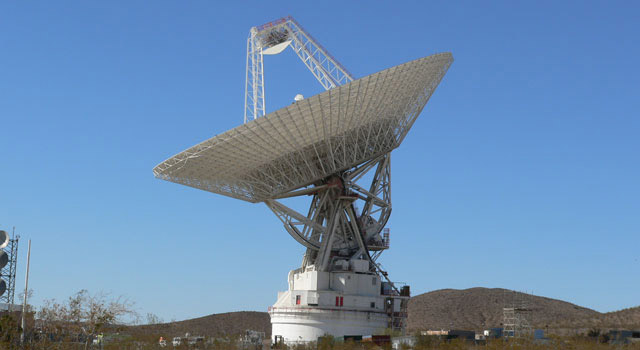
At 7:15 p.m. EDT (1115 GMT), NASA’s Mission Control team will switch over communications with the Orion Integrity capsule from the Deep Space Network of radio dishes based around the globe.
NASA has been using the Deep Space Network, or DSN for short, to communicate with Orion throughout Artemis 2’s transit to the moon and back. For landing, NASA will switch to the Telemetry and Data Relay Satellite System, or TDRSS, in Earth orbit for constant communication with systems on Earth.
7. Orion crew module separates from service module

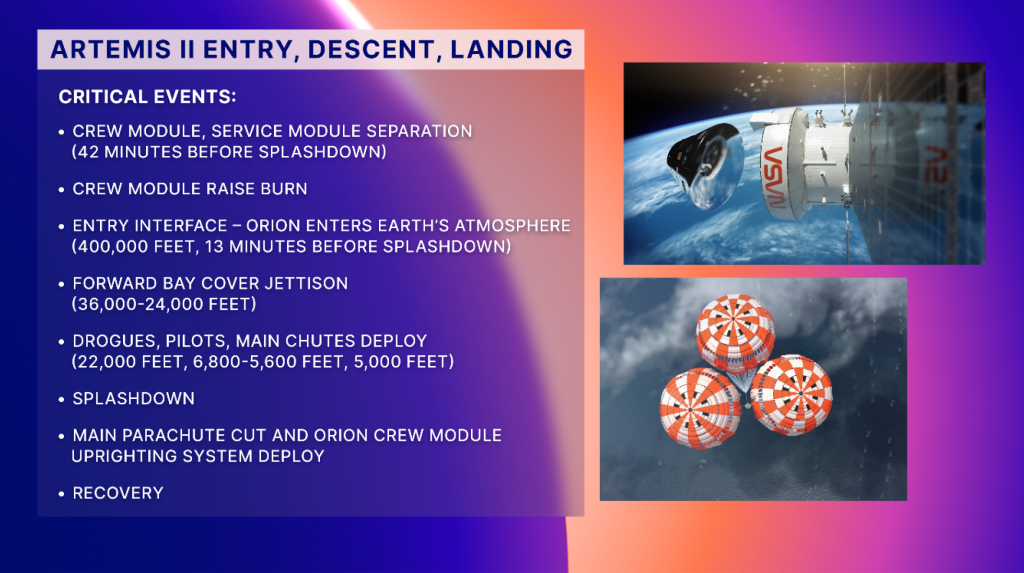
Next up is one of the most important stages of reentry: crew module separation.
At 7:33 p.m. EDT (2333 GMT), the Orion crew module (the gumdrop-shaped part that the crew lives in) will separate from the cylindrical European Service Module built by the European Space Agency. The service module carries all the propellant, water, air and solar arrays used to power Orion during its trip to the moon.
Once separated, the service module will be discarded, reenter Earth’s atmosphere and burn up over the Pacific Ocean. The crew module will return the astronauts to Earth.
8. Crew module raise burn

At 7:37 p.m. EDT (2337 GMT), just after separating from the service module, the Orion crew module will perform what NASA calls a “Crew Module Raise Burn.”
“We do a crew module raise burn to take the crew module slightly away from the service module as it comes down,” Artemis 2 flight director Jeff Radigan told reporters on Thursday.
9. Orion begins reentry for landing

At 7:53 p.m. EDT (2353 GMT), Orion will officially hit Earth’s atmosphere, slamming into the entry interface while traveling at a mind-boggling 24,000 mph. The heat shield protecting the base of Orion will experience temperatures of up to 5,000 degrees Fahrenheit. Orion will be about 400,000 feet (120,00 meters) above Earth at the time.
At maximum speed, the Artemis 2 astronauts will feel about 3.9 Gs during reentry.
“That heat shield thermal protection system, which is built by American hands and American factories from materials designed to withstand temperatures that approach the surface of the sun, will bear the full force of that reentry,” Kshatriya said.
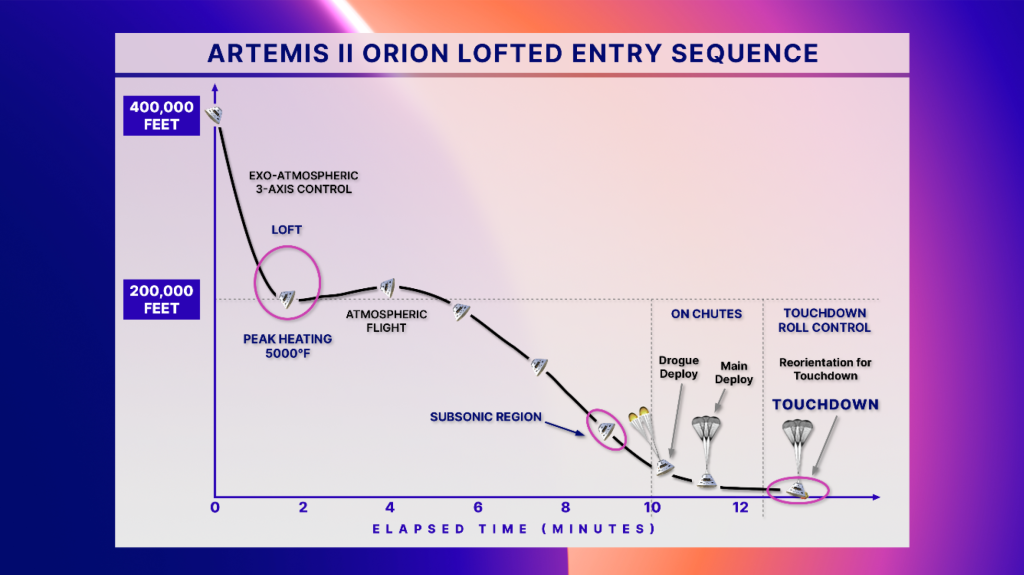
The heat shield for Orion is facing a critical test on Artemis 2, its first reentry with an astronaut crew. During the uncrewed Artemis 1 test flight to lunar orbit in 2022, the heat shield saw more wear than NASA anticipated, leading flight controllers to call for a modified “skip” trajectory for Artemis 2.
“We are still doing a skip entry where we’ve shortened the duration of the skip because of the limited duration of this heat shield,” Kshatriya said.
It will take 13 minutes from entry interface for Orion to splash down.
“It’s 13 minutes of things that have to go right,” Radigan said. “I have a whole checklist in my head we’re going through of all the things that have to happen.”
10. Radio blackout
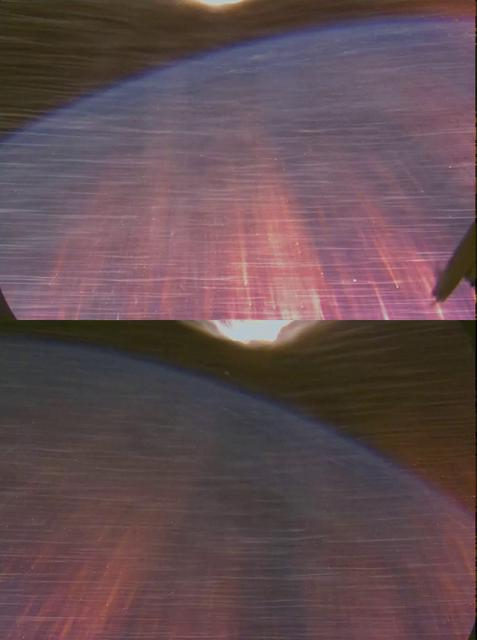
As Orion reenters Earth’s atmosphere, it enters a radio blackout period when the superhot plasma building up arond it as it plunges through Earth’s atmosphere interferes with communications.
The radio blackout is expected and planned.
“We’re going to be thinking of all the things that we know are happening on board, but that we can’t see,” Radigan said, adding that he and the team can only wait until hearing from Orion again. “We’ll just be thinking through things to keep ourselves calm as we wait for reacquisiton of signal.”
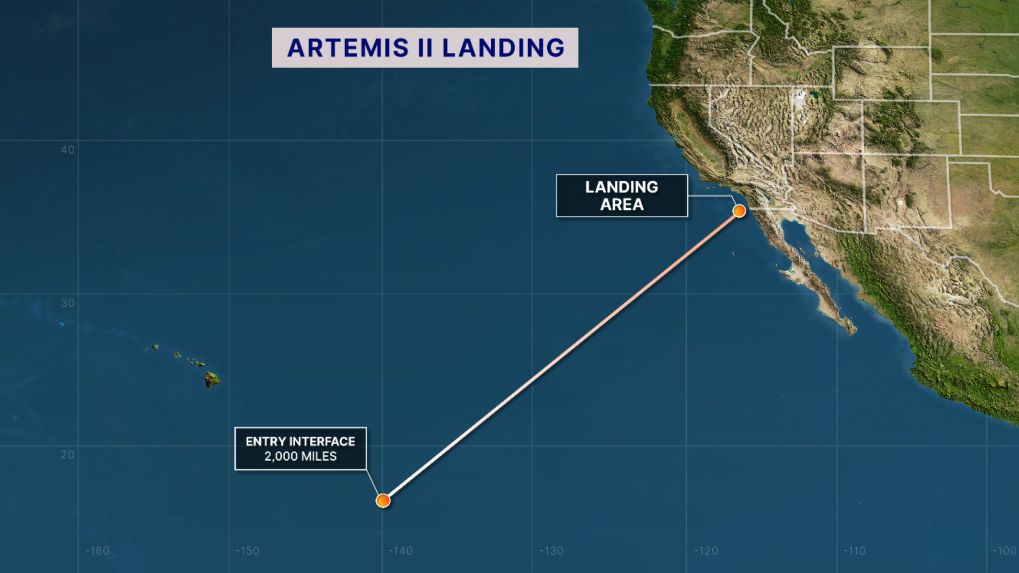
Orion will reenter Earth’s atmosphere southeast of Hawaii and fly about 2,000 miles (3,200 kilometers) to its splashdown site.
11. Orion deploys parachutes
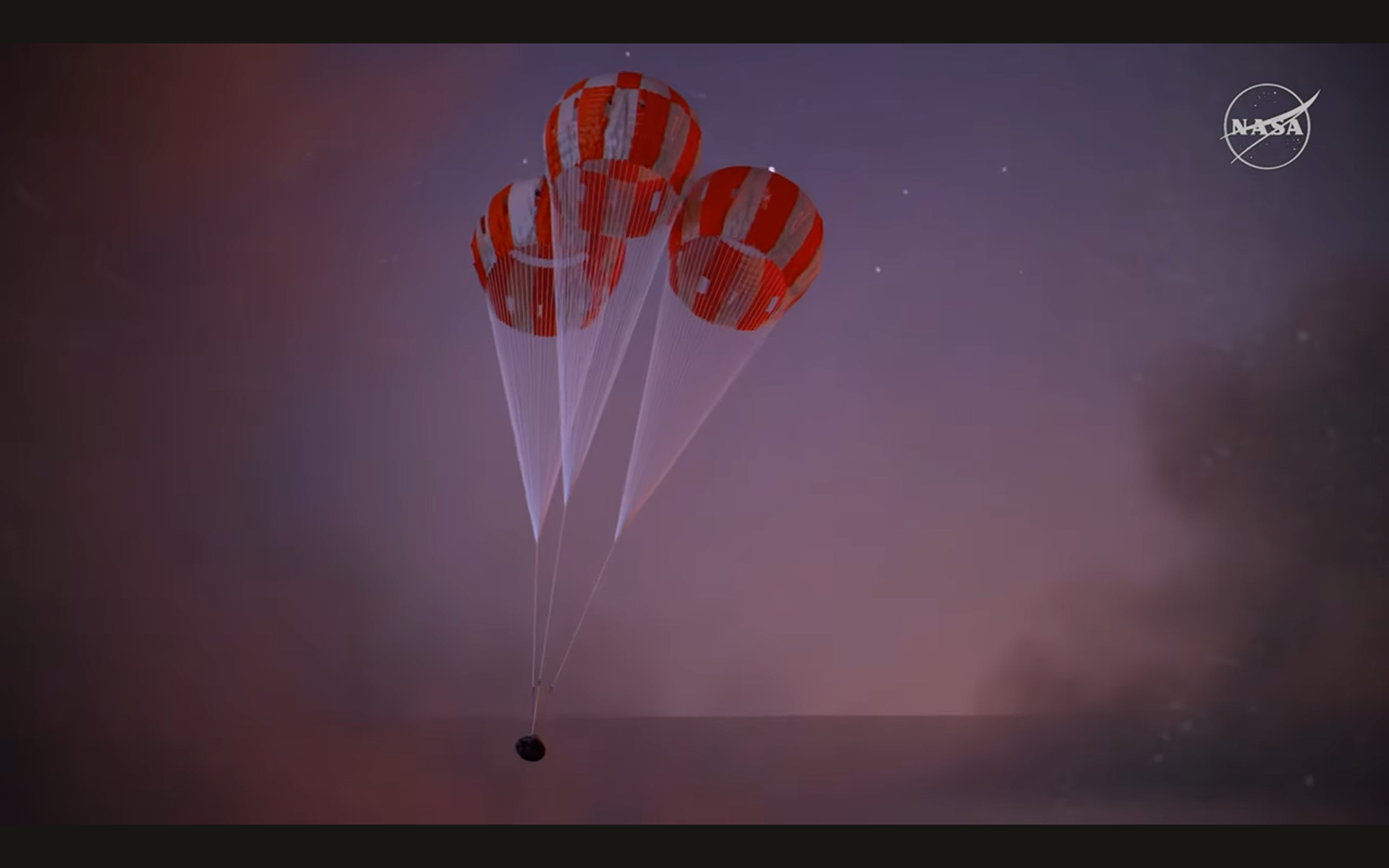
Starting at 8:03 p.m. EDT (0003 GMT), there will be a series of parachute deployments to slow Integrity enough to make a safe splashdown.
Before those begin, Orion will jettison a cover containing the parachutes.
At 8:03 p.m. EDT, two drogue parachutes will deploy, followed closely by three main parachutes a minute later, which will be pulled free by a set of pilot chutes. The drogue parachutes deploy at an altitude of about 22,000 feet (6,705 m), while the mains deploy at about 6,000 feet (1,828 m).
12. SPLASHDOWN: Artemis 2 astronauts back on Earth

Home at last! At 8:07 p.m EDT (0007 April 11 GMT), the Artemis 2 astronauts will finally return to Earth by splashing down at about 20 mph (32 kph) in the Pacific Ocean.
The splashdown will mark the first time astronauts have made a direct ocean splashdown while returning from the moon since 1972, when NASA’s Apollo 17 crew returned to Earth.
13. Orion systems powered down

At 8:22 p.m. EDT (0022 GMT), the Artemis 2 astronauts will work with Mission Control to start powering down Orion.
The Orion capsule Integrity has been the crew’s home for the last 10 days. Wiseman and Glover will work to shut down the systems, ultimately signing off from Mission Control as they are extracted from the ship.
14. Artemis 2 crew recovered from Orion, medical checks

At 9:07 p.m. EDT (0107 April 11 GMT), recovery divers and crews from the Navy ship USS John P. Murtha will retrieve the Artemis 2 crew.
The recovery team will send boats out to the Orion capsule, connect an inflatable “porch” by its hatch and extract the four Artemis 2 astronauts. Once that’s complete, two helicopters will work in tandem to transfer the crewmembers, one at a time, to the Navy ship.
Once there, the Artemis 2 astronauts will undergo medical checks and be transported to San Diego for a flight home to Houston and NASA’s Johnson Space Center.
And thus, the Artemis 2 mission to the moon will have ended.
15. NASA Artemis 2 post-landing press conference
To celebrate the Artemis 2 Orion splashdown, NASA will hold a press conference at 10:30 p.m. EDT (0230 April 11 GMT) that will most likely be led by NASA Administrator Jared Isaacman, who has said he will be staying with the mission until it ends.
The briefing will last about one hour and could include updates on the health of the crew and the status of the Orion spacecraft.
Complete Artemis 2 reentry & splashdown timeline
| Time (EDT/GMT) | Event | What to know |
|---|---|---|
| 11:35 a.m. EDT / 1535 GMT | Artemis 2 crew wakes up | This begins the crew’s last day in space. NASA will play them one last song. |
| 1:50 p.m. EDT / 1730 GMT | Orion cabin configured for entry | The Artemis 2 crew will finsh packing up Orion for reentry. |
| 2:53 p.m. EDT / 1853 GMT | RTC-3 Burn | This is the Reentry Trajectory Correction burn, a thruster manuver to tweak the approach path. |
| 3:20 p.m. EDT / 1930 GMT | Orion cabin ready for entry | Some last-minute packing for the Orion crew. |
| 5:05 p.m. EDT / 2105 GMT | Crew begins entry checklist | The Artemis 2 crew begins their reentry checklist, donning spacesuits, etc for landing. |
| 6:30 p.m. EDT / 2230 GMT) | NASA+ coverage of Artemis 2 landing begins | NASA’s special coverage of Artemis 2 reentry begins. 24/7 coverage will still continue ahead of it. |
| 7:15 pm EDT / 2315 | Orion comms switch to TDRSS | NASA’s Deep Space Network hands off radio comms to the TDRSS satellite network. |
| 7:33 p.m. EDT / 2333 GMT | Orion crew module separation | The Orion crew capsule separates from the European Service Module. |
| 7:37 p.m. EDT / 2337 GMT | Crew module raise burn | Orion’s thrusters perform one last burn to fine-tune approach. |
| 7:53 p.m. EDT / 2357 GMT | Entry interface | Orion begins entering Earth’s atmosphere. |
| 7:53-7:59 p.m. EDT /2353-2359 GMT | Radio blackout | Orion will lose contact with Mission Control for 6 minutes due to plasma interference. The crew experiences 3.9 Gs during entry. |
| 8:03 p.m. EDT / 0003 April 11 GMT | Drogue chutes deploy | 2 large drogue parachutes deploy to slow Orion capsule to 200 mph. |
| 8:04 p.m. EDT / 0004 GMT | Main parachutes deploy | 3 main chutes deploy at 6000 feet up to slow to 20 mph. |
| 8:07 p.m. EDT / 0007 GMT | SPLASHDOWN | Splashdown! Orion has landed. |
| Just after splashdown | Upright device and parachutes cut | Orion cuts its main chute lines and deploys upright device. |
| 8:22 p.m. EDT / 0022 GMT | Orion capsule power down | Integrity Orion capsule is powered down. |
| 9:06 p.m. EDT / 0106 GMT | Orion crew extraction | The Artemis 2 crew is extracted from Orion by recovery team. |
| 9:35 p.m. EDT / 0135 GMT | Orion crew arrives at recovery ship | Artemis 2 crew arrives at USS John P. Murtha for medical checks before heading to San Diego for flight home to Houston. |
| 10: 30 p.m. EDT / 0230 GMT | NASA post-landing briefing | NASA officials will hold a post-landing press conference to discuss the landing. |
So that’s a look at every stage of the Artemis 2 reentry, descent, splashdown and recovery.
It will be a tense final hours and minutes for the Orion crew, Mission Control and the familes of the astronauts, many of whom will be observing the reentry from inside the gallery of Mission Control awaiting the safe return of their loved ones.
Artemis 2 is NASA’s most ambitious crewed test flight of the century: The first astronaut flight to the moon in over 53 years, the first crewed flight ever on an Orion spacecraft and the first crewed launch of their Space Launch System rocket on April 1.
A successful landing for Artemis 2 is critical to NASA’s plans for Artemis 3, which will launch into Earth orbit to dock with moon landers built by SpaceX and Blue Origin, as well as the Artemis program’s goal of landing astronauts on the moon by 2028.
NASA even plans to build a permanent moon base by 2032. But none of that can happen until the agency shows that its Orion spacecraft, one of the pillars of its Artemis program, can safely fly astronatus to the moon (which it has done) and bring them back safely to Earth (which it has yet to do).
You’ll be able to watch the Artemis 2 astronauts return to Earth live on Space.com. We’ll have live coverage throughout the day, but final landing activities begin at about 6:30 p.m .EDT (2230 GMT).

Editor-in-Chief
Tariq is the award-winning Editor-in-Chief of Space.com and joined the team in 2001. He covers human spaceflight, as well as skywatching and entertainment. He became Space.com’s Editor-in-Chief in 2019. Before joining Space.com, Tariq was a staff reporter for The Los Angeles Times covering education and city beats in La Habra, Fullerton and Huntington Beach. He’s a recipient of the 2022 Harry Kolcum Award for excellence in space reporting and the 2025 Space Pioneer Award from the National Space Society. He is an Eagle Scout and Space Camp alum with journalism degrees from the USC and NYU. You can find Tariq at Space.com and as the co-host to the This Week In Space podcast on the TWiT network. To see his latest project, you can follow Tariq on Twitter @tariqjmalik.
How to Get Love Less Wrong: George Saunders on Breaking the Patterns that Break Our Hearts
By Maria Popova (themarginalian.org)

While it is true, as generations of psychologists have found, that “who we are and who we become depends, in part, on whom we love” — a process known as limbic revision — it is also true, as generations of self-aware humans have found, that whom we love depends in large part on who we already are. Our original wounds, our formative attachments, our patterned longings all shape how we engage with those we have chosen to love, to the extent that we are choosing them at all. “People can’t, unhappily, invent their mooring posts, their lovers and their friends, anymore than they can invent their parents,” James Baldwin astutely observed in contemplating the paradox of freedom. “Life gives these and also takes them away and the great difficulty is to say Yes to life.”
The great difficulty, too, is how easily those life-expanding Yeses that can open larger vistas of possibility come fear-concealed as Nos, or how those life-preserving Nos that keep us from entering into experiences too damaging or too small for us bear the momentum of pre-conditioned Yeses. And so we project who we are and what we need onto those we love, and find in them reflections of who we long to be or fear we might be, swarming them and swarming ourselves in all the blooming buzzing confusion of our unmet needs.
Illustration by Margaret C. Cook for a rare 1913 edition of Walt Whitman’s Leaves of Grass. (Available as a print.)
This is not to demean and diminish love as a mere process of projection — Stendhal’s seven-stage delusion of crystallization and decrystallization — or a mere process of reflection — Ortega’s insightful but limited and limiting theory of what our lovers reveal about us — but to honor the elemental fact that each relationship is not between two people, but between three: the two partners, each with their pre-existing patterns of love and loss, and the third presence of the relationship itself — an intersubjective co-creation that becomes the third partner, endowed with the power to deepen those patterns, or to change them.
The great peril and great possibility of every love is that this third partner can be a rewounder masquerading as a healer, and equally a healer in disguise, masked beyond recognition by our own patterned way of seeing. So much of our suffering springs from this confusion and so much of our sanity is redeemed when at last we shed our own blinding masks and come to kneel at the fount of clarity.
That is what George Saunders explores in his immensely insightful and sensitive annotated reading of Chekhov’s short story “The Darling” — one of the seven classic Russian short stories he examines as “seven fastidiously constructed scale models of the world” in A Swim in a Pond in the Rain: In Which Four Russians Give a Master Class on Writing, Reading, and Life (public library), using each as a portable laboratory for the key to great storytelling.
Art by Margaret C. Cook for Leaves of Grass. (Available as a print.)
After a beautiful translation of “The Darling” — a story about a woman who loves four very different people the same patterned way, the only way she knows how, which has entirely to do with her learned understanding of love and nothing to do with its objects, and so she suffers greatly when each of these loves leaves her in the same lonely place; a story the essence of which Saunders captures perfectly as being “about a tendency, present in all of us, to misunderstand love as ‘complete absorption in,’ rather than ‘in full communication with’” — he pauses to marvel at Chekhov’s subtlety in challenging our reflex toward lazy binaries, his mastery in training our muscle of ambiguity, uncertainty, and nuance — which is, of course, the only we grasp and savor the full Yes of life. Saunders writes:
We see Olenka’s mode of loving, from one angle, as a beautiful thing: in that mode, the self disappears and all that remains is affectionate, altruistic regard for the beloved. From another angle, we see it as a terrible thing, the undiscriminating application of her one-note form of love robbing love of its particularity: Olenka, love dullard, vampirically feeding upon whomever she designates as her beloved.
We see this mode of loving as powerful, single-pointed, pure, answering all questions with its unwavering generosity. We see it as weak: her true, autonomous self is nowhere to be found as she molds herself into the image of whatever male happens to be near her (unless he’s a cat).
This puts us in an interesting state of mind. We don’t exactly know what to think of Olenka. Or, feeling so multiply about her, we don’t know how to judge her.
The story seems to be asking, “Is this trait of hers good or bad?”
Chekhov answers: “Yes.”
Elemental by Maria Popova. (Available as a print and as a face mask.)
The story, like every great work of fiction, becomes a mirror for reflection on the most intimate realities of life. Saunders writes:
Maybe you won’t.
Because don’t we all do some version of this, when in love? When your lover dies or leaves you, there you are, still yourself, with your particular way of loving. And there is the world, still full of people to love.
Free Will Astrology: Week of April 9, 2026
by Rob Brezsny | April 7, 2026 (newcity.com)

ARIES (March 21-April 19): Unexpected deliverance? Lucky rides? Beginner’s grace? Dreamy, gleaming replacements? To the untrained eye, it may look like you are bending cosmic law in your favor. In truth, you’re simply redeeming the backlog of blessings you earned in the past—acts of quiet generosity and unselfish hardship that never got their proper reward. Serendipitous leaps? Divine detours? Shortcuts to victory? Welcome the uncanny gifts, Aries, even if they’re not what you expected.
TAURUS (April 20-May 20): The current phase of your destiny could disturb you if you’re not super patient. Life seems to be teasing you with promises that then go into hiding. You’ve been having to master the art of living on the edge between the BIG RED YES and the GREY MURKY NO. My advice: Imagine your predicament as an intriguing riddle, not a frustrating ambiguity. See if you can figure out how to grow wiser and stronger in response to the evasive mysteriousness. My prediction: You will grow wiser and stronger.
GEMINI (May 21-June 20): Why it’s always triple-great to be a Gemini, drawing on an abundance of mercurial wisdom: 1. You excel at the art of translation and are skilled at finding common ground between different realms. You can oscillate and flow between the lyrical and the pragmatic, the insightful and the comic, the detailed focus and the big picture. 2. You know that consistency is overrated. Your capacity to harbor multiple perspectives is a superpower. 3. You get to be both the question and the answer, proving that wholeness includes all the fragments. All the aptitudes I just named should be your featured approaches in the coming weeks.
CANCER (June 21-July 22): The saga of Troy is one of the most renowned tales from ancient Greece. Yet the fabled setting of Homer’s epic tale, the “Iliad,” was a settlement of just seven acres. Let that detail resound for you in the coming weeks. It’s an apt metaphor for what’s taking shape in your life. A seemingly modest situation could become the stage for a mythic turning point. An experience that starts small may grow into a story of immense and lasting significance.
LEO (July 23-Aug. 22): Many people have a favorite number they regard as lucky. Some choose it because it showed up at a major turning point in their life. Others derive it from their birthday or from the numerology of their name. Plenty are drawn to “master numbers” like thirty-three, seventy-seven or ninety-nine. Personally, I give three numbers my special love: 555, the square root of -2 and 1.61803, also known as the golden ratio in Fibonacci-related patterns. I hope this nudges your imagination, Leo. Your fortunes are shifting now in the direction of an unusual kind of luck, so it’s a potent moment to select a new lucky number. I suggest that you also choose a new guiding animal, a fresh initiation name and a charged symbol to serve as your personal emblem.
VIRGO (Aug. 23-Sept. 22): Do you know what ignorance is causing you to suffer? Is there a teacher or teaching that could provide an antidote? I suspect you are very close to attracting or stumbling upon the guidance you need to escape the fog: maybe a therapist who can help you undo a hurtful pattern, a mentor to inspire your quest to do work you long to do or a spiritual friend who reminds you that you’re not merely your latest drama. Your task in the coming weeks is not to obsess on fixing everything at once, but to seek one or two sources of wisdom that illuminate your blind spots and educate your heart.
LIBRA (Sept. 23-Oct. 22): I’m an honorary Libra, with three planets and my lunar north node in your sign. So I speak with authority when I declare that fostering harmony, which is a Libran gift, is only superficially about smoothing away friction and asymmetry. More importantly, it’s about rearranging reality so that beauty is a central feature. The goal is to accomplish practical wonders by stimulating grace and fluency. When I’m best expressing my Libra qualities, I don’t ask how I can please everyone, but rather, how I can serve maximum goodness and intelligence. Here’s another tip to being a potent Libra: Know that your enchanting charm is a lubricant for the truth, not mere decoration. Here’s your homework: Beautify one system you use every day so it serves you with less friction and more pleasure.
SCORPIO (Oct. 23-Nov. 21): You are potentially an expert in creative destruction. You have a knack for eliminating what’s unnecessary and even obstructive. What has outlived its usefulness? You’re prone to home in on energy drains and unleash transformative energy. And yes, this intensity of yours may unnerve people who prefer comfortable numbness—but not me. I love you to exult in your talent for locating beauty and truth that are too complicated for others. I applaud you when you descend into the darkness to retrieve dicey treasures. PS: You’re not shadowy or negative. You’re a specialist in the authentic love that refuses to enable delusion or sanction decay.
SAGITTARIUS (Nov. 22-Dec. 21): My Sagittarian friend Artemisia bemoans “the scarcity of collective delight.” She wishes there were more public acclaim for stories about breakthrough joys, miraculous marvels and surprising healings. Why are we so riveted by reports of misery, malaise and muck, yet so loath to recognize and celebrate everything that’s working really well? She also mourns the odd habit among some educated folks to mistake cynicism for brilliance. If you don’t mind, Sagittarius, I’m assigning you to be an antidote in the coming weeks. Your task is to gather an overflowing harvest of lavish pleasure, fun epiphanies and richly meaningful plot twists. Don’t hoard any of it. Spread it around to everyone you encounter.
CAPRICORN (Dec. 22-Jan. 19): “Id” is a psychoanalytic term. It’s the part of the psyche where basic instincts, needs and drives reside. On the one hand, the id supplies a huge charge of psychic energy. On the other hand, it mostly operates outside conscious awareness. Consider the implications: The fierce, pulsing center of your life force is largely hidden from you. Most of the time, that veil is protective. Encountering the id directly can be overwhelming or unsettling. But in the coming weeks, you Capricorns are poised to cultivate a more interesting and righteous relationship with your high voltage core. Do you dare? Treat your id as a brilliant but untamed creature. Extend a careful, curious invitation for it to show you more about itself.
AQUARIUS (Jan. 20-Feb. 18): In architecture, a “clerestory” is a high window that brings light into a space without compromising privacy. It illuminates without exposing. I suggest that you find metaphorical equivalents for clerestories, Aquarius. Look for ways to let spaciousness and brightness into your world without disturbing your boundaries. Your assignment is to avoid swinging between total lockdown and overexposure. The best option: strategic vulnerability and selective transparency. Allow people to see selected parts of you without giving them access to everything. Be both open and discriminating.
PISCES (Feb. 19-March 20): In 1903, the Wright brothers flew a primitive model of the first airplane. How did they prepare the way for their spectacular milestone? Their workshop was a bicycle shop, not a high-tech, state-of-the-art lab. By building and fixing bikes, they learned key insights about flying machines. The lesson for you, Pisces, is that mastery in one area may be transferable to breakthroughs in another. With this in mind, I invite you to evaluate how your current skills, including those you take for granted, might be repurposed. Methods you developed in one context could solve problems in another. You shouldn’t underestimate the value of what you already know.
Homework: Even if you don’t send it, write a letter to the person you admire most. Newsletter.FreeWillAstrology.com
A Course in Miracles on forgiveness
ChatGPT:
The simpler, grounded version
“Forgive them for what they have not done” can mean:
You’re not forgiving the raw event—you’re forgiving your interpretation of it.
Because what actually hurts us is usually a mix of:
- What happened
- What we think it means
- What it triggers from our past
1. We add meaning automatically
Example:
Someone ignores you.
- Event: they didn’t respond
- Interpretation: “They don’t respect me” or “I don’t matter”
That second layer is where most of the pain comes from.
So in this frame, they didn’t actually do:
- “You don’t matter”
- “You’re worthless”
???? That’s what ACIM would call “what they have not done.”
2. Forgiveness = separating facts from story
Instead of:
“They hurt me”
It becomes:
“Something happened, and I built a painful meaning around it”
Forgiveness is letting go of that meaning—not pretending the event didn’t happen.
3. Why this helps (psychologically)
This shift:
- Reduces emotional reactivity
- Gives you control back
- Stops you from reinforcing old wounds
It’s actually similar to ideas in:
- Cognitive therapy (challenging interpretations)
- Trauma work (distinguishing trigger vs present reality)
4. Important boundary
This does NOT mean:
- Stay in bad situations
- Trust people who behave poorly
- Ignore patterns of harm
You can:
- Set boundaries
- Distance yourself
- Still forgive internally
5. A clean way to phrase it
A grounded translation of ACIM’s idea might be:
“I release the belief that this situation means what I first thought it meant about me or them.”
January 6, a day of epiphany for Jesus and the U.S.
ChatGPT:
It’s more of a symbolic or ironic juxtaposition than any real connection—but people have definitely noticed it.
On one hand, Epiphany (January 6) is about revelation—traditionally the revealing of Christ to the wider world, a moment of clarity, recognition, and truth becoming visible.
On the other hand, the January 6 United States Capitol attack, associated with efforts by Donald Trump and his supporters to overturn the 2020 election results, is seen by many as:
- an attempt to disrupt the constitutional process, and
- a moment that revealed deep divisions in American society.
So what’s the “connection” people point to?
It’s mostly interpretive:
1. “Revelation” in a different sense
Some commentators say January 6, 2021 functioned as a kind of modern epiphany—not in a religious sense, but as a moment that revealed underlying political tensions, beliefs, and vulnerabilities in the system.
2. Irony of meaning
- Epiphany → truth revealed, often uplifting
- Jan. 6, 2021 → for many, a troubling or sobering “revelation”
So the irony (if you see it that way) is:
???? A day meant to symbolize divine illumination coincided with an event many interpret as exposing confusion, conflict, or breakdown
3. Probably coincidence, not design
There’s no evidence the date was chosen because of the holiday. January 6 is when Congress meets to certify electoral votes—so the overlap is structural, not symbolic in origin.
Bottom line
There’s no intrinsic link between the two—but the shared date invites reflection:
- Religious Epiphany → revelation of truth
- Political January 6 → a moment that forced many to confront uncomfortable realities
Whether that feels ironic, tragic, or just coincidental depends a lot on how you interpret the event itself.