Nasa has released the first photographs taken by the Artemis II astronauts during their fly-by of the Moon.
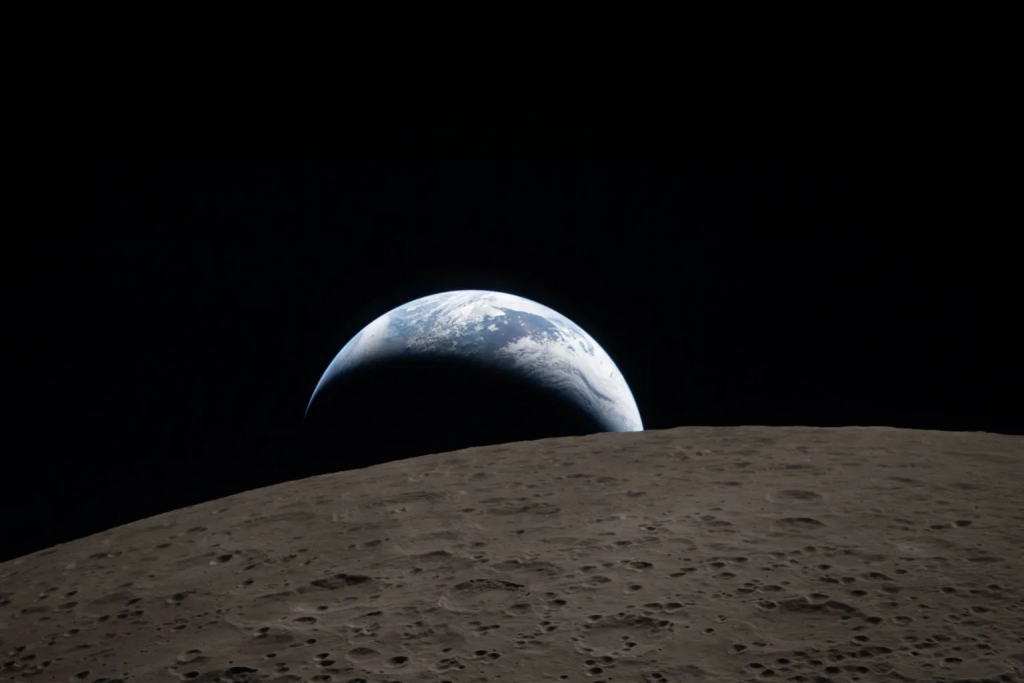
The first image, above, shows an ‘Earthset’ as the astronauts glimpsed our home planet peeking out beyond a cratered lunar landscape.
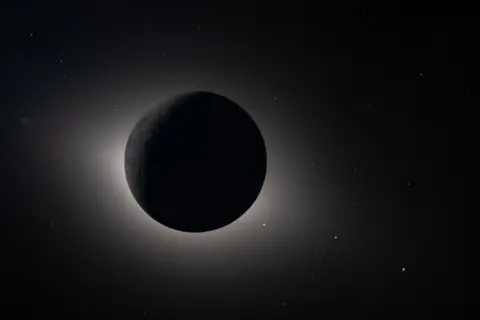
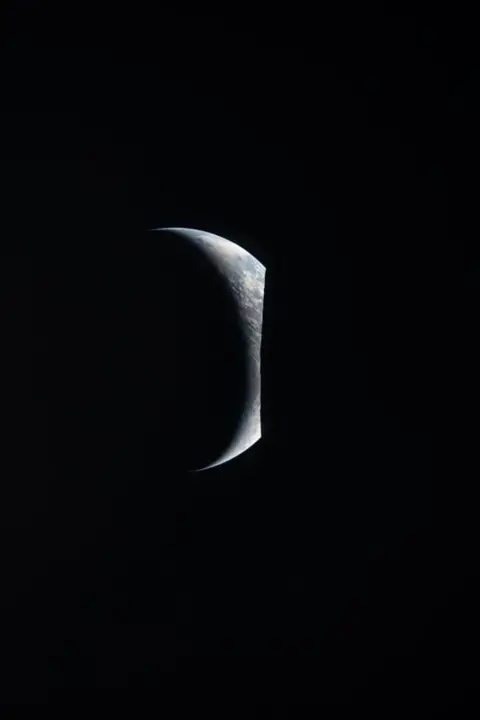
The second photograph, below, shows the spectacular solar eclipse to which the astronauts were treated as the Moon blocked out the Sun.
Nasa did not say which of the astronauts, who are on their return journey to Earth after the fly-by, took the photographs.
The solar eclipse which the astronauts witnessed, with the Moon blocking out the Sun
The Earthset photo carried echoes of the famous Earthrise photograph taken by Bill Anders aboard Apollo 8 in 1968 in the moon fly-by that preceded the historic first human landing the following year.
The astronauts took the photos during a six-hour flyby, including a period of radio silence when their capsule was behind the Moon.
Nasa said in its description that the Earthrise photograph was captured through the Orion spacecraft window at 18:41Eastern Daylight Time (2341BST) on Monday.
“The dark portion of Earth is experiencing nighttime. On Earth’s day side, swirling clouds are visible over the Australia and Oceania region,” Nasa said.
“In the foreground, Ohm crater has terraced edges and a flat floor interrupted by central peaks. Central peaks form in complex craters when the lunar surface, liquefied on impact, splashes upwards during the crater’s formation.’
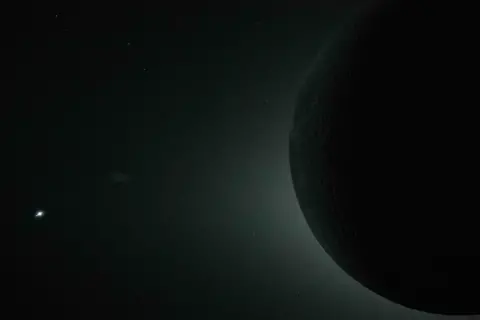
The glow of the Sun’s corona was visible around the Moon’s edge during the eclipse, along with Venus in the bottom left corner of this picture
For the astronauts, seeing a lunar eclipse as the Moon blocked out the Sun was a highlight, even on this extraordinary trip.
In the photo above, the Sun’s corona can be seen around the Moon’s edge. Solar eclipses are fleetingly brief when seen from Earth, but because of Orion’s proximity to the Moon, the astronauts enjoyed nearly 54 minutes of totality, Nasa said.
The bright spot to the left of the frame is Venus.
Victor Glover described the eclipse as “sci-fi” and “unreal”, also describing the view of the corona of the Sun.
“This continues to be unreal,” he said. “The Sun has gone behind the Moon and the corona is still visible, and it’s bright and creates a halo almost around the entire moon.
“The Earth is so bright out there and the Moon is just hanging in front of us.”
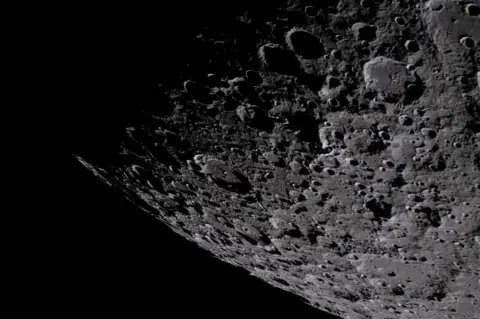
Nasa called this picture of the lunar surface ‘Ready for a close up’
While satellite photographs have been taken of the Moon’s far side in the nearly five decades since the last human landing in 1972, Nasa said that the astronauts seeing it with their own eyes during the flyby was invaluable.
The crew recorded audio descriptions of what they were seeing, and Nasa’s scientists will be poring over these notes for new information.
The following photograph shows Earthrise as our planet came back into the astronauts’ view after their time behind the Moon.
The Universe: His wine cellar; the atom’s heart: His measuring cup. Intellect is drunk, earth drunk, sky drunk heaven perplexed with Him, restlessly seeking, Love in its heart, hoping at least for a single whiff of the fragrance of that wine, that clear wine the angels drank from that immaterial pot, a sip of the dregs- the rest poured out upon the dust: one sip, and the Elements whirl in drunken dance falling now into water, now in blazing fire. And from the smell of that spilled cup man rises from the dust and soars to heaven.
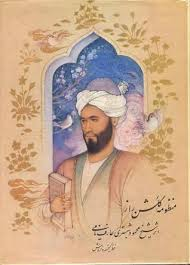
Mahmoud Shabestari or Mahmūd Shabestarī is one of the most celebrated Persian Sufi poets of the 14th century.
New Thinking Allowed with Jeffrey Mishlove Apr 5, 2026 Arthur Versluis is Professor of Religious Studies at Michigan State University. Among his many books are Platonic Mysticism, American Gurus, Magic and Mysticism: An Introduction to Western Esotericism, The New Inquisitions: Heretic-hunting and the Intellectual Origins of Modern Totalitarianism, Wisdom’s Children: A Christian Esoteric Tradition; and American Transcendentalism and Asian Religions. He is the editor of JSR: Journal for the Study of Radicalism. He is the founding president of Hieros, a nonprofit focused on spirituality and cultural renewal. His newest book, the topic of our interview, is Alchemical Lightwork: A Guide to Creating Cultures of Light and Spiritual Awakening. Arthur explores how alchemical traditions—understood as processes of inner, relational, and cultural transformation—can guide the regeneration of society during times of instability. Drawing from Christian theosophy, Hermeticism, and Tibetan Buddhism, he reframes “light work” as a grounded, symbolic practice rooted in natural stages of consciousness and spiritual development. Versluis points toward decentralized, spiritually attuned communities as the foundation for future cultures of renewal and balance. 00:00:00 Introduction: Arthur Versluis and alchemical lightwork 00:05:02 Cultural collapse and regeneration through alchemy 00:07:30 Mysticism beyond institutional religion 00:10:18 Three forms of alchemy explained 00:14:20 Symbolism and the emerald tablet 00:17:46 Lightwork redefined through tradition 00:23:23 Stages of transformation and the spiral path 00:30:29 Decentralized communities and cultural renewal 00:49:03 Conclusion (Recorded on March 13, 2026)
New Thinking Allowed with Jeffrey Mishlove Apr 6, 2026 Philosophy Michael Grosso, PhD, is author of The Man Who Could Fly: St. Joseph of Copertino and the Mystery of Levitation. He also edited and wrote commentary for Wings of Ecstasy: Dominico Bernini’s Vita of St. Joseph of Copertino (1722). His other books include The Millennium Myth: Love and Death at the End of Time, Final Choice: Death or Transcendence?, Soulmaking: Uncommon Paths to Self Understanding and Smile of the Universe: Miracles in an Age of Disbelief. In this rebooted video, he acknowledges that the term “Mind At Large” originated with Aldous Huxley, who employed it to explain the many phenomena experienced under the influence of the psychedelic drug, mescaline. Grosso points out that it also offers a working explanation for the empirical data of parapsychology, as well as the many documented reports concerning religious miracles. He points out that Mind At Large differs from the concept of a deity. New Thinking Allowed host, Jeffrey Mishlove, PhD, is author of The Roots of Consciousness, Psi Development Systems, and The PK Man. Between 1986 and 2002 he hosted and co-produced the original Thinking Allowed public television series. He is the recipient of the only doctoral diploma in “parapsychology” ever awarded by an accredited university (University of California, Berkeley, 1980). He is also the Grand Prize winner of the 2021 Bigelow Institute essay competition regarding the best evidence for survival of human consciousness after permanent bodily death. He is Co-Director of Parapsychology Education at the California Institute for Human Science. (Recorded on September 18, 2020)
One of the 35 girls among the 2,000 students at Mexico’s National Preparatory School, Frida Kahlo (July 6, 1907–July 13, 1954) was fifteen when she met Alejandro Gómez Arias. Both were passionate and erudite, both were members of the anarchist student group known as Los Cachuchas for the pointed cloth caps they wore in defiance of the era’s restrictive dress code, both became each other’s first love. Alejandro was on the bus with Frida that fateful late-summer day shortly after her eighteenth birthday when a tram collision killed several other passengers and left her so severely injured — her pelvis fractured, her stomach and uterus punctured by a rail, her spine broken in three places and her leg in eleven — that the doctors at the Red Cross Hospital did not think she could be saved. It was Alejandro’s unrelenting insistence that made them try. Against all odds, Frida lived — but her life was irrevocably changed. How she coped with what she had to live through in turn changed the history of art.
Her letters to Alejandro, collected in the altogether stirring volume Frida Kahlo: Love Letters (public library) edited by Suzanne Barbezat, offer a rare glimpse of her becoming — as an artist, as a lover, as a person who lived with extraordinary vulnerability, extraordinary courage, and the precocious awareness that the conversation between the two is the measure of a life.
From the outset, her letters command and caress at the same time. “Write to me often and long, the longer the better,” she urges him in one. “On Saturday I’ll bring your sweater, your books and a lot of violets,” she tells him in another. She takes love as seriously as it ought to be taken but also knows it dies without play: “Sorry about constantly repeating the word ‘love’ five times in a row, but it’s just that I’m very silly.” She signs herself “your pretty girl (monkey face),” “your girl, buddy, woman or whatever you like,” “your sister (girlfriend, buddy, wife).” (It starts so early, that trembling gamble of the heart by which a person tries to discern what they mean to another.) Over and over, she offers glimpses into her uncommon inner world. In a letter penned the summer she turned seventeen, after some arrangements for how they can see each other — Frida’s parents disapproved of the relationship — she writes:
Now I’m going to read Salambo until half past 10, it’s 8 o’clock now, and then the Bible in three volumes and, finally, think for a while about huge scientific problems and then go to bed, and sleep until half past 7 in the morning, eh? Until tomorrow, may we have a good night and may we both think that great friends must love each other very, very much, much, much, much, much, mucho . . . with “m” for music or for “mundo.”
A month later, she offers that lovely unasked assurance that makes a fragile young love feel safe and solid:
My Alex, since I won’t see you for two days and I miss you so much, I’m writing you this so that you will start to believe something that you don’t believe, but which is very true.
And then, beneath a drawing, she adds:
Please forgive me for not writing any more but I started to draw the doll at 9 and it took me an astronomical three quarters of an hour to draw and another half hour to write, so it’s about 10 now and you know that makes me sleepy like the hens, but I’ll keep writing this letter in my dreams and you know that I would write enough to fill at least a thousand pages.
I love you very much.
Your pretty girl (monkey face)
On Christmas Day, she tells him:
My Alex: I loved you since I first saw you. What do you say to that? Since we probably won’t see each other for several days, I’m going to beg you not to forget your little woman, eh?
[…]
You must like easy things… I would like to be even easier, a tiny little thing that you could just carry in your pocket always, always… Alex, write to me often and even if it’s not true, tell me that you care for me a lot and that you can’t live without me…
Your girl, buddy, woman or whatever you like Frieda
Punctuating the teenage ardor is the stuff of life — she tells him about taking classes in shorthand and typing so as not to waste money on paying the telegraph operator, tells him about applying for a job at the Education Library for four pesos an hour, tells him about her material and domestic struggles, but always places him above all else. When he gets sick, she writes to him:
Right now the only thing I want is for you to get better and all the rest is in 5th and 6th place, because in 1st to 4th place is that you get better and that you love me… Get better very, very soon and think about me a little bit, that’s what your sister (girlfriend, buddy, wife) wants.
She couldn’t have known, in comforting him through his minor ailment, that only a few months later her own embodiment would be pushed to the brink of mortality. Twenty-five days after the accident, bedridden at the hospital where her mother had only visited her twice and her father once, she writes in a letter adorned with a drawing of skull and bones:
Alex of my life: You know better than anyone how sad I have been in this filthy hospital… Everyone tells me not to despair; but they don’t know what it is for me to be bedridden for three months, which is what I need to be, after having been a first-class stray cat all my life, but what’s there to do, since la pelona didn’t carry me away. Don’t you think?… The day I see you Alex, I’m going to kiss you, there’s no help for it; now I see more than ever how I love you with all my soul and I won’t trade you for anyone; you see how suffering something is always worthwhile.
On the eve of her discharge, she writes:
Here or there, I’ll be waiting for you. I’m counting the hours as I wait for you wherever, here or at home, because seeing you, the months in bed will pass much faster… Life begins tomorrow…! — I adore you —
But rather than revival, she entered a long convalescence, confined to bed and savaged by pain in every region of her body as both of her parents fell seriously ill. Six weeks into her confinement, just after her mother had a seizure, she writes to Alejandro:
I want you to come see me because I’m in over my head and I can’t help but hold on, because it would be worse if I despaired, don’t you think? I want you to come and talk to me like before, to forget everything and to come see me for the love of your holy mother and to tell me that you love me even if it’s not true, ok? (The pen doesn’t write very well with so many tears.)
Alejandro remained by her side for more than a year into her convalescence, then left for Europe in the early spring of 1927. In her passionate dispatches, she never minimized her pain, but she never let it dominate her stubborn will for life.
Self Portrait with Velvet Dress, 1926.
Four months into their separation, having just completed one of her tenderest self-portraits, she writes:
My Alex: I still can’t tell you I’m doing better, but nevertheless I feel much happier than before, I have so much hope of getting better by the time you return that you shouldn’t be sad on my account for a single moment. I almost never lose hope now… There is no reason for you to suffer for me, everything I tell you in my letters is because I’m such a “cry-baby” and at the end just a young girl, but it is not that much, it is fine to suffer a little, don’t you think, my Alex?… You are coming back, what more could I ask for? You can’t imagine how marvelous it is to wait for you with the same serenity as the portrait… Write to me a little bit more, your letters really heal me.
Two weeks later, amidst worries about having enough money for another X-ray, she writes:
You can’t imagine with what pleasure I would give all my life just to kiss you. I think this time I have really suffered, so I must deserve it.
[…]
Your Frieda (I adore you)
Seven months into Alejandro’s absence, she names the terror of abandonment trembling in every lover’s heart even in the closest proximity, for between two people there is always an ocean in which to meet or drown:
Life is ahead of us… In Coyoacán the nights are amazing… and the sea, a symbol in my portrait, synthesizes life, my life.
You haven’t forgotten me?
It would almost be unfair, don’t you think?
She had first voiced this fear a season earlier, writing to him at the peak of summer:
Alex: I’m going to confess one thing: there are moments that I think you’re forgetting me, but you aren’t, right? You couldn’t fall in love with the Mona Lisa.
But he did. Alejandro broke off the relationship shortly after returning to Mexico that autumn. Frida may have intuited it, but she was not prepared, the way we never really are even for the blows we feel coming. Barely twenty, her body shattered and her heart broken, she found herself reeling with that most difficult, most eternal question: Where does love go when it goes?
It went where it always goes — into the totality of her person. We make everything we make with everything we are, everything we have touched that has touched us back in that tender and terrifying contact with life we call experience.
Portrait of Alejandro Gómez Arias, 1928.
Several months later, Frida completed a portrait of Alejandro looking plaintive, almost fragile, and inscribed it at the top:
Alex, with affection I painted your portrait, that he is one of my comrades forever, Frida Kahlo, 30 years later.
Frida did not live another thirty years. But this young love that had shaped her life, possibly saved it, pulsates beneath every painting she ever painted to tell the centuries what it is like to be alive, with all the pain and passion of it — an inextinguishable reminder that every love we have ever loved, every loss we have ever suffered, becomes part of us, part of what we have to give; for, in the end, how we love, how we give, and how we suffer is just about the sum of who we are.
Against the morphological backdrop of the rest of nature, a giant pink bird on stilts sounds like something out of Lewis Carroll’s imagination. And yet flamingos came out of evolution’s laboratory, surprising and inevitable as the neocortex, so extravagant in their improbability that a group of them is called a flamboyance.
But the flamboyance of flamingos does not come from within — it is acquired the way experience and life-history color a person. The story of how pink traveled from volcanos to wings is the story of life on Earth, the beauty of it and the bewilderment of it, forever defying and dismantling the categories in which we try to contain it.
When Carl Linnaeus laid the foundation of biological nomenclature in 1735, he divided the living world into two categories: Regnum Animale (the “animal kingdom”) and Regnum Vegetabile (the “vegetable kingdom”). Although microscopes had existed for more than a century, he excluded single-celled organisms, unsure where to place them. (It is the nature of the human animal to dismiss and negate what it cannot classify.) More than a century later, the year he coined the word ecology, the German marine biologist Ernst Haeckel proposed a third category for microscopic organisms, which he called Protista — “the kingdom of primitive forms.” (Haeckel was so bewildered by the multifariousness and complexity of fungi, which defy our basic intuitions about life, that he kept moving them between Plantae and Protista, finally settling them in the latter; it would be another century until they were given their very own kingdom or, in the more representative term of mycologist Giuliana Furci, “kindom.”)
Ernst Haeckel’s kingdoms of life, 1866.
Pulsating beneath all these distinctions was the fundamental assumption that all organisms are either eukaryotes, ranging from the unicellular paramecium to the immense blue whale, or prokaryotes — bacteria and all remaining microscopic life-forms.
But then, in 1977, as the Voyager sailed into space carrying the Golden Record meant to represent life on our Pale Blue Dot, the microbiologist and biophysicist Carl Woese made a startling discovery — the tiny organisms found in volcanic hot springs, whose ribosomal DNA sequences he was investigating, turned out to be a wholly different microbial life-form sharing as little with bacteria as it did with eukaryotes. He called it Archaea. Suddenly, the tree of life had a third branch.
Aerial image of Yellowstone’s Grand Prismatic Spring.
Born with grey plumage, flamingos spend the first years of their life feasting almost exclusively on brine shrimp — aquatic crustaceans that in turn feast almost exclusively on organisms containing the same carotenoid pigments that remain in autumn leaves when chlorophyll falls away. Haloarchaea — extremophile Archaea that thrive in hypersaline environments — are a chief source of these carotenoids in shrimp. (They are also why Himalayan salt is pink.) Unperturbed by the unremitting sun exposure of open water, these tiny titans of survival protect their DNA from UV radiation by synthesizing a red carotenoid that makes its way across the metabolic Rube Goldberg machine into the feathers of flamingos.
It is not simply that flamingos metabolize archaea, digesting them to turn their pigments into plumage coloration — modern molecular analysis reveals that archaea still live intact in the feathers of flamingos, perhaps the way our own past moves through us, lives in us, colors our present with the hue of something deeper than memory, something shimmering with the mystery of what makes life alive.
We spend our lives searching for portals to the possible. They are rarely gates swung open for us by some great hand. Often, they are where we least expect them — in the chance encounter, in the small unconscious choice, at an inconvenient moment, in a quiet corner of the quotidian. Oftener still, they are the cracks where we have broken — broken the story, broken the ego, broken the pattern. If we are attentive enough and present enough, the shy light of curiosity is enough to begin widening these openings enough to glimpse the other side, to believe there is an other side. Courage is a species of curiosity, bravery a species of belief. The hand through the crevice. The foot across the threshold. And suddenly, where there was nothing, there is something — that first opening into the possibility of everything.
That, at least, is what I think of as I read this splendid poem by Hannah Fries:
WHEREVER YOU THINK THERE IS NOTHING by Hannah Fries
In the hollowed-out heartwood of an old tree.
In a jagged eggshell’s translucent blue.
Between bars, between bombs, between blows.
In the blossom’s chamber where the squash bee sleeps.
In the spiral cupped by the calcium shell.
Between sirens, between slaughters, between famine’s last grains.
In the great choral breath before Händel’s amen.
In the time-machine swirl of stone.
Beyond our blindness, the fabric that holds sun and sun and sun.
The pupil’s black hole.
Garden scent of the fresh-dug grave. The hand’s open palm.
How a 1970s Proposal to ‘Export Products, Not People’ North of the Border Got Rejected
by Irvin Ibargüen April 6, 2026 (ZocaloPublicSquare.org)
In the 1970s, Mexico came up with a plan to stop the migration crisis. Historian Irvin Ibargüen writes the country’s failed attempt to build a “wall of progress” with the United States. Pictured: U.S. President Jimmy Carter meeting with Mexican President Jose López Portillo in 1977. Credit: AP Photo
We often assume that the history of Mexican migration to the United States is a simple story of a “sending state” eager to export its unemployed and a “receiving state” struggling to hold back the tide. But 1970s history reveals a different, more tragic reality: a moment when Mexico proposed a bilateral economic solution to keep its people at home, only to be met with American indifference and a retreat into unilateral policing.
The migration Mexico tried to address in the 1970s was largely of American making. During World War II, the United States came to Mexico requesting farm and railroad workers. Mexico agreed, but with conditions: guaranteed wages, housing, and protections against discrimination. The resulting Bracero Program brought millions of Mexicans to the U.S. as guest workers beginning in 1942. When the war ended and Mexico wanted to wind it down, the U.S. repeatedly insisted on extensions; American growers had become dependent on the labor.
By the early 1960s, domestic American opposition to the Bracero Program was mounting. Labor organizers argued the program undercut American farmworkers. And a series of tragedies—most notoriously the 1963 Chualar crash, which killed 32 braceros traveling in an unsafe converted truck—exposed how disposable these workers were to American employers.
Congress ended the Bracero Program in 1964 unilaterally, with little consultation with Mexico and nary a transition plan. Predictably, the migratory pipelines Washington built kept flowing—now simply reclassified as “illegal.”
Mexico and Mexicans were left to contend with a migration system the U.S. had built and abandoned. Without legal status, Mexican workers had no formal standing, reliable recourse, or pronounced political voice. That invisibility invited abuse from all sides: bosses who knew workers couldn’t complain and immigration officers who faced little accountability.
Meanwhile, Mexico’s northern border cities absorbed tens of thousands of deportees each year, straining under what officials called an “excess labor” problem. Idle workers pooled, as the region contended not just with deportees, but migrants unable to make a clean exit to the U.S.
As these crises grew, the Mexican state proposed a new doctrine: “Export products, not people” to the United States. Mexico was asking the United States to become a partner in managing a migration that American policy had set in motion. The economic logic was straightforward. If the United States lowered tariffs on Mexican products, Americans would buy more Mexican goods. Mexican factories and farms would need more workers to meet the newfound demand, creating jobs that would keep potential migrants home.
In 1972, President Luis Echeverría and President Richard Nixon met for a summit centered on Echeverría’s concerns about the deportation and mistreatment of Mexican nationals in the United States. The two presidents agreed only that each country would establish its own commission to study the labor problem and propose solutions separately.
The Mexican body—the Comisión Intersecretarial—brought together the secretaries of the interior, labor, public education, agrarian matters and colonization, and finance, along with the attorney general, each chosen for the distinct angle their ministry brought to the problem of out-migration. It sampled the records of 10,000 deportees to pinpoint the “critical areas” hemorrhaging people. It zeroed in on specific municipalities in Zacatecas, Michoacán, and Jalisco.
In 1976, before he left office, Echeverría proposed the body’s findings to President Gerald Ford: lower tariffs specifically on goods from these high-migration towns to boost their industries and stem the flow at its source. But Ford dismissed this micro-targeted relief effort, preferring to deter migration through punitive measures.
With no solutions in place to address the migration problem, Echeverría’s successor, President José López Portillo, inherited an escalating crisis. Northern Mexico cities were increasingly strained by the presence of deportees and would-be migrants. Reports reaching Mexico City eventually confirmed Mexicans’ worst fears about migrant abuse. In Arizona, wealthy ranchers tortured three migrants. In Louisiana, a police chief kept workers locked in “tiger cages.” The Border Patrol assassinated border crossers.
López Portillo’s opening moves were the same stopgaps Mexico had cycled through for years: demanding “just and humane” treatment from U.S. authorities and ramping up police operations against human traffickers along the border. These measures addressed the violence migrants suffered without touching the economic conditions that drove them north in the first place.
López Portillo decided to scale up his ask. He lobbied the U.S. for broad tariff reductions to stimulate the entire Mexican economy. In 1977, with a new U.S. president in Jimmy Carter, the two countries signed a modest agreement reducing duties on select Mexican fruits, vegetables, and artisanal products, falling short of Mexico’s vision of comprehensive tariff relief.
López Portillo was optimistic Carter would prove a better partner than Nixon and Ford in managing the migration, given his stated commitment to human rights. So he prodded for more. He sought total exemption from the 10 percent surcharges typically imposed on all U.S. imports. The Mexican ambassador predicted this would create 600,000 jobs within two years, “raising the standard of living and preventing the exodus.” Mexican officials spoke of building a “wall of progress” against migration.
The U.S. rebuffed the broader ask, floating instead a one-time cash infusion of $2 billion to help Mexico create jobs. The proposal never made it through Congress. And in any case, what López Portillo wanted was not a check but a long-term tariff reduction policy that would steadily catalyze Mexican industry, year after year, until staying home made more sense than leaving.
Then, in the late 1970s, Mexico discovered massive oil reserves. López Portillo finally had leverage: the United States, still reeling from the 1973 OPEC crisis, wanted a stable supplier next door. So, López Portillo proposed a package deal—guaranteed oil exports in exchange for tariff relief.
There was a genuine debate within the Carter administration. The State Department and the National Security Council backed the arrangement, arguing that Iranian instability and rising oil prices made a special relationship with Mexico strategically sound. The U.S. would be exchanging tariff and migration concessions to obtain a reliable oil supplier next door. Treasury and Energy overruled them.
Energy Secretary James Schlesinger argued that the United States faced no critical short-term oil shortage, adding that Alaska’s potential domestic production was a better long-term bet than dependency on Mexican reserves. Meanwhile, Treasury officials, negotiating a multilateral trade agreement in Geneva, argued that a unilateral concession to Mexico would undermine American leverage at the table, and invite identical demands from other Latin American governments. Ultimately, Carter refused the package deal.
Mexico, facing mounting debt and currency devaluation, sold the oil to the U.S. anyway. López Portillo decided it was too risky to “pit oil against braceros.” The U.S. got energy security. Mexico obtained payment, but no structural solution to migration.
Mexico’s vision of cooperation crashed against U.S. unwillingness to prioritize migration as an international economic phenomenon. The U.S. instead defaulted to treating migration as an internal security, legal, and cultural problem to be solved punitively: expanding the Border Patrol, building fences, and launching raids that treated Mexican migrants as fugitives rather than jobseekers.
Today, we are living in the wreckage of that failed bilateralism.
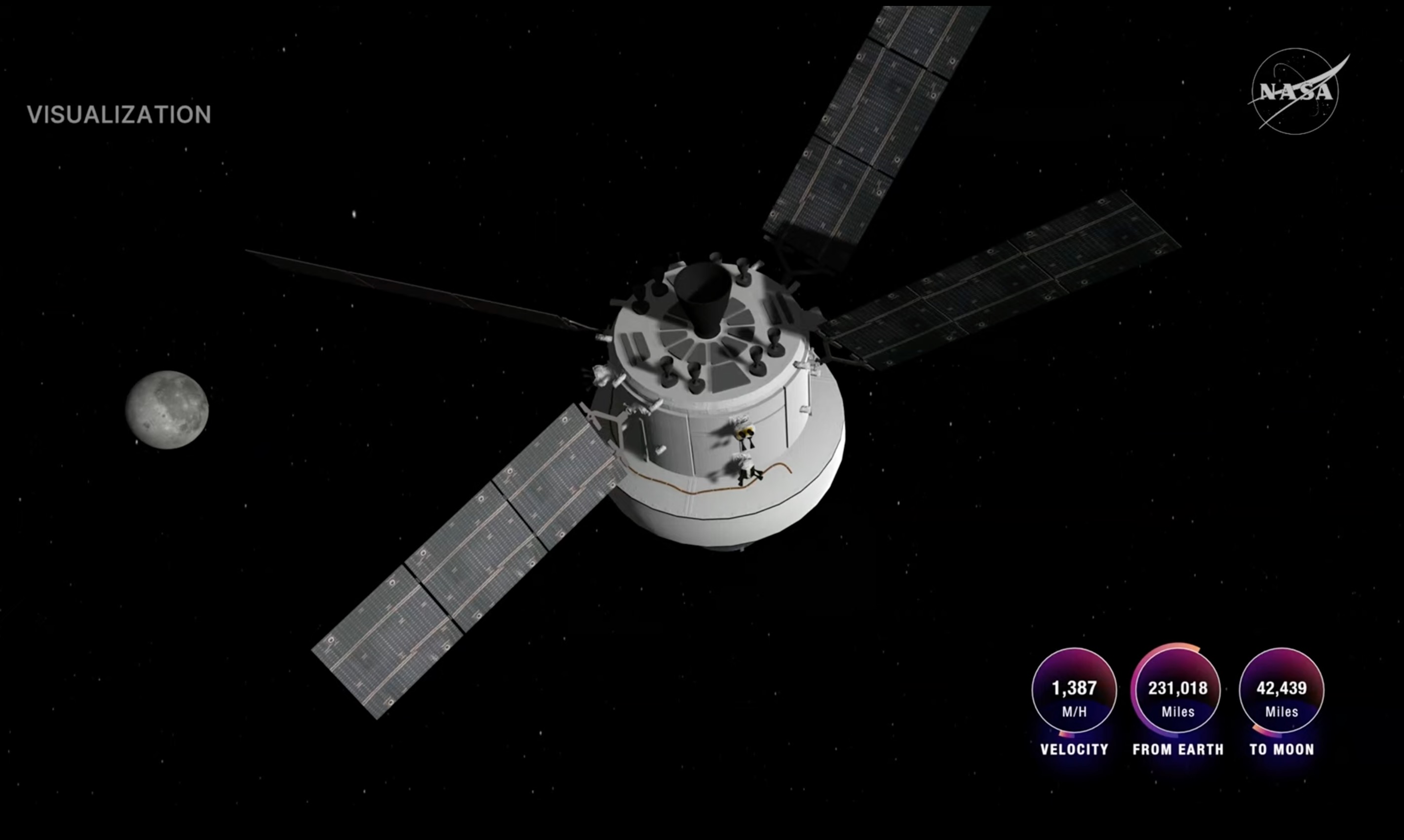
For the first time in more than 50 years, humans are cruising through lunar space.
The four astronauts of NASA’s Artemis 2 mission arrived in the moon‘s sphere of influence — the region where lunar gravity exerts a more powerful pull than that of Earth — today (April 6) at 12:37 a.m. EDT (0437 GMT).
The milestone occurred when the mission’s Orion capsule was about 39,000 miles (62,764 kilometers) from the moon and roughly 232,000 miles (373,368 km) from Earth, a commentator said during NASA’s Artemis 2 livestream.You may like
The four astronauts of NASA’s Artemis 2 mission have arrived at the moon. They entered the lunar sphere of influence early Monday morning (April 6). (Image credit: NASA)
The Artemis 2 astronauts — NASA’s Reid Wiseman, Victor Glover and Christina Koch and the Canadian Space Agency‘s Jeremy Hansen — are the first people to cross the lunar threshold since December 1972, when the three-person Apollo 17 moon-landing mission did so.
Artemis 2 will not touch down on the moon, or even enter lunar orbit. Rather, Orion will loop around the moon’s far side this evening in a history-making flyby. During that encounter, Artemis 2 will get farther from Earth than any crewed flight ever has.
The distance record is currently held by the Apollo 13 astronauts, who got 248,655 miles (400,171 km) from our planet in April 1970. At the height of tonight’s flyby, just after 7 p.m. EDT (2300 GMT), Artemis 2 will be 252,757 miles (406,773 km) away from the rest of humanity, NASA officials have said.
The Artemis 2 astronauts will study the moon during the flyby, gathering data that could help scientists better understand the terrain and geology of Earth’s nearest neighbor. They’ll also be treated to a total solar eclipse, which will not be visible to those of us here on terra firma.
In addition, the flyby will chart their path home: Lunar gravity will slingshot Orion back toward Earth. Artemis 2 astronauts will come home on Friday (April 10), ending their 10-day mission with a parachute-aided splashdown off the coast of San Diego.
Editor’s note: This story was updated at 1:15 a.m. EDT on April 6 with NASA’s revised time of Orion’s entry into the moon’s sphere of influence — 12:37 a.m. EDT rather than 12:41 a.m. EDT.
Michael Wall is the Spaceflight and Tech Editor for Space.com and joined the team in 2010. He primarily covers human and robotic spaceflight, military space, and exoplanets, but has been known to dabble in the space art beat. His book about the search for alien life, “Out There,” was published on Nov. 13, 2018. Before becoming a science writer, Michael worked as a herpetologist and wildlife biologist. He has a Ph.D. in evolutionary biology from the University of Sydney, Australia, a bachelor’s degree from the University of Arizona, and a graduate certificate in science writing from the University of California, Santa Cruz. To find out what his latest project is, you can follow Michael on Twitter.
Democracy’s present difficulties were predictable. History and older theories of democratic stability should have prepared us for both democratic backsliding and the vulnerability of Western democracy we are experiencing today.
By Sheri Berman
Consciousness, sexuality, androgyny, futurism, space, the arts, science, astrology, democracy, humor, books, movies and more



 Now I’m going to read Salambo until half past 10, it’s 8 o’clock now, and then the Bible in three volumes and, finally, think for a while about huge scientific problems and then go to bed, and sleep until half past 7 in the morning, eh? Until tomorrow, may we have a good night and may we both think that great friends must love each other very, very much, much, much, much, much, mucho . . . with “m” for music or for “mundo.”