
Monthly Archives: February 2026

How Not to Be a Victim of Time: Rebecca West on Music and Life
By Maria Popova (themarginalian.org)

Time is the book we fill with the story of our lives. All great storytelling has the shape of music. All music is a shelter in time. In these lives hounded by restlessness, trembling with urgency, we need this shelter, need a place still enough and quiet enough to hear the story of our becoming, the song of life evolution encoded in our cells: “Life is exquisitely a time-thing, like music,” wrote the pioneering marine biologist Ernest Everett Just as he was revolutionizing our understanding of what makes life alive.
Rebecca West (December 21, 1892–March 15, 1983) offers an uncommonly insightful meditation on how music can help us befriend the fundamental dimension of our lives in her 1941 masterwork Black Lamb and Grey Falcon (public library), which I hold to be one of the past century’s great works of philosophy — her lyrical reckoning with art and survival lensed through three visits to Yugoslavia between the world wars, exploring what makes us and keeps us human.
Art by Kay Nielsen from East of the Sun and West of the Moon, 1914. (Available as a print and as stationery cards.)
West recounts a painful moment of political tension at a restaurant table, suddenly interrupted by a Mozart symphony flooding in from the radio box, making “an argument too subtle and profound to be put into words” — an argument for the breadth of time, for how it can hold and heal our longings and losses. With the touching humility of acknowledging the limitations of one’s gift and craft, she writes:
Music can deal with more than literature… Art covers not even a corner of life, only a knot or two here and there, far apart and without relation to the pattern. How could we hope that it would ever bring order and beauty to the whole of that vast and intractable fabric, that sail flapping in the contrary winds of the universe? Yet the music had promised us, as it welled forth from the magic box in the wall over our heads, that all should yet be well with us, that sometime our life should be as lovely as itself.
The greatest music offers something even greater than itself — an amelioration of the most subterranean struggle of human life: our anxiety about time. West writes:
One morning, West follows a waterfall up the river to its source across “a broad and handsome valley,” toward a lake that splits into two streams linked by a dilapidated village nestled in flowering trees. There, she encounters music wholly different from Mozart’s yet just as elemental, just as much a benediction of time in its syncopation of urgency and silence:
That may be what we can learn from music, what it means to have a harmonious relationship with time — training the mind to be unhurried, to halt the rush of certainty just enough to remain curious, to press an ear to the silence of the universe and listen for the clear sound of who and what we are.
Card from An Almanac of Birds: 100 Divinations for Uncertain Days.
What It’s Like to Touch the Bottom of the World
By Maria Popova (themarginalian.org)
The history of our species is the history of mistaking the limits of our imagination for the limits of the possible. It is salutary, I think, for us to be reminded regularly that this world is far wilder and more alien than we suppose it to be, that flowers are not what we supposed them to be, that eyes are not what we supposed them to be, that life and death are not what we supposed them to be, that a self is not what we supposed it to be.
We come to know a world the way we come to know a person — by learning its depths and its limits. It has always tugged at the human imagination to touch these extremes — to reach its poles, to conquer its peaks, to balance life on its sharpest edges. But it is the depths that have enticed and eluded us the longest.
Previously unknown giant dragonfish (Bathysphaera intacta) circling the Bathysphere by artist Else Bostelmann, 1934
At the end of the nineteenth century, upending the long-held dogma that no life existed below 300 fathoms, a series of landmark oceanographic expeditions plunged deeper and discovered the magnificent creatures of the deep, discovered how magnificently deeper the deep really was than imagined. And then, in 1875, the Challenger expedition let a weighted piece of rope drop and drop and drop into the South Pacific, until it sounded a depth of 4,475 fathoms — 8,184 meters. They didn’t realize the spot was part of an immense trench — an upside-down mountain range at the bottom of the world. Over the next century, more expeditions and better technologies continued and refined the measurements, until the bottom of the Mariana Trench was sounded at around 10,984 meters — half the Andes stacked atop Everest.
To touch such depths with the mind was already staggering beyond measure. To touch them with our animal sensorium seemed unimaginable. As a human foot fell on the dusty surface of another planetary body, the deep ocean remained more mysterious than the Moon. “Who has known the ocean? Neither you nor I, with our earth-bound senses,” Rachel Carson wrote in her pioneering essay Undersea. And yet when William Beebe plunged his Bathysphere into the deep, the unimaginable became possible — this, too, is the history of our species.
William Beebe inside the Bathysphere (Wildlife Conservation Society Photo Collection)
Nearly a century after Beebe, Scottish geoscientist Heather Stewart set a diving record with her 10-hour descent to the bottom of the Mariana Trench with the Bakunawa submersible, one of the most impressive and costly technologies humankind has created. On a fascinating episode of BBC’s In Our Time — my favorite radio program — she recounts, in words not dissimilar to astronaut Sally Ride’s exuberant description of what it’s like to launch into space, her experience:
All the while, she reflects, her brain is scrambling to parse this surreality and integrate it with her existing understanding of the world by putting it in a geological context, trying to form a working hypothesis of what kind of world might be the bottom of the world. But we are captives of our frames of reference and we habitually forget that the imagination of nature will always be greater than ours, because it imagined us: Suddenly, out of that blackest darkness — as in life — spring the most surprising colors:

Endpapers of the classic 1959 children’s book Little Blue, Little Yellow by Leo Lionni.
But one doesn’t need a $30-million submersible to taste the sublime strangeness of the deep. We have invented another technology to take us to those places hardest to reach. In this fragment of her sweeping five-part poem “The Depths” (translated by my mother), Natalia Molchanova, considered the greatest free-diver of all time, invites our earth-bound senses into the most alien depths of this world:
nonexistence.The speechlessness of eternal darkness
and its boundlessness.And I emerged from time,
it
poured into me,
And we grew
still.I lost my body between the waves.
And I reached emptiness,
peace,
touching the secret of the ocean —
a bottomless blue abyssI turn inward,
and remember
Self.
I — light.
And I gaze intently:
In the depths breath
is born.
I merge with it.
And I emerge into the world…
At the age of 53, Molchanova plunged into the sea off the coast of Spain and never emerged, touching, somewhere at the bottom of the world, the hardest thing for a human being to touch — peace, total and austere as pure spacetime.
The Purest Definition of Love, the Qualities of a Lasting Relationship, and the Salve for the Betrayals of Time
By Maria Popova (themarginalian.org)

Few things in life cause us more suffering than the confusions of love, all the wrong destinations at which we arrive by following a broken compass, having mistaken myriad things for love: admiration, desire, intellectual affinity, common ground.
This is why knowing whether you actually love somebody can be so difficult, why it requires the rigor of a theorem, the definitional precision of a dictionary, and the courage to weather the depredations of time.
In On the Calculation of Volume (public library) — her startlingly original reckoning with the bewilderments of time and love, partway between Einstein’s Dreams and Ulysses — Danish author Solvej Balle offers the best definition of love I’ve encountered since Iris Murdoch’s half a century ago:
Card from An Almanac of Birds: 100 Divinations for Uncertain Days, also available as a stand-alone print and as stationery cards, benefitting the Audubon Society.
Describing a couple united by this kind of love, Balle captures the essential qualities of a lasting relationship:
The future, however, can bring what the present can’t foresee, can’t bear to consider. People die. Lovers stop loving. Sudden and mysterious phase transitions of feeling take place without warning or explanation, they way the lava of one person’s passion can turn to stone overnight, leaving the other entombed in painful and lonely confusion. Because of this, to live with the fundamental fear of loss and love anyway may be the purest measure of our aliveness. What makes it possible — the only thing that makes it possible — is to refuse the glass-half-empty view of life, to see that death is a token of the luck of having lived and every loss a token of the luck of having had, that these are miracles that weren’t owed us but nonetheless prevailed over the laws of probability so we may live and love.
Art from An Almanac of Birds: Divinations for Uncertain Days. (Available as a print and as stationery cards, benefitting the Audubon Society.)
There are moments we remember this, moments that stagger us into this primal perspective — moments Balle describes as ones when “the ground under one’s feet falls away and all at once it feels as though all predictability can be suspended, as though an existential red alert has suddenly been triggered.” She writes:
It seems so odd to me now, how one can be so unsettled by the improbable. When we know that our entire existence is founded on freak occurrences and improbable coincidences. That we wouldn’t be here at all if it weren’t for these curious twists of fate. That there are human beings on what we call our planet, that we can move around on a rotating sphere in a vast universe full of inconceivably large bodies comprised of elements so small that the mind simply cannot comprehend how small and how many there are. That in this unfathomable vastness, these infinitesimal elements are still able to hold themselves together. That we manage to stay afloat. That we exist at all. That each of us has come into being as only one of untold possibilities. The unthinkable is something we carry with us always. It has already happened: we are improbable, we have emerged from a cloud of unbelievable coincidences… We have grown accustomed to living with that knowledge without feeling dizzy every morning, and instead of moving around warily and tentatively, in constant amazement, we behave as if nothing has happened, take the strangeness of it all for granted and get dizzy if life shows itself as it truly is: improbable, unpredictable, remarkable.
This, of course, is why to live is a probable impossibility and to love is to live against probability; it is why our moral obligation to the universe is to love one another while we are and because we are alive.
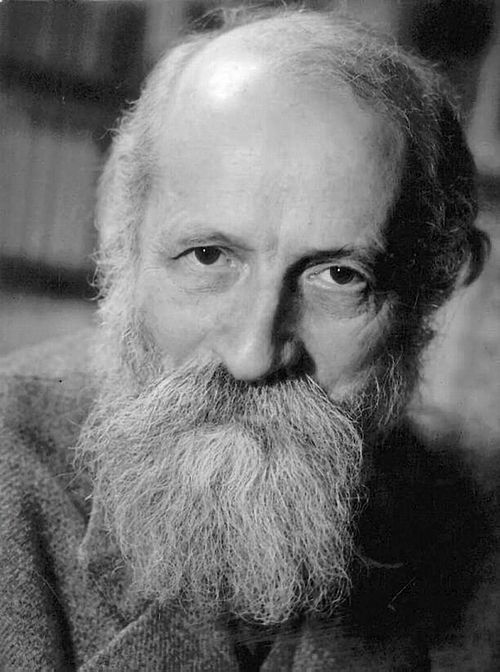
Martin Buber on redemption and embraceability
(Image from Wikipedia.org)
“We can be redeemed only to the extent to which we see ourselves.”
“The world is not comprehensible, but it is embraceable: through the embracing of one of its beings.”
~ Martin Buber
Martin Buber was an Austrian-Israeli philosopher best known for his philosophy of dialogue, a form of existentialism centered on the distinction between the I–Thou relationship and the I–It relationship. Wikipedia
Born: February 8, 1878, Vienna, Austria
Died: June 13, 1965
Langston Hughes and Gertrude Stein


Against Generative AI: Is Art the Last Refuge of Our Humanity?
Nick Ripatrazone on the Importance of the Creative Ego
Nick Ripatrazone January 15, 2026 (lithub.com)
None of this is supposed to be easy. Not writing, not life, not love.
Louise Glück’s debut, Firstborn, was published in 1968. One poem that didn’t make the cut was “The House on Marshland.” Glück said it was “terrible.” She grew up in Woodmere, Long Island, and wanted to write about her “marshy” surroundings. She had an idea: “The knowledge that houses, these structures which are supposed to be consoling and stable, were being built on land that was itself profoundly unreliable seemed to me very moving.” It should have been a good poem.
“I tried to write this poem over and over and over again.” She thought the poem “should be large and important,” and perhaps that ambition stifled her. She put aside the poem, but was haunted by the idea.
Then, in the spring of 1971, she started drafting a new poem. The first few lines “came intact and perfect.” Yet she struggled with the rest, and spent that summer “absolutely obsessed” with those lines of the poem, and could write “nothing else.” Each morning she woke and “heard” those lines. Only in late autumn of that year did she realize that she might use the detritus of her drafts for “The House on Marshland” for this new poem, “To My Mother.”
While it’s easy to fetishize the trope of the struggling artist, art results from failure overcome by determination.
The poem was the point, yes, but perhaps the struggle was also the point. When we create, we are deeply human. The emergence and evolution of generative AI is a threat to creativity. It is a threat to humanity.
*
Artistic ego is the best chance we have of battling against the rise of AI in creative spaces. When we write something and decide to share it with others, we are affirming the worth of our own words, which is an action of the ego. Although that art might be kenotic in nature, steeped in humility or in the passion to do good, we are also affirming that our voice is worth the time and attention of others.
Great art is impossible without some measure of ego.
Most writers, I think, are imperfect people like us. We can forgive them certain foibles and sins (as we might wish for similar grace ourselves) and recognize that their actions of ego are in service of a greater good; a collective catharsis. All of this is slow, mysterious work: the type of gestation that makes art.
AI tools like Sudowrite, Novelcrafter, and Squibler promise full-length books in minutes—or seconds. AI-produced books have begun to flood Amazon, and range from kids and coloring books to derivative novels and faux biographies repurposed from Wikipedia pages. It’s a mess, and it is only going to get worse.
One AI service claims users “can streamline the book creation process, from conception to publication, making it easier to bring your ideas to life and share them with the world.” Such rhetoric is gentle, inclusive, and misleading. Great art isn’t supposed to be easy. While it’s easy to fetishize the trope of the struggling artist, art results from failure overcome by determination. The artistic ego, in asserting itself, is a human action. When we cede creation to the machine, we are not making art.
Reddit posts abound in which people turn to AI to ease their writer’s block, as if it is a temporary inconvenience. The struggle, in fact, feeds the art. Joy Williams once wrote of Jane Bowles: “Each word is built, each step painful, each transition a rope bridge thrown over a chasm. She makes it look as hard as it is.” Williams could feel Bowles’s struggle, but it was a furnace of her creation. Reading Bowles, Williams concluded, “I am always enchanted and unnerved, a little sick, actually, with love for her gloomy waterfalls, her morbid gazebos, her ghastly picnics, her serious ladies and frail whores—her tortured, awkward, groping, uncompleted souls.”
There’s something powerful about the artistic ego; the stubborn belief that we—despite our cosmic insignificance—can create something original that makes others laugh, cry, and think.
In 1962, Tillie Olsen gave a largely extemporaneous talk at Harvard’s Radcliffe Institute. Although she revised the taped transcription into an essay that later appeared in Harper’s, her talk on silence is rangy and raw. “Substantial creative work demands time,” she claimed, and lamented how often women, their lives devoted elsewhere and to others, were consigned to “atrophy; unfinished work; minor effort and accomplishment; silences.”
Olsen also documents the “toil” inherent in great art. My favorite is the testimony she shares of Honoré de Balzac:
To pass from conception to execution, to produce, to bring the idea to birth, to raise the child laboriously from infancy, to put it nightly to sleep surfeited, to kiss it in the mornings with the hungry heart of a mother, to clean it, to clothe it fifty times over in new garments which it tears and casts away, and yet not revolt against the trials of this agitated life—this unwearying maternal love, this habit of creation—this is execution and its toils.
You may think, like Henry James, that Balzac sounds like “a Benedictine monk leading his life within the four walls of his convent.” Perhaps he was. James admired Balzac, for
his subject of illumination was the legends not merely of the saints, but of the much more numerous uncanonized strugglers and sinners, an acquaintance with whose attributes was not all to be gathered in the place of piety itself; not even from the faintest ink of old records, the mild lips of old brothers, or the painted glass of church windows.
Balzac transcended his room, his mind, through the difficult work of his art.
In 1904, the poet Rainer Maria Rilke wrote to a younger writer that “it is clear that we must hold to what is difficult; everything alive holds to it.” He said that “everything serious is difficult, and everything is serious.” In his 1950 Nobel Prize speech, William Faulkner lamented how younger writers of his time were (understandably) worried: “When will I be blown up?” They didn’t have access to AI, of course, but they had other distractions, and Faulkner worried that their art was missing “the old universal truths lacking which any story is ephemeral and doomed—love and honor and pity and pride and compassion and sacrifice.”
Being a good artist is no excuse for being a bad person. Faulkner’s genius doesn’t erase his vices. But there’s something powerful about the artistic ego; the stubborn belief that we—despite our cosmic insignificance—can create something original that makes others laugh, cry, and think. “I don’t think poetry is going to make anyone a better person, and it is not going to save you,” Rita Dove said in an interview. “But writing is a constant for me. There’s an edge that needs to be explored, the edge between being unconscious and then suddenly being so aware that the skin tingles.”
I have felt that electricity. It requires work, and patience, but what a glory when the words sing. “There is that moment in the writing of a poem when things start to come together, coalesce into a discovery.” It is not mere understanding, for “the more I write the less I know of myself.” Yet Dove affirms that “territory is being covered—excursions into the interior.” Art begins with “intimate revelation,” which must then be made “visible—palpable—for others.”
We owe it to ourselves, to our children, and to those who come after them—God willing—to write ourselves into eternity. AI is making most things easier, but not better; art can be our last refuge, a way to affirm that our humanity matters.
AI art artificial technology Balzac capitalism generative AI Henry James humanity Jane Bowles Joy Williams Louise Gluck Nick Ripatrazone poetry Rainer Maria Rilke Rita Dove technology Tillie Olsen William Faulkner writing

Nick Ripatrazone
Nick Ripatrazone is the culture editor at Image Journal, and a regular contributor to Lit Hub. He has written for Rolling Stone, Slate, GQ, The Atlantic, The Paris Review, and Esquire. His most recent book is The Habit of Poetry (2023). He lives in New Jersey with his wife and twin daughters.
Thoreau on speaking the truth

“It takes two to speak the truth – one to speak and another to hear.”
― Henry David Thoreau
Henry David Thoreau (1817-?) was an American essayist, poet, philosopher, naturalist, and social reformer. A key figure in New England transcendentalism, he’s best known for Walden (1854), a book inspired by his time at Walden Pond and reflecting on simple living in nature. He also wrote the essay “Civil Disobedience”, which argues for citizen disobedience against unjust governments. Thoreau was a vocal abolitionist and conductor on the Underground Railroad. Wikipedia.org
Born: July 12, 1817, Concord, MA
Died: May 6, 1862
Book: “Red Orchestra: The Story of the Berlin Underground and the Circle of Friends Who Resisted Hitler”

Red Orchestra: The Story of the Berlin Underground and the Circle of Friends Who Resisted Hitler
Anne Nelson
In this unforgettable book, distinguished author Anne Nelson shares one of the most shocking and inspiring–and least chronicled–stories of domestic resistance to the Nazi regime. The Rote Kapelle, or Red Orchestra, was the Gestapo’s name for an intrepid band of German artists, intellectuals, and bureaucrats (almost half of them women) who battled treacherous odds to unveil the brutal secrets of their fascist employers and oppressors.
Based on years of research, featuring new information, and culled from exclusive interviews, Red Orchestra documents this riveting story through the eyes of Greta Kuckhoff, a German working mother. Fighting for an education in 1920s Berlin but frustrated by her country’s economic instability and academic sexism, Kuckhoff ventured to America, where she immersed herself in jazz, Walt Disney movies, and the first stirrings of the New Deal. When she returned to her homeland, she watched with anguish as it descended into a totalitarian society that relegated her friends to exile and detention, an environment in which political extremism evoked an extreme response.
Greta and others in her circle were appalled by Nazi anti-Semitism and took action on many fronts to support their Jewish friends and neighbors. As the war raged and Nazi abuses grew in ferocity and reach, resistance was the only possible avenue for Greta and her compatriots. These included Arvid Harnack–the German friend she met in Wisconsin–who collected anti-Nazi intelligence while working for their Economic Ministry; Arvid’s wife, Mildred, who emigrated to her husband’s native country to become the only American woman executed by Hitler; Harro Schulze-Boysen, the glamorous Luftwaffe intelligence officer who smuggled anti-Nazi information to allies abroad; his wife, Libertas, a social butterfly who coaxed favors from an unsuspecting Göring; John Sieg, a railroad worker from Detroit who publicized Nazi atrocities from a Communist underground printing press; and Greta Kuckhoff’s husband, Adam, a theatrical colleague of Brecht’s who found employment in Goebbels’s propaganda unit in order to undermine the regime.
For many members of the Red Orchestra, these audacious acts of courage resulted in their tragic and untimely end. These unsung individuals are portrayed here with startling and sympathetic power. As suspenseful as a thriller, Red Orchestra is a brilliant account of ordinary yet bold citizens who were willing to sacrifice everything to topple the Third Reich.
(Goodreads.com)
The Astrology Of February 2026 – Saturn Conjunct Neptune
(Astrobutterfly.com)
The #1 February 2026 highlight is – by far – the Saturn-Neptune conjunction at 0° Aries.
Saturn joins Neptune in Aries on February 14th, 2026, when the process Neptune has been setting in motion since January 2026 begins to take a clearer direction – things get real all of a sudden.
Just before the 2 make final contact on February 21st, 2026, we have an electrifying Solar Eclipse in Aquarius square Uranus, on February 17th, 2026.
And then comes the transit everyone has been anticipating – the most headlined event of the month: on February 21st, 2026, Saturn conjuncts Neptune at 0° Aries.
The Saturn-Neptune conjunction on February 21st at 0° Aries is so significant, so rare, that it’s hard not to think in terms of the world before and after February 2026.
Whether the Saturn-Neptune alignment becomes a clearly defined event that will steal the headlines, OR planting the seed of something that will set the direction for centuries to come, this is a major threshold moment.
We are living in extraordinary times!

Let’s take a look at the most important transits of the month:
February 1st, 2026 – Full Moon In Leo
On February 1st, 2026, we have a Full Moon at 13° Leo.
The Full Moon is opposite the Aquarius stellium – Pluto, Sun, Mars, Venus and Mercury – asking for a balancing act between personal authenticity and collective direction.
The Full Moon invites us to ask: in this new Aquarian world we’re inevitably stepping into, what’s my unique contribution?
How do I stay connected with the larger whole (communities, technology, the crazy AI-world we’re entering) AND stay true to myself?
The answer might be a little bit more roary, a little bit more dramatic than we’re used to. Leo is here to remind us that our uniqueness is not a glitch in the system, but the very thing we’re meant to bring into it.
February 4th, 2026 – Uranus Turns Direct
On February 4th, 2026, Uranus turns direct at 27° Taurus. This is the very last leg of Uranus’ journey through Taurus – a journey that started back in 2018.
Whatever Uranus in Taurus’ mission was – this transit meant different things to different people, depending on our natal charts -, this is the final bolt of lightning, exposing what still wants to break free, pushing things toward the right timing. It’s now or never.
This also means that these are your last couple of months of Uranus in your whole sign Taurus house. A big chapter is coming to a close.
This is the time to take stock of what Uranus has stirred up, integrate the change, and see the bigger picture of something that took a long time (7 years) in the making.
February 6th, 2026 – Mercury Enters Pisces
On February 6th, 2026, Mercury Enters Pisces – and it will be quite busy here this month!
On February 12th, Mercury enters shadow at 8° Pisces, and later this month, on February 26th, Mercury turns retrograde at 22° Pisces.
Mercury feels a bit fuzzy in the last sign of the zodiac. The good news is that this is the first time in a long time when Mercury is not accompanied by Neptune (and from February 14th onwards) by Saturn in the sign.
The focus now is less on trying to figure out the complex collective storyline and decoding the bigger context – and more about our everyday, relatable experiences connected to the Pisces area of our life.
When in Pisces, our mind automatically becomes more ‘in tune’ – picking up subtext, atmosphere, and subtle signals that an intellectual Mercury in Aquarius, for example, would miss.
Mercury in Pisces helps us listen between the lines – and this is a real benefit now, with Saturn-Neptune story building in the background.
February 10th, 2026 – Venus Enters Pisces
On February 10th, 2026, Venus enters Pisces. That’s great news, because the goddess of love loves the Piscean ocean. Aphrodite emerged from a sea shell after all!
Just like with Mercury, this is the first time in a long time since Venus has not shared her favorite sign with Neptune and Saturn.
This means we can focus on enjoying this 3-week transit, especially since for much of it, Venus will be trining Jupiter in Cancer, which makes an already great transit even better!
February 14th, 2026 – Saturn Enters Aries
On February 14th, 2026, Saturn leaves Pisces and enters Aries. Saturn first dipped its toes into Aries last year, on March 25th, 2025, giving us a 3-month taste of what this new cycle is about.
Saturn enters Aries now for good, and as soon as it ingresses into the sign, it starts applying a conjunction to Neptune.
With both planets in Aries, we can expect a very concrete shift, where a direction forward becomes blatantly obvious.
That shift (the subtle version of it) might have first emerged last month with Neptune’s ingress into the sign, but Saturn has a way of making things crystal clear and obvious – so do pay attention to what happens around this date.
Saturn will stay in Aries until April 2028, bringing into focus a particular segment of your chart – and area of life. A detailed report about the Saturn in Aries ingress will follow closer to the date.
February 17th, 2026 – New Moon And Solar Eclipse In Aquarius
On February 17th, 2026, we have a New Moon and Annular Solar Eclipse at 28° Aquarius. The Eclipse is square Uranus at 27° Taurus. This is a tight square!
Things can get dramatically charged when the Aquarian need to stay loyal to an idea clashes with what feels sustainable in real life.
There’s something that needs to break free before we can move into the new era.
However disrupting, remember that Uranus always pushes toward freedom and authenticity. Not that a Uranus square automatically brings upheaval – but if something does get unsettled, it’s because it no longer belongs to the next chapter.
February 18th, 2026 – Sun Enters Pisces
On February 18th, 2026, Sun enters Pisces, the last sign of the zodiac. Happy b-day to all Pisces out there!
Pisces season is that liminal time when we tie up loose ends and reflect on the lessons of the past year, making sense of the 12-month solar cycle before a new one begins.
And this year, Pisces season also acts as the buffer zone before the Saturn-Neptune conjunction at 0° Aries – the last inhale before a major shift.
February 21st, 2026 – Saturn Conjunct Neptune at 0° Aries
On February 21st, 2026, Saturn and Neptune meet at 0° Aries. We cannot stress enough how important this transit is.
This is an alignment that goes beyond the scope of a regular Saturn-Neptune 36-year cycle. Why? Because it occurs at the most important point of the zodiac – the Aries Point.
0° Aries is the cardinal point that marks a shift in the direction of the Sun – the gravitational center of our solar system.
This alignment is so rare that even ephemeris don’t go back in time far enough so we can track when Saturn and Neptune met last time at 0° Aries. Many sources point to something like 6,000 years ago. You get the message. This is rare.
When Saturn and Neptune meet at the zero-point, an energetic window is opening. More than in any other moment in recent history, we want to be intentional about what we’re seeding now.
More detailed reports about this transit will follow closer to the date.
February 22nd, 2026 – Venus Trine Jupiter
On February 22nd, 2026, Venus, at 15° Pisces, is trine Jupiter at 15° Cancer. Venus-Jupiter trines are known to be auspicious, but this is particularly auspicious, because both Venus and Jupiter are in their exaltation signs.
Moreover, Jupiter is also aligned with Sirius, the brightest star in the night sky.
This is a fertile transit promising abundance, opportunities, and a sense of ease and flow – a real blessing in the middle of an intense month.
There’s a lot to look forward to in February – and more detailed reports on the Solar Eclipse and the Saturn-Neptune conjunction will follow closer to the date.