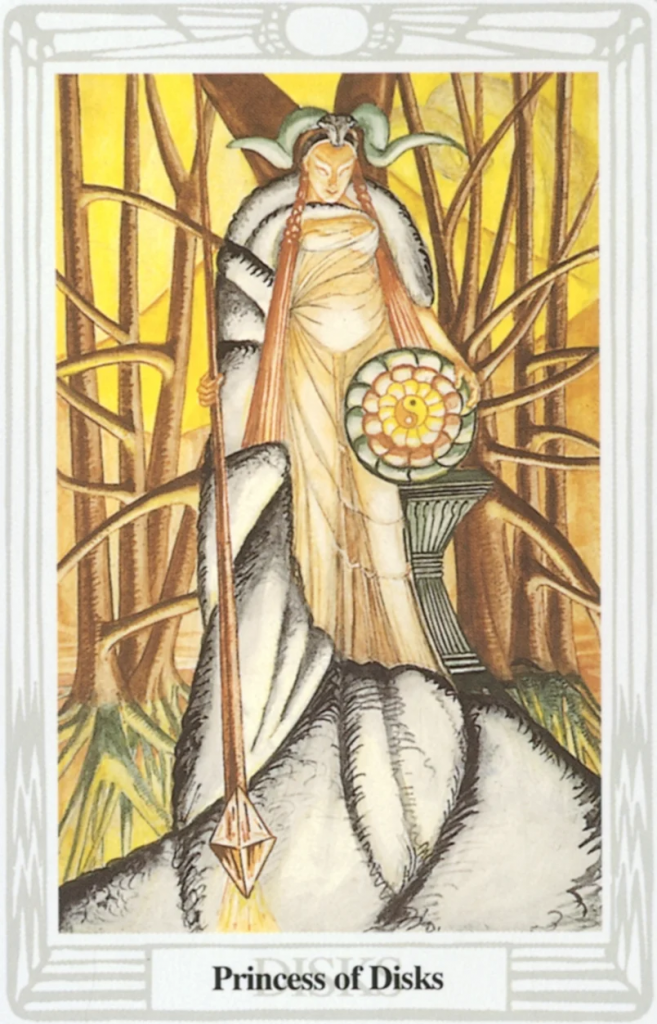
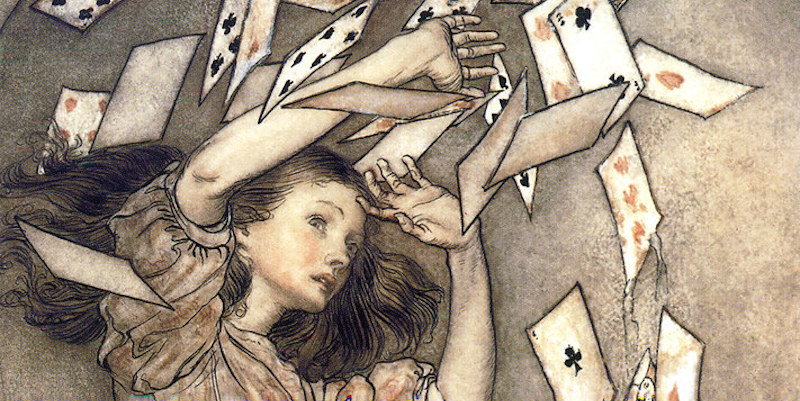
This card is one with a great deal of hidden strength and power within it, which promises new growth, big changes and new beginnings, accompanied by the inner reserves to make the best of those influences.A day ruled by this Princess is one on which financial matters will usually work well, and where you may quite possibly receive good news regarding money and wealth. Pay special attention to ideas you have during a day like this, and be prepared to think them through and act on them as soon as the time is right.Keep firmly in touch with everyday life, but listen for the whispers of intuition which are sparked by part of the Princess’s inner power. This is a day to be well-earthed, but to walk with your head among the stars.The Princess of Disks has a hidden title – the rose of the Palace of Earth. And here we find the deepest spiritual aspects of her influence. The Palace of Earth is the planet, and the rose is connected symbolically to the rosa mundi, the Rose of the World – a symbol of resurrection and eternal life.Thus this card touches upon the most important issues about being in love with life – its creation, its experience, its excitement and promise of fulfilment. When we are able to enjoy each passing minute of our lives, we put ourselves in touch with the mighty and empowering forces of love which flow through the Cosmos at all times. We become more deeply aware of the creative force of the goddess, and more in touch with our own inner vitality and life force.
Affirmation: “I now welcome fresh growth and renewal into my life.”
CONGRESS, NOW MORE THAN EVER, OUR NATION NEEDS YOUR COWARDICE
Published: June 20, 2025
Who will stand up for our democracy? This question, fraught in even the most peaceful times, has only grown more pressing as our country approaches its 250th anniversary. Each passing day brings growing assaults on essential liberties like freedom of speech and due process. Meanwhile, our delicately assembled legal system faces a constant barrage of threats. Even as this issue reaches publication, the U.S. military has been deployed against peaceful protestors. We teeter on the brink of collapse into an authoritarian state. That is why, today, The Onion calls upon our lawmakers to sit back and do absolutely nothing.
Members of Congress—now, more than ever, our nation desperately needs your cowardice.
Our republic is a birthright, an exceedingly rare treasure passed down from generation to generation of Americans. It was gained through hard years of bloody resistance and can too easily be lost. Our Founding Fathers, in their abundant wisdom, understood that all it would take was men and women of little courage sitting in the corridors of power and taking zero action as this precious inheritance was stripped away—and that is where we have finally arrived.
Now is not the time for bravery or valor! This is the time for protecting your own hide and lining your pocket. Now is not the time for listening to your idiotic constituents drone on about what’s happening to their precious democracy. This is the time for getting down on all fours and groveling. Now is not the time to say, “Enough is enough,” and have the tough conversations about resisting the ongoing assaults on American liberty. This is the time to let the wave of apathy and indifference roll over you as you think about getting a really nice renovation to your house in Kalorama.
But what can I, one coward, do alone? you might ask. It’s true. As a solitary person, your fecklessness will make little impact. But if you join together with the most craven senators and representatives in the Capitol, the impact will be immense: The corruption, the disregard for the rule of law, the shipping of residents to foreign gulags, the attacks on judges, the censorship and chilling of speech, the punishment of any and all dissent—it can be made that much worse if you just find it in yourself to clutch your head in your hands, wet the bed, and cower in the hope of being spared from the White House’s wrath.
It won’t be easy, but you must search deep within yourself and muster up every ounce of gutlessness you have. Then, bend over and lick the president’s boots.
Why? Because ultimately none of this matters. Democracy? Equality? The U.S. Constitution? These are hollow phrases. They mean nothing. But money—delicious money? That is solid. You can hold it in your hands. You know this. We know this, too. Only our infantile citizenry fail to appreciate how much you stand to gain by kissing the ring.
In our nation’s darkest moments, the public often looks to Congress for profiles in meekness. We search for men and women much like yourselves, emotional weaklings who are afraid to meet their own glance in the mirror, insignificant do-nothings who quake in their boots at the mention of the slightest exertion. Many of you have already distinguished yourselves as such individuals. To them, our country’s oligarchs can only offer their boundless thanks.
Take solace knowing you are not alone in this endeavor. Over the grand expanse of American history, there have been countless lawmakers who managed to summon up their complete lack of backbone and do the easy thing. Think of the members of Congress who turned a blind eye to Japanese American internment, McCarthyism, or the horrors of the Holocaust, all because doing something seemed a little too hard, a little too inconvenient. These men should be your inspiration. Never forget: You stand on the shoulders of spineless giants.
But we have not descended entirely from a nation of fearful men, have we? Let this be the moment to make amends for any missteps of American bravery and valor. Congress, we are asking, nay, demanding: This coming Independence Day, don’t wave the Stars and Stripes, that enduring symbol of liberty and rebellion.
Caterpillars do not have conscious awareness or foresight about becoming butterflies. Their transformation is driven by instinct and biological processes rather than conscious thought. When caterpillars reach a certain stage of development, they instinctively know to find a safe place to pupate and form a chrysalis or cocoon.
Inside the cocoon, a complex process called metamorphosis occurs, where the caterpillar’s body is broken down and restructured into that of a butterfly. While they are guided by genetic programming, they do not have the capacity to “know” what is happening in the way that we understand knowledge. Their behavior is purely instinctual, aimed at survival and reproduction.
Ascension K Jun 15, 2025 What if sex isn’t just an instinct — but an unconscious force shaping your thoughts, choices, and emotional patterns? In this video, we dive into Carl Jung’s teachings on sexuality, the shadow, and what we refuse to acknowledge within ourselves. ???? Repressed desire isn’t gone — it becomes the silent master of your mind. It’s time to see what you’ve been avoiding. Subscribe, hit the bell, and start reclaiming your inner truth.
How this content was made
Auto-dubbed
Audio tracks for some languages were automatically generated. Learn more
The roots of Ipomoea jalapa, when dried, are carried as the John the Conqueror root amulet.
John the Conqueror, also known as High John the Conqueror, John, Jack, and many other folk variants, is a deity from the African-American spiritual system called hoodoo. Due to there being little early written information on the John the Conqueror root, many of the earliest mentions are from oral traditions and in tales from escaped slaves like Frederick Douglass in his autobiography “Narrative of The Life of Frederick Douglass, an American Slave,[1]” published in 1845. He is associated with the roots of Ipomoea purga, the John the Conqueror root or John the Conqueroo, a plant native to the South-eastern United States. Tales of magical powers are ascribed in African-American folklore to the plant, especially among practitioners of Hoodoo.[2][3][4]Muddy Waters mentions him as Johnny Cocheroo in the songs “Mannish Boy” and “I’m Your Hoochie Coochie Man“. In “Mannish Boy”, the line is “I think I’ll go down/To old Kansas too/I’m gonna bring back my second cousin/That little Johnny Conqueroo”. This line is borrowed from the Bo Diddley song “I’m a Man“, to which “Mannish Boy” is an answer song.[5]
Use in Hoodoo
Frederick Douglass received a High John root from an enslaved conjurer named Sandy Jenkins for protection against slaveholders.[6]
High John the Conqueror has its earliest known roots in Congolese culture with the folk hero thought to have originated from stories of a Congolese Prince who was sold into slavery. Symbolizing luck and strength, the “High John root” has strong connections to use in hoodoo, with some even believing High John’s spirit could be summoned and used for guidance and even protection on plantations. African-American Hoodoo practitioners place High John roots inside mojo bags for protection, victory, empowerment, good luck, love, and protection from evil spirits. “…practitioners do this out of their reverence for or worship of the spirit (or in this case, John de Conquer, who also symbolizes ties to their enslaved ancestors through the land or ‘soil of the South.’)” …”we not only find that the spirit of John de Conquer inhabits or ‘possesses’ a root, but he is also woven into a mojo bag that practitioners wear on their persons or store in a ‘secret place’ of their house.”[7][8][9] The root was used during slavery in the Southern United States by enslaved African-Americans to protect from slaveholders. Frederick Douglass and Henry Bibb used the High John root to prevent whippings and protection from slaveholders.[2][3] In an Arkansasslave narrative, ex-slave Marion Johnson used High John roots to conquer his enemies and receive protection from conjure.[10]
Cultural appropriation
In the twentieth century, white drug store owners appropriated Hoodoo and put a white man on High John the Conqueror product labels. As a result, some people do not know of the cultural and historical origins of the African-American folk spirit John the Conqueror in the enslaved Black community and in present day Black American culture. In 2012, Rob Cleveland, an African-American stage performer, created a play about High John the Conqueror to demystify the folk spirit to audiences. The play focuses on John the Conqueror as an enslaved man whose spirit of resistance could never be broken and who outwitted his enslavers. The spirit of resistance in John the Conqueror encouraged enslaved people to resist their slaveholders to gain their freedom.[11] In 2022 MadameNoire, an online magazine geared toward the lifestyles of African-American women, interviewed Black Hoodoo practitioners who voiced their concerns about the appropriation of Hoodoo. “‘White-washed Hoodoo doesn’t even acknowledge John the Conqueror that much because he’s been white-washed to be the type of Spirit that helps men with their virility, help men get women, help gamblers get lucky, and he’s so much more than that…’”[12][2][3] Storyteller Diane Ferlatte performed the African-American folk tale about High John Conqueror that tells the victories of John the Conqueror on the plantation and how he unified the slave community to escape from slavery.[13] Ferlatte tells other African-American folk stories about Brer Rabbit, Brer Fox, and Uncle Remus. African-American scholars explain that High John the Conqueror symbolized freedom from slavery. High John the Conqueror was a trickster and was able to outsmart his enslavers.[14][15]
Folk hero
Zora Neale Hurston and unidentified man 1935 Belle Glade, Florida. Hurston documented stories about High John the Conqueror from African-Americans in the Southern United States.
Sometimes, John is an African prince (son of a king of Congo), said to have ridden a giant crow called “Old Familiar.” He was sold as a slave in the Americas. Despite his enslavement, his spirit was never broken. He survived in folklore as a reluctant folk hero, a sort of trickster figure, because of the tricks he played to evade those who played tricks on him. Joel Chandler Harris‘s Br’er Rabbit of the Uncle Remus stories is a similar archetype to that of High John the Conqueror, outdoing those who would do him in. Zora Neale Hurston wrote of his adventures (“High John de Conquer”) in her folklore collection The Sanctified Church.[7][8][16]
In one traditional John the Conqueror story told by Virginia Hamilton, and probably based on “Jean, the Soldier, and Eulalie, the Devil’s Daughter“, John falls in love with the Devil‘s daughter. The Devil sets John a number of impossible tasks: he must clear sixty acres (25 ha) of land in half a day and then sow it with corn and reap it in the other half a day. The Devil’s daughter furnishes John with a magical axe and plow that get these impossible tasks done, but warns John that her father the Devil means to kill him even if he performs them. John and the Devil’s daughter steal the Devil’s own horses; the Devil pursues them, but they escape his clutches by shape-shifting.
In “High John De Conquer”, Zora Neale Hurston reports that:[17]
like King Arthur of England, he has served his people. And, like King Arthur, he is not dead. He waits to return when his people shall call him again … High John de Conquer went back to Africa, but he left his power here, and placed his American dwelling in the root of a certain plant. Only possess that root, and he can be summoned at any time.
This is from Hurston’s published article in American Mercury magazine in 1943. In this article, she relates a few stories about High John, enough to define him, but not an exhaustive survey of the folklore. The purpose was to present the nation with the hope-building and the power of this inspiring figure during the darkest days of World War II. The article ends with:
So the brother in black offers to these United States the source of courage that endures, and laughter. High John de Conquer. If the news from overseas reads bad, if the nation inside seems like it is stuck in the Tar Baby, listen hard, and you will hear High John de Conquer treading on his singing-drum. You will know then, that no matter how bad things look now, it will be worse for those who seek to oppress us. … White America, take a laugh from out of our black mouths, and win! We give you High John de Conquer.
— The American Mercury, October 1943, pp. 450-458[18]
High John the Conqueror is a powerful figure in African American folklore, particularly within the practices of hoodoo. He is often depicted as a clever and resourceful trickster who uses his wit and cunning to overcome adversity and oppression, particularly during the era of slavery. High John also refers to a plant root, also known as John the Conqueror root, which is used in hoodoo rituals to symbolize luck, strength, and the ability to conquer obstacles.
Here’s a more detailed look at High John:
Folklore Figure:
High John is a legendary figure, believed to be a former African prince who was enslaved in America.
He is portrayed as a symbol of resistance and resilience against oppression.
His stories often involve him outsmarting his enslavers and using his intelligence to survive and thrive.
He is seen as a source of hope and inspiration for those who are struggling.
Some believe he ascended to a deity-like status after his death and continues to offer guidance and protection.
Root and Rituals:
The High John the Conqueror root is a tangible symbol of the folklore figure.
It’s used in hoodoo to attract luck, prosperity, personal power, and protection.
It can be carried on the person, used in spells, or burned as incense.
Different rituals involve anointing the root with oils or using it in conjunction with other magical items.
The root is believed to help individuals overcome obstacles, gain control over their lives, and achieve their goals.
In summary, High John the Conqueror is a powerful figure in African American folklore and hoodoo, embodying resilience, resistance, and the ability to conquer adversity. The High John root is a tangible representation of these qualities and is used in rituals to attract luck, prosperity, and personal power.
This video explains who High John the Conqueror is:
MONTREAL – The nation’s top sleep researchers made a joint statement earlier today announcing that they too have no goddamn idea what to do with their arms when trying to sleep.
Dr. Fran McMatton of McGill University told the press that though she and her colleagues had hoped for more positive news, the evidence was overwhelmingly to the contrary: “There’s really no two ways about it: these meat noodles we call “arms” are a tyranny that modern medicine is woefully ill-equipped to handle.”
Her associate Dr. Hank Jarvis, speaking from his research facility in Winnipeg agreed, saying, “We gave it our best shot but some things, like time travel or the appeal of Adam Levine, are bigger than science.”
McMatton and Jarvis led a team of researchers who explored numerous options for arm placement but ultimately found flaws in every possibility. For example, when lying on one’s side – a favourite pose among many amateur sleepers – one could keep the arm pinned between the torso and the mattress, a style that works for a maddeningly brief period before the arm goes completely numb.
Sleeping on the stomach provided some opportunities for comfort but at the expense of other parts of the body. If this is your chosen method of rest, Dr. Jarvis recommends having a eulogy prepared for your neck, as it will be rendered completely inoperative.
“Our results were just as confusing when considering sleeping on the back,” he added. “Do you keep the arms resting alongside the body as though lying in state? Or crossed over your chest also like your lying in state? Either way, you look like a fucking clown.”
Fascinatingly, they also found that in the rare event a subject found a comfortable position for their arms, it only ever occurred exactly three minutes before their alarm was set to go off. Dr. McMatton summed up the implication of these findings by stating, “No option is comfortable, you’ll never be comfortable, and what does it even matter? Eventually death comes for us all.”
The team’s efforts were not all in vain, however, as they were able to confirm that anyone who sleeps with socks on is absolutely a sociopath.
WASHINGTON—Describing it as one of the most disturbing scenes they have ever been called upon to investigate, horrified officers from the Washington Metropolitan Police Department told reporters Wednesday they had found an unresponsive legislative body in the U.S. Capitol building.
At approximately 11:30 a.m., after receiving multiple tips from concerned citizens, law enforcement officials dispatched patrolmen to an address at the corner of East Capitol Street and First Street. According to police sources, many of those who entered the building were overwhelmed by what they discovered inside, and onlookers reported that officers walking out of the property appeared visibly shaken and pale.
“Responding officers found the lawmaking body on the floor of the congressional chambers, completely rigid and making no movements of any kind,” said Chief Detective Mike Logan, explaining that it was evident to those on the scene that efforts to revive the subject would be futile. “In addition to being completely inert, the body showed signs of advanced decay.”
“I personally can say that during my time in this city I’ve never seen anything as deeply unsettling as this.”
“Preliminary forensic tests suggest it has been in this state for months, perhaps even years,” he added.
Upon learning what transpired in the Capitol building, residents admitted they were saddened but ultimately unsurprised given the bicameral legislature’s condition in recent years. It had reportedly begun to display symptoms of deterioration, not just moving slower, but exhibiting decreased problem-solving skills, poor judgment, and an inability to complete routine tasks.
“Obviously, no one wants to see something like this happen, let alone see it up close,” said Logan, adding that it was especially gut-wrenching knowing that such an outcome could have likely been easily prevented if appropriate actions had been taken sooner. “A lot of the guys on the force are still dealing with this. It’s hard to look at a thing like that, especially when you know there’s nothing you can do about it now. It’s the kind of thing that stays with you.”
“I personally can say that during my time in this city I’ve never seen anything as deeply unsettling as this,” he continued.
At press time, detectives stated that as many as 220 million eligible voters were currently being investigated as possible suspects in the case.
There is a photograph of Alice Pleasance Liddell, taken by Charles Lutwidge Dodgson (aka Lewis Carroll) circa 1858, in which she sits sideways in a chair, her arm wrapped around its back, her face in profile staring off out of frame during what was likely a rather long time to sit for a photograph. She has short dark hair and dark eyes and wears a lace-trimmed dress and a serious expression. She bears little resemblance to the ubiquitous Tenniel illustrations, but she is the first, the original, Alice. On a boat trip near Oxford in 1862, Wonderland was spun out of summer air for her and her sisters.
I first encountered Alice and her Wonderland as a child through adaptations and re-imaginings. It was years before I read the books properly. I watched and re-watched animated versions and live-action fantasias (the 1985 TV miniseries aired when I was Alice-aged and left a vivid, sometimes disturbing impression). I was always fascinated, even when I didn’t understand, and the lack of understanding made it even more fascinating. I was mesmerized by talking flowers and rabbit-sized pocket watches. I recall being confused by the Walrus and the Carpenter, wondering how and why anyone would eat oysters but now of course I understand that oysters are delicious.
I don’t remember when I first saw that particular photograph of Alice Liddell but it changed something about my relationship with Wonderland, seeing this real girl who was the real inspiration for such an extraordinary story captured on film. I wonder often about that girl who became a piece of modern myth, about that boat trip and those sisters who requested a story, for what a tale they received.
The photograph is dark and moody; it shows its age. There are scratches and lines and other small marks marring the image. It fades off into shadow at the corners, Alice set against an amorphous background, the edges out-of-focus. The Alice in the photograph seems to belong to a different flavor of Wonderland, one with a less saturated color scheme and deeper shadows. That photograph was the turning point in discovering my personal version of Wonderland, because Wonderland can be seen through innumerable lenses and some of them are brighter than others. Each reader paints their own version as they read these pages. There is vibrant detail here but there is also room left for the reader to fill out the world, to shift it toward a personal aesthetic. My Wonderland leans monochromatic, all light and shadow with occasional pops of red.
Alice is a presence that drifts by like a ghost or a half-forgotten dream. I have spent a lot of time with her over the years. She seeps into my writing in ways both subtle and blatant. There is a bottle of honeyed grapefruit gin sitting on my bar, with a handwritten label that reads “Drink Me.” I have several Alice-inspired perfumes, including an ode to the Mouse’s Long and Sad Tale composed of vanilla and amber and sweet pea and sandalwood, so occasionally it even smells like Wonderland around here.
No matter how familiar these stories may be, that white rabbit might lead you somewhere unexpected, if only you will follow.
Wonderland is everywhere. Over time these tales have imbued themselves into the world, familiar in their own peculiar, well-worn brand of strange. That White Rabbit carries the story with it even when it appears as a symbol or a song or a tattoo on a shoulder.
These stories are woven into the fabric of so many of our fictions, leaving pawprints and tea-stains and whimsy in their wake, yet going back to the original texts always leads to more discoveries, more details to catch in imagination nets like bread-and-butterflies.
But for all the pop culture familiarity, in my personal opinion the texts themselves are the best version of the stories. There is more on these pages than could be adapted into any medium, so many small moments and plays on words, tiny details and minuscule cakes. The Mouse’s aforementioned Sad Tale is both a tale and a tail. The book versions remain the quintessential iteration of these stories that love words and text and are so delightfully aware of themselves as stories being told.
Every time I read the books, I am struck by something that hadn’t captured my attention the same way in previous readings. On this most recent re-reading, I noticed anew how often Alice interferes with pencils belonging to other characters, and I was particularly caught by the question of what does the flame of a candle look like after the candle is blown out? There are treasures to be found in these pages, glimmering, whether it is your first time reading, or fifth, or fiftieth.
No matter how familiar these stories may be, that white rabbit might lead you somewhere unexpected, if only you will follow.
*
Alice’s Adventures in Wonderland and Through the Looking-Glass and What Alice Found There are two distinct books, though when they are translated into other mediums they are often blended together.
The first book is a boat ride, gliding over waters from one unique encounter to the next determined by its own whims and wonders. The second book is a chess game, regimented and structured in squares and precise movements. It has a set goal to achieve on its board.
One story begins outdoors on a bright, hot, daisy-chain afternoon and the other commences cozily inside by a November fireplace, snow kissing the window panes, the bonfire being prepared outside as the titular looking-glass looms over the mantel.
Alice’s Adventures in Wonderland was improvised in its original form, told on a boat ride for the entertainment of Alice Liddell and her sisters on a summer afternoon. (Charles Dodgson was a colleague of the girls’ father at Oxford.) The three sisters appear in the opening poem as Prima (Lorina), Secunda (Alice), and Tertia (Edith), requesting the story. (Alice is the one who insists “there must be nonsense in it.”) And while the spontaneous tale was revised and changed for publication, the winding, current-driven feeling remains. Alice’s journey through Wonderland flows and moves from one encounter to another. (The Mad Tea Party does not appear in the original manuscript that was first handwritten as Alice’s Adventures Under-Ground, nor does the Cheshire Cat.)
Through the Looking-Glass and What Alice Found There was written several years after the success of the first book and it is quite literally a game of chess. The moves are listed and illustrated in the preface and ensue in the events of the story, moving Alice from pawn to queen. The looking-glass theme of reflections persists throughout and there is a touch more logic to its nonsense. It is, at times, more philosophical than Wonderland, even forcing Alice to insist on her own existence.
They are complementary texts but they are their own worlds. Many adaptations take bits of Looking-Glass and transpose them into Wonderland where they do not necessarily feel out of place but the Looking-Glass is clearly their natural habitat. In particular the Tweedles Dum and Dee are obvious mirror image looking-glass creatures.
Through the Looking-Glass and What Alice Found There is often overlooked, including the latter half of its title. We talk about “Alice in Wonderland” (truncating the first book’s title as well); the second book is included but left implied, even though it is just as memorable and fantastical an adventure, with its own charms and characters.
The two books feel almost like mirror versions of themselves. For every commonality there is a difference, not opposites but reflections and refractions of each other. And while they are distinct and separate, there are many elements of Looking-Glass that call back to Wonderland, and in some ways the end of the sequel functions as an almost-resolution to all of these adventures.
Alice’s encounter with the White Knight feels like a farewell, a remembrance of adventures past, an awareness of a story nearing a close. Alice almost has her crown but before we make that final chess move we pause here at sunset for a wistful, melancholy song that may or may not bring a tear to the eye.
Our narrator tells us that after her journey through the looking-glass Alice remembered the White Knight most clearly. Of all the things she encountered there, after she has conversed with flowers and witnessed a queen turn into sheep and met a unicorn, the White Knight and his song remain clearest in her memory—even, as the narrator tells us, years later, as if it had been only yesterday.
*
The narrator of these books, who we can suppose is the author (though they appear to be transcribing events that actually happened to Alice) speaks often to the reader, in parenthetical asides (I do love a parenthetical aside, don’t you?) and helpful remarks (If you don’t know what a Gryphon is, look at the picture). This creates a more intimate exchange between story-teller and story-reader. Reading this pair of books is a personal thing and the books themselves are aware of it, aware of the individual reader and what you will bring to the experience.There is something here that can speak to any reader and every reader.
The very last line of Through the Looking-Glass is a question, posed from narrator to reader. This is a story that cares what you think and knows that what you think may differ from what I think or any other reader might think. That is one of the beauties of Alice. Your Alice is yours. Mine is mine. She is all of us together, tumbling head over feet, grasping at an empty jar of orange marmalade. The line between dreamed and dreamer will always be blurred here.
Many questions will remain: How is a raven like a writing desk? What does the flame of a candle look like after the candle is blown out? These are books filled with more questions than answers, more puzzles than solutions, more curiosities than explanations. And that is precisely as it should be.
For why on earth would you try to make sense of a book with so much nonsense in it? Let it be what it is. Revel in the lack of sense. Let yourself be buoyed by its current without concerning yourself with where it might be taking you or what it all might mean.
There is something here that can speak to any reader and every reader. There is a timeless universality to these experiences and these objects and these characters interwoven with the distinct markings of the time and the place they were written in. (My favorite distinct time and place fact that is often lost in time: hatters of that era cured their felt with mercury, which could result in mercury poisoning, thus the Mad Hatter. Also, the tag on his hat is a price tag; that detail went over my head for quite a while when I was young.)
We all need to wonder at something, in this world or another.
Any reader might relate to feeling bewildered or confused or not knowing which way to go or who to believe, listening to people talk in circles and the only one who seems to want to help is a cat. Alice is both curious and stubborn, excellent qualities for a girl of seven (seven and one half exactly in Through the Looking-Glass…) thrown into extraordinary circumstances and dealing with the nonsensical world around her. Sometimes the world does not make sense and still we continue on in our stubborn curiosity.
Erin Morgenstern is the New York Times bestselling author of THE NIGHT CIRCUS (one of TIME Magazine’s 100 Best Fantasy Books of All Time) and THE STARLESS SEA. Her books have won Alex, Locus & Dragon Awards and have been published in dozens of languages. She has a degree in Theater from Smith College and lives in Massachusetts with her husband and Lady Vesper the Cat.
In these reflections, colleagues, friends and admirers recall his risk-taking, his generosity and his insatiable taste for gossip.
Edmund White at home in Paris in 1988. Friends remember him as an inveterate Francophile.Credit…David Gwinnutt/Artist Rights Society (ARS), New York and DACS, London, all rights reserved
Published June 5, 2025 Updated June 19, 2025 (NYTimes.com)
Andrew Sean Greer
Author, “Less Is Lost”
Edmund White was my college thesis adviser, my role model as a gay writer and my friend. He was the Cole Porter of literature: a genius writer who sang dirty lyrics at parties. Always a twinkle of mischief in his eye, a morsel of gossip from the French court, a bit of history about a painting, a comical take on a serious novel, a serious take on a comic one, all in the course of a few minutes’ chat. Other countries celebrate writers who are equally adept at criticism, theater, fiction, biography, memoir — letters in every sense of the word — but in the U.S. the tradition has lapsed. Perhaps Ed was the last of his kind.
Yiyun Li
Author, “Things in Nature Merely Grow”
Edmund and I were close friends for the past eight years. During this time, he was one of the most loving friends supporting me through the losses of my two children. At the onset of the pandemic, we established our two-person book club, meeting Monday through Friday at 5 p.m. on Skype. This continued, and my estimation is that we read between 80 and 120 books together. But if that sounds heavy or dry, the reality was rather the opposite. We spent most of the time giggling and gossiping (about writers living and dead, about characters we just met in a novel, about an actress in Madame de Sévigné’s letters or a courtesan in Louis XIV’s Versailles). Sometimes I would get a detailed and illuminating description of gay sex from 30 years ago, or from an encounter two days ago. Nearly all our conversations would end with irrepressible laughter on both ends. I shall miss his wicked humor, his erudition and most of all, his irreplaceable presence in my life.
White in 1986.Credit…Ulf Andersen/Getty Images
Jeffrey Eugenides
Author, “The Marriage Plot”
A good argument can be made that it was Ed White who invented autofiction. He used that term himself, long before it became fashionable. More important, it was the nature of his work, its astonishing candor, its lack of shame (at a time when that was needed, unlike the present), and the overriding charm that made every detail, no matter how pungent or revealing, feel like a confession between friends. White is a writer whose originality came from his material rather than his style. He had style, but he needed it only to tell his long and obsessional boy’s own story.
Alejandro Varela
Author, “The Town of Babylon”
I corresponded with Edmund only a few times, but I awaited his replies the way one does news of the winning lottery numbers. His writing wasn’t just intimidatingly brilliant or cross-your-legs-on-the-subway sexy, or full of compassion, humor, and devastation; it was all of these at once. He was a literary icon who titillated the mind and body, and whose work, in ways I’m still deciphering, gave us permission to be and to explore. It was gratifying to see Edmund receive some of his flowers in life, but I always wondered why his bouquet wasn’t fuller, bigger. I suspect it was the rampant homophobia of an industry and a society that, ironically enough, he helped to tame.
Adam Haslett
Author, “Mothers and Sons”
Ed White was the great permission-giver of gay literature. His frankness about sex between men, beginning at a time when almost no one else wrote that explicitly, and in almost every mode — elegiac, ecstatic, documentary — opened countless doors in the minds of younger writers, myself included. I can still remember picking up “A Boy’s Own Story” as a teenager in a bookshop in London and taking it furtively to the counter because I was afraid the picture of the beautiful young man on its cover would give me away. But it was the cleareyed beauty of the prose that actually thrilled me. That book told me my desire didn’t have to be divorced from the urge to make art: it could be that art.
And then, when I got to know him in the early ’90s, he gave me a whole different kind of permission: to be less self-serious. He once playfully accused me of being an intimist, meaning I preferred tête-à-têtes to gossipy parties, and, implicitly, favored what used to be called “serious relationships” to different partners every night or week. I was guilty as charged, but his joyfulness let me laugh about it — and myself. And for that, and for his work, I will always be grateful.
It’s hard to imagine a time in the last couple of decades when I wasn’t reading an Edmund White book, with each one scratching a particular itch. The nostalgia of a budding queer identity in “A Boy’s Own Story”or “The Beautiful Room Is Empty”; the fascination with a gay world I’ll never know in “City Boy”; the longing of an impossible love affair in “Jack Holmes and His Friend”; or the gasp-worthy raunch of his autobiography, “My Lives,” whose “My Master” chapter has some of the most intense sex writing I’ve ever encountered, and yet also the truest depiction of obsession, lust and heartbreak. I knew Ed. He read my own self-published memoir, “88×50,” about traveling the 50 states, a genre for which Ed laid the blueprint in “States of Desire,” and even though I’m a concert pianist, he would always introduce me to people as “the author of a fabulous book.” Truly, to this day, only Ed could make me blush, and with such elegance and style.
Kristen Arnett
Author, “Stop Me If You’ve Heard This One”
Edmund White wrote about sex and bodies in beautiful, outrageously visceral ways. His art was both romantic and deeply horny (in my opinion, a perfect compliment). The way he was able to render bodies on the page gave many of us queer people permission to write about the largeness of erotics with real abandon. It was true genius; there was no other like him.
Hanya Yanagihara
Editor, T Magazine; author, “To Paradise”
Contemporary gay literature as we know it wouldn’t exist without Edmund White. From his earliest memoirs and fiction, he wrote without shame or apology about his life as a gay man, about art, about love, about desire, and, most thrillingly, about sex — this in an era when doing so meant risking opprobrium. No one wrote as sexily, or frankly, about sex as Ed did. He read hugely, across eras and cultures — he adored the works of the Japanese author Junichiro Tanizaki, especially “The Makioka Sisters” — and he was unusually generous to younger writers. Getting a note from Edmund White, and then, if you were lucky, being invited over to his apartment, was a rite of passage for many novelists. He was just as generous with his laugh: an infectious trill that began high in the head and spilled into the room. Ed offered a way to be a late-career artist in New York (he published his most recent book last year) who was still engaged, still curious, still hungry and never bitter — a role model for many of us, both on and off the page.
Alexander Chee
Author, “How to Write an Autobiographical Novel”
When I began writing “The Queen of the Night,” a friend said, “If you’re writing about courtesans, you have to speak to Ed White.” So I called him up. When I told him my title, he said, “Is that about the male brothel near the Vatican where all the priests go?” I almost changed my subject. I have joked that I might write another novel set there and title it the same, in his honor. He told me about courtesans, about the French, about how they speak social class — it’s a language for them alongside the French language — and his insights were a tremendous help.
In later years I had the good fortune to teach at Princeton for one autumn, and I would meet up with him and [his husband] Michael Carroll on the train from New York. We’d gossip as we passed through the suburbs out to the campus. He had a busy love life, a busy career, and he was by then in his mid-70s. Whatever I thought getting married or getting older as a writer or a gay man looked like, his life said, “Oh, it isn’t like that.”
In 2019, White talked with cast members of the Broadway play “The Inheritance” about the generations of gay men whose lives were shaped by the AIDS crisis.Credit…Mark Sommerfeld for The New York Times
Garrard Conley
Author, “All the World Beside”
In person, he lived up to every myth. He welcomed me into the competitive, often superficial world of New York gay letters with warmth and generosity, and became a mentor when I was launching my first novel. I carry his early encouragement with me still — it made me believe, as it did for so many others, that I had a place in this world.
Neel Mukherjee
Author, “Choice”
I’ve known no one more generous, more big-hearted, more supportive. He was an omnivorous reader, and he read the works of younger writers with an avidity and engagement that was extremely rare. He endorsed almost everyone, especially gay writers. It was not just part of his politics, but also part of his soul, of who he was. It was a lesson in life for me; here was a better way to be in the world.
He sent me an unedited version of his last book, the sex memoir. When we next Zoomed, I told him that he had written the most explicit book — and there’s, erm, stiff competition in that field — and the most hilarious in his entire career. It was a masterpiece, I added. He smiled, he was genuinely pleased, then he moved on to talk about Elizabeth Bowen, a writer we both adored.
Thomas Beller
Author, “Lost in the Game: A Book About Basketball”
The book of his I feel closest to is “My Lives,” and the essays on his mother and his father in particular. There are whole sentences of his that live in my memory like remembered phrases of poetry. But they are prose, and delivered in such a breezy and matter-of-fact way as to make their ornate sophistication quite approachable. “We had grown up in harem conditions, our ears filled nightly with the counsel and complaints of the counsel’s former favorite” is a line describing his mother after she and his father divorced. Maybe it is poetry.
White in his Manhattan apartment in 2001.Credit…Fred R. Conrad/The New York Times
Manuel Betancourt
Author, “Hello Stranger: Musings on Modern Intimacy”
Reading him could feel like talking to a deliciously slutty friend who would just as easily amuse you with a raunchy tale about who he’d just had as inspire you with some wounding musings about what it means to live and love and lust and mourn and thrive and cry and hope and yearn and ache and every and anything else you could possibly imagine makes up our day to day existence.
Trish Bendix
Journalist
His sense of humor was enduring, particularly when it came to respectability and those who found his sexual explicitness a threat to political progress. He told the truth: that being a queer person can and has often been dark and undesirable, but that it can also be a beautiful inheritance, experiencing the world from a radically different point of view. Sharing that queer context without shame or fear was his gift to us.
These recollections have been condensed and edited for clarity.
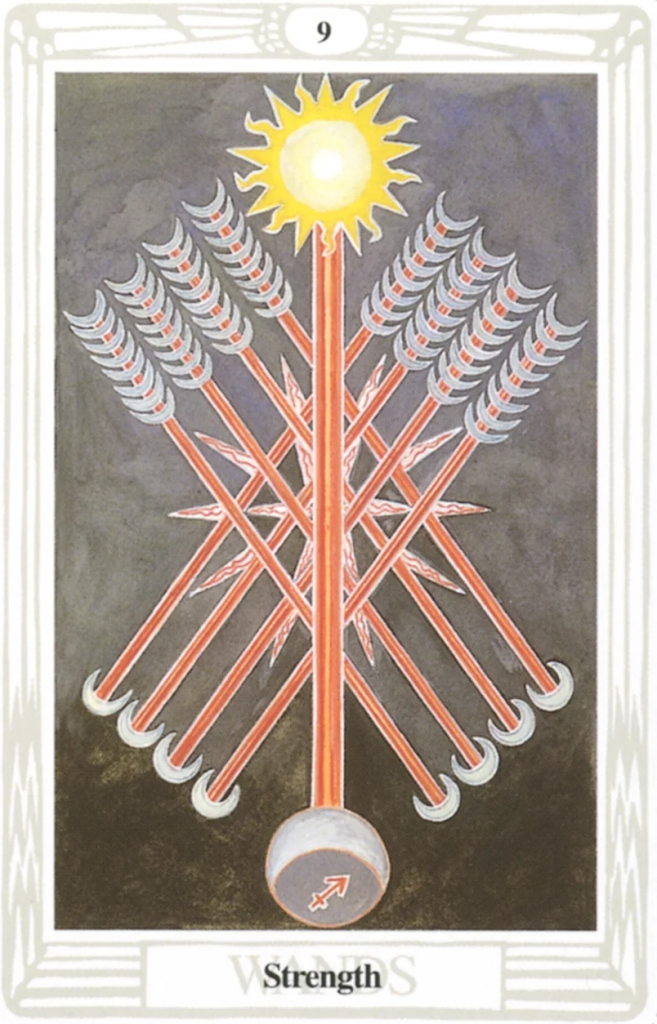
The Lord of Strength relates to our own inner strength and power. When he comes up, we need to allow ourselves to be reminded of our personal wealth of experience, knowledge and talents. This is something that we rarely take time out to assess and consider. Yet since we are constantly adding to it, it is something we should sum up as often as our bank accounts.When we get a clear view of our own strengths, we gather to us a new sense of self-confidence, holding ourselves in high esteem, and treating ourselves as good and trusted friends. This fundamental acceptance of ourselves is essential to allow us a long-term feeling of well-being and optimism.So on a day ruled by the Lord of Strength, we must count our personal strengths. This obviously raises a simple question… how do you know what is strong?The quickest way to identify strengths is to look at the hardest experiences of your life, and assess how you feel you handled them. If you maintain a non-judgemental and objective perspective upon your actions, then you’ll see that, over the years, you have learned to deal with trials and tribulations increasingly efficiently. Every single time you pass through a trying experience, you will have gathered more understanding about how to approach difficulties and resolve them.Your mistakes have special messages for you. To be able to admit you could have dealt with a situation better is, if you allow it to be, one of the most useful revelations of your life. Rather than feeling bad about your actions, allow yourself to consider what would have improved the outcome. Once you have done this, you’ll store that away as new knowledge… and next time a similar situation occurs you’ll remember, and act accordingly. Never be afraid of assessing your mistakes… there’s one very big thing to be said for them – they are all yours!!! And they can be teachers if you let them be.Having worked through the obvious strengths and frailties, go looking for the more subtle aspects of strength… empathy, compassion, patience, morality, humour, respect, honesty, understanding, sensitivity… there are many many things that we might not at first count among our strengths that make us stronger people.
Affirmation: “I acknowledge and grow into my strength.”
(Angelpaths.com)
Consciousness, spirituality, biography, sexuality, androgyny, futurism, space, the arts, science, astrology, democracy, humor, books, movies and more